Trigonometry begins in right triangles, but its true home is the unit circle, where cosine and sine become functions of an arbitrary real number. This chapter installs the radian, the winding of the real line around the circle, the exact values to know by heart, and the symmetries that generate all the classical identities. The study of cos and sin as functions — variations, derivatives — is carried out in Chapter 24.
14.1 Radians and the winding
Definition 14.1(Radian)
Let C be the circle of radius 1 centered at the origin O, and I(1,0). The radian measure of an angle at the center of C is the length of the arc it cuts on C. Since the full circle has circumference 2π:
360∘=2π rad,180∘=π rad,1 rad=π180∘≈57.3∘.
Method 14.2(Converting)
Degrees and radians are proportional: multiply by 180π to go from degrees to radians, by π180 the other way. For instance 60∘=60×180π=3π, and 43π=43×180∘=135∘.
Definition 14.3(Winding the line on the circle)
To each real numbert, associate the point M(t) of C obtained by walking a distance ∣t∣ along the circle from I, counterclockwise if t≥0, clockwise if t<0. Since the circumference is 2π, the numbers t and t+2kπ (k∈Z) reach the same point: M(t+2kπ)=M(t).
Example 14.4
M(0)=I; M(2π)=(0,1), the top of the circle; M(π)=(−1,0); M(−2π)=(0,−1); and M(49π)=M(4π+2π)=M(4π).
14.2 Cosine and sine
Definition 14.5(Cosine and sine)
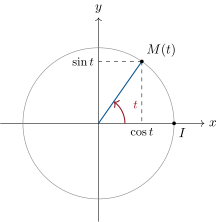
For every real t, the cosine and sine of t are the coordinates of the point M(t) of the unit circle:
M(t)=(cost,sint).
The unit circle: the real numbert, wound counterclockwise from I, lands at the point M(t) whose coordinatesdefinecost and sint.
Proposition 14.6(First properties)
For all t∈R and k∈Z:
−1≤cost≤1,−1≤sint≤1,cos2t+sin2t=1,
cos(t+2kπ)=cost,sin(t+2kπ)=sint.
Proof.M(t) lies on the unit circle, so its coordinates are between −1 and 1, and they satisfy the circle’s equationx2+y2=1, which is the identity cos2t+sin2t=1. Periodicity restates M(t+2kπ)=M(t) (Definition 14.3). ∎
Example 14.7
If sint=53 and t∈[2π,π] (second quadrant), then cos2t=1−259=2516, so cost=±54; in the second quadrant the abscissa is negative, hence cost=−54.
The values to know by heart:
t
0
6π
4π
3π
2π
[6pt] cost
1
23
22
21
0
[6pt] sint
0
21
22
23
1
Remark 14.8
A memory aid: the sines read 20,21,22,23,24, and the cosines are the same list reversed.
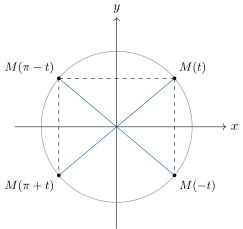
Proof. Each line expresses a symmetry of the circle.
M(−t) is the reflection of M(t) in the x-axis: the abscissa is unchanged, the ordinate changes sign.
M(π−t) is the reflection of M(t) in the y-axis: walking backwards from π by t lands opposite (horizontally) to walking forwards from 0 by t. The abscissa changes sign, the ordinate is unchanged.
M(π+t) is diametrically opposite M(t) (half a turn): both coordinates change sign.
M(2π−t) is the reflection of M(t) in the diagonal line y=x, which swaps the two coordinates. ∎
The four associated points: M(−t) mirrors M(t) in the x-axis, M(π−t) in the y-axis, and M(π+t) is diametrically opposite. Every identity of Proposition 14.9 is read off this picture.
Example 14.10
cos32π=cos(π−3π)=−cos3π=−21, and sin67π=sin(π+6π)=−sin6π=−21. The table of five values, extended by the symmetries, covers the whole circle.
14.4 Solving trigonometric equations
Theorem 14.11(The equations cost=cosa and sint=sina)
Proof. Two points of the unit circle have the same abscissa exactly when they are equal or reflections of each other in the x-axis; by Proposition 14.9, the reflection of M(a) is M(−a). So cost=cosa means M(t)=M(a) or M(t)=M(−a), i.e. t=±a up to a multiple of 2π. Similarly, equal ordinates mean equal points or reflections in the y-axis, and the reflection of M(a) is M(π−a). ∎
Method 14.12(Solving cost=c on an interval)
Find one angle a with cosa=c, from the table of known values.
Write the general solutions t=±a+2kπ (Theorem 14.11).
Choose the integersk that land inside the requested interval, and list the solutions.
Proceed likewise for sint=c with t=a+2kπ or t=π−a+2kπ.
Example 14.13
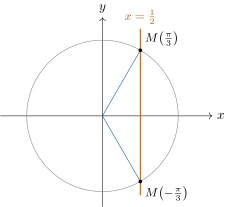
Solve cost=21 on (−π,π]. One solution of cosa=21 is a=3π. The general solutions are t=3π+2kπ and t=−3π+2kπ. Inside (−π,π], only k=0 contributes: t∈{−3π,3π}.
Solve sint=−22 on [0,2π). One angle is a=−4π; the solutions are t=−4π+2kπ and t=π+4π+2kπ=45π+2kπ. In [0,2π): t=47π (from k=1) and t=45π.
Solving cost=21: the vertical line x=21 (orange) cuts the unit circle in two points, symmetric in the x-axis — hence the two solution families t=±3π+2kπ.
14.5 Exercises
Exercise 14.1★
Convert to radians: 30∘, 45∘, 120∘, 270∘. Convert to degrees: 5π, 65π, 47π, 92π.
Solution
Solution of Exercise 14.1.
To radians: 30∘=6π, 45∘=4π, 120∘=32π, 270∘=23π.
To degrees: 5π=36∘, 65π=150∘, 47π=315∘, 92π=40∘.
Exercise 14.2★
Place on the unit circle the points M(t) for
t=32π,t=−4π,t=617π,t=−27π,
after reducing each to a value in (−π,π] modulo 2π.
Solution
Solution of Exercise 14.2.
32π and −4π are already in (−π,π]: second quadrant and fourth quadrant respectively.
617π−2π=65π: second quadrant, close to the negative x-axis.
cost=23: one solution is 6π, so t=±6π (the shifts by 2kπ leave the interval).
sint=21: t=6π or t=π−6π=65π.
cost=−1: the only point of abscissa−1 is M(π), so t=π.
Exercise 14.7★★
Solve on [0,2π):
sint=−23,cost=0,2sint+1=0.
Solution
Solution of Exercise 14.7.
sint=−23: from a=−3π, the families are −3π+2kπ and π+3π+2kπ; in [0,2π): t=34π and t=35π.
cost=0: t=2π and t=23π.
2sint+1=0 means sint=−21: from a=−6π, in [0,2π): t=67π and t=611π.
Exercise 14.8★★
Solve on R the equationcos2t=cost. (Use Theorem 14.11 with a=t, and discuss the two families of solutions.)
Solution
Solution of Exercise 14.8.
By Theorem 14.11, cos2t=cost means 2t=t+2kπ or 2t=−t+2kπ, i.e. t=2kπ or t=32kπ (k∈Z). The first family is contained in the second (take k a multiple of 3), so the solution set is
S={32kπ:k∈Z}
— on the circle, the three points M(0), M(32π), M(34π).
A wheel of radius 30 cm rolls without slipping. Through what angle (in radians, then in degrees) does it turn when the bike advances by 1.5 m? How far does the bike advance during one full turn of the wheel?
Solution
Solution of Exercise 14.10.
Rolling without slipping means the arc length equals the distance travelled: rθ=150 cm gives θ=30150=5 rad =5×π180≈286.5∘. One full turn advances the bike by the circumference 2π×30=60π≈188.5 cm, about 1.88 m.
Exercise 14.11★★★
Solve on (−π,π] the inequality cost≤21. (Sketch the unit circle, mark the region where the abscissa is at most 21, and read off the interval of values of t.)
Solution
Solution of Exercise 14.11.
On the unit circle, the points of abscissa exactly 21 are M(±3π). The points with abscissaat most21 form the arc on the left of the vertical line x=21, travelled as t goes from 3π up to π, or from −π up to −3π. Hence, on (−π,π]:
S=(−π,−3π]∪[3π,π].
(The endpoints ±3π are included since the inequality is wide.)
14.6 Problem: The Ferris wheel and the tide
Problem 14.1
Weekend problem — radians as rolled distance, and the unit circle as the master clock of every periodic phenomenon
A Ferris wheel carries you around a circle; the tide carries the harbor’s water up and down the same mathematical circle. Every periodic phenomenon — wheels, tides, sound, seasons — reads its schedule off the unit circle of this chapter (Definition 14.5), and the equations of Method 14.12 tell the exact times. This problem converts, winds, models and solves — and settles on the way why mathematicians measure angles in radians.
Convert to radians: 30∘, 135∘, 300∘; and to degrees: 43π, 65π (Method 14.2).
The whole point of radians: an arc of angle t (in radians) on a circle of radius r has length exactly rt. What arc does an angle of 2radians cut on a circle of radius 3 m? (No π anywhere — that is the point.)
A wheel of radius 30 cm rolls 1 km without slipping. Through how many radians has it turned, and how many full turns is that?
Place on the unit circle and evaluate exactly: cos32π, sin(−4π), and cos619π (reduce modulo 2π first; Proposition 14.9).
An angle t∈(2π,π) satisfies sint=53. Using cos2t+sin2t=1 and the quadrant, find cost and tant.
Part II — The Ferris wheel. A giant wheel has radius 60 m, its hub 65 m above the ground, and turns once every 30 minutes. You board at the lowest point at time t=0 (in minutes), so your height obeys
h(t)=65−60cos(15πt).
Justify the formula: check the angle turned after t minutes, the height at t=0, and explain the minus sign.
Compute your height at t=7.5, t=15 and t=20 minutes (exact values).
At what time are you first at 95 m? (Solve h(t)=95 with Method 14.12.)
During which time interval of the ride are you at least 95 m high — and for how long in total? (Compare Exercise 14.11.)
Where does the height change fastest? Compare the climb during the first minute (h(1)−h(0)) with the climb between minutes 7 and 8, and formulate the observation (the tool that makes it exact — the derivative of the sinusoid — arrives in grade 12).
Engineer’s turn: design the height formula of a wheel with maximal height 40 m, minimal height 4 m and period 12 minutes, boarding at the bottom at t=0.
Part III — The tide and the circle’s symmetries. In a harbor, the water depth in meters, t hours after midnight, is
d(t)=7+3sin(6πt).
Give the maximal and minimal depths, the times at which they first occur, and the period of the tide.
A cargo ship needs 8.5 m of water. Solve d(t)≥8.5 on [0,12): during which window can it enter, and how long is the window? When does the next window open?
Re-derive two associated-angle identities directly from circle symmetries — sin(π−t)=sint (mirror across the vertical axis) and cos(π+t)=−cost (half-turn) — and state the complementary identity cos(2π−t)=sint.
Parity (Problem 11.1 vocabulary): classify sin, cos, and t↦sint+t3 as even or odd, with one-line proofs from the circle.
Solve on [0,2π): 2sin2t−sint−1=0. (A quadratic in disguise: factor it as in Problem 10.1, then read the circle.)
Part IV — The mathematician’s angle.
How many degrees is 1radian? Then a calculator trap: which is larger, sin(1) (radian mode) or sin(1∘) — and by roughly what factor? Moral for calculator settings?
Solve cost=sint on [0,2π), using the circle (where are abscissa and ordinate equal?).
For small angles, the arc and its sine almost coincide: compare sin(0.1) with 0.1 (five decimals), and give the relative error. This “small-angle approximation” steers ships and pendulums; the theorem behind it (tsint→1) is a star of the grade-12 limits chapter.
Finale — the unit circle as master clock, one sentence per item: radians turn angles into honest numbers (arc = radius × angle); cosine and sine are the clock hand’s shadow and height; the circle’s symmetries are the identities; solving cost=c reads times off the clock; and every periodic phenomenon — wheel, tide, sound — is this clock wearing a costume.
Solution
Solution of Problem 14.1.
1.30∘=6π; 135∘=43π; 300∘=35π. And 43π=135∘; 65π=150∘.
2. Length rt=3×2=6 m. Radians make arc length a plain product — degrees would drag a 180π into every formula.
3.Radians turned =radiusdistance=0.301000≈3333 rad; divided by 2π: about 530 full turns.
4.cos32π=−21; sin(−4π)=−22; 619π−2π=67π, so cos619π=cos67π=−23.
5.cos2t=1−259=2516; in the second quadrant the cosine is negative: cost=−54, and tant=−4/53/5=−43.
6. In t minutes the wheel turns 30t×2π=15πt. At t=0: h=65−60=5 m — the boarding platform at the bottom (hub height minus radius). The minus sign puts you below the hub when the turned angle is 0.
7.h(7.5)=65−60cos2π=65 m (hub height); h(15)=65+60=125 m (the top); h(20)=65−60cos34π=65+30=95 m.
8.65−60cos15πt=95 gives cos15πt=−21: first solution 15πt=32π, i.e. t=10 minutes.
9.cos15πt≤−21 for 15πt∈[32π,34π], i.e. t∈[10,20]: ten minutes of the ride above 95 m, symmetric about the summit at t=15.
10. First minute:
h(1)−h(0)=60(1−cos15π)≈1.3 m.
Between minutes 7 and 8:
60(cos157π−cos158π)≈12.5 m
— nearly ten times more. The height changes fastest when passing hub level and stalls near bottom and top: the sinusoid is steep at its middle, flat at its extremes.
11. Radius =240−4=18 m, hub at 4+18=22 m, period 12 min: h(t)=22−18cos(6πt).
12.Maximum7+3=10 m when sin6πt=1: first at t=3 (3 a.m.); minimum4 m first at t=9; period π/62π=12 hours.
13.sin6πt≥21 for 6πt∈[6π,65π]: t∈[1,5] — a four-hour window from 1 a.m. to 5 a.m., reopening one period later, t∈[13,17] (1 p.m. to 5 p.m.).
14. Mirror across the vertical axis sends the point at angle t to the point at angle π−t, preserving the ordinate: sin(π−t)=sint. The half-turn about the center sends t to π+t, negating both coordinates: cos(π+t)=−cost. And the mirror across the diagonal swaps abscissa and ordinate: cos(2π−t)=sint — the “co” of complementary angles.
15.sin(−t)=−sint: odd (half-turn symmetry of its graph); cos(−t)=cost: even (mirror). And sint+t3 is a sum of two odd functions: odd.
16. Factor: (2sint+1)(sint−1)=0: sint=1 gives t=2π; sint=−21 gives t=67π and t=611π. Three solutions on the circle.
17.1 rad =π180≈57.3∘. So sin(1)≈0.841 while sin(1∘)≈0.0175: a factor of nearly 50. Moral: check the mode light before trusting any trigonometric display.
19.sin(0.1)=0.09983… against 0.1: relative error about 0.17%. For small angles the chord hugs the arc — and the grade-12 limit tsint→1 is exactly this observation made into a theorem.
20.Radians: angle = arc on the unit circle, so angles compute like lengths. Cosine and sine: the coordinates of the clock hand — shadow on the ground, height on the wall. Symmetries of the circle: the whole catalogue of identities, read off mirrors and half-turns. Equationscost=c: the clock’s timetable, with the circle showing every solution at once. Costumes: the wheel wore 65−60cos, the tide wore 7+3sin — same clock, same mathematics.