University Physics — Year 1 · Bachelor Year 1
18Non-Inertial Frames; Dynamics on Earth
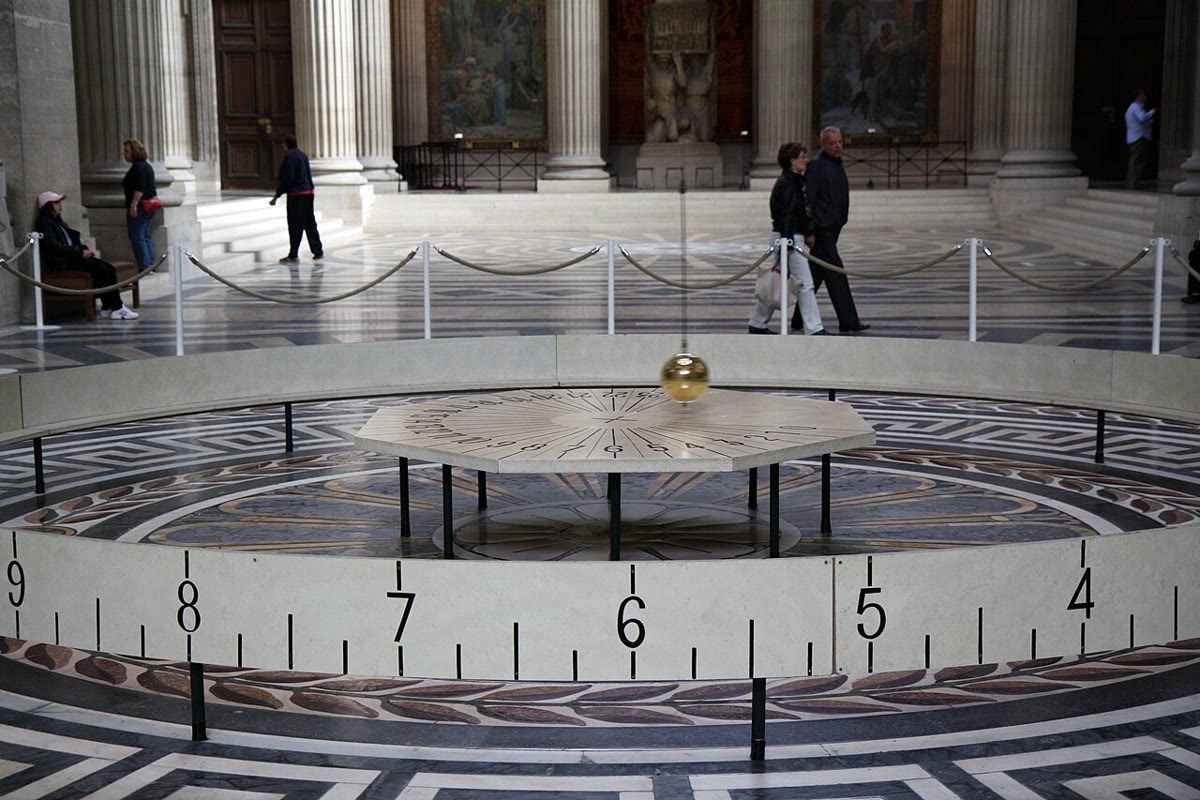
Standing in a bus that turns left, you lean right, pushed by a force nobody exerts. A bucket of water spun on a turntable hollows its surface into a bowl. Under the dome of a museum a pendulum swings for hours, and the line of its swing creeps slowly round, a few degrees an hour, as if an invisible hand turned it. None of these is a new force: they are what Newton’s laws look like when the frame in which one describes the motion is itself accelerating or rotating. This chapter shows how velocities and accelerations transform between frames, how the laws of dynamics are repaired by adding inertial forces, and what those forces do on the most important rotating frame of all — the Earth.
18.1 Changing frame: kinematics
Definition 18.1 (Relative motion; frame in translation, in rotation)
Let be a frame (origin ) and another (origin ) moving with respect to it. is in translation if its axes keep fixed directions in (every point of has the velocity of ); it is in rotation about a fixed axis if is fixed in both frames and turns about it at the angular velocity . The velocity and acceleration of a point relative to , and , are those a stationary observer of measures.
Theorem 18.2 (Composition of velocities and accelerations)
in translation with velocity and acceleration :
rotating about the fixed axis at (vector along the axis); the projection of on the axis:
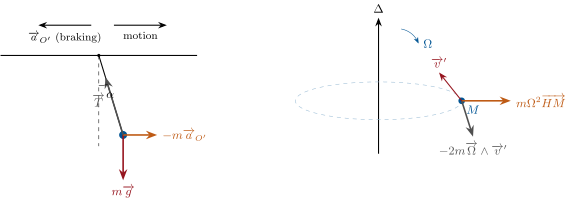
is the entrainment acceleration (the acceleration of the point of that coincides with : centripetal toward the axis for uniform rotation), the Coriolis acceleration, present only when moves relative to the rotating frame.
Proof. Translation: with the components of in the common basis; differentiate twice. Rotation: use cylindrical coordinates about in , , and in , with . Then Theorem 11.7 in with : , and . For the acceleration, : ; expanding and grouping, , and the last bracket is since , . ∎
Example 18.3 (Walking on a turntable)
Exercise 11.12 computed the acceleration of a person walking radially at on a turntable rotating at : . In the new language: relative acceleration zero, entrainment , Coriolis .
18.2 Dynamics in a non-inertial frame: inertial forces
Theorem 18.4 (Newton’s law in a non-inertial frame)
In a frame that is not inertial, the motion of a particle obeys
Newton’s second law holds provided one adds to the real forces the entrainment force (for a uniformly rotating frame, the centrifugal force , directed away from the axis; for a frame in translation, ) and the Coriolis force. These inertial forces are not interactions: no body exerts them, they have no reaction, and they vanish in an inertial frame.
Proof. in the inertial frame ; substitute and move the two terms to the right. ∎
Example 18.5 (The leaning passenger, the plumb bob)
In a bus braking at , a hanging strap feels, in the bus frame, gravity plus a forward inertial force : it hangs along the apparent gravity , tilted forward by . A passenger who wants to stand still must lean into that apparent vertical. In an elevator falling freely, : weightlessness, seen from inside.
Example 18.6 (The spinning bucket)
Water in a bucket rotating at about its vertical axis is at rest in the rotating frame under gravity and the centrifugal force: its free surface is perpendicular to the apparent gravity (the surface of a fluid at rest is normal to the field, Chapter 21). Its slope is , so : a paraboloid. At the rim of a bucket stands above the center — the principle of the liquid-mirror telescope, whose spinning mercury takes exactly the parabolic shape a mirror needs.
Method 18.7 (Working in a non-inertial frame)
Choose the frame in which the question is simplest (the bus, the turntable, the Earth); list the real forces; add and, if the body moves in the frame, ; then proceed as in Method 12.10. Check: inertial forces never appear in the energy balance as “work done by someone” — the Coriolis force, perpendicular to , does no work; the centrifugal force derives from the potential energy in a uniformly rotating frame.
18.3 The terrestrial frame
Definition 18.8 (Geocentric and terrestrial frames)
The geocentric frame has its origin at the Earth’s center and axes pointing to fixed stars; it is inertial to an excellent approximation for motions of a day or less (its own acceleration around the Sun is only , and nearly uniform over the Earth). The terrestrial frame, attached to the ground, rotates with respect to it about the polar axis at
Proposition 18.9 (Weight, and the variation of )
In the terrestrial frame a body at rest feels the gravitational attraction and the centrifugal force ; their sum is what a balance measures and a plumb line shows: the weight . The centrifugal term is largest at the equator, , of ; it reduces from the poles to the equator and tilts the vertical away from the Earth’s center by up to at mid-latitudes.
Proof. Apply Theorem 18.4 with (no Coriolis force); . The deviation angle follows from the triangle of and the centrifugal force (Exercise 18.6). ∎
Proposition 18.10 (The Coriolis force on Earth)
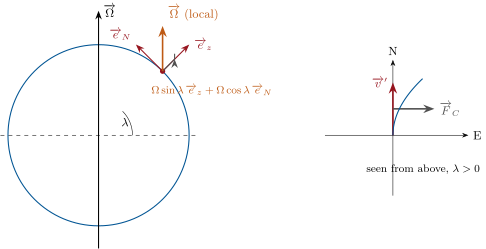
At latitude , a body moving horizontally at speed feels a horizontal Coriolis force of magnitude
directed to the right of the motion in the northern hemisphere and to the left in the southern one, whatever the direction of travel; a body falling vertically is deflected eastward by .
Proof. Decompose (north and local vertical). For horizontal , has a horizontal part — rotated clockwise from seen from above, for — and a vertical part (negligible against gravity). For vertical : , eastward. ∎
Example 18.11 (Small forces, big consequences)
A train at at latitude : , three thousandths of — the right-hand rail of a one-way track wears a little faster. Air flowing at toward a low-pressure center is turned right all the way in and ends up circling it counterclockwise: every cyclone of the northern hemisphere turns that way, every southern one the other. A stone dropped down a shaft at lands east of the plumb line (Exercise 18.7).
Proposition 18.12 (Foucault’s pendulum)
A pendulum swinging with small amplitude at latitude keeps its plane of oscillation fixed with respect to the geocentric frame’s local vertical rotation only: seen in the terrestrial frame, the plane turns clockwise (from above, northern hemisphere) at the angular rate , i.e. one full turn in
Partial proof. At the pole () the argument is geometric: no horizontal force acts on the bob except the tension, whose horizontal component is along the swing, so in the geocentric frame the plane of swing is fixed while the Earth turns beneath it at ; seen from the ground it turns at . At latitude , the horizontal Coriolis force is : exactly what a frame rotating at about the local vertical would produce. In a frame turning with the plane at , that force disappears to first order and the pendulum is an ordinary plane oscillator; hence the plane precesses at in the terrestrial frame. The full calculation, with the neglected second-order terms, is the weekend problem. ∎
Remark 18.13 (Tides, in two lines)
In the frame of the Earth’s center, which falls freely toward the Moon, the Moon’s attraction is not uniform: a little stronger on the near side, weaker on the far side. The difference, of order , stretches the oceans into two bulges — two tides a day — and the Sun’s contribution, of the Moon’s, makes spring and neap tides as the two align or cross (Exercise 18.12).
18.4 Exercises
Exercise 18.1 ★
A plumb bob hangs in a car accelerating at : angle with the vertical, and the tension in units of . Same car braking at the same rate?
Solution
Solution of Exercise 18.1.
, (the bob trails backward); . Braking: same angle and tension, bob tilted forward.
Exercise 18.2 ★
A child sits from the axis of a merry-go-round turning once every . Centrifugal acceleration in the rotating frame, as a fraction of ; what real force provides it?
Solution
Solution of Exercise 18.2.
; , directed outward in the rotating frame; the seat (friction and restraint) supplies the real inward force.
Exercise 18.3 ★
Compute the Earth’s angular velocity , the centrifugal acceleration at the equator, and its fraction of . At what rotation period would objects at the equator float off?
Solution
Solution of Exercise 18.3.
; , of . Floating off needs : — seventeen times faster than now.
Exercise 18.4 ★
A train of runs at at latitude . Coriolis acceleration and the sideways force on the rails; which rail is pushed, heading north? heading east?
Solution
Solution of Exercise 18.4.
; . Heading north: pushed east, onto the right-hand (eastern) rail; heading east: pushed south, again the right-hand rail.
Exercise 18.5 ★★
A bucket of radius spins at , then . Rise of the water at the rim relative to the center. Why is a spinning mercury bath a good telescope mirror?
Solution
Solution of Exercise 18.5.
: at , at . A paraboloid focuses a parallel beam to a point: spinning mercury is a perfect, cheap, self-polishing parabolic mirror (that cannot be tilted).
Exercise 18.6 ★★
Show that the plumb line at latitude deviates from the Earth’s center by about radians, and compute it at in minutes of arc. By how much is smaller at the equator than at the pole from rotation alone?
Solution
Solution of Exercise 18.6.
The centrifugal acceleration points away from the axis; its component perpendicular to the local vertical is , which tilts by . Equator: reduced by from rotation (the flattening adds more).
Exercise 18.7 ★★
A stone falls from rest down a shaft at latitude . Treat the Coriolis acceleration (eastward) as a small perturbation with ; integrate twice to find the eastward deviation at the bottom. Why eastward?
Solution
Solution of Exercise 18.7.
: ; : . Eastward: the top of the shaft moves east faster (larger radius) than the bottom; the stone keeps that excess — or, in the rotating frame, the Coriolis force on a downward velocity points east.
Exercise 18.8 ★★
Precession period of a Foucault pendulum in Paris (), at the pole, and at the equator. Through what angle does the plane turn in one hour in Paris?
Solution
Solution of Exercise 18.8.
: Paris ; pole ; equator infinite (no precession). Paris: per hour.
Exercise 18.9 ★★
Air flows at toward a low-pressure center at north. Coriolis acceleration; in which sense does the air end up circling the center? Why do small eddies (a sink, a tornado) not obey this rule?
Solution
Solution of Exercise 18.9.
, to the right. Air converging from all sides is deflected right, so it spirals in counterclockwise (seen from above): the northern cyclone. A sink drains in seconds and a tornado forms in minutes: the Coriolis deflection over such times is negligible against any initial swirl.
Exercise 18.10 ★★★
A helium balloon on a string floats inside a car. When the car accelerates forward, which way does the balloon lean? Explain with the apparent gravity and buoyancy.
Solution
Solution of Exercise 18.10.
In the car’s frame the apparent gravity tilts backward. The air, heavier, “falls” backward; the balloon, lighter than the air it displaces, is buoyed up the apparent vertical — it leans forward, opposite to a plumb bob.
Exercise 18.11 ★★★
A space station is a ring of radius spun to give of artificial gravity at the rim. Rotation period? An astronaut walks along the rim at : Coriolis acceleration, and its effect on his apparent weight when walking with and against the rotation. He drops a ball from : roughly how far from his feet does it land?
Solution
Solution of Exercise 18.11.
: , . , about : walking with the rotation he feels heavier by (the Coriolis force points outward), against it lighter. A dropped ball: in the inertial frame it moves straight while the floor curves up; over the fall time the deviation is of order — a few decimeters, against the rotation.
Exercise 18.12 ★★★
Show that the difference between the Moon’s gravitational acceleration at the Earth’s center and at the point of the surface nearest the Moon is about ( the Earth’s radius, the Earth–Moon distance); compute it, and the same for the Sun; deduce the ratio of solar to lunar tides.
Solution
Solution of Exercise 18.12.
(first order in ). Moon: ; Sun: ; ratio : the Sun’s tides are almost half the Moon’s, though its attraction is times larger — tides go as .
18.5 Problem: Foucault’s pendulum
Problem 18.1
Weekend problem — a 28-kilogram bob on a 67-meter wire under a dome: why its plane of swing turns, how fast, what it proves, and how small the force is that does it
In 1851 a pendulum of length and mass swung under the dome of the Panthéon in Paris, latitude , with an amplitude of about . , .
Part I — The pendulum as such.
- Period of small oscillations; check that the amplitude is small ().
- Maximal speed of the bob, and its maximal height above the lowest point.
- Tension at the lowest point, in units of .
- Estimate the air drag on the bob at maximal speed (quadratic law, , ) and compare with the maximal restoring force .
- Why a long wire and a heavy bob? (Two reasons, one about the period, one about damping.)
Part II — At the pole. Imagine the same pendulum at the north pole.
- In the geocentric frame, list the forces on the bob and show that nothing can turn its plane of swing.
- Deduce what an observer standing on the ice sees the plane do, and in how long it returns to its initial direction.
- Describe the path of the bob on the ground (a rosette): how many petals in one day?
Part III — At latitude : the Coriolis term. Use local axes: east, north, up; small oscillations, so the motion is nearly horizontal, ; the restoring force is with .
- Write in these axes.
- Compute and keep its horizontal components; show they involve only .
- Write the two equations of motion for and ; set and compare with .
- Introduce and show that .
- Try : find the two values of , and show that for they are .
- Deduce that : interpret the factor — in which sense, at what rate, does the plane of swing turn?
- Compute the precession period in Paris and the angle turned in one hour.
- Why does the plane not turn at the equator?
Part IV — How small the force is.
- Compute the maximal Coriolis force on the bob and compare it with the weight and with the maximal restoring force.
- By how much is the swing’s end point displaced sideways during one half-period? (The plane turns by .)
- In 1851 the bob carried a stylus that knocked over small pegs placed in a ring at the amplitude: about how long before the next peg fell?
- The pendulum was launched by burning a thread that held the bob aside. Why not push it by hand?
- Air drag stops a pendulum after a few hours. Modern museum pendulums use a small electromagnet at the bottom to restore energy without touching the plane of swing: why must that kick be strictly radial?
Part V — What it proves, and what else it does.
- Foucault’s demonstration convinced the public of the Earth’s rotation. What exactly does the precession rate measure, and could the experiment determine the latitude?
- At which latitude would the plane turn once in exactly ?
- A gyroscope (a fast-spinning wheel in gimbals) keeps its axis fixed in the geocentric frame. Explain in one sentence why it too reveals the rotation, and name an application.
- Summarize: the one inertial force responsible, its dependence on latitude, and the period it gives in Paris.
Solution
Solution of Problem 18.1.
1. ; (): small.
2. ; height .
3. : .
4. , against : three hundred times smaller, yet enough to stop the pendulum in a few hours.
5. A long wire gives a long period, hence a slow bob and a small relative drag, and makes the precession per swing visible; a heavy bob stores much energy for the drag to eat — hours of swinging.
6. Weight (vertical) and tension (in the plane of the wire and the vertical, i.e. in the plane of swing): no force has a component perpendicular to that plane.
7. The plane is fixed among the stars; the ice turns beneath it eastward at , so the observer sees the plane turn clockwise, back to its start after one sidereal day, .
8. Each half-swing traces a slightly rotated chord: a rosette; half-swings, each further round.
9. .
10. With : , so has the horizontal components : only enters.
11. , ; .
12. .
13. : .
14. The bracket is a plane oscillation (a fixed line through the origin for real ); the factor rotates the whole pattern clockwise at : the plane of swing precesses clockwise at .
15. ; per hour.
16. : the local vertical component of vanishes; the horizontal Coriolis force is zero for horizontal motion.
17. ; weight ( of it), restoring force : three thousand times smaller.
18. : per half-swing.
19. Pegs a centimeter apart on the ring fall every half-swings, about a minute.
20. A hand push gives a sideways velocity: the bob then describes an ellipse, whose own slow precession (an effect of the finite amplitude) masks Foucault’s.
21. A radial kick adds energy along the swing without adding transverse velocity, so the plane is left untouched; a sideways component would drive the pendulum into an ellipse and fake or hide the precession.
22. The precession rate measures , the vertical component of the Earth’s rotation; knowing from astronomy, the rate gives the latitude (and vice versa).
23. : .
24. Its angular momentum is conserved, so its axis stays fixed among the stars while the Earth turns under it: the gyrocompass, which finds true north without a magnet.
25. The Coriolis force ; its horizontal part grows as ; one turn in , in Paris.