University Physics — Year 1 · Bachelor Year 1
22The First Law of Thermodynamics
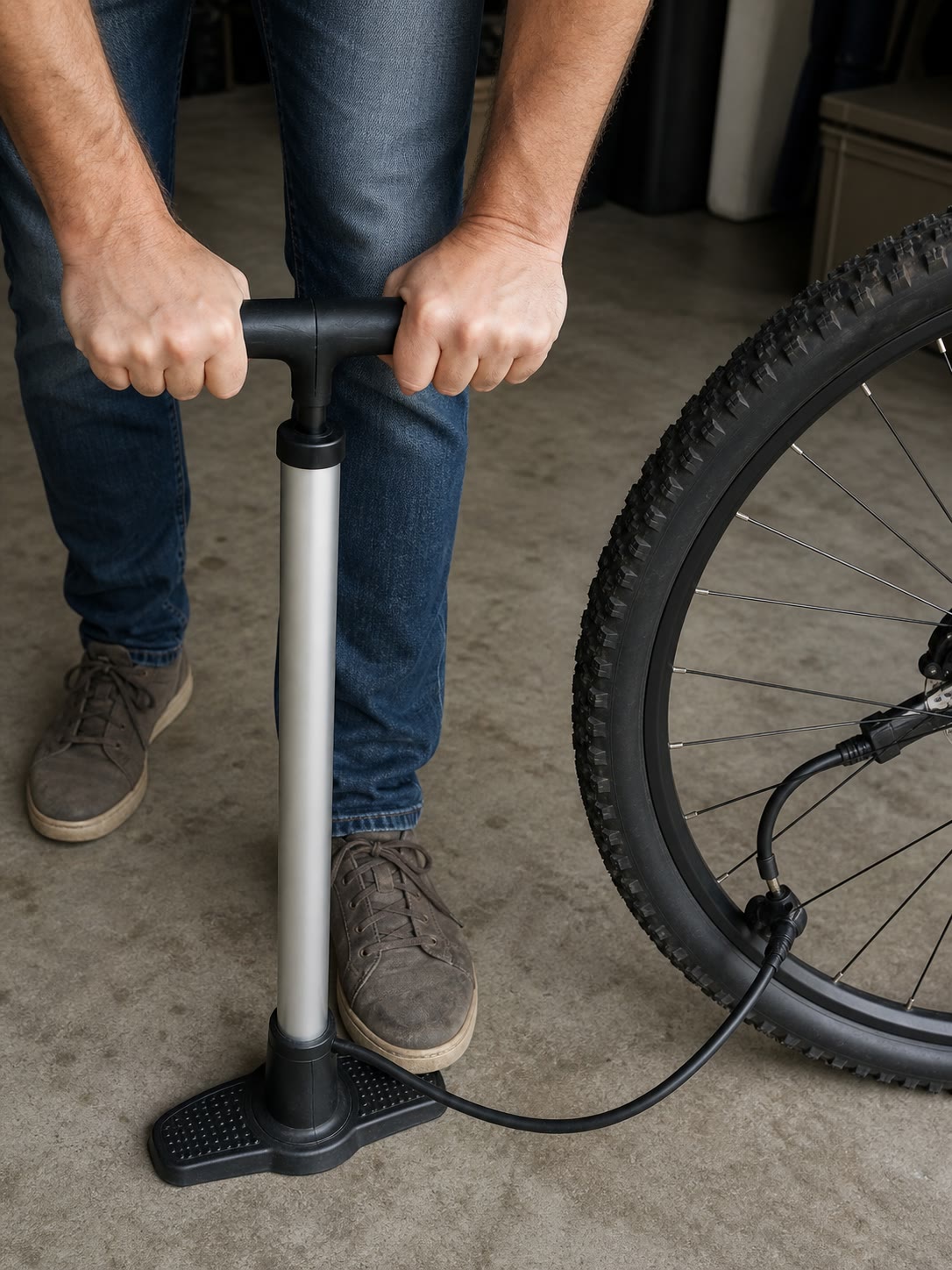
Pump up a bicycle tire and the barrel of the pump gets too hot to hold. A diesel engine has no spark plug: it squeezes its air twenty times smaller, and the air becomes hot enough to light the fuel by itself. A cylinder of compressed gas frosts over as it empties. In each case energy changes form — work becomes heat, heat becomes work, both become internal energy — and the first law of thermodynamics is the bookkeeping that makes the accounts balance. This chapter defines work and heat for a thermodynamic system, states the first law, introduces internal energy and enthalpy as the quantities it conserves, and applies it to the transformations of a perfect gas and to calorimetry.
22.1 Transformations, work, and heat
Definition 22.1 (System, transformation)
A thermodynamic system is the matter inside a chosen boundary; everything else is the surroundings. A transformation takes it from an equilibrium state to another. It is quasi-static if the system passes through a succession of equilibrium states (slow enough for , to be defined throughout), and reversible if, in addition, reversing the external conditions reverses the path (no friction, no finite temperature or pressure gap with the surroundings). Names by what stays constant: isothermal (), isobaric (), isochoric (); adiabatic if no heat is exchanged; monobaric (monothermal) if the external pressure (temperature) is constant, whatever happens inside.
Proposition 22.2 (Work of pressure forces)
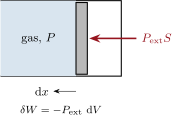
A system whose volume changes by against an external pressure receives the work
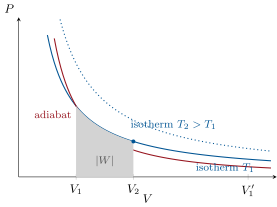
For a quasi-static transformation (the system’s own pressure) and is minus the area under the path in the Clapeyron diagram: positive when compressed, negative when expanding.
Proof. A piston of area pushed by the surroundings with the force moves by outward: the surroundings do the work on the system. Any boundary is a collection of such pistons. Quasi-static: the piston is in equilibrium, up to a vanishing difference. ∎
Definition 22.3 (Heat)
Heat is energy transferred to the system other than by macroscopic work — by molecular collisions at a wall (conduction), by the circulation of a fluid (convection), by radiation. A thermostat is a body so large that its temperature does not change whatever heat it exchanges. Sign convention throughout: and are received by the system, positive when they enter.
22.2 The first law
Theorem 22.4 (First law of thermodynamics)
A closed system possesses a state function, its internal energy (extensive), such that for any transformation
being the macroscopic kinetic energy (zero for a system at rest): the energy received as work and heat is stored as internal energy. and each depend on the path; their sum does not.
Proof. Admitted at this level. ∎
Remark 22.5 (What it says)
It is the conservation of energy, with heat recognized as a transfer of energy (Joule’s paddle-wheel experiment: a measured work always raises the temperature of water as much as a measured heat). “ is a state function” means is fixed by the initial and final states — so a cycle has and : an engine that delivers work must receive heat. The microscopic content of is that of Definition 20.10.
Definition 22.6 (Enthalpy; heat capacities)
The enthalpy is a state function adapted to transformations at constant pressure. The heat capacities at constant volume and pressure are
Proposition 22.7 (Heat at constant volume and at constant pressure)
For a system at rest exchanging work only through pressure forces:
- isochoric transformation: and ;
- monobaric transformation between two states at the external pressure : .
Proof. Isochoric: . Monobaric: , so since . ∎
Proposition 22.8 (Perfect gas: , , Mayer’s relation)
For a perfect gas, and depend on alone (Joule’s laws): , , and
for monatomic gases, for diatomic ones at ordinary temperatures. For a condensed phase in the model of Proposition 20.13, and .
Proof. ; differentiate with respect to . or from Proposition 20.11. ∎
22.3 Transformations of a perfect gas
Proposition 22.9 (The four standard transformations)
For moles of perfect gas:
- isochoric: , ;
- isobaric (quasi-static): , ;
- isothermal reversible: , ;
adiabatic reversible: , , and along the path (Laplace’s law)
Proof. Isochoric and isobaric: the previous propositions. Isothermal: . Adiabatic: , i.e. , so (using ); integrate: constant; the other forms by . ∎
Example 22.10 (Pump and diesel)
Air () compressed adiabatically from , to (a bicycle pump): — for an instant, which the barrel feels. A diesel’s compression ratio of : , — above the self-ignition temperature of the fuel: the engine needs no spark (the weekend problem runs the whole cycle).
Remark 22.11 (Irreversible transformations)
When the transformation is not quasi-static, Laplace’s law and do not apply; only and the first law do. Two classic cases: a gas expanding into vacuum (Joule expansion) receives no work and, in adiabatic walls, no heat — , and a perfect gas keeps its temperature; a gas suddenly compressed by an external pressure jumping to receives , more than the reversible work to the same pressure, and ends hotter (Exercise 22.11).
22.4 Calorimetry
Method 22.12 (Calorimetric balance)
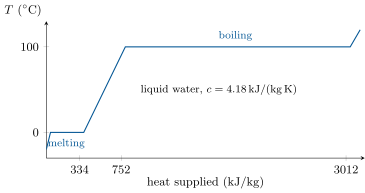
Bodies put in thermal contact inside an insulated vessel at constant (atmospheric) pressure exchange heat only among themselves: the total . For each body (no phase change) or for a change of state at its transition temperature, with the latent heat (enthalpy of fusion or vaporization per unit mass: water, at , at ). Write the balance, solve for the final temperature, and check that each body’s assumed phase is consistent with it.
Example 22.13 (Ice in water)
of ice at into of water at : melting needs ; the water can give in cooling to , so all the ice melts and the balance kJ gives . Had there been of ice, would be needed: only part melts and — the check matters.
22.5 Exercises
Exercise 22.1 ★
One mole of air () is heated from to at constant pressure. Heat received, work received, change of internal energy.
Solution
Solution of Exercise 22.1.
; ; .
Exercise 22.2 ★
One mole of gas at is compressed isothermally and reversibly from to . Work received, heat exchanged, .
Solution
Solution of Exercise 22.2.
; so (given to the bath).
Exercise 22.3 ★
Air at , is compressed adiabatically and reversibly to a tenth of its volume. Final temperature and pressure.
Solution
Solution of Exercise 22.3.
; .
Exercise 22.4 ★
Give , and for argon and for nitrogen. For liquid water (), why is the distinction between and dropped?
Solution
Solution of Exercise 22.4.
Argon: , J/(mol K), ; nitrogen: , , . For water the expansion on heating is tiny, so the work at constant pressure is negligible against the heat: .
Exercise 22.5 ★★
of water at are mixed with at in an insulated cup. Final temperature; what changes if the cup itself has a heat capacity of and starts at ?
Solution
Solution of Exercise 22.5.
. With the cup: .
Exercise 22.6 ★★
of ice at () are dropped into of water at . Final state and temperature. Same question with of ice.
Solution
Solution of Exercise 22.6.
Ice: warm to : ; melt: ; total . Water can give down to : all melts; then kJ: . With : needs : only of ice melt, , of ice remain.
Exercise 22.7 ★★
A gas follows a rectangular cycle in the Clapeyron diagram: with , . Work received over the cycle, as a function of the area; sign, and meaning of the sign.
Solution
Solution of Exercise 22.7.
: the cycle is traversed counterclockwise (expansion at low pressure, compression at high), so the gas receives net work, equal to the enclosed area; clockwise it would deliver it — an engine.
Exercise 22.8 ★★
A bicycle pump compresses air from , to quickly enough to be adiabatic. Temperature reached; why the pump warms up; and why the tire’s pressure drops a little after the pumping stops.
Solution
Solution of Exercise 22.8.
. The hot compressed air heats the barrel by conduction at each stroke. In the tire the air cools to ambient at fixed volume: , the pressure falls by the ratio of temperatures — top it up.
Exercise 22.9 ★★
A perfect gas expands into an evacuated, insulated vessel (Joule expansion). Work, heat, , . Is the transformation reversible? What would a real gas do?
Solution
Solution of Exercise 22.9.
(no external pressure to push against), : , hence for a perfect gas. Irreversible: the gas never flows back by itself. A real gas, whose molecules attract, cools slightly (part of the kinetic energy becomes potential energy as they separate).
Exercise 22.10 ★★★
Boiling of water at and (steam volume ). Heat supplied, work exchanged with the atmosphere, . Where does most of the latent heat go?
Solution
Solution of Exercise 22.10.
; ; : of the heat goes into separating the molecules (internal energy), into pushing back the atmosphere.
Exercise 22.11 ★★★
One mole of diatomic gas at , , in an insulated cylinder, is compressed by suddenly setting the external pressure to and waiting for equilibrium. Final temperature and volume (first law with ); compare with the reversible adiabatic compression to .
Solution
Solution of Exercise 22.11.
, , , : , , , . Reversible: , . The sudden compression does more work on the gas (the full acts from the start) and ends hotter and less compressed.
Exercise 22.12 ★★★
Sound is a fast compression, hence adiabatic: its speed is (the isothermal value was Newton’s mistake). Compute both for air at and compare with the measured . Show that and compare with the rms speed of Chapter 20.
Solution
Solution of Exercise 22.12.
: ; , low. With : ; against = : .
22.6 Problem: From the bicycle pump to the diesel engine
Problem 22.1
Weekend problem — a hand pump that burns the fingers, a cylinder that lights its own fuel, and a steel ball that bounces on a cushion of air: the first law in three compressions
Air: perfect diatomic gas, , , , ; . Initial state everywhere: , .
Part I — The bicycle pump. The pump’s cylinder has a volume ; the air in it is compressed reversibly and adiabatically until it reaches the tire’s pressure, .
- Amount of air in the cylinder.
- Volume at the end of the compression.
- Temperature at the end of the compression.
- Work received by the air during one stroke.
- The tire () must be brought from to at : how many strokes, and how much work in all (take the work per stroke as constant)?
- The hot air then cools in the tire to : what happens to the tire’s pressure, and what does the cyclist do?
- Compare the adiabatic work per stroke with the work of an isothermal compression to the same . Why is the isothermal work larger although the gas ends cooler?
Part II — The diesel compression. A cylinder of compresses its air reversibly and adiabatically by a factor .
- Amount of air, and temperature after compression.
- Pressure .
- The fuel self-ignites above about : explain why a diesel needs no spark plug, and why a petrol engine (ratio , see Exercise 22.3) must not self-ignite.
- Work received by the air during the compression.
- At one cylinder compresses times per second: power absorbed by the compression (it is returned later in the cycle).
- Real compressions are fast (irreversibility) and lose heat to the walls: in which direction does each effect move ?
Part III — Combustion and expansion. At the top of the stroke of fuel (heating value ) burn while the piston starts down, at constant pressure ; then the gas expands reversibly and adiabatically back to . Treat the gas as air throughout.
- Heat released by the fuel.
- Temperature and volume at the end of the isobaric combustion.
- Work exchanged during the isobaric phase (sign!).
- Temperature at the end of the adiabatic expansion, and the work exchanged during it.
- Net work delivered by the gas over the four strokes, and the ratio to the heat released (the ideal efficiency).
- Compare that efficiency with , the bound that Chapter 24 will establish for any engine working between these extreme temperatures.
- Heat rejected with the exhaust, by the first law over the cycle; check the balance.
Part IV — Measuring with a bouncing ball. A steel ball of mass fits a vertical glass tube of cross-section closed at the bottom by a flask of volume of air at ; displaced by from its equilibrium position, it oscillates.
- Why can the compressions and expansions of the air be taken as adiabatic? Write the relation between a small displacement and the pressure change (Laplace’s law, linearized).
- Deduce the restoring force on the ball and show that its motion is harmonic, with .
- Compute the period, and the value of one would deduce from a measured period of .
- Why does friction between ball and tube, and leakage of air, bias the result, and in which direction?
- Summarize the three compressions: which quantity the first law conserved in each, and what the adiabatic exponent governed.
Solution
Solution of Problem 22.1.
1. .
2. constant: .
3. .
4. .
5. Air to add: : strokes, about — a minute of honest effort.
6. At constant volume : the pressure falls as the air cools (by up to for the last stroke’s air); the cyclist adds a few strokes after a pause.
7. : the isothermal path compresses the gas further (to instead of ) to reach , because it stays cool — more volume swept, more work.
8. ; .
9. .
10. is well above the fuel’s self-ignition point: the injected fuel lights on contact. A petrol engine compresses its air–fuel mixture only to about so that it does not ignite before the spark; too high a ratio gives “knock”.
11. .
12. per cylinder, stored in the hot gas and given back in the expansion.
13. Irreversibility (the gas does not follow the quasi-static path; extra work is dissipated) raises ; heat lost to the walls lowers it. In a real engine the second usually wins: is a little below the ideal value.
14. .
15. Isobaric: : , ; .
16. : work delivered by the gas.
17. ; .
18. Net work delivered ; ratio (the ideal Diesel efficiency at these settings; real engines reach about ).
19. : the ideal Diesel cycle stays well below the Carnot bound, because its heat is received over a range of temperatures rather than at the highest one.
20. Over a cycle : , i.e. leave with the exhaust; check: .
21. The oscillation is fast (a second) compared with heat conduction through of air: adiabatic. Linearizing : .
22. Force on the ball : , harmonic, .
23. : . From : .
24. Friction damps the motion and, if it is dry, shifts the equilibrium; leakage past the ball lets air escape during a compression, lowering the restoring force: both lengthen the period and bias low — as the above.
25. Pump and diesel: , so — work became internal energy and temperature, by Laplace’s law with exponent . Ball: a fast compression is adiabatic, and sets the stiffness of an air spring.