Push a child’s swing at the wrong moment and nothing much happens; push it once per period, gently, and within a dozen swings the child is shrieking at the top of the arc. A washing machine shudders violently at one particular speed of its spin cycle and is quiet above it. A wine glass sings when a wet finger circles its rim at just the right rate, and shatters when a singer holds the same note loudly enough. Every one of these is a resonance: a system with a natural frequency, driven near that frequency, accumulates energy cycle after cycle until friction bleeds it off as fast as it comes in. This chapter takes the mechanical oscillator — free, damped, then driven — and derives the resonance curves whose electrical twins appeared in Chapter 8.
14.1 The harmonic oscillator
Definition 14.1(Harmonic oscillator)
A system whose displacement x from a stable equilibrium obeys
x¨+ω02x=0
is a harmonic oscillator of natural angular frequencyω0 (period T0=2π/ω0). The solution x=Acos(ω0t+φ) has an amplitude and phase fixed by the initial conditions and a period independent of the amplitude (isochronism).
Proposition 14.2(Where harmonic oscillators come from)
Any particle near a stable equilibrium of a potential Ep: ω02=Ep′′(x0)/m (Proposition 13.12).
LC circuit: ω02=1/LC, with q↔x, L↔m, 1/C↔k.
The energy E=21mx˙2+21mω02x2=21mω02A2 is constant, sloshing between kinetic and potential form twice per period.
Proof. Newton’s second law with F=−kx; the pendulum equation θ¨+(g/ℓ)sinθ=0 with sinθ≈θ; Taylor’s formula at the minimum of Ep; the loop law of the LC circuit. Energy: differentiate and use the equation. ∎
Example 14.3(A bobbing cylinder)
A vertical cylinder of cross-section S floats with a depth h immersed (mg=ρwgSh, buoyancy from Chapter 21). Pushed down by x, it receives an extra upward force ρwgSx: mx¨=−ρwgSx, so ω02=ρwgS/m=g/h — the same as a pendulum of length h. A buoy immersed by 1m bobs with a 2s period, whatever its mass.
14.2 The damped oscillator
Proposition 14.4(Damped oscillator)
With a viscous friction −αx˙, the equation becomes
x¨+Qω0x˙+ω02x=0,Q=αkm=αmω0,
the canonical second-order form of Chapter 7: for Q>21 a pseudo-periodic decay x=Ae−t/τcos(ωt+φ) with τ=2Q/ω0, ω=ω01−1/4Q2; the energy decays as e−2t/τ and
Q=2πenergy lost per periodenergy stored(Q≫1).
Proof. Divide mx¨+αx˙+kx=0 by m. For the energy: E∝A2e−2t/τ loses the fraction 2T/τ=2π/Q per period when that is small. ∎
Example 14.5(Ringing times)
A tuning fork at 440Hz still sounds ten seconds after being struck: its amplitude fell to about 5% in 3τ=10s, so τ=3.3s and Q=ω0τ/2≈4600. A car’s suspension (Q≈0.7) stops within one period; a child’s swing (Q≈20) loses a third of its energy per swing and needs a push every time.
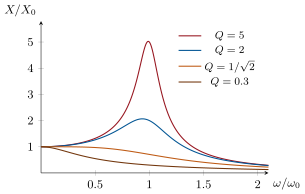
The amplitudeX peaks, for Q>1/2, at ωr=ω01−1/2Q2 with Xmax≈QX0; the velocity amplitudeV=ωX peaks exactly at ω0, where Vmax=F0/α, and its resonance curve
VmaxV=1+Q2(xr−1/xr)21
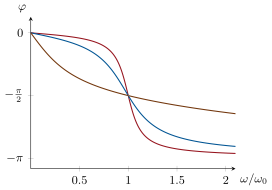
has the bandwidth Δω=ω0/Q. At ω0 the displacement lags the force by π/2 and the velocity is in phase with it.
Proof. Complex method (Chapter 8): X(−ω2+jωω0/Q+ω02)=F0/m, so X=(F0/m)/(ω02−ω2+jωω0/Q); divide numerator and denominator by ω02=k/m. Modulus and argument follow; the maximum of X was located in Proposition 8.10 (same function). Velocity: V=jωX gives V=ωX; writing (1−xr2)/xr=1/xr−xr turns the denominator into 1/Q2+(1/xr−xr)2, i.e. the RLC form. At xr=1, X=−jQX0: a lag of π/2. ∎
Amplitude (left) and phase (right) of the forced oscillator against the driving frequency, for several quality factors. A sharp peak near ω0 for large Q, none below Q=1/2; the displacement goes from in phase (low ω) to opposite (high ω), through a π/2 lag at ω0 — the sharper the resonance, the more abrupt the switch.
Remark 14.7(Two resonances, one circuit)
The correspondence x↔q, x˙↔i, m↔L, α↔R, k↔1/C, F↔e maps the driven oscillator onto the series RLC of Chapter 8: the velocity resonance is the current resonance (always at ω0, bandwidth ω0/Q), the amplitude resonance is the charge, i.e. capacitor-voltage, resonance (slightly below ω0, absent for low Q). Power absorbed, ⟨Fx˙⟩=21F0Vcosφv, peaks at ω0 with the value F02/2α, and the half-power points are the velocity bandwidth — exactly as for the RLC.
Example 14.8(Resonant speeds)
A car’s suspension has f0≈1.3Hz (Problem 7.1). On a road with corrugations every λ=10m the excitation frequency is v/λ: resonance at v=λf0=13m/s, about 47km/h — the speed at which a washboard track shakes the car hardest, and the reason a damper with Q≈0.7 is fitted: with Q=5 the body would bounce with five times the road’s amplitude. Above resonance (xr≫1) the amplitude falls as X0/xr2: the body “floats” over fast bumps — isolation, the other face of resonance.
14.4 Base excitation: isolation and the seismometer
Proposition 14.9(Oscillator shaken by its support)
Let the support of a mass–spring–damper move by xg(t) (the road under a car, the ground under a seismometer), and let u be the displacement of the mass relative to the support and x=xg+u its absolute displacement (from equilibrium). Then
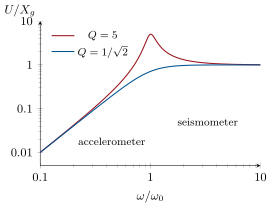
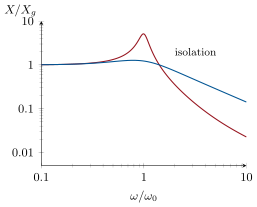
For xr≫1: U→Xg (the mass stays still in space — a seismometer reads the ground’s displacement) and X→0 (the mass is isolated from the shaking); for xr≪1: U≈x¨g/ω02 (an accelerometer) and X≈Xg (the mass follows the support).
Proof. The spring and damper act on the relative motion: mx¨=−ku−αu˙, and x¨=x¨g+u¨. In complex form U(ω02−ω2+jωω0/Q)=ω2Xg, whence U/Xg; then X=U+Xg=Xg(1+jxr/Q)/(1−xr2+jxr/Q). ∎
A mass shaken through its support. Left: relative motion U/Xg — an accelerometer below ω0 (slope 2 on log scales), a seismometer above. Right: absolute motion X/Xg — the mass follows the support at low frequency, is isolated from it well above ω0; a high Q buys nothing but a dangerous peak.
Example 14.10(Why machines sit on soft mounts)
A 50Hz motor on rubber mounts tuned to f0=10Hz (xr=5, Q≈2): X/Xg=(1+6.25)/(576+6.25)=0.11 — nine tenths of the vibration stays out of the floor. The mounts must be softer than intuition suggests: stiffening them raises f0 toward 50 Hz and destroys the isolation. The same formula, read the other way, is the car of Example 14.8 on a washboard road.
14.5 Energy: how a resonance builds up
Proposition 14.11(Energy balance in the forced regime)
In the steady forced regime the average power supplied by the driving force equals the average power dissipated by friction, 21αV2. At resonance the stored energy 21mVmax2 is Q/2π times the energy supplied per period: the oscillator accumulates the drive’s work over about Q cycles before losses match the input, which is also the number of cycles (∼τ/T) the transient lasts.
Proof. Average the energy theorem over a period: ⟨dE/dt⟩=0 in steady state, so ⟨Fx˙⟩=⟨αx˙2⟩=21αV2. At resonance Vmax=F0/α, stored energy 21m(F0/α)2, supplied per period 21α(F0/α)2T; ratio m/(αT)=Q/2π. ∎
Example 14.12(The swing)
A swing of length 2.5m (T0=3.2s, Q≈20) gets a push of 50N over 0.5m each period: 25J per cycle. It grows until the loss per period, 2πE/Q, equals 25J: E=80J; with a 30kg child, mgℓ(1−cosθmax)=80J gives θmax≈27∘. Pushing at any other rhythm, the work of the pushes would alternate in sign and average to nothing.
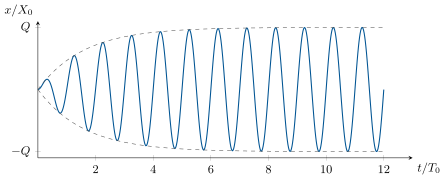
Start-up of a resonance (Q=5, drive switched on at t=0 at ω0): the amplitude grows toward QX0 with the time constantτ=2Q/ω0, i.e. over about Q/π periods — the transient of Chapter 7 superposed on the forced regime.
14.6 Exercises
Exercise 14.1★
A 0.20kg mass on a spring of stiffness 80N/m oscillates with amplitude5.0cm. Angular frequency, frequency, period, maximal speed, total energy.
Period of a 1.0m pendulum on Earth and on the Moon (g=1.62m/s2). What happens to the mass–spring period on the Moon?
Solution
Solution of Exercise 14.2.
T=2πℓ/g: 2.0s on Earth, 4.9s on the Moon. The mass–spring period, 2πm/k, does not involve g: unchanged.
Exercise 14.3★
An oscillator has f0=2.0Hz and Q=50. Decay time τ of the amplitude; time for the energy to halve; number of oscillations before the amplitude is down to 5%.
Solution
Solution of Exercise 14.3.
τ=2Q/ω0=100/(4π)=8.0s; energy ∝e−2t/τ halves at t=τln2/2=2.8s; 5% after 3τ=24s, about 48≈Q oscillations.
Exercise 14.4★
A mass on a spring (k=100N/m, Q=10) is driven by a force of amplitude1.0N. Static deflection; amplitude at resonance; amplitude at ω=3ω0.
Solution
Solution of Exercise 14.4.
X0=F0/k=1.0cm; at resonance ≈QX0=10cm; at 3ω0: X0/64+0.09=0.13cm.
Exercise 14.5★★
A car (f0=1.3Hz, Q=0.7) crosses speed bumps 8.0m apart. Resonant speed? At 60km/h, what fraction of the bump amplitude does the body feel? Comment.
Explain with the energy balance why a swing must be pushed at its own period; for Q=20 and a push adding 25J per cycle, find the steady-state energy, and the amplitude for a 30kg child on a 2.5m swing.
Solution
Solution of Exercise 14.6.
The work of a push is positive only when it acts along the motion; pushed every period, all pushes add; at any other rhythm they alternate. Steady state: 2πE/Q=25J, E=80J; mgℓ(1−cosθmax)=80: 1−cosθmax=0.109, θmax=27∘.
Exercise 14.7★★
Successive maxima of a free oscillation decrease by 10% each period. Find Q and the bandwidth (in hertz) of its velocity resonance if f0=2.0Hz.
Solution
Solution of Exercise 14.7.
δ=ln(1/0.9)=0.105, Q=π/δ=30; Δf=f0/Q=0.067Hz.
Exercise 14.8★★
Give the phase of the displacement relative to the force well below resonance, at resonance and well above, and the phase of the velocity at resonance. Why is the velocity resonance the one that matters for power?
Solution
Solution of Exercise 14.8.
Displacement: in phase (φ=0) well below, −π/2 at resonance, −π (opposite) well above. Velocity at resonance: in phase with the force. Power is F⋅v: it is the velocity’s phase, not the displacement’s, that decides how much work the drive does.
Exercise 14.9★★
Show that the velocity amplitudeV=ωX is maximal exactly at ω0, with Vmax=F0/α, and that V/Vmax has the form 1/1+Q2(xr−1/xr)2.
Solution
Solution of Exercise 14.9.
V=ωX=ω(F0/m)/(ω02−ω2)2+(ωω0/Q)2; divide numerator and denominator by ωω0/Q: V=(F0Q/mω0)/1+Q2(ω0/ω−ω/ω0)2, and F0Q/mω0=F0/α. The square root is ≥1, equal to 1 exactly at ω=ω0.
Exercise 14.10★★★
Compute the average power absorbed at resonance for F0=1.0N, α=0.050Ns/m, and the stored energy if m=0.20kg; check that their ratio is Q/ω0 with ω0=20rad/s.
Solution
Solution of Exercise 14.10.
P=F02/2α=10W; Vmax=F0/α=20m/s, E=21mVmax2=40J; E/P=4.0s and Q/ω0=m/α=4.0s.
Exercise 14.11★★★
A tuning fork at 440Hz is heard for 10s (amplitude down to 5%). Estimate τ and Q, the bandwidth of its resonance, and comment on why it is a good frequency standard.
Solution
Solution of Exercise 14.11.
3τ=10s: τ=3.3s, Q=ω0τ/2=2π×440×3.3/2≈4600; Δf=f0/Q=0.1Hz. It responds to, and emits, essentially one frequency: a standard good to a few parts in 104.
Exercise 14.12★★★
Derive the bobbing frequency of a floating cylinder (Example 14.3) from Newton’s law and Archimedes’ force ρwgS(h+x); show ω02=g/h; compute the period for h=10cm. Why is the result independent of the mass and of the liquid?
Solution
Solution of Exercise 14.12.
mx¨=mg−ρwgS(h+x)=−ρwgSx (since mg=ρwgSh): ω02=ρwgS/m=g/h; T=2π0.10/9.81=0.63s. Both the mass and the liquid’s density enter only through the equilibrium depth h.
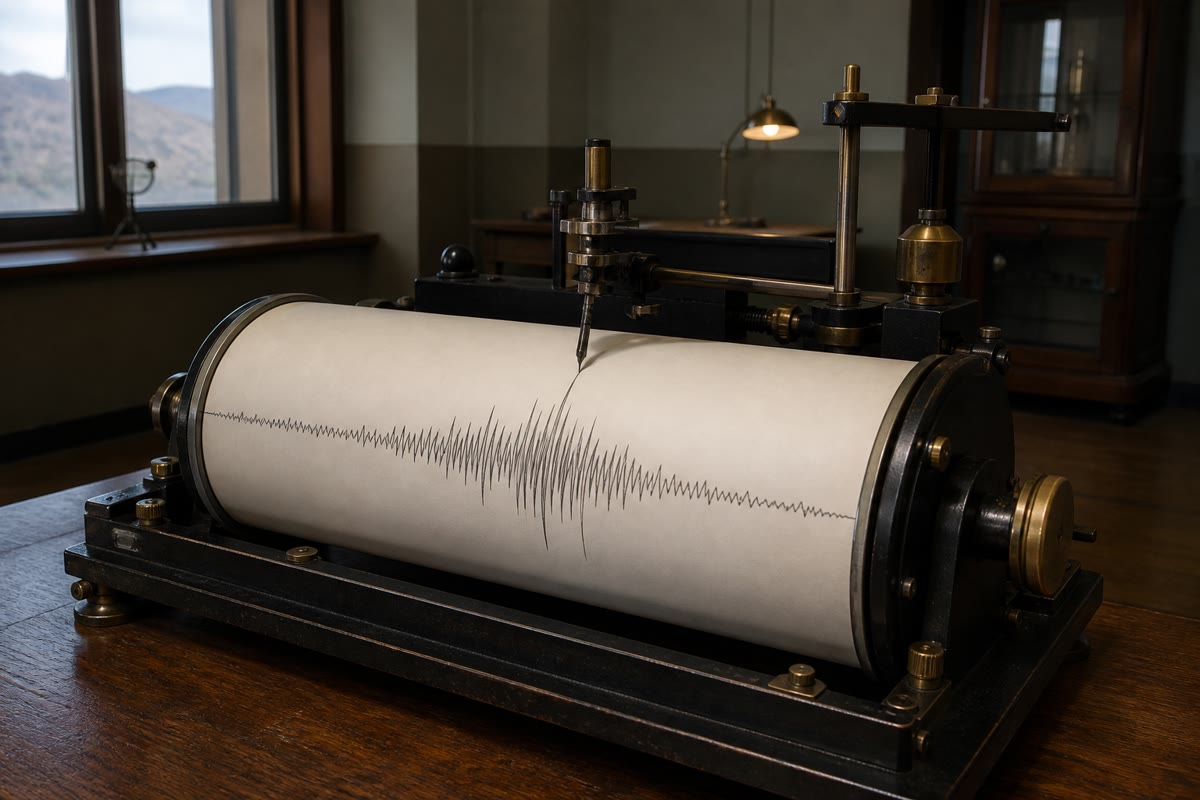
A seismograph: a heavy mass on a soft suspension stays still while the ground moves, and the pen writes the difference — the base-excited oscillator of the weekend problem.
14.7 Problem: The seismograph
Problem 14.1
Weekend problem — a mass hangs from a spring inside a box bolted to the ground; the ground shakes: what does the pen record, why the same instrument measures displacement at high frequency and acceleration at low frequency, and why a long-period seismometer cannot simply be a long spring
A mass m=1.0kg hangs from a spring of stiffness k inside a rigid frame fixed to the ground; a damper exerts −αu˙, where u is the displacement of the mass relative to the frame, measured from its equilibrium position. The ground, hence the frame, moves vertically by xg(t). The frame of the distant stars is inertial.
Part I — The equation.
Write the absolute position of the mass as x=xg+u+const, list the forces on the mass (in the inertial frame), and show that
mu¨+αu˙+ku=−mx¨g.
Put it in canonical form; identify ω0 and Q.
The instrument is built with f0=0.50Hz and Q=0.70: compute k and α.
A constant ground acceleration ag (the frame tilting, say) gives what steady u? Interpret.
What does the pen attached to the mass, writing on a drum fixed to the frame, record?
Part II — Harmonic ground motion. The ground moves as xg=Xgcosωt; write xr=ω/ω0.
Limit xr≫1: show U→Xg and explain physically what the mass does (what is the instrument measuring?).
Limit xr≪1: show U≈xr2Xg=ag/ω02 with ag the ground’s acceleration amplitude: what is the instrument now?
Value at xr=1; why is Q≈0.7 a sensible choice?
Sketch U/Xg against xr (log scales) for Q=0.7 and Q=5.
Phase of u relative to xg at high frequency; interpret.
Part III — Designing for earthquakes. Distant earthquakes produce surface waves at 0.05 to 0.1Hz with millimeter amplitudes; local tremors reach 5 to 10Hz.
To record 0.05Hz waves as displacements one wants f0≪0.05Hz, say 0.02Hz. What static stretch would the spring have under the mass’s weight? Comment.
Real long-period instruments use a nearly horizontal “garden-gate” pendulum, or electronic force feedback. Explain in one sentence what each achieves.
For the 0.50Hz instrument, compute the static stretch: feasible?
With it, a 0.10Hz wave of amplitude1.0mm gives what U? In which regime is the instrument?
A 5.0Hz local tremor of amplitude1.0mm: U? Regime?
Part IV — The accelerometer in a phone. A micro-machined mass on silicon springs has f0=1.0kHz and Q=0.7.
A 10Hz shake of acceleration amplitudeg: compute U. How is such a displacement read?
Up to what frequency is the reading within 10% of ag/ω02?
What time constantτ=2Q/ω0 governs its response to a jolt, and why does that matter for detecting a fall?
The seismometer’s τ: value and consequence after a sudden ground step.
Why is critical (or near-critical) damping chosen for both instruments, rather than a high Q?
The phone is shaken at exactly 1.0kHz: by what factor is the reading off?
Summarize: one device, two regimes, decided by which single comparison.
Solution
Solution of Problem 14.1.
1. Forces: weight (balanced by the static stretch), spring −ku, damper −αu˙; mx¨=−ku−αu˙ with x¨=x¨g+u¨.
2.u¨+(ω0/Q)u˙+ω02u=−x¨g, ω0=k/m, Q=km/α.
3.k=mω02=π2=9.9N/m; α=mω0/Q=3.14/0.70=4.5Ns/m.
4.u=−ag/ω02: the mass sags by a fixed amount — the instrument is an accelerometer at zero frequency (and a tilt meter).
5. The relative displacement u(t).
6.−ω2U+jω(ω0/Q)U+ω02U=ω2Xg; divide by ω02.
7.U/Xg=xr2/(1−xr2)2+xr2/Q2.
8.U→Xg: the mass does not move in the inertial frame (its inertia keeps it still while the spring is too soft to drag it); the frame moves around it, and the pen records the ground displacement — a seismometer.
9.U≈xr2Xg=ω2Xg/ω02=ag/ω02: an accelerometer.
10.U=QXg=0.7Xg: no peak; the two regimes join smoothly and the instrument rings not.
11. For Q=0.7: a line of slope 2 rising to 1 near xr=1, then flat at 1; for Q=5: the same with a peak of height 5 at xr=1.
12.U→−Xg: u=−xg, the mass still while the frame moves.
13.Δℓ=g/ω02=9.81/(2π×0.02)2=620m: absurd.
14.ℓ=g/ω02=620m.
15. Garden gate: the pendulum swings about a nearly vertical axis, so only a tiny fraction of g restores it and a short arm gives a long period. Force feedback: a coil holds the mass fixed, and the current needed is proportional to the ground acceleration — the stiffness is electronic and adjustable.
16.Δℓ=9.81/π2=0.99m: feasible.
17.xr=0.2: U/Xg=0.04/0.92+0.08=0.040: 40µm — accelerometer regime, needs amplification (optical lever or electronics).
19.ω0=6.3×10³rad/s: U=g/ω02=2.5×10−7m — read as the change of a capacitor gap.
20.U/(ag/ω02)=1/(1−xr2)2+xr2/Q2; with Q=0.7 it decreases monotonically and stays above 0.9 up to xr≈0.7: about 700Hz.
21.τ=2Q/ω0=0.22ms: it tracks a fall (tens of milliseconds) without lag.
22.τ=1.4/3.14=0.45s: after a ground step the record settles in half a second with no ringing.
23. A high Q would make the instrument ring at f0 after every jolt (recording itself rather than the ground) and peak near f0; Q≈0.7 is flat and quick.
24.U=QXg=0.7Xg against the ideal Xg (or ag/ω02=Xg): 30% low.
25. Compare the signal frequency with f0: well above, the mass is a fixed reference and u is the displacement; well below, u is the acceleration over ω02.