Inside the oscilloscope that drew the traces of Chapter 7, a beam of electrons is steered across a screen by the voltage between two plates; inside the magnet of a mass spectrometer, ions of two isotopes separate by millimeters because one is eight percent heavier than the other; inside a hospital’s cyclotron, protons spiral outward through two hundred turns before leaving at a third of the speed of light to burn a tumor. All three are the same dynamics: a charge in a uniform field, electric or magnetic, and Newton’s law. This chapter works it out — the parabola in an electric field, the circle and the helix in a magnetic field — and turns it into the instruments that sort, accelerate and measure charged particles.
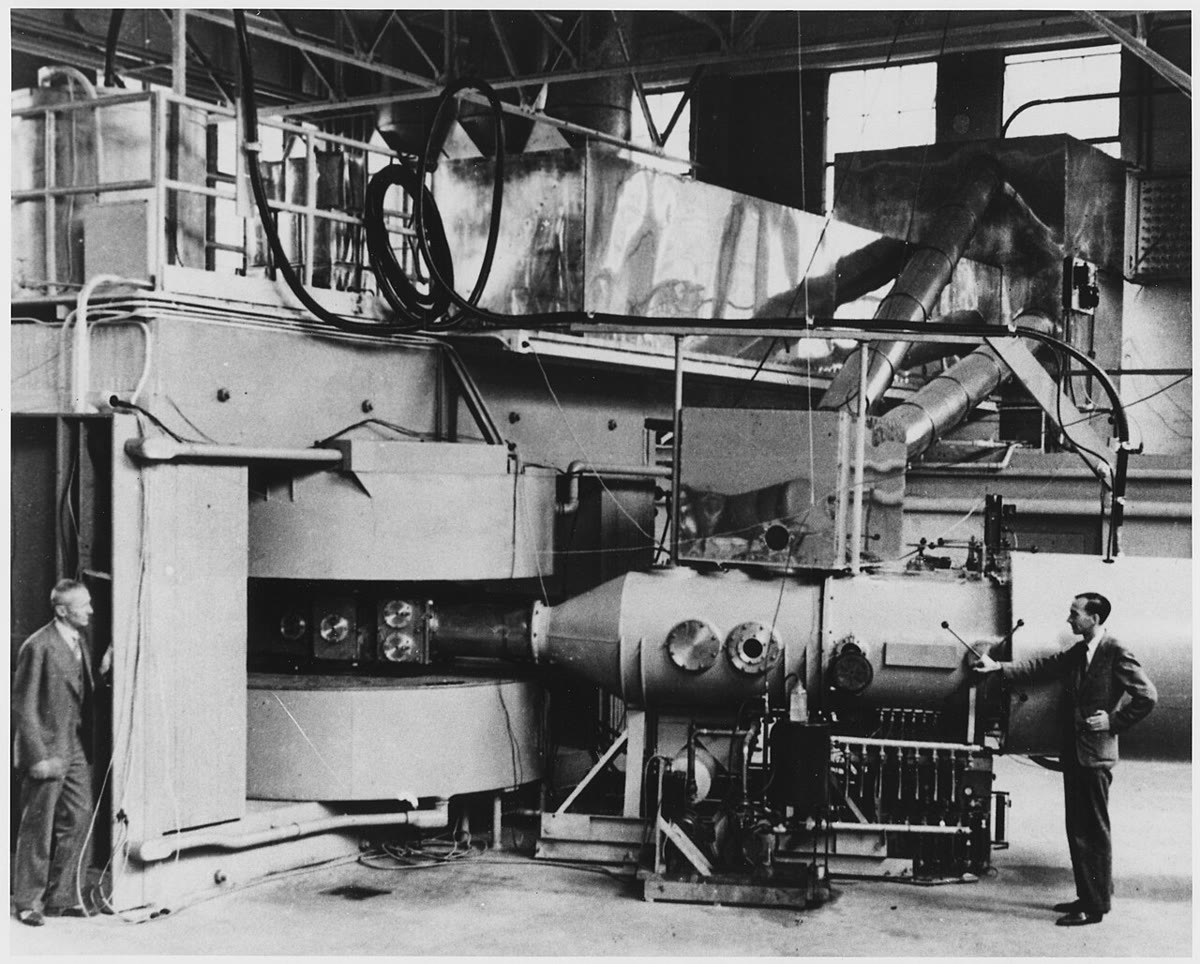
Lawrence’s 60-inch cyclotron at Berkeley, 1939 (US Department of Energy): between the poles of the magnet, protons spiral outward as they are kicked twice per turn, exactly as in the weekend problem.
17.1 The Lorentz force
Definition 17.1(Lorentz force)
A particle of charge q moving at velocity v in an electric field E and a magnetic field B receives the force
F=q(E+v∧B).
The electric part is along E (or opposite, for q<0) and independent of the motion; the magnetic part is perpendicular both to v and to B, proportional to the speed, and vanishes for a particle at rest. Units: E in V/m (or N/C), B in teslas (T): 1T=1N/(Am).
Proposition 17.2(Work of the Lorentz force)
The magnetic force does no work: its power q(v∧B)⋅v is zero, so a magnetic field alone changes the direction of the velocity but never the speed or the kinetic energy. The electric force has power qE⋅v, and between two points its work is q(VA−VB)=qUAB (Chapter 27): a particle of charge q crossing a voltageU gains the kinetic energy∣qU∣.
Proof.v∧B⊥v. The electrostatic field derives from the potential, E=−gradV, so qE is conservative with Ep=qV. ∎
Definition 17.3(The electron-volt)
The electron-volt is the kinetic energy gained by an elementary charge crossing one volt: 1eV=1.60×10⁻¹⁹J. Chemistry lives at a few eV, X-ray tubes at tens of keV, nuclear physics at MeV, particle physics at GeV and TeV.
Remark 17.4(Why gravity is ignored)
For an electron in a field of 1kV/m — a modest laboratory value — the electric force is eE=1.6×10⁻¹⁶N, against a weight mg=9×10⁻³⁰N: 1013 times smaller. Weight is dropped from every calculation of this chapter without a second thought. (The relativistic limit is another matter: the formulas below hold for 21mv2≪mc2, i.e. below about 50keV for electrons and 100MeV for protons; see the Year 3 volume.)
17.2 Uniform electric field
Proposition 17.5(Acceleration and deflection)
In a uniform field E the acceleration a=qE/m is constant: the motion is that of a projectile, with qE/m in place of g.
Released from rest and accelerated through a voltageU, the particle reaches v=2∣qU∣/m.
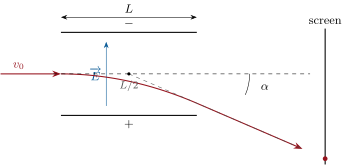
Entering at speed v0 along x a region of length L where E=Eey, it follows the parabola y=(qE/2mv02)x2 and leaves deflected by the angle α with tanα=qEL/mv02, as if it had come in a straight line from the middle of the plates.
Proof. Energy: 21mv2=∣qU∣. Deflection: x=v0t, y=21(qE/m)t2; at the exit, dy/dx=(qE/m)(x/v02) evaluated at L; the tangent at the exit, y=(qEL/mv02)(x−L/2), crosses the axis at x=L/2. ∎
Electrostatic deflection: between the plates the electron (here q<0, deflected toward the positive plate) follows a parabola; beyond them it flies straight, as if coming from the midpoint of the plates — the geometry of the cathode-ray oscilloscope.
Example 17.6(The oscilloscope tube)
Electrons accelerated through U0=2.0kV (v0=2.65×10⁷m/s, a tenth of c — just non-relativistic) cross 4.0cm plates 1.0cm apart carrying 100V: E=1.0×10⁴V/m, tanα=eEL/mv02=EL/2U0=0.10, and on a screen 30cm past the plates’ center the spot moves by 3.0cm — 0.3mm per volt, the tube’s sensitivity, set purely by geometry and the accelerating voltage.
17.3 Uniform magnetic field
Theorem 17.7(Motion in a uniform magnetic field)
A particle of charge q, mass m, velocity v0 perpendicular to a uniform B, describes a circle at constant speed v0, of radius and angular frequency
R=∣q∣Bmv0,ωc=m∣q∣B,
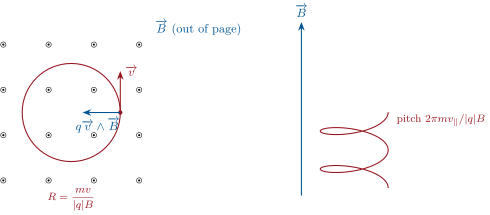
the cyclotron frequencyωc being independent of the speed; the sense of rotation depends on the sign of q. If v0 also has a component v∥ along B, that component is unchanged and the trajectory is a helix of radius mv⊥/∣q∣B and pitch 2πmv∥/∣q∣B wound around the field lines.
Proof. The force qv∧B is perpendicular to v and to B; the speed is constant (no work) and the component along B sees no force. In the plane perpendicular to B the force has the constant norm ∣q∣v⊥B, always perpendicular to the velocity: uniform circular motion (Theorem 11.13) with mv⊥2/R=∣q∣v⊥B. Then ωc=v⊥/R; the period 2πm/∣q∣B times v∥ is the pitch. ∎
Left: a charge whose velocity is perpendicular to B circles at the cyclotron frequency∣q∣B/m, the magnetic force supplying the centripetal acceleration. Right: with a velocity component along B, a helix winds around the field line — the motion of electrons trapped in the Earth’s field.
Example 17.8(Orders of magnitude)
A 1keV electron (v=1.9×10⁷m/s) in 1mT: R=11cm, ωc=1.8×10⁸rad/s, one turn in 36ns — the same period at any energy, which is what makes the cyclotron possible. A proton of the solar wind (1keV, 4.4×10⁵m/s) in the Earth’s 50µT: R=92m; it cannot cross the field lines, only spiral along them toward the poles — the aurora.
17.4 Instruments
Proposition 17.9(Velocity selector and mass spectrometer)
In crossed uniform fields E⊥B, a particle moving perpendicular to both passes undeflected iff v=E/B, whatever its charge and mass (velocity selector). In a magnetic field alone a particle of known speed describes a semicircle of diameter 2mv/∣q∣B: measuring it gives m/q (mass spectrometer). Ions accelerated through a voltageU then bent in B land at
R=B1∣q∣2mU:
two isotopes of masses m and m+Δm separate by ΔR≈RΔm/2m.
Proof.qE+qv∧B=0 requires vB=E with the right orientation. R=mv/qB with v=2qU/m; differentiate lnR=21lnm+const. ∎
Example 17.10(Carbon isotopes)
Singly charged 12C and 13C ions accelerated through 20kV in 0.50T: R=14.1cm and 14.7cm, 5.8mm apart — two separate spots on the detector, and the ratio of their intensities is the isotopic abundance, the raw material of radiocarbon dating and of every isotope analysis.
Proposition 17.11(Cyclotron)
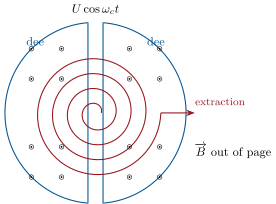
Two hollow half-cylinders (“dees”) in a uniform B, with an alternating voltageU between them at the cyclotron frequency: the particle circles inside each dee (no field there), is accelerated by ∣q∣U at each of the two gap crossings per turn, and spirals outward with R∝v; at the extraction radius Rmax its kinetic energy is
Ek=2mq2B2Rmax2,
independent of the voltage, which only sets the number of turns.
Proof. Because ωc does not depend on the speed, a fixed-frequency voltage stays in step with the particle turn after turn; v=∣q∣BR/m at radius R. ∎
The cyclotron: two dees in a uniform magnetic field; the particle circles inside the dees and is kicked by the gap voltage twice per turn, always in phase because its period does not depend on its speed. The energy at the rim depends only on B and the radius.
Example 17.12(A hospital cyclotron)
Protons, B=1.5T, Rmax=0.50m: Ek=(1.6×10−19×1.5×0.5)2/(2×1.67×10−27)=4.3×10−12J=27MeV, at fc=ωc/2π=23MHz. With 50kV on the dees, 100keV per turn: 270 turns in 12µs. Above a few tens of MeV the relativistic increase of the mass (the Year 3 volume) desynchronizes the protons; therapy machines at 230MeV modulate the frequency or the field to compensate — the weekend problem’s subject.
Proposition 17.13(Hall effect)
A ribbon of thickness d carrying a current I of carriers of charge q and density n, in a field B perpendicular to the ribbon, develops across its width the Hall voltage
UH=nqdIB:
proportional to B (a magnetometer) and inversely to n (a probe of the carrier density and sign).
Proof. The magnetic force qvdB on the carriers (drift speed vd) pushes them to one edge until the transverse electric fieldEH balances it: qEH=qvdB, and UH=EHw across the width w; with I=nqvdwd, EHw=vdBw=IB/(nqd). ∎
17.5 Exercises
Exercise 17.1★
Convert 1eV, 13.6eV, 1MeV to joules. Speed of an electron and of a proton accelerated from rest through 1.0kV.
Solution
Solution of Exercise 17.1.
1eV=1.60×10⁻¹⁹J, 13.6eV=2.18×10⁻¹⁸J, 1MeV=1.60×10⁻¹³J. v=2eU/m: electron 1.9×10⁷m/s; proton 4.4×10⁵m/s (1836 times slower).
Exercise 17.2★
A 1.0keV electron enters a 1.0mT field perpendicularly. Radius, cyclotron angular frequency, period.
A proton at 1.0×10⁵m/s in the Earth’s field (50µT): radius of its circle. What happens if its velocity makes 30∘ with the field?
Solution
Solution of Exercise 17.3.
R=mv/qB=1.67×10−27×105/(1.6×10−19×5×10−5)=21m. At 30∘: a helix of radius Rsin30∘=10m and pitch 2π(m/qB)vcos30∘=114m, drifting along the field line.
Exercise 17.4★
A velocity selector has E=10kV/m and B=20mT. Which speed passes? What happens to faster ions, and to the same speed with the opposite charge?
Solution
Solution of Exercise 17.4.
v=E/B=104/0.020=5.0×105m/s. Faster ions: the magnetic force wins, they curve toward the magnetic side; opposite charge at the same speed: both forces reverse, still balanced — the selector is blind to the sign and to the mass.
Exercise 17.5★★
Oscilloscope: electrons at 2.0kV, plates 4.0cm long, 1.0cm apart, 100V between them, screen 30cm past the plates’ center. Deflection on the screen and sensitivity in mm/V. Why does a higher accelerating voltage reduce the sensitivity?
Solution
Solution of Exercise 17.5.
tanα=EL/2U0=104×0.04/4000=0.10; deflection 0.30×0.10=3.0cm; sensitivity 0.30mm/V. Faster electrons spend less time between the plates: tanα∝1/U0.
Exercise 17.6★★
Singly charged 12C and 13C ions, accelerated through 20kV, enter a 0.50T field (1u=1.66×10⁻²⁷kg). Radii and separation of the two spots after a half turn.
Solution
Solution of Exercise 17.6.
R=2mU/e/B: m12=1.99×10⁻²⁶kg, R12=2×1.99×10−26×2×104/1.6×10−19/0.5=14.1cm; R13=R1213/12=14.7cm; separation 2ΔR=1.2cm between the landing points (radii differ by 5.8mm, diameters by twice that).
Exercise 17.7★★
A proton cyclotron has B=1.5T and Rmax=0.50m. Frequency of the dee voltage, maximal kinetic energy, number of turns for 50kV on the dees, time spent inside. By what fraction has the proton’s mass increased at the exit (γ−1≈Ek/mc2, mc2=938MeV)?
Solution
Solution of Exercise 17.7.
fc=eB/2πm=23MHz; Ek=e2B2R2/2m=4.3×10−12J=27MeV; 100keV per turn: 270 turns; time 270/fc=12µs; γ−1=27/938=2.9%.
Exercise 17.8★★
An electron at 1.0×10⁶m/s enters a 2.0mT field at 30∘ to the field lines. Radius and pitch of its helix; number of turns per meter along the field.
Solution
Solution of Exercise 17.8.
v⊥=5.0×10⁵m/s, v∥=8.7×10⁵m/s: R=mv⊥/eB=9.11×10−31×5×105/(3.2×10−22)=1.4mm; period 2πm/eB=18ns, pitch v∥T=1.5cm: about 64 turns per meter.
Exercise 17.9★★
A copper strip 1.0mm thick carries 5.0A in 1.0T (n=8.5×1028m−3). Hall voltage. Why are Hall sensors made of semiconductors (n∼1×10²²m−3)?
Solution
Solution of Exercise 17.9.
UH=IB/nqd=5.0/(8.5×1028×1.6×10−19×10−3)=3.7×10−7V: sub-microvolt. With n ten million times smaller, a semiconductor gives millivolts — a usable sensor.
Exercise 17.10★★★
Prove from Newton’s law that a charge in any magnetic field (uniform or not), with no electric field, keeps a constant speed. A 10keV electron enters a region of strong, non-uniform field: what can and cannot change?
Solution
Solution of Exercise 17.10.
mdv/dt=qv∧B; dot with v: d(21mv2)/dt=0 whatever B(r,t), provided there is no E. The direction of the velocity, the radius of curvature, the pitch can all change; the speed, the kinetic energy (10keV) cannot.
Exercise 17.11★★★
A charge q starts from rest at the origin in E=Eey and B=Bez. Write the equations of motion, show that the particle drifts on average at the velocity E/B along ex (hint: look for a solution of the form v=u+w with u constant), and describe the trajectory (a cycloid). Numbers for an electron with E=1.0×10⁴V/m, B=0.10T.
Solution
Solution of Exercise 17.11.
mv˙x=qvyB, mv˙y=qE−qvxB, vz=0. With v=(E/B)ex+w: mw˙x=qwyB, mw˙y=−qwxB — a pure cyclotron rotation of w at ωc. Starting from rest, w(0)=−(E/B)ex: w turns at constant norm E/B, so the velocity is the drift E/B plus a rotating vector of the same norm — a cycloid, with cusps where v=0. Electron: drift E/B=1.0×105m/s, ωc=1.8×10¹⁰rad/s, arch height 2mE/qB2=11µm.
Exercise 17.12★★★
In the oscilloscope of Exercise 17.5, replace the plates by a magnetic deflection coil producing 1.0mT over the same 4.0cm. Deflection angle (small-angle: the arc of radius R over a length L), and deflection on the screen. Why do television tubes, with their large angles, use magnetic rather than electric deflection?
Solution
Solution of Exercise 17.12.
R=mv0/eB=9.11×10−31×2.65×107/(1.6×10−22)=0.15m; α≈L/R=0.04/0.15=0.27 (about 15∘): deflection ≈0.30×0.27=8cm for a modest millitesla. Large angles with plates would need kilovolts and long plates; a coil bends the beam through tens of degrees with no voltage at all.
17.6 Problem: Protons against a tumor
Problem 17.1
Weekend problem — the cyclotron behind the wall of a hospital: how protons are spun up to a third of the speed of light, why the simple machine stops working before the energy a therapist needs, and how many protons it takes to treat a tumor
Why must the dee voltage alternate at exactly fc? What happens if it is slightly off?
The protons are injected at the center with negligible speed: radius after the first turn? After n turns?
Part II — To the rim.
Kinetic energy at extraction (in J and MeV), and the speed, as a fraction of c.
Number of turns needed and time spent in the machine.
Total length of the spiral path (sum of the circumferences — approximate the sum by an integral).
Does the result of question 7 depend on U? On what does U act?
The vacuum inside must be good: estimate the distance a proton travels between collisions with residual gas molecules if the mean free path must exceed the spiral length; the mean free path scales as 1/p and is about 70nm at atmospheric pressure. What pressure is needed?
Compute γ−1≈Ek/mc2 at extraction and the resulting relative change of the period. Over the number of turns found above, by what fraction of a period has the proton slipped relative to the voltage? Comment.
Part III — 230 MeV. Proton therapy needs about 230MeV to reach tumors 30cm deep.
With the non-relativistic formula, what product BR would give 230MeV? With B=2.0T, what radius?
At that energy γ−1=0.245: what happens to the cyclotron period as the proton gains energy, and why does a fixed-frequency cyclotron fail?
Two cures exist: vary the voltage frequency during the acceleration (synchrocyclotron), or make B grow with radius so that B/γ stays constant (isochronous cyclotron). Explain each in one sentence and name a drawback of the first.
The relativistic momentum is p=γmv and the radius R=p/qB still holds: with γ=1.245 and v=0.60c, compute R for B=2.0T and compare with question 13.
The extracted beam passes between two plates 1.0m long with E=1.0×10⁵V/m to be steered by a small angle: estimate the deflection angle (non-relativistically, with p from the previous question as mv replacement). Is electric steering practical here?
The same steering with a magnet of 1.0T over 1.0m: angle? Conclude on why beam lines use magnets.
Part IV — The dose.
A 230MeV proton deposits most of its energy near the end of its range (the Bragg peak). If all of it is absorbed in a tumor of mass 0.50kg, how many protons deliver a dose of 2.0Gy (1Gy=1J/kg)?
The beam current is 1.0nA: protons per second, and duration of the session.
Power carried by the beam; compare with a light bulb.
The protons are slowed to a stop inside the patient: what is the energy deposited per proton in the last centimeter, roughly, if a quarter of the energy is lost there? In electron-volts per micrometer?
Each ionization in tissue costs about 30eV: how many ionizations does one proton cause along its whole path?
Why is a proton beam preferable to X-rays for a deep tumor, in one sentence about where the energy goes?
Summarize the chain from the Lorentz force to the dose: which equations fixed the energy, the radius, the number of turns and the treatment time.
Solution
Solution of Problem 17.1.
1.F=ev∧B⊥v: no power, constant speed.
2.mv2/R=evB: R=mv/eB; T=2πR/v=2πm/eB, free of v.
3.fc=eB/2πm=1.6×10−19×1.5/(2π×1.67×10−27)=23MHz.
4.eU=50keV per crossing, 100keV per turn.
5. The gap must be at the accelerating polarity each time the proton arrives, half a period apart; off frequency, the phase slips and the kicks eventually decelerate.
6. After one turn Ek=100keV, v=2Ek/m=4.4×106m/s, R=mv/eB=3.0cm; after n turns Ek=n×100keV and R=3.0cmn.
10. No: Ek depends on B and Rmax only; U sets the number of turns and the time.
11. Path 560m: need λ≳1km, i.e. p≲105Pa×7×10−8/103=7×10−6Pa — a high vacuum.
12.γ−1=27/938=0.029; the period grows by 2.9%. Over 270 turns the slip accumulates to several periods — the last turns would be out of phase; in practice B and the injection phase are trimmed, and 27MeV is near the limit of the simple machine.
13.Ek=(eBR)2/2m: BR=2mEk/e=2×1.67×10−27×3.68×10−11/1.6×10−19=2.2Tm; R=1.1m at 2T.
14.T=2πγm/eB grows by 24% from center to rim: a fixed frequency falls hopelessly out of step.
15. Synchrocyclotron: lower the frequency as the bunch gains energy — only one bunch at a time, low average current. Isochronous: shape B(R)∝γ so the period stays constant — continuous beam, the modern choice.
16.p=γmv=1.245×1.67×10−27×1.8×108=3.7×10⁻¹⁹kgm/s; R=p/eB=1.2m, a little more than the non-relativistic 1.1m.
17. Transverse impulse eEL/v=1.6×10−19×105×1.0/1.8×108=8.9×10−23kgm/s; angle ≈8.9×10⁻²³/3.7×10−19=2.4×10−4rad: hopeless for steering.
18. Magnetic: R=p/eB=2.3m, angle L/R=0.43rad≈25∘: a thousand times more — magnets it is.
19. Energy per proton 3.68×10⁻¹¹J; dose 2.0×0.50=1.0J: 2.7×10¹⁰ protons.
20.10−9/1.6×10−19=6.2×109protons/s: about 4.4s.
21.P=230MeV×6.2×109s−1=0.23W: a night light, delivered exactly where wanted.
22.58MeV in 1cm: about 6keV/µm — dense ionization along the last track.
23.230×10⁶/30≈8×106 ionizations per proton — the molecular damage that kills the cell.
24. X-rays deposit energy all along their path, most near the entrance; protons deposit most of theirs at the end of their range, sparing the tissue in front and leaving nothing behind.
25.R=mv/eB and T=2πm/eB (the circle), Ek=(eBR)2/2m (the energy), Ek/2eU (the turns), dose = (protons × energy)/mass and current =e× rate (the time).