Shine ultraviolet light on a clean metal and electrons fly out at once, with an energy that depends on the colour of the light and not at all on its brightness; shine red light and nothing comes out however bright the lamp. Send electrons one by one through two slits and they land as dots, each in one place — and the dots build up, over thousands, into the fringes of a wave. Neither fact fits the physics of the first twenty-nine chapters. This last chapter introduces the ideas that do fit them: light comes in quanta, the photons; matter has a wavelength; what propagates is an amplitude whose square is a probability; position and momentum cannot both be sharp; and a confined particle can only have certain energies — which is why atoms have sizes, spectra have lines, and a grain of semiconductor a few nanometres across glows in a colour set by its diameter.
30.1 The photon
Theorem 30.1(Planck–Einstein relations)
Light of frequency ν and wavelength λ exchanges energy with matter only in quanta, the photons, of energy and momentum
E=hν=λhc,p=λh=cE,
with Planck’s constanth=6.626×10⁻³⁴Js (ℏ=h/2π=1.055×10−34Js). Useful: hc=1240eVnm — a photon of 620nm carries 2eV.
Proof.Admitted at this level.∎
Proposition 30.2(The photoelectric effect)
Light falling on a metal of work functionW (the energy binding its least-bound electrons, a few eV) extracts electrons of maximal kinetic energy
Ek,max=hν−W,
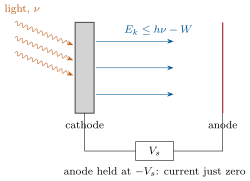
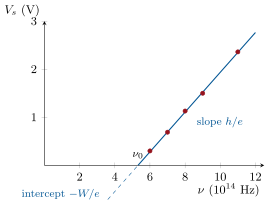
hence only above the thresholdν0=W/h, instantly, with an energy independent of the intensity; the intensity fixes the number of electrons per second. The stopping potentialVs that just cancels the current measures Ek,max=eVs, and the plot of Vs against ν is a straight line of slope h/e — how Millikan measured h.
Proof. Each photon is absorbed by one electron, which keeps hν−W at best; a wave would deliver energy continuously to every electron, the energy would grow with intensity, and a weak light would need hours to accumulate W on one atom (Problem 30.1) — none of which is observed. Einstein’s interpretation (1905) is admitted as the law. ∎
Left: the photoelectric cell — light frees electrons from the cathode; a reverse voltageVs just sufficient to stop them measures their maximal energy. Right: the stopping potential against frequency is a straight line for every metal, of slope h/e; the intercept gives the work function, the threshold the minimum frequency.
Example 30.3(Orders of magnitude)
A visible photon: 2eV; an X-ray photon of 0.1nm: 12keV; a radio photon at 100MHz: 4×10⁻⁷eV. A 1mW red laser emits 10−3/(3.1×10−19)=3×1015 photons per second; a radio antenna picking up 1pW at 100MHz receives 1013 per second — so many, so small, that the wave description is exact for every purpose; the eye, by contrast, can register a flash of a hundred photons. The quantum nature of light shows when photons are few or energetic: photoelectric cells, X-ray detectors, the grain of a faint photograph.
Remark 30.4(Compton scattering)
A photon bouncing off a free electron transfers momentum like a billiard ball: its wavelength grows by Δλ=mech(1−cosθ), with h/mec=2.43pm (admitted — a relativistic collision, Year 2). Invisible for light (Δλ/λ∼10−5), it is a 20% effect for X-rays, and was the experiment that convinced the sceptics (1923) that the photon carries momentum h/λ.
30.2 Matter waves
Theorem 30.5(de Broglie)
A particle of momentum p propagates as a wave of wavelength
λ=ph,
and shows diffraction and interference accordingly: electrons on a crystal (Davisson and Germer, 1927), through two slits (Jönsson, 1961), neutrons, atoms, and molecules of sixty carbon atoms. For an electron accelerated by U, λ=h/2meeU=1.23nm/U/V.
Proof.Admitted at this level.∎
Example 30.6(Why we never saw it)
An electron of 100eV: λ=0.12nm, the spacing of atoms in a crystal — hence the diffraction, and the electron microscope. A thermal neutron (0.025eV): 0.18nm. A ball of 1g at 1m/s: λ=7×10⁻³¹m, 1020 times smaller than a nucleus: no slit, no crystal could ever diffract it. The wave nature of matter is universal; its wavelength is what makes it visible only for the light and the slow.
Proposition 30.7(Single particles build the fringes)
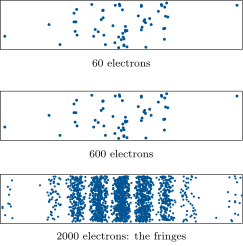
Electrons sent one at a time through two slits (Tonomura, 1989) each make a single dot on the screen, at a place that cannot be predicted; the dots accumulate into the two-slit interference pattern of a wave of wavelength h/p. Closing one slit erases the fringes — the pattern is not made by electrons interfering with each other, but by each electron’s wave passing through both slits. Detecting which slit a particle went through also erases the fringes.
Proof.Admitted at this level.∎
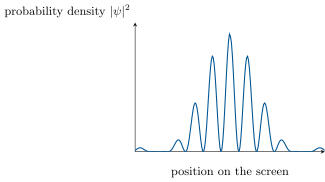
Electrons one at a time through two slits. Each arrives as a dot somewhere (left, top); the dots pile up where the two-slit wave is intense (left, bottom), following the probability density∣ψ∣2 of the amplitude that passed through both slits (right). The pattern is the same for photons, neutrons and molecules.
30.3 Amplitudes, probabilities, and the uncertainty principle
Definition 30.8(Wavefunction)
The state of a particle is described by a wavefunctionψ(x,t) (complex), such that ∣ψ(x,t)∣2dx is the probability of finding the particle between x and x+dx when one looks: ∣ψ∣2 is a probability density, and ∫∣ψ∣2dx=1. Amplitudes add (superposition): if two paths lead to the same point, ψ=ψ1+ψ2 and ∣ψ∣2=∣ψ1∣2+∣ψ2∣2+2Re(ψ1∗ψ2) — the last term is the interference. A measurement gives one of the possible results, at random with the probabilities the amplitudes prescribe, and leaves the particle in the state found.
Remark 30.9(What is waving)
ψ is not a physical field like E: it is not measured, only its square is, and it describes our best possible knowledge of where the particle will be found. A single electron is not spread over the screen; it is detected whole, at one point; what is spread is the probability. This is the content of the theory, and it has never failed a test.
Theorem 30.10(Heisenberg’s uncertainty principle)
The position and the momentum of a particle along the same axis cannot both be sharply defined: their standard deviations in any state obey
ΔxΔpx≥2ℏ.
A particle confined to a region of size ℓ therefore has a momentum spread of at least ℏ/2ℓ, hence a kinetic energy of order ℏ2/2mℓ2 that no cooling can remove: confinement costs energy.
Proof.Admitted at this level.∎
Example 30.11(The size of the hydrogen atom)
An electron within r of the proton has p≳ℏ/r and energy E(r)≈2mer2ℏ2−4πε0re2: the first term blows up if r shrinks, the second if it grows. dE/dr=0 at
the Bohr radius and the ionization energy of hydrogen, to the last digit. Classical physics could not explain why the electron does not spiral into the nucleus (it radiates) nor why all atoms of an element are identical; the uncertainty principle answers both in one line: the atom is as small as it can be without the kinetic energy exceeding the binding.
30.4 Quantization of energy
Proposition 30.12(Particle in a box)
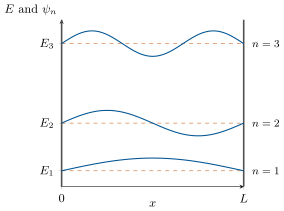
A particle of mass m confined between two impenetrable walls a distance L apart has, like Melde’s string (Chapter 5), only the standing wavesλn=2L/n, hence only the momenta pn=nh/2L and the energies
En=8mL2n2h2,n=1,2,3,…
with wavefunctionsψn(x)∝sin(nπx/L). The energy is quantized; the lowest, the ground stateE1>0, is the confinement energy of the uncertainty principle made exact; the particle jumps between levels by absorbing or emitting a photon of energy hν=Ep−En.
Proof.ψ must vanish at the walls (the particle cannot be there), so the wave fits a whole number of half-wavelengths in L — the string condition; de Broglie gives p, and E=p2/2m. That ψ obeys a wave equation with these boundary conditions is admitted (the Schrödinger equation, Year 2). ∎
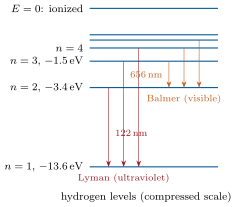
Left: the three lowest states of a particle in a box — the wavefunctions are the standing waves of a string, the energies grow as n2, and the ground state is not at zero. Right: the levels of the hydrogen atom and its two first series of lines; each line is a photon of energy equal to the gap it bridges.
Proposition 30.13(The hydrogen atom)
The electron of the hydrogen atom has the discrete energies
En=−n213.6eV,n=1,2,3,…,
n=1 being the ground state and E≥0 the ionized atom. Its spectrum consists of lines at hν=Ep−En: the Lyman series down to n=1 (ultraviolet, 122nm for 2→1), the Balmer series down to n=2 (visible: 656nm, 486nm, 434nm, …), and so on. Bohr’s model (1913) obtains these energies by quantizing the angular momentum of a circular orbit, mevr=nℏ (Exercise 30.9); the full theory replaces orbits by wavefunctions but keeps the energies.
Proof.Admitted at this level.∎
Example 30.14(Colours from size: the quantum dot)
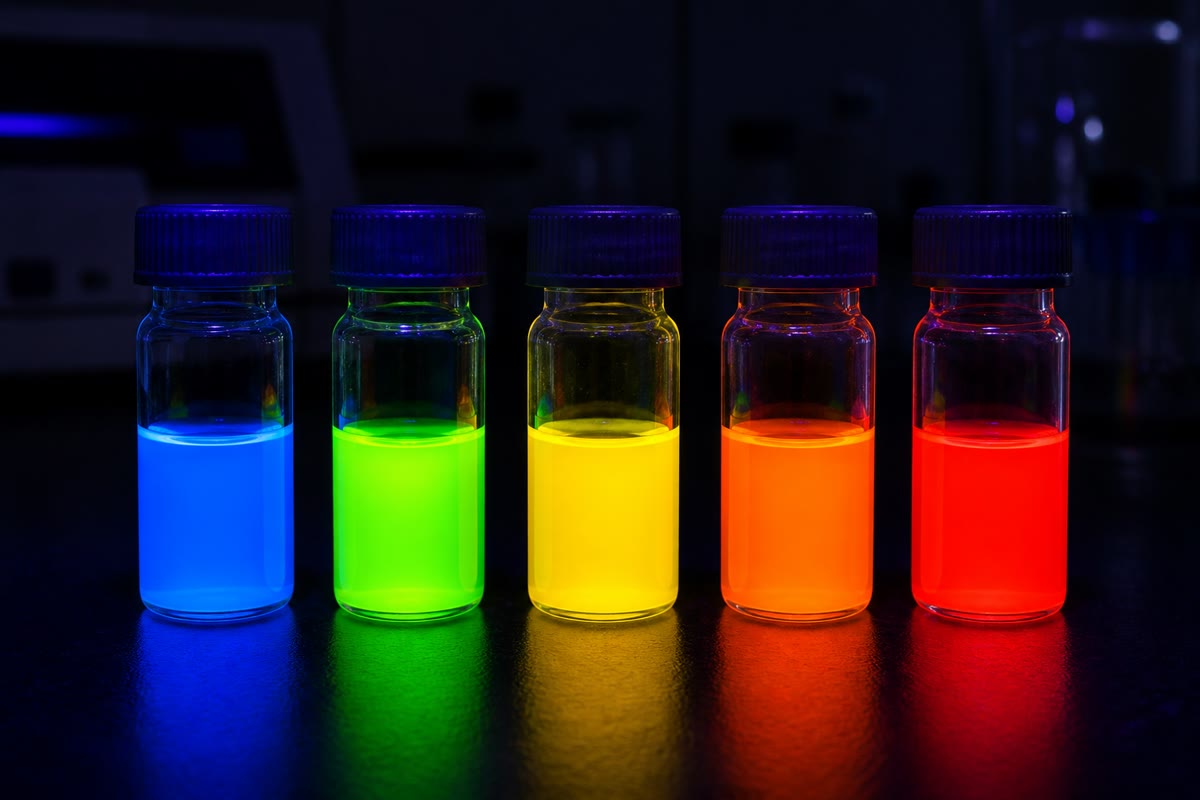
A nanocrystal of semiconductor a few nanometres across confines its electrons like a box: the smaller the crystal, the larger the confinement energy added to the semiconductor’s gap, the bluer the light it emits. Cadmium selenide dots of radius 2nm glow blue, 3nm yellow, 4nm red — one material, colours chosen with a ruler (Problem 30.1). Television screens use them.
Remark 30.15(What the rest of the theory adds)
The Schrödinger equation makes the box, the atom and the molecule exact; it predicts that a particle can cross a barrier it has not the energy to climb (the tunnel effect, behind radioactivity and the scanning tunnelling microscope); that identical particles are either sociable (bosons — hence the laser, where photons pile into one mode) or exclusive (fermions — hence the periodic table and the stiffness of matter); and that the spin of the electron is a magnetic moment with no classical counterpart. All of it is Year 2 and beyond; all of it rests on the few ideas of this chapter.
30.5 Exercises
Exercise 30.1★
Energy of a photon of: radio at 100MHz; light at 500nm; X-rays at 0.10nm; gamma rays of 1MeV (give its wavelength). Number of photons per second from a 1.0mW laser at 633nm.
Solution
Solution of Exercise 30.1.
hν: 100MHz: 6.6×10⁻²⁶ J =4.1×10⁻⁷eV; 500nm: 1240/500=2.5eV; 0.10nm: 12.4keV; 1MeV: λ=1240/106=1.2×10−3nm=1.2pm. Laser: 1240/633=1.96eV=3.1×10−19J, so 10−3/3.1×10−19=3.2×1015 photons per second.
Exercise 30.2★
Sodium, W=2.3eV: threshold wavelength; maximal kinetic energy and stopping potential for 400nm light; what changes if the intensity is doubled? and with 600nm light?
Solution
Solution of Exercise 30.2.
λ0=1240/2.3=540nm. At 400nm, hν=3.1eV: Ek,max=0.8eV, Vs=0.8V. Doubling the intensity doubles the current and leaves Vs unchanged. At 600nm (2.07eV<W): nothing, at any intensity.
Exercise 30.3★
De Broglie wavelength of an electron of 100eV, of 1.0keV; of a neutron of 0.025eV; of a 1g ball at 1m/s. Which of these can be diffracted by a crystal (0.2nm spacing)?
Solution
Solution of Exercise 30.3.
Electron: 1.23/100=0.12nm; at 1keV: 0.039nm. Neutron: E=4.0×10⁻²¹J, p=2mnE=3.7×10⁻²⁴kgm/s, λ=h/p=0.18nm. Ball: 6.6×10⁻³⁴/10−3=7×10−31m. The first three have λ of the order of the atomic spacing and are diffracted (electron, neutron and X-ray crystallography); the ball never.
Exercise 30.4★
An electron in a box of 1.0nm: E1, E2, wavelength of the photon emitted from 2→1. A proton in a box of 5fm (a nucleus): E1 in MeV.
Solution
Solution of Exercise 30.4.
E1=h2/8meL2=4.39×10−67/(8×9.11×10−31×10−18)=6.0×10−20J=0.38eV, E2=4E1=1.5eV; photon 1.13eV, λ=1240/1.13=1.1µm (near infrared). Proton in 5fm: 4.39×10−67/(8×1.67×10−27×25×10−30)=1.3×10−12J=8MeV — the scale of nuclear energies, from confinement alone.
Exercise 30.5★★
Stopping potentials measured for a metal: 0.40V at 6.0×10¹⁴Hz, 1.23V at 8.0×10¹⁴Hz, 2.05V at 1.0×10¹⁵Hz. Deduce h (with e known) and the work function; threshold wavelength; which metal could it be (caesium 2.1eV, potassium 2.3eV, zinc 4.3eV)?
Compton: an X-ray photon of 10pm scatters at 90∘ off an electron. New wavelength; energies of the photon before and after; energy given to the electron. Relative shift for 500nm light — why Compton needed X-rays.
Solution
Solution of Exercise 30.6.
Δλ=2.43pm: λ′=12.4pm. Before: 1240/0.010=124keV; after: 1240/0.0124=100keV; the electron takes 24keV. For light, Δλ/λ=2.4×10−12/5×10−7=5×10−6: unmeasurable in 1923 — X-rays made the shift a 25% effect.
Exercise 30.7★★
Jönsson’s experiment. Electrons of 50keV (use p=2meE), two slits 2.0µm apart, screen at 35cm. Wavelength; fringe spacing; why a magnifying electron lens was needed. In Tonomura’s version one electron at a time crosses the apparatus: what does the screen show after 10, after 105 electrons, and what does that teach?
Solution
Solution of Exercise 30.7.
p=2×9.11×10−31×5×104×1.6×10−19=1.2×10⁻²²kgm/s, λ=5.5pm (relativity corrects it to 5.4pm); fringe spacingλD/d=5.5×10−12×0.35/2×10−6=1µm: invisible to the eye, hence the magnifying lens. Ten electrons: ten dots, apparently at random; 105: the fringes. Each electron lands at one point; the probability of landing follows the two-slit wave — a single electron’s wave goes through both slits.
Exercise 30.8★★
Minimum kinetic energy, from the uncertainty principle, of: an electron confined to 0.1nm (an atom); an electron confined to 5fm (a nucleus — use E≈pc if the result is relativistic, and conclude whether nuclei can contain electrons); a dust grain of 1µg localized to 1µm (give Δv).
Solution
Solution of Exercise 30.8.
Atom: Δp≥ℏ/2Δx=5.3×10−25kgm/s, E∼Δp2/2me=1.5×10−19J≈1eV: the right scale. Nucleus: Δp≥1.1×10⁻²⁰kgm/s; Δp2/2me would be 400MeV, far above mec2, so use E≈Δpc=3×10⁻¹²J=20MeV: no force in the nucleus could hold an electron that energetic — nuclei contain no electrons (beta electrons are created when emitted). Grain: Δv≥ℏ/2mΔx=1.05×10−34/(2×10−9×10−6)=5×10−20m/s: irrelevant.
Exercise 30.9★★
Bohr’s model. Electron on a circular orbit of radius r round a proton: (a) speed and energy as functions of r (Coulomb dynamics, Chapter 16); (b) impose mevr=nℏ and deduce rn=n2a0, En=E1/n2 with a0 and E1 as in Example 30.11; (c) v1 and v1/c; (d) wavelengths of Lyman α (2→1) and of Hα (3→2); (e) show that the orbit n holds exactly nde Broglie wavelengths.
Solution
Solution of Exercise 30.9.
(a) mev2/r=e2/4πε0r2: v=e2/4πε0mer, E=21mev2−e2/4πε0r=−e2/8πε0r. (b) mevr=nℏ and mev2r=e2/4πε0: divide the square of the first by the second: mer=n2ℏ2⋅4πε0/e2, rn=n2a0, and En=−e2/8πε0n2a0=E1/n2 with a0=52.9pm, E1=−13.6eV. (c) v1=ℏ/mea0=2.19×106m/s, v1/c=1/137. (d) 2→1: 43×13.6=10.2eV, 122nm; 3→2: (41−91)×13.6=1.89eV, 656nm. (e) λn=h/mevn=nh/mev1=2πna0 (since mev1a0=ℏ), and 2πrn=2πn2a0=nλn.
Exercise 30.10★★★
Hydrogen-like systems. (a) For a nucleus of charge Ze show En=−Z2×13.6eV/n2 and rn=n2a0/Z: ionization energy of He+ and of the last electron of uranium (Z=92; comment). (b) Muonic hydrogen: the muon has 207 times the electron’s mass: radius and ground energy; wavelength of its Lyman α line; why it is used to measure the size of the proton (radius 0.84fm). (c) Positronium (electron and positron, equal masses): show that the reduced mass halves the energies: its Lyman α.
Solution
Solution of Exercise 30.10.
(a) Replace e2 by Ze2: a0→a0/Z, E1→Z2E1. He+: 54.4eV. U91+: 922×13.6=115keV — but v1=Zαc=0.67c: the non-relativistic model is only indicative there. (b) a0/207=256fm, E1=207×13.6=2.8keV; Lyman α: 2.1keV, λ=0.59nm (X-rays). The muon’s orbit is only 300 proton radii: its levels shift measurably with the proton’s size, which is how the proton radius was re-measured (2010). (c) The two particles orbit their common centre: the reduced massme/2 halves every energy: E1=−6.8eV, Lyman α at 5.1eV, 243nm.
Exercise 30.11★★★
Quantum dots. In a spherical nanocrystal of radius R the confinement energy of a particle of effective mass m∗ is h2/8m∗R2 (admitted). CdSe: gap Eg=1.74eV, me∗=0.13me, mh∗=0.45me (the “hole” left by the excited electron also confines). (a) Emitted photon energy Eg+Ee+Eh and wavelength for R=2.0nm, 3.0nm, 4.0nm; colours. (b) Radius for emission at 520nm (green). (c) Why does bulk CdSe emit at 713nm only? (d) A 10% spread in radius in a batch: spread in wavelength at 3nm.
Solution
Solution of Exercise 30.11.
(a) h2/8me=6.02×10−38Jm2. R=2nm: Ee=6.02×10−38/(0.13×4×10−18)=0.72eV, Eh=0.21eV, total 1.74+0.93=2.67eV, 464nm: blue. 3nm: confinement ×4/9, 2.15eV, 577nm: yellow. 4nm: ×1/4, 1.97eV, 629nm: red. (b) 520nm is 2.38eV: confinement 0.65eV=0.93×(2/R)2, R=2.4nm. (c) No confinement: Eg alone, 713nm. (d) δE=−2×0.1×0.41=−0.08eV, 4% of 2.15eV: about 20nm of spread — pure colours need monodisperse batches.
Exercise 30.12★★★
Zero-point energy. (a) For a harmonic oscillatorE=p2/2m+21mω2x2, take ΔxΔp=ℏ/2 and minimize E≈Δp2/2m+21mω2Δx2 over Δx: show Emin=ℏω/2 (the exact ground energy). (b) The H2 molecule vibrates at ω=8.3×10¹⁴rad/s: zero-point energy in eV, and the lowest temperature at which its vibration is “thermal” (kBT∼ℏω). (c) Liquid helium never freezes at atmospheric pressure: estimate the zero-point energy of a helium atom localized to Δx=0.05nm (a fraction of the interatomic distance) in a crystal, and compare with its binding energy in the solid, about 1meV. (d) Compare the box formula E1=h2/8mL2 with the uncertainty bound for Δx=L/2: which is larger, and why must it be?
Solution
Solution of Exercise 30.12.
(a) E(Δx)=ℏ2/8mΔx2+21mω2Δx2; zero derivative at Δx2=ℏ/2mω, where both terms equal ℏω/4: Emin=ℏω/2. (b) 21×1.055×10−34×8.3×1014=4.4×10⁻²⁰J=0.27eV; T∼ℏω/kB=6300K — at room temperature the vibration is frozen in its ground state. (c) Δp=ℏ/2Δx=1.05×10−24kgm/s, E=Δp2/2mHe=1.1×10−48/1.33×10−26=8×10−23J=0.5meV: half the binding — the atoms cannot sit still enough to crystallize; helium stays liquid down to absolute zero unless squeezed (25bar). (d) E1=π2ℏ2/2mL2 against ℏ2/2mL2: ten times larger, as it must be — the bound is a lower limit, and the box state has Δx≈0.18L, not L/2.
The visible emission spectrum of hydrogen: the Balmer lines at 656nm, 486nm, 434nm and 410nm, each a jump down to n=2.
Quantum dots of one material in vials: the smaller the nanocrystal, the larger the confinement energy and the bluer the light — colour chosen by size.
30.6 Problem: The hydrogen spectrum and a quantum dot
Problem 30.1
Weekend problem — measuring h with light and a voltmeter, building the hydrogen atom from three constants, and choosing the colour of a crystal with its size
Part I — Measuring Planck’s constant. A potassium photocathode is lit with monochromatic light; the stopping potential is measured: 0.30V at 6.0×10¹⁴Hz, 0.69V at 7.0×10¹⁴Hz, 1.13V at 8.0×10¹⁴Hz, 1.50V at 9.0×10¹⁴Hz, 2.36V at 1.1×10¹⁵Hz.
Describe the cell and explain why a reverse voltage can stop the current, and what eVs measures.
Write Einstein’s relation and say what the slope and the intercept of Vs(ν) give.
From the data (a linear fit, or the two extreme points), deduce h; compare with the accepted value.
Work function of potassium in eV; threshold frequency and wavelength; could a red laser pointer extract electrons?
The lamp’s intensity is doubled: what happens to Vs, to the current? Why is this incompatible with a purely wave picture?
Classical estimate: a light of 1µW/m2 falls on the metal; an atom offers an area of about 1×10⁻²⁰m2: how long would it take to accumulate 2.2eV on one atom? What is observed instead?
Bohr’s condition mevr=nℏ: show rn=n2a0 and give a0=4πε0ℏ2/mee2 numerically.
En=E1/n2 with E1=−mee4/[2(4πε0)2ℏ2]; numerical value in eV.
Speed on the first orbit and the ratio v1/c (the fine-structure constant α≈1/137).
Wavelengths of the lines 2→1 (Lyman α), 3→2 and 4→2 (Balmer Hα, Hβ): which are visible?
Show that 1/λ=RH(1/n2−1/p2) and compute the Rydberg constant RH; the shortest Balmer wavelength.
Ionization energy of hydrogen from the ground state; wavelength of the photon that just ionizes it.
De Broglie: show that the circumference of orbit n is n wavelengths — Bohr’s condition is a standing-wave condition.
Two things the model gets wrong, one thing it gets exactly right, and what replaces the orbit in the full theory.
Part III — The quantum dot. A CdSe nanocrystal of radius R confines an excited electron (effective mass me∗=0.13me) and the hole it leaves (mh∗=0.45me); the confinement energy of each in a sphere of radius R is h2/8m∗R2 (admitted); the gap of bulk CdSe is Eg=1.74eV.
Derive the energies En=n2h2/8mL2 of a particle in a one-dimensional box from the standing-wave condition, and comment on the analogy with the sphere formula.
Confinement energies of the electron and of the hole for R=2.0nm.
Energy and wavelength of the emitted photon for R=2.0nm, 3.0nm and 4.0nm; colours.
Explain in one sentence why smaller dots are bluer.
Check the order of magnitude with the uncertainty principle: Δp∼ℏ/R for the electron at R=2nm, and the kinetic energy it implies.
A dot emits 1.0nW at 577nm: photons per second.
Part IV — Counting quanta.
Photons per second from a 1.0mW laser at 633nm.
The dark-adapted eye detects a flash of about 100 photons at 500nm arriving within 0.1s: the corresponding power.
An FM antenna receives 1.0pW at 100MHz: photons per second; is there any hope of detecting them one by one?
Sum up: from h, e, me alone, which three quantities of the atomic world did this problem produce, and with which magnitudes?
Solution
Solution of Problem 30.1.
1. Light frees electrons from the cathode with various energies; held at −Vs, the anode repels them and only those with Ek>eVs arrive. The current vanishes when eVs=Ek,max.
2.eVs=hν−W: slope h/e, intercept −W/e; Vs=0 at the threshold ν0=W/h.
3. Extreme points: (2.36−0.30)/(5.0×1014)=4.12×10−15Vs, h=1.602×10−19×4.12×10−15=6.60×10⁻³⁴Js (a fit on all five gives 6.62): within 0.5% of 6.626×10⁻³⁴.
4.W=hν−eVs=2.47−0.30=2.2eV; ν0=W/h=5.3×1014Hz, λ0=1240/2.2=560nm. A red pointer (650nm, 1.9eV) extracts nothing.
5.Vs unchanged, current doubled: twice the photons, each of the same energy. A wave would give each electron more energy with more intensity, and a threshold in intensity rather than in frequency.
6.10−6×10−20=1×10⁻²⁶W on the atom; 2.2eV=3.5×10⁻¹⁹J takes 3.5×10⁷ s — a year. Emission is observed within nanoseconds: the energy arrives in whole quanta.
14.vn=v1/n, λn=h/mevn=nh/mev1=2πna0 (as mev1a0=ℏ); 2πrn=2πn2a0=nλn: the orbit carries n whole waves — Bohr’s rule is a standing-wave rule.
15. Wrong: the electron has no orbit (it would radiate; the ground state has zero angular momentum) and the model fails for any atom with two electrons. Right: the hydrogen levels, hence every line of its spectrum. The orbit is replaced by a wavefunction, a probability cloud of size ∼n2a0.
16.Standing waves: L=nλ/2, pn=h/λn=nh/2L, En=pn2/2m=n2h2/8mL2. The sphere formula is the same with L→R: the ground state fits half a wavelength in the radius.
19. The confinement energy grows as 1/R2: a smaller box lifts the levels, the photon is more energetic, the light bluer.
20.Δp∼ℏ/R=5.3×10−26kgm/s, E∼Δp2/2me∗=1.2×10−20J=0.07eV: the right order (the exact coefficient π2/2 and the cruder Δp account for the factor ten).
21.1240/577=2.15eV=3.4×10−19J: 10−9/3.4×10−19=2.9×109 photons per second.
22.10−3/(1.96×1.6×10−19)=3.2×1015 per second.
23.100×2.48×1.6×10−19=4×10⁻¹⁷J in 0.1s: 4×10⁻¹⁶W.
24.hν=6.6×10⁻²⁶J: 1.5×10¹³ photons per second — and each is 105 times smaller than the thermal energy kBT of the antenna: no hope, and no need; the wave picture is exact there.
25. The size of atoms, a0=53pm; their energy scale, 13.6eV (hence eV photons, chemistry, the visible spectrum); and the speed of their electrons, αc≈2×10⁶m/s — all three from h, e and me (and ε0), with nothing adjusted.