University Biology — Year 1 · Bachelor Year 1
23Plant Water and Mineral Nutrition
A maize plant in July draws a litre of water a day out of soil that feels dry to the hand, and with it the thirty milligrams of nitrogen, as nitrate, that it needs to build a day’s growth. It has no pump. The water enters because the root is drier than the soil, in the precise sense of Chapter 7; the nitrate enters because the root cells spend ATP to make it; and both must pass a single layer of cells whose walls are sealed with wax before they reach the xylem. This chapter describes the root as an absorbing organ, the water potentials that drive water from soil to xylem, the mineral elements a plant needs and how it takes them up, the special case of nitrogen, and the fungi and bacteria that most roots employ to do part of the work.
23.1 The root as an absorbing organ
Definition 23.1 (Apoplast, symplast, endodermis)
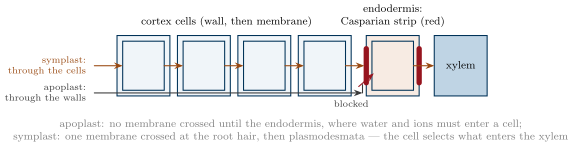
Water and solutes cross the root cortex by two routes: the apoplast, the continuous system of cell walls and intercellular spaces, through which they move without crossing any membrane; and the symplast, the continuous cytoplasm of the cells connected by plasmodesmata (Chapter 6), entered by crossing one plasma membrane. At the inner boundary of the cortex the endodermis (Chapter 3) blocks the apoplast: a band of suberin and lignin, the Casparian strip, impregnates its radial walls, so that everything entering the vascular cylinder must pass through an endodermal cell’s membrane. The membrane’s transporters thus decide what reaches the xylem, and prevent what has been loaded into the xylem from leaking back.
Proposition 23.2 (Root pressure)
The endodermis and the cells within it pump ions into the xylem, which lowers the xylem’s water potential and draws water in osmotically from the cortex; when the shoot transpires little (at night, in humid air), the water accumulates and the xylem sap is pushed upward under a positive root pressure of a few tenths of a megapascal — enough to force droplets out of the leaf tips of small plants (guttation) and to refill air-blocked vessels, but not enough to lift sap to the top of a tree. By day the pull of transpiration (Chapter 24) takes over and the root pressure vanishes.
Evidence. A stem cut near the ground exudes sap for hours from its stump, and a manometer attached to the stump registers a pressure of ; the exudate is richer in ions than the soil solution, and its flow stops when the roots are cooled or poisoned with an inhibitor of respiration: the flow is driven by active ion loading, not by any pumping of water. ∎
23.2 Water: from soil to xylem
Proposition 23.3 (The water-potential ladder)
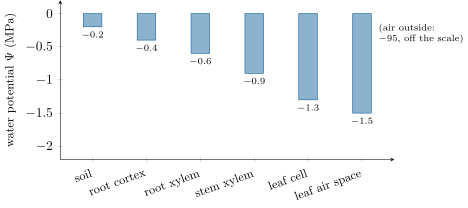
Water moves from soil to xylem because the water potential (Chapter 7) falls at each step:
| compartment | () |
|---|---|
| moist soil | to |
| soil at the wilting point | |
| root cortex cell | to |
| root xylem | to |
| leaf cells | to |
| air at relative humidity |
The soil’s potential is set mostly by the tension with which its pores hold water (capillarity); the cells’ by their solutes and their turgor; the xylem’s by the tension of the transpiring column; the air’s by its humidity, , which is enormous even in humid air. The steepest step by far is the last, from leaf to air: that is where nearly all the driving force is spent, and why plants control it with stomata.
Method 23.4 (Reading a water-potential profile)
- List the compartments in order and their ; water flows only from higher to lower, so the sequence must decrease along the path or the flow reverses.
- Split each cell’s into (solutes, negative) and (turgor, positive); a root cell at with has . Xylem water has and negative : it is under tension.
- The flow across a step is the difference of times the hydraulic conductance of the barrier; the endodermis and the stomata are the two steps of low conductance where the plant regulates.
- Dry the soil and its falls; when it reaches the leaf’s, flow stops and the plant wilts; when the leaf cells’ reaches zero the leaf hangs. Recovery needs the soil, not the plant, to change.
Example 23.5 (A litre a day)
A maize plant’s fine roots offer some of surface with a hydraulic conductance of about ; between soil at and root xylem at the flux is — a litre and a half a day, all of it lost from the leaves. The root does no work to move it: the leaf’s transpiration sets the tension, and the soil supplies the water as long as its potential stays above the root’s.
23.3 Mineral nutrition
Definition 23.6 (Essential elements)
An element is essential to a plant if the plant cannot complete its life cycle without it and no other element can replace it. Seventeen are: carbon, hydrogen and oxygen from air and water; the macronutrients taken from the soil in grams per kilogram of dry mass — nitrogen (as nitrate or ammonium), phosphorus (phosphate), potassium, calcium, magnesium, sulfur (sulfate); and the micronutrients needed in milligrams or less — iron, manganese, zinc, copper, boron, molybdenum, chlorine, nickel. Nitrogen builds proteins and nucleic acids; phosphorus, nucleotides and membranes; potassium is the cell’s main cation and the osmotic agent of stomata; magnesium sits in chlorophyll; iron in the cytochromes and ferredoxin; molybdenum in nitrate reductase and nitrogenase.
Proposition 23.7 (How the list was made)
The essential elements were identified by growing plants in water containing known salts only.
Evidence. Sachs and Knop (1860s) grew plants to maturity in solutions of a few mineral salts, with no soil at all, proving that soil supplies nothing but minerals and support; leaving out one salt at a time gave a characteristic sickness for each element, and adding it back cured it. The micronutrients were found later, as chemists learned to purify the salts: a plant deprived of molybdenum, needed at one part in ten million, fails to reduce nitrate. The technique, hydroponics, now feeds greenhouses. ∎
Method 23.8 (Reading a deficiency)
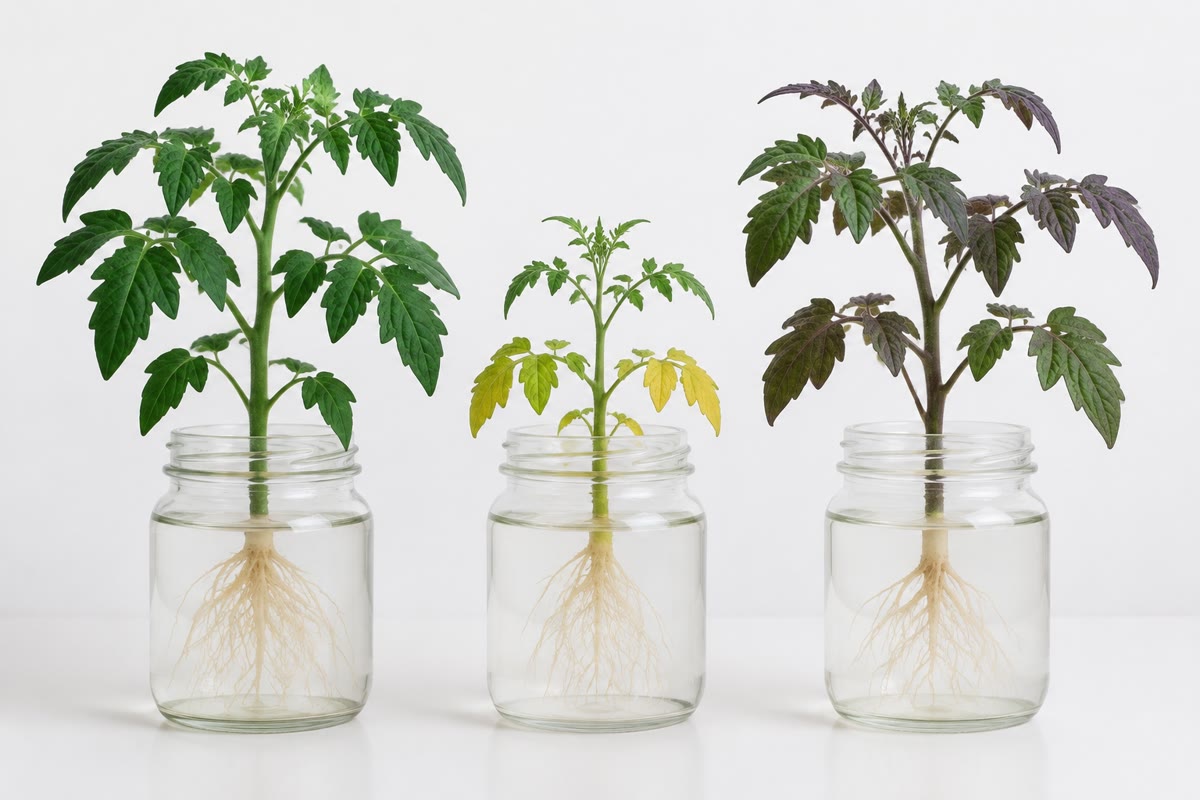
- Ask where the symptom appears. Elements the plant can move in the phloem (N, P, K, Mg) are withdrawn from old leaves to feed young ones: the old leaves show the deficiency first. Elements it cannot move (Ca, Fe, B) are stranded where they were laid down: the young leaves and growing tips show it.
- Ask what the element does: no nitrogen, little chlorophyll and protein — pale, stunted; no magnesium or iron, chlorophyll fails — yellow leaves with green veins; no potassium, the leaf margins scorch; no calcium, the growing tips die.
- Confirm by supplying the suspected element alone and watching the new growth.
Proposition 23.9 (Active uptake of ions)
The soil solution holds ions at micromoles to a few millimoles per litre; the root cells hold potassium at , phosphate at , nitrate at several. Uptake is therefore mostly uphill and paid for with ATP, but indirectly: a proton pump in the plasma membrane (Chapter 7) exports , making the outside acid and the inside negative by ; cations such as then enter through channels down the electrical gradient, and anions (, , ) by symporters that ride protons back in. Transporters are selective: potassium is taken up a hundred times more readily than sodium of the same charge and nearly the same size, and the plant holds sodium out even in salty soil. Roots use a third of the plant’s respiration on this transport.
23.4 Nitrogen
Proposition 23.10 (Nitrate to amino acid)
Most plants take nitrogen as nitrate. In the cytosol nitrate reductase, a molybdenum enzyme, reduces it to nitrite with electrons from NADH; in the plastid nitrite reductase reduces nitrite to ammonium with electrons from ferredoxin; and ammonium is fixed at once into glutamine and glutamate (Chapter 16) — ammonium itself is toxic and never accumulates. The whole reduction costs eight electrons per nitrogen, a tenth of a leaf’s photosynthetic electron flow on a nitrate-rich soil, and a leaf does much of it in the light, straight from the chloroplast’s ferredoxin. Ammonium, where the soil offers it, is taken up directly and skips the cost.
Definition 23.11 (Nitrogen fixation and nodules)
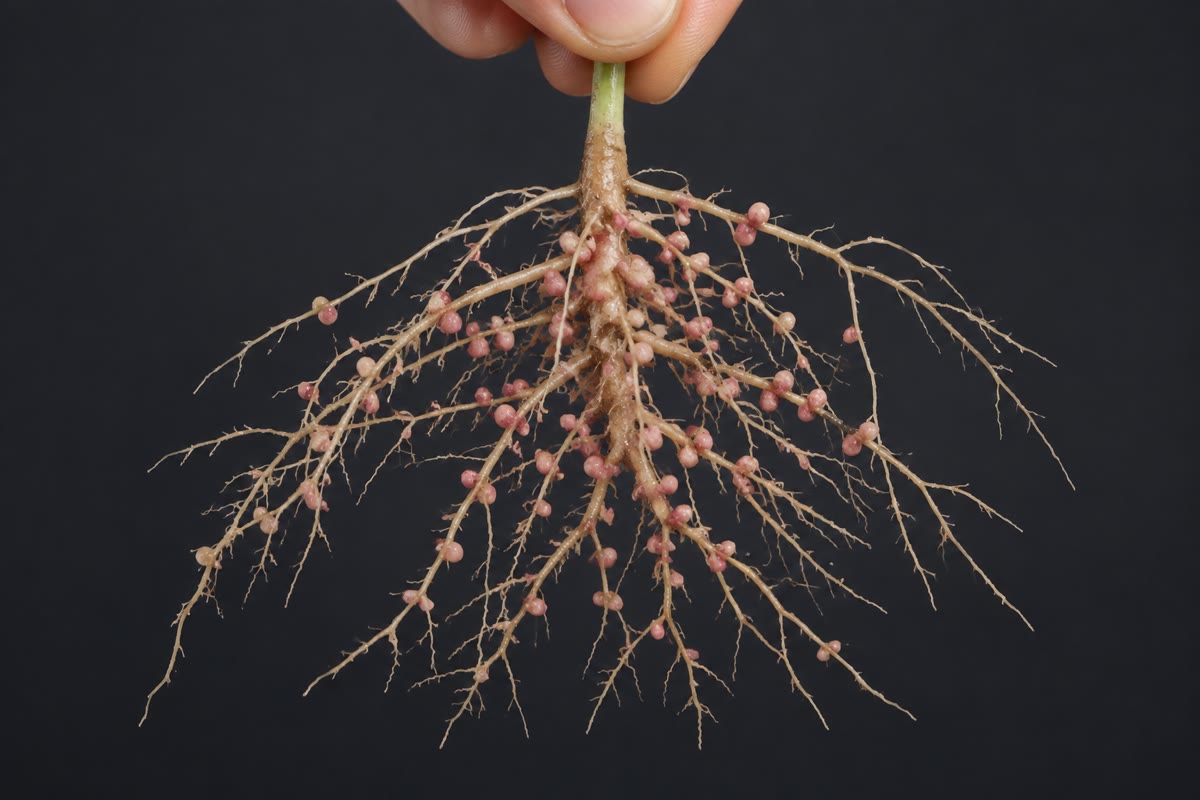
No eukaryote can use the of the air. Some bacteria can: nitrogenase breaks the triple bond of and reduces it to two ammonia, at a cost of sixteen ATP and eight electrons per molecule, and only where oxygen is excluded. Legumes (peas, beans, clover) house such bacteria (Rhizobium) in root nodules: the plant builds a chamber, feeds the bacteria sugar, and keeps the oxygen low with a red protein, leghaemoglobin, that delivers it to the bacteria’s respiration at a concentration too low to harm the enzyme; the bacteria give back ammonium, which the plant turns into amino acids. A field of clover fixes a hundred kilograms of nitrogen per hectare a year, for which the plant pays a tenth of its photosynthesis. The nitrogen cycle as a whole belongs to the Year 2 volume.
Example 23.12 (The price of nitrogen)
A maize plant needs about of nitrogen a day; from nitrate at it gets that in the litre of water it transpires, and spends a few hundred millimoles of electrons reducing it. A clover plant fixing the same amount pays ATP per plus the reductant — roughly of sugar per gram of nitrogen, some a day, a tenth of its production — and can grow on soil with no nitrate at all. Farmers have rotated legumes with cereals for two thousand years to move that nitrogen from one field to the next.
23.5 Partners in the soil
Definition 23.13 (Mycorrhiza)
A mycorrhiza is an association between a root and a fungus, found in nine plants out of ten. In the commonest form the fungal hyphae grow into the cortex cells and branch inside them into arbuscules, the exchange surface, while outside the root a network of hyphae a few micrometres across explores the soil for metres. The fungus delivers phosphate and other poorly mobile ions, and water, that the root’s own hairs could not reach; the plant delivers sugar, a tenth or more of its photosynthesis. Trees of temperate forests carry a second form, in which the fungus sheathes the root tips and threads between the cells; its fruiting bodies are the mushrooms of the forest floor.
Evidence. Seedlings grown in sterilised soil grow poorly and take up little phosphate; inoculated with spores of the fungus, they grow several times larger. Radioactive phosphate placed in soil beyond the reach of the roots appears in the plant only if hyphae connect the two, and labelled carbon fed to the leaves appears in the hyphae within a day. Cutting the hyphae with a fine mesh that lets solutes but not fungi pass abolishes the gain. ∎
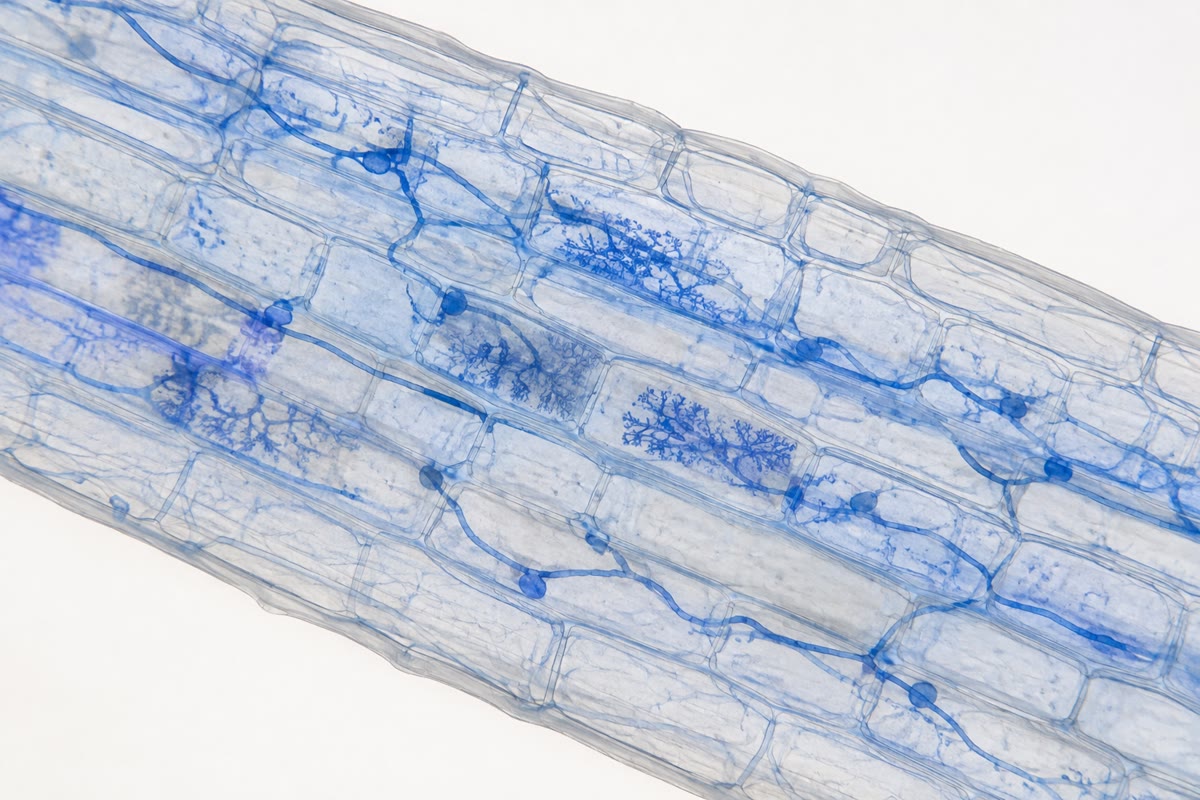
Example 23.14 (Why phosphate needs a fungus)
Phosphate binds to soil particles and diffuses a millimetre in a day; a root hair takes up all the phosphate within reach in hours and then waits. Hyphae a tenth as thick as a root hair reach ten times farther per gram of tissue, and a metre of hypha costs the plant a thousandth of what a metre of root does. For nitrate, which moves freely with the soil water, the root’s own hairs suffice, and plants on nitrate-rich soils reduce their fungus; for phosphate, the fungus is the root’s extension.
23.6 Exercises
Exercise 23.1 ★
Define apoplast and symplast, and say what the Casparian strip does.
Solution
Solution of Exercise 23.1.
Apoplast: the continuous walls and spaces, crossed without passing a membrane. Symplast: the connected cytoplasm of the cells, entered through one membrane and continued through plasmodesmata. The Casparian strip blocks the apoplast at the endodermis, forcing everything through a membrane and preventing back-leakage from the xylem.
Exercise 23.2 ★
List the six macronutrients a plant takes from the soil and one role of each.
Solution
Solution of Exercise 23.2.
N (proteins, nucleic acids), P (nucleotides, membranes), K (osmotic agent, stomata), Ca (walls, signalling), Mg (chlorophyll), S (amino acids cysteine and methionine).
Exercise 23.3 ★
From the water-potential figure, read in the soil, the root xylem and the leaf cell, and state the direction of flow at each step.
Exercise 23.4 ★
Why do nitrogen deficiency and iron deficiency show on different leaves?
Exercise 23.5 ★★
A root cortex cell has and ; the soil is at , the xylem at . Show that water flows from soil to cell to xylem, and compute the cell’s at which it would stop taking up water from this soil.
Exercise 23.6 ★★
Compute the water potential of air at , and relative humidity at (). Compare with the soil at the wilting point and comment.
Solution
Solution of Exercise 23.6.
: , , . Even humid air is ten times drier, in this sense, than soil at the wilting point: a leaf always loses water to air; the only question is how fast.
Exercise 23.7 ★★
A root cell at takes up from to . Compute the Nernst potential for this ratio at and say whether channels alone can do it. Repeat for nitrate at outside and inside.
Solution
Solution of Exercise 23.7.
: at the cell is slightly less negative than needed, so a thousandfold accumulation needs a little more than channels — but a ratio of 100 would be at equilibrium: channels do nearly all of it. Nitrate: ; the cell is at , away and in the wrong direction: an anion must be pumped in, by proton symport.
Exercise 23.8 ★★
Explain why guttation is seen at dawn on grass but never on a tall tree, and what happens to root pressure when transpiration begins.
Solution
Solution of Exercise 23.8.
At night, with no transpiration, ion loading into the xylem draws water in and a root pressure of a few tenths of a megapascal pushes sap up a few metres at most — enough to reach the tips of grass blades and force droplets out, not to reach the top of a tree. When the stomata open, transpiration puts the xylem under tension and root pressure disappears.
Exercise 23.9 ★★
A plant is transferred to a solution lacking molybdenum. Predict its growth on nitrate and on ammonium, and explain the difference.
Solution
Solution of Exercise 23.9.
Without molybdenum nitrate reductase does not work: on nitrate the plant cannot make amino acids and shows nitrogen deficiency though nitrate is abundant. On ammonium it grows normally, since ammonium enters the amino acids without reduction. The difference locates the element in one enzyme.
Exercise 23.10 ★★★
Compute the electrons needed to reduce of nitrate nitrogen to ammonium per day, and the NADPH-equivalents; compare with the electrons a maize leaf of moves through its photosystems in a day at per square metre per second (4 electrons per , ).
Solution
Solution of Exercise 23.10.
of N ; of electrons, of NADPH-equivalents. Leaf: of , of electrons: nitrate reduction takes half as many electrons as carbon fixation on this reckoning — a large fraction, which is why plants do it in the light and why fast-growing leaves are heavy consumers of reductant.
Exercise 23.11 ★★★
A clover fixes of nitrogen a day at ATP and electrons per , and of sugar per gram of nitrogen overall. Compute the ATP spent by nitrogenase alone, the sugar it would cost (30 ATP per glucose), and the fraction of the that this represents. Where does the rest go?
Solution
Solution of Exercise 23.11.
of N of : ATP , i.e. of glucose, ; plus 8 electrons per (another of glucose). The rule gives a day: nitrogenase itself is most of it, and the rest is building and maintaining the nodules, their leghaemoglobin, and the bacteria’s own respiration to keep oxygen low.
Exercise 23.12 ★★★
“A root is a mining operation that hires contractors.” Discuss in a paragraph: what the root does itself (water, mobile ions), what it contracts out (phosphate, fixed nitrogen), what it pays, and when it stops paying.
Solution
Solution of Exercise 23.12.
The root itself takes water and the mobile ions (nitrate, potassium) that the soil water brings to its hairs, spending ATP only on the proton pump. For phosphate, which will not come to it, it pays a fungus in sugar to extend its reach; for nitrogen in a soil without nitrate it pays bacteria in sugar to fix it. The fee is a tenth or more of its photosynthesis, and the plant stops paying when the service is not needed: on phosphate-rich soil mycorrhizae are reduced, on nitrate-rich soil legumes make fewer nodules — contractors are kept only while they are cheaper than doing the job alone.
23.7 Problem: The Water-Potential Ladder of a Maize Root
Problem 23.1
Weekend problem — water and nitrate from a July soil into a maize plant: potentials at each step, the flux through the roots, the nitrogen it carries and the cost of reducing it, ending on the daily water flux into the root
A maize plant in July: fine-root surface , hydraulic conductance of the root ; leaf area . Soil water potential ; root cortex cells with and ; root xylem ; leaf cells ; air at relative humidity (). Soil nitrate ; the plant needs of nitrogen a day. Nitrate reduction to ammonium uses 8 electrons per nitrogen; photosynthesis moves 4 electrons per and the leaf fixes of per square metre per second for .
Part I — The ladder.
- Compute the water potential of the root cortex cells.
- Write the sequence soil, cortex, xylem, leaf, and verify that water flows inward and upward at each step.
- Compute the water potential of the air.
- Compute the drop from soil to leaf and the drop from leaf to air; what fraction of the total is the last step?
- The soil dries to . What happens to the flow into the cortex cells, and to their turgor?
- The soil dries to . What happens to the leaves, and why does watering restore them?
Part II — The flux.
- Compute the water flux into the roots (conductance surface the difference between soil and root xylem).
- Convert it to litres per day.
- All of it is lost by transpiration. Compute the transpiration per square metre of leaf per hour, in grams.
- Express the transpiration per square metre of leaf per second in millimoles of water ().
- The stomata close at midday and the leaf’s rises to while the xylem’s rises to . Recompute the flux. What has the plant done, and why?
- Why does the root take up water without spending energy, while it must spend energy to take up nitrate?
Part III — Nitrogen.
- Compute the nitrate carried into the root by the water flux of question 8, in millimoles and in milligrams of nitrogen.
- Does it cover the plant’s need? What happens to the balance?
- The root accumulates nitrate to in its cells. Compute the free energy of moving one mole from outside to inside against a membrane potential of (; an anion entering a negative cell).
- The uptake is a symport with two protons. Compute the free energy two protons release entering a cell at from pH 5.5 to pH 7.5, and check it suffices.
- Compute the electrons needed per day to reduce the of nitrogen to ammonium.
- Compute the electrons the leaf moves through its photosystems per day, and the fraction diverted to nitrate.
Part IV — Alternatives.
- If the soil offered ammonium instead of nitrate, what would the plant save, and what problem would ammonium uptake create for its pH balance?
- A clover fixes the same of nitrogen a day. With ATP and electrons per , compute the ATP spent by nitrogenase per day.
- At of sugar per gram of nitrogen fixed overall, compute the clover’s daily cost in sugar and compare it with a production of of sugar per day. Is the bargain worth it in a soil of nitrate? In a soil with none?
- Phosphate is at in the soil solution. Compute the phosphate the water flux of question 8 brings in, and compare with a need of of phosphorus a day (). What must the plant rely on?
- Explain in two sentences how the Casparian strip lets the root keep nitrate at in its xylem while the soil is at .
- A mutant lacks the Casparian strip. Predict the composition of its xylem sap and its behaviour in salty soil.
- State the result: the water flux into the maize root per day, the nitrogen it delivers, and the fraction of the leaf’s electrons spent reducing it.
Solution
Solution of Problem 23.1.
1. . 2. : each step lower, water moves soil cortex xylem leaf. 3. . 4. Soil to leaf ; leaf to air : of the total is the last step. 5. Soil at is below the cortex cells’ : water leaves the cells until they fall to , i.e. their turgor drops to zero; uptake stops until the cells lower their by accumulating solutes. 6. The soil is now below the leaves’ : water flows out of the plant; the leaves lose turgor and wilt. Watering raises the soil’s above the root’s and the flow resumes; the leaves, whose walls were intact, refill. 7. . 8. per day. 9. over and of daylight (most of it): about per square metre per hour. 10. per square metre per hour, per square metre per second — a thousand water molecules for every fixed at . 11. Difference : flux halved, a day. Closing the stomata has cut the loss, the tension has relaxed, and the whole ladder has risen: the plant trades carbon gain for water when the air is driest. 12. Water moves down its own potential gradient, created by the leaf’s evaporation, so the root is passive; nitrate must be concentrated against both a concentration and an electrical gradient, which only coupling to the proton pump can pay for. 13. , of nitrogen. 14. Yes, with a third to spare; the surplus is stored in the vacuoles as nitrate or excluded at the endodermis. 15. . 16. Per proton: ; two protons: , three times what is needed. 17. of electrons. 18. of , of electrons: to nitrate. 19. It would save the 8 electrons per nitrogen; but taking up a cation and releasing a proton for each acidifies the soil around the root and the cell must export acid, and ammonium is toxic if it accumulates, so it must be assimilated at once in the root. 20. of of ATP. 21. of sugar, of . With of nitrate available for the cost of its reduction ( of the electrons), fixation is a poor bargain and a legume makes few nodules; with no nitrate it is the only way, and of production is cheap for the whole of the plant’s protein. 22. , of phosphorus — a fortieth of the need; the plant must rely on diffusion to its root hairs, which soon exhaust their surroundings, and above all on its mycorrhizal fungus. 23. The strip blocks the apoplast, so nitrate can enter the xylem only through endodermal membranes that pump it inward; and it prevents the concentrated xylem sap from leaking back out along the walls, so the gradient is held. 24. Its xylem sap would resemble the soil solution — dilute, unselected, with sodium and other unwanted ions — and could not be kept concentrated; in salty soil sodium would reach the leaves freely and the plant would be poisoned, where a normal plant excludes it at the endodermis. 25. About of water a day through of root, carrying of nitrogen against a need of , whose reduction takes about of the leaf’s photosynthetic electrons.