书籍暂未推出简体中文版——当前显示英文版。
University Earth and Space Sciences — Year 3 · 本科三年级
12Trace-Element Modelling
Two basalts erupted on the same island a few kilometres apart. One holds over one and a half times as much lanthanum as the other, and nearly four times less ytterbium. Did they melt from two different mantles, or from one mantle melted by different amounts, or at different depths? The major elements barely tell: both are basalts. The trace elements, which follow the minerals without changing them, keep a record of how much melt was made, how it left its source and which minerals stayed behind. This chapter writes that record as equations and reads it back.
You already know
The mineral–melt partition coefficient , the bulk partition coefficient, compatible and incompatible elements, the rare earth elements, the CI chondrite and the primitive mantle, normalised diagrams and the europium anomaly, MORB and OIB are in the Year 2 volume, in its chapter on elements in the Earth. Peridotite, lherzolite, partial melting and the melt fraction are in its chapter on melting the mantle; equilibrium and fractional crystallisation, the Rayleigh fractionation law, mixing and assimilation–fractional crystallisation (AFC), in its chapter on magmatic differentiation. There the constancy of the ratio of two very incompatible elements during crystallisation was proved.
12.1 The bookkeeping of a melting rock
A rock of mass 1 melts. At the melt fraction it has made a mass of melt and kept a mass of solid residue. A trace element present at the concentration in the source is shared between them; its concentration in the melt is , in the residue . Every model of this chapter is a form of one balance, for the whole melt and residue, and a rule that links to : at the contact between a crystal and the melt, . The models differ in what touches what, and when.
The partition coefficients of the minerals of the mantle differ widely. In one compilation, lanthanum has in clinopyroxene and in garnet and in olivine, orthopyroxene and spinel; ytterbium has in clinopyroxene, in garnet and in the other three. Garnet takes the heavy rare earths and rejects the light ones.
Definition 12.1 (Non-modal melting)
In non-modal melting, the minerals of the source enter the melt in proportions that differ from their mass fractions in the source. The melt then sees the bulk partition coefficient of the source, , at the start and the melting-weighted coefficient as it grows.
Melting is seldom modal. In one worked example of a spinel lherzolite of olivine, orthopyroxene, clinopyroxene and spinel, the minerals enter the melt in the proportions 20, 25, 45 and : clinopyroxene melts four times faster than its share, olivine three times slower.
Proposition 12.2 (Bulk partition coefficient of the residue)
In non-modal melting at constant , the residue at the melt fraction has the bulk partition coefficient
valid while every mineral remains, that is for for each .
Proof. Per unit mass of source, the mass of mineral left at is , and the residue has mass . Its bulk coefficient is the mass-weighted mean, . A mineral is exhausted when . ∎
With the mineral coefficients above, a spinel lherzolite of the worked example, and a garnet lherzolite held at and in the laboratory, of olivine, orthopyroxene, clinopyroxene and garnet by mass, have the bulk coefficients below.
| source | |||
|---|---|---|---|
| spinel lherzolite | 0.0078 | 0.062 | 0.21 |
| garnet lherzolite | 0.012 | 0.107 | 0.97 |
Lanthanum is very incompatible in both. Ytterbium is moderately incompatible in the spinel lherzolite and nearly neutral in the garnet lherzolite. The difference between the two sources lies almost entirely in the heavy rare earths.
12.2 Batch melting
Theorem 12.3 (Batch melting)
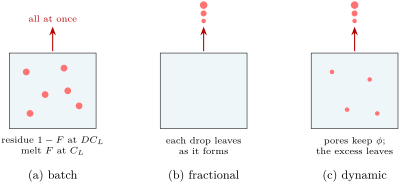
In batch melting, the melt stays in equilibrium with the whole residue until it leaves in one batch. With a constant bulk partition coefficient , the melt and the residue at the melt fraction have
Proof. At equilibrium every crystal of the residue holds , so the residue holds on average. The balance gives , and follows. ∎
The formula is the equilibrium crystallisation law of the Year 2 volume read backwards: in both, is the fraction of liquid in a closed system. Its two limits are worth knowing. As , : the first drop of melt can enrich an element at most by the factor . As , : a perfectly incompatible element is diluted into the melt, and its enrichment measures alone. For a compatible element, , the melt is poorer than the source, and the more so the smaller .
Proposition 12.4 (Non-modal batch melting)
In batch melting with the melting proportions of Definition 12.1,
Proof. The residue holds (Proposition 12.2), so . ∎
When exceeds , as for lanthanum in the worked example, where and , the residue loses its best host, clinopyroxene, faster than the rest. The melt is then a little richer than modal melting predicts, by under at for lanthanum (exercise 6), but the residue runs out of clinopyroxene at , and beyond that the minerals and coefficients change.
12.3 Fractional and dynamic melting
Melt in a peridotite gathers along grain edges and can escape as soon as it is connected. The opposite end member to batch melting removes every drop as it forms.
Theorem 12.5 (Fractional melting)
In fractional melting, each increment of melt is in equilibrium with the residue only at the moment it forms, and then leaves it. With a constant , after a total mass of melt has been extracted, the residue and the melt forming at that moment have
Proof. The residue has mass and concentration . When a mass of melt leaves at , the element in the residue falls by . Expanding, , so . Integrating from at gives , and . ∎
For an incompatible element, is large and positive: the residue is stripped within a few times of melting, and the instantaneous melt falls from to almost nothing. A residue of fractional melting is far more depleted than one of batch melting. The melts are not erupted one by one, though: they gather in channels and pool, and the pooled melt, defined below, is drawn dashed in the figure.
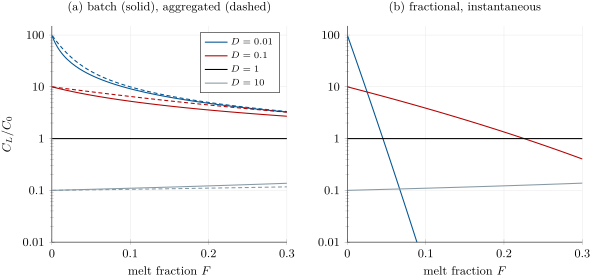
Definition 12.6 (Aggregated fractional melt)
The aggregated fractional melt is the mixture of all the instantaneous melts of a fractional melting from to , pooled without further reaction with the residue.
Proposition 12.7 (Composition of the aggregated melt)
With a constant , the aggregated fractional melt has
Proof. The element extracted is the source minus the residue, by Theorem 12.5, spread over a mass of melt. ∎
Once is small, the aggregated melt holds the whole of the element and , whatever : for very incompatible elements, pooled fractional melts and batch melts with small agree, and both measure .
Real melting lies between the two end members. A residue keeps some melt in its pores, and the melt that leaves is the excess above that porosity.
Definition 12.8 (Dynamic melting)
In dynamic melting (also called continuous melting), the residue keeps a constant mass fraction of melt in its pores, in equilibrium with its crystals, and every melt produced beyond it is extracted.
Proposition 12.9 (Dynamic melting)
Dynamic melting with porosity is fractional melting with the effective partition coefficient , where is the mass fraction of melt extracted:
Proof. The residue is crystals with the fraction and pore melt with the fraction , both in equilibrium with the melt at , so it holds . The proof of Theorem 12.5 then applies with . ∎
For the model is fractional melting; for it approaches batch melting. A porosity of one per cent caps the enrichment of the first melt at , however small : the pore melt buffers the residue.
12.4 Melting, then crystallisation
A melt that leaves its source rarely erupts unchanged. It crystallises olivine, then pyroxene and plagioclase on its way up, it may assimilate wall rock, and it may mix with other batches. The laws of the Year 2 volume apply in turn: a lava is a melt of fraction of its source, then a liquid that has kept a fraction of its mass through fractional crystallisation, so that, for an element with in the melting residue and in the crystallising minerals,
The second factor is the same for every element that the crystallising minerals reject, : it scales them all by . Ratios of such elements are therefore set at the source, and a lava that has lost olivine keeps the La/Yb of its primary melt while its lanthanum rises. Inverting from a concentration needs as well; inverting the source from a ratio does not. Plagioclase is the exception among the rare earths: it takes europium, and its removal leaves the europium anomaly of the Year 2 volume.
12.5 Reading rare earth patterns
A melt of a spinel lherzolite and a melt of a garnet lherzolite share their light rare earths, which neither residue keeps, and differ in the heavy ones, which garnet holds. On a chondrite-normalised diagram the garnet melts are steep and flat-bottomed at the heavy end; the spinel melts are gentler. The steepness grows as falls.
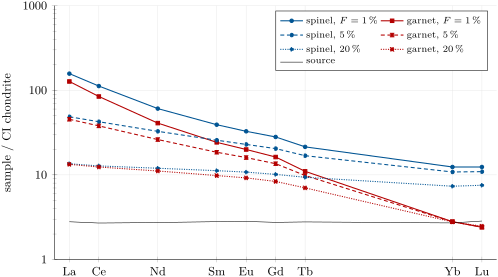
Garnet gives way to spinel as the aluminous mineral of the mantle at about 60 to depth. A melt whose heavy rare earths are flat and low, with a steep light-to-heavy slope, has therefore left garnet in its residue and began to melt at least that deep.
A pattern mixes two unknowns, and the source. Plotting two elements against each other separates them.
Definition 12.10 (Ratio–ratio diagram)
A ratio–ratio diagram plots, for a suite of lavas, the ratio of a highly incompatible element to a less incompatible one against the concentration of (or against another ratio). Partial melting, crystallisation and mixing draw lines of different shapes on it.
Proposition 12.11 (The batch melting line)
For batch melts of one source with and a constant , the points lie on the straight line
Proof. With , , so . Then , and the first term is . ∎
Fractional crystallisation of minerals that reject both elements moves a lava horizontally on this diagram, since the ratio does not change; melting moves it along a sloping line whose slope grows with ; mixing of two melts draws a hyperbola. A source with garnet has a large , hence a steep melting line in La/Yb against La.
Method 12.12 (Inverting two lavas)
(1) Check that the lavas are cogenetic and that is far more incompatible than . (2) Correct each lava for crystallisation, or use only ratios. (3) Through two or more lavas, fit the line . (4) Then and : with assumed, and . (5) Each lava’s melt fraction is .
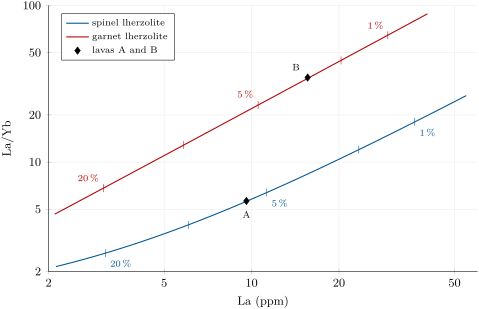
On logarithmic axes the straight line of the proposition bends, and with it is only nearly straight on linear axes; the curves of the figure are exact. A spinel source cannot make a melt with La/Yb above , about 40 for the primitive mantle; a garnet source can reach about 120.
12.6 Exercises
Exercise 12.1 ★
With the mineral coefficients of samarium, 0.40 in clinopyroxene, 0.11 in garnet and 0.016 in olivine, orthopyroxene and spinel, compute the bulk partition coefficient of samarium in the spinel lherzolite ( clinopyroxene) and in the garnet lherzolite ( clinopyroxene, garnet) of the chapter.
Solution
Solution of Exercise 12.1.
Spinel lherzolite: . Garnet lherzolite: .
Exercise 12.2 ★
An element with is present at in a source. Compute its concentration in batch melts at and .
Solution
Solution of Exercise 12.2.
; .
Exercise 12.3 ★
What is the largest enrichment that batch melting can give to an element with ? And to an element with at ?
Solution
Solution of Exercise 12.3.
The enrichment is largest as : . With , .
Exercise 12.4 ★
A lava holds La and Yb. With the CI chondrite values La 0.232 and Yb , compute its La/Yb and its chondrite-normalised .
Solution
Solution of Exercise 12.4.
; .
Exercise 12.5 ★★
For an element with , compare the residues after of batch melting and of fractional melting. What does the instantaneous fractional melt hold at that moment?
Solution
Solution of Exercise 12.5.
Batch: . Fractional: , 27 times lower. The instantaneous melt holds : less than the source.
Exercise 12.6 ★★
In the worked example of the chapter (modes 58, 27, 12, ; melting proportions 20, 25, 45, for olivine, orthopyroxene, clinopyroxene and spinel), lanthanum has the coefficients 0.0003, 0.002, 0.053 and 0.01. Compute and , then the enrichment of lanthanum in the batch melt at and , non-modal and modal.
Solution
Solution of Exercise 12.6.
; . At : non-modal , modal . At : 9.54 and 9.38, apart.
Exercise 12.7 ★★
At , compare the batch melt and the aggregated fractional melt for and for . Which differ more, and why?
Solution
Solution of Exercise 12.7.
: batch ; aggregated . : batch ; aggregated . The pair with differs more: for both melts already hold nearly all the element, and both tend to .
Exercise 12.8 ★★
An element with melts dynamically with . Compute , the enrichment of the first melt extracted, and that of the melt extracted at ; compare with fractional melting.
Solution
Solution of Exercise 12.8.
. First melt: , against 1000 in fractional melting. At : , against : the pore melt keeps the residue from being stripped.
Exercise 12.9 ★★
In the spinel lherzolite of the chapter, and . By what factor does batch melting raise La/Sm above the source value at and at ? What does that say about using ratios to estimate ?
Solution
Solution of Exercise 12.9.
The ratio is raised by : at , ; at , . The ratio is sensitive to at small and nearly blind above about ; it depends also on , hence on the residual minerals.
Exercise 12.10 ★★★
Show that the aggregated fractional melt is the mean of the instantaneous melts from 0 to , and that it tends to when . For , from what is it within of ?
Solution
Solution of Exercise 12.10.
, the formula of the chapter; if it tends to times . Within : , , about .
Exercise 12.11 ★★★
Two cogenetic lavas P and Q have La 20 and and La/Yb 10 and 6. Assuming lanthanum perfectly incompatible and a source with Yb, apply the method of the chapter: find , the La of the source and the melt fraction of each lava.
Solution
Solution of Exercise 12.11.
Slope ; intercept . ; . , .
Exercise 12.12 ★★★
In the non-modal melting of exercise 6, at what melt fraction is each mineral exhausted? Compute the bulk coefficient of the residue for lanthanum at , and say why the formula of the chapter cannot be used beyond the first exhaustion.
Solution
Solution of Exercise 12.12.
: clinopyroxene , spinel , orthopyroxene , olivine ; clinopyroxene goes first. At : . Beyond the change (no clinopyroxene left to melt), and the formula, which assumes constant , no longer applies.
12.7 Problem: Two Lavas of Aldren Island
Problem 12.1
Weekend problem — the source, depth and degree of melting of two invented basalts, from their lanthanum and ytterbium
On Aldren Island, an invented volcanic island, lava A holds La and Yb, lava B La and Yb. Both are taken as primary melts of a primitive-mantle source with La and Yb (CI chondrite: La 0.232, Yb ). Mineral coefficients: La 0.058 in clinopyroxene and 0.001 in garnet and in olivine, orthopyroxene and spinel; Yb 0.58 in clinopyroxene, 4.5 in garnet and 0.16 in olivine, orthopyroxene and spinel. The spinel lherzolite is olivine, orthopyroxene, clinopyroxene, spinel; the garnet lherzolite olivine, orthopyroxene, clinopyroxene, garnet. Melting is modal.
Part I — The two sources.
- Compute and of the spinel lherzolite.
- Compute them for the garnet lherzolite. Round all four to two significant figures for the rest of the problem.
- Which coefficient differs most between the sources, and why? Is ytterbium compatible in the garnet lherzolite?
- Compute the chondrite-normalised of the source. What does its pattern look like?
Part II — Batch melting of lava A.
- Compute La in batch melts of the spinel lherzolite at , 5 and .
- Find the melt fraction that gives lava A its lanthanum.
- Predict its ytterbium and its La/Yb, and compare with lava A.
- Compute La and Yb in the residue, and the fraction of the source’s lanthanum left in it.
- What melt fraction would you find by taking lanthanum as perfectly incompatible?
Part III — Fractional melting of lava A.
- Compute La in the instantaneous fractional melt at , 1 and .
- Compute La in the aggregated fractional melt at .
- Find the melt fraction at which the aggregated melt has the lanthanum of lava A. Why is it so close to the answer of question 9?
- Compare the lanthanum of the residue with that of question 8.
- Which estimate of do you keep?
Part IV — Lava B and garnet.
- Compute La/Yb and of both lavas.
- What is the largest La/Yb that a batch melt of the spinel lherzolite can reach?
- At what melt fraction would a spinel-lherzolite melt have the La/Yb of lava B, and how much lanthanum would it hold? Conclude.
- Find the melt fraction of lava B from its lanthanum, for the garnet lherzolite, and predict its ytterbium.
- What do the two sources say about the depths at which A and B began to melt? Could lava A come from the garnet lherzolite?
- Compute the slope and intercept of the batch melting line La/Yb of the garnet source with taken as zero, and check lava B against it.
- If lava A had lost of its mass as olivine before erupting, how would its La/Yb and its melt fraction change?
- Answer the question of the chapter’s opening for these two lavas.
- Give the degree of melting of lava A.
Solution
Solution of Problem 12.1.
1. ; .
2. ; . Rounded: 0.0078, 0.21, 0.012, 0.97.
3. , from 0.21 to 0.97, because garnet holds the heavy rare earths (). Ytterbium is still very slightly incompatible, .
4. : a flat pattern about 2.8 times chondrite.
5. ; at , ; at , .
6. , .
7. and La/Yb ; lava A has 1.7 and 5.6: it fits a spinel source.
8. La , Yb . Lanthanum left: , about .
9. .
10. : at , at , at .
11. .
12. : at this , , so the pooled melt holds all the lanthanum of the source, and as for a perfectly incompatible element.
13. , some 800 times less than the of batch melting.
14. The two models bracket the answer: (batch) to (pooled fractional). Lanthanum fixes to within about of melting, whatever the model.
15. A: La/Yb , . B: La/Yb , .
16. As : .
17. , where the melt would hold La and Yb. Lava B has La: a spinel source cannot make it.
18. , ; , as observed.
19. Garnet replaces spinel at about 60 to : B began to melt deeper than that, A shallower, in the spinel field. A garnet-lherzolite melt with La () would have La/Yb near 21, not 5.6: A did not come from the garnet lherzolite.
20. , ; at La , La/Yb , against 34.7 for lava B.
21. Olivine rejects both elements: La/Yb is unchanged. The primary melt had La, so instead of 6.0.
22. One source can make both lavas: B is a small melt () that began in the garnet field, deeper than about 60 to ; A a larger melt in the spinel field.
23. Lava A is a batch melt of a spinel lherzolite ( if the melt was extracted fractionally and pooled).