书籍暂未推出简体中文版——当前显示英文版。
University Earth and Space Sciences — Year 3 · 本科三年级
10Thrust Belts and Orogenic Wedges
Push a bulldozer into wet sand or snow, and a wedge of material piles up in front of the blade. It deforms until its surface reaches a certain slope; from then on it slides forward as a whole and grows at the same shape, taking in new material at its toe. The outer parts of mountain belts, from Taiwan to the foothills of the Alps, behave in the same way: they are wedges of rock scraped off a plate and pushed over a weak base, and their surface slope and the dip of their base tell how weak that base is and how high the pressure of the fluids within it. This chapter builds the geometry of thrust belts, the mechanics of the wedge, and the clocks that measure how fast its rocks come up to the surface.
You already know
Thrusts, vergence and fold geometry are in the Year 1 volume, in its chapter on faults, folds and fabrics; the Coulomb criterion, Byerlee’s law, the effective stress and the pore-pressure ratio in its chapter on stress, strain and rheology; closure temperature and cooling age in its chapter on radiometric dating methods. The décollement, the fold-and-thrust belt, thin- and thick-skinned tectonics and the balanced cross-section are in the Year 2 volume, in its chapter on the anatomy of a mountain belt; exhumation and its rate in its chapter on P–T–t paths. The kink construction and the excess area of a fold above a detachment are in Chapter 8; the thermal Péclet number in Chapter 5.
10.1 The geometry of thrusts
A thrust does not cut through a layered sequence along one straight plane. It follows a weak layer, a shale or an evaporite, for long distances, then climbs steeply through the strong layers above to the next weak one. The staircase it draws controls the folds of the hanging wall.
Definition 10.1 (Ramp, flat, duplex, out-of-sequence thrust)
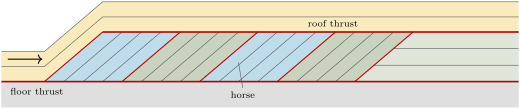
A flat (thrust) is a segment of a thrust that runs parallel to the bedding, usually in a weak layer; a ramp (thrust) is a segment that cuts across the bedding, typically at 20 to , joining a lower flat to an upper one. A duplex (thrust) is a stack of fault-bounded slices, the horses, enclosed between a floor thrust below and a roof thrust above, each horse cut off by a ramp that joins the two. Thrusts usually form in sequence, each new one in the footwall of the previous one, closer to the foreland; an out-of-sequence thrust is one that forms or slips again behind the active front, cutting older thrusts.
As the hanging wall moves over a bend in the fault, it must fold to stay in contact with it: a syncline forms where it enters the ramp and an anticline where it leaves it.
Definition 10.2 (Fault-bend, fault-propagation and detachment folds)
A fault-bend fold is a fold of the hanging wall of a thrust produced as it slides over a bend of the fault, a ramp between two flats. A fault-propagation fold grows above the tip of a thrust that is still propagating upward: the shortening that the fault no longer carries is taken up by folding in front of its tip, which gives a steep or overturned forelimb. A detachment fold grows above a flat with no ramp: the shortening is taken up by folding and by a weak layer, salt or shale, that flows into its core.
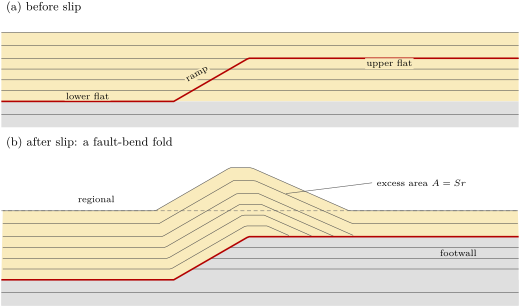
The figure below builds a fault-bend fold. Here the hanging wall moves parallel to the fault segment beneath it and folds at axial surfaces that bisect each bend, a kinematic model called fault-parallel flow; the classic model of constant layer thickness and length gives the same flat-topped anticline with a steeper forelimb, at the cost of a longer construction (admitted here). Both models are bound by the conservation of area.
Proposition 10.3 (Excess area of a fault-bend fold)
Let a thrust carry its hanging wall up a ramp of height from a lower flat to an upper flat, with the slip on the lower flat. For any bed of the hanging wall that lies above the upper flat, the area enclosed between the folded bed and its original level is , the same for every such bed.
Proof. Rock is neither created nor destroyed, and its volume is kept. Take a section parallel to the slip, bounded by two vertical lines far behind and far in front of the ramp. Through the rear line, the hanging wall between the lower flat and a bed at the height above it has moved in by : the area has entered. Through the front line, the rock between the upper flat and the same bed, of thickness , has moved out by the slip on the upper flat, also when the rock keeps its area: the area has left. The difference, , has stayed between the two lines, and lifts the bed above its original level. ∎
The excess area of a fault-bend fold measures the slip times the height of the ramp, not times the depth to the décollement, as it would for a detachment fold (Chapter 8). The two kinds of fold must be told apart before an area is turned into shortening.
A duplex (the figure below) grows when the thrust, instead of carrying its hanging wall ever farther along the same ramp, abandons it and cuts a new ramp in its footwall, ahead of the old one. The slice between the old and the new ramp becomes a horse, carried up the new ramp and stacked beneath the roof; the next ramp forms ahead again. Each horse is shortened from its original length to the length it now occupies along the floor, and the shortening of the duplex is the sum over its horses. Out-of-sequence thrusts cut this order: they form when the wedge behind the front must thicken, a case the mechanics of the next section predicts.
10.2 The critical taper
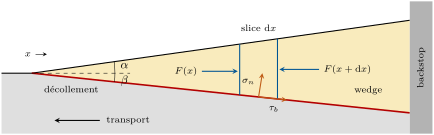
A fold-and-thrust belt in cross-section is a wedge: thin at its front, where the décollement reaches the surface, and thickening towards the hinterland. Its upper surface slopes towards the foreland at the angle ; its base, the décollement, dips towards the hinterland at the angle . The taper of the wedge is the angle between them, .
Definition 10.4 (Critical taper)
The critical taper of a wedge pushed from behind over a base is the taper at which the wedge is everywhere on the verge of failure, inside and along its base, under horizontal compression. A wedge at its critical taper slides over its base without deforming internally; a wedge below it (subcritical) deforms and thickens until it reaches it; a wedge above it (supercritical) slides without deforming.
Theorem 10.5 (Critical-taper equation)
Consider a subaerial wedge of uniform density made of cohesionless Coulomb material of internal friction , with the pore-pressure ratio , on a base of friction and pore-pressure ratio . If and are small and is horizontal, the critical-taper equation is
with the angles in radians.
Proof. Let be the depth below the surface. With small slopes, the vertical stress is the weight of the rock above, , and the pore pressure is , so that the effective vertical stress is . Everywhere at failure with horizontal, the Coulomb criterion for a cohesionless material gives the ratio of the effective principal stresses , hence the total horizontal stress
At the distance from the toe the wedge has the thickness , and the horizontal force per unit length of the belt on a vertical section is . On the slice between and (the figure above), the surface carries no stress and the push from behind exceeds the push from the front by . The base holds the slice back in two ways: the friction per unit length, and its normal stress , which is perpendicular to a base dipping towards the hinterland and so leans that way by , giving the horizontal part . Equilibrium of the slice requires
which is the equation. Since cancels, a wedge at failure keeps the same taper as it grows. ∎
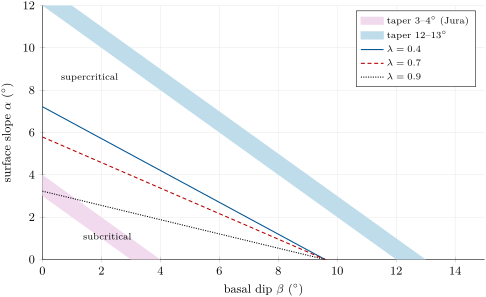
The equation says, first, that the taper is set by the ratio of the strength of the base, in the numerator, to the strength of the wedge, in the denominator: a weak base gives a thin wedge, a strong base a thick one. Second, the surface slope falls as the base dips more steeply. Third, fluid pressure lowers the taper: raising takes from the strength of the base more, in proportion, than from the strength of the wedge. The figure below shows the critical surface slope for the friction coefficients fitted in western Taiwan. Points below each line are subcritical wedges, which thicken; points above are supercritical, which slide.
A wedge is not a static object: material is added to it and removed from it, and each change pushes it off its critical taper.
Definition 10.6 (Frontal accretion, tectonic underplating)
Frontal accretion is the addition of material to a wedge at its toe, as the décollement propagates into the undeformed sediments of the foreland and a new thrust slice is cut. Tectonic underplating is the addition of material to the base of the wedge, behind its toe, as slices of the lower plate are detached and stacked beneath it, often as duplexes.
Frontal accretion lengthens the wedge at constant taper. Underplating thickens its rear and steepens its surface: the wedge becomes supercritical there and may extend by normal faulting until the taper falls back. Erosion does the opposite: it lowers the surface slope, the wedge becomes subcritical, and it thickens by out-of-sequence thrusting behind the front. Erosion and deformation are thus coupled: a wedge eroded fast keeps its taper by moving rock upward faster, and the rocks it brings to the surface are younger in the sense of the next section.
In the lab — Sandbox models
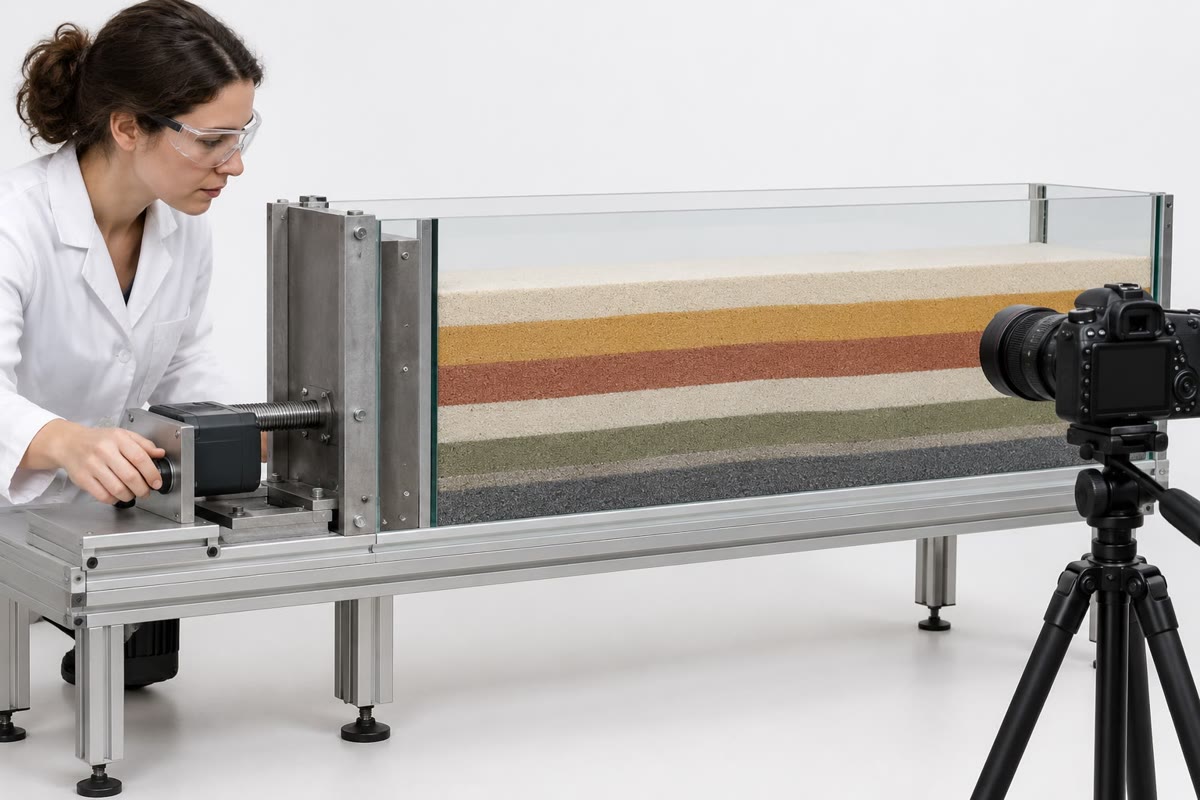
In an analogue sandbox model, layers of dry sand of different colours are laid flat in a long glass-sided box. A motor slowly pushes a vertical wall into them, or pulls a sheet out from beneath them; a camera beside the glass photographs the section at regular steps. The sand fails along thrusts, grows a wedge that keeps a constant taper, and develops ramps, duplexes and back-thrusts like those of real belts. A layer of glass beads or of a silicone putty beneath the sand plays the part of a weak décollement, and the wedge then grows thinner and wider. Davis, Suppe and Dahlen found that their experiments with dry sand matched the critical-taper theory. Correlating the successive photographs gives the displacement field inside the model.
10.3 Real wedges
In the active fold-and-thrust belt of western Taiwan, the surface slope, the dip of the décollement and the pore pressures are all known, from topography, seismic sections and wells. Davis, Suppe and Dahlen used them to solve the critical-taper equation for the strength of the wedge and found inside and on the base: Byerlee’s friction on the base, and a wedge stronger than its own faults, because they are not all oriented to slip easily. With these two coefficients they turned the observed tapers of other active wedges, on land and under the sea, into pore-pressure ratios, and found them everywhere above hydrostatic, in line with drilling. They also found where the theory stops: the taper drops abruptly where wedges grow thicker than about , the depth at which quartz-rich rocks become plastic for common geotherms, and the base no longer obeys a frictional law.
At the front of the western Alps, the Jura is a thrust wedge with a narrow angle of only 3 to . Its décollement lies mostly in halite-bearing layers of Triassic age, and the fluids there are not overpressured: the weakness of salt alone explains the narrow taper. South of the Jura, where the Triassic layers hold no halite, the same front has a taper of 12 to , with stacks of thrust slices, although fluid pressures measured there are high. In the Central Alps, critical-taper analysis of the surface slope gives a basal strength (with a small cohesion term) below 0.1, and even 0.05 in evaporites and shales near the front, increasing towards the hinterland, with pore-pressure ratios above 0.54. The base of a wedge is often far weaker than Byerlee’s law would make it, by its rock type and by its fluids.
10.4 Flux through a wedge
A wedge at its critical taper grows by accretion, at fixed shape: its length and height increase together. Erosion removes rock from its surface. When the two balance, the wedge keeps its size, and rock flows through it.
Proposition 10.7 (Steady-state flux balance)
A wedge of width along the transport direction receives, per unit length of the belt, the accretionary flux , where is the convergence rate and the thickness of the incoming layer above the décollement. It loses the erosional flux , where is the mean erosion rate over its surface. Its cross-sectional area changes at the rate ; at steady state, .
Proof. In unit time, a length of the incoming layer, of thickness , passes into the wedge across its toe, and the thickness is removed at each point of its surface; the area is conserved, so the area of the section changes by . At steady state the change is zero. ∎
With , and , the erosion rate needed for steady state is . Exhumation in the sense of the Year 2 volume is the removal of the rock above a given rock: at steady state, rocks reach the surface at the rate at which erosion lowers it, and the wedge brings them up from depths where they were hot. Measuring how fast requires a clock that starts at a known temperature.
10.5 Thermochronology
Definition 10.8 (Thermochronology, thermochronometer)
Thermochronology is the use of radiometric cooling ages to date the time at which a rock passed through a given temperature, and so to reconstruct its thermal history. A thermochronometer is a pair of a mineral and a dating method with its closure temperature: for instance apatite with the (U–Th)/He method, or zircon with fission tracks.
The table below orders the main thermochronometers by closure temperature; the depths assume a mean surface temperature of and a uniform gradient of . A rock that cools as it is exhumed passes them in turn, and its ages grow from the low-temperature methods to the high-temperature ones. The physics of fission tracks and of helium diffusion, which sets these temperatures, is in Chapter 13.
| thermochronometer | closure temperature () | depth () |
|---|---|---|
| apatite (U–Th)/He | 50–80 | 1.3–2.3 |
| apatite fission track | 90–120 | 2.7–3.7 |
| zircon (U–Th)/He | 160–200 | 5.0–6.3 |
| zircon fission track | about 280 | 9 |
| 40Ar/39Ar on biotite | 350–400 | 11–13 |
| 40Ar/39Ar on muscovite | about 425 | 14 |
| U–Pb on zircon | above 900 | — |
These depths are only a first guess, because erosion changes the geotherm.
Proposition 10.9 (Steady-state geotherm with erosion)
Let rock rise at the constant speed through a layer of thickness whose surface () is held at and base at , with no heat production. The steady temperature is
and the gradient at the surface is times the conductive gradient .
Proof. A rock particle at the depth moves upward, toward smaller : the temperature it carries changes as , and the diffusion equation becomes . At steady state, , so and , which meets . Setting fixes and gives the formula. At , . ∎
For the factor tends to 1: conduction wins and the geotherm stays straight. For across , with , and the surface gradient rises from 30 to : the isotherms crowd towards the surface and every thermochronometer closes shallower.
Definition 10.10 (Age–elevation relationship)
The age–elevation relationship of a thermochronometer is the plot of the cooling ages of samples collected over a range of elevations, usually along a steep slope or a vertical profile, against their elevations.
Proposition 10.11 (Slope of the age–elevation relationship)
Let rocks rise vertically at the constant speed under a steady topography, and let the closure isotherm lie at the elevation , where is the surface elevation and . A sample collected at the surface at the elevation has the age , and the age–elevation relationship is a straight line of slope
With a flat isotherm, and the slope is the exhumation rate.
Proof. The rock now at the surface at crossed the closure isotherm directly below, at the elevation , and has risen since, at the speed : . Hence . ∎
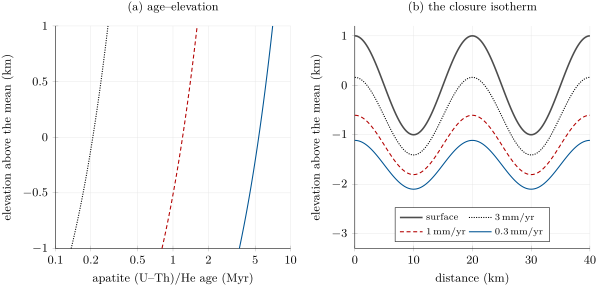
Isotherms are not flat beneath a relief: the surface is colder on the peaks than in the valleys, by the atmospheric lapse rate, but much less so than the rock would be at the same elevation underground, and the shallow isotherms follow the topography in a subdued way. For a sinusoidal topography of wavelength and a lapse rate , a first-order solution of the steady equation gives
where is the depth of the closure isotherm below the mean surface, the surface gradient and the gradient at (admitted; the script tests it). The perturbation dies away with depth over the distance , at most : low-temperature thermochronometers, which close shallow, feel the relief most. The figure above shows the effect for apatite (U–Th)/He.
An age–elevation profile measures the exhumation rate only where the closure isotherm is flat beneath the relief. Elsewhere it overestimates it, by the factor , which reaches two or more for apatite (U–Th)/He in a relief of wavelength. Ages from several thermochronometers on the same samples, and thermal models of the relief, correct for it.
10.6 Exercises
Exercise 10.1 ★
Compute and the ratio at failure for a wedge with .
Solution
Solution of Exercise 10.1.
: and .
Exercise 10.2 ★
A sandbox wedge of dry sand () has inside and on its base. Compute its critical surface slope on a horizontal base, then on a base dipping .
Solution
Solution of Exercise 10.2.
, , . On a horizontal base, . On a base dipping , , so .
Exercise 10.3 ★
With a surface at and a gradient of , check the depths of the table of closure temperatures for apatite (U–Th)/He, apatite fission track and zircon fission track. Which thermochronometer would you use to date exhumation from ?
Solution
Solution of Exercise 10.3.
Depth : apatite (U–Th)/He 1.3 to ; apatite fission track 2.7 to ; zircon fission track . At the rock was at : zircon (U–Th)/He, which closes at 160 to , 5.0 to deep.
Exercise 10.4 ★
A ramp high dips . Compute its horizontal length and its length along the dip. By how much is a bed of the hanging wall lifted once it has crossed the whole ramp, and what slip brings the cut-off of the lowest bed from the foot of the ramp to the upper flat?
Solution
Solution of Exercise 10.4.
Horizontal length ; along the dip . The bed is lifted by the ramp height, . The cut-off must travel the whole ramp: a slip of .
Exercise 10.5 ★★
With the Taiwan coefficients, compute the critical surface slope on a base dipping for and . What does an increase of the fluid pressure do to a wedge that was at its critical taper?
Solution
Solution of Exercise 10.5.
, ; . For : , . For : , . Raising the fluid pressure lowers the critical taper: the wedge becomes supercritical, slides forward on its base without thickening, and its front advances until accretion and erosion bring it back to the new taper.
Exercise 10.6 ★★
A fault-bend fold lies above a ramp high; a bed above the upper flat shows an excess area of . Compute the slip. A colleague reads the same fold as a detachment fold, the bed lying above the décollement. What shortening would he find?
Solution
Solution of Exercise 10.6.
. Read as a detachment fold, : half the true value. The two readings must be told apart by the shape of the fold and the presence of a ramp.
Exercise 10.7 ★★
Take inside both the Jura wedge (taper ) and the wedge to its south (taper ), a hydrostatic inside both, and a basal dip of for both. Compute the basal strength that each taper requires, and compare it with Byerlee’s at hydrostatic pressure. Is the result consistent with the décollement in halite beneath the Jura?
Solution
Solution of Exercise 10.7.
and . The equation gives , with . Jura: . South: . Byerlee at hydrostatic pressure: . The base to the south is close to Byerlee’s; the Jura base is almost five times weaker, as expected of a décollement in halite, whose friction is low, under fluids that are not overpressured.
Exercise 10.8 ★★
Rock rises at through a layer thick, from at its base to at the surface, with . Compute the Péclet number, the surface gradient, and the depth of the isotherm. Compare with the depth without erosion.
Solution
Solution of Exercise 10.8.
, and : . The factor raises the gradient from 30 to . For : , so and , against without erosion.
Exercise 10.9 ★★
Two samples from the same slope, at 1200 and , have apatite (U–Th)/He ages of 3.4 and . Compute the apparent exhumation rate. A thermal model of the relief gives : what is the true rate?
Solution
Solution of Exercise 10.9.
. With , .
Exercise 10.10 ★★★
Show that, for , the critical surface slope vanishes at a basal dip that does not depend on . Compute it for Taiwan. What happens to a wedge whose base dips more steeply?
Solution
Solution of Exercise 10.10.
With and : , so and , whatever . For Taiwan, . On a steeper base, the critical surface slope is negative: any wedge with a level or foreland-sloping surface is already supercritical, and it slides on its base without thickening. A thrust belt cannot grow its normal shape there.
Exercise 10.11 ★★★
Show that, for a very long wavelength and a very slow exhumation, tends to , where is the uniform gradient; evaluate it for and . What is then the slope of the age–elevation relationship? For and the values of exercise 8 (, , ), compute for wavelengths of 5 and .
Solution
Solution of Exercise 10.11.
As and , , so , and the geotherm is straight, : . The slope is then . For , . At : , , . At : , , .
Exercise 10.12 ★★★
A wedge grows at its critical taper by frontal accretion alone, without erosion, from the flux . Show that its width grows as . With and a taper of , how wide is it after , and how long does it take to reach ?
Solution
Solution of Exercise 10.12.
The section is a triangle of base and height : . With and at , , which gives . With : after ; to reach .
10.7 Problem: The Front of the Kestrel Wedge
Problem 10.1
Weekend problem — the shortening, mechanics, flux and exhumation of an invented thrust wedge
The Kestrel Range is the invented front of a mountain belt, a subaerial fold-and-thrust belt wide pushed at over a foreland whose sedimentary layer is thick above a shale décollement. Its frontal thrust follows the décollement below the surface, climbs a ramp dipping and runs along an upper flat deep. At the front the surface stands above sea level and the décollement below it; behind the front the surface stands at and the décollement lies below sea level. Take, as in Taiwan, and , a rock density of , water at and .
Part I — Thrust geometry.
- Compute the height of the ramp, its horizontal length and its length along the dip.
- By how much has a bed of the hanging wall been lifted once it has crossed the whole ramp?
- Above the ramp, a bed lying above the upper flat shows an excess area of above its regional level. Compute the slip.
- What excess area do you predict for a shallower bed? Had the fold been read as a detachment fold over the décollement, with the bed above it, what shortening would have been found?
- Behind the ramp, a seismic section shows a duplex of four horses, each now long along the floor thrust, cut from slices long. Compute the shortening taken up by the horses, and compare it with the slip on the frontal ramp.
- The horses formed in sequence. Which is the youngest, and why is the roof thrust folded?
Part II — The taper.
- Compute the surface slope , the basal dip and the taper.
- Compute the thickness of the wedge behind the front. Can the Coulomb wedge theory be used?
- Compute . What surface slope would a dry wedge have on this base?
- What surface slope would it have with hydrostatic fluid pressure in the wedge and on its base? Is the wedge consistent with it?
- Solve the critical-taper equation for .
- Compute the vertical stress, the fluid pressure and the hydrostatic pressure at the base of the wedge behind the front.
- Drainage lowers to 0.7. Compute the new critical surface slope. How does the wedge respond?
Part III — The flux.
- Compute the accretionary flux per kilometre of the belt.
- What mean erosion rate keeps the wedge at steady state?
- Compute the volume and the mass of rock eroded per year from of the belt.
- If erosion stopped, how fast would the wedge widen at first?
- If half the incoming layer were underplated beneath the rear of the wedge instead of accreted at its front, would the steady-state mean erosion rate change? Where would erosion concentrate?
Part IV — The clock. Take the layer thick, at the mean surface ( above sea level) and at its base, , a closure temperature of for apatite (U–Th)/He, a lapse rate of and a relief of wavelength . Five samples collected on one valley side give:
| elevation () | 1.30 | 1.65 | 2.00 | 2.35 | 2.70 |
| apatite (U–Th)/He age () | 1.60 | 1.83 | 2.07 | 2.30 | 2.54 |
- With the erosion rate of question 15 as the exhumation rate, compute the Péclet number and the surface gradient.
- Compute the depth of the closure isotherm below the mean surface and the gradient there.
- With a flat closure isotherm, what age would a sample at the mean elevation have? Compare with the data.
- Compute and the deflection factor .
- Fit a straight line to the age–elevation data. What apparent exhumation rate does its slope give?
- Correct it for the deflection of the isotherm.
- Compare with Part III, and give the exhumation rate of the Kestrel wedge.
Solution
Solution of Problem 10.1.
1. high; long horizontally; along the dip.
2. By the ramp height, .
3. .
4. The same, : in a fault-bend fold the excess area of every bed above the upper flat is . As a detachment fold, : a quarter too little.
5. , two and a half times the of slip on the frontal ramp.
6. The frontal horse, the one nearest the foreland: each new ramp forms in the footwall ahead of the last. Each horse, carried up its ramp, lifts the roof thrust and the cover above it as a fault-bend fold lifts its hanging wall, so the roof is folded over the stack.
7. ; ; taper .
8. , less than about : the base is still frictional, and the Coulomb theory applies.
9. , , . Dry: , .
10. : , . The observed would make the wedge strongly subcritical, thickening rather than advancing: the fluids must be overpressured.
11. With and , gives : .
12. ; ; hydrostatic . The fluids carry more than a column of water would.
13. , . The wedge, at , is now subcritical: it stops advancing and thickens by out-of-sequence thrusting behind its front until its surface slope reaches .
14. , that is per kilometre of the belt.
15. .
16. , or (10 million tonnes a year).
17. .
18. No: at steady state the erosion must still remove the whole incoming flux, so the mean rate stays . But the rock added beneath the rear is lifted there: erosion and exhumation would be fastest over the rear, where the youngest cooling ages would be found.
19. : ; .
20. , so and ; .
21. , the age of the sample at : at the mean elevation the deflection of the isotherm is zero.
22. , : ; ; .
23. The mean elevation is and the mean age ; and , so the slope is : an apparent rate of .
24. .
25. The thermochronometer and the flux balance agree: the wedge is at steady state, and taking the apparent slope at face value would have overestimated the rate more than twofold. The exhumation rate of the Kestrel wedge is .