University Earth and Space Sciences — Year 3 · Bachelor Year 3
13Advanced Geochronology
A crystal of zircon a tenth of a millimetre long has kept two clocks running since its granite crystallised: uranium-238 decaying to lead-206 and uranium-235 decaying to lead-207. When the two clocks agree, the age is beyond doubt. When they disagree, the disagreement itself can be dated: the crystal lost part of its lead in a later event, and the two clocks, read together, give the age of the granite and the age of the event. This chapter reads several clocks at once, in uranium and lead, in argon, in neodymium, in fission tracks and helium, and in the rare atoms made by cosmic rays, and it says how far each age can be trusted.
You already know
Radioactive decay, the age equation, the isochron and its initial ratio, the least-squares line, branching decay, the potassium–argon age, closure temperature and cooling age are in the Year 1 volume, in its chapter on radiometric dating; the steady-erosion formula of cosmogenic nuclides is in its chapter on erosion and transport. The chondritic uniform reservoir, the epsilon notation and the depleted mantle are in the Year 2 volume, in its chapter on isotope geochemistry; thermal ionisation and multi-collector mass spectrometry in its chapter on field and lab methods. Thermochronology and the age–elevation relationship are in Chapter 10.
13.1 Uranium, lead and the concordia
Uranium has two long-lived isotopes. Uranium-238 decays through a chain of short-lived daughters to lead-206 with ; uranium-235 decays to lead-207 with , six times faster. Their present ratio is , or , the same in every terrestrial rock. Zircon, , takes in much uranium and almost no lead when it grows, and it resists weathering and survives metamorphism: almost all its lead is radiogenic.
Write and for the present ratios of radiogenic lead to its parent. Each gives an age, and .
Definition 13.1 (Concordia, discordia, intercepts, Tera–Wasserburg diagram)
The concordia is the curve of the plane on which the two uranium–lead ages are equal. A discordia is a straight line along which discordant analyses of one population of crystals are aligned; its intersections with the concordia are the upper intercept (the older) and the lower intercept (the younger). The Tera–Wasserburg diagram plots against .
Theorem 13.2 (The concordia)
A crystal that has stayed closed to uranium and lead since it formed, a time ago, plots at
As grows the curve rises ever more slowly against : its slope, , decreases from at the origin, so the concordia is concave towards the axis.
Proof. For each parent, the number of radiogenic daughters per parent atom left is , the age equation of the Year 1 volume. Differentiating both coordinates with respect to and dividing gives the slope; since , it decreases with . ∎
Lead is a large ion that sits badly in the zircon lattice. In the parts of a crystal damaged by its own radioactivity, it can leave in a later event of heating or fluid circulation.
Theorem 13.3 (Episodic lead loss gives a chord)
A crystal formed a time ago that lost, a time ago, a fraction of its radiogenic lead, and was closed otherwise, plots today at
on the chord joining the points and of the concordia. Crystals that lost different fractions lie along that chord, a discordia whose upper intercept is and lower intercept is .
Proof. Take one decay system, with constant , and count per atom of parent present today. A time ago there were parent atoms, and radiogenic daughters . The event left ; since then the parent made more. The sum is . The two lead isotopes behave alike chemically, so is the same for both, and the two coordinates combine into the point stated. ∎
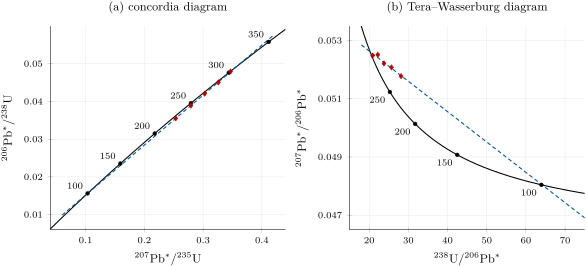
The intercepts are found where , an equation in that is solved by Newton’s method: with and , iterate from a guess near each intercept. Three properties of the result matter in practice. First, the upper intercept is precise only if the discordia crosses the concordia at a large angle. A young discordia, as in the figure above, runs almost along the concordia, and a small change in its slope moves the intercept far. Second, if the lead loss is recent, , the discordia passes through the origin, and every crystal has the same ratio,
which gives without the uranium: the lead–lead age. Third, a line in the concordia diagram, , becomes in the Tera–Wasserburg coordinates , again a line. The Tera–Wasserburg diagram uses ratios measured directly, with no need to compute uranium-235 from uranium-238, and a mixture with common lead, unradiogenic and rich in lead-207, plots on a line that reaches the axis at the ratio of the common lead.
Uranium–lead ages are measured in two ways. Single crystals or fragments, dissolved after the damaged zones have been removed by partial dissolution and their lead and uranium separated, are measured by thermal ionisation mass spectrometry, with the most precise ages of geology. Spots a few tens of micrometres across are measured in place, by an ion probe or by laser ablation, less precisely but zone by zone through a crystal that grew in several events.
In the lab — The geochronology laboratory

A zircon date begins with a crushed rock and ends in a clean laboratory. The geochronologists separate the zircons by density and magnetism, pick the clearest crystals under the binocular microscope and image their zoning. The crystals are partly dissolved to remove their damaged zones, then dissolved completely with a spike of known isotopes, and the uranium and lead are separated on tiny columns of resin, in air filtered to keep out the lead of dust. A mass spectrometer measures the isotope ratios. Argon samples follow a different path: a reactor, then a gas line where a laser heats each step and the argon is cleaned before the spectrometer.
13.2 Argon–argon dating
The potassium–argon method of the Year 1 volume measures the potassium and the argon in two separate aliquots of a mineral. The argon–argon method measures only argon, in one aliquot, as ratios of isotopes. The sample is irradiated with fast neutrons in the core of a nuclear reactor, where the reaction turns a fixed fraction of its potassium-39 into argon-39, a proxy for potassium. A mineral of known age, the monitor, is irradiated beside it.
Definition 13.4 (Argon–argon dating, J factor, age spectrum, plateau age)
dating dates a potassium-bearing mineral by the ratio of its radiogenic argon-40 to the argon-39 made from its potassium by neutron irradiation. The J factor of an irradiation is , found from a monitor of known age and measured ratio , with the total decay constant of potassium-40. When the sample is degassed in steps of increasing temperature, its age spectrum plots the age of each step against the cumulative fraction of argon-39 released. A plateau age is the weighted mean age of consecutive steps that agree within their uncertainties and release a large part of the argon-39.
Theorem 13.5 (The argon–argon age)
A sample irradiated with a monitor has the age
Proof. The radiogenic argon is , by the branching decay of the Year 1 volume. The argon-39 made is , where collects the neutron dose and the cross-section of the reaction. So with . The ratio is the same in all potassium, and the same for two samples irradiated side by side, so is the same for the sample and the monitor; the monitor’s age and ratio give it, and inverting gives . ∎
The constants are those of the potassium–argon method, . A common monitor is a sanidine of a volcanic tuff dated at ; a monitor ratio gives . Atmospheric argon, with , is subtracted with the argon-36 measured in each step, and argon made by neutrons from calcium and from potassium itself is corrected with salts irradiated in the same package.
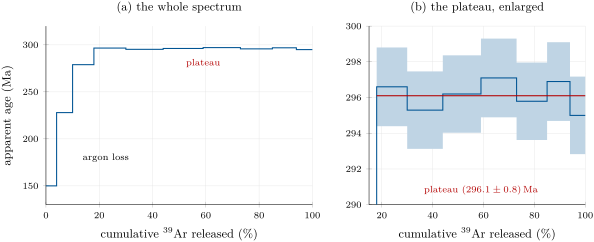
Step heating is the strength of the method. The sample is heated in a furnace or by a laser in steps of increasing temperature, and each step gives an age. If the mineral stayed closed since it cooled, all steps agree: the spectrum is flat. If it lost argon from the rims of its grains, the first steps, which come from the rims, are younger, and the ages rise as a staircase towards a plateau given by the cores. The recommended criteria for a plateau are at least five consecutive steps carrying more than of the argon-39, with no trend among them; the low-temperature steps of a staircase are commonly read as a loss of radiogenic argon. Excess argon, trapped from a fluid when the mineral grew, does the opposite: it makes some steps too old, often the first and the last, in a saddle-shaped spectrum. The sum of all steps, the total-gas age, is what a potassium–argon age would have given: an average that hides the history.
13.3 Neodymium model ages
When a melt is extracted from the mantle to make continental crust, samarium, more compatible, stays behind more than neodymium: the new crust has a lower than its source, about 0.13 for most crustal rocks, against 0.1966 for the chondritic reservoir. Its then grows more slowly. Once formed, a crustal rock tends to keep its samarium–neodymium ratio, through erosion, sedimentation and even remelting, so its neodymium remembers when it left the mantle.
Definition 13.6 (Model age)
The model age of a rock in an isotope system is the time at which its ratio, projected back with its present parent–daughter ratio, equals that of a model reservoir. For neodymium, uses the chondritic uniform reservoir and the depleted mantle.
Theorem 13.7 (Model age)
A sample with present ratios and , compared with a reservoir of present ratios and , has the model age
Proof. A closed system had, a time ago, the ratio : the isochron equation read backwards. Equating this for the sample and the reservoir gives . ∎
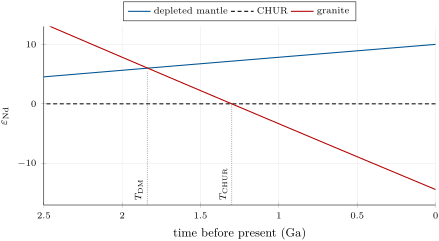
With , the reservoirs are the chondritic one, 0.512638 and 0.1966 today, and the depleted mantle, 0.51315 today, about , which a closed evolution from chondritic values since gives the ratio . An invented granite with and has today, and . The figure below reads both. The depleted-mantle age is the better estimate, because the crust is extracted from a mantle already depleted; it is the mean age at which the neodymium of the sample left the mantle, its crustal residence age. Two caveats limit it: the crust must not have changed its samarium–neodymium ratio since, and a rock made by mixing old crust with new mantle melts has a meaningless intermediate model age.
13.4 Fission tracks and helium
Uranium-238 also decays, very rarely, by spontaneous fission: the nucleus splits into two fragments that fly apart and leave a trail of damage in the crystal, up to wide and about long in apatite. Etched with acid, the trails become visible under the microscope. They heal when the crystal is heated, over about 20 to depending on the mineral; in apatite, they shorten in the partial annealing zone, about 60 to , and vanish above it.
Definition 13.8 (Fission-track dating, track annealing)
Fission-track dating dates a mineral by the density of the tracks left in it by the spontaneous fission of uranium-238, compared with its uranium content. Track annealing is the shortening and disappearance of the tracks by repair of the crystal when it is heated.
Theorem 13.9 (The fission-track age)
With the decay constant of spontaneous fission and the total one, a crystal with spontaneous fissions per unit volume and atoms of uranium-238 has the age
In the laboratory, the uranium is measured by inducing the fission of uranium-235 with thermal neutrons, and the age becomes
with and the spontaneous and induced track densities, the track density of a dosimeter glass, a geometry factor and a calibration constant found on standards of known age.
Proof. Uranium-238 has decayed times, and the fraction of these decays were fissions: , which inverts into the first form. The track densities are proportional to and to the number of induced fissions, , where is the fission cross-section of uranium-235 and the neutron fluence, itself proportional to . The ratio is then times a product of constants, and , , and the efficiency of etching and counting are gathered with into . ∎
The fission decay constant is known only to within about , between and , which is why most laboratories prefer the calibration. The lengths of the tracks keep a record of the path in temperature. A rock that cooled fast through the partial annealing zone has long tracks of nearly equal length; one that lingered in it has shorter tracks of widely spread lengths, and the fission-track age is then a mixed age, not the time of a passage through one temperature.
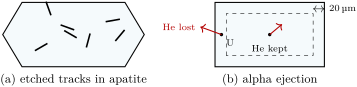
Each alpha decay emits a helium-4 nucleus. Uranium, thorium and their chains accumulate helium in a crystal, which keeps it only when cool.
Definition 13.10 ((U–Th)/He dating, partial retention zone)
(U–Th)/He dating dates a mineral by the helium-4 accumulated from the alpha decays of uranium, thorium and their daughters, compared with its uranium and thorium. The partial retention zone is the range of temperature in which the helium produced is partly kept and partly lost by diffusion.
Theorem 13.11 (Helium ingrowth)
A crystal closed to helium for a time holds
in atoms, with the parents measured today; samarium-147 adds a small term.
Proof. Each chain loses its mass difference in alpha particles, four mass units each: , , , while beta decays do not change the mass number. Each chain is at secular equilibrium, so each parent decay is followed by its whole chain, and the number of decays of each parent is that of the age equation. ∎
For a young crystal, and the age follows from a single division. An alpha particle travels about before it stops, so a crystal loses the helium made near its surface; the measured age is divided by the retained fraction , which is smaller for small grains ( means lost). Apatite closes to helium at about 50 to , zircon at 160 to : with apatite fission tracks, near 90 to , the low-temperature chronometers date the last few kilometres of the ascent of a rock to the surface, as Chapter 10 used them.
13.5 Cosmogenic nuclides
Cosmic rays striking the atmosphere make showers of secondary particles. The fast neutrons that reach the ground break nuclei in the minerals of the top metres of rock, by spallation: oxygen in quartz becomes beryllium-10, silicon aluminium-26. Muons make some nuclides deeper, and dominate below about .
Definition 13.12 (Cosmogenic nuclide, exposure age, production rate)
A cosmogenic nuclide is a nuclide made in a mineral at or near the surface by the secondary particles of cosmic rays. Its production rate is the number of atoms made per unit mass of mineral and per year. The exposure age of a surface is the time since it was first exposed to cosmic rays, found from the concentration of a cosmogenic nuclide.
The production rate decreases with depth as , where the attenuation length is taken as , about of granite of density . At the surface it grows with altitude, because less air shields the rock, and with geomagnetic latitude, because the field deflects fewer particles near the poles. Rates are given for a reference at sea level and high latitude and scaled to each site: one calibration gives of beryllium-10 in quartz at that reference. Beryllium-10 has a half-life of , .
Theorem 13.13 (Exposure with decay and erosion)
A surface lowered at the steady rate , exposed for a time with no nuclide inherited, carries at its surface the concentration
Without erosion, ; after a long time, , and without decay this is the formula of the Year 1 volume.
Proof. Follow the grain that is at the surface today. A time ago it was at the depth , where it gained atoms at the rate ; of those atoms the fraction is left today. Summing over the exposure,
The limits follow by setting , letting , and then . ∎
Without erosion the concentration saturates at after a few half-lives: a surface reaches of it after , and beyond that it can no longer be dated. With erosion, the steady state is reached sooner, after a few times , and its concentration gives ; the rate is averaged over the time that the grain took to rise through one attenuation length, a few tens of thousands of years at the rates of a few tens of metres per million years. Outcrops of bedrock erode at a few metres to a few tens of metres per million years; river basins, measured from the sand of their rivers, faster.
Two nuclides with different half-lives date burial. Beryllium-10 and aluminium-26 are made together in quartz in a fixed ratio; when a grain is buried deep in a cave or under thick sediment, production stops, and aluminium-26, which decays faster, falls behind: the ratio of the two decays with time and dates the burial.
13.6 The statistics of an age
An age comes with its uncertainty, and a set of ages with the question whether they agree. Let measurements of one quantity have standard deviations . Their weighted mean is , with and , and its standard deviation is .
Definition 13.14 (Mean square of weighted deviates)
The mean square of weighted deviates (MSWD) of measurements about a fitted model with adjusted parameters is
where is the model value: for a weighted mean, for a straight line such as an isochron or a discordia.
Proposition 13.15 (The MSWD has expectation one)
If the are independent, normal, with the mean and the standard deviations , the MSWD about their weighted mean has expectation 1.
Proof. Expanding and using ,
On the left, each term has expectation 1, so the sum has expectation . On the right, has variance , so the last term has expectation 1. Hence has expectation . ∎
The MSWD scatters about 1 more widely when there are few degrees of freedom, : its upper limit at is about , 2.63 for and 2.15 for . Above the limit, the measurements scatter more than their uncertainties allow: the samples have not all the same age, or the system was disturbed. Far below 1, the uncertainties were overestimated.
Method 13.16 (Fitting an isochron with errors on both axes)
When both coordinates carry errors , , correlated with the coefficient , as in uranium–lead and isochron data:
- start from the slope of the ordinary least-squares line;
- give each point the weight , the inverse variance of its distance to the line measured along ;
- fit the weighted line with these weights, which gives a new , and return to step 2 until no longer changes;
- compute the MSWD with the weights and degrees of freedom, and the uncertainty of the slope and intercept from the final weights.
With the weights do not depend on , and the method reduces to the weighted least squares of on used in the problem.
The uncertainty of a decay constant is the same for every age of one system: it does not enter when ages of one system are compared, but must be added when ages from two systems are. The decay constant of samarium-147, for instance, is known to about ; those of potassium-40, branched and slow, limit the accuracy of argon ages.
13.7 Exercises
Exercise 13.1 ★
A zircon has and . Compute its two uranium–lead ages. Is it concordant? On which side of the concordia does it plot?
Solution
Solution of Exercise 13.1.
; . The ages differ by : the zircon is discordant. Its is the older, so it plots below the concordia, on the side of lead loss.
Exercise 13.2 ★
A monitor of gives . Compute with , then the age of a sample of the same irradiation with (use ).
Solution
Solution of Exercise 13.2.
. Then .
Exercise 13.3 ★
A shale has and . Compute its and with the values of the chapter.
Solution
Solution of Exercise 13.3.
; .
Exercise 13.4 ★
A boulder of quartz on a moraine at the reference site holds atoms of beryllium-10 per gram. Assuming no erosion and no inheritance, compute its exposure age without and then with decay, with .
Solution
Solution of Exercise 13.4.
Without decay, . With decay, , older.
Exercise 13.5 ★★
Show that near the origin the concordia is a line of slope , and compute it. Explain why the discordia of crystals that lost lead only very recently passes through the origin, and what the lead–lead age of such crystals measures.
Solution
Solution of Exercise 13.5.
For small , and , so , slope . If the lead was lost very recently, and the lower intercept is , the origin. Along a line through the origin, is constant, and so is : every crystal gives the lead–lead age of the upper intercept, the age of formation.
Exercise 13.6 ★★
Four step ages of a plateau are , , and (). Compute their weighted mean, its standard deviation and the MSWD. Do they agree?
Solution
Solution of Exercise 13.6.
Weights , , , , ; , . The weighted squared deviations sum to ; with , , below : the ages agree.
Exercise 13.7 ★★
An apatite has and , with , and a laboratory calibration . Compute its fission-track age. What event does it date?
Solution
Solution of Exercise 13.7.
; . If the rock cooled fast, it dates its passage through the partial annealing zone of apatite, about 60 to ; if it cooled slowly, it is a mixed age, and the track lengths must tell.
Exercise 13.8 ★★
An apatite holds uranium ( uranium-238, uranium-235 by atoms), thorium-232 (half-life ) and helium. Compute its (U–Th)/He age with the linear approximation, then the age corrected for alpha ejection with .
Solution
Solution of Exercise 13.8.
Per gram: uranium atoms, of which of uranium-238 and of uranium-235; thorium , ; helium . The production rate is , and . Corrected: .
Exercise 13.9 ★★
For beryllium-10 at the reference site, compute the saturation concentration without erosion and the time to reach of it. Compute the steady concentration of a surface eroding at (granite, , ).
Solution
Solution of Exercise 13.9.
, reached to after . At : , and , 35 times less.
Exercise 13.10 ★★★
Two measurements and of one age are combined. Show that their MSWD about the weighted mean is , and prove directly that its expectation is 1 when both measure the same age.
Solution
Solution of Exercise 13.10.
With , and , so ; with this is the MSWD. If both measure the same age, has mean 0 and variance , so the expectation of its square divided by that variance is 1.
Exercise 13.11 ★★★
A zircon of lost lead at and has today . What fraction of its lead did it lose? Compute its , its two uranium–lead ages and, by iteration, its lead–lead age. Which of the three ages has a meaning?
Solution
Solution of Exercise 13.11.
, . , half its lead. . , ; the ratio gives by iteration a lead–lead age of . None of the three has a meaning: they are mixtures of the two events, and only the intercepts date them. The lead–lead age is a minimum for the crystallisation.
Exercise 13.12 ★★★
A bedrock surface at the reference site holds atoms of beryllium-10 per gram. Compute its exposure age assuming no erosion, then its erosion rate assuming a steady state. Show that every pair between these two limits fits the measurement, and say what second measurement would separate them.
Solution
Solution of Exercise 13.12.
No erosion: . Steady state: , . For any below this, fixes one , from upwards to infinity: one measurement has two unknowns. A second nuclide with another half-life, such as aluminium-26 in the same quartz, or the concentration at depth in a core, separates them.
13.8 Problem: Zircons of the Varden Granite
Problem 13.1
Weekend problem — the crystallisation, cooling and unroofing of an invented granite, read on four clocks
The granite of the Varden Hills, the series’ invented region, was unroofed by the Triassic, buried under the Mesozoic cover and brought back to the surface. Five of its zircons give, with one-standard-deviation errors on (take as exact):
| zircon | Z1 | Z2 | Z3 | Z4 | Z5 |
|---|---|---|---|---|---|
| 0.3467 | 0.3260 | 0.3027 | 0.2793 | 0.2535 | |
| 0.04794 | 0.04505 | 0.04207 | 0.03892 | 0.03553 | |
| 0.00010 | 0.00009 | 0.00008 | 0.00008 | 0.00007 |
Use the constants of the chapter. All analyses are exercise data.
Part I — The zircons.
- Compute the two uranium–lead ages of each zircon. Are they concordant?
- Why do the ages decrease from Z1 to Z5, with for each?
- Compute the Tera–Wasserburg coordinates of Z1 and Z5.
- With the weights , compute the weighted means and and .
- Compute the slope and the intercept of the discordia.
- Compare with the slope of the concordia near . What does this foretell?
Part II — The intercepts.
- Find the upper intercept by Newton’s method from .
- Find the lower intercept from .
- Compute the weighted residuals and the MSWD. Is the fit acceptable?
- The standard deviation of the slope is . Compute it.
- Pivot the line about to the slopes and recompute the upper intercept for each. What is the uncertainty of the age?
- What fraction of its lead did Z1 lose, and Z5?
Part III — The biotite. A biotite of the granite, irradiated with a monitor of giving , is degassed in ten steps:
| step | 1 | 2 | 3 | 4 | 5 | 6 | 7 | 8 | 9 | 10 |
| () | 4 | 6 | 8 | 12 | 14 | 15 | 14 | 12 | 9 | 6 |
| 7.225 | 11.226 | 13.937 | 14.891 | 14.820 | 14.869 | 14.918 | 14.847 | 14.907 | 14.804 | |
| age () | 228.0 | 279.0 | 295.3 | 296.2 | 297.1 | 295.8 | 296.9 | |||
| () | 0.6 | 0.9 | 1.0 | 1.1 | 1.1 | 1.1 | 1.1 | 1.1 | 1.1 | 1.1 |
- Compute ; round it to 0.01200.
- Compute the ages of steps 1, 4 and 10.
- Which steps form a plateau by the criteria of the chapter?
- Compute the plateau age, its standard deviation and its MSWD.
- Compute the total-gas ratio and age. Why is it younger than the plateau?
- Taking the granite to have crystallised at and the biotite to close at , compute the mean cooling rate.
- What could have happened at the lower intercept? Is the argon spectrum consistent with it?
Part IV — The unroofing. Four apatites, sampled on a slope of the hills, give (U–Th)/He ages of 43.1, 46.0, 49.2 and at 310, 370, 430 and . The top of the granite, on a gentle hill crest at a site where , holds atoms of beryllium-10 per gram of quartz.
- Compute the slope of the age–elevation relationship, in metres per million years.
- With a closure temperature of , a surface at and a geotherm of , at what depth did the lowest apatite close? What mean rate of unroofing since then follows?
- Compute the present erosion rate from the beryllium-10, assuming a steady state.
- What rate does the formula of the Year 1 volume, without decay, give?
- Over what time is the beryllium-10 rate averaged? Compare the three rates.
- State the age of crystallisation of the Varden granite with its uncertainty.
Solution
Solution of Problem 13.1.
1. / , in : Z1 301.9 / 302.2, Z2 284.1 / 286.5, Z3 265.7 / 268.5, Z4 246.1 / 250.1, Z5 225.1 / 229.4. An error of on is about : Z1 is concordant within error, the others are discordant, increasingly from Z2 to Z5.
2. The zircons lost increasing fractions of their lead in one later event: they lie further and further down the chord. The chord lies below the concave concordia, where is larger for a given : .
3. Z1: , . Z5: , .
4. Weights , , , , (in ); , , .
5. , .
6. At , . The discordia is only steeper than the concordia: it meets it at a small angle, and the upper intercept will be imprecise.
7. Newton from : .
8. From : .
9. , , , , ; , below the limit for : the zircons fit one line.
10. .
11. With the upper intercept is ; with , . The age is at two standard deviations.
12. : Z1 , Z5 .
13. , .
14. Step 1: ; step 4: ; step 10: .
15. Steps 4 to 10: seven consecutive steps, of the argon-39, with no trend. Steps 1 to 3 rise as a staircase.
16. Equal errors: the mean is , ; the squared deviations sum to , , below .
17. , : the argon lost from the rims, released in the first steps, lowers the average, as it would lower a potassium–argon age.
18. (with a wide range, since the zircon age is known to ).
19. Near the granite was buried under its Mesozoic cover, and a heating or a circulation of fluids made the zircons lose lead. The biotite lost argon from its rims, which the staircase records; its lowest step, , is a mixture of old and reset argon. The plateau survived: the biotite was not heated enough to lose all its argon.
20. The least-squares slope of elevation against age is .
21. ; since , a mean of .
22. ; .
23. , more: decay barely matters at this rate.
24. . The granite rose at about between 52 and , at on average since, and erodes at now: the unroofing was faster at some time in the Cenozoic.
25. The Varden granite crystallised ago (upper intercept, two standard deviations).