University Earth and Space Sciences — Year 3 · Bachelor Year 3
14Stable-Isotope Geochemistry
Snow falling on the high domes of the East Antarctic ice sheet is among the lightest water on Earth. Each of its molecules left the ocean as vapour, and on the way inland the air lost most of its water as snow, the heavy molecules first. What is left on arrival depends on how much was lost, which depends on how cold the air became. A column of ice is therefore a thermometer, a shell of calcite another, and the carbon of limestones a ledger of what the biosphere buried. This chapter derives the laws behind these records and reads them.
You already know
The value, the fractionation factor and the equilibrium and kinetic isotope effects are in the chemistry books’ university volumes. The reference standards VSMOW and VPDB and the meteoric water line are in the Year 2 volume, in its chapter on isotope geochemistry; the Rayleigh fractionation law of trace elements in its chapter on magmatic differentiation; climate proxies, the ice-volume effect and the Mg/Ca thermometer in its chapter on climate archives and proxies; the Palaeocene–Eocene Thermal Maximum in its chapter on climate over geological time; the Great Oxidation Event in its chapter on the Precambrian Earth. Photosynthesis and bacterial sulfate reduction are in the biology books.
14.1 Fractionation between two phases
For two phases A and B in isotopic equilibrium, , with the ratios of the heavy to the light isotope. Water vapour and liquid water have for oxygen-18 and for deuterium at , and at ; ice and water at , and . The heavier phase is always the more condensed one, and the fractionation grows as the temperature falls.
Definition 14.1 (Isotopic difference)
The isotopic difference between two phases is , in per mil.
Proposition 14.2 (The isotopic difference and the fractionation factor)
For close to 1 and small values,
Proof. , and , so . Finally for near 1. ∎
The error is : a fraction of a per mil at the values of the ocean, nearly a per mil between the ocean and the light snow of polar ice. The quantity is the one that theory relates to temperature: it varies nearly as at high temperature and as at low temperature, and calibrations are written in that form. For ice and vapour, for instance,
with in kelvins.
Definition 14.3 (Mass-dependent and mass-independent fractionation)
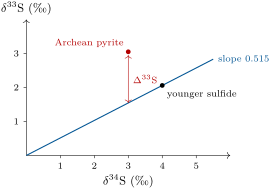
An element with three isotopes or more has a mass-dependent fractionation when the fractionations of its isotope ratios are in the ratio of their mass differences, as set by the masses; otherwise it has a mass-independent fractionation, measured by the departure from the mass-dependent line, such as .
For oxygen, the fractionation of is about 0.52 times that of , close to the ratio of the mass differences, 1 to 2; for sulfur, . Mass-independent fractionation is rare: it is found in meteorites, in stratospheric ozone and in Archean sulfur.
14.2 Rayleigh distillation in the water cycle
An air mass that cools makes cloud droplets or snow crystals, which fall and leave. Each condensate is richer in the heavy isotopes than the vapour, so the vapour left grows lighter, and the next condensate, in equilibrium with it, is lighter too.
Proposition 14.4 (Rayleigh distillation)
Let a reservoir of vapour lose its water by condensates, each removed as soon as it forms in equilibrium with the vapour. If is the fraction of the vapour left and the condensate–vapour fractionation factor, the ratio of the vapour obeys . For a constant this is Rayleigh distillation:
and the condensate formed at has .
Proof. Let be the number of molecules of vapour (almost all light) and the number of heavy ones. Removing molecules of condensate removes heavy ones: . Hence , which is the differential law with . With a constant it integrates to the power law. ∎
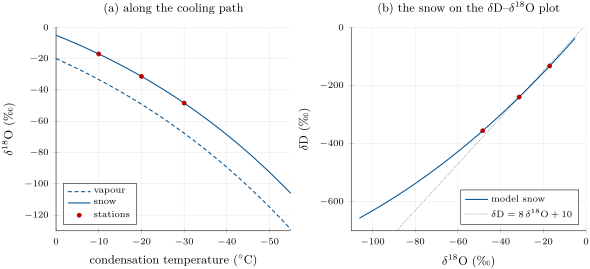
When depends on the temperature, along the path. For an air mass cooled at constant pressure, the vapour it can hold is set by the saturation pressure, so , which the sublimation curve of ice gives below . The figure below integrates the law for an air mass whose vapour starts at with an assumed and . Real vapour over the ocean is lighter than equilibrium with seawater would make it, about instead of in oxygen-18, because evaporation is partly kinetic.
Definition 14.5 (Deuterium excess)
The deuterium excess of a water sample is , in per mil.
Precipitation from the continents of the Northern Hemisphere lies on the line : its deuterium excess is about . Slope 8 is close to the ratio of the equilibrium fractionations of the two isotopes in condensation. The excess of 10, not 0, records the kinetic evaporation from the ocean, and the excess of a sample measures how far from equilibrium its water evaporated.
Definition 14.6 (Temperature, amount and continental effects)
The temperature effect is the decrease of and of precipitation with the local temperature. The amount effect is their decrease with the amount of rain, in the tropics. The continental effect is their decrease inland, at a given temperature.
All three are Rayleigh distillation seen from the ground. At high latitudes the temperature effect dominates: the annual means of Greenland and North Atlantic stations follow and (in per mil, with the mean annual surface temperature in ). In the tropics the amount effect dominates: on one ocean island, monthly rain loses about of oxygen-18 for every more rain. The simple model of the figure above gives a steeper slope, about per degree of condensation temperature. The slopes are not comparable directly: the surface of an ice sheet is colder than the air where the snow forms, and the model ignores the mixing of air masses and the kinetic effects of snow formation, so the slope against the surface temperature is calibrated, not computed.
14.3 Palaeothermometry
Definition 14.7 (Palaeothermometry, palaeotemperature equation)
Palaeothermometry is the measurement of past temperatures from the composition of materials formed then. A palaeotemperature equation is a calibrated relation between the temperature of formation of a mineral and its fractionation with the water it grew from.
For calcite precipitated slowly from water, one calibration gives
with both values on the VSMOW scale. Carbonates are reported on the VPDB scale, converted by . Near the fractionation falls by about per degree of warming.
Method 14.8 (A carbonate palaeotemperature)
- convert the of the calcite from VPDB to VSMOW;
- estimate the of the water the shell grew from, on VSMOW, correcting the present value for the ice volume of the time;
- compute ;
- invert the calibration: .
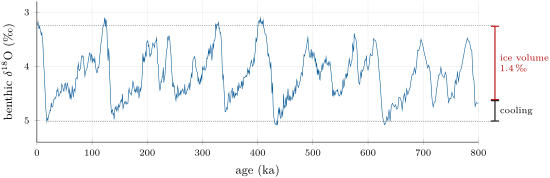
The second step is the hard one. During a glaciation the ice sheets store light water, and the ocean grows heavier. Each metre of sea level corresponds to about of ocean ; the last glacial lowered sea level by about , which made the ocean about heavier. Organisms add their own offsets, the vital effects, and a shell can exchange oxygen with pore water after burial.
Definition 14.9 (Clumped isotopes)
Clumped isotopes are molecules or groups that contain two heavy isotopes bonded together. In carbonates, is the excess, in per mil, of the abundance of groups, measured as mass-47 carbon dioxide, over a random distribution of the isotopes.
The heavy isotopes bond together slightly more than chance would have them, and the more so the colder the crystal. The excess depends only on the temperature of growth, not on the composition of the water: one unified calibration is (in per mil, in kelvins) from 0.5 to . Measured together with , it gives both the temperature and the composition of the water. Its sensitivity is small, about per degree near , which demands long measurements.
14.4 Carbon isotopes
Photosynthesis fractionates carbon kinetically. The diffusion of carbon dioxide into a leaf costs about , the enzyme RuBisCO ; plants of the common C3 pathway end to lighter than the air, and average about , those of the C4 pathway about . Organic carbon is light, and the inorganic carbon it is made from grows heavier.
Definition 14.10 (Organic carbon burial fraction)
The organic carbon burial fraction is the fraction of the carbon leaving the ocean and atmosphere that is buried as organic matter rather than as carbonate.
Proposition 14.11 (Carbon isotope mass balance)
At steady state, with inputs of composition and burial of carbonate and organic carbon , the carbon isotope mass balance is
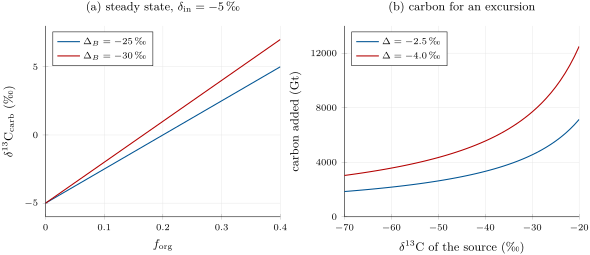
Proof. At steady state the carbon that enters equals the carbon that is buried, and so does carbon-13; with values the balance of carbon-13 is a mass-weighted mean of the values, to the approximation of Proposition 14.2. Substituting and solving gives . ∎
The inputs, from volcanoes and the weathering of old carbonates and organic matter, are taken at about , the mantle value; has stayed between and ; and carbonates have kept a near 0, within about , through most of Earth history. The balance then gives the classical : a fifth of the carbon is buried as organic matter, and with it the oxygen that photosynthesis released stays in the air. Recent work argues that varied more than this constancy suggests.
Definition 14.12 (Carbon isotope excursion)
A carbon isotope excursion is a geologically brief shift of the of carbonates and organic matter worldwide, followed by a return, recorded in sedimentary sections.
Proposition 14.13 (Mass of an excursion)
Carbon of composition and mass , mixed into an exchangeable reservoir of mass and composition , shifts it by when
Proof. The mixture has , linear in . ∎
At the onset of the Palaeocene–Eocene Thermal Maximum, between 55.5 and , the carbon of the ocean and atmosphere fell by 2.5 to in less than . The required carbon is about 2000 to if it was methane at , 6000 to if it was organic carbon at : the lighter the source, the less carbon is needed. Read backwards with the proposition and , these estimates imply an exchangeable reservoir of to of carbon.
14.5 Sulfur and the oxygen of the air
Bacterial sulfate reduction makes light sulfide, and its fractionations are all mass dependent. Archean sedimentary sulfides and sulfates do something no younger rock does: before their reaches ; between 2.45 and it stays below ; after it vanishes. In the laboratory, ultraviolet light breaking sulfur dioxide makes mass-independent sulfur. Without oxygen and ozone in the air, ultraviolet light reached the lower atmosphere and split volcanic sulfur dioxide; the products, sulfate with negative and elemental sulfur with positive , reached the sediments separately. Once oxygen rose, the ozone screen stopped the photolysis and the oxidation of the products mixed them again. The disappearance of the signal is among the sharpest records of the rise of atmospheric oxygen, which other evidence places about 2 to ago.
In the lab — From an ice core to a temperature
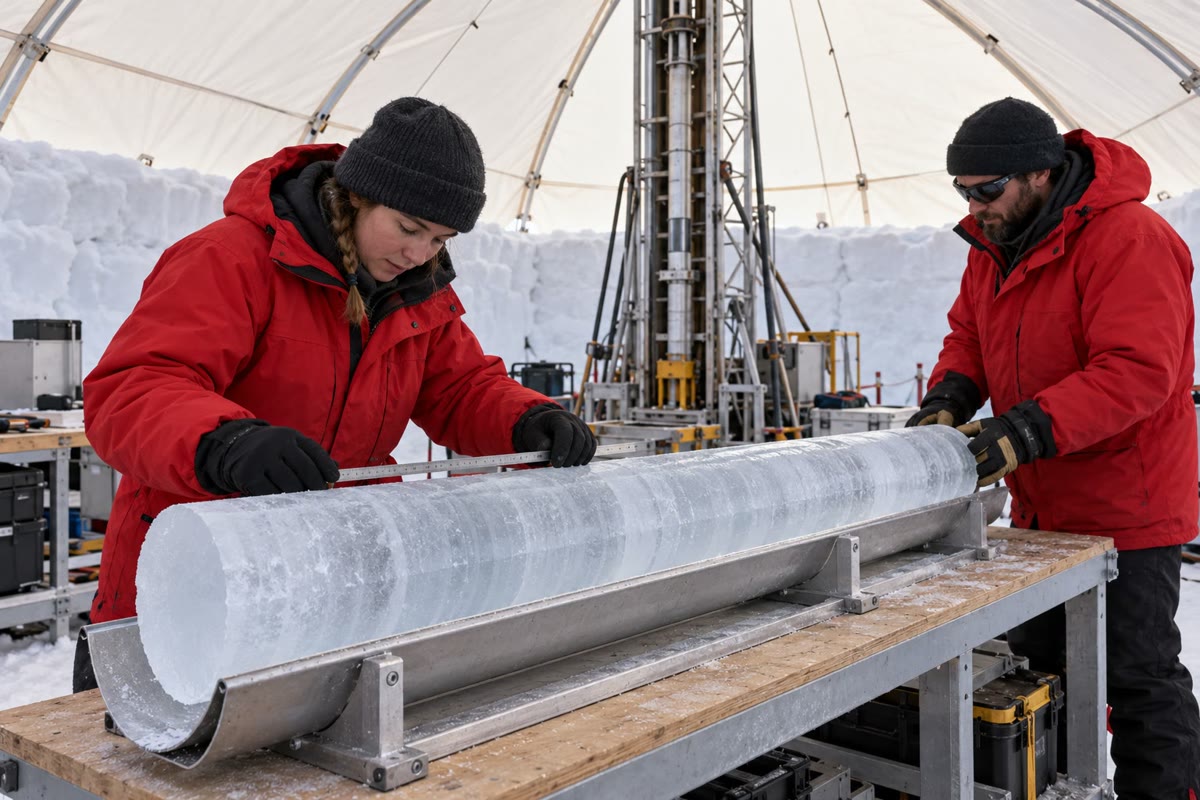
In a drilling tent on an ice sheet, the core is measured, logged and cut into lengths as it comes up. In the laboratory, a sampling line melts it continuously from one end, and the meltwater flows to an instrument that measures and every few centimetres, a resolution of years near the top. For carbonates, the geochemists dissolve a few tens of micrograms of a foraminifer in phosphoric acid and measure the carbon dioxide released in a gas-source mass spectrometer that compares it, again and again, with a reference gas. Every result is tied to the international scales by standards run in the same session.
14.6 Exercises
Exercise 14.1 ★
A calcite has and the water it grew from , both on VSMOW. Compute , and . How far apart are the last two?
Solution
Solution of Exercise 14.1.
; ; . They differ by , the of the proposition.
Exercise 14.2 ★
A high-latitude coastal station has a mean annual temperature of . With the relations of the chapter for such stations, predict the , and deuterium excess of its precipitation.
Solution
Solution of Exercise 14.2.
; ; .
Exercise 14.3 ★
In a basin, carbonates have and organic matter . With inputs at , compute .
Solution
Solution of Exercise 14.3.
; .
Exercise 14.4 ★
A brachiopod shell has . With the calibration of the chapter, at what temperature did it grow?
Solution
Solution of Exercise 14.4.
, , .
Exercise 14.5 ★★
Vapour leaves the ocean at and rains out with a constant . What fraction of it is left when the vapour reaches ? What is the of the rain then?
Solution
Solution of Exercise 14.5.
, : of the vapour has rained out. The rain: .
Exercise 14.6 ★★
Snow at is compared with ocean water at 0. Compute , , and between them. Which of the approximations of the proposition fails, and by how much?
Solution
Solution of Exercise 14.6.
; ; ; . Both approximations miss by about , the second by twice as much as the first: at the expansion to first order is no longer enough.
Exercise 14.7 ★★
A foraminifer has VPDB and grew in water at VSMOW. Compute its temperature of growth with the method of the chapter, and how much an error of on the water changes it.
Solution
Solution of Exercise 14.7.
VSMOW; ; , . The fractionation changes by about per kelvin, so on the water is about .
Exercise 14.8 ★★
The benthic stack changes by from the present to the last glacial maximum. Remove the ice-volume share computed in the chapter and convert the rest into a change of deep-water temperature, using the slope of the calcite calibration near .
Solution
Solution of Exercise 14.8.
Ice volume ; the rest, . Near the slope is , so the deep water was about colder.
Exercise 14.9 ★★
A pyrite has and . Compute . What does it say about the atmosphere when the pyrite formed?
Solution
Solution of Exercise 14.9.
, far from 0: mass-independent sulfur, which forms only without an ozone screen. The pyrite formed under an atmosphere without significant oxygen, before about .
Exercise 14.10 ★★★
In closed-system condensation, the vapour and all the condensate formed stay together in equilibrium. Show that the vapour then has , and compare it with Rayleigh distillation for and .
Solution
Solution of Exercise 14.10.
The heavy isotope is conserved in the closed system: , so . For , : , the vapour is lighter; Rayleigh gives , lighter. Removing each condensate at once drives the vapour twice as far.
Exercise 14.11 ★★★
From the estimate that of methane carbon at shifts the exchangeable carbon by , find the reservoir mass implied, with . With that mass, how much organic carbon at gives the same shift? Compare with the published range.
Solution
Solution of Exercise 14.11.
. Then , a little below the published 6000 to , whose upper end corresponds to the larger excursion.
Exercise 14.12 ★★★
Show that, along a cooling path, . At , where the vapour of the model of the chapter has and the sublimation curve gives , compute this slope.
Solution
Solution of Exercise 14.12.
, so , and gives . At , : for the vapour.
14.7 Problem: A Raindrop’s Journey to Dome Ilse
Problem 14.1
Weekend problem — the isotopes of the snow along an invented traverse, a palaeotemperature and a carbon excursion
An air mass leaves the edge of an invented ice sheet at with vapour of and , and cools at constant pressure as it travels inland. Snow forms at the Coast station at , at Midway at and at Dome Ilse at , when the fraction of the vapour left is , and . Use the ice–vapour fractionation factors of the chapter, constant over each leg at the value of its mid temperature.
Part I — Distillation.
- Compute and at , , , , and (five significant figures for oxygen, four for deuterium).
- Compute the of the vapour on arrival at the Coast.
- Compute that of the Coast snow.
- Repeat for Midway (the leg ratio of is ).
- Repeat for Dome Ilse.
- What fraction of the original oxygen-18 of the vapour is still in the air at Dome Ilse?
Part II — Temperature and deuterium.
- Compute the slope of the snow’s against the condensation temperature from the Coast to Dome Ilse.
- Which mean annual surface temperature would the relation of the Greenland stations assign to the snow of Dome Ilse? Why can it differ from ?
- Compute the of the snow at the three stations in the same way.
- Compute their deuterium excess. How does it change inland?
- Is the snow of Dome Ilse on the meteoric water line? What does the model leave out that real snow formation includes?
Part III — A foraminifer off the coast. A sediment core off the coast gives benthic foraminifera of VPDB at the top and at the last glacial maximum; the bottom water is VSMOW today.
- Compute the present bottom-water temperature with the calcite calibration.
- Compute the glacial temperature assuming the water unchanged. Is the result possible?
- Correct the glacial water for a sea-level fall of and recompute. What is the glacial cooling of the bottom water?
- Compute the expected at both temperatures and their difference.
- Why does the clumped-isotope thermometer not need the composition of the water?
Part IV — A carbon excursion. Deeper in the core, carbonates of are interrupted by a brief excursion of .
- Before the excursion, with and , compute .
- Take the reservoir of exercise 11, at 0. How much carbon does the excursion need if the source is methane at ?
- And if it is organic carbon at ?
- And if it is mantle carbon at ?
- Which observation in the same core could help choose between the sources?
- State the of the snow falling at Dome Ilse.
Solution
Solution of Problem 14.1.
1. : 1.01605, 1.01691, 1.01779, 1.01872, 1.01968, 1.02068; : 1.1424, 1.1524, 1.1630, 1.1744, 1.1866, 1.1997 (at to ).
2. .
3. .
4. Vapour ; snow .
5. Vapour ; snow .
6. : of the oxygen-18, against of the water: the vapour has lost the heavy isotope faster.
7. per degree.
8. . The relation is for surface temperatures; over an ice sheet the surface is much colder than the air where the snow forms, and the model ignores mixing and kinetic effects.
9. Vapour , , ; snow , , .
10. ; then 10.7 and : the excess grows inland. The local slope of the distillation, , falls below 8 as the vapour grows very light ( shrinks much faster than ), so the snow drifts above the line.
11. The line gives ; the snow is above it. The model has only equilibrium fractionation; real snow forms in supersaturated air, with a kinetic effect, and air masses mix with others on the way.
12. ; ; , .
13. , , , : colder than seawater can be without freezing. The change cannot be all temperature.
14. ; ; , : a cooling of .
15. and : a difference of .
16. It measures how the heavy isotopes are arranged within the mineral, an internal equilibrium that depends on temperature only.
17. .
18. .
19. .
20. , more than the reservoir itself, in a geologically brief time: implausible.
21. The depth and extent of carbonate dissolution in the core, which measures how much carbon entered the ocean, independently of its composition; with the excursion’s size it fixes .
22. The snow at Dome Ilse has ( with varying continuously).