书籍暂未推出简体中文版——当前显示英文版。
University Earth and Space Sciences — Year 3 · 本科三年级
11Thermodynamics of Rocks
A garnet a few millimetres across grew zone by zone as its schist was buried and heated. Its rim still records, in its calcium, iron and magnesium, the last equilibrium it reached with the biotite and plagioclase around it. The Year 2 volume turned such compositions into a temperature and a pressure with two calibrated equations. This chapter opens the box: where the equations come from, how far tables of measured enthalpies and entropies can be trusted, how many minerals a rock can hold, how solid solutions mix and unmix, and how a computer turns a bulk composition into a map of the assemblages it should show.
You already know
The Gibbs energy, the chemical potential, the activity and the equilibrium constant, the variance and the phase rule, the miscibility gap and the lever rule are in the chemistry books’ university volumes. The univariant reaction, its Clapeyron slope , the invariant point and the aluminosilicate diagram computed from tables are in the Year 2 volume, in its chapter on metamorphic facies; the geothermometer and geobarometer, the garnet–biotite exchange thermometer and the GASP barometer, in its chapter on P–T–t paths; ternary diagrams and the cotectic, in its chapter on magmas. A solid solution and its end members are in the Year 1 volume, in its chapter on minerals.
11.1 Equilibrium from tables
For a reaction among minerals of fixed composition, equilibrium at the temperature and pressure is . Tables give, at and , the enthalpy of formation, the entropy and the molar volume of each mineral, and the heat capacity above. The Year 2 volume took , and as constants. The general result is the following.
Theorem 11.1 (Gibbs energy of a reaction at and )
Let a reaction have, at and , the enthalpy and entropy , the heat capacity change and, among solids, a volume change independent of and . Then
and the equilibrium line is .
Proof. At , and ; integrating from gives and , and . At fixed , , constant by hypothesis; integrating from 1 to adds . Setting gives the line. ∎
The two integrals partly cancel: their sum is , in which the factor is negative and small where is close to . Among solids, is itself small, because the heat capacity of a mineral is nearly the sum of those of its oxides. The constant-property approximation is therefore good, and the tables say how good. For the GASP reaction,
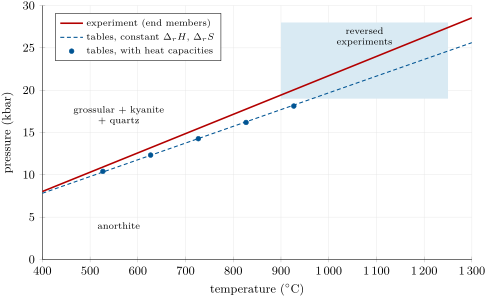
the summary table gives , and , so a line of slope ; the high-temperature tables, which include the heat capacities, give at each , and the two lines differ by less than up to (the figure below).
The experiments do not agree as well. Reversed in a piston-cylinder press at 900 to , the reaction lies higher than the tables at and higher at . With , is an error of in ; the uncertainties of the four enthalpies of formation, for grossular, for anorthite and kyanite, for quartz, combine to about in . Calorimetry fixes each mineral to a few kilojoules; a reaction among large formula units multiplies these errors and divides them by a small volume change.
Definition 11.2 (Internally consistent thermodynamic dataset)
An internally consistent thermodynamic dataset is a table of the standard properties of many minerals and fluids (enthalpy of formation, entropy, volume, heat capacity, thermal expansion and compressibility) adjusted together, within the uncertainties of calorimetry, so that every equilibrium computed from it passes through the reversed experiments on which it was fitted.
Such a dataset is fitted once, by weighted least squares or by linear programming over all the brackets at once, and then used for every reaction among its minerals, including reactions never studied in the laboratory. Its numbers are not independent measurements: one enthalpy may be shifted by a kilojoule to fit a reaction it takes part in. Values from different datasets must never be mixed.
11.2 The phase rule in rocks
The phase rule of chemistry gives the variance of a system of components in phases. A rock is such a system, and its minerals show which part of the pressure–temperature plane it equilibrated in.
Proposition 11.3 (Mineralogical phase rule)
A rock that has reached equilibrium at a pressure and temperature chosen freely within an area of the pressure–temperature plane holds at most as many phases as it has components: . This is the mineralogical phase rule.
Proof. The phase rule gives independent intensive variables. If the pressure and temperature can both vary without changing the assemblage, two of them are free: , so . A rock with phases lies on a univariant line; with , at an invariant point; neither is likely for a rock picked at random. ∎
A rock that breaks the rule either equilibrated on a reaction line, which its textures may show, or never reached equilibrium as a whole: corona textures, zoned minerals and relict grains are common reasons. Counting components needs care. A component held only in one phase of fixed composition, such as zircon, can be dropped with its phase; a component fixed by an external reservoir, such as water when a fluid flows through the rock, is not counted as free, since its chemical potential is imposed.
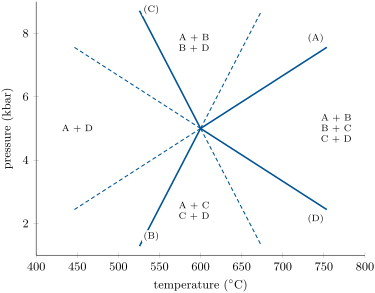
Around an invariant point, the univariant lines do not cross at random. In a system of components, phases meet at the point and reactions radiate from it, each written among phases and named after the phase it omits, in brackets.
Definition 11.4 (Schreinemakers analysis)
Schreinemakers analysis is the method that arranges the univariant lines around an invariant point from the compositions of the phases alone, before any measurement of their thermodynamic properties: it fixes the order of the lines, the side of each line that is stable, and the assemblages of each sector between them.
Method 11.5 (Schreinemakers’ rules)
(1) Write the reactions, each without one phase. (2) Each line is stable on one side of the point and metastable on the other. (3) The metastable extension of the () line, which omits the phase , lies in a sector where is stable. (4) No sector between two consecutive stable lines spans more than . (5) Across a line, the assemblages on either side are those of the two sides of its reaction. Fixing one line with data then fixes the whole bundle, up to a mirror image.
The aluminosilicate triple point of the Year 2 volume is the simplest case, and three lines. The figure below shows a two-component case computed by minimising the Gibbs energy at every point.
11.3 Solid solutions
Most rock-forming minerals are solid solutions, and their end members appear in reactions through their activities. The Year 2 volume took for the grossular in a garnet and for the anorthite in a plagioclase. Both are cases of one model.
Definition 11.6 (Site-mixing activity model)
In a site-mixing activity model, the ions of a mineral mix at random on each crystallographic site, independently of the other sites. The ideal activity of an end member is then the product, over the sites, of the fraction of each site it fills raised to the number of such sites per formula unit: .
A garnet has three dodecahedral sites for , , and : . A garnet with holds of grossular, but its activity is . The ideal model counts the configurations; real solutions also have an excess energy, because ions of different sizes strain the lattice.
Definition 11.7 (Gibbs energy–composition diagram)
A Gibbs energy–composition diagram plots, at fixed temperature and pressure, the molar Gibbs energy of each phase of a system against its composition. The stable assemblage of any bulk composition lies on the lower convex hull of the curves: a single phase where its curve is on the hull, two phases at the ends of a common tangent.
Proposition 11.8 (Regular solution)
In a binary solution with one mixing site per formula unit and the interaction energy , the Gibbs energy of mixing is
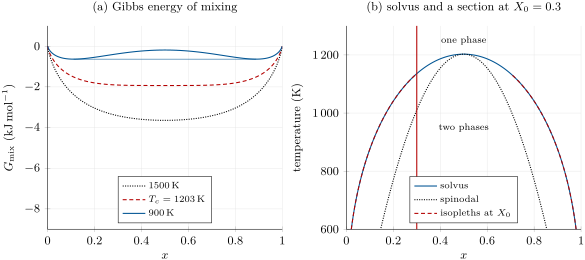
If , the solution is stable at every composition above ; below the curve has two inflections and the compositions between the two points of its common tangent split into two phases.
Proof. The first term is times the configurational entropy of random mixing; the second, the simplest excess energy, symmetric and zero at both ends. Differentiating twice, . Its minimum over is at , where it equals , which is positive for every if . Below, on an interval around : the curve bends down there, a straight line between two points of the curve lies below it, and by the definition above the rock is two phases. ∎
Definition 11.9 (Solvus, exsolution)
The solvus is the curve, in the temperature–composition plane, that bounds the miscibility gap of a solid solution: below it, a single crystal of intermediate composition is unstable and splits into two. Exsolution (mineral) is that splitting within a crystal on cooling: lamellae of one composition grow in a host of the other.
Alkali feldspars, pyroxenes and amphiboles show exsolution lamellae, visible under the microscope or to the eye: the perthite of many granites is an exsolved alkali feldspar, a potassium-rich host with sodium-rich lamellae. Between the solvus and the spinodal, where , a crystal must first nucleate the second phase; inside the spinodal, any small fluctuation of composition grows by diffusion alone.
11.4 Pseudosections
Panel (b) of the figure above is already a small pseudosection: for one bulk composition, it says which phases are stable at each temperature, and what their compositions and proportions are. A metamorphic rock has some ten components and many solid solutions, but the principle is the same.
Definition 11.10 (Gibbs energy minimisation)
Gibbs energy minimisation finds, at a given temperature and pressure, the set of phases, their compositions and their amounts that minimises the total Gibbs energy of a system of fixed bulk composition, subject to the conservation of each component.
Definition 11.11 (Pseudosection, isopleth, effective bulk composition)
A pseudosection is a phase diagram, usually in the pressure–temperature plane, computed for one fixed bulk composition: it is divided into fields, each labelled by the assemblage that minimises the Gibbs energy there. An isopleth (pseudosection) is a line of a pseudosection along which a compositional variable of one phase, or its amount, is constant. The effective bulk composition is the part of the rock’s composition that still takes part in the equilibrium, once the cores of zoned crystals, porphyroblasts sealed off from the matrix and other isolated material are removed.
A pseudosection does not show univariant lines in the sense of the Year 2 volume: in a system with solid solutions, the boundary between two fields is where one phase appears or disappears, and its position depends on the bulk composition. Reading one is direct. The observed assemblage fixes a field; the measured composition of a mineral, the calcium of a garnet rim for instance, picks an isopleth inside it; a second isopleth, of another element or another mineral, crosses it at the pressure and temperature of equilibrium. Zoned garnets carry a sequence of such crossings, one for each zone, along the path of the rock. But as the garnet grows its core takes manganese and calcium out of reach of the matrix: the effective bulk composition changes, and the pseudosection must be recomputed for the later zones.
In the lab — The petrologist’s desk
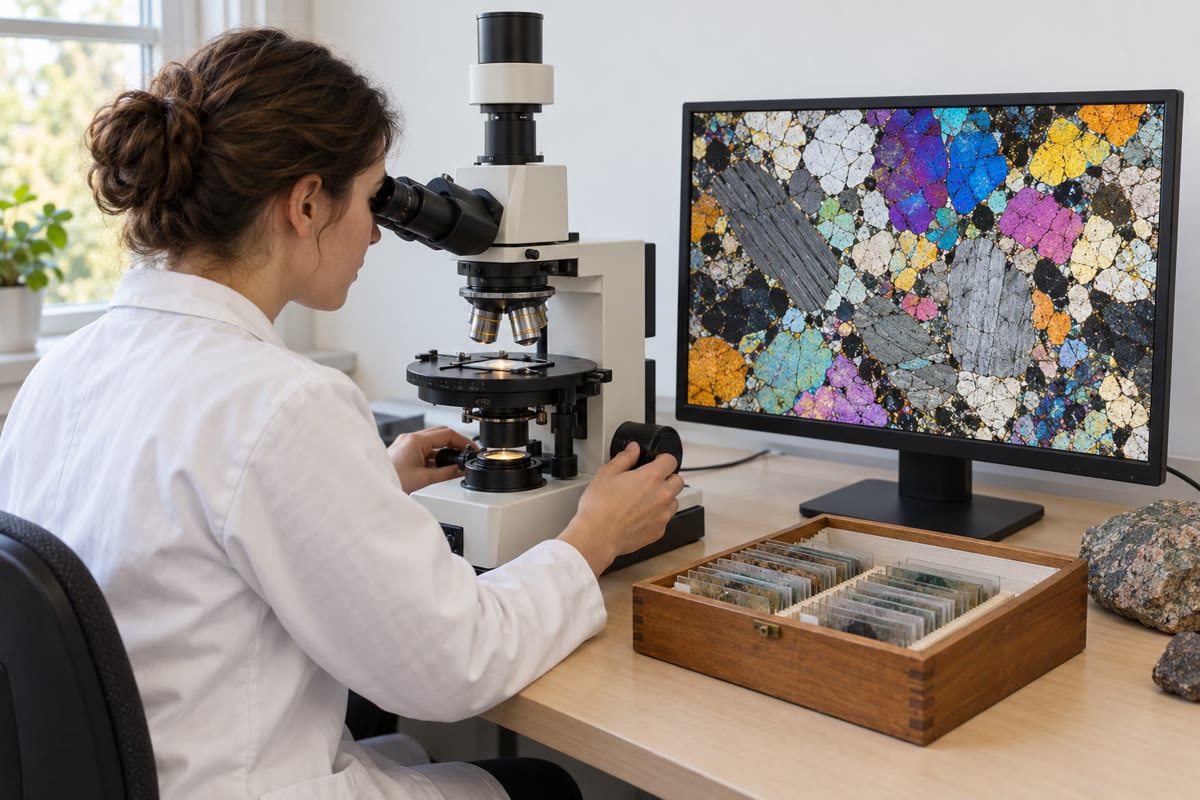
The petrologist first studies a thin section under the polarising microscope, to identify the assemblage, its textures and which grains grew together. The same section, coated with carbon, then goes into an electron microprobe, which measures the composition of spots a few micrometres across along profiles through the garnets. Software that minimises the Gibbs energy with an internally consistent dataset and a set of activity models computes a pseudosection for the bulk composition, measured on a slice of the same rock. The isopleths of the measured compositions are plotted on it, and where they cross is the answer. The uncertainty of the dataset and of the activity models, not that of the measurements, usually limits it.
11.5 Exercises
Exercise 11.1 ★
From the tables, albite has , , ; jadeite , 133.5, 60.40; quartz , 41.5, 22.69 (per mole). For albite = jadeite + quartz, compute , , (in ), the Clapeyron slope and the pressure of the line at with constant properties.
Solution
Solution of Exercise 11.1.
; ; . Slope . At : .
Exercise 11.2 ★
A rock of the system – holds forsterite, enstatite and quartz. Apply the mineralogical phase rule. What do you conclude?
Solution
Solution of Exercise 11.2.
and : the rule is broken. The three phases coexist only on the univariant line of ; a rock picked at random is not there, so the assemblage records an incomplete reaction, for instance forsterite armoured by a rim of enstatite that kept it from the quartz.
Exercise 11.3 ★
Compute the ideal activities of grossular and pyrope in a garnet with and , and of anorthite in a plagioclase with (one site).
Solution
Solution of Exercise 11.3.
; ; .
Exercise 11.4 ★
Compute the critical temperature of a regular solution with . What gives ?
Solution
Solution of Exercise 11.4.
; .
Exercise 11.5 ★★
At , the tables give the Gibbs energies of formation (grossular), (anorthite), (kyanite) and (quartz), in . Compute of the GASP reaction at and its equilibrium pressure, and compare with the experimental line (bar, ).
Solution
Solution of Exercise 11.5.
; . The experimental line gives , higher.
Exercise 11.6 ★★
For the regular solution of the figure (), compute at and , then at the solvus limb . Show that splitting a crystal of composition 0.5 into the two limbs lowers its Gibbs energy, and by how much.
Solution
Solution of Exercise 11.6.
. At : . At : , and the same at 0.889 by symmetry. Equal amounts of the two limbs have the bulk composition 0.5 and the Gibbs energy : splitting lowers it by .
Exercise 11.7 ★★
How many phases meet at an invariant point, and how many univariant lines radiate from it, in a system of three components? In the bundle of the figure, check that each of the four reactions is balanced.
Solution
Solution of Exercise 11.7.
phases and 5 lines. (D) : . (A) : . (C) : . (B) : .
Exercise 11.8 ★★
A rock of bulk composition in the regular solution of the figure has cooled to , where the solvus limbs are 0.111 and 0.889. Compute the proportion of each phase.
Solution
Solution of Exercise 11.8.
By the lever rule, the phase at 0.889 makes , , and the phase at 0.111 .
Exercise 11.9 ★★
With the GASP barometer (bar), compute at and . By how much does an error of 0.01 in move the pressure?
Solution
Solution of Exercise 11.9.
per unit of : an error of 0.01 moves the pressure by .
Exercise 11.10 ★★★
Show that the spinodal of a regular solution is . At what temperature does a crystal of composition 0.3 become unstable to any small fluctuation, for ? Compare with the temperature at which it reaches the solvus, , and explain the gap.
Solution
Solution of Exercise 11.10.
and , zero where . For : ; the solvus is reached at . Between the two, the crystal is metastable: splitting would lower its energy, but a small fluctuation raises it, so the second phase must nucleate.
Exercise 11.11 ★★★
Show that the solvus of a symmetric regular solution satisfies , and that it reaches its maximum, , at .
Solution
Solution of Exercise 11.11.
Since , the common tangent touches the curve at two symmetric points and and is horizontal: , which is the equation. Solving, . With , and , so as ; and for , grows as approaches 1/2, so this limit is the maximum.
Exercise 11.12 ★★★
A rock holds . Garnet cores containing make up of the rock and are sealed off from the matrix. Compute the content of the effective bulk composition. Why does it matter for the pseudosection of the garnet rims?
Solution
Solution of Exercise 11.12.
. Manganese favours garnet: with less of it in the effective bulk composition, the rims grow in a different field and along different isopleths than the whole-rock analysis would predict.
11.6 Problem: The Garnet of the Varden Schist
Problem 11.1
Weekend problem — the pressure and temperature of an invented schist, from tables, the phase rule, activity models and thermobarometry
The schist of the Varden Hills basement, metamorphosed about ago, holds garnet, biotite, muscovite, plagioclase, kyanite and quartz. At the rim of a garnet and in the grains around it, the microprobe gives: garnet , , , ; biotite ; plagioclase . Use the tables of this chapter for the GASP reaction, the Year 2 volume’s thermometer
and its experimental barometer , with in and in kelvin. Take , a crustal density of and .
Part I — The tables.
- From the summary table, compute , and of the GASP reaction.
- Compute at and . Which side is stable at the surface?
- Compute the end-member pressure at with constant properties, and the Clapeyron slope.
- The high-temperature tables give at and at (). Compute the pressures.
- Compare with the experimental line at the same temperatures.
- What error in would explain the gap at ? Compare with the combined uncertainty of the four enthalpies.
- Why do the heat capacities change the result so little?
Part II — The phase rule.
- List the components needed to describe the six minerals and a water fluid, and count the phases.
- Compute the variance with the phase rule, and check the mineralogical phase rule.
- A second sample holds kyanite and sillimanite side by side. What does it say about its pressure and temperature?
- Water flowed through the rock during metamorphism. How does that change the count?
Part III — Activities and thermobarometry.
- Compute the ideal activities of grossular and anorthite, and of the GASP reaction in the rock.
- Compute of the garnet–biotite exchange.
- Compute the temperature at .
- Compute the GASP pressure at that temperature.
- Iterate to the intersection of the two equations.
- Redo the intersection with the end-member line of the tables in place of the experimental line (with ). Which result do you keep, and why?
- By how much does an error of 0.05 in move the result?
Part IV — The burial.
- With the constant properties of the Year 2 volume, kyanite = sillimanite has , , . Is the result in the kyanite field?
- Compute the depth of burial.
- The garnet core has and grew with plagioclase of the same , at about the same temperature. Was the core formed deeper or shallower than the rim?
- Give the peak pressure and depth of burial of the Varden schist.
Solution
Solution of Problem 11.1.
1. ; ; .
2. : positive, so anorthite is stable at the surface.
3. ; slope .
4. at ; at .
5. At 626.85 and the experimental line gives 13.2 and : 0.9 and above the tables.
6. . The combined uncertainty is : the gap is 1.6 times it, possible for calorimetry, and the reason the line is taken from the experiments.
7. is small among solids, and its two integrals partly cancel: the tables move the line by only 26 and .
8. , , , , , , , and : . Phases: garnet, biotite, muscovite, plagioclase, kyanite, quartz and fluid, .
9. : pressure, temperature and two compositional variables. : the rule holds, and the assemblage can be stable over an area of the pressure–temperature plane.
10. Two pure polymorphs in equilibrium lie on the univariant line kyanite = sillimanite: one relation between and , and a thermometer then gives the pressure.
11. The fluid imposes the chemical potential of water: 8 free components for 6 solid phases, , and still holds.
12. , ; .
13. .
14. , or .
15. ; ; .
16. At , , then ; at that pressure and , unchanged after: and .
17. and . The tables put the end-member line about too low (Part I); the experimental line is kept.
18. With : and , less.
19. At : , below : kyanite, as observed.
20. .
21. : the core grew about shallower. The garnet grew during burial, and its rim records the deepest point.
22. The Varden schist reached a peak pressure of at , a burial of about .