书籍暂未推出简体中文版——当前显示英文版。
University Earth and Space Sciences — Year 3 · 本科三年级
24Glaciology
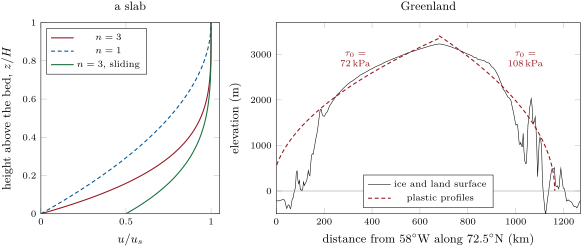
Cross Greenland from west to east along the parallel N. The ice begins a few tens of kilometres inland, rises steeply, then ever more gently, to a broad summit high, and falls again to the mountains of the east coast. Plotted, the surface is close to a parabola lying on its side, with its vertex at the margin. This chapter shows where that shape comes from: from a material that creeps faster and faster as it is pushed harder, so that it behaves almost as if it could not bear more than a certain stress. It then follows the ice from the snow that feeds it to the sea that receives it.
You already know
Glaciers, ice sheets, ice shelves, icebergs, sea ice, permafrost and the ice ages are in the school books. Flow laws and dislocation creep are in Chapter 7; satellite gravimetry and the ice-sheet mass balance it measures in Chapter 3; ice cores and their oxygen isotopes in Chapter 14. The sea-level budget, the ice–albedo feedback and thermosteric sea-level rise are in the Year 2 volume, in its chapter on anthropogenic climate change. Latent heat and heat conduction are in the physics books.
24.1 Ice as a material
Glacier ice is a rock, a mass of interlocking crystals of ice, and it deforms close to its melting point. Under a stress it creeps by the motion of dislocations in its crystals, like the rocks of Chapter 7, and its flow law has the same form: a power of the stress times an Arrhenius factor.
Theorem 24.1 (Glen’s flow law)
In isotropic glacier ice the strain-rate tensor is proportional to the deviatoric stress,
with and a rate factor that grows with temperature. In simple shear, with the only non-zero deviatoric stress, .
Proof. The law itself is empirical: a power law fitted to creep experiments and to the deformation of glaciers, its coefficient and exponent fitted together. In simple shear and the other components vanish, so , and . ∎
With , ice is a strongly non-linear fluid: doubling the stress makes it deform eight times faster. Its effective viscosity, , is not a property of the ice alone but falls as the stress rises.
Definition 24.2 (Rate factor (ice))
The rate factor of Glen’s law, also called the softness of the ice, is written , with an activation energy . A widely used fit (Paterson and Budd) takes and below , and and above it, closer to the melting point, where the ice softens faster with temperature.
| temperature | |||
| () |
Ice at its melting point flows about fifty times faster than at under the same stress. Stresses in glaciers are of the order of a bar, .
A glacier moves in two ways. Its ice deforms by creep, everywhere; and where the bed is at the melting point, it may also slide.
Definition 24.3 (Basal sliding)
Basal sliding is the motion of a glacier over its bed, on a thin film of water or a layer of soft wet sediment. It requires a bed at the melting point; a glacier frozen to its bed moves only by the creep of its ice.
24.2 Glacier flow
Theorem 24.4 (Flow of a parallel-sided slab)
A slab of ice of thickness and density lies on a bed of slope and flows down it by simple shear, sliding at speed . At height above the bed the shear stress is , the velocity
and the flux per unit width . The basal shear stress is .
Proof. The ice above height has weight per unit area; its component along the slope, , is balanced by the shear stress on its base, the surface being free of stress. By Glen’s law, ; integrating from the bed, where , gives , and integrating from 0 to gives . ∎
The velocity changes little in the upper part of the slab and fast near the bed, where the stress is greatest: with the shear is concentrated in the lowest layers. The surface speed grows as and as the cube of the slope: a glacier twice as thick flows sixteen times faster.
Definition 24.5 (Shallow-ice approximation)
The shallow-ice approximation treats an ice sheet whose thickness is small against its width as locally a parallel-sided slab: at each place the ice deforms by simple shear under the driving stress , being the surface elevation, and the flux follows the slab formula with the local thickness and surface slope.
In the shallow-ice approximation the basal stress is set by the shape of the ice. Because the strain rate rises as the cube of the stress, a modest increase of stress produces a large increase of flow, which thins the ice and lowers the stress again: the stress stays within a narrow range, whatever the size of the ice mass. Take this to its limit, a material that does not deform at all below a yield stress and deforms without limit above it, and the shape follows.
Proposition 24.6 (Plastic ice-sheet profile)
A perfectly plastic ice sheet of yield stress on a flat horizontal bed has, at the distance inland from its margin, the surface height
Proof. Everywhere the basal stress equals the yield stress: , the slope being small. Then , and at the margin. ∎
24.3 Mass balance
A glacier is fed by snow and loses ice by melting, evaporation and, where it reaches water, by breaking off.
Definition 24.7 (Mass balance; accumulation and ablation zones; equilibrium line)
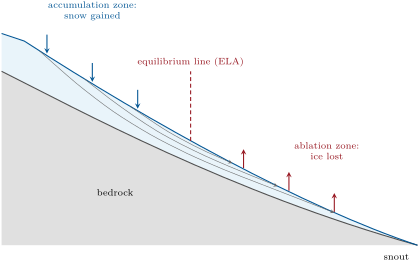
The glacier mass balance is the change of the mass of a glacier over a year, usually given in metres of water equivalent averaged over its area. The surface mass balance is its part due to the processes at the surface, snowfall minus melting, runoff and sublimation; the rest is lost by calving and by melting at the base or under floating ice. The accumulation zone is the part of the surface where the surface mass balance over a year is positive, the ablation zone the part where it is negative, and the equilibrium-line altitude (ELA) the elevation of the line between them, where it is zero.
On the ice sheets and the high glaciers, snow is not turned into ice in a season. It is buried by later snow, compressed, and recrystallised.
Definition 24.8 (Firn; pore close-off)
Firn is snow that has survived at least one melt season and is being compacted into ice: denser than snow, still permeable to air. Pore close-off is the point in its compaction, at a density of about , where the pores between the grains are sealed into bubbles and the air in them is cut off from the atmosphere.
On the polar ice sheets pore close-off lies below the surface, depending on the temperature, the accumulation and the impurities; the air of an ice core’s bubbles is therefore younger than the ice around it, as Chapter 14 recalled. For most glaciers the change from snow to ice takes more than a hundred years.
A glacier does not respond at once to a change of its climate. Its thickness must change before its length can follow.
Proposition 24.9 (Glacier response time)
A glacier of typical thickness whose balance at the terminus is (in metres of ice per year) adjusts to a change of climate over a time of the order of
Proof. A change of the balance by over the glacier changes its volume until the area lost or gained at the terminus, where the balance is , compensates it: per unit width, for a glacier of length . The volume change needed is about , and the imbalance that drives it is per year, at first, so the change takes years. ∎
A glacier thick that loses of ice a year at its snout needs some forty years to respond. Glaciers therefore lag the climate: those of today will go on losing mass for decades even if the temperature stops rising.
24.4 Ice sheets and ice shelves
The ice sheets of Greenland and Antarctica hold more than of the land ice. Greenland’s covers and is more than thick at most; Antarctica’s covers almost and is nearly thick at most. Many parts of the Antarctic ice sheet rest on a bed below sea level.
Definition 24.10 (Ice stream)
An ice stream is a band of an ice sheet that flows much faster than the ice on either side of it, mostly by sliding or by the deformation of a soft wet bed, and drains a large part of the ice sheet’s interior towards its margin.
Definition 24.11 (Grounding line; calving)
The grounding line is the line where ice resting on its bed begins to float: seaward of it the ice is an ice shelf or a floating glacier tongue. Calving is the breaking off of blocks of ice, icebergs, at the front of a glacier or an ice shelf that ends in water.
Ice shelves float, so their melting does not raise sea level. But they are held at their sides and on the rises of the sea floor where they run aground, and the drag there resists the flow of the ice behind: they buttress it. After the Larsen B ice shelf disintegrated in 2002, the glaciers that had fed it sped up, up to eight times.
Proposition 24.12 (Flotation)
Ice of density and thickness over a bed at depth below sea level, in sea water of density , floats if . With and , the grounding line lies where the ice is thick.
Proof. Floating ice displaces its own weight of water: a column of thickness needs a draught . If the water is deeper than that draught, the ice floats. ∎
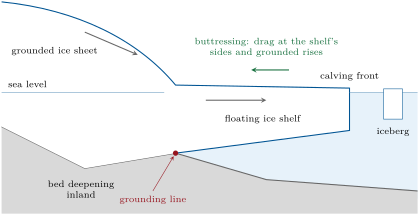
On a bed that deepens inland the grounding line is fragile. Where the water is deeper, the ice at the grounding line is thicker, by the flotation condition, and by the slab theorem the flux of a thicker column grows steeply with its thickness. If the grounding line retreats down such a slope, it reaches thicker ice that discharges more, thins faster, and lets the line retreat further.
Definition 24.13 (Marine ice-sheet instability)
Marine ice-sheet instability (MISI) is the proposed self-reinforcing retreat of the grounding line of an ice sheet resting on a bed that slopes down towards the interior: without the buttressing of an ice shelf, the grounding line on such a bed is inherently unstable until it reaches a bed sloping upward.
Ice shelves can hold a grounding line in place even on a downward slope. Models in which all the Antarctic ice shelves are removed and not allowed to reform lose ice equivalent to of sea level in 500 years through this instability, of it from West Antarctica. On ice sheets resting mostly on bedrock above sea level, like Greenland, the main self-reinforcing process is another: as the surface melts and lowers, it lies in warmer air and melts more.
Definition 24.14 (Sea-level equivalent)
The sea-level equivalent of a mass of land ice is the rise of the global mean sea level that its melting would cause if the water spread over the present ocean.
Proposition 24.15 (Sea-level equivalent of a mass of ice)
A mass of ice resting above sea level, spread over an ocean of area as water of density , raises the sea level by : about for each .
Proof. The water occupies the volume over the area . With the per millimetre adopted by the ice-sheet mass-balance assessments, : an ocean of about for water of the density of fresh water. ∎
Ice already below sea level displaces sea water, so it counts for less: Antarctica’s of ice are equivalent to about of sea level, less than its mass divided by .
In the field — A camp on the ice
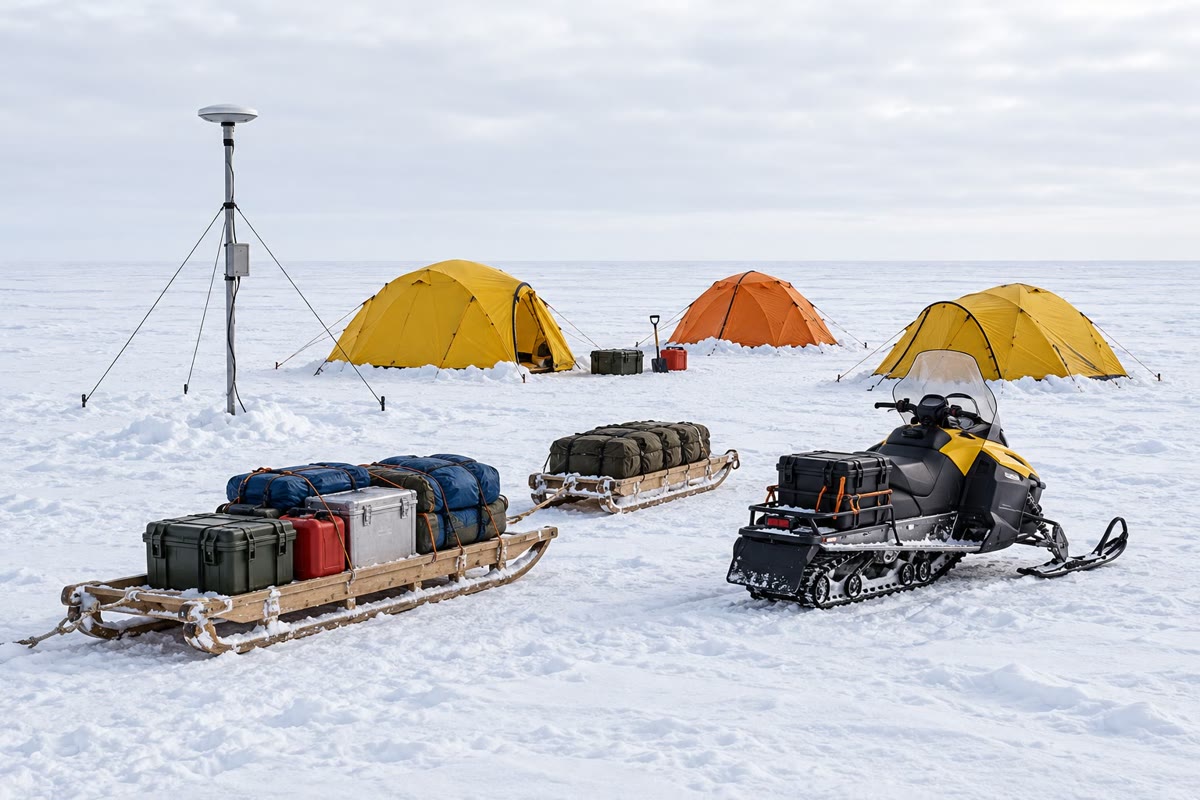
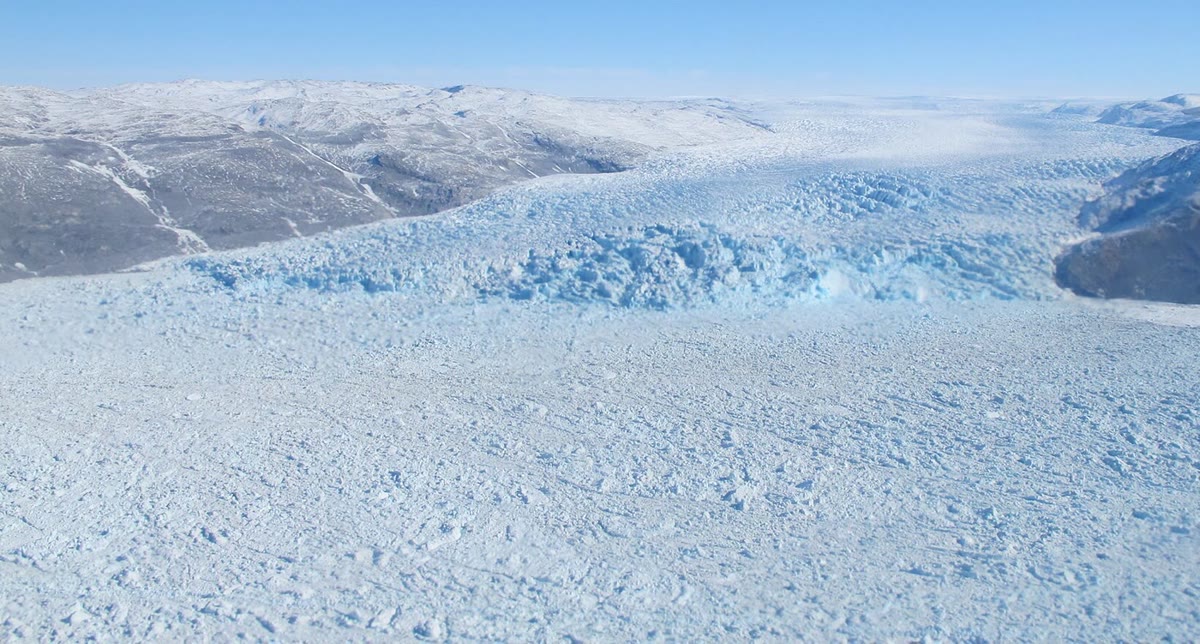
On an ice sheet the glaciologists’ instruments travel by sledge and live in tents. To measure how fast the ice moves, they freeze a pole into the snow and mount on it the antenna of a satellite-navigation receiver. The receivers used in geodesy fix a position to within a few centimetres, so positions repeated over weeks or seasons give the speed and the direction of the ice, and the height of the pole, surveyed again, the thinning or thickening of the ice beneath it.
24.5 Sea ice and permafrost
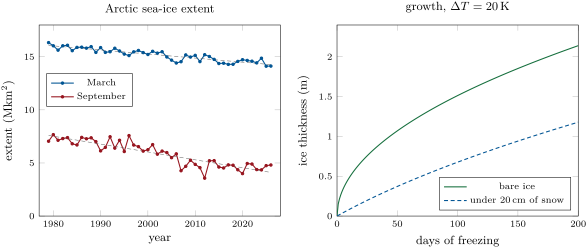
Sea ice forms, grows and melts in the ocean. In the Arctic it reaches its largest area in March and its smallest in September.
Definition 24.16 (Sea-ice extent)
The sea-ice extent is the total area of the cells of a satellite map in which sea ice covers more than of the surface. It is larger than the sea-ice area, which counts only the ice itself.
Since satellites began to map it in 1979 the Arctic extent has shrunk, in March and much more in September: by per decade in September, about of the 1981–2010 mean per decade, against , , in March. The smallest September extent so far, , was in 2012. Arctic sea ice reflects of the sunlight, the open ocean about : losing the ice darkens the surface, the ice–albedo feedback of the Year 2 volume.
Sea ice grows at its base, where sea water freezes on it, and the latent heat of that freezing must be conducted up through the ice to the cold air.
Theorem 24.17 (Stefan’s law)
Sea ice of thermal conductivity , density and latent heat of fusion , its surface held at a temperature below the freezing point of the water beneath, grows, if the heat from the ocean is negligible, as
Under a layer of snow of thickness and conductivity the growth rate is .
Proof. The temperature in the thin ice is linear, from the freezing point at the base to the surface temperature at the top, so the heat flux through it is , or, through ice and snow in series, . Freezing a layer releases per unit area, which this flux must carry away: . Then . ∎
With , and , a surface below freezing grows of ice in a hundred days and in two hundred. Snow, with a conductivity of , is a good insulator: of it more than halves the growth. Thick ice grows slowly, thin ice fast: the law tends to even out the thickness of the ice after a summer of melting.
Permafrost is ground that stays at or below for two years or more. It underlies about a quarter of the exposed land of the Northern Hemisphere.
Definition 24.18 (Active layer)
The active layer is the layer of ground above the permafrost that thaws each summer and freezes again each winter.
Its thickness is set, like the growth of sea ice, by the conduction of heat into the ground during the thaw season, against the latent heat of the ground’s ice. Permafrost temperatures have increased over the past three to four decades throughout the permafrost regions (high confidence); permafrost warmed globally by [] between 2007 and 2016 (medium confidence), and an increase of the active-layer thickness is a pan-Arctic phenomenon (medium confidence). Where its ice melts, the ground can collapse.
24.6 The cryosphere and sea level
The sea-level budget of the Year 2 volume adds the expansion of the warming ocean to the water added by the ice and by the land. Of the of sea-level rise observed over 2006–2018, glaciers contributed , Greenland and Antarctica : the ice together more than the expansion of the ocean, .
Figures as of 2021
Greenland lost of ice over 1992–2020 [4140 to 5640], of sea level, at rates rising from in the 1990s to in 2010–2019, by discharge and, increasingly, by surface melt (high confidence). Antarctica lost [1800 to 3540], , its rate rising from in the 1990s to in 2010–2019; the losses came from the outlet glaciers of West Antarctica, mainly through the melting of the ice shelves from below (high confidence). The glaciers outside the ice sheets lost over 1993–2019, , more in 2010–2019 than in any other decade of the record (very high confidence). Greenland will continue to lose mass throughout this century under all the scenarios considered (virtually certain), and so will Antarctica (likely): by 2100 Greenland likely adds to the sea level under a low-emissions scenario and under a very high one, Antarctica and . The Arctic Ocean will likely become practically free of sea ice, with less than of it, at its September minimum for the first time before 2050 under all the scenarios considered.
The ice-sheet losses are those of Chapter 3, measured by altimetry, by gravimetry and by the difference between the snow that falls and the ice that flows out: three independent methods brought into one estimate.
24.7 Exercises
Exercise 24.1 ★
A valley glacier thick flows down a slope of . Compute the basal shear stress, and compare it with the basal stresses of real glaciers, of the order of a bar.
Solution
Solution of Exercise 24.1.
, about : the order of the stresses under real glaciers.
Exercise 24.2 ★
(a) The Greenland ice sheet holds about of ice of density . Compute its mass and its sea-level equivalent at , and compare with the usually quoted. (b) Do the same for Antarctica’s , quoted as about . Why do the two compare so differently?
Solution
Solution of Exercise 24.2.
(a) ; divided by , , , the value quoted. (b) , against . Greenland’s ice rests mostly on bedrock above sea level, so all of it would add water to the ocean. Much of Antarctica’s rests on a bed below sea level: that ice already displaces sea water, and melting it only replaces the water it displaces; the floating ice shelves add nothing at all.
Exercise 24.3 ★
A glacier has an accumulation zone of with a mean balance of water equivalent, and an ablation zone of with . Compute its net balance in cubic metres of water, its mean specific balance, and its accumulation-area ratio. Is it growing or shrinking?
Solution
Solution of Exercise 24.3.
Gain , loss of water: net , a mean specific balance of water equivalent. The accumulation-area ratio is . The glacier is losing mass: shrinking.
Exercise 24.4 ★
At pore close-off the firn has a density of . What fraction of its volume is still pore space (ice: )?
Solution
Solution of Exercise 24.4.
and : about a tenth of the volume is still pore space when the pores close.
Exercise 24.5 ★★
A temperate glacier (ice at , ) is thick on a slope of . Compute its surface speed by internal deformation alone. By what factor would the speed change if it were twice as thick? If the slope were halved?
Solution
Solution of Exercise 24.5.
. By the slab theorem, . Twice as thick: , sixteen times faster. Half the slope: , eight times slower.
Exercise 24.6 ★★
From the Paterson–Budd constants, compute the rate factor at and , and the ratio of the speeds of two identical ice masses at and at .
Solution
Solution of Exercise 24.6.
At (), , or . At , . At (warm branch) . Under the same stresses the speeds are in the ratio of the rate factors: .
Exercise 24.7 ★★
Compute the greatest thickness of a plastic ice sheet from centre to margin with , and compare with the greatest thickness of the Antarctic ice, nearly .
Solution
Solution of Exercise 24.7.
, close to the of Antarctica: the plastic model gets the thickness of an ice sheet from its width alone.
Exercise 24.8 ★★
A glacier thick loses of ice a year at its snout. Estimate its response time. If the climate warmed abruptly and then stayed constant, how long would its length go on changing?
Solution
Solution of Exercise 24.8.
. The length would go on adjusting for several decades, a few response times, after the warming stopped: today’s glaciers have not yet caught up with today’s climate.
Exercise 24.9 ★★
(a) Using Stefan’s law with , compute the thickness of bare sea ice after 100 days, and the time needed to reach . (b) What does this suggest about ice thicker than ?
Solution
Solution of Exercise 24.9.
(a) . Since , takes days, more than a winter. (b) Ice much thicker than cannot grow by freezing in one winter: it is ice that has survived several, or ice piled up by the wind and the currents in ridges.
Exercise 24.10 ★★★
(a) Where the bed is below sea level, how thick is the ice at the grounding line? (b) Using the slab flux for a given surface slope, by what factor does the flux of the grounded ice rise if the grounding line retreats to where the bed is deep? (c) Explain why a bed deepening inland makes the retreat self-reinforcing, and what an ice shelf changes.
Solution
Solution of Exercise 24.10.
(a) . (b) At the grounding-line thickness is , of the former; the flux rises by . (c) As the line retreats down a bed deepening inland, the ice at the line is thicker, discharges more, thins the ice behind, and the line retreats further: a positive feedback. An ice shelf buttressing the grounded ice reduces the flux at the grounding line and can hold it in place even on a downward slope.
Exercise 24.11 ★★★
Show that the volume of a circular plastic ice cap of radius is . By what factor does its sea-level equivalent grow if its radius doubles?
Solution
Solution of Exercise 24.11.
With , , . Substituting ,
so . Doubling multiplies , and the sea-level equivalent, by .
Exercise 24.12 ★★★
The mean Arctic extent was in March 1979 and in March 2026; in September, and . (a) Compute the relative change in each month. (b) Give two physical reasons why the September extent has fallen so much faster than the March extent.
Solution
Solution of Exercise 24.12.
(a) March: ; September: . (b) In March the ice edge is held largely by the coasts that surround the Arctic Ocean, and refreezing each winter fills the basin again; the thinner ice of recent years melts out more completely each summer. And the ice–albedo feedback acts in summer: open water absorbs about of the sunlight, ice reflects , so each loss of summer ice warms the water and melts more.
24.8 Problem: The Arkel Ice Cap
Problem 24.1
Weekend problem — the shape, flow, balance and sea-level equivalent of an invented ice cap
The invented Arkel ice cap lies on a flat plateau. It is nearly circular, in radius, and its ice is at about . Take and .
Part I — Is the cap plastic?
- Show that under ice of thickness with a small surface slope the basal shear stress is about .
- Radar soundings and surveys at 5, 10 and from the centre give thicknesses of 580, 470 and and surface slopes of , and . Compute the basal shear stress at the three points.
- Is the cap close to plastic? What yield stress do you adopt?
- With , compute .
- Predict the thickness at the three points from the plastic profile and compare with the soundings.
Part II — Shape and volume.
- Compute the thickness at the centre.
- Show that the volume is .
- Compute the volume in cubic kilometres.
- Compute the area and the mean thickness.
- An ice cap twice as wide on the same plateau: by what factor is its volume larger?
Part III — Flow and balance.
- Compute the rate factor at in .
- At from the centre, treating the ice as a slab, compute the surface speed by internal deformation.
- Compute the ice flux per unit width there, and the mean velocity of the column.
- In a steady state, the flux leaving the circle of radius equals the balance gained inside it. What mean balance, in metres of ice per year, does this require?
- The equilibrium line lies above the plateau. Where is it on the cap, and what is the accumulation-area ratio?
- If the ice warmed to , by what factor would the speeds rise? What would happen to the cap’s shape?
Part IV — Sea level.
- Compute the mass of the cap in gigatonnes.
- Compute its sea-level equivalent in millimetres.
- If the whole cap thinned by of ice a year, without flowing, how long would it last?
- Why would the real cap disappear sooner than that, once it began to thin?
- At the rate at which Greenland lost ice in 2010–2019, how long would it take to lose a mass equal to the Arkel cap?
- Give the sea-level equivalent of the Arkel ice cap, in millimetres, to one decimal.
Solution
Solution of Problem 24.1.
1. The column above the bed, of weight per unit area, is pushed downslope by the component , balanced by the shear stress on its base; for small slopes (the slab theorem with the surface slope).
2. ; ; .
3. The stress is the same within while the thickness almost halves: the cap is close to plastic, with .
4. .
5. : , and at 15, 10 and from the margin, within a few metres of the soundings.
6. .
7. As in Exercise 24.11: .
8. .
9. ; mean thickness , , a little over half the central thickness.
10. times.
11. , times : .
12. At , , slope , ; .
13. ; mean velocity , four-fifths of the surface speed.
14. , so of ice a year over the inner .
15. where , at ; the accumulation area is the disc inside it, of the cap.
16. rises by , and so do the speeds under the same stresses. The ice would flow out faster than the balance supplies it: the cap would thin and spread until the stresses, lower, again matched the balance; a softer plastic cap has a smaller yield stress and a flatter profile.
17. .
18. .
19. years.
20. As the surface lowers it lies in warmer air and melts faster, the elevation–mass balance feedback; and as it thins the stresses and the flow change too. The thinning accelerates.
21. : the whole cap is less than two years of Greenland’s loss in 2010–2019.
22. The Arkel ice cap holds a sea-level equivalent of ().