University Physics — Year 2 · Bachelor Year 2
12Electromagnetic Energy and the Poynting Vector
A battery lights a bulb through two copper wires. Where does the energy travel? Not inside the copper, it turns out: the electrons there drift at a millimetre per second and carry next to nothing. The energy flows through the space around the wires, in the electromagnetic field, and enters the bulb’s filament through its sides. The Sun delivers a kilowatt to every square metre of a sunny roof the same way, across a hundred and fifty million kilometres of vacuum. This chapter derives from Maxwell’s equations the balance sheet of electromagnetic energy — how much is stored in a field, and the vector, Poynting’s, that says where it goes — and applies it to a wire, a capacitor, a coil and a beam of light.
12.1 The energy balance of the field
Theorem 12.1 (Poynting’s theorem)
Define the electromagnetic energy density and the Poynting vector
Maxwell’s equations imply, at every point,
and, for any fixed volume bounded by ,
the field energy inside decreases by what flows out through the boundary — the flux of — and by what the field gives to the charges (, the Joule power in a conductor). is the energy flux density: the power crossing a unit surface normal to it.
Proof. From Maxwell–Ampère, , so . The identity (check it on the components) and Maxwell–Faraday give . Collect: . Integrate over and apply the divergence theorem. ∎
Remark 12.2 (What is and is not fixed)
The theorem fixes only the flux of through closed surfaces and the total ; adding to any divergence-free field would change nothing observable. The choice above is the simplest, it is the one that agrees with the momentum carried by light (below), and it is used universally. The densities and are the energies of the capacitor and of the inductor of the Year 1 volume, now assigned to every point of space: a field of (the breakdown limit of air) stores , a field of stores — a hundred thousand times more, which is why energy storage in magnets, not in capacitors, reaches the megajoule.
12.2 Where the energy flows: three circuits
Example 12.3 (The resistive wire)
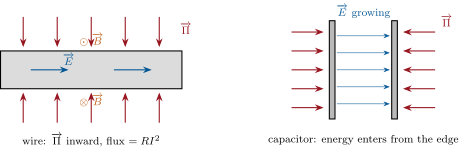
A cylindrical wire of radius carries the steady current under the field along its axis; just outside it, (azimuthal). At the surface, points radially inward, with magnitude ; its flux through the lateral surface of a length is : the Joule heat enters the wire through its sides, delivered by the surrounding field, not carried down the wire by the electrons. Inside, : the inward flow decreases toward the axis as the energy is deposited layer by layer.
Example 12.4 (The capacitor and the solenoid)
A capacitor with circular plates being charged: axial, (Chapter 11), so , inward; through the cylinder of radius and height its flux is : the electric energy enters from the edge. A solenoid whose current grows: axial, the induced , , again inward, with flux . In every case the energy reaches the device through the field outside it; the wires only guide the field.
Remark 12.5 (Energy in a static crossed field)
A charged capacitor placed in the field of a permanent magnet has everywhere between its plates, although nothing changes and nothing heats. There is no contradiction: there has zero divergence, its lines close on themselves, and its flux through any closed surface vanishes — the theorem says nothing about a circulating flow that delivers nothing. Only fluxes through closed surfaces are physical.
12.3 Light: intensity and radiation pressure
Proposition 12.6 (Energy of a plane wave)
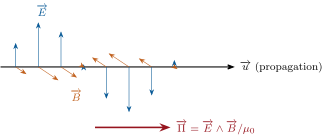
For a plane wave in vacuum — the solution of Chapter 13, with , and — the electric and magnetic energy densities are equal and
being the direction of propagation: the energy travels at . For a sinusoidal wave of amplitude the intensity (irradiance) is the mean flux,
and the wave carries a momentum density (admitted), so that it exerts on a surface it strikes at normal incidence the radiation pressure if absorbed and if reflected.
Proof. ; along ; . The momentum density follows from the Lorentz force on the charges of the absorbing surface (or from relativity: for light): the momentum arriving per unit time on a surface is a force . ∎
Example 12.7 (Sunlight, laser, microwave)
Sunlight at the top of the atmosphere, : , , energy density , pressure — of force on a square kilometre, yet enough to steer a solar sail and to blow the dust of a comet into its tail. A laser pointer on a spot: , like the Sun; focused to : , , near the breakdown of air. A microwave oven with a standing wave filling : energy density J/m and of a few kilovolts per metre.
Method 12.8 (Energy bookkeeping)
(1) Find and (statics, quasi-statics or waves). (2) Form and . (3) Choose a closed surface around the device and compute the flux of : it must equal the Joule power plus the rate of change of the stored energy inside — a check on the fields. (4) For a wave, the mean of is the intensity; divide by for the pressure, by the photon energy for the photon flux.
12.4 Exercises
Exercise 12.1 ★
Sunlight at the ground, : amplitudes and , energy density, radiation pressure on a black roof and on a mirror; force on a roof; photon flux per square metre for an average photon energy of .
Solution
Solution of Exercise 12.1.
, ; ; (black), (mirror); on the roof; .
Exercise 12.2 ★
A laser pointer, beam diameter : intensity, , ; the same beam focused to a spot; a () pulsed laser focused to : , compared with the field binding the electron in a hydrogen atom ().
Solution
Solution of Exercise 12.2.
Area : , , . Focused to : , . Petawatt: , , five hundred times the atomic field — the atom is torn apart in a cycle.
Exercise 12.3 ★
Energy densities: an electric field of (breakdown of air); of (a thin insulator); a magnetic field of , (MRI), (record magnet). Energy in a MRI bore; the equivalent in litres of petrol ().
Solution
Solution of Exercise 12.3.
: , . : , , . The MRI bore holds — of petrol.
Exercise 12.4 ★
A solar sail of , perfectly reflecting, at the Earth’s distance (): force; acceleration of a craft; speed gained in a month; compare with the Sun’s gravity on the craft at that distance ().
Solution
Solution of Exercise 12.4.
; ; in a month; the Sun pulls with : the sail cannot fight gravity, it tacks against it in orbit.
Exercise 12.5 ★★
A copper wire of radius carries (). (a) inside, at the surface, at the surface (direction and magnitude). (b) Flux of into of wire; compare with . (c) inside the wire and the power deposited between and ; check it is . (d) Where does the energy come from — describe the field between the battery and the wire.
Solution
Solution of Exercise 12.5.
(a) , ; ; , radially inward. (b) per metre; , . (c) , so and the shell receives . (d) The battery’s surface charges set up an electric field along the whole circuit, outside the wires; there carries the energy from battery to load.
Exercise 12.6 ★★
Capacitor of circular plates (, ) charged by . (a) , , between the plates. (b) Flux of through the lateral cylinder; show it equals . (c) For , , at the instant : at the edge and the power entering. (d) Is the magnetic energy negligible?
Solution
Solution of Exercise 12.6.
(a) axial, azimuthal, . (b) . (c) ; ; times : with . (d) Yes: smaller by -type factors (Chapter 11).
Exercise 12.7 ★★
A long solenoid (, radius ) whose current increases. (a) Induced inside; ; direction. (b) Flux through the lateral surface per unit length and . (c) Just outside the solenoid (where ), what is ? How then does the energy get in? (Think of where the current flows: the winding is a thin sheet; take the surface just inside it.)
Solution
Solution of Exercise 12.7.
(a) , : inward while grows. (b) . (c) Outside , so : the energy is injected at the winding itself, where the generator drives the current against the induced field ( there); just inside the sheet is already the inward flow of (a).
Exercise 12.8 ★★
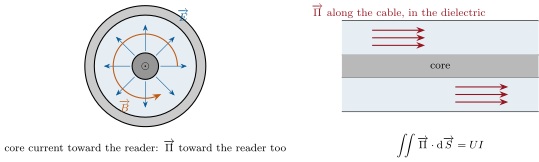
Where the power of a cable travels. A coaxial cable (radii , ) carries a steady current in the core, back in the braid, under the voltage between them (perfect conductors). (a) and in the dielectric () from Gauss and Ampère. (b) : direction and magnitude. (c) Integrate over the annulus : show the result is — the whole power travels in the insulator. (d) With a slightly resistive core, in which direction does tilt, and what does its flux into the core equal?
Solution
Solution of Exercise 12.8.
(a) radial, azimuthal. (b) , along the core current. (c) . (d) gains an axial component ; tilts toward the core, and its radial flux into a metre of core is per metre.
Exercise 12.9 ★★
Comet dust. A spherical dust grain of radius and density at distance from the Sun absorbs the sunlight ( at , solar mass ). (a) Radiation force and gravitational force; show that their ratio is independent of . (b) Radius below which the grain is blown away. (c) Why do comet tails point away from the Sun, and why do they curve?
Solution
Solution of Exercise 12.9.
(a) , : ratio , independent of . (b) Ratio for . (c) Fine dust is pushed away from the Sun while keeping the comet’s orbital speed, so the dust tail points away and curves; the ion tail, driven by the solar wind, is straight.
Exercise 12.10 ★★★
A discharging capacitor. The capacitor of Exercise 12.6 discharges through the wire of Exercise 12.5 ( per metre, length ). (a) Direction of at the capacitor’s edge now. (b) Power leaving the capacitor, power entering the wire; what happens to the difference (if any)? (c) Write the energy balance and check it against , . (d) Why does the magnetic energy of the circuit not appear in the balance at the beginning and at the end?
Solution
Solution of Exercise 12.10.
(a) : points outward at the edge. (b) leaves the capacitor and enters the wire; in the quasi-static regime they are equal — nothing accumulates in between. (c) , . (d) vanishes at both ends () and is negligible in between for a small loop.
Exercise 12.11 ★★★
The charged magnet. Between the plates of a charged capacitor () sits a uniform field (a magnet). (a) ; its divergence. (b) Take the closed surface of a box inside the region: flux of . (c) Where do the lines of go, and what closes them? (d) A proposal: measure the energy flow with a small absorber placed in the gap — would it heat? Why not?
Solution
Solution of Exercise 12.11.
(a) , uniform: . (b) Zero. (c) Along through the gap, closing through the fringing fields at the edges of the plates and of the magnet. (d) A body at rest in static fields carries no current: , no heating. The circulating is bookkeeping, not a flow that deposits energy.
Exercise 12.12 ★★★
Standing wave. Two counter-propagating plane waves of equal amplitude form , (check it against Maxwell–Faraday). (a) ; its time average. (b) Energy density; where is it electric, where magnetic, and how does it slosh? (c) A perfectly conducting mirror at reflects the incoming wave: force per unit area on it from the momentum argument, and from the Laplace force on its surface current (use the boundary relation for ). (d) Show both give on average.
Solution
Solution of Exercise 12.12.
Faraday: equals since . (a) : mean zero. (b) : electric at , magnetic at , sloshing between them twice per period. (c) Momentum: each wave has , the reflected one reverses its momentum: . Laplace: at , just outside and inside, so ; the force per unit area on the sheet is . (d) Its mean is .
12.5 Problem: The energy of a line, a panel and an oven
Problem 12.1
Weekend problem — following the electromagnetic energy from a power line into a house, from the Sun into a solar panel, and from a magnetron into a cup of water
Part I — The line. A coaxial power cable (core radius , braid radius , dielectric ) carries a direct current at ; the core has conductivity .
- Fields and in the dielectric (perfect conductors first); values at .
- Poynting vector in the dielectric; its flux through the annular section: check it equals .
- Energy densities and at (in a dielectric the electric energy density carries ); which dominates, and by how much?
- At what fraction of the speed of light does the energy "move" (take at )? Compare with .
- Now the core is resistive: field inside it; the Poynting vector just outside its surface acquires a radial component: magnitude, and the power per metre it delivers to the core; check against per metre.
- Ratio of the radial to the axial component of at : what does it say about where the energy goes?
- Magnetic energy per metre of cable, , and electric energy per metre, ; recover them as and with the inductance and capacitance per metre of Chapter 8.
- A line: power delivered, power lost, fraction. Repeat with and (same power).
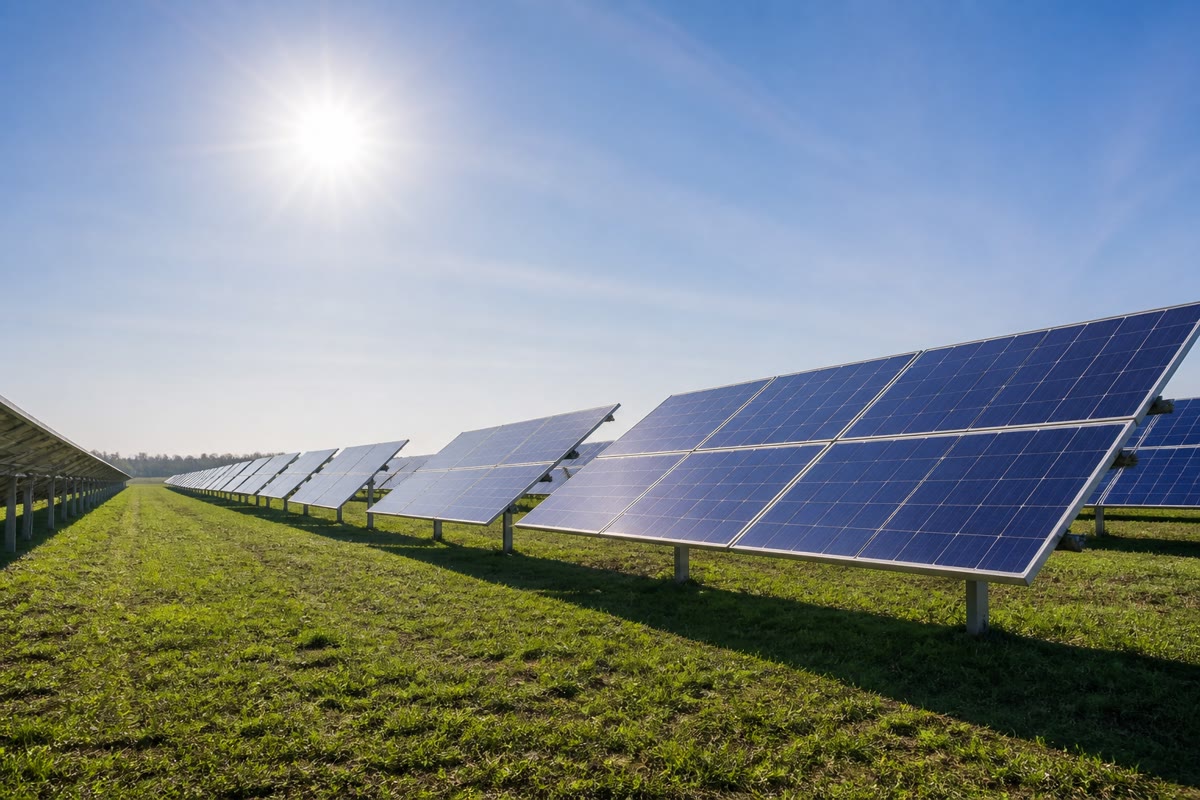
Part II — The panel. Sunlight at noon on a clear day: ; a photovoltaic panel of and efficiency; photon energy on average.
- , , energy density and photon flux in the beam.
- Electric power delivered; heat to be evacuated; temperature rise if the panel loses heat by both faces at .
- Radiation pressure on the panel (absorbing); force; compare with its weight ().
- Energy received per day ( of equivalent full sun) and per year; the area needed to supply a household’s .
- The panel produces at : check the power; Poynting flux along the of two-wire cable to the inverter — where, in the field picture, does that power travel?
- At the Earth’s orbit the Sun radiates : total power of the Sun; the mass it converts per second (, ).
- Number of photons striking the panel per second.
- Photon momentum flux at the Earth: total radiation force of the Sun on the Earth (disk radius , absorbing); compare with gravity ().
Part III — The oven. A microwave oven delivers at into a cavity of ; a cup of of water absorbs of it.
- Wavelength; is the cavity large compared with it? Why are the walls metal?
- Time to heat the water from to (); power absorbed per unit volume.
- If the power flowed as a plane wave through the cup’s section, intensity and ; actual fields are standing waves of comparable amplitude — how far apart are the hot spots, and why does the plate turn?
- Energy stored in the cavity field if its quality factor is when empty: stored energy, mean energy density, — compare with the breakdown of air ().
- Water absorbs because its molecules are dipoles driven at : the local Joule-like power is with for water: in the water needed for the power density of question 16; is it consistent?
- Photon energy at in eV, and the number of photons absorbed per second by the cup; why microwaves can heat but not ionize (ionization needs some ).
- Radiation pressure of the cavity field on the walls (of the order of the energy density ): is it worth worrying about?
- Why does an empty oven (no load) risk damage, in Poynting terms?
- Sum up in a table, for the line, the panel and the oven: the carrier of energy, ’s direction, the power, and what converts it.
Solution
Solution of Problem 12.1.
1. : at ; : at .
2. ; .
3. , : comparable.
4. , : .
5. ; inward; ; , .
6. : almost all the energy runs down the line; a whiff leaks into the copper.
7. lost of , ; at : , .
8. with ; electric: with : .
9. , , , .
10. electric; of heat over of faces: .
11. ; against a weight of .
12. , ; five panels, .
13. ; the power flows in the field between the two wires — across , around the currents — not in the copper.
14. ; .
15. photons per second.
16. : of gravity.
17. ; the cavity is a few wavelengths — a resonator with modes, not a free beam; metal walls reflect the wave (skin depth of micrometres) and hold it in.
18. at : ; .
19. , ; hot spots apart — hence the turntable.
20. ; ; — a hundred times below breakdown.
21. : inside the water — of the order of the cavity field, reduced by the water’s permittivity: consistent.
22. ; photons per second; a million times too little energy per photon to ionize.
23. : no.
24. With nothing to absorb it, the flux of has nowhere to end but back into the magnetron, which overheats.
25. Line: the dielectric, axial, , a load at the end. Panel: the beam, along the Sun’s rays, in, out, the semiconductor. Oven: the cavity field, circulating, , the water’s dipoles.