A ball in a bowl rolls back and forth with whatever energy it was given; an electron in an atom, a nucleon in a nucleus, an electron in a nanometre-sized crystal can only have certain energies, and the lowest of them is not zero. A ball cannot cross a hill higher than its energy allows; an α particle leaves a nucleus through a Coulomb wall it could never climb, the needle of a scanning tunnelling microscope draws a current across a gap of vacuum, and the nitrogen atom of ammonia swings through the plane of its three hydrogens twenty-four billion times a second. This chapter solves the Schrödinger equation in the simplest potentials — wells with infinite and finite walls, a step, a barrier, a double well — and finds in them the two great quantum facts that classical mechanics cannot produce: the quantisation of bound energies, and tunnelling through classically forbidden regions, with its exponential sensitivity to the width and height of the barrier, which is why it can serve as a ruler of picometres and why radioactive lifetimes span thirty orders of magnitude.
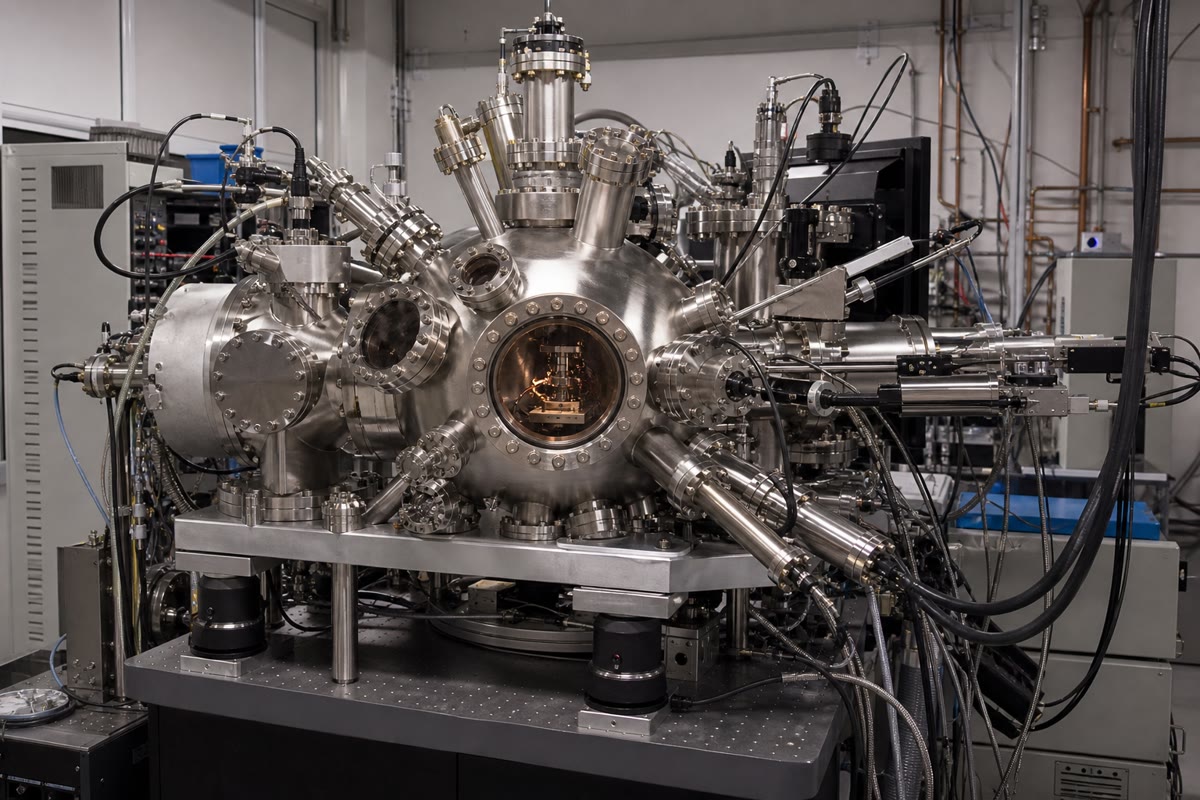
A scanning tunnelling microscope: a metal tip held a few tenths of a nanometre above a surface; the tunnelling current, which changes tenfold per tenth of a nanometre, maps the surface atom by atom.
31.1 The infinite well
Proposition 31.1(Infinite square well)
A particle confined to 0<x<L by impenetrable walls (V=0 inside, V=∞ outside, so φ=0 at the walls) has the stationary states and energies
φn(x)=L2sinLnπx,En=8mL2n2h2=n2E1,n=1,2,3,…
The energies are quantised, grow as n2, and the lowest is not zero: the confinement energyE1=h2/8mL2 is the price of localisation (Δx∼L forces Δp∼h/2L). The φn are orthogonal, ∫φnφmdx=δnm, and any state of the well is a superposition of them.
Proof. Inside, φ′′=−k2φ with k2=2mE/ℏ2: φ=Asinkx+Bcoskx; φ(0)=0 kills B, φ(L)=0 requires kL=nπ — the standing waves of a string, with E=ℏ2k2/2m. Normalisation gives A=2/L; orthogonality is that of the sines. ∎
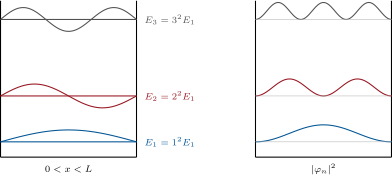
The infinite well: the first three levels, En∝n2, with their wave functions (left) and probability densities (right) — n−1 nodes, and a ground state that is spread over the well and has a non-zero energy.
Example 31.2(Orders of magnitude, and colours)
E1=h2/8mL2: an electron in 1nm, 0.38eV; in 0.1nm (an atom), 38eV — the scale of atomic energies; a nucleon in 5fm, 8MeV — the scale of nuclear energies; a marble in a box, 10−63J — no one will notice. A semiconductor nanocrystal a few nanometres across (a quantum dot) confines its electrons: the confinement energy adds to the crystal’s gap, so the smaller the dot, the bluer the light it emits — the same material glows red at 6nm and green at 3nm, tuned by size alone.
31.2 The finite well
Proposition 31.3(Finite square well)
For V=0 in ∣x∣<a and V=V0 outside, a state with 0<E<V0 oscillates inside (k=2mE/ℏ) and decays outside (κ=2m(V0−E)/ℏ): φ∝e−κ∣x∣ beyond the walls. Matching φ and φ′ at x=±a gives, for the even and odd states,
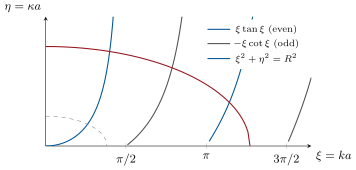
Graphically, the solutions are the intersections of the curves η=ξtanξ, η=−ξcotξ with the circle ξ2+η2=R2 (ξ=ka, η=κa): there is always at least one bound state (the even ground state), and 1+⌊2R/π⌋ in all. The particle penetrates the forbidden region over the depth 1/κ, and the levels lie below those of the infinite well of the same width.
Proof. The even solution is Acoskx inside and Be−κ∣x∣ outside; the continuity of φ′/φ at x=a gives −ktanka=−κ. Same for the odd one with sin. The circle is the definition of k and κ. Each branch of ξtanξ starting at ξ=nπ and of −ξcotξ starting at (n+21)π meets the circle once if it starts inside it: hence the count. ∎
Graphical solution of the finite well: the bound states are the intersections of the circle of radius R=a2mV0/ℏ with the branches ξtanξ (even states) and −ξcotξ (odd). Here R=4: three bound states; the dashed small circle (R=1.2) still cuts the first branch — a well always binds at least one state.
Example 31.4(An electron in a nanometre well)
V0=1eV, width 2a=1nm: R=a2mV0/ℏ=0.5×10−9×5.1×109=2.6, so 1+⌊2R/π⌋=2 bound states; the ground state lies near 0.26eV instead of the infinite well’s 0.38eV, and leaks 0.2nm into the walls (1/κ=ℏ/2m(V0−E)). Such wells, grown as layers of semiconductors a few nanometres thick, are the heart of the diode lasers of Chapter 23.
31.3 Step and barrier: tunnelling
Proposition 31.5(Potential step)
A particle of energy E coming from x<0 onto the step V=V0 for x>0:
E>V0: φ=eik1x+re−ik1x on the left, teik2x on the right, with k1,2=2m(E−V0,left/right)/ℏ; continuity of φ and φ′ gives r=(k1−k2)/(k1+k2) and the reflection probability (ratio of currents) R=r2, T=1−R=4k1k2/(k1+k2)2 — a particle can be reflected by a step it has the energy to climb, exactly as a wave on a string by a change of impedance (Chapter 15);
E<V0: on the right φ=te−κx, κ=2m(V0−E)/ℏ — an evanescent wave; ∣r∣=1 (total reflection, with a phase shift), no current flows into the step, but the particle is found there with a probability decaying over 1/κ.
Proof. Write the continuity equations at x=0 and solve; for the currents use j=(∣A∣2−∣B∣2)ℏk/m (Chapter 30). For E<V0, r=(k−iκ)/(k+iκ), of modulus one. ∎
Theorem 31.6(Tunnelling through a barrier)
A particle of energy E<V0 meeting a rectangular barrier of height V0 and width a is transmitted with the probability
This is the tunnel effect: classically impossible, quantum-mechanically exponentially small — and exponentially sensitive to the width a, the height V0−E and the mass m. For an electron 1eV below the top, κ=5.1nm−1: T∼10−2 for a=0.5nm, 10−4 for 1nm, 10−9 for 2nm; for a proton, κ is 43 times larger and nothing passes at these widths.
Proof.φ=eikx+re−ikx for x<0, Aeκx+Be−κx inside, teikx for x>a; four continuity conditions (of φ and φ′ at 0 and a) for four unknowns; eliminating A, B, r gives 1/∣t∣2=1+(k2+κ2)2sinh2(κa)/4k2κ2, which is the formula with k2=2mE/ℏ2, κ2=2m(V0−E)/ℏ2. For κa≫1, sinhκa≈eκa/2. For a barrier of arbitrary shape the exponent becomes 2∫κ(x)dx across the forbidden region (the Gamow factor, admitted). ∎
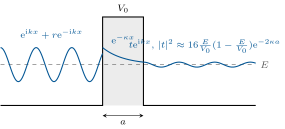
Tunnelling through a barrier: the wave oscillates on the left, decays exponentially inside the classically forbidden region, and emerges on the right with a reduced amplitude — the same wavelength, a small probability.
Example 31.7(The scanning tunnelling microscope)
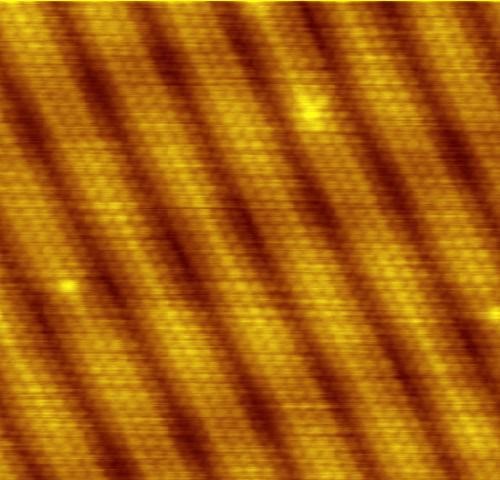
A sharp metal tip is brought within d≈0.5nm of a conducting surface and a small voltage applied: electrons tunnel across the vacuum gap, whose barrier height is the work function Φ≈4.5eV, so κ=2mΦ/ℏ=1.1×1010m−1 and the current I∝e−2κd changes by a factor e2.2≈10 for every 0.1nm. A feedback loop moves the tip to keep I constant, and the tip’s height, recorded as it scans, draws the surface with a vertical resolution of a picometre — and laterally atom by atom, because the last atom of the tip, being nearest, carries most of the current (Binnig and Rohrer, 1981).
Example 31.8(Alpha decay)
An α particle of 5MeV inside a heavy nucleus faces the Coulomb barrier of the remaining charge Ze, tens of MeV high at the nuclear surface and extending to the radius b=2Ze2/4πε0E≈50fm where V=E. The Gamow factor 2∫κdr is of order 80: T∼e−80∼10−35. The particle hits the wall some 1021 times per second, so it escapes at a rate ∼10−14s−1: a lifetime of a million years. Because the exponent varies as Z/E, a 2MeV change of E shifts the lifetime by twenty orders of magnitude — the Geiger–Nuttall law, from microseconds to the age of the universe (Gamow, 1928: the first application of tunnelling).
Atomic resolution on a gold surface, imaged by a scanning tunnelling microscope: the rows of atoms of the reconstructed (100) face, a few tenths of a nanometre apart.
31.4 The double well
Proposition 31.9(Tunnel splitting)
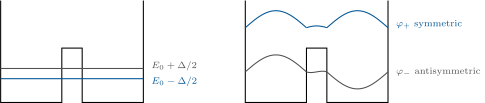
Two identical wells separated by a barrier: if the barrier were impenetrable each well would have the same ground level E0, twice. Tunnelling couples them and the two lowest states of the double well are the symmetric and antisymmetric combinations, φ±≈(φL±φR)/2, with energies E0∓Δ/2: the level is split by an amount Δ∝e−κa (the tunnelling amplitude, not its square). A particle placed in the left well, ψ=(φ++φ−)/2, is not stationary: it oscillates between the wells at the frequency ν=Δ/h — tunnelling oscillations, the two-level beats of Chapter 30.
Proof. The symmetric combination has no node under the barrier and a lower curvature, hence a lower energy; the antisymmetric one has a node and lies higher; the splitting is proportional to the overlap of the localised functions under the barrier, e−κa. The beating is the two-level superposition already computed. ∎
The double well: the degenerate level of the two isolated wells splits into a symmetric state (lower) and an antisymmetric one (higher) by Δ∝e−κa; a particle started on one side tunnels back and forth at the frequency Δ/h.
Example 31.10(Ammonia)
In NH3 the nitrogen atom sits on one side of the plane of the three hydrogens or on the other — a double well with a barrier of about 0.25eV. The tunnel splitting of the ground level is Δ=1×10⁻⁴eV: ν=Δ/h=24GHz, the inversion frequency, the transition of the first maser and of the first atomic clock (1949). Replace hydrogen by deuterium and the heavier molecule tunnels less: 1.6GHz. In heavier pyramids (PH3, AsH3) the splitting collapses to kilohertz and below: the molecule stays on its side for years — which is why left- and right-handed molecules exist at all, and why sugar does not racemise on the shelf.
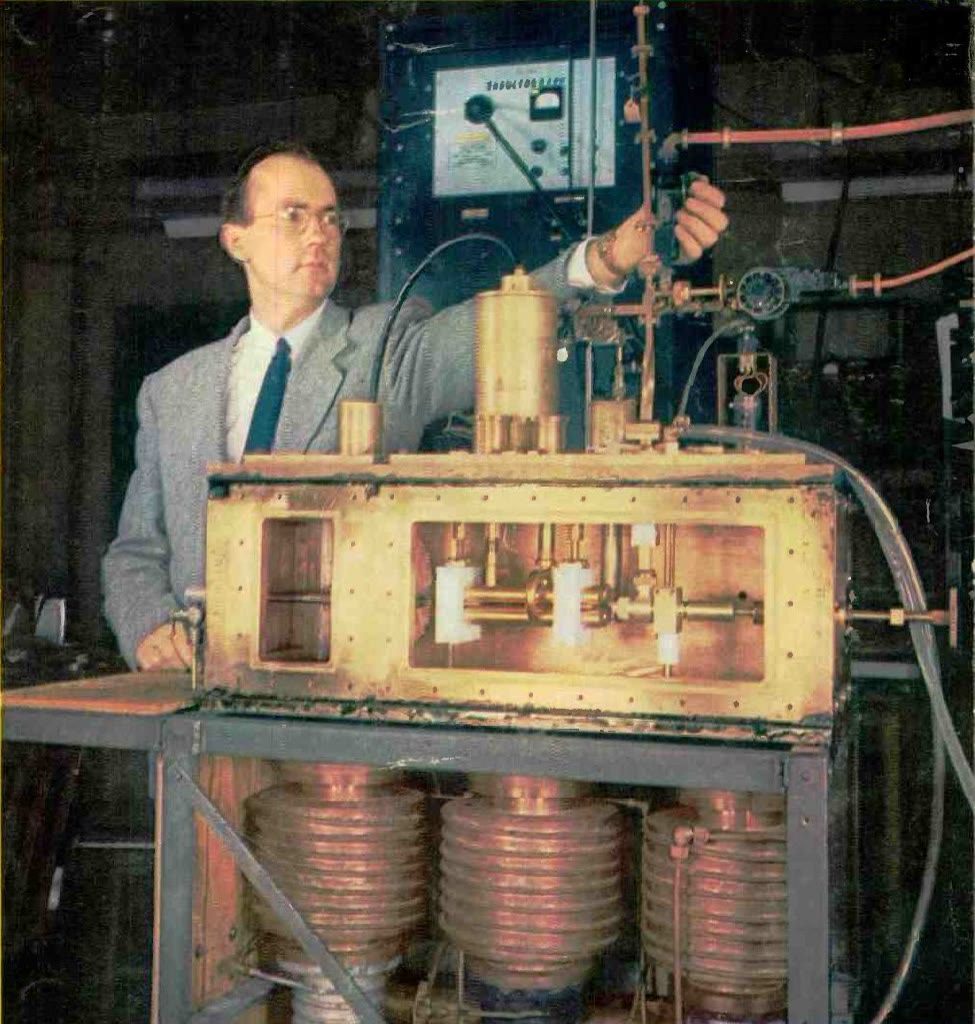
Charles Townes with the first maser (1954): a beam of ammonia molecules, sorted by an electric field into the upper inversion state, amplified the 24GHz transition in a cavity — stimulated emission’s first device, six years before the laser.
Method 31.11(Wells and barriers)
(1) Write φ region by region: e±ikx where E>V, e±κx where E<V, with k,κ=2m∣E−V∣/ℏ. (2) Match φ and φ′ at each boundary (at an infinite wall, φ=0). (3) Bound states: the matching has solutions only for discrete E — count them graphically. (4) Scattering: currents (∣A∣2−∣B∣2)ℏk/m give R and T. (5) Tunnelling: T∼e−2κa; order of magnitude first, prefactor after. (6) Double well: splitting ∝e−κa, beats at Δ/h.
31.5 Exercises
Exercise 31.1★
Infinite well: electron in 1nm (E1, E2, E3, wavelength of the 2→1 photon); electron in 0.1nm; nucleon in 5fm; a 1g marble in 10cm (E1, and the quantum number for a speed of 1cm/s).
Quantum dots: a nanocrystal of gap 1.74eV confines an electron–hole pair whose confinement energy is h2/8m∗L2 with m∗=0.1me. Emission wavelength for L=6, 4, 3, 2.5nm; which colours?
Tunnelling: electron with V0−E=4.5eV: κ; e−2κa for a=0.3, 0.5, 1, 2nm; factor per 0.1nm; same for a proton at a=0.3nm.
Solution
Solution of Exercise 31.3.
κ=1.09×10¹⁰m−1; e−2κa: 1.5×10⁻³, 1.8×10⁻⁵, 3×10⁻¹⁰, 10−19; ×8.8 per 0.1nm; proton: κ is 43 times larger, e−280 at 0.3nm.
Exercise 31.4★
Step: electron of 2eV onto a step of 1eV: k1, k2, R, T. Same for a step down of 1eV. Why is this impossible classically, and what is the analogue for light?
Solution
Solution of Exercise 31.4.
k1=7.3×10⁹m−1, k2=5.1×10⁹m−1; R=0.03, T=0.97. Step down: k2=8.9×10⁹m−1, R=0.01. A classical particle never turns back when it has the energy; a light wave is partly reflected at any change of index.
Exercise 31.5★★
Infinite well in detail. (a) Derive the levels and normalise. (b) Show the orthogonality. (c) For n=1: ⟨x⟩, Δx=L1/12−1/2π2, ⟨p⟩=0, Δp=πℏ/L; check Heisenberg. (d) Sketch ∣φn∣2 for large n and compare with the classical probability of finding a bouncing particle.
Solution
Solution of Exercise 31.5.
(a), (b) Proposition 31.1. (c) L/2; 0.18L; 0; πℏ/L; product 0.57ℏ>ℏ/2. (d) Rapid oscillations about the mean 1/L — the classical uniform density.
Exercise 31.6★★
Finite well. (a) Derive ktanka=κ for the even states. (b) Show graphically there is always a bound state and count them for R=1, 4, 10. (c) Electron, V0=1eV, 2a=1nm: R, number of states, penetration depth of the ground state (take E≈0.26eV). (d) What happens to the number of bound states as V0→∞, and to their energies?
Solution
Solution of Exercise 31.6.
(a) Proposition 31.3. (b) 1, 3, 7. (c) R=2.6, two states; κ=4.4×10⁹m−1, depth 0.23nm. (d) Infinitely many, tending to the infinite well’s from below.
Exercise 31.7★★
Step, E<V0. (a) Write φ on both sides and find r=(k−iκ)/(k+iκ). (b) Show ∣r∣=1 and compute the phase of r. (c) Show the current vanishes for x>0 although ∣φ∣2=0 there. (d) Electron 1eV below the top: penetration depth; compare with the evanescent wave of total internal reflection.
Solution
Solution of Exercise 31.7.
(a) 1+r=t, ik(1−r)=−κt. (b) Numerator and denominator are conjugates; phase −2arctan(κ/k). (c) ψ∗ψ′ is real for a real exponential. (d) 0.2nm; like the evanescent wave of total reflection: present, carrying no flux, and able to feed a second medium — that is tunnelling.
Exercise 31.8★★
The barrier. (a) Write the four continuity conditions and derive T. (b) Evaluate exactly and with the approximation for E=V0/2, κa=3; for κa=1. (c) For E>V0 show T=[1+V02sin2(k2a)/4E(E−V0)]−1 and find the energies of perfect transmission. (d) Interpret them (think of the anti-reflection layer of Chapter 15).
Solution
Solution of Exercise 31.8.
(a) Theorem 31.6. (b) κa=3: exact 1/(1+sinh23)=9.9×10−3, approximation 4e−6=9.9×10⁻³; κa=1: 0.42 against 0.54. (c) κ→ik2; T=1 for k2a=nπ. (d) The reflections from the two faces cancel when the barrier is a whole number of half-wavelengths — resonant transmission.
Exercise 31.9★★
Gamow. For the Coulomb barrier from the nuclear radius Rn to b=2Ze2/4πε0E, the exponent is G=2∫κdr=(22mE/ℏ)b[arccosRn/b−(Rn/b)(1−Rn/b)]. (a) Z=90, E=5MeV, Rn=8fm: b, G, T. (b) Frequency of hits v/2Rn and the lifetime. (c) Repeat for E=4 and 6MeV: ratio of lifetimes. (d) Why do nuclei emit α particles rather than protons or 12C?
Solution
Solution of Exercise 31.9.
(a) b=52fm; G=82; T=e−82≈2×10−36. (b) v=1.55×10⁷m/s, 1021 hits per second: rate 2×10⁻¹⁵s−1, lifetime ∼107 years. (c) G=100 and 69: e18≈108 longer, e−13≈10−6 shorter. (d) The α is tightly bound and leaves with positive energy; a proton would not; a 12C has three times the charge and a far larger exponent (cluster decay exists, at 10−10).
Exercise 31.10★★★
Ammonia. Splitting Δ=1×10⁻⁴eV. (a) Inversion frequency and the period of the tunnelling oscillation. (b) The N atom is prepared on one side: write ψ(t) and the probability of finding it on the other side. (c) ND3 tunnels at 1.6GHz: deduce κa from the ratio of the splittings if Δ∝e−κa and κ∝m (mD=2mH, barrier unchanged). (d) Why can a chiral molecule be left-handed for years?
Solution
Solution of Exercise 31.10.
(a) 24GHz; 41ps. (b) ψ=(φ+e−iE+t/ℏ+φ−e−iE−t/ℏ)/2; P=sin2(πνt). (c) e(2−1)κa=15: κa=6.5. (d) Heavier groups and higher barriers make the tunnelling period longer than years.
Exercise 31.11★★★
The STM.Φ=4.5eV, d=0.5nm, bias 0.1V, I=1nA. (a) κ, the factor of I per 0.1nm, the height resolution if I is measured to 1%. (b) Electrons per second in the current. (c) The tip’s apex atom is 0.25nm closer than its neighbours (laterally 0.25nm away, so d′=d2+0.252): fraction of the current it carries. (d) A 1cm steel frame expands by αLΔT with α=1×10⁻⁵K−1: what temperature stability does a picometre need, and how do designs get round it?
Solution
Solution of Exercise 31.11.
(a) 1.09×10¹⁰m−1; ×8.8; 1% of I is 0.5pm. (b) 6×10⁹. (c) Each neighbour at d′=0.56nm carries e−2κ×0.06nm=0.28 of the apex’s current; the apex carries about half. (d) 10−5K — impossible; symmetric designs in which tip and sample expand together, fast scans, low-expansion materials, and the feedback.
Exercise 31.12★★★
A quantum-well laser. A 10nm layer of GaAs (gap 1.42eV, me∗=0.067me, mh∗=0.45me) between barriers 0.3eV higher. (a) Ground confinement energies of electron and hole (infinite well). (b) Photon energy and wavelength of the laser. (c) Width for 780nm. (d) With the finite barrier, how many bound electron states does the 10nm well hold?
Part I — The scanning tunnelling microscope. Tip and sample are tungsten (Φ=4.5eV); gap d; bias 50mV; the current is I=I0e−2κd.
κ for electrons at the Fermi level facing the vacuum barrier Φ.
Factor of change of I for Δd=0.1nm; for 1pm.
The feedback holds I constant to 1%: height noise.
I=1nA: electrons per second; average time between two electrons, compared with the tunnelling “time” ∼ℏ/Φ.
The apex atom and its neighbours 0.25nm away laterally, d=0.5nm: share of the apex atom; why a single atom is enough to image atoms.
An adsorbed atom 0.1nm high: change of I in constant-height mode; why constant-current mode is preferred.
A 2cm metal frame, α=1×10⁻⁵K−1: temperature change that moves the tip by 1pm; how do instruments cope (symmetry, speed, low-expansion materials)?
With a 1V bias the barrier is no longer rectangular: sketch it and say whether I grows faster or slower than linearly with V.
On an oxidised patch the work function is 3eV instead of 4.5eV: by how much does the tip retract in constant-current mode over a perfectly flat surface? What does the STM image, then?
Part II — Alpha decay of a nucleus Z=92, A=238. The α (E=4.2MeV) moves in a nucleus of radius Rn=8fm; outside, the Coulomb energy is V(r)=2(Z−2)e2/4πε0r.
Height of the barrier at Rn; classical turning point b.
Speed of the α inside and its frequency of hits on the wall.
Gamow exponent G=(22mE/ℏ)b[arccosRn/b−(Rn/b)(1−Rn/b)] and T=e−G.
Decay rate and half-life; compare with the measured 4.5×10⁹ years.
The same with E=5.2MeV (another isotope): half-life; the Geiger–Nuttall sensitivity.
Taking Rn=9fm instead of 8fm: effect on the half-life; comment on the precision of such estimates.
Why is the tunnelling of a proton (charge 1, mass 1/4) not observed from the same nucleus, and that of a 12C (charge 6) either?
The α emerges with the full 4.2MeV although it “passed under” a 30MeV wall: is energy conserved?
Part III — The ammonia maser. The N atom tunnels through the H3 plane; the ground level is split by Δ=9.8×10⁻⁵eV.
Frequency and wavelength of the inversion transition.
Write the symmetric and antisymmetric states in terms of “N up” and “N down”; which is lower, and why?
A molecule prepared “N up”: ψ(t), the probability of “down” at time t, the period.
Boltzmann ratio of the two levels at 300K: can the thermal population give a maser? How is the inversion obtained (a state-selecting electric field)?
Photon energy in joules; number of molecules that must emit per second for an output of 1×10⁻¹⁰W.
ND3 tunnels at 1.6GHz: deduce κa for NH3 assuming Δ∝e−κa with κ∝m.
The maser was the first atomic clock: why is a tunnelling frequency a good clock and which effects shift it?
Summarise: quantisation from confinement, tunnelling from evanescence, and what fixes the exponents.
Solution
Solution of Problem 31.1.
1.κ=2mΦ/ℏ=1.09×1010m−1.
2.e2.2=8.8; e0.022: 2.2% per picometre.
3.0.5pm.
4.6×10⁹ per second; 0.16ns apart, against ℏ/Φ∼10−16s: one at a time.
5. About half; the rest decays so fast with distance that the image is that of one atom.
6.×8.8; constant current keeps the tip safe and turns the exponential into a linear height.
7.ΔT=10−12/(10−5×0.02)=5×10−6K; symmetric mounts, speed, low-expansion materials, and a feedback that follows the drift.
8. A trapezoid, lowered on the collecting side: the effective barrier thins and I grows faster than linearly.
9.κ′=0.89×10¹⁰m−1; at 0.5nm the exponent drops from 10.9 to 8.9, I×7: the tip retracts by ln7/2κ′≈0.1nm — a bump that is electronic, not geometric.
10.V(Rn)=2×90×1.44/8=32MeV; b=62fm.
11.v=1.4×10⁷m/s; 9×10²⁰ hits per second.
12.G=96; T=e−96≈10−42.
13. Rate ∼10−21s−1, half-life ∼1013 years — a thousand times the measured value: for an exponent of a hundred, a crude model does well to land within a few orders of magnitude.
14.G=79: e17≈107 times shorter, about 106 years — one extra MeV, seven orders of magnitude.
15.G=92: e4.5≈90 times shorter — a fermi of radius is two orders of magnitude.
16. A proton is not pre-formed with positive energy (it is bound by some 7MeV); a 12C has three times the charge and an exponent three times larger.
17. Yes: the α always has 4.2MeV; its wave function merely has an evanescent part under the barrier, where no measurement finds it with negative kinetic energy.
18.23.7GHz; 1.27cm.
19.(∣↑⟩±∣↓⟩)/2; the symmetric one is lower — no node, less curvature.
20.ψ=(φ+e−iE+t/ℏ+φ−e−iE−t/ℏ)/2; P↓=sin2(πνt); period 42ps.
21.e−Δ/kBT=0.996: almost equal, no inversion; an inhomogeneous electric field sorts the beam and sends the upper-state molecules into the cavity.
22.1.6×10−23J; 6×10¹² molecules per second.
23.κa=6.5.
24. It is fixed by the molecule alone, identical for every molecule, and insensitive to the outside; shifts come from the Doppler effect in the beam, stray electric fields, collisions and the cavity’s pulling.
25. Confinement quantises (En∝n2/L2); evanescence lets the wave through (T∼e−2κa); the exponents are set by 2m(V0−E)/ℏ and the width — mass, height, distance.