University Physics — Year 2 · Bachelor Year 2
13Plane Electromagnetic Waves and Polarization
Tilt your head while wearing polarizing sunglasses and the glare on the wet road comes and goes; turn the glasses in front of a phone screen and the screen goes black. The light that reaches your eye is not only a wave with a frequency and an intensity: it has a direction of vibration, and every polarizer, screen, 3D-cinema lens and optical fibre connector plays with it. This chapter solves Maxwell’s equations in empty space — the plane wave, with its transverse electric and magnetic fields locked at right angles — surveys the spectrum those waves span, and studies the polarization: how to describe it, how to select it with a polarizer (Malus’s law), and how to transform it with a birefringent plate.
13.1 Plane waves in vacuum
Theorem 13.1 (Wave equation; plane progressive harmonic waves)
In vacuum, free of charges and currents, Maxwell’s equations give
The plane progressive harmonic wave (PPH wave) is a solution provided (no dispersion), and Maxwell’s equations then require
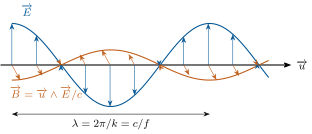
being the direction of propagation: the wave is transverse, is a right-handed orthogonal triad, and are in phase and . Its intensity is and it carries the momentum flux (Chapter 12).
Proof. The wave equation was derived in Exercise 11.11. For , and : , so ; Maxwell–Gauss gives , Maxwell–flux , Maxwell–Faraday , whence , of modulus and perpendicular to both; Maxwell–Ampère is then satisfied identically. ∎
Remark 13.2 (The spectrum)
One equation, one speed, and twenty orders of magnitude of frequency. Radio: – ( from to ), antennas and circuits (Chapter 17). Microwaves: –, radar, ovens, mobile phones, the cosmic background. Infrared: to (), the thermal radiation of everything around us (Chapter 26). Visible: –, (red) to (violet) — one octave, photons of to . Ultraviolet to ; X-rays to (), from inner atomic shells and braking electrons; gamma rays beyond, from nuclei. Only the sources and the detectors differ: the wave is the same.

13.2 Polarization
Definition 13.3 (Polarization states)
For a PPH wave along the field in a plane const is
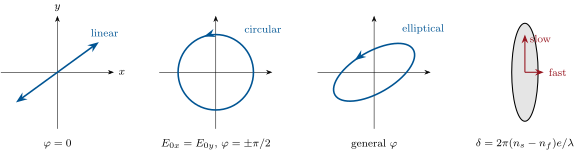
and the tip of describes, in general, an ellipse: elliptical polarization. Two special cases: or , linear polarization along a fixed direction at angle from ; and , circular polarization, of constant modulus turning at (right or left according to its sense of rotation, seen facing the oncoming wave). Natural (unpolarized) light, from a lamp or the Sun, is a succession of short wave trains with random, rapidly changing polarizations: no direction is preferred on average. Any polarization decomposes into two linear (or two circular) components.
Proof. With , : , , so , an ellipse, degenerate into the lines for and into a circle for , . ∎
Proposition 13.4 (Polarizers and Malus’s law)
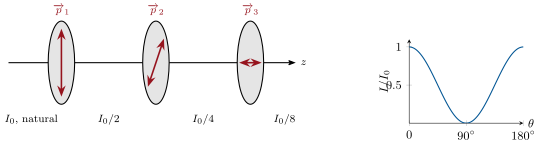
A polarizer transmits the component of along its transmission axis and absorbs the other (a sheet of aligned long molecules, which conduct along their length — the transmitted polarization is perpendicular to the molecules). Linearly polarized light of intensity whose direction makes the angle with emerges linearly polarized along with
natural light emerges with , polarized along . Two crossed polarizers transmit nothing; a third one inserted at between them transmits .
Proof. The transmitted amplitude is and . Natural light: average of over all , . Three polarizers: — the middle polarizer does not merely attenuate, it turns the polarization. ∎
Example 13.5 (Sunglasses, screens, photographs)
Light reflected at a glancing angle from water or asphalt is largely polarized horizontally (Brewster’s angle, Chapter 15): sunglasses with a vertical transmission axis cut the glare and keep the rest. A liquid-crystal screen emits polarized light: through a polarizer at it goes black. A photographer’s polarizing filter darkens the sky (scattered light is partly polarized, Chapter 17) and removes reflections from glass.
13.3 Birefringence and wave plates
Proposition 13.6 (Wave plates)
In a birefringent crystal (calcite, quartz, mica; also a stretched plastic sheet) a wave propagating along a given direction splits into two linear polarizations, along the fast and slow axes of the plate, travelling with different indices (admitted — the crystal responds differently along its axes). A plate of thickness delays the slow component by the phase
A half-wave plate () turns a linear polarization at angle from the fast axis into a linear polarization at : it rotates it by . A quarter-wave plate () turns a linear polarization at from its axes into circular light, and circular light back into linear; at other angles, into elliptical light with axes along the plate’s.
Proof. Write the incident field ; after the plate, . For the component changes sign: direction . For and : , a circle. ∎
Example 13.7 (Where plates are used)
A quarter-wave plate between a polarizer and a mirror makes an optical isolator: the light goes out circular, comes back circular of the opposite handedness, is turned by the plate into linear light at from the polarizer and is absorbed — no reflection returns to the laser. The two eyes’ images of a 3D film are projected in opposite circular polarizations and sorted by the quarter-wave–polarizer sandwiches of the glasses, which still work when you tilt your head (linear polarizers would not). A transparent ruler between crossed polarizers shows coloured fringes: stress makes plastic birefringent, and engineers read the stresses of a model from the pattern.
Method 13.8 (Following a polarization through optics)
(1) Choose axes; write the incident field as two components with their phase difference. (2) A polarizer: keep the projection on its axis (amplitude , intensity ; natural light ). (3) A plate: project on its fast and slow axes, delay the slow one by , recombine. (4) Read the result: phase or means linear, with equal amplitudes means circular. (5) To test an unknown beam: rotate a polarizer (intensity varies: linear or elliptical part), then add a quarter-wave plate (circular becomes linear and can be extinguished).
13.4 Exercises
Exercise 13.1 ★
An FM station at gives, at a receiver, an intensity of . Wavelength, wavenumber, period; amplitudes and ; energy density; emf induced in a antenna aligned with ; photon flux (per square metre and second).
Solution
Solution of Exercise 13.1.
, , ; , ; ; emf ; .
Exercise 13.2 ★
Frequency and photon energy (in eV) for , , , , , , ; name the band of each; the wavelength of a gamma ray and of the cosmic background (peak near ).
Solution
Solution of Exercise 13.2.
(, radio); (, microwave); (, infrared); (, visible); (, extreme UV); (, X); (, gamma). : ; : .
Exercise 13.3 ★
Linearly polarized light of intensity falls on a polarizer at , then a second at from the first, then a third at from the first: intensity after each. Same with natural light. Remove the middle one: what changes?
Solution
Solution of Exercise 13.3.
, , ; natural: , , . Without the middle one: (natural ): the intermediate polarizer lets more through by turning the polarization.
Exercise 13.4 ★
Check that , satisfies the four Maxwell equations in vacuum when . Which equation fixes the direction of , which its magnitude? What happens if one tries along ?
Solution
Solution of Exercise 13.4.
, ; iff — Faraday fixes both the direction () and the magnitude () of ; . along would have with no charge: impossible — the wave is transverse.
Exercise 13.5 ★★
Circular light. (a) Write the field of a circularly polarized wave along and show that is constant while its direction turns at . (b) Show that the sum of a right- and a left-circular wave of equal amplitudes is linearly polarized, along a direction set by their relative phase. (c) Through a polarizer, what does circular light give, and does the intensity depend on the polarizer’s angle? (d) How then can one tell circular light from natural light?
Solution
Solution of Exercise 13.5.
(a) : modulus , angle . (b) : linear along ; a relative phase turns the direction by . (c) at every angle. (d) A quarter-wave plate turns circular light into linear light, which a polarizer then extinguishes; natural light stays unpolarized.
Exercise 13.6 ★★
Quartz has at . (a) Thickness of a quarter-wave plate of lowest order; of a half-wave plate. (b) A quarter-wave plate for used at : phase delay (neglect the variation of the indices); what comes out for linear light at ? (c) Why are "multiple-order" plates (thickness ) more sensitive to wavelength and temperature? (d) Why must a plate’s thickness be controlled to better than a micrometre?
Solution
Solution of Exercise 13.6.
(a) ; half-wave . (b) : elliptical light. (c) : a plate of waves has and larger by . (d) : a micrometre on is of .
Exercise 13.7 ★★
Half-wave plate. (a) Show that linear light at angle from the fast axis comes out linear at . (b) Hence a plate rotated by rotates the polarization by : what rotation of the plate turns a vertical polarization horizontal? (c) What does a half-wave plate do to circular light? (d) Between crossed polarizers, a half-wave plate is rotated slowly: sketch the transmitted intensity against its angle.
Solution
Solution of Exercise 13.7.
(a) The slow component changes sign: . (b) A polarization at angle from a plate at comes out at : rotation ; . (c) Reverses the handedness. (d) : four maxima and four extinctions per turn.
Exercise 13.8 ★★
polarizers are placed one after the other, each rotated by from the previous one, the last being at from the first. Transmission of linearly polarized light aligned with the first for ; limit (use ). Comment: a polarization can be turned by with no loss — by what?
Solution
Solution of Exercise 13.8.
: , , , , , . A continuously twisting medium (optical activity, a liquid-crystal cell) rotates the polarization without loss.
Exercise 13.9 ★★
Partial polarization. A rotating polarizer in front of a beam gives a maximum intensity and a minimum . (a) Model the beam as natural light plus linearly polarized light : express and ; the degree of polarization . (b) Blue sky at from the Sun: : . (c) Light reflected from a lake near Brewster’s angle, : how much can polarizing sunglasses remove? (d) Can a polarizer alone distinguish partially linearly polarized light from partially circular light? What is needed?
Solution
Solution of Exercise 13.9.
(a) , ; . (b) . (c) The crossed polarizer passes : removed. (d) No — both give a constant intensity; a quarter-wave plate is needed.
Exercise 13.10 ★★★
Two crossed beams. Two PPH waves of equal amplitude and frequency, both polarized along , propagate in the plane at angles from . (a) Write the total field and show it is a wave travelling along whose amplitude is modulated along as . (b) Spacing of the dark planes (interference fringes); numbers for , , and for (counter-propagating). (c) Phase velocity of the pattern along ; compare with ; is anything travelling faster than light? (d) Compute the time-averaged Poynting vector and show that its component vanishes: the energy flows along in the bright planes.
Solution
Solution of Exercise 13.10.
(a) Phases : sum . (b) : at , at . (c) : a pattern’s phase; the energy goes along at (and each wave at ). (d) , : ; , maximal in the bright planes.
Exercise 13.11 ★★★
The liquid-crystal pixel. A twisted-nematic cell between crossed polarizers rotates the polarization of light by when no voltage is applied (the molecules’ alignment twists through the cell and the polarization follows it — admitted), and not at all when a few volts untwist them. (a) Transmission in both states: which one is bright? (b) Real cells rotate by at the design wavelength: contrast ratio if the dark state leaks through a residual error. (c) Why does a cell designed for leak some blue and red in the dark state (think of the rotation as a stack of many thin half-wave-like retarders)? (d) A colour pixel uses three such cells with filters; why does the screen go black through a polarizer at some angle, and what does that angle tell you?
Solution
Solution of Exercise 13.11.
(a) No voltage: rotated by , passes the crossed polarizer: bright; with voltage: dark. (b) Leak : contrast . (c) The twist works as a stack of retarders whose : exact at , the rotation is off at the ends of the spectrum, which leak — the dark state looks purplish. (d) When the external polarizer is crossed with the screen’s output polarizer; the angle is the screen’s polarization axis.
Exercise 13.12 ★★★
Optical activity. In a sugar solution the two circular polarizations travel with slightly different indices and . (a) Decompose a linear polarization into circular components and show that after a length the polarization is still linear but rotated by . (b) A tube of a sucrose solution rotates sodium light by : . (c) A saccharimeter measures to : precision on the concentration. (d) The same effect is produced in glass by a magnetic field along the beam (Faraday effect, with ): why does a Faraday rotator, unlike a sugar tube, not cancel its rotation when the light is sent back, and how does that make an isolator?
Solution
Solution of Exercise 13.12.
(a) ; after the two components have phases and , and recombine into linear light at the angle . (b) . (c) . (d) The Faraday rotation is fixed by , not by the direction of travel: on the return trip it adds ( ), and the input polarizer blocks the returning light — an isolator.

13.5 Problem: The wave, the screen and the sail
Problem 13.1
Weekend problem — a laser beam taken apart into its fields, a screen that paints with polarization, and a spacecraft that sails on light
Part I — The beam. A helium–neon laser emits at in a beam of diameter, linearly polarized along , travelling along .
- Frequency, wavenumber, photon energy; photons emitted per second.
- Intensity; amplitudes and ; write and .
- Energy density (mean) and the energy contained in of beam; how long is the beam emitted in , and how many wavelengths does it contain?
- Poynting vector: mean value and its oscillation; momentum carried per second; force on a black target and on a mirror.
- Compare with the field that binds the electron in a hydrogen atom () and with the Earth’s field ().
- Radiation pressure on a black beam stop, in pascals.
- A free electron placed in the beam: amplitude of its velocity oscillation in the electric field (neglect the magnetic force first); ratio of the magnetic to the electric force on it — why is the magnetic force negligible for matter in ordinary light?
- Write the fields of the same beam if it were circularly polarized; what changes in the intensity, in the Poynting vector and in its time dependence?
- The beam passes through a polarizer whose axis makes with : transmitted power; then through a second one crossed with the first: power; insert between them a third at from the first: power.
Part II — The screen. A liquid-crystal screen: backlight (natural light), a polarizer, the cell, a crossed polarizer. With no voltage the cell rotates the polarization by ; with voltage it does nothing.
- Fraction of the backlight’s intensity transmitted in the bright state (perfect polarizers); in the dark state.
- An intermediate voltage makes the cell behave as a retarder of phase between its axes, which are at to the polarizers (no rotation): show that the transmission is — the grey scale.
- Viewed through a polarizer rotated to from the screen’s output polarizer, what is seen? At ?
- A quarter-wave plate glued on the screen at to its polarizer turns the output circular: advantage for a viewer wearing polarizing sunglasses?
- Perfect polarizers would pass half of the backlight in the bright state; real sheets transmit of the ideal each, and the colour filters of a pixel pass a third of the light: fraction of the backlight’s power reaching the viewer in white; name the two places where most of the light is lost.
- Real crossed sheets leak of the light: contrast ratio of the screen (bright over dark) in the dark room.
- Photographers’ "circular polarizers" are a linear polarizer followed by a quarter-wave plate at : what does the camera receive, and why is that better for the polarization-sensitive beam splitter of its autofocus than linear light?
- Why do 3D-cinema glasses use circular rather than linear polarization? What happens to the crosstalk between the eyes if the viewer tilts the head by with linear glasses (intensity leaking into the wrong eye)?
Part III — The sail. A solar sail of area and total mass , perfectly reflecting, at from the Sun (; Sun’s gravity there).
- Radiation force when the sail faces the Sun; acceleration; ratio to solar gravity.
- The sail is tilted by from facing the Sun: show that the force is normal to the sail and proportional to (intercepted power , momentum change along the normal ).
- To spiral outward the sail keeps a force component along its orbital velocity: for , tangential acceleration; speed gained per year; compare with the Earth’s orbital speed ().
- Why does the same sail, near Mercury (), get times the force, and why is the ratio to gravity unchanged?
- The sail’s film is of aluminized plastic: its temperature in sunlight if it absorbs and radiates from both faces as a black body ().
- Time needed to gain facing the Sun; what would an absorbing (black) sail of the same size achieve?
- Check the momentum of light with photons: number of photons hitting the sail per second ( average) and the momentum of each; recover the force.
- Sum up: the three quantities carried by the wave (energy, momentum, polarization) and the device of this problem that exploits each.
Solution
Solution of Problem 13.1.
1. , , ; photons per second.
2. ; , ; , .
3. ; per metre of beam; , wavelengths.
4. along , oscillating as at ; on black, on a mirror.
5. ; is a fifth of the Earth’s field.
6. .
7. ; : the magnetic force on slow charges is negligible.
8. with (same power), : the intensity is unchanged but is now constant in time — the energy flow no longer pulses.
9. ; ; .
10. Bright: ; dark: .
11. After the first polarizer, equal components on the axes; after the retarder, phase between them; projection on the crossed direction : .
12. Black; half intensity.
13. Circular output looks equally bright through polarizing sunglasses at any head angle.
14. ; the first polarizer (half absorbed) and the colour filters (two thirds).
15. Bright , dark : contrast .
16. Circular light, whatever the filter’s rotation: the polarization-sensitive splitter receives the same power however the filter is turned.
17. Circular polarization keeps its handedness when the head tilts; linear glasses tilted by leak into the wrong eye.
18. ; ; of solar gravity.
19. Intercepted power , reflected momentum change along the normal : along the normal.
20. , tangential part : , per year — of the orbital speed.
21. ; gravity scales the same way.
22. : — the mirror stays cold.
23. , two months; a black sail gets half the force.
24. photons per second, each with ; reflected: .
25. Energy (, ): the beam stop and the photodiode. Momentum (): the sail. Polarization (Malus, the plates): the screen and its polarizers.