Stretch a rubber band quickly and touch it to your lip: it is warm; let it contract and it is cool. Hang a weight on it and warm it with a hair-dryer: it shortens. No steel spring behaves so, and the reason is that a rubber band’s tension is not a matter of energy but of entropy — the stretched chains have fewer ways to arrange themselves. To reason about such things one needs to know what a system at fixed temperature, or at fixed temperature and pressure, tends to do, and how much work can be drawn from it: questions the internal energy and the entropy answer only clumsily, because they speak the language of an isolated system. This chapter introduces the two functions built for the laboratory’s conditions, the Helmholtz free energyF=U−TS and the Gibbs free enthalpyG=H−TS, shows that they measure the recoverable work and decrease toward equilibrium, extracts from their differentials the Maxwell relations that link quantities no one would have thought related, and applies the whole to the equilibrium of two phases, where G decides which phase wins and gives back Clapeyron’s formula.
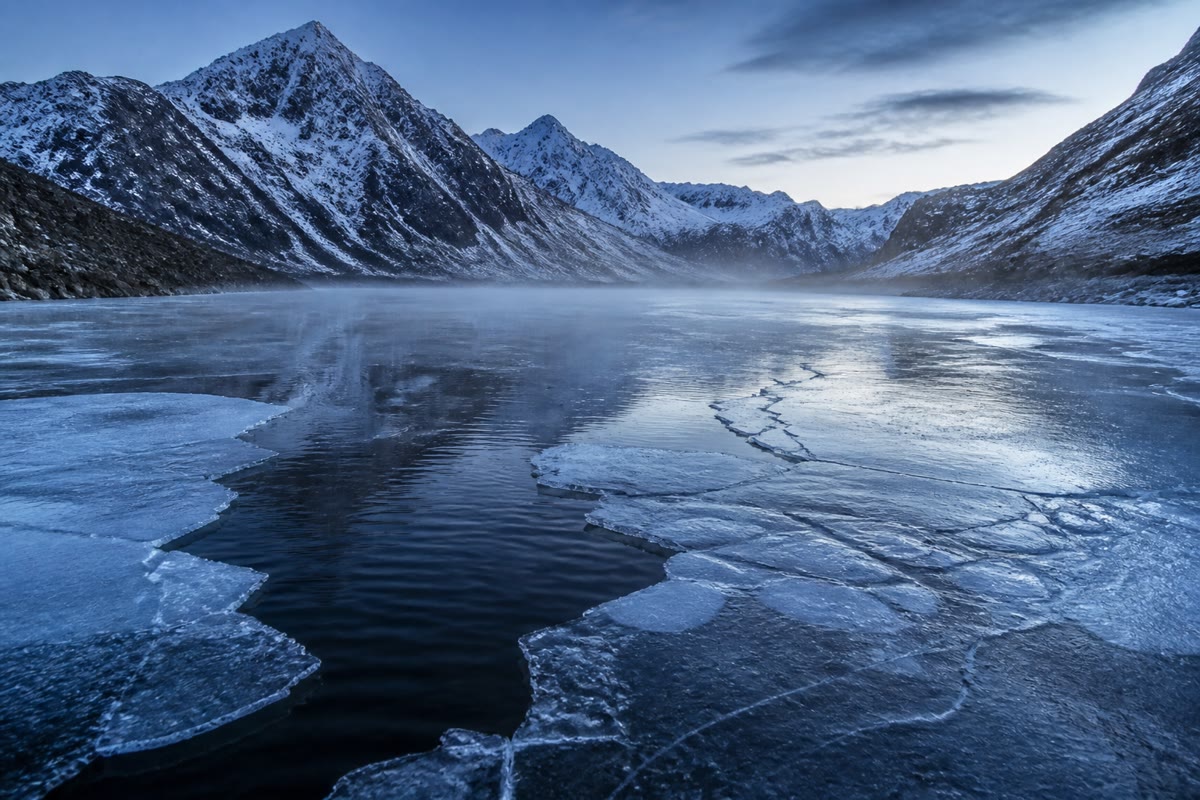
Ice and water coexisting on a lake at dawn: at the melting point the two phases have the same free enthalpy per kilogram, and a small change of pressure or temperature tips the balance — the Clapeyron slope tells by how much.
28.1 The fundamental identity and its variables
Proposition 28.1(Fundamental identity)
For a closed system of fixed composition, the internal energy, regarded as a function of the entropy and the volume, satisfies
dU=TdS−PdV,T=(∂S∂U)V,P=−(∂V∂U)S,
and the enthalpyH=U+PV satisfies dH=TdS+VdP. Each function, in its natural variables — (S,V) for U, (S,P) for H — contains the whole thermodynamics of the system: its partial derivatives give the other state variables. The second law selects the equilibrium of an isolated system (fixed U, V) as the state of maximum S.
Proof. The first law for a reversible transformation, dU=δQrev+δWrev=TdS−PdV, involves only state functions and therefore holds for any infinitesimal change between equilibrium states. Add d(PV) for H. ∎
Remark 28.2(Why new functions)
Experiments are not done at fixed entropy. A chemist’s flask sits at the temperature of the room and the pressure of the atmosphere; a piston in a thermostat works at fixed T. One wants functions whose natural variables are (T,V) and (T,P), and which play, under those conditions, the role that S plays for an isolated system: to tell which way the system evolves and how much work it can give. A Legendre transform — subtracting TS to trade S for T as the independent variable — builds them.
and (Gibbs–Helmholtz) U=F−T(∂F/∂T)V=−T2∂(F/T)/∂T, H=−T2∂(G/T)/∂T. Knowing F(T,V) or G(T,P) is knowing everything: the equation of state, the entropy, the energy, the heat capacities.
Proof.dF=dU−TdS−SdT=−SdT−PdV; likewise for G from dH. Read off the partial derivatives; for Gibbs–Helmholtz, F−T∂TF=F+TS=U and ∂T(F/T)=(T∂TF−F)/T2=−U/T2. ∎
Example 28.5(The perfect gas)
For n moles, U=ncVT+U0 and S=ncVlnT+nRlnV+S0 give F(T,V)=−nRTlnV+f(T): then P=−∂VF=nRT/V — the equation of state comes out of F — and S=−∂TF gives back the entropy. In the variables (T,P), G(T,P)=nRTlnP+g(T), so V=∂PG=nRT/P, and the molarfree enthalpyμ(T,P)=μ∘(T)+RTln(P/P∘) — the chemical potential of the gas, which grows with its pressure: gas flows from high to low μ, here from high to low pressure.
28.3 Maximum work and the direction of evolution
Theorem 28.6(Monothermal transformations)
A system exchanging heat with a single thermostat at T0, and whose initial and final temperatures equal T0, receives during any transformation the work
W≥ΔF,i.e.Wrecovered=−W≤−ΔF:
the decrease of F is the maximum work recoverable from the system at fixed temperature (reached for a reversible transformation) — hence “free” energy: the part of U that can be turned into work, the rest, TS, being bound. If moreover the transformation is monobaric (pressure P0 outside, initial and final pressure P0), the work other than that of the atmosphere (useful work, e.g. electrical) satisfies Wu≥ΔG: −ΔG is the maximum useful work recoverable at fixed T and P (the work of a fuel cell, of a battery).
Proof. First law: ΔU=W+Q. Second law with one thermostat: ΔS=Q/T0+Sc, Sc≥0, so Q≤T0ΔS. Hence W=ΔU−Q≥ΔU−T0ΔS=Δ(U−T0S)=ΔF, using T=T0 at both ends. With the atmosphere’s work −P0ΔV separated, W=Wu−P0ΔV and Wu≥ΔU+P0ΔV−T0ΔS=ΔG. ∎
Theorem 28.7(Criteria of evolution and equilibrium)
A system held at fixed T and V and receiving no work can only evolve so that F decreases; its equilibrium is the state of minimum F. A system held at fixed T and P and receiving no useful work can only evolve so that G decreases; its equilibrium is the state of minimum G. (More generally, for a system in contact with a surrounding at T0, P0, the quantity U−T0S+P0V decreases.)
Proof. Take W=0 (resp. Wu=0) in the previous theorem: ΔF≤0 (resp. ΔG≤0), with equality for a reversible, i.e. equilibrium, evolution. ∎
Example 28.8(Isothermal expansion, real and ideal)
One mole of gas at 300K expands from 1L to 10L in contact with the thermostat: ΔF=−RTln10=−5.7kJ. A reversible expansion recovers 5.7kJ; an expansion against the atmosphere at 1bar recovers only P0ΔV=0.9kJ; a free expansion into vacuum, nothing. The 5.7kJ is the maximum the gas and its thermostat can give for this change of state, however clever the machine.
28.4 Maxwell relations
Theorem 28.9(Maxwell relations)
Because dF and dG are exact differentials (Schwarz’s theorem on mixed second derivatives),
(∂V∂S)T=(∂T∂P)V,(∂P∂S)T=−(∂T∂V)P.
They express the unmeasurable (how the entropy varies with volume or pressure at fixed temperature) through the equation of state. Two consequences:
with α=V−1(∂V/∂T)P the expansion coefficient and κT=−V−1(∂V/∂P)T the isothermal compressibility.
Proof.∂2F/∂T∂V computed in both orders: −∂VS=−∂TP. Same for G. Then dU=TdS−PdV at fixed T gives (∂VU)T=T(∂VS)T−P; and CP−CV follows from writing S(T,V(T,P)): (∂TS)P=(∂TS)V+(∂VS)T(∂TV)P, multiplied by T. ∎
Example 28.10(What the relations reveal)
For a perfect gas, T(∂TP)V−P=0: the energy does not depend on the volume (Joule’s law recovered) and CP−CV=nR. For a van der Waals gas, (∂VU)T=a/Vm2: the internal pressure of the attractions. For liquid water, (∂TP)V=α/κT=2.1×10−4/4.6×10−10=4.6×105Pa/K: heating water in a rigid full vessel by one kelvin raises the pressure by 4.6bar (never seal a full bottle), and (∂VU)T≈1400bar — the cohesion of the liquid; yet cP−cV=Tvα2/κT≈30J/kg/K, less than 1% of cP: for condensed matter the two heat capacities nearly coincide.
Proposition 28.11(Entropic elasticity of rubber)
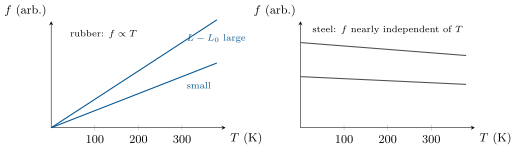
For a band of length L under the tension f, dU=TdS+fdL and dF=−SdT+fdL, so that (∂S/∂L)T=−(∂f/∂T)L and (∂U/∂L)T=f−T(∂f/∂T)L. Rubber obeys, to a good approximation, f=Tφ(L) with φ>0 for L>L0: then (∂U/∂L)T=0 — the energy does not change on stretching — and (∂S/∂L)T=−φ(L)<0: the tension is entropic, f=−T(∂S/∂L)T, the band pulls back because its stretched chains have fewer configurations. Consequences: stretched isothermally it gives off heat (Q=TΔS<0); stretched adiabatically it warms; heated under constant load it contracts (f/T fixed means φ(L) fixed, so at fixed f, φ must fall as T rises).
Proof. Maxwell relation from dF; the rest is substitution. The microscopic origin is the random walk of Chapter 24: a chain of N links of length a has its end-to-end distance distributed as a Gaussian of variance Na2, so the number of configurations at extension L is Ω∝e−L2/2Na2, S=S0−kBL2/2Na2 and f=kBTL/Na2: a spring whose stiffness is proportional to the temperature. ∎
Tension at fixed extension against temperature. Left: rubber, f∝T — the tension is entropic, (∂f/∂T)L>0, so stretching lowers the entropy and the band warms. Right: a steel spring, whose tension comes from the bonds’ energy and falls slightly as the metal softens.
28.5 Equilibrium between two phases
Theorem 28.12(Condition of coexistence)
A pure substance at fixed T and P, split between two phases of masses m1, m2 with free enthalpies per unit mass g1(T,P), g2(T,P), has G=m1g1+m2g2; at equilibrium G is minimal, so
if g1<g2 all the matter goes into phase 1 (the stable phase is the one of lowerg);
the two phases coexist only where
g1(T,P)=g2(T,P),
a relation between T and P: the coexistence curve of the phase diagram.
Along that curve (Clapeyron),
dTdP=v2−v1s2−s1=T(v2−v1)L1→2.
Proof.dG=(g1−g2)dm1 at fixed T, P (with m1+m2 fixed): G decreases by moving mass to the phase of lower g, until that phase is alone or until g1=g2. Differentiate g1=g2 along the curve with dg=−sdT+vdP for each phase: −s1dT+v1dP=−s2dT+v2dP; and s2−s1=L/T since the transition at fixed T, P is reversible. The Year 1 volume obtained this formula from a Carnot cycle; here it falls out of G. ∎
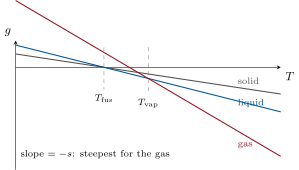
Free enthalpy per unit mass of the three phases at fixed pressure: each falls with temperature with the slope −s, the gas fastest; the stable phase is the lowest line, and the transitions occur where the lines cross. The upper branches beyond a crossing are the metastable states (supercooled liquid, superheated liquid).
Example 28.13(Water: slopes and metastability)
Fusion: L=334kJ/kg, vliq−vice=−9.1×10⁻⁵m3/kg: dP/dT=−1.3×107Pa/K, negative — ice melts under pressure, but 130bar per kelvin: a skater’s 70bar lower the melting point by half a degree only (skating works by friction and a premelted surface layer), while the 270bar under three kilometres of ice sheet melt its base and let it slide. Vaporisation at 100∘C: L=2.26MJ/kg, Δv=1.67m3/kg: 3.6kPa/K — 92∘C at 0.7bar on a mountain, 120∘C in a pressure cooker at 2bar. Below 0∘C, liquid water has gliq−gice≈(L/Tfus)(Tfus−T)=1.2kJ/kg per kelvin of supercooling: it is metastable, not unstable, and pure droplets in clouds stay liquid down to −40∘C for want of a nucleus.
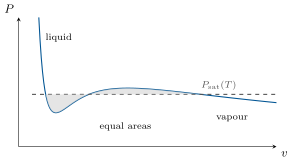
A van der Waals isotherm below the critical temperature and Maxwell’s construction: the real isotherm follows the horizontal Psat placed so that the two shaded areas are equal — the condition gliq=gvap, since dg=vdP at fixed T. The rising parts of the loop near the ends are the metastable superheated liquid and supersaturated vapour.
Remark 28.14(Van der Waals and Maxwell’s construction)
The van der Waals equation (P+a/v2)(v−b)=RT gives, below its critical temperature Tc=8a/27Rb, isotherms with a loop. The real fluid does not follow the loop: at Psat(T) it jumps from the liquid to the vapour branch, and Psat is fixed by gliq=gvap, i.e. ∫liqvapvdP=0 along the loop: the horizontal line cuts off equal areas. The parts of the loop where (∂P/∂v)T>0 are mechanically unstable; the parts between them and the line are metastable — the superheated liquid that “bumps” in a microwave, the supersaturated vapour of the cloud chamber.
Method 28.15(Using the potentials)
(1) Identify the constraints: isolated →S max; fixed T,V→F min; fixed T,P→G min. (2) Maximum work: −ΔF at fixed T, −ΔG of useful work at fixed T,P. (3) Need a derivative of S at fixed T? Use a Maxwell relation and the equation of state. (4) Two phases: compare g; coexistence g1=g2; Clapeyron for the slope; sign of Δv for the sign of the slope. (5) Chemical potentialμ=g per mole: matter flows toward lower μ.
28.6 Exercises
Exercise 28.1★
For n moles of perfect gas, write F(T,V) and G(T,P) up to functions of T alone; recover the equation of state from each; show that S=−∂TF gives the known entropy.
Solution
Solution of Exercise 28.1.
F=−nRTlnV+f(T), G=nRTlnP+g(T); P=−∂VF=nRT/V, V=∂PG=nRT/P; −∂TF=nRlnV−f′(T), the entropy nCVlnT+nRlnV+const if f′=−nCVlnT+…
Exercise 28.2★
One mole of gas, 300K, from 1L to 10L in a thermostat: ΔF, ΔU, ΔS; work recovered if reversible; if against 1bar; if into vacuum; the entropy created in each case.
Water and ice at 1bar: show that gliq−gice≈(L/Tfus)(Tfus−T) near 0∘C and compute it at −5 and +5∘C (L=334kJ/kg). Which phase is stable in each case; is the other impossible?
Solution
Solution of Exercise 28.3.
Δg=Δh−TΔs with Δh≈L, Δs≈L/Tfus. At −5∘C: gliq−gice=+6.1kJ/kg, ice stable, liquid metastable (supercooling exists); at +5∘C: −6.1kJ/kg, liquid stable — superheated ice is not observed, its surface melts first.
Exercise 28.4★
Clapeyron slopes of water: fusion (Δv=−9.1×10⁻⁵m3/kg) and vaporisation at 100∘C (L=2.26MJ/kg, Δv=1.67m3/kg). Melting point under 70bar; boiling point at 0.7bar and at 2bar.
Solution
Solution of Exercise 28.4.
Fusion −1.3×10⁷Pa/K; vaporisation 3.6kPa/K. 70bar: −0.5K; 0.7bar: 92∘C; 2bar: ≈127∘C by the local slope (120∘C in fact: the slope grows).
Exercise 28.5★★
Maxwell. (a) Derive the two Maxwell relations of the chapter and the two from dU and dH. (b) Show (∂U/∂V)T=T(∂P/∂T)V−P; evaluate it for a perfect gas and a van der Waals gas. (c) Liquid water: α=2.1×10⁻⁴K−1, κT=4.6×10⁻¹⁰Pa−1: pressure rise per kelvin in a rigid full vessel, and (∂U/∂V)T. (d) A full, sealed glass bottle is warmed by 10K: comment.
Solution
Solution of Exercise 28.5.
(a) Also (∂T/∂V)S=−(∂P/∂S)V and (∂T/∂P)S=(∂V/∂S)P. (b) 0; a/v2. (c) α/κT=4.6bar/K; Tα/κT−P≈1400bar. (d) 46bar: the bottle bursts.
Exercise 28.6★★
CP−CV. (a) Derive CP−CV=TVα2/κT. (b) Perfect gas. (c) Water at 300K; copper (α=5×10⁻⁵K−1, κT=7×10⁻¹²Pa−1, ρ=8900kg/m3); compare with cP (4180 and 385J/kg/K). (d) Why can one speak of “the” heat capacity of a solid?
Solution
Solution of Exercise 28.6.
(a) Theorem 28.9. (b) nR. (c) Water 29J/kg/K (0.7%); copper 12J/kg/K (3%). (d) The difference is negligible for condensed matter.
Exercise 28.7★★
Rubber. A band obeys f=CT(L−L0) with C=1N/m/K. (a) (∂S/∂L)T and (∂U/∂L)T. (b) Entropy change, heat and work when stretched isothermally at 300K from L0 to L0+0.1m. (c) Stretched adiabatically instead (heat capacity 4J/K): temperature change. (d) Hung with a fixed weight and warmed by 30K: relative change of L−L0.
Evaporation of a puddle. The chemical potential of water vapour at partial pressure p is μv=μv∘(T)+RTln(p/p∘), and equals that of the liquid when p=psat(T). (a) Show that liquid evaporates when p<psat and vapour condenses when p>psat; define the relative humidity. (b) μliq−μv at 50% humidity, 293K. (c) Why does washing dry even at 20∘C, and never at 100% humidity? (d) Dew: on what surfaces does it form first, and why?
Solution
Solution of Exercise 28.8.
(a) Matter goes to the lower μ: μv<μliq when p<psat; humidity =p/psat. (b) −RTln0.5=1.7kJ/mol in favour of the vapour. (c) Evaporation needs only p<psat, not boiling; at 100% the potentials are equal. (d) On the coldest surfaces, whose psat(Ts) has dropped below the air’s p — those radiating to the night sky.
Exercise 28.9★★
Van der Waals.(P+a/v2)(v−b)=RT (molar). (a) Find the critical point (∂vP=∂v2P=0): vc=3b, Tc=8a/27Rb, Pc=a/27b2. (b) Carbon dioxide, Tc=304K, Pc=73.8bar: a and b. (c) Justify Maxwell’s equal-area rule from g. (d) Which parts of the loop are unstable, which metastable, and what phenomena show the metastable ones?
Solution
Solution of Exercise 28.9.
(a) Standard. (b) b=RTc/8Pc=4.3×10−5m3/mol, a=27R2Tc2/64Pc=0.36Pam6/mol2. (c) dg=vdP at fixed T and g equal at the two ends: ∫vdP=0 around the loop. (d) Unstable where ∂vP>0; metastable between: the superheated liquid (bumping) and the supersaturated vapour (fog that waits for nuclei, cloud chamber).
Exercise 28.10★★★
Clausius–Clapeyron integrated. For vaporisation, neglect vliq and treat the vapour as perfect. (a) Show dlnP/dT=Lm/RT2 (Lm molar) and integrate for constant Lm. (b) Water, Lm=40.7kJ/mol: Psat at 20∘C from the 1bar at 100∘C; compare with the measured 23mbar. (c) Predict the triple-point pressure (0.01∘C) and compare with 611Pa. (d) Show the same law follows from Gibbs–Helmholtz applied to Δg.
Solution
Solution of Exercise 28.10.
(a) dP/dT=LmP/RT2: ln(P/P0)=−(Lm/R)(1/T−1/T0). (b) 28mbar against 23mbar — L is larger at 20∘C. (c) 820Pa against 611Pa. (d) ∂(Δg/T)/∂T=−L/T2 and Δg=0 along the curve give the same slope.
Exercise 28.11★★★
Osmosis. A solvent’s chemical potential is lowered by a dilute solute: μ=μ∘−RTxs (xs the solute mole fraction). A membrane lets only the solvent through; pure solvent on one side, solution on the other, same T. (a) Show that equilibrium requires an extra pressure Π on the solution with Πvm=RTxs, i.e. Π=cRT (van ’t Hoff). (b) Sea water, c≈1.1mol/L of dissolved particles, 293K: Π. (c) Minimum work to extract a cubic metre of fresh water; compare with real plants (3kWh/m3). (d) Why do plant cells burst in pure water and shrivel in brine?
Solution
Solution of Exercise 28.11.
(a) Equal μ across the membrane: μ∘(P+Π)−RTxs=μ∘(P), i.e. vmΠ=RTxs, Π=cRT. (b) 27bar. (c) ΠV=2.7MJ=0.75kWh per cubic metre; real plants four times more. (d) Water flows to the lower potential: into the solute-rich cell, out of it in brine.
Exercise 28.12★★★
The chain. A polymer chain of N links of length a: the number of configurations with end-to-end vector of length L along the band is Ω∝e−L2/2Na2 (the random walk). (a) S(L) and, at fixed U, the tension f=−T∂S/∂L. (b) The chain’s stiffness and its temperature dependence. (c) N=1000, a=0.5nm, 300K, L=10nm: f; how many chains in parallel give 30N? (d) Estimate the Young’s modulus of a rubber with 1026 chains per cubic metre, each of N=100.
28.7 Problem: The rubber band and the phase diagram of water
Problem 28.1
Weekend problem — entropy that pulls, and phases that compete
Part I — The rubber band. A band of mass 2g (heat capacity 4J/K) has the tension f=CT(L−L0) with C=1N/m/K; at 300K and L−L0=0.1m, f=30N.
Write dU and dF for the band (dU=TdS+fdL).
Derive the Maxwell relation (∂S/∂L)T=−(∂f/∂T)L.
Show that (∂U/∂L)T=0 for this band: what does it mean?
Isothermal stretching from L0 to L0+0.1m at 300K: ΔS, heat Q, work W; check ΔU=0.
Same stretching done adiabatically: temperature change.
The band holds a fixed weight; it is warmed by 30K: new L−L0. Describe the “rubber engine” (a wheel with rubber spokes heated on one side).
A chain of N links of length a has Ω∝e−L2/2Na2: S(L) and f(L,T); why does the stiffness grow with T?
N=1000, a=0.5nm, L=10nm, 300K: f for one chain and the number of chains for 30N.
Why does a steel spring behave oppositely (tension falling with T at fixed length)?
Part II — The phase diagram of water. Data: Lfus=334kJ/kg, vice=1.091×10⁻³m3/kg, vliq=1.000×10⁻³m3/kg; Lvap=2.26MJ/kg at 100∘C, vvap=1.67m3/kg; Lm=40.7kJ/mol; triple point 0.01∘C, 611Pa; critical point 647K, 221bar.
Sketch g(T) for ice, liquid and vapour at 1bar; justify the order of the slopes and locate the transitions.
Derive Clapeyron’s formula from g1=g2.
Slope of the fusion curve; its sign, and why it is unusual.
A skater: 700N on 1cm2: change of the melting point; conclude about the popular explanation of skating.
Under 3km of ice (ρ=917kg/m3): pressure and melting point; consequence for the ice sheet.
Slope of the vaporisation curve at 100∘C; boiling point at 0.7bar and at 2bar.
Integrate Clausius–Clapeyron with a perfect vapour and constant Lm; Psat at 20∘C and at the triple point; comment on the accuracy.
At the triple point, compare the slopes of the sublimation and vaporisation curves (Lsub=Lfus+Lvap).
Supercooled water at −10∘C: gliq−gice; why can cloud droplets stay liquid to −40∘C?
What happens to Δv, L and the slope at the critical point; what is a supercritical fluid?
Part III — Applications.
Explain Maxwell’s equal-area construction on a van der Waals isotherm from the continuity of g.
Superheated water in a microwave “bumps”: which branch of the isotherm, and why the danger?
Freeze-drying: describe the path in the (P,T) diagram and why the water leaves without melting.
Why does a dish of water evaporate at 20∘C in dry air and stop in saturated air — in terms of chemical potentials?
A pressure cooker at 2bar: why does food cook so much faster (the rate of the chemistry roughly doubles every 10K)?
Summarise: which potential for which constraint, and what the Maxwell relations buy.
Solution
Solution of Problem 28.1.
1.dU=TdS+fdL; dF=−SdT+fdL.
2. Schwarz on dF.
3.f−T∂Tf=CT(L−L0)−CT(L−L0)=0: the energy does not change; the pull is entropic.
4.ΔS=−5×10⁻³J/K; Q=−1.5J; W=+1.5J; sum zero.
5.+0.4K.
6.L−L0∝1/T: 9.1cm, a contraction of 9mm; the heated spokes shorten, the rim’s centre of mass shifts, the wheel turns.
7.S=S0−kBL2/2Na2; f=kBTL/Na2; the entropy penalty is paid in kBT.
8.1.7×10−13N; 1.8×10¹⁴ chains.
9. Its force is energetic (∂LU=0); warming softens the bonds, so f falls with T.
10. Slopes −s, with sgas>sliq>sice; the lowest line is the stable phase; crossings at Tfus and Tvap.
13.70bar: −0.5K — not how one skates at −10∘C; friction and the liquid-like surface layer do it.
14.270bar, −2K: with the geothermal flux, the base melts and the sheet slides.
15.3.6kPa/K; 92∘C; about 127∘C (120 in fact).
16.28mbar (23), 820Pa (611): L grows as T falls; errors of 20–30%.
17. Same Δv, so the ratio of slopes is Lsub/Lvap=1.15: the sublimation curve is steeper — a kink at the triple point.
18.12kJ/kg; ice must nucleate, and a small nucleus costs more surface energy than it gains: pure droplets wait, down to −40∘C.
19.Δv→0, L→0, their ratio finite: the curve ends; beyond, one fluid passing continuously from liquid-like to gas-like.
20.dg=vdP at fixed T; g equal at the two ends of the horizontal: ∫vdP=0, equal areas.
21. The superheated-liquid branch: no bubble nucleus in a smooth cup; a disturbance boils it at once.
22. Freeze, pump below 611Pa, warm gently: the path crosses the sublimation curve, never the fusion curve; the structure is preserved.
23.μv(p)<μliq when p<psat; equal at saturation.
24.120∘C instead of 100: four times faster.
25.S for isolated, F for fixed T,V, G for fixed T,P; −ΔF, −ΔG the recoverable work; the Maxwell relations turn derivatives of S into the equation of state.