Touch a metal rail and a wooden bench on the same cold morning: the rail feels colder, though a thermometer gives both the same temperature. Put a pan on the stove and its handle warms only after a while; dig two metres down in summer and the soil is still cold from the winter; a processor that dissipates a hundred watts on a square centimetre does not melt because a block of finned aluminium sits on it. All of this is heat conduction, the transport of internal energy through matter by the agitation of its molecules, without any flow of matter — and all of it obeys one law, Fourier’s, and one equation, the heat equation, which is the diffusion equation of the last chapter with temperature in place of density. This chapter sets up the law and the equation from an energy balance, solves them in the cases that matter (stationary walls and their thermal resistances, periodic heating and the thermal wave, cooling fins), introduces the exchange with a fluid (Newton’s law and the Biot number), and computes the entropy that conduction creates — for heat flows only downhill.
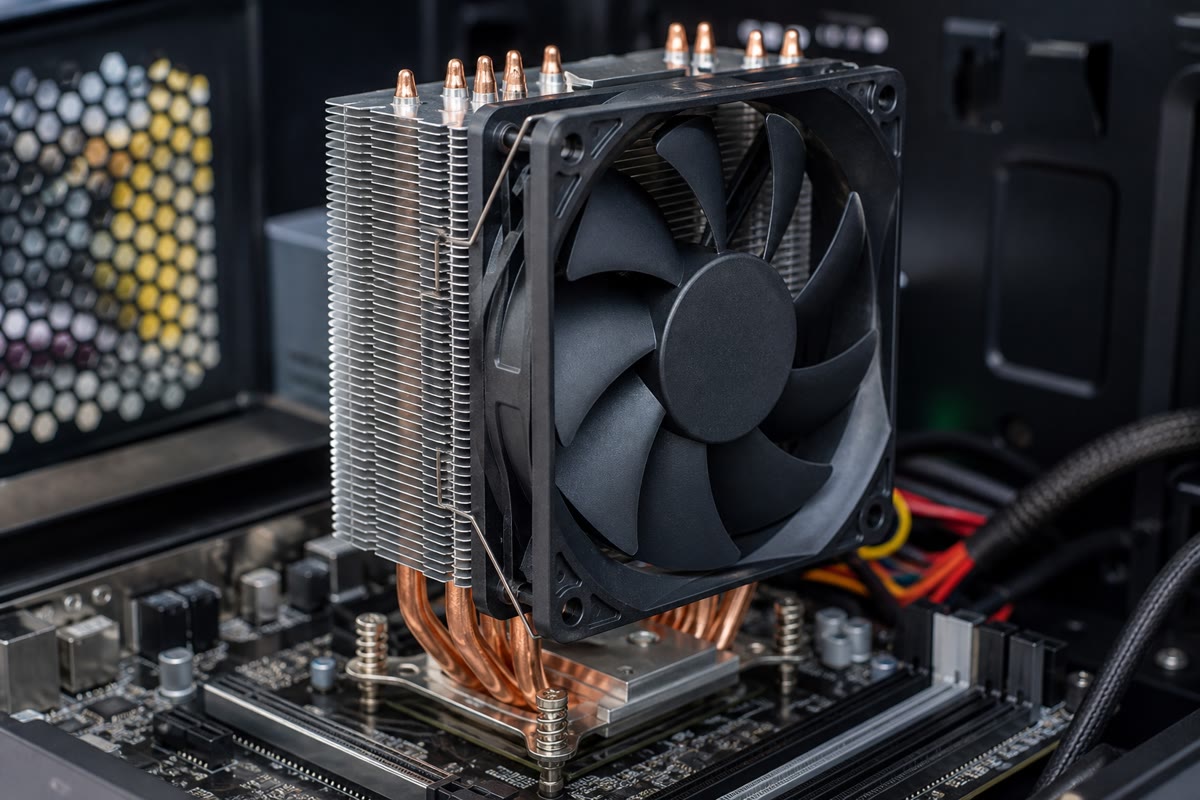
A finned heat sink on a processor: a hundred watts conducted out of a square centimetre of silicon, spread through a metal base, and handed to the air by fins that multiply the surface thirty times.
25.1 Fourier’s law
Definition 25.1(Heat current density)
The heat current densityjQ (in W/m2) is the vector such that the energy transferred by conduction through an oriented surface element dS during dt is jQ⋅dSdt; the thermal flux (a power, in watts) through a surface S is Φ=∬SjQ⋅dS.
Theorem 25.2(Fourier’s law)
In a medium at rest whose temperature is not uniform,
jQ=−λgradT,
where the thermal conductivityλ>0 (in W/m/K) depends on the material and, weakly, on the temperature. Heat flows down the temperature gradient, from hot to cold — the second law built into a linear law.
Proof. Phenomenological, like Fick’s law, and with the same microscopic justification: the molecules (or the free electrons of a metal, or the lattice vibrations) carry their energy on a random walk, and more of it comes from the hot side. ∎
Example 25.3(Conductivities)
Metals (electrons carry the heat as well as the current — conductivities track each other): copper 400W/m/K, aluminium 240W/m/K, steel 50W/m/K. Insulating solids: concrete 1.5W/m/K, glass 1W/m/K, brick 0.8W/m/K, wood 0.15W/m/K. Liquids: water 0.6W/m/K. Gases: air 0.026W/m/K — and the best insulators, glass wool or foam at 0.04W/m/K, are mostly still air, trapped so that it cannot convect. Four orders of magnitude from copper to air.
25.2 The energy balance and the heat equation
Theorem 25.4(Local energy balance)
In a solid (or a fluid at rest) of density ρ and specific heat c, with a power p released per unit volume (Joule heating, a chemical or nuclear reaction, absorbed radiation),
ρc∂t∂T=−divjQ+p,in one dimensionρc∂t∂T=−∂x∂jQ+p.
Proof. First law for the slab between x and x+dx (section S, fixed volume, so no work): its internal energy ρcTSdx changes in dt by the heat received, [jQ(x)−jQ(x+dx)]Sdt=−∂xjQdxSdt, plus pSdxdt. In three dimensions the heat entering a fixed volume through its closed surface is −∬jQ⋅dS=−∭divjQdτ. ∎
Theorem 25.5(Heat equation)
For uniform λ, ρ, c,
∂t∂T=aΔT+ρcp,a=ρcλ(the thermal diffusivity, in m2/s).
Everything said of the diffusion equation holds: linearity, irreversibility, smoothing, and the scales L∼at, t∼L2/a.
Proof. Insert Fourier’s law in the balance: ρc∂tT=λΔT+p. ∎
Example 25.6(Diffusivities and times)
Copper a=1.1×10⁻⁴m2/s, air 2×10⁻⁵m2/s, concrete and brick ≈5×10⁻⁷m2/s, water 1.4×10⁻⁷m2/s, wood 1×10⁻⁷m2/s. Heat crosses a centimetre of copper in a second, a centimetre of brick in three minutes, a 20cm wall in a day (which is why thick walls smooth the day–night cycle), the 1.5cm half-thickness of a steak in a quarter of an hour (cooking times scale as the square of the thickness), and a kilometre of rock in 1012s, thirty thousand years — the Earth is still cooling from its formation.
25.3 Stationary regime: thermal resistances
Proposition 25.7(Thermal resistance of a slab)
In the stationary regime without sources, a slab of thickness e, area S, conductivity λ, between the temperatures T1 and T2, has a linear profile and carries the flux
Φ=RthT1−T2,Rth=λSe(in K/W):
its thermal resistance. Temperature plays the role of potential, the flux that of current: resistances in series (layers of a wall) add, resistances in parallel (wall and window) add their inverses. For a cylindrical shell (a pipe’s insulation) between the radii r1<r2 and of length ℓ, Rth=ln(r2/r1)/2πλℓ; for a spherical shell, (1/r1−1/r2)/4πλ.
Proof.d2T/dx2=0: affine profile, jQ=λ(T1−T2)/e uniform, Φ=jQS. In cylindrical geometry Φ=−λ2πrℓdT/dr is the same at every r (no accumulation), so T=A−(Φ/2πλℓ)lnr; in spherical geometry, Φ=−4πr2λdT/dr gives T=A+Φ/4πλr. ∎
Proposition 25.8(Exchange with a fluid: Newton’s law)
A solid surface at Ts in contact with a fluid at Tf (away from the surface) loses the flux density
jQ=h(Ts−Tf),
where the heat transfer coefficienth (in W/m2/K) sums up the conduction through the thin fluid layer that sticks to the wall and the convection that renews it: h≈5–25W/m2/K for air in natural or light convection, 50–500W/m2/K for forced air, 103–104 for water. The surface then adds a film resistance1/hS in series with the wall.
Proof. Phenomenological: the fluid’s motion is not computed, it is summarised in h (measured, or given by the correlations of fluid mechanics). ∎
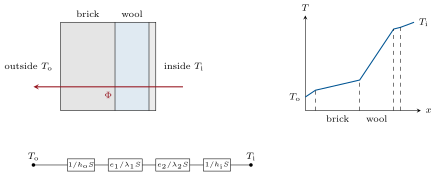
A composite wall and its thermal circuit: film, brick, wool, film in series. Right: the temperature profile — almost all the drop falls across the layer of largest resistance, the wool, though it is the thinnest.
Example 25.9(A wall and a window)
Per square metre: brick 20cm at 0.8W/m/K, R=0.25m2K/W; the two films, 1/8+1/25=0.165m2K/W: total 0.415, i.e. U=1/R=2.4W/m2/K and, for a 20K difference, 48W/m2. Add 10cm of glass wool, R=2.5m2K/W: the total is 2.9, U=0.34W/m2/K — seven times less. A single pane of glass, 4mm at 1W/m/K, is all film: R=0.004+0.165, U≈6W/m2/K; a 12mm layer of still air between two panes adds 0.012/0.026=0.46m2K/W and divides the loss by more than three.
Definition 25.10(Biot number)
For a solid of size L exchanging with a fluid, the Biot number
compares the two. If Bi≪1 the solid is uniform in temperature at every instant and cools as a whole, exponentially with the time constant τ=ρcV/hS; if Bi≫1 the surface is at the fluid temperature and the interior conducts at its own pace L2/a.
25.4 Periodic heating: the thermal wave
Proposition 25.11(Thermal wave in a half-space)
If the surface x=0 of a half-space is held at T(0,t)=T0+θ0cosωt, the temperature inside is, in the established regime,
T(x,t)=T0+θ0e−x/δcos(ωt−δx),δ=ω2a:
a wave that propagates inward at the speed ωδ=2aω and is damped over one penetration depthδ per radian of phase — by e−2π=2×10⁻³ per wavelength. Fast oscillations penetrate less than slow ones.
Proof. Seek T=θ0ei(ωt−kx): iω=−ak2, so k2=−iω/a, k=(1−i)ω/2a=(1−i)/δ (the root that decays for x>0). Take the real part. ∎
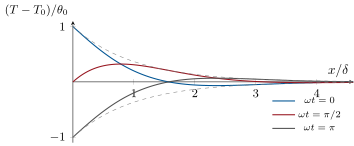
The thermal wave at three instants: the surface oscillation penetrates as a damped wave, its amplitude falling as e−x/δ (dashed) and its phase lagging by x/δ — at x=πδ the temperature is opposite to the surface’s.
Example 25.12(The soil, the cellar and the wine)
Soil, a≈5×10⁻⁷m2/s. Daily cycle, ω=2π/86400s: δ=12cm — half a metre down the day is gone. Annual cycle: δ=2.2m; at that depth the 10K summer–winter swing is down to 3.7K and lags by one radian, two months: the cellar is coldest in March and warmest in September, and at 5m it is 1K from constant — the cellar that keeps wine. The same mathematics gives the skin depth of electromagnetism (Chapter 14): same equation, same 2/(diffusivity×ω).
25.5 Fins
Proposition 25.13(The cooling fin)
A thin rod or plate (section S, perimeter p, conductivity λ) attached at x=0 to a wall at T0, in a fluid at Tf with the coefficient h, has the excess temperature θ=T−Tf obeying
dx2d2θ=m2θ,m=λShp;
for a long fin, θ=θ0e−mx and the fin evacuates Φ=hpλSθ0 — as much as a bare surface λS/hp=1/m long, with a temperature that has fallen to θ0/e at x=1/m. For a fin of finite length L (tip adiabatic), θ=θ0coshm(L−x)/coshmL and its efficiency — the flux over that of an isothermal fin at θ0 — is η=tanh(mL)/mL.
Proof. Stationary balance of the slice [x,x+dx]: conducted in, −λSθ′(x); out, −λSθ′(x+dx); lost to the fluid, hpθdx: λSθ′′=hpθ. The flux at the base is −λSθ′(0): λSmθ0 for the long fin, λSmθ0tanhmL for the finite one, to be compared with hpLθ0. The Biot number across the fin’s thickness, ht/λ, must be small for the one-dimensional treatment. ∎
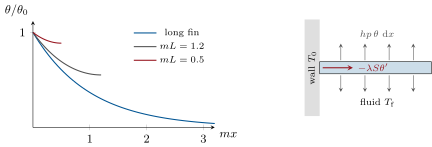
Left: temperature along a fin, for a long fin and two finite ones (adiabatic tip) — beyond mx≈2 a fin adds little. Right: the balance of a slice: conduction along, convection out through the perimeter.
Example 25.14(A heat sink)
Aluminium fins 1mm thick (p/S≈2/t=2000m−1), 30mm high, in forced air h=50W/m2/K: m=2h/λt=20m−1, mL=0.6, η=0.89 — the fins work at 89% of their area. Thirty of them, 60mm wide, offer 0.11m2 where the bare 60mm square offered 0.0036m2: a resistance 1/ηhA=0.2K/W instead of 5.6K/W; 100W raise the base by 20K instead of 560K. Longer fins gain little (tanh saturates), thinner ones lose efficiency: mL≈1 is the engineer’s compromise.
25.6 Entropy created by conduction
Proposition 25.15(Entropy production)
A flux Φ conducted from a body at Th to a body at Tc<Th through a stationary wall creates entropy at the rate
S˙c=Φ(Tc1−Th1)>0;
locally, conduction creates σs=λ(gradT)2/T2≥0 per unit volume and time — zero only where the temperature is uniform. Heat conduction is irreversible: the same energy, delivered at a lower temperature, can do less work.
Proof. The wall’s state does not change, so its entropy is constant: the hot body loses Φ/Th per unit time, the cold one gains Φ/Tc; the difference is created. Locally, the entropy balance ∂t(ρs)+div(jQ/T)=σs with ρT∂ts=−divjQ gives σs=jQ⋅grad(1/T)=−jQ⋅gradT/T2=λ(gradT)2/T2. ∎
Method 25.16(Conduction estimates)
(1) Stationary: build the thermal circuit — slabs e/λS, films 1/hS, shells ln(r2/r1)/2πλℓ; series and parallel. (2) Transient: Bi=hL/λ; if small, τ=ρcV/hS; if large, t∼L2/a. (3) Periodic: δ=2a/ω, damping e−x/δ, lag x/δ. (4) Sources: p per unit volume, parabolic profiles. (5) Fins: m=hp/λS, η=tanh(mL)/mL. (6) Entropy: Φ(1/Tc−1/Th).
25.7 Exercises
Exercise 25.1★
A brick wall 20cm thick (λ=0.8W/m/K), 100m2, between 20∘C inside and 0∘C outside (surfaces at these temperatures): flux density, total flux; with 10cm of glass wool (0.04W/m/K) added.
Solution
Solution of Exercise 25.1.
j=λΔT/e=80W/m2; 8kW; with wool R=0.25+2.5=2.75m2K/W: 7.3W/m2, 730W.
Exercise 25.2★
Diffusivities: copper (λ=400, ρ=8900, c=385J/kg/K), concrete (1.5, 2300, 900), wood (0.15, 600, 2500). Times for heat to cross 1cm and 20cm of each; the 30km crust of the Earth.
Solution
Solution of Exercise 25.2.
a: 1.2×10⁻⁴m2/s, 7×10⁻⁷m2/s, 1×10⁻⁷m2/s. 1cm: 0.9s, 140s, 1000s; 20cm: 6min, 15h, 5days; crust (a∼1×10⁻⁶m2/s): 1015s, thirty million years.
Exercise 25.3★
Single glazing (4mm, λ=1W/m/K) with films hi=8, ho=25W/m2/K; double glazing with a 12mm layer of still air (0.026W/m/K): U values and fluxes for 20K. Why is the real double glazing about twice worse than this estimate, and what do argon and low-emissivity coatings do?
Solution
Solution of Exercise 25.3.
Single: R=0.169, U=5.9W/m2/K, 118W/m2; double: R=0.63, U=1.6W/m2/K, 32W/m2. The gap convects and the panes exchange by radiation (about half the real transfer); argon conducts less and convects less, a low-emissivity coating suppresses the radiation.
Exercise 25.4★
Cooking: a=1.4×10⁻⁷m2/s for meat. Time for the centre of a 3cm steak to feel the pan; of a 12cm roast. A turkey twice as heavy: how much longer (the dimension scales as the cube root of the mass)?
Solution
Solution of Exercise 25.4.
L2/a with the half-thickness: 27min; roast: 16×, 7h; t∝L2∝m2/3: ×1.6.
Exercise 25.5★★
Internal source. A cylinder of radius R releases p per unit volume; surface at Ts. (a) Show that T(r)=Ts+p(R2−r2)/4λ. (b) Copper wire, R=1mm, j=1×10⁷A/m2, γ=6×10⁷S/m: p and the centre–surface difference. (c) Nuclear fuel rod, R=5mm, p=3×10⁸W/m3, λ=3W/m/K: same question. (d) Comment.
Solution
Solution of Exercise 25.5.
(a) (rT′)′/r=−p/λ with T′(0)=0. (b) p=j2/γ=1.7×106W/m3; pR2/4λ=1×10−3K. (c) 625K. (d) A wire is isothermal; a fuel pellet’s centre is hundreds of kelvins above its surface — the power density of a reactor is limited by conduction in the fuel.
Exercise 25.6★★
The ground. (a) Derive δ=2a/ω. (b) Soil, a=5×10⁻⁷m2/s: daily and annual penetration depths. (c) Depth at which the annual amplitude is a tenth of the surface’s; phase lag there. (d) A water pipe must not freeze where the winter surface temperature dips to −10∘C around a mean of 10∘C: minimum depth (annual wave).
Solution
Solution of Exercise 25.6.
(a) Proposition 25.11. (b) 12cm; 2.2m. (c) δln10=5.2m; lag 2.3rad, 130 days. (d) The 20K amplitude must halve: x=δln2=1.5m.
Exercise 25.7★★
Biot. (a) Copper sphere, radius 1cm, in air (h=10W/m2/K): Biot number, time constant of its cooling. (b) A potato (λ=0.5W/m/K, a=1.4×10⁻⁷m2/s, radius 3cm) in an oven with h=20W/m2/K: Biot number; which time governs its cooking? (c) Why is a thermocouple bead made small? (d) Why does a cup of coffee cool faster when stirred or blown on — which resistance changes?
Solution
Solution of Exercise 25.7.
(a) Bi=hR/3λ≈10−4; τ=ρcR/3h=1100s. (b) Bi=1.2: neither limit; the internal time R2/a≈6000s governs. (c) Small R: tiny τ and small Biot number. (d) The film resistance 1/h, the dominant one, drops.
Exercise 25.8★★
A fin. (a) Derive θ′′=m2θ and the long-fin solution. (b) Aluminium fin, 1mm thick, 30mm high, natural convection h=20W/m2/K: m, mL, efficiency. (c) By what factor does the fin multiply the exchange area of its footprint, and the flux? (d) Why is a very long or very thin fin a waste of metal?
Solution
Solution of Exercise 25.8.
(a) Proposition 25.13. (b) m=2h/λt=13m−1, mL=0.39, η=0.95. (c) Area ×2L/t=60, flux ×57. (d) Beyond mL≈2 the extra length is at the fluid temperature; a thinner fin has a larger m and a lower efficiency.
Exercise 25.9★★
Pipes. (a) Derive the resistance of a cylindrical shell. (b) A steam pipe, outer radius 5cm at 150∘C, wrapped in 5cm of glass wool, air at 20∘C with h=10W/m2/K outside: loss per metre, compared with the bare pipe. (c) Show that the total resistance of insulation plus film has a minimum at the critical radiusrc=λ/h. (d) For an electric wire of radius 1mm with a plastic sheath (λ=0.2W/m/K), does the sheath cool or warm the copper?
Solution
Solution of Exercise 25.9.
(a) Proposition 25.7. (b) Wool ln2/2πλ=2.76Km/W, outer film 1/2πr2h=0.16: 45W/m; bare, 2πr1hΔT=410W/m. (c) d/dr[ln(r/r1)/2πλ+1/2πhr]=0 at r=λ/h. (d) rc=2cm>1mm: the sheath increases the loss — it cools the copper.
Exercise 25.10★★★
Entropy. The wall of Exercise 25.1 (bare) between 293K and 273K. (a) Entropy created per second. (b) Compute ∫σsdV with the linear profile and check it agrees. (c) Entropy created once insulated. (d) The work that a reversible engine could have extracted from the 8kW between these temperatures, and what remains of it after the wall.
Solution
Solution of Exercise 25.10.
(a) 8000(1/273−1/293)=2.0W/K. (b) σs=λT′2/T2 with T′=100K/m; ∫σsdx=λT′(1/Tc−1/Th)=j(1/Tc−1/Th); times 100m2: the same. (c) 0.18W/K. (d) Φ(1−Tc/Th)=550W; nothing — the heat now sits at Tc (TcS˙c=550W).
Exercise 25.11★★★
Why metal feels cold. (a) For the thermal wave, compute the surface flux jQ(0,t) and show it leads the surface temperature by π/4, with the amplitude λρcωθ0. The quantity b=λρc is the effusivity. (b) Two half-spaces at T1 and T2 are brought into contact: admitting that each then follows an erfc profile with the common surface temperature Tc, and writing the continuity of the flux at the contact, show that Tc=(b1T1+b2T2)/(b1+b2). (c) Skin (b≈1000J/m2/K/s1/2, 33∘C) touching copper (b=37000) or wood (b=400) at 20∘C: contact temperatures. (d) Why does a tile floor feel colder than a carpet at the same temperature, and why is the sensation only transient?
Solution
Solution of Exercise 25.11.
(a) jQ(0,t)=−λ∂xT=λθ02/δcos(ωt+π/4)=λρcωθ0cos(ωt+π/4). (b) Each side’s flux at the contact is bi∣Ti−Tc∣/πt; equate: Tc=(b1T1+b2T2)/(b1+b2). (c) Copper 20.3∘C, wood 29∘C. (d) Tile b≈1500, carpet ≈100; the formula holds while both bodies look semi-infinite; once the heat fronts reach the blood supply and the object’s far side, the steady state depends on the heat actually supplied.
Exercise 25.12★★★
Cooling a slab. A slab −L<x<L at T0 is plunged at t=0 into a bath at Tf with h→∞. (a) Show that θ=T−Tf admits the solutions cos(knx)e−akn2t with kn=(2n+1)π/2L. (b) Expand the initial condition in a Fourier series on these modes and write the full solution. (c) After the first instants, which mode survives, and what is the time constant? (d) Time for the centre of a 3cm steak (a=1.4×10⁻⁷m2/s) to get within 1% of the bath.
25.8 Problem: Insulating a house, cooling a processor
Problem 25.1
Weekend problem — conduction at the scale of a building and of a chip
Data: brick λ=0.8W/m/K, ρ=1800kg/m3, c=840J/kg/K; glass wool 0.04W/m/K; glass 1W/m/K; still air 0.026W/m/K; aluminium 240W/m/K, ρ=2700kg/m3, c=900J/kg/K; silicon 150W/m/K; thermal paste 5W/m/K; soil a=5×10⁻⁷m2/s, λ=1W/m/K; films hi=8, ho=25W/m2/K.
Part I — The house. A house has 100m2 of walls (brick 20cm) and 20m2 of single-glazed windows (4mm); inside 20∘C, outside 0∘C.
Resistance per square metre of the brick alone; flux density if its faces were at the two temperatures.
With the two films: R and U=1/R per square metre; same with 10cm of glass wool added.
U of the single glazing; of a double glazing with 12mm of still air.
Total loss of the house before and after insulating the walls and doubling the windows.
Over a heating season of 2500 degree-days (the integral of the temperature difference over the season, in Kday), energy lost before and after, in kilowatt-hours.
Inner surface temperature of the wall, bare and insulated; why does a cold wall feel uncomfortable and grow mould?
Diffusion time across the brick; what does it do to the day–night cycle?
Part II — The ground under the house.
Derive the penetration depth δ=2a/ω of a thermal wave.
Daily and annual δ in the soil.
Depth at which the daily swing is down to 1%; annual amplitude at 2.2m and at 5m for a 10K surface swing.
Phase lag at 2.2m, in days: when is the cellar coldest?
Surface heat flux of the annual wave (amplitude and phase); compare its amplitude with the geothermal flux 0.06W/m2.
The geothermal gradient is 30K/km: check it against the flux and λ, and explain why it is invisible in the cellar’s seasons.
Part III — The processor. A chip dissipates 100W in a die of 1cm2, 0.5mm thick; a 50µm layer of paste over 10cm2 bonds it to an aluminium heat sink: base 60mm×60mm×5mm, thirty fins 60mm wide, 30mm high, 1mm thick; a fan gives h=50W/m2/K; ambient 25∘C.
Flux density through the die; resistance of the die.
Resistance of the paste; and if a 50µm air gap replaced it.
Fin parameter m, mL, efficiency; check the Biot number across the fin thickness.
Total fin area and the resistance of the fins; resistance of the base (conduction through 5mm); junction temperature.
Same without fins (bare 60mm square): conclusion.
The fan stops (h=10W/m2/K): junction temperature; what does the processor do at 100∘C?
Mass and heat capacity of the sink; its time constant RC; and that of the die alone (0.1g, 700J/kg/K).
Why do good sinks have a copper base or heat pipes?
Part IV — Entropy.
Entropy created per second by the bare house envelope (question 4) between 293K and 273K; after insulation.
Entropy created by the chip’s 100W passing from the junction to the ambient; and by the conversion of electrical work into heat in the die.
Show that for a slab ∫σsdV=Φ(1/Tc−1/Th).
Summarise in five lines what governs a wall, a fin, a cellar and a chip.
21. The heat must spread from 1cm2 to 36cm2: copper halves that spreading resistance; a heat pipe moves heat by evaporation and condensation with an effective conductivity a hundred times copper’s.
22.7200(1/273−1/293)=1.8W/K; 0.33W/K.
23.100(1/298−1/324)=0.027W/K; 100/324=0.31W/K — ten times more: turning work into heat is the big irreversibility.
24.∫λT′2/T2dx=λT′[−1/T]=j(1/Tc−1/Th).
25. Wall: resistances in series, the worst conductor rules. Fin: m=hp/λS, mL≈1. Cellar: δ=2a/ω, damping and lag together. Chip: a chain of resistances from die to air, the fins’ area doing the work. Everywhere: heat flows down, and creates entropy doing so.