University Physics — Year 2 · Bachelor Year 2
19Two-Wave Interference
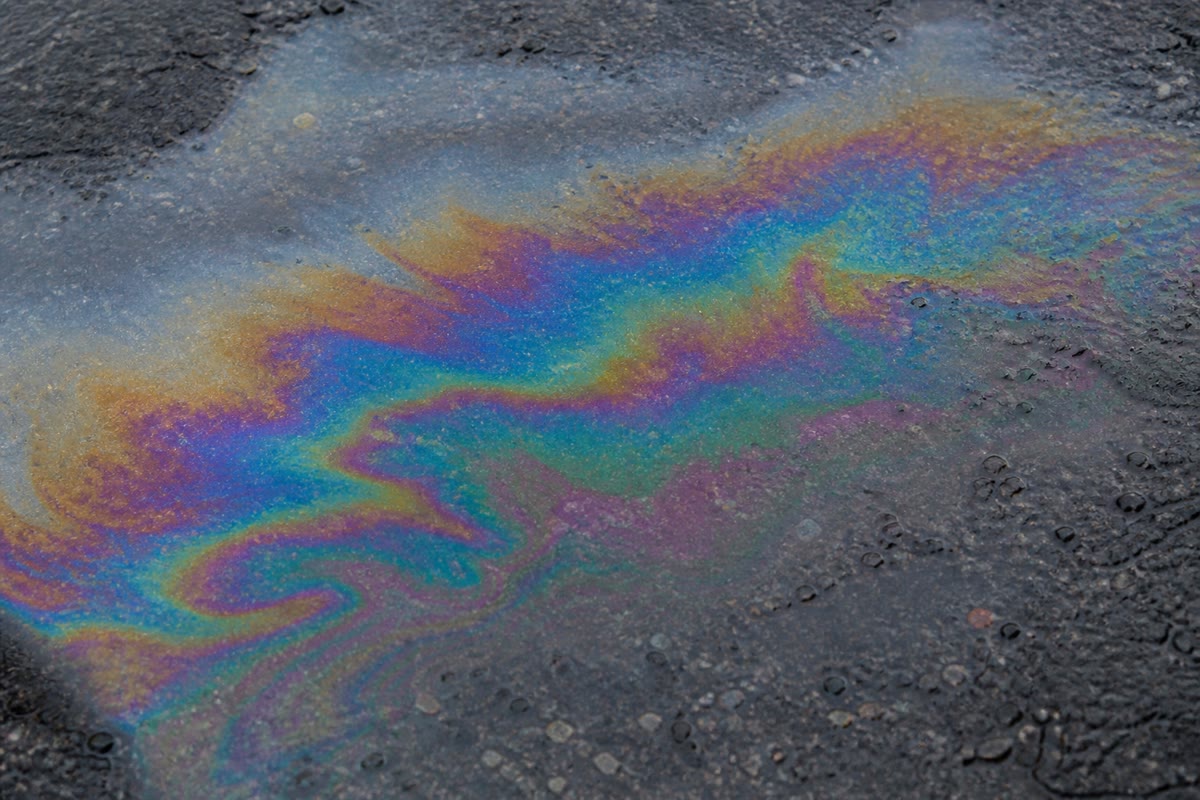
A soap bubble is made of a colourless liquid, yet it shimmers with colour; a film of oil on a wet road shows the same rainbow bands; the wings of a dragonfly glint green and violet. None of these colours comes from a pigment: they come from two copies of the same light wave, reflected at the two faces of a thin film, arriving with a delay and either reinforcing or cancelling each other — the interference of two waves. Young made it the proof that light is a wave in 1801, with two slits and a candle; this chapter sets out the formula, the geometry of Young’s fringes, the two conditions — temporal and spatial coherence — under which fringes survive, and the thin-film colours.
19.1 The interference formula
Theorem 19.1 (Two-wave interference)
Two coherent monochromatic waves of intensities , and phase difference at a point give there the intensity
where is the optical path difference between the two routes from the source to . The intensity is maximal () where , an integer — the order of interference — and minimal () where . The contrast (visibility) of the fringes is
equal to for equal intensities, where the minima are perfectly dark: .
Proof. ; as in Chapter 18, with fixed during the detection; . The phase difference of two waves that left the source together and travelled optical paths , is (plus for each reflection that reverses the sign, Chapter 15). ∎
Remark 19.2 (The three conditions)
Fringes exist only if (1) the two waves come from the same source (two copies of one vibration, otherwise is random); (2) the path difference is smaller than the coherence length, (temporal coherence: beyond it the copies belong to different wave trains); (3) the source is small enough that its different points do not produce displaced fringe systems washing each other out (spatial coherence, below). And a fourth, usually satisfied: the two waves must not have perpendicular polarizations (they would add in intensity, like the torches).
19.2 Young’s slits
Proposition 19.3 (Division of wavefront: Young’s experiment)
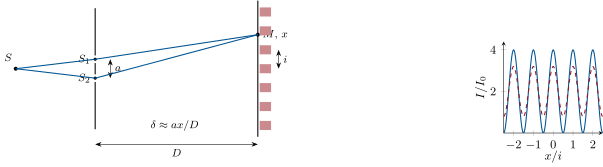
A point source (or a slit) illuminates two narrow parallel slits , a distance apart, equidistant from ; a screen stands at the distance . At the point of the screen at height (parallel to ) the path difference is
and the screen shows straight, equidistant fringes, bright at , with the interfringe
The fringes exist everywhere behind the slits (they are not localized); with a lens of focal length after the slits, they are seen in its focal plane with (fringes "at infinity"). The intensity is .
Proof. and , so . Two orders differ by , i.e. by . With a lens the two waves leaving the slits at the angle from the axis have the path difference and meet at . ∎
Example 19.4 (Numbers, and white light)
, , : — large enough to see, which is why Young’s slits must be close and the screen far. With white light every colour makes its own fringes, all coinciding at the centre (): a white central fringe, then coloured fringes as the orders drift apart (red is times the violet), and after a few orders a uniform whitish field — the coherence length of white light is a micrometre, two or three wavelengths. A spectrometer pointed at that "white" field still sees dark bands at the wavelengths for which : a channelled spectrum.
Proposition 19.5 (Spatial coherence: the source must be small)
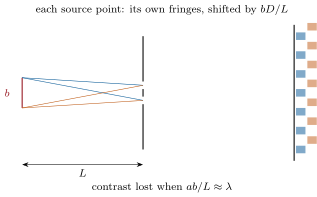
Each point of an extended source produces its own fringe system; a source point displaced transversally by at the distance before the slits shifts the fringes by (the path difference gains ). A source of width spreads the fringes over one interfringe, and the contrast vanishes, when
The two slits must be within the coherence area of the light — the region over which the wave from the source has a well-defined phase, of width . Sunlight () gives a coherence width of : Young needed a pinhole to widen it.
Proof. For a source point at height , the extra path adds to : the pattern shifts by . Integrating the displaced patterns over a source of width gives a contrast , zero at . ∎
19.3 Thin films: division of amplitude
Proposition 19.6 (Interference in a thin film)
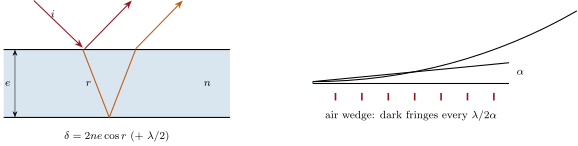
A film of index and thickness in air, lit at incidence (refraction angle ), returns two waves reflected at its two faces, with the path difference
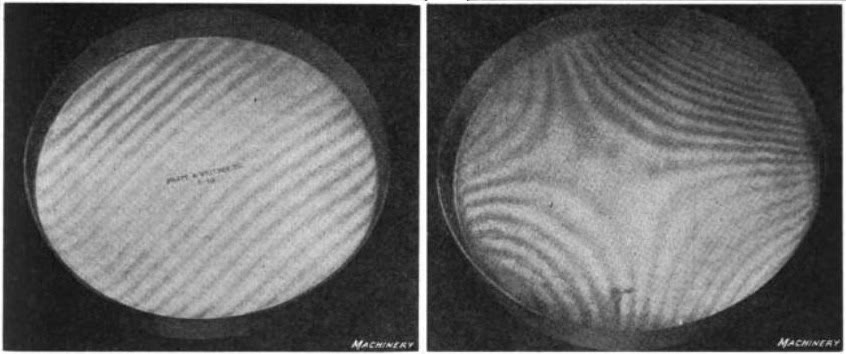
the extra half wavelength counting the sign reversal of the reflection on the denser medium at the first face and not at the second (Chapter 15). The fringes are bright for , dark for — a film of vanishing thickness reflects nothing (the black top of a draining soap film). For a film of uniform thickness the fringes depend on only and are seen at infinity (rings of equal inclination); for a wedge of slowly varying thickness seen at near-normal incidence they follow the contours of equal and are localized on the film (fringes of equal thickness): an air wedge of angle shows straight fringes spaced ; a lens of radius on a flat gives Newton’s rings, dark at .
Proof. Geometry: the wave refracted at the first face crosses the film twice ( in glass, optical path ) while the wave reflected at the first face advances in air; the difference is with . For the wedge, and successive dark fringes at ; for the lens, . ∎
Example 19.7 (Soap, oil, dragonflies)
A soap film () thick seen at normal incidence: bright for , i.e. nm: (green, ) within the visible, and a dark band at ; the film looks green. As it drains and thins, the colour runs through the sequence, ending black. An oil film (, ) on water (): the second reflection, toward a lower index, does not reverse the sign, so again and the film is bright at : (), blue. The iridescence of a butterfly’s wing, a beetle’s shell or a compact disc are interferences of the same kind (the disc’s, of many waves: Chapter 21), which is why they change with the angle — depends on — while a pigment’s colour does not.
Method 19.8 (Solving an interference problem)
(1) Identify the two routes from the source to and compute the optical path difference , adding for each reflection with sign reversal. (2) ; bright at . (3) The fringe spacing from . (4) Check temporal coherence (, number of visible fringes ) and spatial coherence (source angle ). (5) Say where the fringes are localized (everywhere for two point sources; on the film for equal-thickness fringes; at infinity for equal-inclination ones).
19.4 Exercises
Exercise 19.1 ★
Young’s slits apart, screen at , : interfringe; order of the fringe at ; position of the tenth dark fringe; interfringe with the slits apart, and in water ().
Solution
Solution of Exercise 19.1.
; ; tenth dark fringe at ; : ; in water : .
Exercise 19.2 ★
Two waves of intensities and interfere: , , contrast. Same for and : why are fringes still visible with such unequal beams? One slit of Young’s pair is covered by a grey filter transmitting : new contrast.
Solution
Solution of Exercise 19.2.
: . : — the interference term goes as the amplitude ratio, , not the intensity ratio. Filter: .
Exercise 19.3 ★
A soap film thick () seen at normal incidence: visible wavelengths reflected most and least; its colour. A film of : how many bright wavelengths in the visible, and what does the eye see?
Solution
Solution of Exercise 19.3.
: bright at : (blue-violet); dark at : (red): a blue film. : , bright at , , , — four colours at once, a washed-out pinkish white.
Exercise 19.4 ★
Newton’s rings between a lens of radius and a flat, in sodium light: radii of the first three dark rings; number of rings within a radius of ; is the centre bright or dark, and why? What changes if the gap is filled with water?
Solution
Solution of Exercise 19.4.
: , , ; rings within ; the centre is dark: zero thickness and one sign reversal. Water: radii divided by , rings.
Exercise 19.5 ★★
White light. Young’s slits with white light (–), , . (a) Interfringe for violet and for red; position of the second red and the third violet bright fringes. (b) Beyond which order do the red and violet fringes of successive orders overlap? (c) At , which wavelengths are missing (channelled spectrum)? (d) Explain the sequence of colours seen from the centre outward.
Solution
Solution of Exercise 19.5.
(a) and ; second red , third violet . (b) Order red at mm meets order violet at : from the orders overlap. (c) : missing : , , . (d) White centre; then fringes with a blue inner edge and a red outer edge; by the third order the colours mix into white.
Exercise 19.6 ★★
Source size. A sodium lamp lights Young’s slits () through a source slit at . (a) Maximum width of the source slit for good contrast (take ). (b) The source slit is widened to : contrast (use ). (c) Why can one not simply use the bare lamp (width )? (d) The Sun as a source, across: maximum slit separation that gives fringes.
Solution
Solution of Exercise 19.6.
(a) . (b) : contrast . (c) A centimetre-wide source spans hundreds of interfringes of shift: no fringes. (d) .
Exercise 19.7 ★★
Lloyd’s mirror. A point source at height above a plane mirror, screen at , : the direct wave interferes with the one reflected by the mirror (a virtual source at ). (a) Interfringe. (b) The fringe at the mirror’s edge () is dark: what does that tell about the reflection? (c) Number of fringes visible if the source’s coherence length is . (d) Why is this arrangement the radio astronomer’s "sea interferometer" for a rising star?
Solution
Solution of Exercise 19.7.
(a) : . (b) At the paths are equal yet the fringe is dark: the reflection adds (sign reversal at grazing incidence on the denser medium). (c) : fringes. (d) The sea is the mirror, the cliff-top aerial the screen: as the source rises, the fringes sweep past and give its elevation.
Exercise 19.8 ★★
Air wedge. Two glass plates long touch at one end and are separated at the other by a hair of diameter ; in sodium light dark fringes are counted. (a) . (b) Fringe spacing. (c) The gap is filled with water: number of fringes. (d) The plates are pressed slightly at the far end: what do the fringes do, and what precision on does counting a quarter of a fringe give?
Solution
Solution of Exercise 19.8.
(a) : . (b) . (c) : fringes. (d) The fringes move toward the far end and spread as falls; a quarter fringe is on .
Exercise 19.9 ★★
Oil on water. A film of oil () of thickness floats on water (). (a) Which of the two reflections reverses the sign? Path difference. (b) For at normal incidence: reflected wavelengths reinforced and cancelled; colour. (c) Thinnest film that looks violet (). (d) Why do the colours shift toward blue when the film is viewed obliquely? (e) What changes for a film whose index lies between those of the two media (a coating on glass)?
Solution
Solution of Exercise 19.9.
(a) Only the first (air oil, denser); oil water goes to a lower index: , bright at . (b) : reinforced (edge of the visible), (blue); cancelled : (yellow): blue. (c) : . (d) falls with the angle: the reinforced wavelengths move toward the blue. (e) Both reflections then reverse the sign, no extra : bright at , dark at — the quarter-wave anti-reflection layer.
Exercise 19.10 ★★★
A slide on one slit. A glass plate of thickness and index covers slit of a Young’s pair (, , ). (a) Extra optical path; by how many fringes and in which direction does the pattern shift? (b) With white light, where does the (now displaced) white central fringe go — is it still visible? Coherence length . (c) Use the white-light pattern to measure : how? (d) The plate is tilted: the shift grows — show that to first order it grows as and estimate it for .
Solution
Solution of Exercise 19.10.
(a) , fringes, toward the covered slit (where the geometric path must shorten by to restore ): . (b) The white fringe sits there; the glass’s dispersion ( across the visible, i.e. of path) is below : still visible, slightly coloured. (c) Measure the shift of the white fringe: . (d) at : an eighth of a fringe.
Exercise 19.11 ★★★
The stellar interferometer. Two mirrors a distance apart collect the light of a star and bring it to interfere. The star is a uniform disk of angular diameter ; each point of it shifts the fringes, and the contrast vanishes for (admitted, the disk’s version of ). (a) Betelgeuse, (seconds of arc), : baseline at which the fringes disappear (Michelson, 1920, Mount Wilson). (b) Why can a single telescope of not resolve the disk (its limit is )? (c) Modern interferometers link telescopes apart: smallest measurable diameter. (d) Why must the two paths be equal to within the coherence length, and how long is that for a filter?
Solution
Solution of Exercise 19.11.
(a) : . (b) Its limit is above the star’s diameter, and the atmosphere blurs to . (c) . (d) The fringes need .
Exercise 19.12 ★★★
Equal-inclination rings. A parallel plate of thickness and index is lit by a broad sodium source; the reflected light is focused by a lens of . (a) Show that the rings are at the angles with (bright) and that, near the centre, . (b) Order at the centre; is the centre bright? (c) Radii of the first three bright rings in the focal plane. (d) Why are these rings seen with an extended source while Young’s fringes need a narrow one? (Localization at infinity.)
Solution
Solution of Exercise 19.12.
(a) ; . (b) : the centre, with between and , is neither bright nor dark. (c) for , , : , , , , , . (d) The angle alone fixes the order: every source point feeds the same ring at the same angle, so the rings, seen at infinity, survive a broad source.
19.5 Problem: Fresnel’s mirrors and an oil film
Problem 19.1
Weekend problem — an interferometer of 1816 and a rainbow on a puddle: two ways of splitting one wave and the two coherences that limit both
Part I — Fresnel’s mirrors. Two plane mirrors touching along a line make a very small angle ; a slit source , parallel to that line, is at from it, and the screen at beyond. (sodium).
- Show that the two mirrors give two virtual images , of on a circle of radius centred on the line of contact, separated by ; value.
- Why do the waves from and interfere, whereas those of two separate lamps would not?
- Interfringe on the screen (distance from the sources to the screen ); number of fringes across the -wide region where the two reflected beams overlap.
- Order of interference at the edge of that region; is it below the limit set by the lamp’s coherence length ()?
- The source slit is wide: shift of the fringes produced by its two edges (each source point is imaged in two virtual points; the fringe system shifts by with ); is the contrast preserved (compare with )?
- The slit is widened to : contrast, using .
- The two mirrors reflect and of the light: contrast of the fringes.
- A glass plate thick () is placed in front of one mirror: shift of the pattern, in fringes; can it be followed with sodium light? With white light?
- Replace the sodium lamp by white light: describe the screen; how many coloured fringes on each side of the centre?
Part II — The oil film. A film of oil () spreads on a wet road (), lit by the overcast sky and viewed at near-normal incidence.
- Reflections at the two faces: which reverse the sign? Path difference; condition for a bright colour.
- Thickness of the thinnest region that looks red (); green (); violet ().
- A region thick: which visible wavelengths are reinforced, which cancelled; its colour.
- Why does the film show bands of colour (what varies along the road), and why do the bands follow the contours of thickness?
- The film thins by evaporation: describe the change of the colour sequence at a given point; what is seen when here — bright or dark? Compare with a soap film in air.
- The top of a draining soap film turns black just before it bursts: thickness there (a few nanometres) and why black.
- Viewed at incidence: refraction angle in the oil, and the shift of the bright wavelengths of question 11.
- Beyond what thickness do the colours fade into a uniform grey, for daylight of coherence length about ?
- The light from the sky is unpolarized and arrives from many directions: why does the pattern not wash out as an extended source washes out Young’s fringes? (Localization on the film.)
Part III — Two coherences.
- Temporal coherence: for the Fresnel mirrors with sodium light, the maximum order visible; with a laser ().
- Spatial coherence: the maximum source width for the mirrors (from ) and for Young’s slits with at .
- Explain why the thin film tolerates an extended source while Young’s slits do not: sketch the two rays of the film for two different source points and show they still meet on the film.
- The sodium line itself is wide: how many fringes can the mirrors show at most (use )?
- A student replaces the sodium lamp by a green LED (): number of fringes visible with the mirrors.
- With a laser the fringes extend over the whole overlap region with full contrast but the screen is "speckled": why?
- In one table, for the mirrors and the film: how the wave is split, where the fringes are localized, what limits their number, and what a wider source does.
Solution
Solution of Problem 19.1.
1. Each mirror images by symmetry at the distance from the contact line; the two images lie on the circle of radius , at the angle apart: .
2. and are two images of the same vibration: their phase jumps are the same.
3. : ten fringes across .
4. at the edge, : far below .
5. Shift , a third of : contrast .
6. : .
7. Amplitudes , : .
8. : fringes; trivially followed with sodium light; in white light the white fringe moves by and is still there (the glass’s dispersion costs a fraction of a micrometre).
9. A white central fringe, two or three coloured fringes on each side, then a uniform white.
10. Air oil reverses, oil water (lower index) does not: ; bright for .
11. : red , green , violet .
12. : reinforced : (red), (blue-green), ; cancelled : (yellow), : a purplish mixture of red and blue-green.
13. The thickness varies along the road; each colour is bright where has the right value, so the bands are contours of equal thickness.
14. The orders fall: the colours run through the sequence toward the thin-film end; at the single sign reversal leaves for every colour: dark — as for a soap film in air.
15. A few nanometres: for all colours, the two reflections are in antiphase and cancel: black.
16. , , : , bright at , , : the red of question 12 has turned green-yellow — toward the blue.
17. When exceeds , i.e. beyond some of oil, the orders overlap and the colours fade to grey.
18. The two rays reflected from the film for any source direction meet back on the film: the fringes are localized there and a broad, multidirectional source merely adds identical patterns.
19. : with sodium, with the laser.
20. : for the mirrors, for the slits.
21. Draw two source points: for each, the two reflected rays recombine at the same point of the film, with the same at near-normal incidence; the film’s pattern does not move, Young’s does.
22. .
23. fringes.
24. Coherent light scattered by the screen’s grains interferes with random phases at the eye: speckle.
25. Mirrors: division of wavefront, fringes everywhere (non-localized), number limited by , a wide source washes them out. Film: division of amplitude, fringes on the film, colours limited by , a wide source is harmless.