University Physics — Year 2 · Bachelor Year 2
22Fraunhofer Diffraction and Spatial Filtering
Squint at a street lamp through the gap between two fingers and the lamp stretches into a band of fringes; look at a star through the finest telescope and you see not a point but a small disc ringed with faint circles. Light passing through an opening spreads — the narrower the opening, the wider the spread — and no lens can focus it tighter than this spread allows. This is diffraction, the reason a microscope cannot see a virus, a telescope’s resolving power grows with its diameter, and a laser beam cannot stay parallel. This chapter computes the diffraction pattern of an aperture in the far field, the limit it sets on every optical instrument, the way it combines with interference, and the idea — Abbe’s — that turns the focal plane of a lens into a place where an image can be filtered.
22.1 The Huygens–Fresnel principle and the Fraunhofer regime
Definition 22.1 (Huygens–Fresnel principle)
Every point of a wavefront (or of an aperture lit by a wave) acts as a secondary source emitting a spherical wavelet, in phase with the wave there; the wave beyond is the coherent sum of the wavelets. For an aperture lit by a plane wave of amplitude , the amplitude reaching a far point is , with the phase of the path from the aperture point to ( a constant). Fraunhofer (far-field) diffraction is the case where is at infinity — or in the focal plane of a lens — so that the rays from all points of the aperture toward are parallel, in the direction , and
The pattern is observed at infinity, or at the focus of a lens, where the direction of small angles maps to the point .
Proof. Admitted at this level. ∎
Remark 22.2 (When is it far enough?)
For an aperture of size seen at distance without a lens, the rays are parallel enough when the quadratic term of Exercise 18.12 is negligible, — the Fresnel number . A slit at needs ; a aperture, — hence the lens, which brings infinity to its focal plane. Closer in (Fresnel diffraction) the patterns are more complex; the shadow of a straight edge, for instance, has fringes along its lit side.
22.2 The single slit and the circular aperture
Proposition 22.3 (Diffraction by a slit)
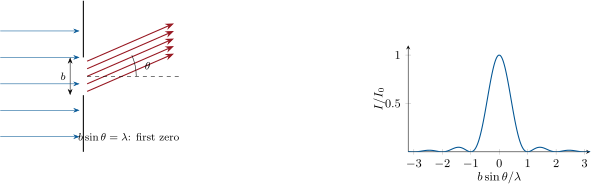
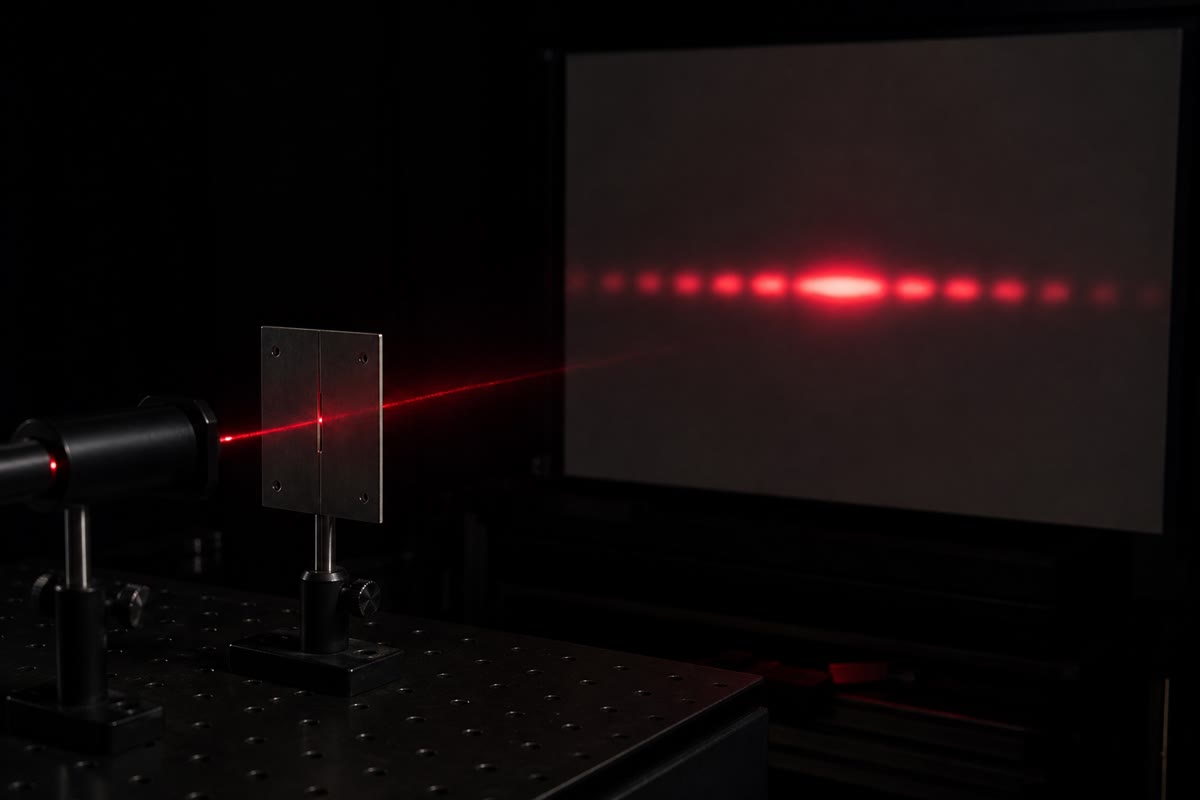
A slit of width (long along ) lit at normal incidence sends in the direction (in the plane perpendicular to the slit) the intensity
a bright central maximum of angular half-width (first zeros at ), containing of the light, and secondary maxima at about , , …, of relative intensities , , …— the narrower the slit, the wider the pattern. In the focal plane of a lens of focal length the central maximum is wide.
Proof. with ; square. Zeros where , : the wavelets from the two halves of the slit then cancel pairwise. ∎
Proposition 22.4 (Circular aperture; the Airy disc)
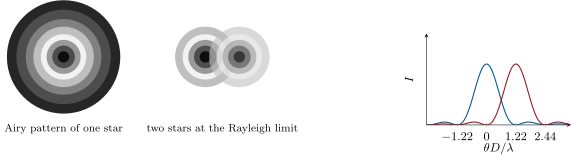
A circular aperture of diameter gives a central bright disc, the Airy disc, surrounded by faint rings; the first dark ring is at
and the disc holds of the light. Every instrument with an entrance pupil of diameter — eye, camera, telescope, microscope objective — turns a point source into an Airy disc of that angular radius; two points are resolved (Rayleigh’s criterion) if their angular separation exceeds : the resolving power of the instrument.
Proof. Admitted at this level. ∎
Example 22.5 (Eye, telescope, microscope)
The eye (, ): , about — a detail at , which is indeed about the acuity of a good eye: evolution matched the retina’s cells to the diffraction limit. A telescope: , a thousand times better, if the atmosphere lets it (it does not, from the ground: of "seeing", whence space telescopes and adaptive optics). A radio dish of at : , worse than the eye; interferometers across continents restore the resolution. A microscope objective of aperture angle resolves — about in the visible, whatever the magnification: the limit that drove microscopy to electrons and to X-rays.
22.3 Diffraction and interference together
Proposition 22.6 (Young’s slits of finite width; the grating’s envelope)
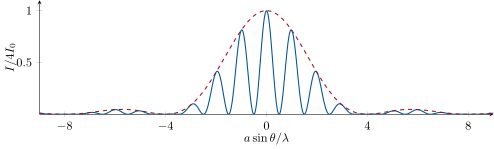
Two slits of width whose centres are apart give
Young’s fringes (spacing in ) under the single-slit envelope (width ); fringes fill the central lobe, and the fringes at that fall on a zero of the envelope () are missing. A grating of slits of width likewise has its principal maxima modulated by the same envelope — which the blaze of Chapter 21 tilts toward the order in use.
Proof. The aperture integral splits into a sum over the two slits of the same integral shifted by : . For slits the second factor is the -wave sum. ∎
22.4 The Fourier plane and spatial filtering
Proposition 22.7 (The lens as a Fourier analyser)
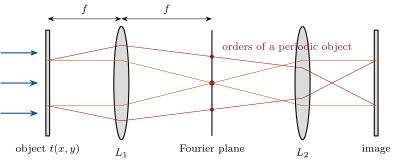
A transparency of transmittance in the front focal plane of a lens, lit by a plane wave, produces in the back focal plane the amplitude
— its two-dimensional Fourier transform, each point of the Fourier plane collecting the light diffracted at the angles , i.e. the spatial frequencies of the object: fine details (high frequencies) far from the axis, coarse ones near it. A second lens re-forms the image from that plane; whatever is blocked or altered there is filtered out of the image (spatial filtering, Abbe’s theory of the microscope): a pinhole on the axis keeps only the low frequencies (smoothing, "cleaning" a laser beam); a stop on the axis removes the uniform background and keeps the edges (dark-field, strioscopy); a quarter-wave plate on the axis turns phase objects, invisible otherwise, into intensity contrast (phase contrast, Zernike).
Justification. In the Fraunhofer integral, with the direction mapped to ; the transmittance weights each secondary source. (The Fourier transform itself is studied in the Year 3 mathematics volume; here it is only the name of this integral.) For a periodic object of period the transform is the set of grating orders at : the image can show the period only if at least the orders pass through the lens — Abbe’s condition, which is the microscope’s resolution limit again. ∎
Example 22.8 (Cleaning a beam, seeing the invisible)
A laser beam carries dust and ripples: focus it through a pinhole of a few micrometres — the size of the central Airy disc of the clean Gaussian beam — and everything else, which lies outside, is blocked; the re-collimated beam is smooth: a spatial filter. A living cell is transparent; it changes only the phase of the light. Blocking the axial spot makes its edges bright on black; Zernike’s plate shifts the undiffracted light by a quarter wave so that it interferes with the diffracted light in intensity: the cell’s interior appears, and biology got its microscope (1953 Nobel prize).
Method 22.9 (Diffraction estimates)
(1) Angular spread for an aperture of size ( for a circle); the pattern’s size at distance or focal length is , . (2) Check the Fraunhofer condition or use a lens. (3) Combine: diffraction envelope interference fringes. (4) Resolution: two points need ; a periodic object needs its first orders to enter the pupil. (5) The Fourier plane picture: what to block to remove which detail.
22.5 Exercises
Exercise 22.1 ★
A slit of lit by a He–Ne laser (); screen at . Width of the central maximum; position of the first two secondary maxima; Fresnel number — is the screen far enough? Same slit with a lens of .
Solution
Solution of Exercise 22.1.
; secondary maxima at and ; Fresnel number : far enough. With the lens, .
Exercise 22.2 ★
Resolving power (Rayleigh) of: the eye (, ); a amateur telescope; the Hubble mirror; a radio dish at ; a camera lens at (pupil ): size of the Airy disc on the sensor, compared with a pixel.
Solution
Solution of Exercise 22.2.
: eye (); : ; Hubble ; dish ; camera: radius, an disc — three pixels: diffraction already limits a sensor at .
Exercise 22.3 ★
Two slits of width , centres apart, , lens : fringe spacing; width of the central envelope; number of fringes in it; which orders are missing?
Solution
Solution of Exercise 22.3.
; envelope ; ten fringes; orders () missing.
Exercise 22.4 ★
A laser beam of diameter at propagates to the Moon (): diffraction angle , diameter of the spot; with a telescope as emitter; why are lunar ranging returns so faint (the retroreflector, , sends the light back with its own diffraction)?
Solution
Solution of Exercise 22.4.
: a spot across; with , . The reflector’s own diffraction, , spreads the return over : of photons sent, a handful come back.
Exercise 22.5 ★★
The slit in detail. (a) Carry out the Fraunhofer integral for the slit and obtain . (b) Show the secondary maxima are at (), the first near , and compute its relative intensity. (c) Fraction of the energy in the central lobe (admit and ). (d) The slit is lit at incidence : show the pattern is the same, centred on the direction .
Solution
Solution of Exercise 22.5.
(a) . (b) gives ; , . (c) . (d) The phase becomes : the same pattern about .
Exercise 22.6 ★★
Microscope. An objective of numerical aperture (oil immersion) at : smallest resolved distance ; with blue light (); in the ultraviolet (); why does a eyepiece not help (the eye’s own limit at is )? What do electron microscopes change ( at )?
Solution
Solution of Exercise 22.6.
: ; ; . Beyond some the eyepiece only enlarges the blur (empty magnification). Electrons at with : — atoms.
Exercise 22.7 ★★
Rectangular and circular. (a) A rectangular aperture : show the pattern is : a cross, wider along the narrower side. (b) A square of with : size of the central square. (c) For a circle of the same width the first zero is at instead of : why further out (think of the light concentrated near the centre of a disc)? (d) A telescope’s secondary mirror is held by four vanes: what do they add to the image of a bright star?
Solution
Solution of Exercise 22.7.
(a) The integral factorizes in and . (b) . (c) A disc’s chords are shorter than its diameter away from the centre: its effective width is smaller, its pattern wider. (d) Four diffraction spikes in a cross.
Exercise 22.8 ★★
Abbe. A grating of period is observed with a microscope objective of aperture angle in air, . (a) Angles of its orders , . (b) Minimum for the image to show the period (orders must enter). (c) With : what does the image show — is it a faithful grating? (d) Oblique illumination lets the zero order and one first order through: minimum then, and the gain.
Solution
Solution of Exercise 22.8.
(a) (), (). (b) . (c) Orders , only: a sinusoidal image of the right period, not the sharp bars. (d) : twice the resolution.
Exercise 22.9 ★★
Spatial filter. A laser beam () is focused by a lens of through a pinhole. (a) Diameter of the central Airy disc at the focus; pinhole diameter to let it through (take ). (b) A dust speck of on the beam diffracts light at what angle, and where does that light land in the focal plane — through the pinhole or not? (c) Power lost if the beam is Gaussian and the pinhole passes of it; why is the emerging beam smooth? (d) Why does the pinhole have to be centred to a few micrometres?
Solution
Solution of Exercise 22.9.
(a) ; pinhole . (b) : off axis, blocked. (c) ; the pinhole keeps only the low spatial frequencies. (d) Offset by a few micrometres and the pinhole clips the spot itself.
Exercise 22.10 ★★★
Babinet. Two complementary screens (a slit, and an opaque strip of the same width) are lit by a plane wave. (a) Show that, away from the direction of the incident beam, their Fraunhofer patterns are identical (the sum of the two amplitudes is that of the unobstructed wave, zero off-axis). (b) The pattern of a hair of diameter at with a laser: fringe spacing, and the hair’s diameter from it — a standard measurement. (c) What is seen on the axis itself? (d) Why do small droplets in a thin cloud produce a corona of coloured rings around the Moon, and what does the ring radius give?
Solution
Solution of Exercise 22.10.
(a) Amplitudes add to the unobstructed wave, which is zero off axis: there. (b) Fringes apart; measure the spacing, get . (c) The strip’s shadow sits in the bright undiffracted beam. (d) Droplets of diameter diffract like holes: rings at , red outside; the radius gives .
Exercise 22.11 ★★★
Dark field and phase contrast. A transparent object has with . (a) Intensity of its ordinary image: show it is uniform to first order — invisible. (b) In the Fourier plane the "1" is the axial spot and the diffracted light around it: if a stop blocks the axial spot, image intensity — dark field; its weakness. (c) If instead the axial spot is retarded by (multiplied by ): image — phase contrast, linear in . (d) Why is the Zernike plate often also absorbing (it attenuates the axial spot)?
Solution
Solution of Exercise 22.11.
(a) : uniform to first order. (b) Without the axial light, : second order, faint. (c) : linear. (d) The axial spot outshines the diffracted light; attenuating it evens the two amplitudes and raises the contrast.
Exercise 22.12 ★★★
Resolution of a spectrograph’s slit image and the grating. A grating of width is the aperture of the spectrograph: show that the diffraction pattern of that aperture, (for the beam leaving at ), has the angular half-width , and that converted to wavelength through the dispersion this is — the resolving power of Chapter 21, seen as diffraction. (b) A telescope of diameter and a grating of width : the grating must be wider than : why? (c) Explain in one sentence why every "resolving power" in optics is (size of the aperture)/. (d) What does the slit add, and when does it dominate?
Solution
Solution of Exercise 22.12.
(a) Half-width ; divided by : . (b) The collimated beam has the diameter ; a smaller grating would waste light and resolving power. (c) A resolution is always the angle over which the phase across the aperture changes by one wavelength, . (d) Its image width, which dominates when wider than the diffraction width of the grating — the usual case.
22.6 Problem: What can be resolved
Problem 22.1
Weekend problem — the diffraction limit at four scales: the eye, a telescope, a microscope, and the laser beam that must be cleaned before it is used
Part I — The eye. Pupil by day, at night; ; the retina’s cones are apart at the fovea, the eye’s focal length is .
- Angular radius of the Airy disc by day; its linear radius on the retina; compare with the cone spacing — is the retina matched to the optics?
- Smallest separation of two points resolved at ; at ; can you read a text at arm’s length?
- At night the pupil opens to : diffraction limit then; why does vision nevertheless get worse (aberrations of the lens at full aperture, rods coarser than cones)?
- Two car headlights apart: distance at which they merge into one light.
- A hole held before the eye: what does diffraction do, and why does a pinhole nevertheless help a short-sighted eye (depth of field)?
Part II — The telescope. A telescope, , with a camera of pixels; .
- Diffraction limit in seconds of arc; Airy radius on the detector; pixels per Airy disc.
- The atmosphere blurs images to : how much of the telescope’s resolution is lost? Diameter of telescope for which the diffraction limit equals the seeing.
- Adaptive optics corrects the atmosphere at : diffraction limit there; why is it easier in the infrared?
- A binary star with components apart: resolved with adaptive optics at ? At from space?
- The Moon is away: smallest crater this telescope could resolve (diffraction only); and the footprint of a lunar lander ()?
- Light-gathering power of the telescope relative to the night eye (); what does that buy, and what not?
- The light of a star through the four vanes holding the secondary mirror: describe the image.
Part III — The microscope. Objective of numerical aperture (dry) or (oil), ; the resolved distance is .
- Resolved distance with each objective; number of line pairs per millimetre.
- A bacterium of with internal structure at : what is seen with each? A virus of ?
- Abbe: a periodic structure of period is imaged only if its first orders at enter the objective: minimum for ; compare with .
- Why does oil between the slide and the objective improve the resolution?
- Ultraviolet at and an electron microscope at : resolved distances in the same formula (for electrons the practical NA is ): compare.
- A cell is transparent: in bright field its image is empty. Explain what the phase-contrast plate in the objective’s Fourier plane does, in two sentences.
Part IV — The beam. A laser at , beam diameter , is to be expanded to and cleaned.
- Diffraction half-angle of the raw beam (); its diameter after with no optics.
- A lens of focuses it: diameter of the focal spot; pinhole diameter chosen ( the spot).
- A second lens of recollimates at : ; new diffraction angle; diameter after .
- Dust of on the first lens diffracts at what angle; where does that light fall at the pinhole plane, and what happens to it?
- The pinhole passes of a Gaussian beam: power lost, and where it goes.
- Why must the expanded beam be larger to stay parallel (relate to the distance over which the beam doubles, )?
- Sum up the four limits of this problem in one table: aperture, wavelength, , what it limits.
Solution
Solution of Problem 22.1.
1. ; : two cone spacings — the retina samples at the optics’ limit.
2. at , at ; at is ten times the limit: easily.
3. ; the lens’s aberrations at full aperture and the coarser, pooled rods undo the gain.
4. .
5. Diffraction worsens to , but the blur circle of a defocused eye shrinks with the aperture: depth of field wins.
6. (); radius: a disc of pixels.
7. , seven times the limit; already reaches the seeing.
8. (); the atmosphere’s phase errors are a smaller fraction of a longer wavelength: fewer, slower corrections.
9. : no; at from space, : just.
10. ; the lander, no.
11. A cross of four diffraction spikes.
12. : fainter objects, not sharper ones.
13. and : and line pairs per millimetre.
14. The bacterium, yes; its structure at the limit with oil, not dry; the virus, no.
15. under normal illumination, with oblique light — the of two points lies between.
16. The oil’s index raises and suppresses the total reflection that would trap the steep rays in the coverslip.
17. ; electrons: .
18. The plate retards the undiffracted light by a quarter wave so that it interferes with the light diffracted by the cell’s phase structure; the phase pattern becomes an intensity pattern.
19. ; .
20. ; pinhole .
21. ; ; after a kilometre.
22. : off axis at the pinhole — blocked.
23. , absorbed by the pinhole plate.
24. A beam of diameter doubles over : for , for .
25. Eye , telescope , objective (NA ), beam : in each, sets the smallest angle, the finest detail, the slowest spread.