University Physics — Year 2 · Bachelor Year 2
26Thermal Radiation
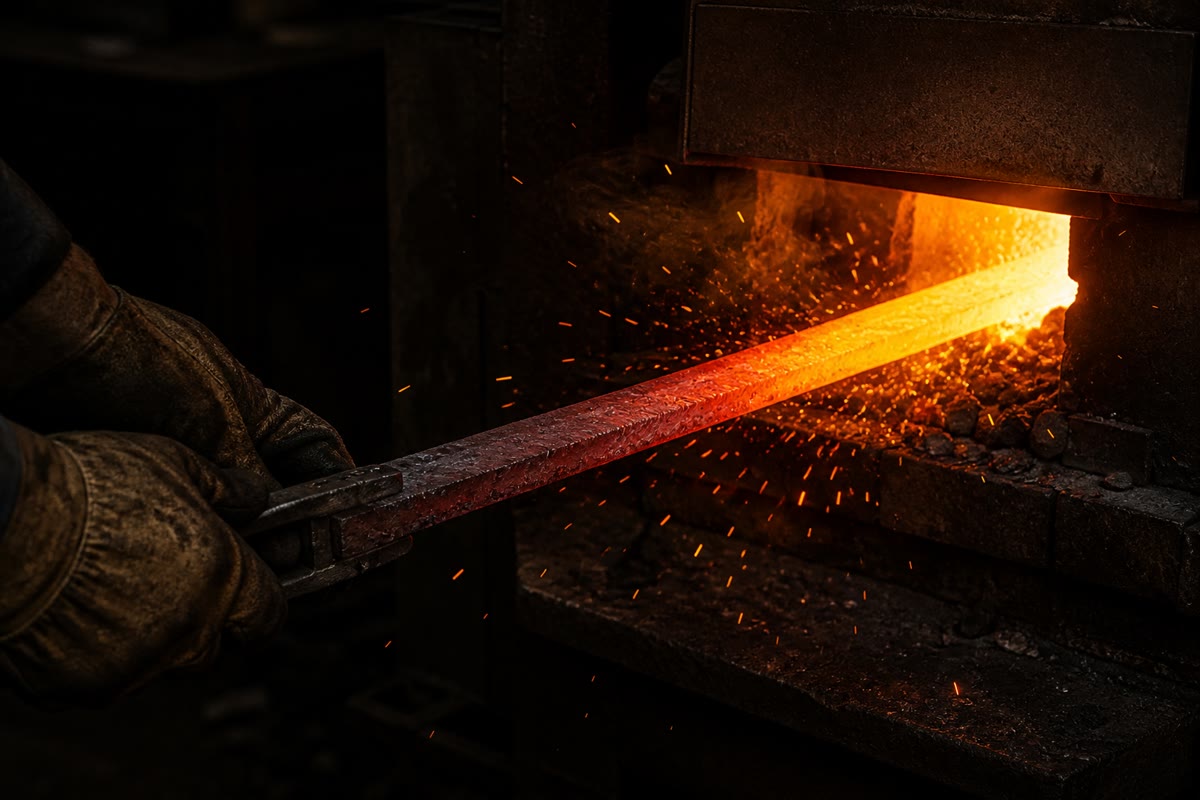
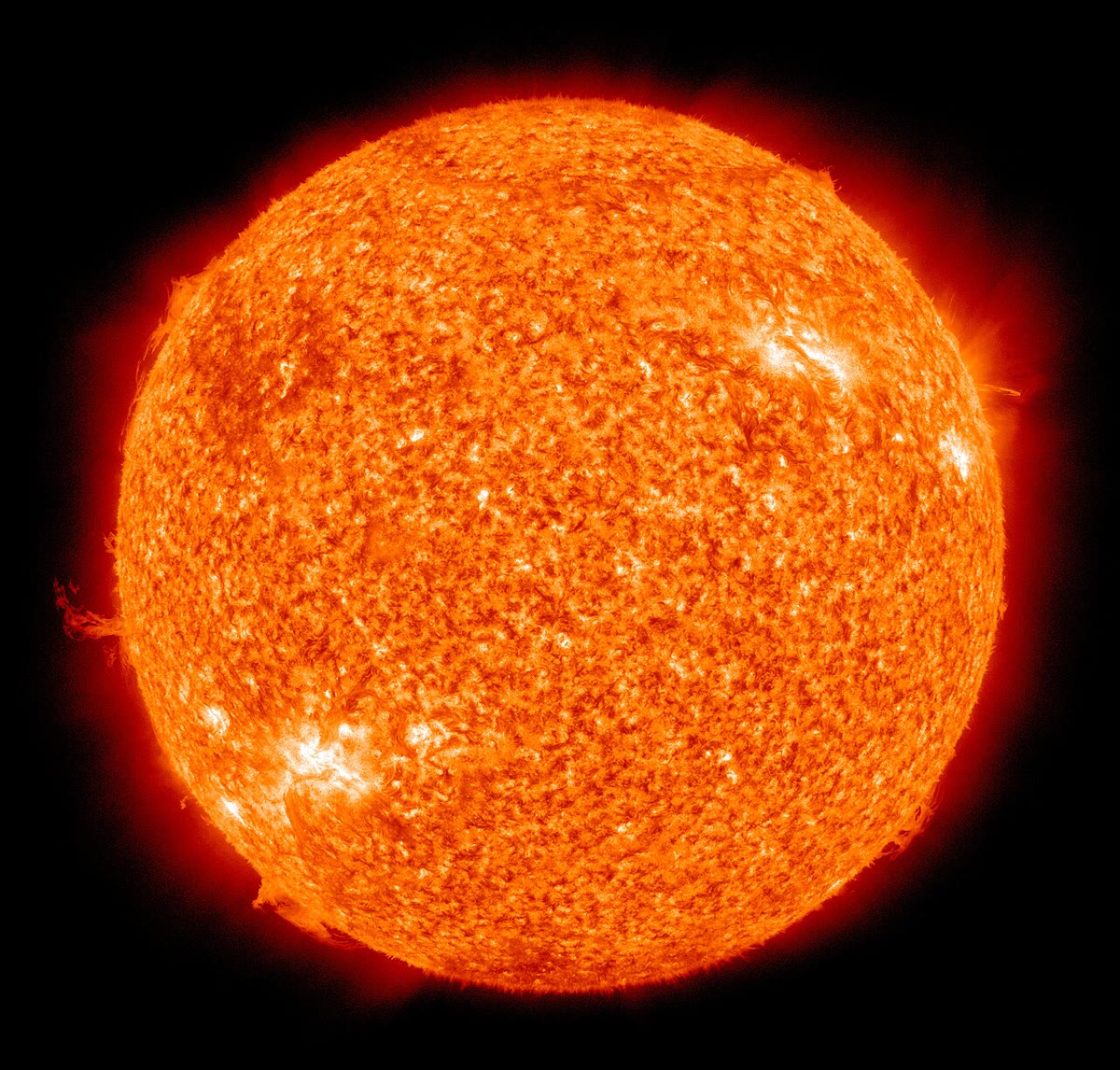
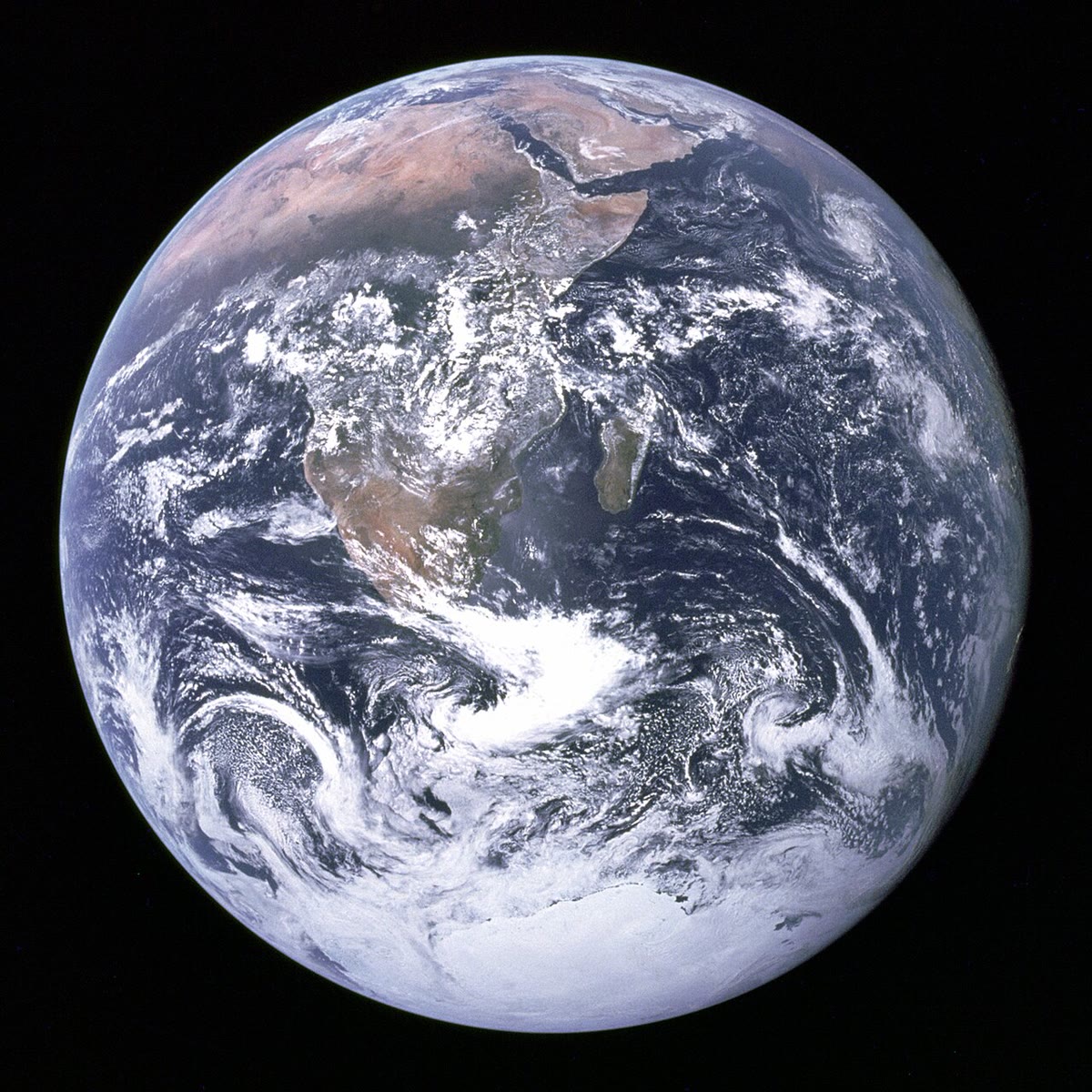
Everything warm glows. A hand, a wall, a glass of water at room temperature radiate invisibly, at wavelengths near , a few hundred watts per square metre; heat a poker and at it glows dull red, at orange, at — the filament of a bulb — white; the Sun’s surface at radiates yellow-white, sixty megawatts per square metre, and that light, after eight minutes of travel, is what keeps the Earth at a temperature where water is liquid. Radiation is the third mode of heat transfer and the only one that crosses empty space; it is also the place where classical physics failed and Planck, in 1900, had to introduce the quantum. This chapter states the law he found, draws from it the two results that one uses constantly — Wien’s displacement and the Stefan–Boltzmann law — and applies them to the exchanges between bodies, to the Sun and the Earth, and to the one-layer model of the greenhouse effect that fixes our climate.
26.1 Thermal radiation and the black body
Definition 26.1 (Thermal radiation, absorptivity, black body)
Every body at temperature emits electromagnetic radiation from the thermal agitation of its charges: its thermal radiation. Its surface also receives radiation from its surroundings and absorbs a fraction of it (the absorptivity, between and , in general depending on the wavelength), reflecting or transmitting the rest. A black body absorbs everything ( at every wavelength). A small hole in the wall of a closed cavity is the practical black body: radiation entering it is absorbed at the walls before it can find the way out.
Proposition 26.2 (Equilibrium radiation and Kirchhoff’s law)
Inside a closed cavity whose walls are at , the radiation is in equilibrium with the walls and is universal: isotropic, unpolarised, with a spectral energy density (energy per unit volume and unit frequency) that depends on and only, not on the cavity’s material or shape. The radiation leaving a small hole in such a cavity is the black-body radiation at . A surface that absorbs the fraction of the radiation it receives at the frequency emits, at that frequency, the fraction of what a black body at the same temperature would emit (its emissivity): good absorbers are good emitters.
Proof. Universality: connect two cavities at the same by a hole with a filter passing one frequency; if the densities differed, energy would flow from one to the other at equal temperatures, violating the second law. Kirchhoff: place the surface in the cavity at its own ; in equilibrium it must emit at each frequency exactly what it absorbs, . ∎
26.2 Planck’s law
Theorem 26.3 (Planck’s law)
The spectral energy density of black-body radiation at the temperature is
and the power radiated by a black surface per unit area and per unit wavelength (its spectral exitance) is
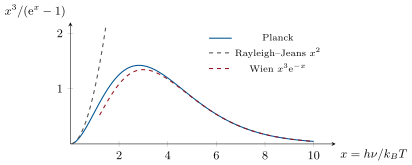
Two limits: for , (Rayleigh–Jeans: each mode of the cavity carries the classical energy — a law that integrates to infinity, the “ultraviolet catastrophe”); for , (Wien: the Boltzmann factor of a photon of energy , Chapter 29).
Proof. Admitted: the counting of the cavity’s modes ( per unit volume and frequency, two polarizations) belongs to the Year 3 volume, and the mean energy of a mode, instead of the classical , is the quantum hypothesis: energy is exchanged with the mode in quanta , so that modes with are frozen out. The relation is the geometric factor computed in Theorem 26.5. ∎
Proposition 26.4 (Wien’s displacement law)
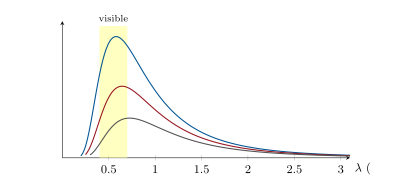
The spectral exitance peaks at
A body at radiates mostly near ; the Sun () near , in the green, where the eye is most sensitive — not by chance.
Proof. With , ; gives , i.e. , whose non-zero root is . ∎
Theorem 26.5 (Stefan–Boltzmann law)
A black surface at radiates, per unit area, the total power
the energy density of the equilibrium radiation is and its pressure . A grey surface of emissivity radiates .
Proof. Integrate Planck’s density: and the integral is (admitted from analysis): . The power leaving a hole of unit area in the cavity wall is : the radiation is isotropic, the photons moving toward the hole within the solid angle at the angle from its normal carry the flux , and over the outward hemisphere equals . Hence . The pressure, as for any isotropic gas of particles moving at , is . ∎
Example 26.6 (Orders of magnitude)
At : — a person of radiates , but receives almost as much from the walls at ; the net loss, , is the body’s whole metabolic output, which is why one needs clothes in a room that feels mild. The Sun’s surface: , total . A bulb’s filament at : , from half a square centimetre of tungsten. The cosmic background, : peak at , , and photons per cubic centimetre of the universe.
26.3 Radiative exchanges
Proposition 26.7 (Net exchange and the radiative coefficient)
A small grey body (emissivity , area , temperature ) inside large surroundings at loses the net power
where at room temperature — comparable to natural convection: in a room, radiation carries about half the heat leaving a body or a radiator. Between two large parallel black plates the net flux density is ; for grey plates of emissivities , it is , and each thin radiation shield interposed divides it further — the principle of the vacuum flask and of the gold foil on satellites.
Proof. The body emits and absorbs the fraction of the black radiation that fills the enclosure (Kirchhoff). Linearise . For the grey plates, sum the multiple reflections (a geometric series). ∎
Example 26.8 (Frost under a clear sky, and the thermal camera)
On a clear night the sky radiates like a body at about (the dry upper atmosphere), while the air near the ground is at . A leaf or a car roof () balances its radiative loss to the sky against convection from the air (): gives — frost at on the grass while the thermometer reads . A cloud (radiating at ) lifts to : no frost. A thermal camera measures the radiance near and converts it to a temperature assuming ; a polished metal () mostly reflects the room and appears at the room’s temperature whatever its own — hence the black tape that thermographers stick on shiny parts.
26.4 The Sun, the Earth and the greenhouse
Proposition 26.9 (Solar constant and effective temperature)
The Sun (radius , surface temperature ) delivers at the distance the flux density above the Earth’s atmosphere (the solar constant). A planet of albedo (the fraction reflected) absorbs and, in the steady state, radiates it from its whole surface as a black body at its effective temperature
Proof. Energy conservation: absorbed emitted, the cross-section for the intercepted beam, the full sphere for the emission (day and night, spread by rotation and circulation). ∎
Proposition 26.10 (One-layer greenhouse model)
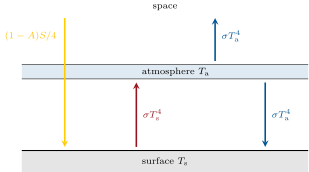
Surround the planet with a thin layer of atmosphere that is transparent to sunlight but absorbs all the infrared emitted by the surface, and radiates as a black body at both up and down. In the steady state,
If the layer absorbs only the fraction of the infrared, ; the observed corresponds to . The surface is warmer than the effective temperature because it receives, in addition to the Sun, the infrared that the atmosphere sends back down — the greenhouse effect, on Earth, without which the oceans would be frozen.
Proof. Balance of the layer: absorbs , emits . Balance of the planet seen from space: emits . Balance of the surface: receives , emits . For the partial layer, replace the absorbed and emitted infrared by and and let the fraction of the surface radiation escape directly. ∎
Remark 26.11 (Why the greenhouse is selective)
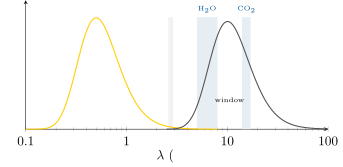
Sunlight peaks at , the Earth’s radiation at : the two spectra hardly overlap, so a gas can be transparent to the first and absorbing for the second. Nitrogen and oxygen absorb neither; water vapour, carbon dioxide, methane and ozone have vibration bands in the infrared and are the greenhouse gases. The window between and is what the thermal camera looks through, what the night sky’s refers to, and what radiative cooling paints exploit. The glass of a real greenhouse does the same (transparent to , opaque to ), but mostly it blocks convection — the name is a little unfair.
Method 26.12 (Radiation estimates)
(1) tells where the spectrum lies; (2) per unit area; (3) exchanges: emitted minus absorbed, linearised as near room temperature; (4) a planet: , then the layers; (5) compare with conduction and convection — radiation wins at high temperature () and in vacuum; (6) mind emissivities: shiny metals , paints, skin, water, soil – in the infrared whatever their visible colour.
26.5 Exercises
Exercise 26.1 ★
and for: the Sun (), a human (), a bulb’s filament (), the cosmic background (), liquid nitrogen (), a red-hot poker (). Which are visible?
Solution
Solution of Exercise 26.1.
: , , , , , ; : , , , , , . Visible: the Sun and the filament; the poker glows dull red with the short-wave tail, a ten-thousandth of its power.
Exercise 26.2 ★
From , , : the solar constant, the Sun’s luminosity, the power intercepted by the Earth (), and the same divided among people. Compare with the world’s power consumption ().
Solution
Solution of Exercise 26.2.
; ; ; per person — nine thousand times the world’s consumption.
Exercise 26.3 ★
A person: skin at , , , in a room at . Emitted power, absorbed power, net loss; the radiative coefficient ; compare with the of metabolism and conclude about clothes and about a room with cold walls.
Solution
Solution of Exercise 26.3.
Emitted , absorbed , net ; . More than the metabolism: clothes cut it; walls at add some of loss — one feels cold in warm air between cold walls.
Exercise 26.4 ★
A bulb: tungsten filament at , . Radiating area; length of a wire with that area; about of the power is visible: luminous power; a LED giving the same light at efficiency.
Solution
Solution of Exercise 26.4.
; ; of light; a LED.
Exercise 26.5 ★★
The two limits. (a) Expand Planck’s for and identify the energy per mode. (b) Show that the Rayleigh–Jeans law gives an infinite total energy. (c) At , the frequency where ; conclude that radio and microwave thermal radiation is classical. (d) In the Wien limit, interpret .
Solution
Solution of Exercise 26.5.
(a) : — per mode. (b) diverges. (c) (): radio and microwaves at are deep in the classical regime (a resistor’s noise is per unit bandwidth). (d) The probability of finding the quantum excited at : a Boltzmann factor.
Exercise 26.6 ★★
Wien. (a) Derive and solve it numerically to three figures. (b) Value of . (c) Show that peaks at , and that this does not correspond to : why not? (d) Temperature of a star whose spectrum peaks at ; its colour to the eye.
Solution
Solution of Exercise 26.6.
(a) . (b) . (c) peaks where : ; the densities per unit frequency and per unit wavelength are different functions () and peak at different places. (d) ; bluish white.
Exercise 26.7 ★★
Stefan. (a) Carry out the integration of Planck’s law, given , and the value of . (b) Justify the factor between the density and the exitance. (c) Given , the number of photons per unit volume at , and the mean photon energy in units of . (d) Photons per cubic centimetre at and at .
Solution
Solution of Exercise 26.7.
(a) , . (b) Isotropy and the projection: over a hemisphere. (c) ; mean energy . (d) and per cubic centimetre.
Exercise 26.8 ★★
Shields. Two large black plates at , . (a) Net flux. (b) A thin black sheet is placed between them: its temperature and the new flux. (c) sheets. (d) Grey plates of emissivity : show the flux is and compute it for polished surfaces () at and — the vacuum flask.
Solution
Solution of Exercise 26.8.
(a) . (b) ; half. (c) . (d) Summing the reflections, ; : — a flask of loses , boiling off a quarter of a kilogram of nitrogen a day.
Exercise 26.9 ★★
Night frost. Surface , sky at , air at with . (a) Write the balance and solve for the surface temperature. (b) Under a cloud at . (c) Why does wind prevent frost? (d) Why does a car parked under a tree escape it?
Solution
Solution of Exercise 26.9.
(a) : . (b) . (c) A larger pins the surface to the air. (d) The canopy at replaces the sky.
Exercise 26.10 ★★★
Planets. (a) Effective temperatures of Venus (, ), Earth, Mars (, ). (b) Their surface temperatures are , , : greenhouse warming of each. (c) In the model with opaque layers, show ; how many layers for Venus? (d) The Moon: , no atmosphere, slow rotation — temperature of the subsolar point, and why the night side falls to .
Solution
Solution of Exercise 26.10.
(a) , , . (b) , , . (c) Each opaque layer radiates up and down; the balances give from the top: for Venus. (d) ; without atmosphere nothing carries heat to the night side, and the regolith stores little: the surface radiates its day’s heat away in about a day and settles near .
Exercise 26.11 ★★★
Climate sensitivity without feedbacks. (a) Linearise the planetary balance: a small extra forcing (in ) at the top of the atmosphere raises the effective temperature by . Compute . (b) Doubling the carbon dioxide is a forcing of about : in this model. (c) The ocean’s mixed layer ( of water) stores the heat: time constant of the response. (d) Why do water-vapour and ice-albedo feedbacks make the real sensitivity larger than (b)?
Solution
Solution of Exercise 26.11.
(a) . (b) . (c) , , two years. (d) Warmer air holds more water vapour (a greenhouse gas) and melts ice (lower albedo): both amplify the initial warming.
Exercise 26.12 ★★★
Pyrometry. (a) In the Wien limit, show that the ratio of the radiances at two wavelengths, and , gives independently of a grey emissivity. (b) A steel bar: : temperature. (c) A thermal camera at assumes ; it looks at polished aluminium () at in a room at : in the linearised regime, what temperature does it report? (d) Why does a painted surface next to the aluminium, at the same , read correctly?
Solution
Solution of Exercise 26.12.
(a)
cancels. (b) . (c) Received ; reported : it misses the . (d) Its emissivity is the one assumed.
26.6 Problem: The Earth’s energy budget and the incandescent bulb
Problem 26.1
Weekend problem — black bodies from the Sun to the filament
Data: , , , , ; Sun: , ; Earth: , albedo .
Part I — The Sun as a black body.
- The solar spectrum peaks at : surface temperature.
- Exitance of the surface and total luminosity.
- Solar constant at the Earth; energy density and pressure of sunlight there.
- Mean photon energy () and number of solar photons per second per square metre at the Earth.
- The Sun has radiated at this rate for years: energy emitted; compare with for .
Part II — The Earth without atmosphere.
- Power absorbed by the Earth; effective temperature.
- Why does the balance divide by ? What would the temperature be at the subsolar point of a non-rotating airless Earth ()?
- The Moon (): subsolar temperature; and why its night side drops to (think of the heat stored in the regolith during the two-week day, effective).
- Wavelength of the Earth’s emission peak; compare with the Sun’s.
- If more ice or cloud raised the albedo to , by how much would the effective temperature fall?
Part III — The greenhouse.
- Write the three balances (space, layer, surface) of the one-layer model and obtain .
- With a layer absorbing the fraction of the infrared: ; the value of giving .
- Which gases absorb, which do not, and in which wavelength band; what is the atmospheric window?
- The infrared sent back to the ground by the atmosphere, in , in the model; compare with the absorbed sunlight.
- A forcing of (doubled carbon dioxide): temperature change without feedbacks.
- Heat capacity of a ocean mixed layer per square metre and the time constant of the response.
- Why do clouds both cool (albedo) and warm (infrared) the surface; which effect wins at night?
Part IV — The incandescent bulb. A bulb has a tungsten filament at , ; the fraction of a black body’s power that falls in the visible (–) is at and at .
- Radiating area of the filament; length of a wire having it; why is it coiled?
- Peak wavelength; visible power; luminous efficiency.
- Resistance of the filament in operation at ; tungsten’s resistivity is about ten times smaller at room temperature: current at switch-on, and a consequence.
- At : the area needed for the same and the visible power; why not run every bulb at (the tungsten’s evaporation rate roughly doubles every )?
- What does the halogen cycle do, and why does it allow a hotter filament?
- Where does the rest of the go, and why does the bulb’s glass reach ?
- The filament’s cooling time once switched off: estimate from its mass (, ) and its radiated power.
- Summarise: what a black body’s temperature fixes, and what the filament, the Sun and the Earth have in common.
Solution
Solution of Problem 26.1.
1. .
2. ; .
3. ; ; if absorbed, twice if reflected.
4. (); photons per second per square metre.
5. ; : three ten-thousandths of its mass.
6. ; .
7. Intercepted on , emitted from thanks to rotation and winds; the subsolar point alone: .
8. ; at night the stored heat () drains by radiation with the time constant , short against the fortnight of darkness: the ground falls to where its radiation matches the trickle from below, .
9. , twenty times the Sun’s.
10. : lower, .
11. Space: ; layer: ; surface: . Hence .
12. ; gives .
13. Water vapour, carbon dioxide, methane, ozone absorb in the infrared (vibration bands: HO around and beyond , CO at ); N and O do not (no dipole); the window is –.
14. : , against of absorbed sunlight (a multilayer atmosphere sends back more, some ).
15. .
16. ; , two years.
17. They reflect sunlight and radiate infrared down; at night only the second acts: cloudy nights are warmer.
18. ; ; coiled to fit and to cut convective losses to the filling gas.
19. ; ; .
20. ; cold : instead of — bulbs fail at switch-on.
21. ; visible; eight doublings of evaporation, times shorter life — hours.
22. Evaporated tungsten binds to the halogen and is returned to the hot filament instead of blackening the glass: a hotter filament at normal life, in a small quartz envelope.
23. of infrared and conduction through the gas; the glass absorbs part of the infrared.
24. ; with , the time to halve is — and the glow follows the mains with a lag, which is why it hardly flickers.
25. Temperature fixes the spectrum’s shape and peak (), and the total (); filament, Sun and Earth are three black bodies, at , and , each balancing what it receives against .