High School Biology · Grades 10–12
33Innate Immunity
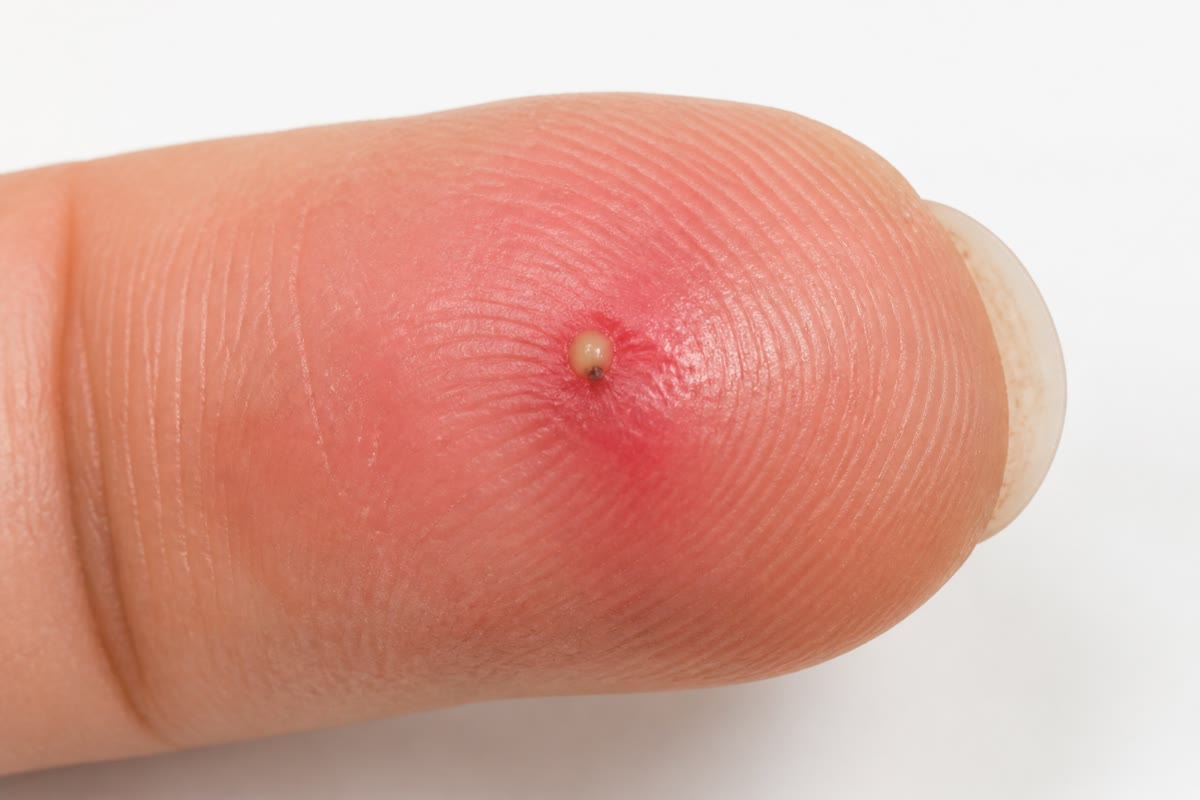
A splinter goes into a fingertip and is pulled out within the minute. By evening the spot is red, warm, swollen and throbbing; by the next day a bead of yellow pus has formed under the skin; by the third day it is gone. Nothing was decided, nothing learnt: the same four signs appear in every wound, in every person, in every mammal, and did so long before anyone knew that a splinter carries bacteria. They are the visible surface of the body’s first line of defence — a set of cells and molecules that recognise an intruder within minutes and attack it without ever having met it. This chapter describes that line; the next describes the slower, learning defence that it summons.
33.1 Two immunities
Definition 33.1 (Innate and adaptive immunity)
The immune system is the set of organs, cells and molecules that defend the body against infection and damage. It has two parts. Innate immunity is present from birth, acts within minutes to hours, recognises broad classes of intruders — bacteria, viruses, fungi, damaged cells — by features they share, and responds the same way every time. Adaptive immunity takes days to act, recognises each intruder individually, and remembers it (Chapter 34). The innate system is shared by all animals; the adaptive one exists only in vertebrates, and depends on the innate one to be triggered.
Proposition 33.2 (Barriers first)
Most intruders never enter. The skin, dry, acid and shedding its surface continuously, stops almost everything; the linings of the airways, gut and reproductive tract are wet but coated with mucus that traps microbes and is swept away or renewed; tears, saliva and mucus carry an enzyme that splits bacterial walls; the stomach’s acid and the gut’s own bacteria, which occupy the space, leave little room for newcomers. The immune response of this chapter begins when a barrier is breached.
Proof. Admitted at this level. ∎
33.2 The inflammatory response
Proposition 33.3 (The four signs and what makes them)
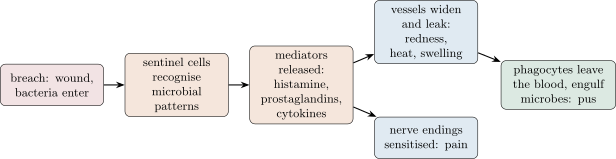
A breach — a wound, an infection, a burn — provokes within minutes the inflammatory response: redness, heat, swelling and pain. Each has a cause:
- Sentinel cells resident in the tissue — macrophages, dendritic cells, mast cells — carry receptors that recognise molecules common to whole classes of microbes (fragments of bacterial walls, viral nucleic acids) and molecules released by damaged cells. On recognition they release mediators: histamine, prostaglandins, and signalling proteins called cytokines.
- The mediators widen the local blood vessels and make their walls leaky: more blood (redness, heat), and plasma seeping into the tissue (swelling). They also sensitise the nerve endings (pain), and make the vessel walls sticky for passing white cells.
- Phagocytes — neutrophils from the blood within hours, monocytes that become macrophages within a day — squeeze through the vessel walls, crawl up the gradient of mediators to the site, and engulf and digest the microbes and debris. Dead phagocytes, bacteria and fluid are the pus.
The response is local, fast, and the same for a splinter as for a bacterium: it needs no prior contact with the intruder.
Evidence. Injecting a fragment of bacterial wall alone into the skin, without any living bacterium, produces the full response within an hour: the signal is a molecular pattern, not the microbe. Blocking histamine (with the antihistamines of hay fever) abolishes the early redness and swelling; blocking the enzyme that makes prostaglandins (with aspirin or ibuprofen) reduces the swelling, the pain and the fever. Watching a wound under the microscope shows neutrophils rolling along the vessel wall, stopping, crossing it and swarming to the site within two hours; mice whose neutrophils have been depleted die of infections a normal mouse clears overnight. ∎
Definition 33.4 (Phagocytosis)
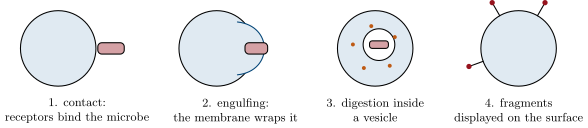
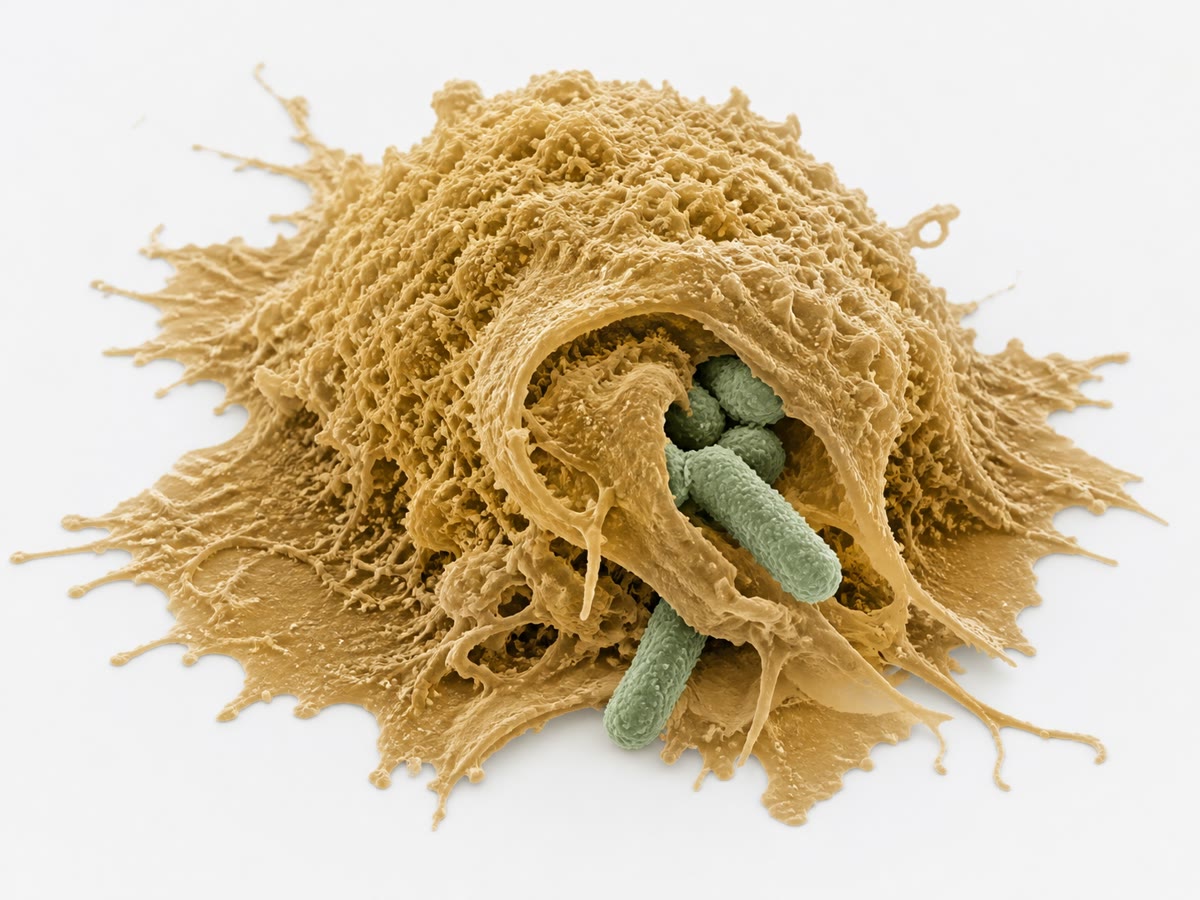
Phagocytosis is the engulfing of a particle — a bacterium, a dead cell, a speck of dust — by a cell that wraps its membrane around it, draws it inside in a vesicle, and digests it with enzymes and reactive chemicals. The phagocytes of the innate response are the neutrophils, short-lived and numerous, and the macrophages, long-lived and resident. A macrophage that has digested a microbe keeps fragments of its proteins and displays them on its surface — the step that will connect this response to the next chapter’s.
Example 33.5 (The timetable of a splinter)
Minute 0: bacteria from the splinter in the tissue. Minutes 1–10: mast cells and macrophages recognise their wall fragments and release histamine and cytokines; vessels widen. Hour 1: redness, warmth, the first neutrophils crossing the vessel walls. Hours 2–12: neutrophils swarm, engulf bacteria, die; swelling and pain at their height. Day 1: monocytes arrive and become macrophages, clearing debris; pus visible. Day 2–3: bacteria gone, mediators no longer released, vessels return to normal, repair begins. If the bacteria multiply faster than the phagocytes clear them, the response widens, fever appears, and the adaptive response — already begun in the lymph node — takes over.
33.3 Calming the response
Proposition 33.6 (Anti-inflammatory drugs)
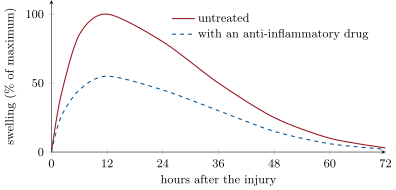
The inflammatory response is useful and costly: its swelling and pain are the price of clearing the intruder, and when it is excessive, misdirected (against harmless pollen, or the body’s own joints) or prolonged, it does damage of its own. Anti-inflammatory drugs act on its mediators: aspirin, ibuprofen and their relatives block the enzyme that makes prostaglandins, reducing pain, swelling and fever; corticosteroids, derived from a hormone of the adrenal gland, switch off the production of most mediators and are used for severe or chronic inflammation. All of them reduce the signs; none of them removes the cause, and by damping the response they can slow the clearing of a real infection.
Proof. Admitted at this level. ∎
Example 33.7 (Fever)
Cytokines released at a large or persistent site of inflammation reach the brain, where they raise the body’s temperature set point: fever. A degree or two of extra heat speeds the phagocytes and slows many bacteria, at the cost of energy and discomfort; above the cost outweighs the benefit, which is where the antipyretic (prostaglandin-blocking) drugs are used. Fever is a regulated response, not a failure of regulation.
33.4 From innate to adaptive
Proposition 33.8 (The hand-over)
Among the sentinel cells, the dendritic cells have a second job. Having engulfed the intruder, they leave the tissue through the lymph vessels, carrying its protein fragments displayed on their surface, and travel to the nearest lymph node. There they present the fragments to the lymphocytes of the adaptive system, and the cytokines they carry tell those lymphocytes what kind of intruder it was. The innate response thus not only fights the first days; it identifies the enemy and delivers the description. Without that hand-over, no adaptive response begins — which is why a vaccine contains, besides the antigen, substances that provoke a small inflammation.
Proof. Admitted at this level. ∎
Method 33.9 (Reading an inflammation)
- Name the breach and the likely intruder (or the damage without intruder: a sprain inflames too).
- Attribute each sign to its mediator and vessel change: redness and heat to widened vessels, swelling to leaky ones, pain to sensitised nerves.
- Identify the cells present at each stage: sentinels first, neutrophils by hours, macrophages by a day; pus as their remains.
- Judge whether the response is proportionate: local and resolving in days (working as intended), spreading with fever (infection winning, adaptive response needed), or directed at something harmless or chronic (a case for anti-inflammatory treatment).
Remark 33.10 (Old, fast and blunt)
Innate immunity is the immunity of a sponge, an insect and an oak as much as of a human: pattern receptors and phagocytes are older than the vertebrates by hundreds of millions of years. It is fast because it is prepared in advance for classes of enemy, and blunt for the same reason: it cannot tell one bacterium from another, and it cannot improve. The next chapter’s system can do both — but only once this one has sounded the alarm.
33.5 Exercises
Exercise 33.1 ★
Give three differences between innate and adaptive immunity.
Solution
Solution of Exercise 33.1.
Innate: present from birth, acts within hours, recognises classes of intruders by shared patterns, responds identically every time. Adaptive: takes days, recognises each intruder individually, remembers it (and exists only in vertebrates).
Exercise 33.2 ★
List the four signs of inflammation and the vessel or nerve change behind each.
Solution
Solution of Exercise 33.2.
Redness and heat: widened vessels bringing more blood. Swelling: leaky vessel walls letting plasma into the tissue. Pain: nerve endings sensitised by the mediators.
Exercise 33.3 ★
What do sentinel cells recognise, and what do they release?
Solution
Solution of Exercise 33.3.
Molecular patterns shared by classes of microbes (wall fragments, viral nucleic acids) and molecules released by damaged cells. They release mediators: histamine, prostaglandins, cytokines.
Exercise 33.4 ★
Describe phagocytosis in four steps.
Exercise 33.5 ★
How do aspirin and ibuprofen reduce inflammation? What do they not do?
Solution
Solution of Exercise 33.5.
They block the enzyme that makes prostaglandins, reducing swelling, pain and fever. They do not remove the cause or kill any microbe.
Exercise 33.6 ★★
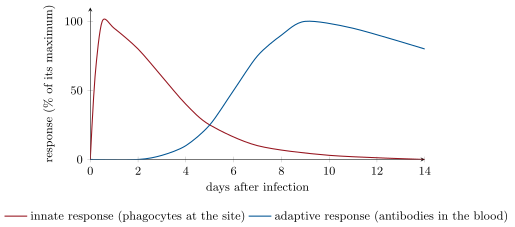
From the two-responses figure, when does the innate response peak, when does the adaptive one, and at what day do the two curves cross?
Solution
Solution of Exercise 33.6.
Innate at about half a day; adaptive at about day 9; the curves cross around day 5–6.
Exercise 33.7 ★★
A fragment of bacterial wall injected alone causes the full inflammatory response. What does this show, and what would happen with an injection of sterile saline?
Solution
Solution of Exercise 33.7.
The trigger is a molecular pattern recognised by the sentinel cells, not a living intruder. Sterile saline carries no pattern and no damage: at most a slight response to the needle.
Exercise 33.8 ★★
What is pus made of? Why does it appear a day after the wound rather than at once?
Solution
Solution of Exercise 33.8.
Dead neutrophils, dead and living bacteria, digested debris and plasma. Neutrophils arrive over hours and die over a day; pus is what accumulates once they have fought.
Exercise 33.9 ★★
Explain why an antihistamine relieves hay fever but does nothing against a bacterial infection’s later stages.
Solution
Solution of Exercise 33.9.
Hay fever is histamine released by mast cells against pollen: blocking histamine removes the response. In an infection histamine drives only the first minutes; the later swelling, pain and recruitment run on prostaglandins and cytokines, which the antihistamine does not touch.
Exercise 33.10 ★★
From the swelling figure, compare the swelling at 12 and at 36 hours with and without the drug. Does the drug shorten the response?
Solution
Solution of Exercise 33.10.
At 12 hours 100% against 55%; at 36 hours 50% against 30%. The drug lowers the swelling at every time but the curve still falls to zero at about 72 hours: it does not shorten the response.
Exercise 33.11 ★★
A sprained ankle, with no wound and no microbe, becomes red, hot, swollen and painful. Explain what triggered the sentinel cells.
Exercise 33.12 ★★★
Mice lacking neutrophils die of infections that normal mice clear in a night; mice lacking adaptive immunity survive them but die of infections a few weeks later. Explain what each result says about the role and the timing of the two systems.
Solution
Solution of Exercise 33.12.
Without neutrophils the first days are lost and ordinary bacteria overwhelm the body: the innate response is what holds the line at once. Without adaptive immunity the innate response clears the first infections, but persistent or repeated ones, which need specific antibodies and memory, eventually win: the adaptive response finishes what the innate one contains.
Exercise 33.13 ★★★
Explain why a doctor may refuse an anti-inflammatory drug to a patient with an abscess but prescribe one for arthritis, using the cause of each inflammation.
Solution
Solution of Exercise 33.13.
An abscess is an inflammation fighting living bacteria: damping it slows their clearance and risks spreading. Arthritis is an inflammation without any microbe, directed at the joint itself: there the response is the disease, and reducing it is the treatment.
Exercise 33.14 ★★★
Explain why the innate response cannot improve with repeated infections, and why the adaptive one can, from the nature of what each recognises.
Solution
Solution of Exercise 33.14.
Innate receptors are fixed by the genes and recognise patterns shared by whole classes; nothing about a second meeting changes them. The adaptive system builds receptors specific to each intruder and keeps the cells that made them: it recognises the individual, and keeps the recognition.
Exercise 33.15 ★★★
"Inflammation is a disease." Discuss in a paragraph: when it is the cure, when it is the disease, and what decides.
Solution
Solution of Exercise 33.15.
Inflammation is the cure when it is directed at a real intruder or injury, proportionate, and resolving in days: it clears the site and starts repair. It is the disease when it is directed at something harmless (pollen, the body’s own joints), excessive, or unending: then its mediators and phagocytes damage the tissue they were meant to protect. What decides is the target and the duration, not the mechanism, which is the same in both.
33.6 Problem: Three Days of a Splinter
Problem 33.1
Weekend problem — a wound followed hour by hour: the cells counted, the mediators traced, the drugs tested, and the hand-over to the lymph node timed
A splinter carries about bacteria into a fingertip; they divide every 40 minutes. The tissue holds 200 resident macrophages within a millimetre of the wound; neutrophils begin to arrive from the blood after 1 hour at a rate of per hour, each able to engulf about 20 bacteria before dying.
Part I — The race.
- How many bacteria would there be after 2 hours, then after 4, if nothing killed them?
- The 200 macrophages each engulf about 5 bacteria an hour. How many do they remove in the first hour, and does that stop the growth?
- From hour 1, neutrophils arrive. How many bacteria can the first hour’s neutrophils remove in all?
- Compare with the bacterial population at hour 2. Who is winning?
- By what hour, roughly, is the wound cleared? What is left at the site?
Part II — The signs.
- Attribute each of redness, heat, swelling and pain to a mediator and to a change in vessels or nerves.
- Explain why the swelling helps the neutrophils, and why it hurts.
- The fingertip throbs with each heartbeat. Explain from the widened vessels and the pressure in the swollen tissue.
- A day later a bead of pus has formed. List its contents.
- On day 3 the signs are gone. What stopped the release of the mediators?
Part III — Drugs.
- An antihistamine is taken at hour 1. Which signs does it reduce, and which not?
- Ibuprofen is taken at hour 6. Which mediator does it block, and which signs does it reduce?
- A corticosteroid cream is applied. What happens to the recruitment of neutrophils, and what risk follows for the infection?
- Explain why none of the three drugs shortens the infection, and which one could lengthen it.
- The patient also has a fever of . Which molecules caused it, and what is it for?
Part IV — The report.
- Dendritic cells that engulfed bacteria at hour 2 reach the elbow’s lymph node at hour 20, displaying bacterial fragments. What do they carry besides the fragments, and to whom do they report?
- From the two-responses figure, how many days will pass before antibodies against these bacteria are abundant? Will they be needed for this splinter?
- The same bacteria enter through a second splinter a month later. Which of the two responses is different the second time, and which is identical?
- A person born without functional neutrophils survives with daily antibiotics. Explain which part of the defence the antibiotics replace and which they cannot.
- State the result: the hour at which the phagocytes overtake the bacteria, the mediator behind each of the four signs, and the cell that carries the report to the lymph node.
Solution
Solution of Problem 33.1.
1. Three doublings in 2 hours: ; six in 4 hours: .
2. per hour — far below the new bacteria the first hour’s doublings add: growth continues.
3. bacteria.
4. At hour 2 there are fewer than bacteria; the first hour’s neutrophils alone can remove a million. The phagocytes are winning from hour 2.
5. Within a few hours the bacteria are gone; what remains is the dead neutrophils, debris and fluid that will be the pus, and macrophages clearing it.
6. Redness and heat: histamine and prostaglandins widen the vessels. Swelling: histamine makes the walls leaky and plasma seeps out. Pain: prostaglandins sensitise the nerve endings.
7. The leaky vessels are how the neutrophils and the plasma’s defensive proteins reach the tissue; the fluid pressing on the sensitised nerves is the pain.
8. Each heartbeat pushes more blood into the widened vessels; the swollen tissue cannot expand, so each pulse raises the pressure on the sensitised nerves: a throb in time with the heart.
9. Dead neutrophils, bacteria dead and alive, digested debris, plasma.
10. The patterns disappeared with the bacteria and the debris was cleared: no pattern, no recognition by the sentinels, no mediators; the vessels return to normal.
11. It reduces the early redness, heat and leak due to histamine; not the later swelling and pain due to prostaglandins, nor the recruitment of neutrophils.
12. It blocks the enzyme that makes prostaglandins: pain, part of the swelling, and the fever fall.
13. The cream switches off most mediators, so fewer neutrophils are called; with fewer phagocytes the bacteria may not be cleared and the infection may spread.
14. All three act on the signs and none kills bacteria; the corticosteroid, by cutting the recruitment of phagocytes, can let the infection last longer.
15. Cytokines reaching the brain, raising the temperature set point; the extra heat speeds the phagocytes and slows the bacteria.
16. The cytokines they took up at the site, which tell the lymphocytes what kind of intruder it was; they report to the lymphocytes of the lymph node.
17. About a week to ten days. For a splinter cleared by the innate response in a few hours, they will not be needed — but they will be made, and remembered.
18. The adaptive response is faster and stronger the second time, thanks to memory; the innate response is exactly the same.
19. Antibiotics kill bacteria, taking the place of the missing phagocytes against bacterial infections; they cannot replace the phagocytes’ clearing of debris, their action on fungi, or the report to the lymph node.
20. Around hour 2 the phagocytes overtake the bacteria; histamine and prostaglandins behind redness, heat and swelling, prostaglandins behind pain; the dendritic cell carries the report.