High School Biology · Grades 10–12
31Cellular Respiration and Fermentation
A marathon runner’s muscles spend, over three and a half hours, about half a mole of ATP every minute — a quarter of a kilogram of the molecule, made, used and remade thousands of times over from a stock that would last five seconds. Every one of those ATP molecules is paid for by a glucose or a fatty acid taken apart, atom by atom, and by an oxygen molecule breathed in at the beginning and breathed out as water at the end. Chapter 4 gave the balance; this chapter opens the mitochondrion and follows the glucose through the three stages that turn its energy into ATP — and shows what a cell does when the oxygen runs out.
31.1 ATP, the currency
Definition 31.1 (ATP)
ATP (adenosine triphosphate) is a nucleotide carrying three phosphate groups in a row. Removing the last one releases about per mole under cell conditions, and every energy-requiring process of the cell — contraction, transport, synthesis, the light of a firefly — is driven by that removal. The product, ADP, is recharged into ATP by the reactions of this chapter. A cell holds a few seconds’ worth of ATP and turns it over continuously; a resting human recycles about its own body mass of ATP in a day.
Proposition 31.2 (Where the energy is)
Glucose stores energy in its carbon–hydrogen bonds; releasing it means transferring the hydrogen, with its electrons, to oxygen — oxidising the glucose to carbon dioxide and reducing the oxygen to water. Done in one step, as in a flame, the energy would leave as heat. The cell does it in dozens of small steps, each run by an enzyme, and captures part of the energy at several of them: the hydrogen is first loaded onto carrier molecules — reduced NAD — and only at the end handed to oxygen.
Proof. Admitted at this level. ∎
31.2 Three stages
Proposition 31.3 (Glycolysis)
In the cytoplasm, without oxygen, a glucose (six carbons) is split into two molecules of pyruvate (three carbons each) by ten enzyme steps: glycolysis. The balance: two ATP consumed to start, four produced, hence a net gain of 2 ATP, and two reduced NAD loaded with hydrogen. The pyruvate still holds most of the glucose’s energy.
Proof. Admitted at this level. ∎
Proposition 31.4 (The mitochondrion completes the oxidation)
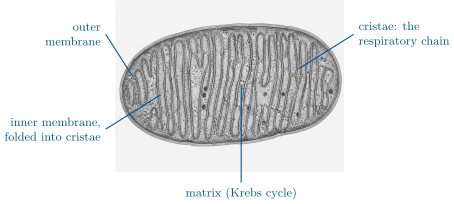
When oxygen is available, pyruvate enters the mitochondrion, an organelle bounded by two membranes, the inner one folded into cristae that enclose the fluid matrix.
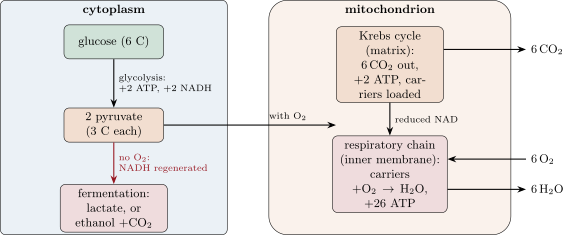
- In the matrix, each pyruvate is taken apart in a cycle of reactions, the Krebs cycle: its three carbons leave as three , its hydrogen is loaded onto carriers (reduced NAD and a second carrier), and a little ATP is made directly — one per pyruvate.
- In the inner membrane, the loaded carriers hand their electrons to a chain of proteins, the respiratory chain, that passes them down to oxygen, which combines with protons to form water. The energy released along the chain pumps protons across the membrane, and their return through a rotary enzyme drives the synthesis of ATP — about 26 per glucose.
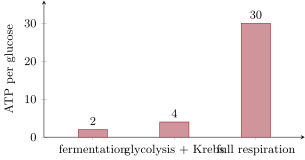
Total for one glucose: about 30 ATP (2 from glycolysis, 2 from the cycle, some 26 from the chain), six released, six consumed, and the rest of the as heat.
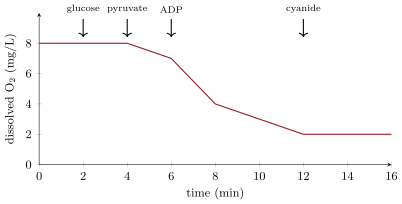
Evidence. Isolated mitochondria in a sealed chamber with an oxygen probe consume no oxygen when given glucose, but consume it rapidly when given pyruvate — the mitochondrion cannot start from glucose; the cytoplasm must. Adding a poison of the respiratory chain (cyanide) stops the consumption at once, whatever substrate is present. Adding ADP speeds the consumption and its exhaustion slows it: oxygen use is coupled to ATP synthesis. And the mitochondria of a hummingbird’s flight muscle or a marathon runner’s thigh have cristae packed several times more densely than those of a resting tissue. ∎
Example 31.5 (Reading an oxygen trace)
Isolated mitochondria in the chamber: the oxygen stays at ; glucose is added, nothing; pyruvate is added, the oxygen falls at per minute; ADP is added, the fall steepens to per minute for a while, then returns to ; cyanide is added, the fall stops. Four facts in one trace: the mitochondrion needs pyruvate, not glucose; oxygen use is coupled to ATP synthesis; the coupling is through the chain that cyanide blocks; and a mitochondrion without work to do idles.
31.3 Without oxygen: fermentation
Proposition 31.6 (Fermentation regenerates the carrier)
Glycolysis loads two NAD carriers per glucose; with oxygen, the mitochondrion unloads them. Without oxygen the carriers would all be loaded within seconds and glycolysis would stop. Fermentation is the cytoplasm’s way of unloading them: the pyruvate itself accepts the hydrogen and becomes either lactate (muscle cells, milk bacteria) or, after losing a , ethanol (yeast). No further ATP is made; the yield is the 2 ATP of glycolysis, some fifteen times less than respiration’s, and the product — lactate or ethanol — still holds most of the glucose’s energy.
Proof. Admitted at this level. ∎
Example 31.7 (The muscle’s choice)
A sprinter’s muscle fibre needs ATP faster than its mitochondria and its oxygen supply can make it; glycolysis with lactic fermentation delivers ATP three times faster, at fifteen times the glucose cost, and the lactate accumulates until the pain stops the effort. A marathon runner’s fibres run on respiration, slowly and almost indefinitely, burning fat as well as glucose; her mitochondria are larger and more numerous, her capillaries denser, and her lactate stays low. The fibre types of Chapter 9 are these two strategies built into cells.
Method 31.8 (Balancing an energy budget)
- Convert the power needed into ATP: at about per mole of ATP usable, of metabolic power is of ATP per minute.
- Convert ATP into fuel: 30 ATP per glucose in respiration, 2 in fermentation.
- Convert fuel into oxygen: 6 per glucose respired, per mole of gas.
- Compare the oxygen needed with what the blood delivers (Chapter 8): the shortfall is met by fermentation, with its lactate.
Remark 31.9 (The mirror of photosynthesis)
Photosynthesis loads electrons from water onto carriers with light and uses them to reduce carbon dioxide into sugar, releasing oxygen; respiration unloads electrons from sugar onto carriers and passes them to oxygen, making water and releasing carbon dioxide, and uses the energy to make ATP. The two are run by organelles that were both once free bacteria (Chapter 24), the chloroplast supplying what the mitochondrion consumes; between them they turn sunlight into the currency of every cell, and the atmosphere’s oxygen is the balance of their accounts.
31.4 Exercises
Exercise 31.1 ★
What is ATP, and what happens when a cell uses it?
Solution
Solution of Exercise 31.1.
A nucleotide with three phosphates in a row, the cell’s energy currency. Using it removes the last phosphate, releasing about per mole to drive a process, and leaves ADP to be recharged.
Exercise 31.2 ★
Name the three stages of respiration, where each occurs, and what each yields.
Solution
Solution of Exercise 31.2.
Glycolysis in the cytoplasm: 2 ATP and 2 reduced NAD, two pyruvates. Krebs cycle in the mitochondrial matrix: carbon dioxide, loaded carriers, 2 ATP. Respiratory chain in the inner membrane: carriers unloaded onto oxygen, water, about 26 ATP.
Exercise 31.3 ★
Describe the mitochondrion and say which stage runs in each of its compartments.
Solution
Solution of Exercise 31.3.
Two membranes, the inner one folded into cristae, enclosing the matrix. Matrix: the Krebs cycle. Inner membrane: the respiratory chain and ATP synthesis.
Exercise 31.4 ★
What does fermentation achieve for the cell, and what does it yield?
Solution
Solution of Exercise 31.4.
It unloads the reduced NAD of glycolysis onto pyruvate, so that glycolysis can continue without oxygen. Yield: the 2 ATP of glycolysis only, plus lactate or ethanol and .
Exercise 31.5 ★
Compare the ATP yield of respiration and fermentation, and the products left at the end of each.
Solution
Solution of Exercise 31.5.
About 30 ATP against 2. Respiration leaves carbon dioxide and water; fermentation leaves lactate, or ethanol and carbon dioxide, still rich in energy.
Exercise 31.6 ★★
From the oxygen trace, what does each of the four additions show?
Solution
Solution of Exercise 31.6.
Glucose: no effect — mitochondria cannot use it. Pyruvate: oxygen consumption starts — the mitochondrion’s substrate. ADP: consumption speeds up — oxygen use is coupled to ATP synthesis. Cyanide: consumption stops — the respiratory chain is the site of oxygen use.
Exercise 31.7 ★★
Why can isolated mitochondria not use glucose, while a whole cell can?
Solution
Solution of Exercise 31.7.
Glycolysis, which converts glucose to pyruvate, takes place in the cytoplasm; the mitochondrion lacks its enzymes and takes in pyruvate, not glucose.
Exercise 31.8 ★★
Explain why glycolysis would stop within seconds without oxygen if fermentation did not exist.
Solution
Solution of Exercise 31.8.
Each glucose loads two NAD; the cell has only a small stock of NAD, and once all of it is loaded glycolysis has no carrier to hand its hydrogen to and halts. Fermentation unloads the NAD onto pyruvate and keeps the pathway running.
Exercise 31.9 ★★
A cell needs 60 ATP per second. How many glucose molecules per second does that cost by respiration, and by fermentation?
Solution
Solution of Exercise 31.9.
Respiration: glucose per second. Fermentation: glucose per second, fifteen times more.
Exercise 31.10 ★★
Cyanide is lethal within minutes. Explain, from the respiratory chain, why, and why the brain and heart fail first.
Solution
Solution of Exercise 31.10.
Cyanide blocks the respiratory chain, so no electrons reach oxygen and about 26 of the 30 ATP per glucose are lost at once; fermentation cannot cover the shortfall. The brain and heart use ATP fastest and have the smallest reserves, so they fail within minutes.
Exercise 31.11 ★★
Where does the carbon dioxide you breathe out come from, stage by stage? And the water made by respiration?
Solution
Solution of Exercise 31.11.
The carbon dioxide is released in the mitochondrial matrix, by the Krebs cycle (and the step that admits pyruvate to it): none in glycolysis. The water is made at the end of the respiratory chain, when electrons and protons join oxygen.
Exercise 31.12 ★★★
A muscle produces lactate during a race and, afterwards, the liver turns the lactate back into glucose using ATP from respiration. Explain why the whole body ends up having paid more than 30 ATP for the glucose the muscle fermented.
Solution
Solution of Exercise 31.12.
The muscle got 2 ATP per glucose fermented; rebuilding that glucose from lactate costs the liver about 6 ATP, paid by respiring other fuel. The body has spent 6 to get 2: fermentation borrows energy that must be repaid with interest.
Exercise 31.13 ★★★
Yeast in air uses glucose slowly and makes no ethanol; sealed, it uses it fast and makes ethanol. Explain with the yields, and say why bread dough rises whether or not the yeast has air.
Solution
Solution of Exercise 31.13.
In air respiration gives 30 ATP per glucose, so little glucose is needed and none is diverted to ethanol; sealed, fermentation gives 2, so fifteen times more glucose is consumed and ethanol is made. Dough rises on carbon dioxide, which both routes produce (respiration six per glucose, fermentation two); in the dense dough oxygen runs out quickly anyway.
Exercise 31.14 ★★★
Brown fat cells of a newborn contain mitochondria whose chain runs without making ATP: the proton flow is short-circuited. What do these cells produce instead, and why is that useful to a newborn?
Solution
Solution of Exercise 31.14.
Heat: the energy of the chain, no longer captured as ATP, is released directly. A newborn loses heat fast and cannot shiver well; brown fat is a built-in heater.
Exercise 31.15 ★★★
Compare respiration and photosynthesis point by point: source and destination of electrons, gas consumed and released, energy input and output, organelle. Then say in one sentence why neither can exist on Earth without the other.
Solution
Solution of Exercise 31.15.
Electrons: photosynthesis takes them from water and puts them into sugar; respiration takes them from sugar and gives them to oxygen. Gases: photosynthesis consumes and releases ; respiration the reverse. Energy: photosynthesis takes light in and stores it in sugar; respiration takes it out of sugar as ATP and heat. Organelles: chloroplast and mitochondrion. Each consumes what the other produces: photosynthesis would exhaust the and respiration the and the food.
31.5 Problem: Half a Mole of ATP a Minute
Problem 31.1
Weekend problem — a runner’s energy followed from the watt to the molecule: ATP counted, glucose and oxygen reckoned, the mitochondria’s share measured, and the sprint that the chain cannot pay for
A runner sustains a metabolic power of , of which about a third is captured as ATP, the rest leaving as heat. Take of usable energy per mole of ATP, 30 ATP per glucose in respiration and 2 in fermentation, per mole of glucose, per mole of gas, and glucose .
Part I — ATP.
- How many moles of ATP does the runner use per minute? (Only the third captured as ATP counts.)
- What mass of ATP is that, at ? Compare with the few grams the muscles hold at any moment.
- How many times per minute is each ATP molecule recharged, if the body’s stock is ?
- If that ATP were made by respiration alone, how many moles of glucose per minute would be consumed?
- How many litres of oxygen per minute does that require? Compare with a max of .
Part II — The mitochondria’s share.
- Of the 30 ATP per glucose, how many are made in the cytoplasm and how many in the mitochondrion? What fraction of the runner’s ATP is mitochondrial?
- How many moles of does she exhale per minute, and from which stage of respiration do they come?
- How much of the of a glucose ends in ATP? Where does the rest go, and what does the runner do about it?
- Her muscle mitochondria have a total inner-membrane area of some . Why does the chain need so much surface?
- Training doubles the mitochondria of her fibres. Which of the quantities above does that change, and which does it not?
Part III — The sprint. In the final sprint her muscles need of power as ATP for 30 seconds, while respiration, limited by the oxygen the blood delivers, can supply at most as ATP.
- How many moles of ATP does the sprint require in total?
- How much of it can respiration supply in 30 seconds, and how much must come from fermentation?
- How many moles of glucose does the fermented part consume, and how many moles of lactate does it leave?
- Compare the glucose used per ATP in the two routes during the sprint. Why does the muscle accept the waste?
- After the race, the lactate is oxidised or turned back into glucose. Explain why her oxygen consumption stays high for several minutes after she stops.
Part IV — The other fuel. Fat supplies about per gram and, per gram, needs about 20% more oxygen than glucose for the same energy.
- If half her came from fat, what mass of fat would she burn per hour?
- Why does fat, though richer in energy per gram, give less power per litre of oxygen?
- Fatty acids enter respiration at the Krebs cycle, bypassing glycolysis. Which of the three stages, then, can fat not use, and what follows for a sprint?
- Why does the brain, which runs on glucose alone, keep working during the race although the muscles are taking most of the blood’s glucose?
- State the result: the moles of ATP the runner uses per minute, the litres of oxygen that pays for them, and the stage of respiration that makes most of them.
Solution
Solution of Problem 31.1.
1. A third of is : per minute, i.e. of ATP per minute.
2. About per minute — against a few grams held: the stock is recycled continuously.
3. is : each molecule is recharged about 6 times a minute.
4. of glucose per minute (about ).
5. of , about per minute — below her maximum, and consistent with the per litre of oxygen of Chapter 7: the can be sustained by respiration.
6. 2 in the cytoplasm, 28 in the mitochondrion: about 93% of the ATP.
7. of per minute, all from the Krebs cycle and pyruvate entry in the matrix.
8. of the , about a third; the rest is heat, which she sheds by sweating and by the blood flow to her skin.
9. The chain’s proteins and the ATP-making enzymes sit in the membrane; the rate of ATP synthesis is proportional to the area that holds them.
10. It raises the rate at which respiration can make ATP (and the share of fat she can burn), hence the power she can sustain without fermentation; it does not change the yield per glucose or the oxygen per glucose.
11. : of ATP.
12. Respiration: , i.e. ; fermentation must supply the other .
13. of glucose, leaving of lactate.
14. Respiration: glucose per ATP; fermentation: — fifteen times more glucose. The muscle accepts it because ATP is needed now and glycogen is there; the debt is repaid later.
15. The lactate must be oxidised or rebuilt into glucose, which costs ATP made by respiration: oxygen consumption stays above rest until the debt is cleared.
16. for an hour is : of fat.
17. Fat is more reduced — richer in hydrogen — so each gram needs more oxygen to be fully oxidised; per litre of oxygen it yields slightly less energy than glucose.
18. Glycolysis and its fermentation: fat cannot be fermented, so a sprint, which runs on fermentation, cannot use fat at all — only glucose and glycogen.
19. The liver releases glucose from its glycogen and rebuilds some from lactate, keeping the blood glucose near (Chapter 32); the brain’s supply is protected.
20. About of ATP per minute; about of oxygen per minute pays for them; the respiratory chain of the mitochondrial inner membrane makes some nine tenths of them.