High School Biology · Grades 10–12
26Reading Kinship: Phylogenetic Trees
In 1837, on a page of a private notebook, Darwin sketched a branching line with a few twigs and wrote above it two words: "I think". The sketch proposed that species are related as the twigs of a tree are — by descent from common branches — and that their kinship could be reconstructed. Today the sketch is a standard tool: a phylogenetic tree, built from shared characters and from DNA, read according to rules. This chapter teaches those rules: how to build a tree from a table of characters, how to read one without misreading it, and how molecules turn it into a clock.
26.1 What a tree says
Definition 26.1 (Phylogenetic tree)
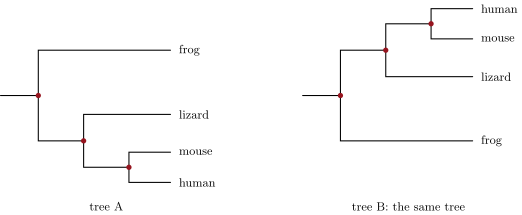
A phylogenetic tree is a diagram of the kinship of a set of species (or other groups). Its tips are the species compared; each node where two branches meet represents their most recent common ancestor — a hypothetical population, not a known fossil; the root is the common ancestor of all. Two species are closer kin than a third when their common ancestor (their node) is more recent than the node they share with the third. Kinship is read from the nodes, never from the left-to-right position of the tips.
Proposition 26.2 (Rules of reading)
- A tree can be rotated at any node without changing its meaning: the order of the tips is arbitrary.
- A node has no name and is not one of the tips: a species is never the ancestor of another species on the tree; two tips are sister groups, descended from a shared ancestor.
- A group made of an ancestor and all its descendants — everything beyond one node — is a clade, the only kind of group a phylogenetic classification names.
- Branch lengths carry information only if the tree says so (time, or number of changes); otherwise only the branching order counts.
Proof. Admitted at this level. ∎
Example 26.3 (Misreadings to avoid)
"Humans descend from chimpanzees": no — on the tree, humans and chimpanzees are sister tips, descended from a common ancestor that was neither. "The frog is more primitive": no — every tip is a present species with the same length of history since the root; the frog lineage has evolved for as long as ours. "The lizard is closer to the frog than to the mouse" (from tree A): no — lizard and mouse share a more recent node.
26.2 Building a tree from characters
Definition 26.4 (Ancestral and derived states)
A character is a feature that varies among the species compared (the presence of a vertebral column, of four limbs, of an amniotic egg, of hair). Each character has an ancestral state — the one the common ancestor of the group had — and one or more derived states that appeared later in some lineage. Only shared derived states indicate kinship: two species sharing a derived state inherited it from the ancestor in which it arose. A shared ancestral state says nothing, since everyone’s ancestor had it.
Method 26.5 (From a character matrix to a tree)
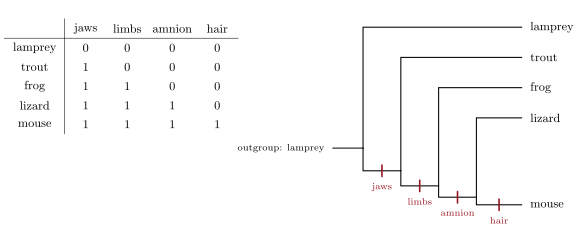
- Make a table: species in rows, characters in columns, 1 for the derived state and 0 for the ancestral one. Decide which state is ancestral by comparing with an outgroup, a species known to be outside the group studied.
- Find the derived state shared by the most species: it defines the first, largest clade. Within it, find the next most widely shared derived state, and so on.
- Draw the nested clades as a tree: each shared derived state marks one node, and the character is written on the branch where it appeared.
- Check for conflicts: a character shared by species that other characters place apart either arose twice (convergence) or was lost once. Choose the tree that requires the fewest changes in all — the most parsimonious tree.
Example 26.6 (A conflict resolved by parsimony)
Add "wings" to a matrix with bat, pigeon and mouse. Wings would group bat with pigeon; hair and milk group bat with mouse. A tree with bat and mouse together needs wings to have arisen twice (two changes); a tree with bat and pigeon together needs hair, milk, the mammalian jaw and a dozen other characters to have arisen twice each. The first tree is far more parsimonious: wings are a convergence, the mammalian characters a common inheritance. Parsimony does not prove the tree; it chooses the least improbable one.
26.3 Trees from molecules
Proposition 26.7 (Molecular phylogeny)
A gene or protein shared by all the species compared is a character matrix in itself: each position of the sequence is a character, and each nucleotide or amino acid a state. Aligning the sequences and counting the differences between every pair gives a distance matrix, from which a tree is built by joining the closest pairs first. The molecular tree, computed from sequences that owe nothing to anatomy, matches the anatomical tree in the great majority of cases — the strongest test of both.
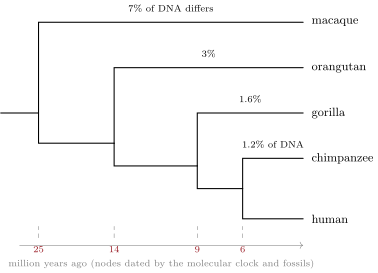
Evidence. Chapter 6 gave the cytochrome c distances of the vertebrates, which reproduce the boxes drawn from their skeletons. Among the primates, sequences of dozens of genes agree: human and chimpanzee differ by about 1.2% of their DNA, either from the gorilla by 1.6%, the three from the orangutan by 3%, and the great apes from the macaque by 7%. A tree built from any one of these genes has the same shape; the few exceptions concern the most recent nodes, where the differences are smallest. ∎
Proposition 26.8 (The molecular clock)
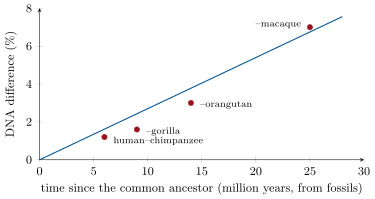
For a given gene, differences between two lineages accumulate at a roughly constant rate over long periods, since most substitutions are neutral and fix by drift at the rate at which they arise. The number of differences between two species is therefore proportional to the time since their common ancestor. Calibrated on one node dated by fossils, the clock dates the others — with the caution that rates differ between genes and between lineages, and that the calibration carries its own uncertainty.
Proof. Admitted at this level. ∎
Example 26.9 (Dating a node)
Two species differ by 4.5% of their DNA; at 0.27% per million years, their common ancestor lived some 17 million years ago. The estimate assumes the primate rate applies; for a gene evolving twice as fast, or in a lineage with shorter generations, the same 4.5% would mean half the time. A clock is only as good as its calibration.
26.4 Classification, from trees
Proposition 26.10 (Classifying by descent)
A phylogenetic classification names only clades: groups defined by a node and containing all its descendants. Familiar groups that fail this test are not used: "fish" excludes the tetrapods that descend from the same node; "reptiles" excludes the birds that descend from within them; "invertebrates" is everything except a clade. The consequences are worth stating plainly: birds are dinosaurs, the lungfish is closer to us than to the trout, and humans are one branch of the apes, which are one branch of the primates, the mammals, the amniotes, the tetrapods, the vertebrates.
Proof. Admitted at this level. ∎
Remark 26.11 (What a tree is not)
A tree is a hypothesis about history, built from present species and tested by every new character and every new sequence; it is redrawn when they disagree, and the redrawing is the work of the field. It has no top and no direction of progress: humans sit at one tip among millions, no higher and no more finished than the lamprey at another. And it has no ancestor at any tip: the ancestors are the nodes, populations gone, whose existence the tree infers and whose fossils, when they are found, sit beside the branches rather than on them.
26.5 Exercises
Exercise 26.1 ★
What do the tips, the nodes and the root of a phylogenetic tree represent?
Solution
Solution of Exercise 26.1.
Tips: the species compared. Nodes: their hypothetical most recent common ancestors. Root: the common ancestor of all of them.
Exercise 26.2 ★
In tree A of the first figure, which species is the closest relative of the lizard? Of the frog?
Solution
Solution of Exercise 26.2.
The lizard’s closest relatives are mouse and human together (they share the node just below the lizard’s branch). The frog’s closest relative is the whole group of the other three, equally.
Exercise 26.3 ★
Define a shared derived state and explain why a shared ancestral state does not indicate kinship.
Solution
Solution of Exercise 26.3.
A state that appeared in an ancestor and was inherited by its descendants; sharing it means sharing that ancestor. The ancestral state was possessed by the ancestor of the whole group, so every species could have kept it: sharing it shows nothing about closer kinship.
Exercise 26.4 ★
What is a clade? Is "birds" a clade? Is "reptiles" (in the everyday sense)?
Solution
Solution of Exercise 26.4.
An ancestor and all its descendants. Birds are a clade. "Reptiles" in the everyday sense is not: it leaves out the birds, which descend from within it.
Exercise 26.5 ★
From the primate tree, which is the human’s closest relative, and which node is the oldest?
Solution
Solution of Exercise 26.5.
The chimpanzee; the oldest node is the one joining the macaque to the apes, 25 million years ago.
Exercise 26.6 ★★
Redraw tree A of the first figure with the human at the top and the frog at the bottom, and check that every kinship is unchanged.
Solution
Solution of Exercise 26.6.
Rotate at each node: root splits into frog (bottom) and the rest; then lizard, then mouse and human at the top. Mouse and human still share the most recent node, the lizard joins them next, the frog last.
Exercise 26.7 ★★
Add the pigeon (jaws 1, limbs 1, amnion 1, hair 0, feathers 1) to the matrix of the second figure and place it on the tree. What does the character "feathers" add?
Exercise 26.8 ★★
A dolphin has a streamlined body and fins like a shark, and hair, milk and a mammalian jaw. Which tree is most parsimonious, and what are the fins?
Solution
Solution of Exercise 26.8.
Hair, milk and the jaw place the dolphin among the mammals; putting it with the shark would require all the mammalian characters to have arisen twice. The fins and streamlined body arose separately in the two lineages: a convergence.
Exercise 26.9 ★★
Using the clock figure, date the common ancestor of two species whose DNA differs by 2.2%.
Solution
Solution of Exercise 26.9.
million years.
Exercise 26.10 ★★
Explain why the sentence "the chimpanzee is our ancestor" misreads the tree, and write the correct sentence.
Solution
Solution of Exercise 26.10.
Both are present tips; neither descends from the other. Correct: humans and chimpanzees are sister species, descended from a common ancestor, now extinct, that lived about six million years ago and was neither a human nor a chimpanzee.
Exercise 26.11 ★★
Why is the lamprey used as the outgroup in the second figure, and what would go wrong if the mouse were used instead?
Solution
Solution of Exercise 26.11.
The lamprey is known to lie outside the group of jawed vertebrates, so its states are ancestral for them. With the mouse as outgroup, hair, amnion, limbs and jaws would all be read as ancestral and their absence as derived: the tree would be built upside down.
Exercise 26.12 ★★★
Two genes give different trees for three closely related species that separated within a million years of each other. Explain how this can happen without either tree being "wrong", using the shuffle of alleles in the ancestral population.
Solution
Solution of Exercise 26.12.
The ancestral population carried several alleles of each gene; when it split twice in quick succession, different alleles were sorted into the three descendants at different genes, so one gene’s history groups species 1 with 2 and another’s groups 2 with 3. Each gene tree is right for that gene; the species tree is the majority verdict of many genes.
Exercise 26.13 ★★★
The molecular clock of a fast-evolving virus runs at 1% per year; that of a mammalian gene at 0.3% per million years. Explain why the first is used to trace an epidemic and the second to date the origin of the mammals, and why neither can do the other’s job.
Solution
Solution of Exercise 26.13.
At 1% per year, viral samples taken months apart already differ measurably: the virus tree resolves who infected whom within an epidemic, but over millions of years the sequence would have been overwritten many times. At 0.3% per million years, a mammalian gene changes too slowly to see anything within an epidemic but keeps a readable record over 200 million years.
Exercise 26.14 ★★★
A fossil bird with teeth and a long bony tail is found in rocks 150 million years old. Explain why it is placed beside a branch of the tree rather than at a node, and what it tells about the node.
Solution
Solution of Exercise 26.14.
A fossil is a species of its own, with its own derived states, not necessarily the ancestral population; it sits on a side branch near the node where feathers appeared. It shows that the node — the common ancestor of birds and their nearest reptilian relatives — is at least 150 million years old and that feathers preceded the loss of teeth and tail.
Exercise 26.15 ★★★
"The tree of life has humans at its top." Discuss in a paragraph with the rules of reading, the equal age of the tips, and the number of tips.
Solution
Solution of Exercise 26.15.
A tree has no top: rotating any node moves humans to the bottom without changing a kinship. Every present tip has evolved for the same time since the root, so none is more advanced. And humans are one tip among millions, on one branch of the apes; the tree’s shape records descent, not rank.
26.6 Problem: Six Species and a Clock
Problem 26.1
Weekend problem — a tree built twice, from a character table and from DNA distances, the two compared, and the nodes dated
Six species: shark, salmon, salamander, crocodile, pigeon, cat. The outgroup is the lamprey. Character table (1 = derived):
| bony skeleton | four limbs | amniotic egg | feathers | hair | skull opening | |
|---|---|---|---|---|---|---|
| shark | 0 | 0 | 0 | 0 | 0 | 0 |
| salmon | 1 | 0 | 0 | 0 | 0 | 0 |
| salamander | 1 | 1 | 0 | 0 | 0 | 0 |
| crocodile | 1 | 1 | 1 | 0 | 0 | 0 |
| pigeon | 1 | 1 | 1 | 1 | 0 | 0 |
| cat | 1 | 1 | 1 | 0 | 1 | 1 |
DNA differences (%) for one gene:
| salmon | salamander | crocodile | pigeon | cat | |
|---|---|---|---|---|---|
| shark | 30 | 31 | 30 | 31 | 30 |
| salmon | 24 | 25 | 25 | 24 | |
| salamander | 19 | 20 | 19 | ||
| crocodile | 8 | 15 | |||
| pigeon | 15 |
Part I — From the characters.
- Which derived state is shared by the most species? Name the clade it defines and the species left outside. (The last character is the single opening in the side of the skull that mammals have.)
- Continue with the next most widely shared states and list the nested clades.
- Feathers, hair and the skull opening each occur in one species. Do they help to build this tree? What would make them useful?
- Draw the tree, writing each character on the branch where it appeared.
- Which species is the crocodile’s closest relative according to this table? Which pair cannot be resolved by the table alone?
Part II — From the DNA.
- Which pair of species has the smallest distance? Join them first.
- Which species joins that pair next? Continue until the tree is complete.
- Compare the DNA tree with the character tree: where do they agree, and what does the DNA settle that the characters could not?
- The shark’s distances to all others are nearly equal. Explain why, from the shape of the tree.
- The crocodile–pigeon distance (8) is smaller than the crocodile–cat distance (15). What does this say about the everyday group "reptiles"?
Part III — The clock. Fossils date the separation of the salamander lineage from the amniotes at 340 million years.
- Using the salamander–amniote distances (about 19%), compute the rate of the clock in per cent per million years. (Both lineages have been changing: the distance counts the changes on both branches.)
- Date the crocodile–pigeon node and the amniote node (crocodile/pigeon versus cat).
- Date the salmon node and the shark node.
- Fossils give about 250 million years for the crocodile–bird split and 310 for the amniote split. Compare with your dates and comment on the accuracy of a single-gene clock.
- The shark distances (30–31%) hardly exceed the salmon’s (24–25%) although the shark node is much older. Propose an explanation, and say what it implies for dating very old nodes with this gene.
Part IV — Reading and naming.
- List the clades of your tree that contain the cat, from the smallest to the largest.
- Is "fish" (shark and salmon) a clade? Is "amniotes"? Justify.
- A student says the salamander is "an intermediate between fish and reptiles". Correct the statement in the tree’s terms.
- A fossil with a bony skeleton, four limbs and no amniotic egg, dated 360 million years, is found. Where does it sit relative to the tree, and what does its date confirm?
- State the result: the tree of the six species (as nested parentheses), the one kinship the DNA settled, and the estimated date of the crocodile–pigeon split.
Solution
Solution of Problem 26.1.
1. Bony skeleton (five species): the bony vertebrates; the shark is outside.
2. Four limbs: tetrapods (salamander, crocodile, pigeon, cat). Amniotic egg: amniotes (crocodile, pigeon, cat). Nested: bony vertebrates tetrapods amniotes.
3. No: a state in a single species groups nothing. They would be useful with more species sharing them (other birds, other mammals, other reptiles).
4. Root: shark versus the rest (bony skeleton); then salmon versus tetrapods (four limbs); then salamander versus amniotes (amniotic egg); among the amniotes, an unresolved three-way split, with feathers on the pigeon’s branch and hair and the skull opening on the cat’s.
5. The table places crocodile, pigeon and cat together but cannot order them: the crocodile’s closest relative is undecided.
6. Crocodile–pigeon, 8%.
7. The cat (15% from each); then the salamander (19–20%); then the salmon (24–25%); then the shark (30–31%).
8. They agree on every nesting; the DNA resolves the amniotes: crocodile and pigeon are sisters, the cat joins them next.
9. The shark’s lineage separated before all the others diverged from one another; each of them has been apart from the shark for the same time and shows the same distance.
10. The crocodile is closer kin to the pigeon than to the cat — and, by the same logic, than to a lizard; "reptiles" without the birds is not a clade.
11. 19% over million years of branch: about 0.028% per million years per lineage, i.e. 0.056% per million years of separation.
12. Crocodile–pigeon million years; amniote node million years.
13. Salmon ; shark million years.
14. Fossils: 250 and 310; the clock gives 140 and 270. The order is right and the older date close, but the crocodile–bird date is far too young: a single gene’s rate varies between lineages, and one gene gives a rough clock at best.
15. At large distances many positions have changed more than once, so differences no longer add up: the clock saturates. Old nodes are underestimated by this gene; a slower gene, or many genes, are needed.
16. (cat, (crocodile, pigeon)) is the smallest clade containing the cat: the amniotes; then the tetrapods; then the bony vertebrates; then all six with the shark.
17. "Fish" is not a clade: the node joining shark and salmon is the root, whose descendants include everything. Amniotes is a clade: crocodile, pigeon, cat and their common ancestor.
18. The salamander is a present species, not an intermediate; it is the sister group of the amniotes, sharing with them the tetrapod ancestor and lacking the amniotic egg that arose later in their line.
19. Beside the branch between the tetrapod node and the amniote node: a tetrapod that is not an amniote. Its date confirms that four limbs existed by 360 million years ago and the amniotic egg appeared later.
20. (shark, (salmon, (salamander, (cat, (crocodile, pigeon))))); the DNA settled that crocodile and pigeon are sisters; their split dates, by this gene, to about 140 million years (fossils say 250).