High School Biology · Grades 10–12
27A Look at Human Evolution
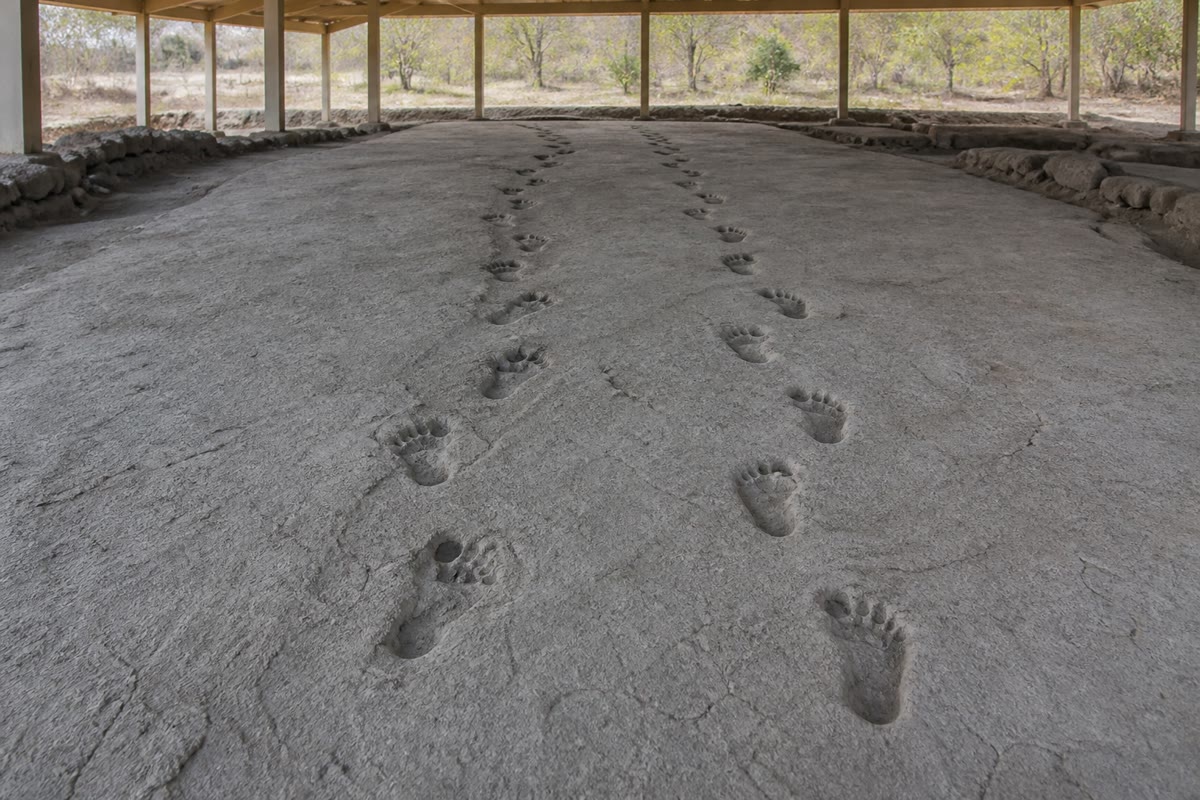
In a layer of volcanic ash three and a half million years old, two trails of footprints run side by side for twenty-seven metres. They were left by creatures walking upright, heel first, with an arched foot and a big toe in line with the others — feet like ours — at a time when no brain larger than an ape’s existed. Upright walking came first, by two million years; the brain, the tools and the speech came after, and not in a straight line but along a bush of species, most of which left no descendants. This chapter applies the tools of the last two — shared characters, trees, dates, DNA — to the lineage that leads to us.
27.1 Humans among the primates
Proposition 27.1 (Our place in the tree)
Humans are primates: mammals with grasping hands, nails instead of claws, forward-facing eyes and a large brain for their size. Within the primates, the great apes — orangutan, gorilla, chimpanzee, bonobo, human — form a clade, and within it the chimpanzee and the bonobo are the humans’ sister group: our DNA differs from theirs at about 1.2% of positions, and the common ancestor of the two lineages lived some six to seven million years ago, in Africa. That ancestor was neither a chimpanzee nor a human; both lineages have evolved since.
Evidence. The character matrices and the DNA comparisons of Chapter 26: every gene sequenced places the chimpanzee closer to the human than to the gorilla, and the human chromosome 2 is the fusion, end to end, of two chromosomes that remain separate in the chimpanzee — which is why we have 23 pairs and they 24. The molecular clock, calibrated on the fossil dates of older primate splits, gives the human–chimpanzee node its date. ∎
Definition 27.2 (The human lineage)
The human lineage is the clade of all species closer to modern humans than to the chimpanzee: everything descended from the human side of the six-million-year node. It contains one living species, Homo sapiens, and a score of fossil ones — the australopithecines and the several species of the genus Homo. A fossil belongs to it if it shows derived characters of the lineage: upright walking, a shortened face, small canines, and later a large brain and tools.
27.2 The characters of the lineage
Proposition 27.3 (Bipedalism came first)
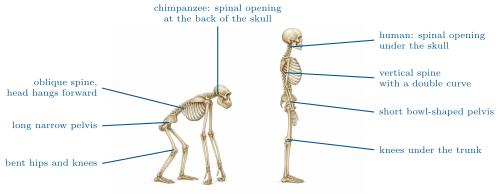
The earliest derived character of the human lineage is habitual walking on two legs. It shows in the skeleton: the opening at the base of the skull through which the spinal cord passes sits under the skull rather than behind it, so the head balances on a vertical spine; the spine has a double curve; the pelvis is short and bowl-shaped; the femurs angle inwards to the knee, bringing the feet under the body’s centre; the foot has an arch and a big toe in line with the others, made for pushing off, not for grasping. All of these are present, with a few ape-like traits, in fossils four million years old with brains no larger than a chimpanzee’s.
Evidence. The footprint trails in volcanic ash, 3.6 million years old, show a striding gait with heel strike and an arched foot. The skeleton of a female australopithecine 3.2 million years old, 40% complete, has a human-like pelvis and knee and a brain of about . Skull bases of the same age have the spinal opening forward, under the skull. The characters appear in the order: walking, then, more than a million years later, the growth of the brain. ∎
Proposition 27.4 (Then the brain, the tools, the face)
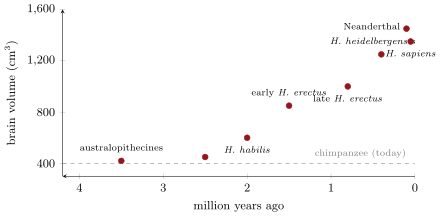
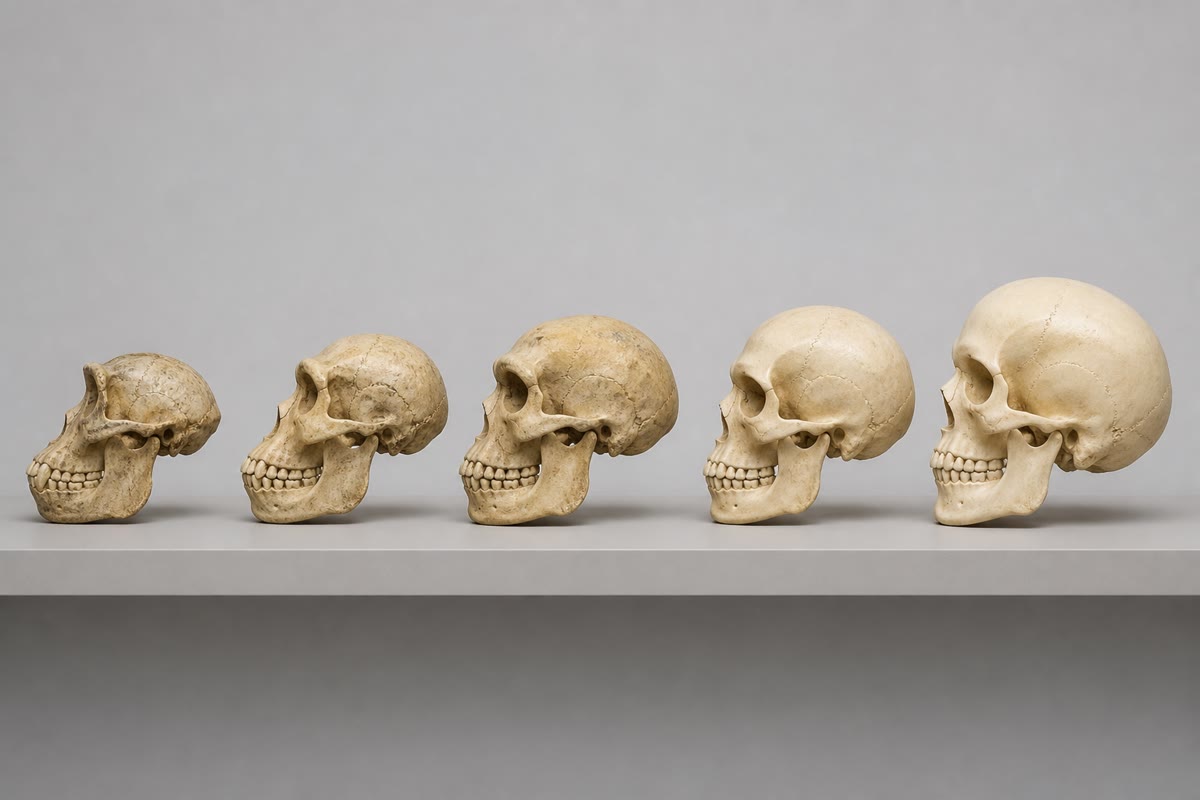
From about 2.5 million years ago the lineage shows a second set of derived characters: a brain growing from to , a face and jaws that shrink beneath it, a chin, and stone tools — first pebbles chipped to an edge, then shaped hand-axes, then blades, points and hafted tools. Fire is controlled by a million years ago, the dead are buried by a hundred thousand, and images are painted by forty thousand. Brain and tools grow together, each making the other useful, over two million years.
Proof. Admitted at this level. ∎
Example 27.5 (Reading a skull)
A fossil skull with a spinal opening underneath, a braincase of , large jaws and a projecting face is an australopithecine: upright, small-brained. One with , a heavy brow ridge, a receding forehead and no chin is Homo erectus. One with , a high forehead, a small face tucked under the braincase and a chin is a modern human. The order of these characters on the tree is the order in which they appear in the rocks.
27.3 A bush, not a ladder
Proposition 27.6 (Several species at once)
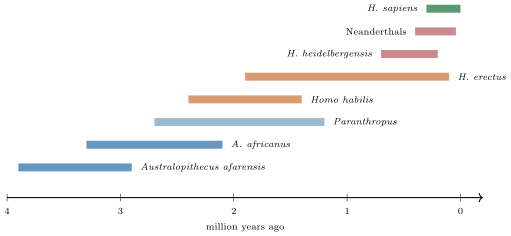
The human lineage is not a single line of ancestors and descendants but a bush of species, several of which lived at the same time: two or three kinds of australopithecine two million years ago beside the first Homo; Homo erectus spread over three continents while other species arose in Africa; and as recently as fifty thousand years ago, modern humans shared the Earth with the Neanderthals in Europe, another population in Asia, and a small-bodied species on an island. Most branches of the bush ended in extinction; ours is the one that remains.
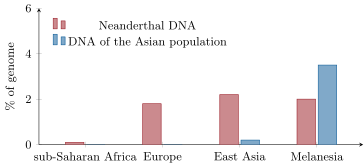
Evidence. Fossils of distinct species are found in layers of the same age at the same sites. Neanderthal and modern human remains overlap in Europe for several thousand years. The DNA of Neanderthals and of the Asian population, recovered from their bones, is distinct from ours — and present in us: people outside Africa carry about 2% of Neanderthal DNA, and some Pacific populations several per cent of the Asian population’s, the trace of interbreeding when the species met. The branches touched before they ended. ∎
Proposition 27.7 (Modern humans)
Homo sapiens appeared in Africa about 300 000 years ago, recognisable by its high, rounded skull, small face and chin. Small groups left Africa some 60 000 years ago and, within 50 000 years, had reached every continent but Antarctica, meeting and partly absorbing the older populations they found. All living humans descend from that African population: the genetic diversity of the whole species is smaller than that of the chimpanzees of one African region, and it is greatest in Africa, decreasing with distance from it along the routes of dispersal — the signature of successive founding groups.
Proof. Admitted at this level. ∎
27.4 What made us
Proposition 27.8 (Genes, and then culture)
The characters of the lineage arose as the previous chapters describe: mutations, including changes in the regulation of developmental genes (a longer growth of the brain, a shorter face), sorted by selection in the environments of African savannas, and by drift in small populations. But the lineage added a second mode of inheritance — the transmitted behaviour of Chapter 24, raised to a scale no other species reached: tools, fire, language, cooperation, teaching. Culture accumulates within a lifetime and passes to all who learn it, not only to descendants; for the last hundred thousand years the changes that mattered most to humans have been cultural, and the environment the species evolves in is largely one it made.
Proof. Admitted at this level. ∎
Method 27.9 (Placing a fossil)
- Date the layer (radioactive decay of volcanic minerals, or the known age of the strata).
- Read the gait: position of the spinal opening, shape of the pelvis and femur, the foot.
- Measure the braincase; note the face, the brow ridge, the chin, the teeth.
- List the derived states present and absent, and place the fossil on the tree by Chapter 26’s rules: as a side branch near the node where its combination of characters fits, not as "the ancestor".
- Where bone is preserved well enough, read the DNA and compare it with living populations.
Remark 27.10 (No missing link)
The phrase supposes a chain with one gap; the record is a bush with many branches, most of them known from a few bones, and the "link" between us and the chimpanzee is a node — an extinct population that was neither — not a creature half-way between. What the fossils do show, in the order the rocks preserve them, is each derived character appearing in its turn: feet, then brains, then tools, then the chin — and in the last fifty thousand years, the works of a species whose evolution is now mostly of its own making.
27.5 Exercises
Exercise 27.1 ★
Which living species is the human’s closest relative, and how long ago did the two lineages separate?
Solution
Solution of Exercise 27.1.
The chimpanzee (with the bonobo); the lineages separated six to seven million years ago.
Exercise 27.2 ★
List four skeletal signs of upright walking.
Solution
Solution of Exercise 27.2.
Spinal opening under the skull; a double-curved spine; a short, bowl-shaped pelvis; femurs angled inwards to the knee; an arched foot with the big toe in line.
Exercise 27.3 ★
From the brain-volume figure, give the volume of an australopithecine, of early Homo erectus and of a modern human.
Solution
Solution of Exercise 27.3.
About ; about ; about .
Exercise 27.4 ★
Why is the human lineage described as a bush rather than a ladder?
Exercise 27.5 ★
Where and when did Homo sapiens appear, and what does the distribution of human genetic diversity show?
Solution
Solution of Exercise 27.5.
In Africa, about 300 000 years ago. Genetic diversity is greatest in Africa and falls with distance from it: all living humans descend from that African population, through successive small founding groups.
Exercise 27.6 ★★
The human chromosome 2 corresponds to two chimpanzee chromosomes joined end to end. Explain how this accounts for the different chromosome numbers, and why it is evidence of kinship rather than against it.
Solution
Solution of Exercise 27.6.
Two ancestral chromosomes fused in the human lineage into one, so 24 pairs became 23. The fused chromosome carries, in the middle, the remains of the two original ends and a second, silent centromere — a record of the fusion; the gene content matches the two chimpanzee chromosomes gene for gene. Descent from a common set of chromosomes, modified once, is what kinship predicts.
Exercise 27.7 ★★
Which came first in the lineage, upright walking or a large brain? By how long? Cite the evidence.
Solution
Solution of Exercise 27.7.
Upright walking, by about two million years: footprints and pelvises 3.6 to 3.2 million years old belong to walkers with brains; brain growth begins around 2.5 million years.
Exercise 27.8 ★★
From the timeline figure, which species coexisted two million years ago? And 100 000 years ago?
Solution
Solution of Exercise 27.8.
Two million years ago: A. africanus (just), Paranthropus, Homo habilis and early H. erectus. 100 000 years ago: H. erectus (last populations), H. heidelbergensis (last), Neanderthals and H. sapiens.
Exercise 27.9 ★★
A person of European ancestry carries 2% Neanderthal DNA. Explain what event this records, and why sub-Saharan Africans carry almost none.
Solution
Solution of Exercise 27.9.
Interbreeding between modern humans leaving Africa and Neanderthals met in western Asia and Europe some 50 000 years ago. Populations that stayed in sub-Saharan Africa never met Neanderthals, so they carry none.
Exercise 27.10 ★★
Apply Method 27.9 to a skull with a forward spinal opening, , large jaws, found in a layer 2.8 million years old.
Solution
Solution of Exercise 27.10.
Upright (forward opening), small brain, large jaws, 2.8 million years: an australopithecine, placed on a side branch near the base of the lineage — a relative of the ancestors of Homo, not a demonstrated ancestor.
Exercise 27.11 ★★
Explain why "humans descend from apes" is correctly stated as "humans are apes", using the vocabulary of clades.
Exercise 27.12 ★★★
The Neanderthals had brains slightly larger than ours and made sophisticated tools, yet disappeared within a few thousand years of our arrival in Europe. Propose two hypotheses compatible with the chapter and say what evidence would distinguish them.
Solution
Solution of Exercise 27.12.
Hypothesis 1: competition — modern humans, more numerous or better organised, took the resources; evidence would be a decline of Neanderthal sites where the two overlapped. Hypothesis 2: absorption — small Neanderthal populations were partly absorbed by interbreeding and partly went extinct by drift and chance in a changing climate; evidence would be the Neanderthal DNA in us and signs of small, declining Neanderthal populations before contact. Both may be true.
Exercise 27.13 ★★★
Human genetic diversity decreases with distance from Africa along the dispersal routes. Explain this with the founder effect of Chapter 25, and say what it implies about how the dispersal happened.
Solution
Solution of Exercise 27.13.
Each step of the dispersal was made by a small group carrying a sample of the alleles of the population it left; each new region was founded from the last. Diversity fell at every founding, so the farthest populations have the least. The dispersal proceeded by successive small migrations rather than by mass movement.
Exercise 27.14 ★★★
Lactase persistence, light skin at high latitudes and resistance to malaria are human traits that evolved in the last ten thousand years. Explain how a cultural change (dairying, migration, farming) can create the selection that changes genes.
Solution
Solution of Exercise 27.14.
Dairying made milk a food for adults: carriers of the persistence allele fed better and left more descendants. Migration to weak-sun latitudes made vitamin D scarce: lighter skin, making more of it, was favoured. Farming created dense populations and standing water where malaria spread: alleles protecting against it rose. In each case a change in the way of life changed which alleles reproduced.
Exercise 27.15 ★★★
"Evolution has stopped for humans, since medicine and culture protect us from selection." Discuss in a paragraph, with drift, the three traits of the previous exercise, and the meaning of selection.
Solution
Solution of Exercise 27.15.
Selection is any difference in reproduction between carriers of different alleles; medicine changes which alleles matter, not whether any do — resistance to infections, fertility, the age of reproduction still vary and are inherited. The three traits show selection acting within the last ten thousand years, driven by culture itself. And drift continues in every population regardless. Human evolution has changed direction, not stopped.
27.6 Problem: The Walkers in the Ash
Problem 27.1
Weekend problem — two trails of footprints read for gait, height and speed; a row of skulls measured; and the DNA of a living student traced to three populations
Two trails of footprints, 3.6 million years old, run parallel for . Trail A: footprint length , stride (from one print to the next of the same foot) . Trail B: length , stride . In modern humans the foot is about 15% of standing height, and a walking stride of about 0.8 times the height corresponds to a slow walk.
Part I — The footprints.
- Estimate the height of walker A and of walker B.
- Compare each stride with 0.8 times the height. Were they walking or running?
- The prints show a deep heel, an arch, and a big toe parallel to the others. What does each feature show about the foot and the gait?
- A chimpanzee walking upright leaves prints with a flat sole and a divergent big toe, and cannot keep it up for long. Which characters of Proposition 27.3 do the trails establish for their makers, and which do they leave unknown?
- The nearest fossils of the same age have brains of . What does the combination — these feet, that brain — settle about the order of the lineage’s characters?
Part II — The skulls. Five skulls, with braincase volume, age and features: 1: , 3.0 million years, projecting face, no chin. 2: , 1.9 million years, smaller face. 3: , 1.0 million years, heavy brow, no chin. 4: , 60 000 years, heavy brow, no chin, long low skull. 5: , 30 000 years, high forehead, chin.
- Assign each skull to a group of the timeline figure.
- Plot, or describe, brain volume against age for the five. Over which interval does the volume grow fastest?
- Skull 4 is larger than skull 5. Does brain volume alone identify a modern human? Which characters do?
- Skulls 4 and 5 overlap in time. What does the chapter say about the relation between their two populations, and what evidence supports it?
- Skull 1 and the footprints of Part I could belong to the same species. Explain why that species is an ancestor-like relative rather than a demonstrated ancestor, in the language of Chapter 26.
Part III — The student’s genome. A student of European and Melanesian ancestry has her genome compared with those of Neanderthals and of the extinct Asian population: 1.6% matches the Neanderthal genome, 1.8% the Asian one.
- Explain what a 1.6% match means and what event it records.
- Compare her figures with the chart. Which of her ancestral populations contributed each share?
- If interbreeding occurred 50 000 years ago and a generation is 25 years, how many generations separate her from the event? Why has the share not been diluted to nothing?
- Two lineages contributed genes to hers although they are called species. What does this say about the species boundary of Chapter 25 at that time?
- Her mitochondrial DNA is of the modern human type, as is every living person’s. What does that show about the direction or the fate of the interbreeding?
Part IV — The clock and the bush.
- Human and chimpanzee DNA differ by 1.2%; the primate clock of Chapter 26 runs at 0.27% per million years. Date the common ancestor.
- The oldest known fossils of the human lineage are 6 to 7 million years old. Is that consistent with your date?
- List the species of the timeline that were alive one million years ago, and state how many of them have living descendants.
- Explain why the last hundred thousand years of the lineage are better described by cultural change than by the characters of this chapter.
- State the result: the height and the gait of walker A, the order in which feet, brain and chin appeared, and the number of extinct populations whose genes the student carries.
Solution
Solution of Problem 27.1.
1. A: ; B: .
2. and : both strides are shorter than a slow walk’s; they were walking, unhurried.
3. A deep heel: the heel strikes first, as in human walking; an arch: a foot that acts as a lever and spring; a parallel big toe: a foot for pushing off, not for grasping branches.
4. A striding, heel-first gait with a human-like foot, sustained over : habitual bipedalism. Unknown from prints: the pelvis, the femur angle, the spinal opening, the spine’s curves.
5. That upright walking preceded the enlargement of the brain by more than a million years.
6. 1: australopithecine. 2: Homo habilis. 3: Homo erectus. 4: Neanderthal. 5: Homo sapiens.
7. From 450 at 3.0 million to 650 at 1.9, 950 at 1.0, then 1450 and 1350: the fastest growth is between 1.9 and 1.0 million years ( per million years), then between 1.0 and 0.06.
8. No: Neanderthal brains were as large or larger. Modern humans are identified by the high forehead, the small face under the braincase, the chin and the rounded skull.
9. Two populations of the bush living side by side, distinct in anatomy, that interbred: the Neanderthal DNA in living people outside Africa is the evidence.
10. A fossil is a tip on its own side branch; its combination of characters places it near the node from which later species descend, but no character proves it was the very population that gave rise to them. It is a relative close to the ancestor, which is all a fossil can be shown to be.
11. Segments making up 1.6% of her genome are closer to the Neanderthal sequence than to any modern one: they were inherited from Neanderthal ancestors who interbred with modern humans.
12. The chart gives about 1.8% Neanderthal in Europe and about 3.5% of the DNA of the Asian population in Melanesia: her European ancestry brought the Neanderthal share, her Melanesian ancestry the other (diluted by her mixed descent).
13. generations. The share is not diluted because the whole population carries it: mixing with other carriers keeps the average constant; dilution happens only when carriers mix with non-carriers, and outside Africa there were none.
14. That the boundary was not sealed: after some 500 000 years of separation the populations could still produce fertile offspring — species in the making, isolated by geography more than by biology.
15. Mitochondria pass only through mothers: no Neanderthal maternal line has survived among living humans, whether because Neanderthal mothers’ descendants died out or because the interbreeding ran mostly one way. The nuclear traces survived; that lineage did not.
16. million years — a lower estimate, since the clock was fitted on more distant nodes.
17. The fossils are older than the clock’s estimate; the true node is at least as old as the oldest fossil of the lineage, so 6 to 7 million years, and the clock’s rate for this recent interval must be somewhat slower than 0.27%.
18. H. erectus and, in the timeline, the last Paranthropus (and, from about 0.7, H. heidelbergensis); of these, only the lineage leading through H. heidelbergensis to H. sapiens has living descendants, and H. erectus only through populations that fed into it — one line out of several.
19. The skeleton and brain have changed little in that time, while tools, art, language, farming and cities have transformed how humans live; the changes are transmitted by learning, accumulate within generations, and now shape the environment in which the species evolves.
20. Walker A stood about and walked slowly on human-like feet; feet came first, the brain a million years later, the chin last; the student carries genes of two extinct populations.