High School Biology · Grades 10–12
29The Domesticated Plant
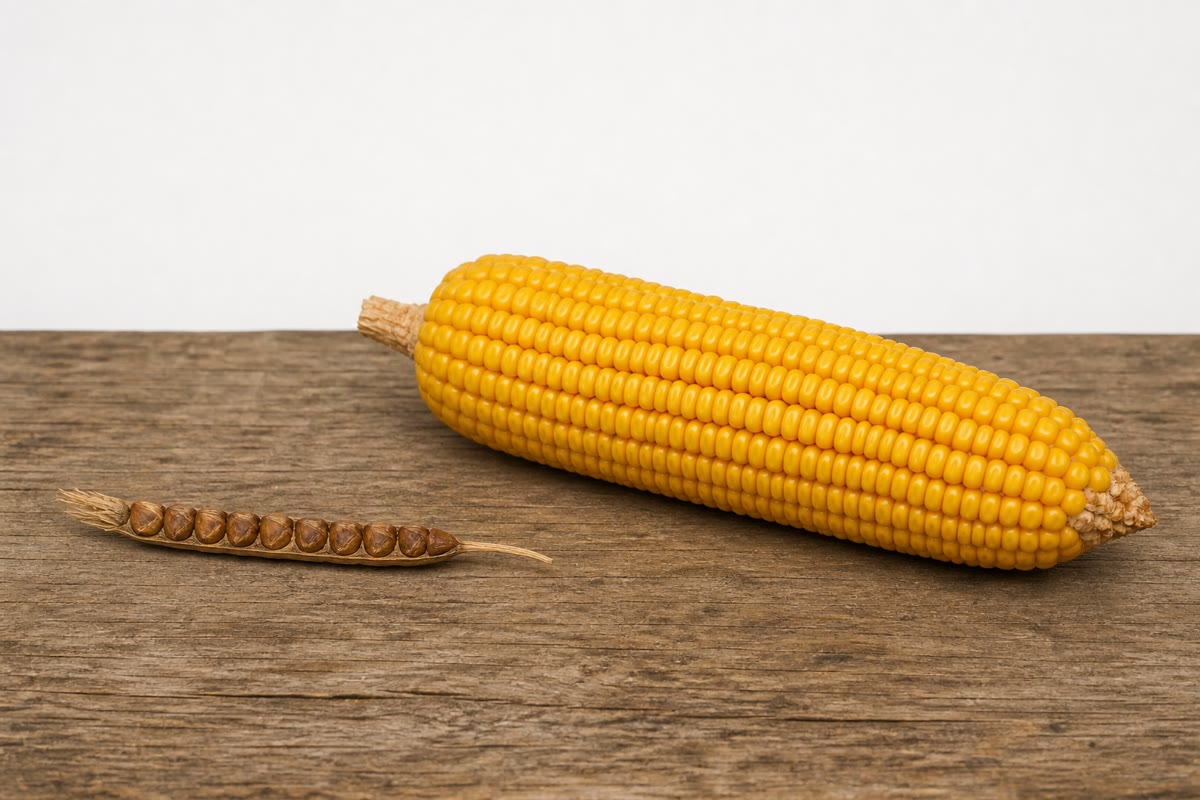
Beside a modern ear of maize — six hundred kernels in tidy rows, wrapped in husks, held on a cob that will not let them go — lay the ear of teosinte, the wild grass it came from: a dozen kernels in a single row, each cased in a stony shell, dropping off one by one at maturity. Nine thousand years of choosing, by farmers who kept the seeds of the plants they preferred, turned the one into the other. The result cannot survive a season without us: a maize ear left in a field rots where it lies. This chapter is about what happens to a plant when people become its selecting environment — and about the newer ways of changing a plant’s genes on purpose.
29.1 Selection by people
Definition 29.1 (Domestication, artificial selection)
Domestication is the transformation of a wild species into one that depends on humans and serves them, by artificial selection: at each generation, people keep and sow the seeds of the individuals with the traits they want, so that the alleles behind those traits rise in frequency. It is the selection of Chapter 25 with a human eye in place of the environment, and it works by the same arithmetic — faster, since the selecting is deliberate and severe.
Proposition 29.2 (What domestication selects)
Crops share a set of traits that no wild plant would keep, the domestication syndrome: seeds that stay on the plant instead of scattering (a non-shattering ear); larger seeds and fruits; seeds that germinate at once instead of waiting years in the soil; the loss of toxins and bitter defences; a compact plant with few branches and one large ear rather than many small ones; and simultaneous ripening. Each is useful to the harvester and harmful to a plant on its own — a crop is a plant selected for our convenience and against its independence.
Evidence. Wild wheat sheds its grains from a brittle stalk; the first cultivated wheats, found in the oldest farming sites, have a tough stalk that holds the grain — the harvester’s sickle selected, unintentionally, the mutants whose grain stayed on the plant to be gathered and sown. Teosinte and maize differ at only about five major genes: one changes a many-branched plant into a single stalk, another frees the kernel from its stony case, others multiply the rows. Crossing the two gives fertile offspring, and the intermediate forms exist: the same species, reshaped. ∎
Example 29.3 (What a crop has lost)
Maize cannot scatter its seed; cultivated wheat cannot shed its grain; the banana and the seedless grape make no seeds at all and are propagated by cuttings, every plant a clone. A crop’s survival is delegated to the farmer, and its genetic diversity has shrunk with every stage of selection: a modern variety is nearly uniform, and a whole region may grow one. The wild relatives, still diverse, are where the alleles a future crop may need — for a new disease, a drier climate — are kept (Chapter 5).
29.2 Breeding by crossing
Proposition 29.4 (Varieties and hybrids)
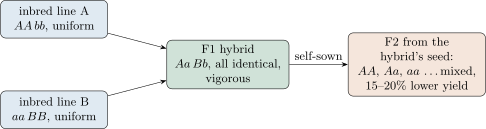
Breeders make new varieties by crossing plants that carry different useful alleles and selecting, among the offspring, the combinations they want, over several generations. A special case dominates maize and many vegetables: the F1 hybrid. Two inbred lines — each made uniform and homozygous by generations of self-pollination — are crossed; their offspring are all genetically identical, heterozygous at every gene where the lines differ, and markedly more vigorous and productive than either parent. Sown again, the hybrid’s own seed segregates into a mixture of less vigorous plants: the farmer buys new hybrid seed every year.
Proof. Admitted at this level. ∎
Example 29.5 (Why the hybrid is vigorous, and why it does not last)
Each inbred line, homozygous everywhere, carries some weak recessive alleles in double dose; crossing two lines masks each line’s weak alleles behind the other’s working ones, at every gene where they differ. The F1 is therefore heterozygous and vigorous. At the next generation, meiosis and fertilisation deal the alleles out again (Chapter 23): a quarter of the plants are homozygous for the weak allele at each gene, and the field is a patchwork.
29.3 Changing the genes directly
Proposition 29.6 (Transgenic and edited crops)
Since the 1980s a gene can be introduced into a plant without crossing: transgenesis (Chapter 3). A soil bacterium that naturally injects a piece of its DNA into plant cells is used as the vehicle: the desired gene is inserted into that piece, plant cells are infected, and whole plants are regrown from the cells that took the gene. The gene may come from any species. More recently, a plant’s own genes can be altered at a chosen position — gene editing — without adding foreign DNA. Traits so far: resistance to an insect (a bacterial toxin gene), tolerance of a herbicide, resistance to a virus, a vitamin precursor in rice, oils of altered composition.
Proof. Admitted at this level. ∎

Example 29.7 (A toxin gene in maize)
A soil bacterium makes a protein toxic to caterpillars and harmless to mammals; its gene, inserted into maize, makes every cell of the plant produce the toxin, and the borer caterpillars that tunnel the stalks die at their first bite. Insecticide spraying falls; yields rise where the borer was severe. Within a decade, borers resistant to the toxin appeared where the crop was grown without interruption — the selection of Chapter 18 in a field — and farmers are now required to sow refuges of ordinary maize beside the transgenic one, so that sensitive borers survive to dilute the resistant ones.
29.4 Choices
Proposition 29.8 (What is at stake)
Every technique of this chapter raises the same questions in a new form: the narrowing of diversity (one variety over a region, one gene in every plant), the dependence of farmers on seed they cannot save, the selection of pests and weeds resistant to the crop’s defences, the spread of a crop’s genes to wild relatives by pollen, and the safety and ownership of what is eaten. None is answered by the biology alone; the biology says what each technique does and does not do, and what it selects.
Proof. Admitted at this level. ∎
Method 29.9 (Reading a crop’s history)
- Identify the wild ancestor and what the crop has lost relative to it (dispersal, dormancy, defences, diversity).
- Identify how the change was made: unconscious selection by harvesting, deliberate selection, crossing and selection, hybridisation, transgenesis, editing.
- Count the genes involved where known: a few major genes for the domestication syndrome, many small ones for yield, one for a transgenic trait.
- Ask what the crop now depends on (the farmer, bought seed, a herbicide, refuges) and what depends on it.
Remark 29.10 (The oldest experiment in evolution)
Darwin opened his book on the origin of species with a chapter on pigeons and cabbages, because breeders had already shown what selection could do in a few centuries; he only had to remove the breeder and lengthen the time. Every crop is a demonstration of the last three chapters — variation, selection, and a change of frequencies that alters a species — run at human speed, with a record of the results in every field and every market.
29.5 Exercises
Exercise 29.1 ★
Define domestication and artificial selection.
Solution
Solution of Exercise 29.1.
Domestication: the transformation of a wild species into one that depends on and serves humans. Artificial selection: humans keeping and sowing the individuals with the traits they want, raising the frequency of the alleles behind them.
Exercise 29.2 ★
List four traits of the domestication syndrome and say why each is a handicap for a wild plant.
Solution
Solution of Exercise 29.2.
Non-shattering ears (no dispersal); immediate germination (no waiting out a bad year); loss of toxins (eaten by everything); a single large ear on an unbranched plant (all eggs in one basket); simultaneous ripening (one bad week destroys the whole crop).
Exercise 29.3 ★
What is an F1 hybrid, and why do farmers buy its seed every year?
Solution
Solution of Exercise 29.3.
The uniform, vigorous offspring of two homozygous inbred lines. Its own seed segregates into a mixture of less vigorous plants, so the farmer buys fresh hybrid seed each year.
Exercise 29.4 ★
How is a gene introduced into a plant without crossing?
Exercise 29.5 ★
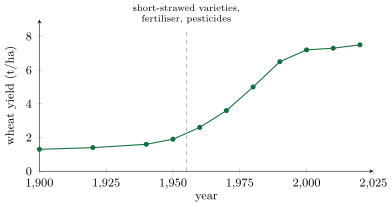
From the yield figure, by what factor did wheat yield rise between 1950 and 2000?
Solution
Solution of Exercise 29.5.
From about to : nearly four times.
Exercise 29.6 ★★
Explain how harvesting with a sickle, without any intention of breeding, selected wheat with a tough stalk.
Solution
Solution of Exercise 29.6.
Plants whose grain shattered lost it before or during the harvest; mutants with a tough stalk kept theirs and were the ones gathered, hence the ones sown. Harvesting itself selected the tough-stalk allele, generation after generation.
Exercise 29.7 ★★
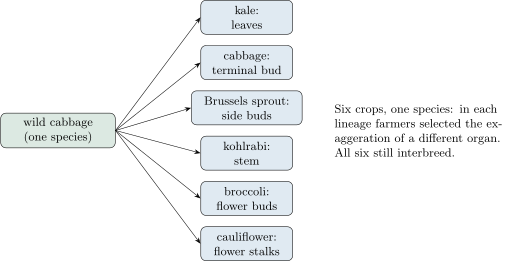
Kale, cabbage and broccoli interbreed freely. Are they one species or three? What made them look so different?
Solution
Solution of Exercise 29.7.
One species: they interbreed and give fertile offspring. Farmers selected the exaggeration of a different organ in each lineage — leaves, terminal bud, flower buds — so they differ in the regulation of growth, not in their ability to cross.
Exercise 29.8 ★★
Two inbred lines are crossed. At a gene where line A is and line B is , give the genotype of the F1 and the genotypes and proportions of the F2. Why is the F1 uniform and the F2 not?
Exercise 29.9 ★★
Why did resistant borers appear in fields of toxin-producing maize, and how does a refuge of ordinary maize slow them?
Solution
Solution of Exercise 29.9.
Among millions of borers a few carried a mutation making them tolerate the toxin; on a field where every plant makes it, only they survived and bred — selection. A refuge keeps many sensitive borers alive; their matings with the rare resistant ones give offspring carrying one resistance allele, which (being recessive) die on the toxin maize, so the allele is diluted each generation.
Exercise 29.10 ★★
Teosinte and maize differ at about five major genes. Explain how so few genes can change the plant so much, using Chapter 24.
Exercise 29.11 ★★
Why are the wild relatives of crops conserved in seed banks, given that they yield almost nothing?
Solution
Solution of Exercise 29.11.
They hold the alleles that selection removed from the crop: resistance to diseases and pests, tolerance of drought, salt or cold. When a new disease or climate arrives, breeders cross those alleles back into the crop; once a wild relative is extinct its alleles are gone.
Exercise 29.12 ★★★
A herbicide-tolerant rapeseed is grown next to a wild mustard it can cross with. Predict what may happen over some years, and name the processes of the earlier chapters involved.
Solution
Solution of Exercise 29.12.
Pollen from the rapeseed fertilises the mustard; hybrids carry the tolerance gene; back-crossed to mustard over some generations and selected by the herbicide sprayed on the fields, a tolerant wild mustard spreads. Processes: hybridisation and horizontal movement of a gene between populations, then natural selection by the herbicide.
Exercise 29.13 ★★★
The yield curve has been flat since 2000. Propose two biological reasons and one non-biological one, and say what a breeder might try.
Solution
Solution of Exercise 29.13.
Biological: the plant’s photosynthesis and its capacity to fill grain are near their limits, and the genetic diversity of the elite varieties, from which further gains must come, is narrow. Non-biological: fertiliser and pesticide use is no longer increasing, or is being reduced, and climate stresses have grown. A breeder might bring alleles from wild relatives, or edit genes of photosynthesis or drought tolerance.
Exercise 29.14 ★★★
Compare, on three points, a variety obtained by crossing and selection with one obtained by transgenesis: the origin of the new allele, the number of genes changed, and the time taken.
Solution
Solution of Exercise 29.14.
Crossing: the allele must exist in a plant that can be crossed with the crop; thousands of genes are reshuffled and must be sorted out by selection over some ten generations. Transgenesis: the gene may come from any organism; one gene is added and the rest of the genome is untouched; a few years.
Exercise 29.15 ★★★
"Domestication is the opposite of natural selection." Discuss in a paragraph with the arithmetic of allele frequencies, the agent of selection, and the fate of the selected plant.
Solution
Solution of Exercise 29.15.
The arithmetic is identical: individuals carrying certain alleles reproduce more, and the alleles’ frequencies rise. What differs is the agent — a human choice in place of the environment — and the outcome for the plant: natural selection keeps a species able to live on its own, while domestication selects traits that serve the selector and leaves the plant dependent on it. Domestication is natural selection with a different selector, not its opposite.
29.6 Problem: Nine Thousand Years, Five Genes
Problem 29.1
Weekend problem — maize made from teosinte: the ears compared, the selection reckoned, a hybrid’s yield followed through the F2, and a toxin gene managed against resistance
A teosinte spike carries 12 kernels of , cased in a hard shell, on a brittle axis; a maize ear carries 600 kernels of , naked, on a rigid cob. Maize was domesticated about 9000 years ago; one generation is one year.
Part I — The ears.
- Compute the mass of grain per ear in teosinte and in maize, and the factor between them.
- List the traits of the maize ear that belong to the domestication syndrome, and for each say why it would be a handicap for a wild plant.
- The cased kernel is controlled by one gene, with the naked allele recessive. Explain why the first farmers could only have found naked-kernel plants as rare individuals in their fields.
- Suppose the naked allele had frequency 0.01 in the wild population. What fraction of plants showed naked kernels?
- A farmer sows only seed from naked-kernel plants. What is the frequency of the naked allele in her next crop?
Part II — Nine thousand generations.
- The ear’s kernel number rose from 12 to 600 over 9000 generations. Compute the average factor of increase per generation. Why is a change so small per generation enough?
- The number of kernel rows is controlled by many genes of small effect. Explain why such a trait responds to selection gradually and for a long time, while the cased-kernel trait changed in one step.
- Maize still crosses with teosinte and gives fertile offspring. Are they one species? What has domestication changed and not changed?
- A modern variety is genetically uniform. State the risk that follows, and the resource that answers it.
- Maize cannot disperse its seeds. What does this imply about the relation between the plant and the farmer, in terms of selection?
Part III — The hybrid. Inbred line A yields , line B , their F1 hybrid ; the F2 grown from the hybrid’s seed yields . Hybrid seed costs the equivalent of of maize.
- By what percentage does the F1 exceed the better parent? By what percentage does the F2 fall below the F1?
- Explain the F1’s vigour and the F2’s loss with the genotypes of Example 29.5.
- A farmer hesitates between buying hybrid seed each year and saving seed from the F1. Compare the net harvests, and say why the seed company’s business exists.
- Why can the inbred lines not simply be sold to farmers to make the hybrid themselves?
- What has the hybrid system done to the genetic diversity of the fields, and to the farmer’s independence?
Part IV — The toxin gene. A borer population has a resistance allele at frequency 0.001, recessive; only borers survive on the toxin maize.
- What fraction of borers survives on a field of toxin maize in the first year? Compute the frequency of among the survivors.
- Explain why, without refuges, resistance spreads within a few years, using the antibiotic case as a model.
- A refuge of ordinary maize keeps a large population of sensitive borers alive next to the toxin field. Explain how this keeps the resistance allele rare, using the genotype of the offspring of a resistant survivor and a refuge borer.
- Compare the refuge with the "full course" of antibiotics: what is the same, what is different?
- State the result: the factor by which domestication multiplied the grain of an ear, the number of major genes it took, and the one dependence it created.
Solution
Solution of Problem 29.1.
1. Teosinte ; maize : nearly two hundred times.
2. Many kernels on a rigid cob (no dispersal); naked kernels (unprotected from animals and rot); one large ear on a single stalk (no spreading of risk); kernels held in husks (cannot fall to the ground at all).
3. The naked allele is recessive: a plant shows naked kernels only when it carries two copies, which for a rare allele happens in a tiny minority of plants; carriers of one copy look ordinary.
4. : one plant in ten thousand.
5. All the seed comes from plants, whose kernels received from the mother; pollen came mostly from the ordinary field ( with frequency 0.99). The seed is nearly all , so the frequency of jumps to about 0.5 — one generation of severe selection.
6. over 9000 generations: a factor of per generation, a gain of 0.04%. Tiny steps, compounded over thousands of generations, become a large change — the arithmetic of selection.
7. With many genes each adding a little, selection raises the frequency of favourable alleles at all of them and keeps finding new combinations for a long time; a single-gene trait switches as soon as the recessive allele is made homozygous.
8. One species: fertile hybrids. Domestication changed the frequencies of alleles at a few genes and the plant’s form; it did not create a reproductive barrier.
9. A disease or pest that overcomes one plant overcomes them all; the answer is the diversity kept in old varieties and wild relatives, in seed banks and fields.
10. The farmer is the plant’s dispersal, its selecting environment and its only route to the next generation: maize is under artificial selection at every generation and cannot leave it.
11. above the better parent; below the F1.
12. Each line is homozygous for some weak recessive alleles; in the F1 every such allele is masked by the other line’s working one. In the F2 a quarter of the plants are homozygous for the weak allele at each such gene, and the average falls.
13. Buying: ; saving: . Buying wins by each year, which is why a company that holds the inbred lines can sell the hybrid seed every season.
14. The company keeps the lines; with them, a farmer could make the hybrid indefinitely and the company would sell once. The lines are the company’s capital; only their product is sold.
15. Every field of a hybrid variety is genetically identical, and regions grow a few hybrids: diversity is narrowed. The farmer no longer produces seed and depends on the supplier each year.
16. : one borer in a million survives; among the survivors, all , the frequency of is 1.
17. The survivors breed among themselves; their offspring are all ; within a few generations the borers of the field are resistant — as bacteria in a patient on an incomplete course.
18. A resistant survivor () mating with a refuge borer (, the vast majority) gives offspring, which die on the toxin maize. So long as sensitive borers greatly outnumber resistant ones, almost every resistant borer’s children are heterozygous and are removed, and stays rare.
19. Same: both aim to prevent the multiplication of the rare resistant individuals. Different: the full course removes them by killing every individual before resistance can be selected; the refuge accepts survivors and dilutes them with sensitive mates.
20. Nearly two hundred times more grain per ear; about five major genes; a plant that depends on the farmer to disperse and sow it.