High School Biology · Grades 10–12
15Enzymes and the Phenotype
A Siamese cat is cream-coloured over most of its body and dark brown on its ears, muzzle, paws and tail — the cold parts. Shave a patch on its back, keep the patch cool under an ice pack while the fur regrows, and the new fur comes in dark. The cat’s genes have not changed; its pigment-making enzyme simply works below and not above. Between a gene and a visible trait stands, almost always, an enzyme; and between the enzyme and the trait stands the environment in which it works. This chapter is about those two intermediaries.
15.1 The phenotype at three scales
Definition 15.1 (Genotype and phenotype)
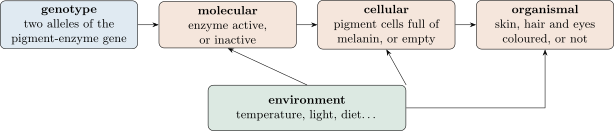
The genotype of an individual is the set of alleles it carries; its phenotype is the set of its observable characteristics. The phenotype can be described at three scales:
- the molecular scale: which proteins are present, in which form, with what activity;
- the cellular scale: the shape, contents and behaviour of the cells;
- the organismal scale: the visible traits, from eye colour to the symptoms of a disease.
Each scale is the consequence of the one below it.
Example 15.2 (Sickle-cell disease at three scales)
Molecular: one amino acid of the haemoglobin chain (glutamate, the sixth) is replaced by valine; the changed molecules stick to one another into long fibres when oxygen is low. Cellular: the fibres deform the red blood cell into a rigid crescent that blocks small vessels and breaks easily. Organismal: anaemia, crises of pain when vessels block, damage to the spleen and kidneys. One substitution in one codon of one gene, and three descriptions of its consequence.
Proposition 15.3 (Proteins make the phenotype)
Every level of the phenotype is produced by proteins: an allele determines a protein (Chapter 14); the protein’s activity determines the cell’s chemistry and structure; the cells determine the organism’s traits. Most of those proteins are enzymes, and most traits are therefore the outcome of chains of enzyme-run reactions.
Proof. Admitted at this level. ∎
15.2 Enzymes
Definition 15.4 (Enzyme, substrate, active site)
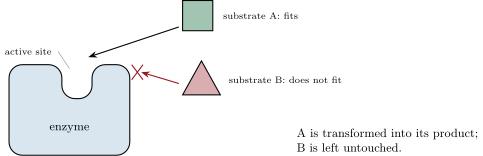
An enzyme is a protein that catalyses one chemical reaction: it makes the reaction run millions of times faster without being consumed. The molecule it transforms is its substrate; the reaction takes place in a pocket of the enzyme, the active site, whose shape and chemistry fit that substrate and no other. This specificity follows from the enzyme’s three-dimensional fold, hence from its amino acid sequence, hence from its gene.
Example 15.5 (Lactase)
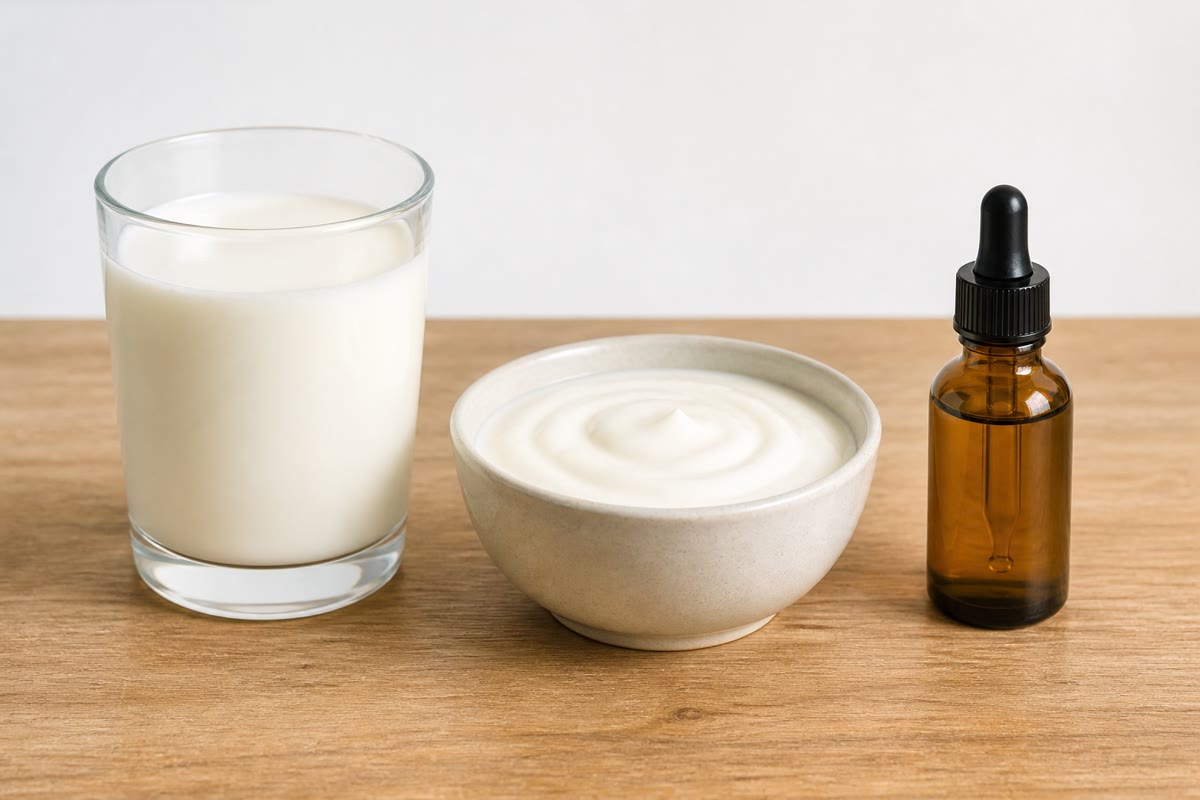
Milk sugar, lactose, is split into two simple sugars by the enzyme lactase in the lining of the small intestine; without the split it passes undigested to the colon, where bacteria ferment it, with gas, cramps and diarrhoea as the result. All infants make lactase; in most of humanity its gene is switched off after weaning, and adults are lactose intolerant. In populations with a long history of dairying, an allele that keeps the gene active for life is common — 90% in northern Europe, 10% in eastern Asia. The lactase drops sold to the intolerant contain the same enzyme, made by fungi.
Proposition 15.6 (Conditions of activity)
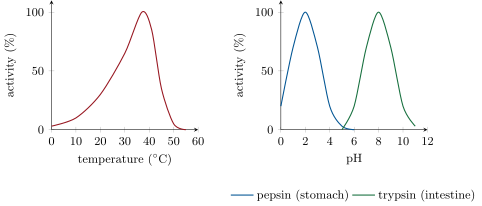
An enzyme’s activity depends on its surroundings. It rises with temperature until the protein begins to unfold, then collapses — human enzymes work best near and are destroyed above about ; each enzyme works within a range of acidity suited to its place (pepsin in the acid of the stomach, trypsin in the neutral intestine); and its rate rises with the concentration of its substrate up to a maximum, when every active site is busy.
Proof. Admitted at this level. ∎
15.3 Chains of reactions
Proposition 15.7 (Metabolic pathways)
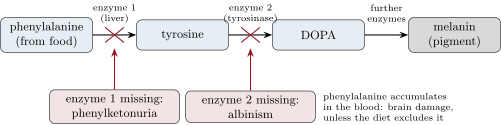
A cell rarely makes a product in one step: a starting molecule is transformed by a succession of enzymes, each acting on the product of the previous one, along a metabolic pathway. Each enzyme is encoded by its own gene. A non-working allele of any one of them blocks the pathway at that step: the product is not made, and the substrate of the blocked enzyme may accumulate. Two different genes can thus produce the same visible defect, and one gene’s defect can produce several.
Proof. Admitted at this level. ∎
Example 15.8 (Phenylketonuria, and how a diet changes a phenotype)
About one newborn in ten thousand carries two non-working alleles of the gene for enzyme 1. Phenylalanine from food is not converted; its concentration in the blood rises twentyfold and it poisons the developing brain. Untreated, the child suffers severe intellectual disability. Detected at birth by a drop of blood on a card — every newborn is tested — and fed a diet almost free of phenylalanine, the same child develops normally. The genotype is unchanged; the phenotype, at every scale above the molecular one, is that of a healthy person. The environment, here the diet, decided.
15.4 Genotype, environment, phenotype
Proposition 15.9 (The environment shapes the phenotype)
The phenotype is the result of the genotype and the environment. The environment acts on the molecular scale (temperature and acidity setting enzyme activity, the presence of a substrate setting whether a pathway runs), on the cellular scale (cells responding to signals, nutrients, light) and on the organismal scale (diet, exercise, disease). Individuals of identical genotype — identical twins, cuttings of one plant — differ in phenotype according to their histories; and individuals of different genotypes can converge on the same phenotype under suitable conditions.
Evidence. The Siamese cat’s temperature-sensitive tyrosinase: pigment forms only in the cool extremities, and a cooled shaved patch regrows dark. Phenylketonuria controlled by diet. Identical twins raised apart differing in height by several centimetres and in body mass by more. A plant of the same clone grown at sea level and at altitude differing in height tenfold, and reverting when transplanted. In each case the genotype is fixed and the phenotype moves with the conditions. ∎
Method 15.10 (Reasoning from gene to trait)
- Identify the protein: which enzyme, in which pathway, and what it does.
- Identify the allele’s effect on the protein: normal, reduced, absent, altered in its conditions of activity.
- Follow the consequence up the scales: what the cell lacks or accumulates, then what the organism shows.
- Ask how many working alleles are needed: for most enzymes one suffices, so the defect appears only with two non-working alleles (a recessive trait).
- Ask what the environment adds: substrate present or not, temperature, a treatment.
Remark 15.11 (Why one working allele is usually enough)
Enzymes are catalysts: a small quantity turns over a large amount of substrate. Half the normal amount of tyrosinase still makes enough melanin, half the normal lactase still digests a glass of milk. A carrier of one non-working allele is therefore usually indistinguishable from a non-carrier — the "recessive" of the Primary volume, now explained — and the trait appears only when both alleles fail. Proteins that are not enzymes, needed in quantity or in exact shape, are often the exception: half-normal haemoglobin makes a difference.
15.5 Exercises
Exercise 15.1 ★
Define genotype and phenotype, and name the three scales of the phenotype.
Exercise 15.2 ★
What is an enzyme’s active site, and what does "specificity" mean?
Solution
Solution of Exercise 15.2.
The pocket of the enzyme where the substrate binds and is transformed. Specificity: the site fits one substrate (or one family of substrates) and catalyses one reaction.
Exercise 15.3 ★
From the temperature curve, at what temperature is the enzyme most active, and what fraction of that activity remains at ?
Solution
Solution of Exercise 15.3.
Near ; at about a third remains.
Exercise 15.4 ★
Describe albinism at the three scales of the phenotype.
Solution
Solution of Exercise 15.4.
Molecular: tyrosinase absent or inactive, no melanin made. Cellular: pigment cells present but empty of melanin. Organismal: white hair, very pale skin and eyes, sensitivity to light and sunburn.
Exercise 15.5 ★
Why is pepsin inactive in the intestine?
Solution
Solution of Exercise 15.5.
Pepsin’s fold works only in strong acid (pH 2); the intestine is neutral to slightly alkaline, where the curve shows zero activity.
Exercise 15.6 ★★
Explain, with the notion of catalysis, why a person carrying one working and one non-working allele of the tyrosinase gene is normally pigmented.
Exercise 15.7 ★★
Two albino parents from different families have a normally pigmented child. Using the pathway figure, propose an explanation.
Exercise 15.8 ★★
A child with phenylketonuria is fed normally. Which molecule accumulates and which is lacking? Explain why such children are also often lightly pigmented.
Solution
Solution of Exercise 15.8.
Phenylalanine accumulates; tyrosine (and what derives from it) is lacking. Since melanin is made from tyrosine, its shortage reduces pigment: fair hair and skin are common in untreated phenylketonuria.
Exercise 15.9 ★★
Adult lactose intolerance is the ancestral human condition and lactase persistence a mutation. Explain in what sense the mutant phenotype is "healthier", and why only in some environments.
Exercise 15.10 ★★
A mutation replaces one amino acid in an enzyme’s active site by another of very different shape. Predict the consequence at the three scales for a pathway of your choice.
Exercise 15.11 ★★
A Siamese kitten is raised in a very warm house. Predict its coat and explain. What happens if it later lives outdoors in winter?
Exercise 15.12 ★★★
Sickle-cell haemoglobin causes disease in double carriers, but single carriers show sickling only at very low oxygen (high altitude, deep diving). Discuss the phenotype of a carrier at the three scales and the role of the environment.
Solution
Solution of Exercise 15.12.
Molecular: half the haemoglobin is the sickle form. Cellular: at normal oxygen the cells stay round; at very low oxygen some sickle. Organismal: healthy in ordinary life, at risk at altitude or when diving — and protected against malaria. The environment (oxygen, malaria) decides whether the carrier’s phenotype is a burden or an advantage.
Exercise 15.13 ★★★
A fever of makes a patient feel ill but is not directly dangerous; is. Explain with the temperature curve.
Exercise 15.14 ★★★
Identical twins have the same genotype. One becomes a marathon runner, the other sedentary. List three phenotypic differences at the cellular or molecular scale you expect between them, and say what each tells about "genetic" traits.
Solution
Solution of Exercise 15.14.
More mitochondria and capillaries per muscle fibre; a larger heart with a bigger stroke volume; more haemoglobin per litre of blood; larger glycogen stores. Each is a phenotype produced by the same genotype under a different environment: "genetic" traits are the range the genotype allows, not a fixed value.
Exercise 15.15 ★★★
"Since the phenotype depends on the environment, the genotype does not matter much." Discuss with phenylketonuria, albinism and the Siamese cat: in each case, what the genotype fixes and what the environment can and cannot change.
Solution
Solution of Exercise 15.15.
The genotype fixes which enzyme is made and how it behaves: no enzyme 1 (phenylketonuria), no tyrosinase (albinism), a heat-sensitive tyrosinase (Siamese). The environment can change the outcome only within what the enzyme allows: a diet removes the substrate and saves the brain, but cannot make the missing enzyme; cold makes the Siamese enzyme work, but no temperature makes the albino’s; and nothing in the environment gives the albino its pigment. The genotype sets the range; the environment chooses within it.
15.6 Problem: The Cat with Cold Ears
Problem 15.1
Weekend problem — a Siamese cat’s coat explained enzyme by enzyme: the temperature-sensitive tyrosinase, the map of body temperatures, the shaved patch, and a diet that rewrites a phenotype
The Siamese allele of the tyrosinase gene encodes an enzyme whose activity, measured in the laboratory, is: at , at , at , at , at . The ordinary allele’s enzyme keeps up to . Skin temperatures of a cat: trunk , legs , paws , ears and muzzle . Melanin is visible in the fur when the enzyme works at more than about .
Part I — The map.
- For each body region, read the activity of the Siamese enzyme and say whether the fur is pigmented.
- Draw, or describe, the resulting coat. Does it match a Siamese?
- Do the same for a cat with the ordinary allele.
- A Siamese kitten is born uniformly cream. Explain, knowing that the womb is at .
- At what skin temperature does the boundary between dark and pale fur lie? Which part of the enzyme’s curve fixes it?
Part II — The experiment.
- A patch on the trunk is shaved and kept at under a cold pack while the fur regrows. Predict its colour.
- A patch on a paw is shaved and kept warm at with a bandage. Predict.
- After the packs are removed, the regrown fur keeps its colour for months, then is gradually replaced. Explain both facts.
- Explain why these experiments show that the environment acts at the molecular scale, not on the genotype.
- A student proposes that the dark extremities are due to a different allele in those cells. Give two arguments against.
Part III — The three scales.
- Describe the Siamese phenotype at the molecular, cellular and organismal scales.
- The Siamese allele differs from the ordinary one by a single substitution changing one amino acid. Explain how one amino acid can make an enzyme temperature-sensitive.
- A cat carrying one Siamese and one ordinary allele is fully pigmented. Explain with Remark 15.11.
- An albino cat has two alleles of the same gene that encode no working enzyme at any temperature. Compare its phenotype with the Siamese’s at the three scales.
- Himalayan rabbits and certain mice show the same pattern. What does this suggest about their tyrosinase gene, and what would you expect of the mutation?
Part IV — A diet that rewrites a phenotype. A newborn is found to have phenylketonuria: blood phenylalanine instead of . The safe level for brain development is below .
- By what factor is the phenylalanine raised, and which enzyme of the pathway figure is missing?
- Explain why the child’s brain, and not, say, its skin, is the organ at risk.
- The diet reduces phenylalanine intake to a fifth of normal; the blood level falls in proportion. Is the child safe? What does this say about the relation between substrate supply and the phenotype when the enzyme is absent?
- Some phenylalanine is nevertheless indispensable, since the body cannot make it. Explain why the diet must be controlled rather than phenylalanine simply eliminated.
- State the result: for the Siamese cat and for the child, what the genotype fixed, what the environment set, and the single sentence that relates genotype, environment and phenotype.
Solution
Solution of Problem 15.1.
1. Trunk : about 2%, pale. Legs : about 20%, pale. Paws : 80%, dark. Ears and muzzle : over 90%, dark.
2. Pale body and legs, dark paws, ears, muzzle (and tail): the Siamese pattern.
3. 100% everywhere: a uniformly pigmented cat.
4. In the womb every part of the kitten is at , the enzyme is inactive throughout, and no pigment is laid down before birth; the points darken as the extremities cool after birth.
5. Around , where the activity crosses 30%: the steep descending part of the curve between 33 and fixes the boundary.
6. Dark: at the enzyme is fully active in the growing hairs.
7. Pale: at the enzyme is inactive.
8. Pigment is deposited in the hair as it grows and cannot be removed or added afterwards; the colour changes only when the hairs are shed and replaced by new ones grown at the local temperature.
9. The genotype of the patch’s cells is the same before and after, and the same as the rest of the trunk; only the temperature of the enzyme changed, and with it the pigment. The action is on the enzyme’s activity, a molecular event.
10. All the cat’s cells descend from one egg and carry the same alleles; and the shaved-patch experiments change the colour of a region without changing its cells — an allele cannot be switched by an ice pack.
11. Molecular: a tyrosinase that works only below about . Cellular: pigment cells full of melanin in the extremities, empty in the trunk. Organismal: a pale cat with dark points.
12. The amino acid sits where it stabilises the fold; the replacement holds the fold together at low temperature but lets it loosen a few degrees higher, so the active site loses its shape before the ordinary enzyme’s does.
13. The ordinary allele’s enzyme is fully active at body temperature; half the normal amount is still more than enough to make pigment everywhere. The Siamese allele is recessive to it.
14. Molecular: no working enzyme at any temperature, against a conditionally working one. Cellular: no melanin anywhere, against melanin in the cool regions. Organismal: an all-white cat with pink eyes, against the pointed pattern. Cold changes nothing for the albino.
15. That they carry a temperature-sensitive allele of the same gene; probably a similar substitution destabilising the enzyme, arisen independently in each species.
16. Twentyfold; enzyme 1, which converts phenylalanine to tyrosine.
17. Excess phenylalanine interferes with the developing brain’s cells specifically (their supply of other amino acids and their maturation); skin cells tolerate it. The molecular defect is the same everywhere; the cellular consequence is not.
18. A fifth of is , below : safe. Without the enzyme the blood level simply follows the intake, so the phenotype is set by the substrate supply — the environment — rather than by the missing enzyme alone.
19. Phenylalanine is needed to build the body’s proteins and cannot be synthesised; with none, growth stops. The intake must be enough for protein synthesis and no more, which requires measuring and adjusting.
20. The genotype fixed the enzyme (heat-sensitive in the cat, absent in the child); the environment set its conditions (skin temperature; dietary phenylalanine); the phenotype is the result of the genotype expressed in a given environment.