High School Biology · Grades 10–12
20Hormonal Control of Reproduction
A woman keeps a chart: her temperature every morning, a small rise around the middle of each month; a bleeding every twenty-eight days or so. A laboratory measuring four hormones in her blood every day would draw four curves that rise and fall in a fixed order, month after month, each peak causing the next. A man’s laboratory chart would show the same hormones at nearly constant levels, day after day. The organs are different; the control system — a centre in the brain, a gland beneath it, the gonad, and messages carried by the blood in both directions — is the same. This chapter reads the charts, and shows how understanding them made it possible to prevent a pregnancy, or to obtain one.
20.1 Hormones and their loops
Definition 20.1 (Hormone, feedback)
A hormone is a molecule secreted into the blood by a gland and acting, at a distance, on the cells that carry a receptor for it. A hormonal system is regulated by feedback: the hormone produced at the end of a chain acts back on the glands at its start. Negative feedback — the product reduces the command — holds a level constant; positive feedback — the product increases the command — produces a surge.
Proposition 20.2 (The common chain)
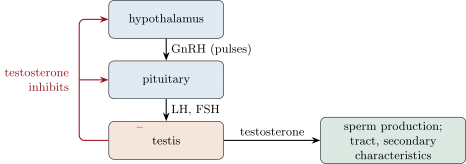
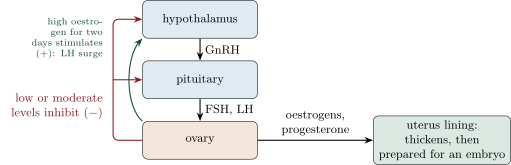
In both sexes the same three-tier chain controls the gonads. A centre of the brain, the hypothalamus, secretes in pulses a releasing hormone, GnRH, into the small vessels that lead to the pituitary gland just beneath it; the pituitary responds by secreting two hormones into the general blood, LH and FSH; these act on the gonads, which produce both gametes and sex hormones — testosterone in the testis, oestrogens and progesterone in the ovary. The sex hormones act on the body, and act back on the hypothalamus and the pituitary.
Proof. Admitted at this level. ∎
20.2 The male: a constant level
Proposition 20.3 (Control of the testis)
The testis has two compartments. The seminiferous tubules, stimulated by FSH and by testosterone, produce sperm continuously from puberty, some hundred million a day. The cells between the tubules, stimulated by LH, secrete testosterone, which maintains the reproductive tract, the secondary characteristics and sperm production. Testosterone inhibits the hypothalamus and the pituitary: when it rises, GnRH, LH and FSH fall and the testis secretes less; when it falls, they rise. This negative feedback holds the level nearly constant, within small daily fluctuations, from puberty to old age.
Evidence. Castration of an animal raises its LH severalfold within days; an injection of testosterone brings LH back down. A lesion of the hypothalamus abolishes LH, FSH and testosterone together; injecting GnRH in pulses restores all three, while a continuous infusion of GnRH does not — the pulsing matters. Men treated with testosterone for other reasons see their sperm production fall: the external hormone switches off their own pituitary. ∎
20.3 The female: cycles
Proposition 20.4 (The ovarian cycle)
From puberty to menopause the ovary runs a cycle of about 28 days.
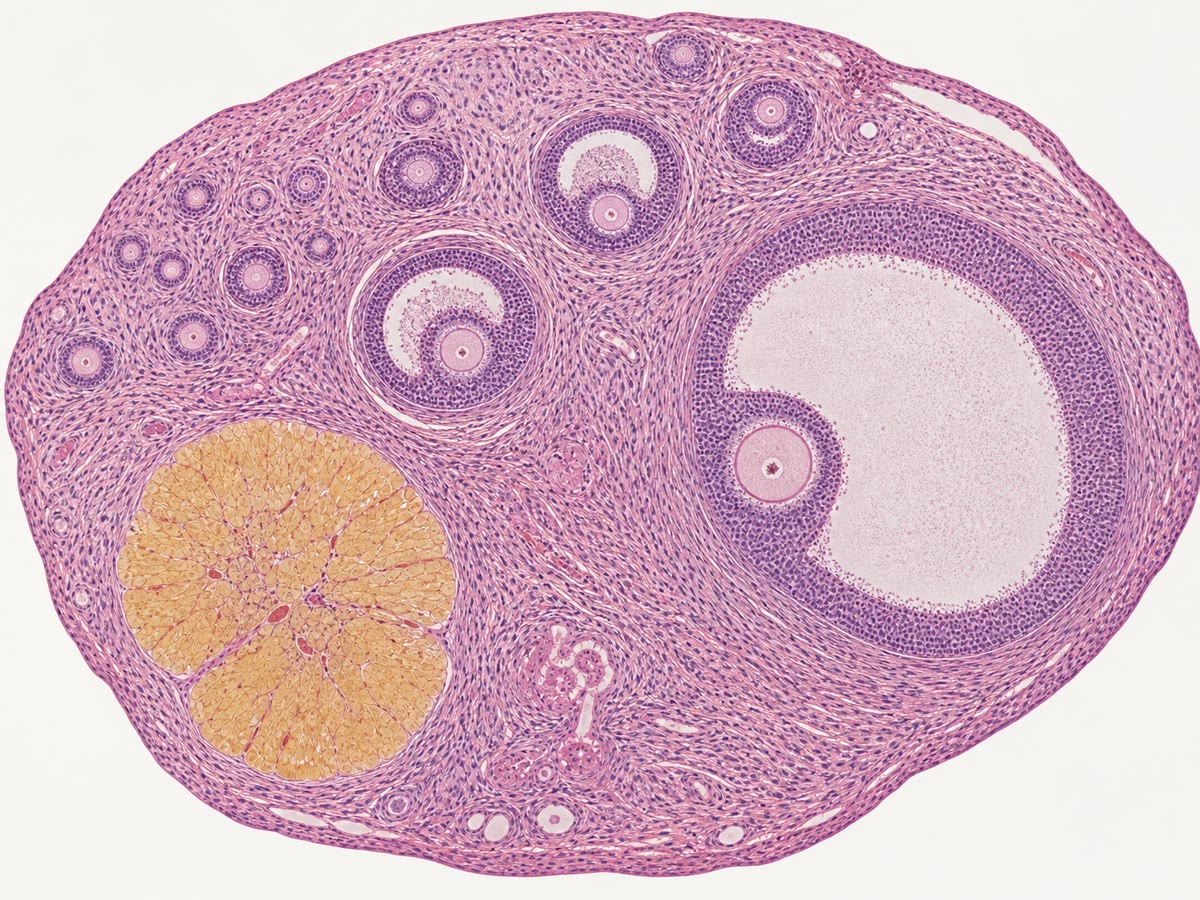
- Follicular phase (days 1–13): under FSH, a follicle — an egg cell surrounded by its nurse cells — grows and secretes rising amounts of oestrogens.
- Ovulation (day 14): a surge of LH ruptures the mature follicle, which releases its egg into the oviduct.
- Luteal phase (days 15–28): the emptied follicle becomes the corpus luteum, which secretes progesterone and oestrogens; if no pregnancy begins it degenerates after about twelve days, the two hormones fall, and a new cycle starts.
Proof. Admitted at this level. ∎
Proposition 20.5 (The uterine cycle and the feedbacks)
The lining of the uterus follows the ovary’s hormones: oestrogens make it thicken during the follicular phase; progesterone makes it secretory and ready to receive an embryo during the luteal phase; the fall of both at the cycle’s end makes it break down and bleed — menstruation, days 1 to 5 of the next cycle. The feedbacks change sign during the cycle: at low and moderate levels, oestrogens and progesterone inhibit the hypothalamus and pituitary (negative feedback); but the high oestrogen of the mature follicle, sustained for two days, stimulates them (positive feedback), which produces the LH surge that triggers ovulation. After ovulation, the progesterone of the corpus luteum restores the negative feedback, and no second surge occurs.
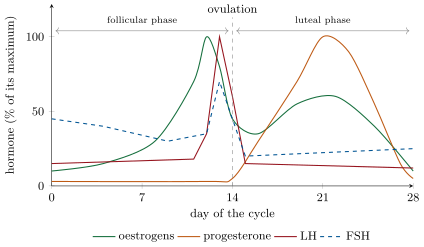
Evidence. Daily blood measurements give the curves of the next figure: the LH surge follows the oestrogen peak by a day and precedes ovulation by a day; progesterone appears only after ovulation. Removing the ovaries raises LH and FSH; small doses of oestrogens lower them; a large, sustained dose given at mid-cycle provokes an LH surge — the sign of the feedback reverses with the dose. A woman whose pituitary cannot respond to oestrogen’s rise has no surge and does not ovulate, though her follicles grow. ∎
Method 20.6 (Reading a cycle chart)
- Find the LH peak: ovulation is the following day; the follicular phase is everything before, the luteal phase everything after.
- Check the order: oestrogen peak, then LH surge, then ovulation, then progesterone. A curve out of order is a sign of a disorder.
- Count: the luteal phase is close to 14 days in every woman; cycle length varies through the follicular phase. Ovulation is therefore 14 days before the next period, not 14 days after the last.
- Interpret a drug or a lesion by asking which hormone it adds or removes, and what the feedback then does to the others.
20.4 Choosing: contraception
Proposition 20.7 (Hormonal contraception)
The combined pill supplies, every day, small doses of an oestrogen and a progesterone-like molecule. At those levels the feedback is negative throughout: FSH stays low, no follicle matures, no oestrogen peak occurs, no LH surge, no ovulation. The lining of the uterus, kept thin, and the mucus of the cervix, kept thick, add two barriers. Stopping the pills for a week lets the hormones fall and the lining bleed. Other methods act elsewhere: a copper device in the uterus prevents fertilisation and implantation; the emergency pill, taken within days of intercourse, delays ovulation; condoms stop the gametes from meeting — and are the only method that also stops sexually transmitted infections.
Proof. Admitted at this level. ∎
Example 20.8 (Reading the pill’s effect)
On the chart of a woman taking the pill, the four curves are flat: oestrogens and progesterone at the low, steady level the pills supply, LH and FSH below their cycle minimum, no peak anywhere. Miss the pills for a few days early in the pack and FSH escapes: a follicle may start, and the rest can follow. The pill works because the feedback works, and a forgotten pill is a hole in the feedback.
20.5 Obtaining: assisted reproduction
Proposition 20.9 (When a pregnancy does not come)
About one couple in seven consults after a year of trying. The causes are shared: absent or irregular ovulation, blocked oviducts, too few or immobile sperm, and in a third of cases no identified cause. The treatments follow the biology:
- ovulation induction: FSH injections, or a drug that blocks oestrogen’s negative feedback, make follicles mature; an LH-like injection then triggers ovulation at a chosen hour;
- insemination: prepared sperm placed in the uterus at ovulation;
- in vitro fertilisation: after stimulation, eggs are collected from the ovary with a needle, fertilised in a dish — if necessary by injecting one sperm into each egg — and one or two embryos are placed in the uterus three to five days later. About one attempt in three or four results in a birth; the rest can be repeated with frozen embryos.
Each step of the natural chain that fails is replaced by the corresponding intervention.
Proof. Admitted at this level. ∎
Example 20.10 (The numbers of one attempt)
Stimulation yields 10 eggs; 8 are mature; 5 fertilise; 3 reach the five-day stage; 1 is transferred and 2 frozen. The transfer succeeds in about a third of cases; with the two frozen embryos, the chance of a birth from the one collection rises to about 60%. The technique has produced several million children since 1978; it has also raised questions — about embryos not used, about the age of parents, about what may be chosen — that the biology does not answer.
Remark 20.11 (Two systems that meet)
The hormones of this chapter control the gonads and the body; they do not, in humans, control sexual behaviour the way they do in many animals, in which mating is tied to the ovarian cycle. Human sexual activity is largely independent of the cycle and depends on the brain’s systems of desire, pleasure and attachment — circuits of reward shared with other motivations — and on the person’s history, culture and choices. Reproduction and sexuality overlap; they are not the same thing, and the hormones govern only the first.
20.6 Exercises
Exercise 20.1 ★
Define hormone and feedback, and distinguish negative from positive feedback.
Solution
Solution of Exercise 20.1.
A hormone is a molecule secreted into the blood by a gland and acting on distant cells carrying its receptor. Feedback is the action of the end product on the glands at the start of the chain: negative when it reduces the command (holding a level constant), positive when it increases it (producing a surge).
Exercise 20.2 ★
Name the three tiers of the chain controlling the gonads and the hormones each secretes.
Solution
Solution of Exercise 20.2.
Hypothalamus (GnRH), pituitary (LH and FSH), gonad (testosterone in the testis; oestrogens and progesterone in the ovary).
Exercise 20.3 ★
What are the two compartments of the testis and what does each produce?
Solution
Solution of Exercise 20.3.
The seminiferous tubules produce sperm; the cells between them secrete testosterone.
Exercise 20.4 ★
List the phases of the ovarian cycle with their hormones.
Solution
Solution of Exercise 20.4.
Follicular phase (days 1–13): growing follicle, oestrogens. Ovulation (day 14): LH surge. Luteal phase (days 15–28): corpus luteum, progesterone and oestrogens.
Exercise 20.5 ★
What causes menstruation?
Solution
Solution of Exercise 20.5.
The degeneration of the corpus luteum at the end of the cycle: the fall of progesterone and oestrogens makes the thickened lining of the uterus break down and bleed.
Exercise 20.6 ★★
From the cycle figure, give the day of the oestrogen peak, of the LH peak, of ovulation and of the progesterone peak.
Solution
Solution of Exercise 20.6.
Oestrogen peak day 12, LH peak day 13, ovulation day 14, progesterone peak day 21.
Exercise 20.7 ★★
Explain why castration raises LH, and why a testosterone injection lowers it again.
Solution
Solution of Exercise 20.7.
Castration removes testosterone, hence its inhibition of the hypothalamus and pituitary: LH rises. Injected testosterone restores the inhibition and LH falls — negative feedback in both directions.
Exercise 20.8 ★★
Explain why the oestrogen peak of day 12 produces an LH surge while the oestrogen of day 20 does not.
Exercise 20.9 ★★
A woman has cycles of 35 days. On which day does she ovulate? Justify.
Solution
Solution of Exercise 20.9.
Day 21: the luteal phase lasts about 14 days whatever the cycle length, so ovulation is 14 days before the next period; the extra week is in the follicular phase.
Exercise 20.10 ★★
Explain how the combined pill prevents ovulation, using the sign of the feedback.
Exercise 20.11 ★★
A man taking testosterone for bodybuilding finds his testes shrinking and his sperm count falling. Explain.
Solution
Solution of Exercise 20.11.
The external testosterone inhibits his hypothalamus and pituitary; LH and FSH fall; his testes, no longer stimulated, stop secreting and stop making sperm, and shrink.
Exercise 20.12 ★★★
A drug blocks the oestrogen receptors of the hypothalamus. Predict its effect on FSH, on follicle growth and on ovulation, and say why it is used to treat some infertilities.
Solution
Solution of Exercise 20.12.
Without oestrogen’s inhibition, GnRH and FSH rise; follicles mature; their oestrogen peak (acting on the pituitary, still able to respond) triggers an LH surge and ovulation. It is used when ovulation fails because the follicles receive too little FSH.
Exercise 20.13 ★★★
A woman’s chart shows an oestrogen peak but no LH surge and no progesterone. Locate the defect in the chain and propose a treatment.
Exercise 20.14 ★★★
During pregnancy the embryo’s tissues secrete an LH-like hormone that keeps the corpus luteum alive. Explain why this prevents menstruation and further ovulations, and why pregnancy tests detect this hormone.
Solution
Solution of Exercise 20.14.
Kept alive, the corpus luteum keeps secreting progesterone: the lining is maintained (no menstruation) and the negative feedback holds LH and FSH down (no new follicle or ovulation). The hormone appears in the blood and urine within days of implantation, which is what the tests detect.
Exercise 20.15 ★★★
An IVF cycle collects 12 eggs, of which 60% fertilise and 40% of those reach day 5; each transferred embryo gives a birth in 35% of cases. Compute the expected number of embryos, and the probability of at least one birth if they are transferred one at a time until success or exhaustion.
Solution
Solution of Exercise 20.15.
: about 3 embryos. Probability of no birth in three transfers: ; at least one birth: about 73%.
20.7 Problem: The Chart
Problem 20.1
Weekend problem — one woman’s cycle charted hormone by hormone, read for its feedbacks, disturbed by a pill, and assisted when it fails
Blood samples are taken daily through one cycle. Rounded values, as percentages of each hormone’s maximum:
| day | 2 | 6 | 10 | 12 | 13 | 14 | 18 | 22 | 27 |
|---|---|---|---|---|---|---|---|---|---|
| oestrogens | 10 | 20 | 55 | 100 | 80 | 45 | 45 | 60 | 15 |
| LH | 15 | 15 | 20 | 35 | 100 | 60 | 15 | 15 | 12 |
| FSH | 45 | 35 | 30 | 35 | 70 | 45 | 22 | 25 | 25 |
| progesterone | 3 | 3 | 3 | 3 | 4 | 5 | 55 | 100 | 15 |
Part I — Reading the chart.
- On which day does ovulation take place? Justify from two hormones.
- Give the follicular and luteal phases, with their lengths.
- Which structure of the ovary secretes the oestrogens of day 10? Of day 22? Which secretes the progesterone of day 22?
- Describe the state of the uterine lining on days 6, 22 and 28.
- Why is FSH highest at the start of the cycle and lowest in the luteal phase?
Part II — The feedbacks.
- Between days 2 and 10, oestrogens rise while FSH falls. Which feedback is at work? Explain.
- Between days 12 and 13, oestrogens are at their peak and LH rises sevenfold. Which feedback? What condition on the oestrogen level makes it possible?
- Between days 18 and 27, oestrogens are moderate, progesterone high, and LH low. Which feedback, and why is there no second surge?
- The corpus luteum degenerates on day 26. Predict the hormones of day 28 and what follows.
- Explain why the cycle is self-restarting: what rise on day 1 launches the next follicle?
Part III — The pill. The same woman takes the combined pill for a month, which supplies oestrogens at 25% and a progesterone-like hormone at 40% of their maxima, every day.
- Predict the levels of FSH and LH throughout the month, and the fate of the follicles.
- Will there be an oestrogen peak? An LH surge? Ovulation?
- During the seven pill-free days, what happens to the lining of the uterus, and why is this not a true menstruation?
- She forgets the pills on days 5 to 8. Explain the risk, step by step.
- Explain why a progesterone-only pill, at a level that keeps the negative feedback, can also prevent ovulation.
Part IV — When the chain fails.
- Another woman’s chart shows FSH and LH always below 10% and oestrogens below 10%. Where is the defect? What treatment would restore ovulation, and by what route?
- A third woman’s chart is normal but her oviducts are blocked. Which steps of Proposition 20.9 replace the blocked step?
- In IVF, a single injection of an LH-like hormone is given 36 hours before the eggs are collected. Explain what it imitates and why the timing is exact.
- After stimulation, 10 follicles mature instead of 1. Explain, with FSH, why the natural cycle usually ripens only one.
- State the result: the day of ovulation on the chart, the two signs of the feedback that produced it, and the mechanism by which the pill suppressed it.
Solution
Solution of Problem 20.1.
1. Day 14: the LH surge of day 13 precedes ovulation by a day, and progesterone, which appears only after ovulation, rises from day 14.
2. Follicular phase days 1–13 (13 days); luteal phase days 14–27 or 28 (about 14 days).
3. The growing follicle on day 10; the corpus luteum on day 22, for both oestrogens and progesterone.
4. Day 6: thin, beginning to thicken under oestrogens. Day 22: thick and secretory under progesterone, ready for an embryo. Day 28: breaking down, bleeding, as both hormones have fallen.
5. At the start the previous cycle’s hormones have fallen and their inhibition with them, so FSH rises; in the luteal phase progesterone and oestrogens inhibit it strongly.
6. Negative feedback: the rising oestrogens of the follicle inhibit the pituitary, and FSH falls.
7. Positive feedback: oestrogens at their maximum for about two days stimulate the hypothalamus and pituitary instead of inhibiting them, and LH surges.
8. Negative: progesterone with moderate oestrogens inhibits the pituitary; without a sustained oestrogen peak, no positive feedback and no second surge.
9. Progesterone and oestrogens collapse; the lining breaks down and bleeds on day 1 of the next cycle; FSH, released from inhibition, rises.
10. The fall of the luteal hormones removes the negative feedback, FSH rises, and a new follicle begins to grow: the end of one cycle is the signal for the next.
11. FSH and LH low all month (negative feedback maintained by the pill’s hormones); no follicle matures.
12. No peak (no maturing follicle), no surge, no ovulation.
13. The pill’s hormones fall and the lining, thin, breaks down and bleeds; it is a withdrawal bleed, not the end of a luteal phase — there was no corpus luteum.
14. Without the pill’s hormones the feedback lifts, FSH rises, a follicle may start to grow and secrete; if it reaches its oestrogen peak, an LH surge and ovulation can follow, and the thin lining and thick mucus are no longer maintained.
15. Progesterone alone inhibits the hypothalamus and pituitary enough to prevent the LH surge, and thickens the cervical mucus.
16. The hypothalamus or pituitary: the ovary is not stimulated. Pulses of GnRH (if the pituitary works) or injections of FSH and LH restore follicle growth and ovulation, bypassing the missing tier.
17. In vitro fertilisation: eggs collected from the ovary, fertilised in a dish, embryo placed in the uterus — the meeting of the gametes and the transport that the oviduct would have done.
18. The natural LH surge; ovulation follows the surge by about 36 hours, so the eggs are collected just before they would be released and lost.
19. Naturally, the rising oestrogens of the leading follicle lower FSH, and the smaller follicles, starved of FSH, degenerate; only the largest survives. Injected FSH overrides this selection and keeps all of them growing.
20. Ovulation on day 14; the negative feedback that lowered FSH as the follicle grew, then the positive feedback that turned the oestrogen peak into an LH surge; the pill held the feedback negative all month, so no follicle matured and no surge occurred.