বইগুলো এখনো বাংলা ভাষায় পাওয়া যায় না — ইংরেজি সংস্করণ দেখানো হচ্ছে।
University Earth and Space Sciences — Year 2 · স্নাতক দ্বিতীয় বর্ষ
3Elements in the Earth
A tonne of the rocks of the continents holds about one and a half milligrams of gold. A tonne of the carbonaceous chondrites of the previous chapter, the most primitive stones that fall from the sky, holds about a hundred times more. The Earth was assembled from such material, so the gold is not missing from the Earth: it is elsewhere. Combine the estimated compositions of the core and of the silicate Earth with the mass of the core, and more than 99 per cent of the Earth’s gold turns out to sit in the core, where it sank with the iron early in the Earth’s history. Gold is one of a family of elements that follow metallic iron; others follow sulfide, others the silicate rock, and others still escape to the air. This chapter sorts the elements into these families, uses the chondrites to reconstruct the composition of the whole Earth and to weigh its core, describes the compositions of the mantle, the oceanic crust and the continental crust, and introduces the trace elements and the diagrams on which geochemists read the history of a rock.
You already know
The Earth has a metallic core, mostly iron, under a silicate mantle and a thin crust; seismology gives the radius and the density of each layer, and the core is 5 to 10 per cent less dense than pure iron would be at the same pressure and temperature, which calls for light elements in it: silicon, sulfur, carbon, oxygen and hydrogen are the candidates (Year 1 volume). The electronegativity of an element measures how strongly its atoms attract the electrons of a bond, and the radius of an ion depends on its charge and on the number of its neighbours (chemistry books’ Year 1 volume). A partition coefficient is the ratio of the concentrations of a substance in two phases in equilibrium (chemistry books’ Year 1 volume). Chondrites, carbonaceous chondrites and the condensation sequence were introduced in Chapter 2.
3.1 Goldschmidt’s classification
When a chondritic body melts, its matter separates into immiscible liquids: a dense metal of iron and nickel, a sulfide liquid if there is enough sulfur, and a silicate melt, with a gas phase above. Each element distributes itself between these phases according to its chemistry, and the same partition is seen in smelting, where molten iron, a sulfide matte and a silicate slag separate in the furnace.
Definition 3.1 (Goldschmidt classification)
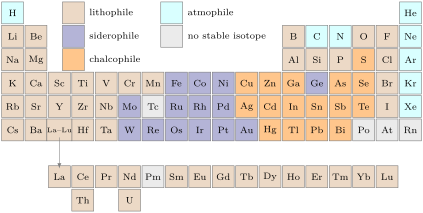
The Goldschmidt classification sorts the elements by the phase they favour in a body that separates into metal, sulfide, silicate and gas. A lithophile element favours silicate and oxide; a siderophile element favours metallic iron; a chalcophile element favours sulfide; an atmophile element stays in the gas, as a gas or a volatile compound.
The classes follow the chemistry of bonding. Lithophile elements, such as the alkali and alkaline-earth metals, aluminium, titanium or the rare earths, give up their electrons readily to oxygen, which is far more electronegative, and form ionic bonds with it. Siderophile elements, the platinum-group metals, gold, nickel and cobalt, have electronegativities close to that of iron, bond weakly with oxygen and dissolve in the metal. Chalcophile elements, copper, zinc, lead, silver and cadmium among them, form bonds with sulfur that are more covalent. The atmophile elements are the noble gases, nitrogen and hydrogen. Many elements belong to two classes, depending on the conditions: iron itself is siderophile in a metal-rich body and lithophile in the oxidised mantle, where it sits in olivine and pyroxene; tungsten and molybdenum are siderophile in the Earth, but much of them stayed in the mantle (figure below).
3.2 The chondritic Earth
No one can sample the Earth as a whole: the core is out of reach, and the mantle reaches the surface only in pieces. The composition of the bulk Earth is built instead from two pieces of evidence: the meteorites, which sample the material from which the planets formed, and the rocks of the mantle and the melts that come from it.
Definition 3.2 (CI chondrite)
A CI chondrite is a member of the group of carbonaceous chondrites named after the Ivuna meteorite: black, crumbly stones made almost entirely of fine-grained matrix, rich in water-bearing minerals and carbon, almost without chondrules. Apart from hydrogen, carbon, nitrogen, oxygen and the noble gases, their composition is the closest of all known materials to that of the Sun’s photosphere; they are the reference composition of geochemistry.
The group counts five meteorites, all of them falls: Alais (1806), Orgueil (1864), Tonk (1911), Ivuna (1938) and Revelstoke (1965); Orgueil is the largest, at fourteen kilograms. The composition adopted for the group is a weighted mean of their analyses, element by element; the values used in this chapter are quoted where they are needed.
Definition 3.3 (Refractory and volatile elements)
A refractory element is one whose 50 per cent condensation temperature (Chapter 2) lies above those of magnesium, silicon and iron, at ; a volatile element is one whose condensation temperature lies below them.
The magnesium content serves as a yardstick. Magnesium is lithophile, condenses with the bulk of the rock and does not enter the core, so the ratio of an element to magnesium in the silicate Earth, divided by the same ratio in CI chondrites, measures how much of that element the silicate Earth kept relative to a chondritic starting material. The water, carbon and other volatile compounds that CI chondrites hold, which the Earth did not keep, cancel out of the ratio.
Definition 3.4 (Bulk silicate Earth, primitive mantle)
The bulk silicate Earth is the Earth without its core: mantle, crust, ocean and atmosphere taken together, as they would be if mixed. The same composition is called the primitive mantle: the mantle as it was after the core formed and before any crust was extracted from it.
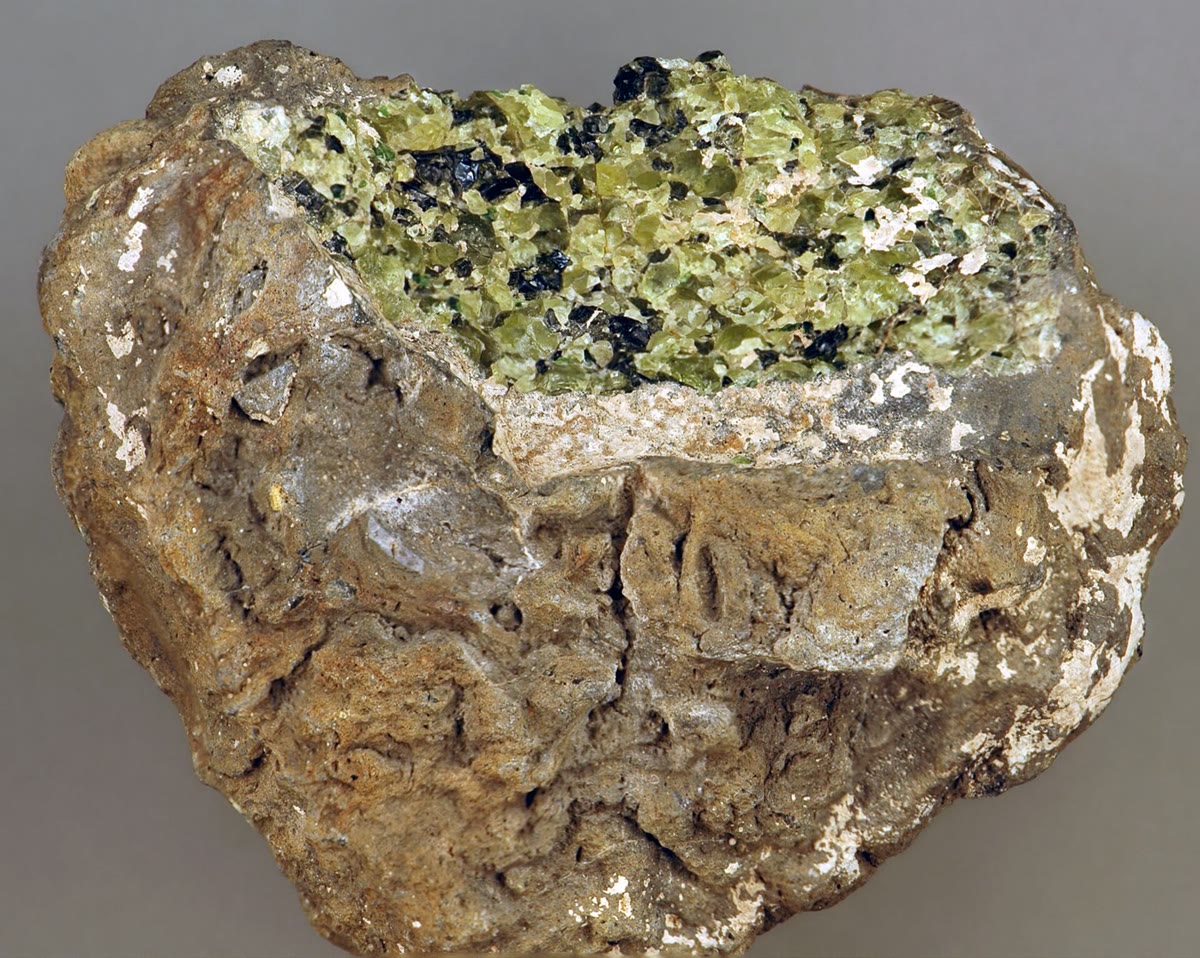
Estimates of the primitive mantle rest on the mantle rocks that have lost the least melt, peridotites brought up as xenoliths in lavas (photograph below) or exposed in mountain belts, and on the assumption that the refractory lithophile elements stand in chondritic proportions to one another. One widely used result, with magnesium 22.8, silicon 21.0 and iron 6.26 per cent by mass, is given in the table of compositions further on.
The figure below compares this silicate Earth with CI chondrites, element by element, against the condensation temperature of the previous chapter. It sorts the elements in a way no other evidence can. The refractory lithophile elements, from zirconium and the rare earths down to strontium and barium, all stand at the same level, within twenty per cent of one another: the silicate Earth kept them all in their chondritic proportions. The volatile lithophile elements fall away with their condensation temperature: about a fifth of the potassium and sodium, a tenth of the rubidium, a hundredth of the chlorine and a few thousandths of the bromine and iodine are there. The siderophile elements lie far below every lithophile element of the same volatility: the silicate Earth holds a seventh of its share of iron, a thirteenth of the nickel, and about three thousandths of the platinum-group metals and gold. These went into the core. The chalcophile elements, most of them also volatile, are depleted on both counts.
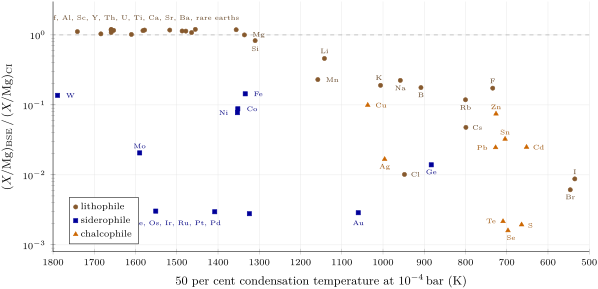
The refractory lithophile elements stand about 15 per cent above magnesium. The two cannot both be exactly chondritic: either the Earth gained refractory elements, or it lost a little magnesium, or the magnesium of the model is an underestimate (Exercise 3.12). Silicon, at 0.83, falls further short of the refractory level; part of the missing silicon may sit in the core (problem).
The siderophile elements in the silicate Earth, combined with a chondritic bulk Earth, weigh the core. Suppose the bulk Earth has the CI ratio for a siderophile element , and the core holds the concentration of it but no magnesium.
Proposition 3.5 (Core mass fraction from a chondritic ratio)
Let be the mass fraction of the core, and the concentrations of and magnesium in the silicate Earth, and that of in the core. If the Earth has the chondritic ratio , then
Proof. A mass of Earth holds of and of magnesium. Their ratio is : . Dividing by gives the result. ∎
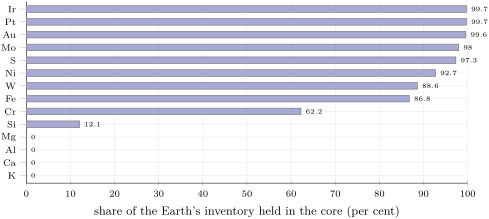
With iron, in CI chondrites, 22.8 per cent magnesium and 6.26 per cent iron in the silicate Earth, and 85.5 per cent iron in a model core, the proposition gives , a core of 30 per cent of the Earth’s mass. Seismology, integrating the density of the reference Earth model, gives 32.5 per cent. The agreement to within a tenth supports the picture of a chondritic Earth whose iron is mostly in the core; the difference measures how far the Earth’s iron-to-magnesium ratio departs from the chondritic one (problem). The same balance tells where each element of the Earth is (figure below): nearly all its platinum, iridium and gold, and most of its iron, nickel and sulfur, are in the core.
3.3 Mantle and crusts
The silicate Earth has been divided since its formation into a mantle and two kinds of crust. The oceanic crust is made by melting of the mantle beneath the mid-ocean ridges; the continental crust by a long history of melting above subduction zones, reworking and erosion (later chapters). Two reference melts of the mantle anchor the discussion.
Definition 3.6 (Mid-ocean ridge basalt, ocean island basalt)
A mid-ocean ridge basalt (MORB) is a basalt erupted at a mid-ocean ridge, the rock of the top of the oceanic crust. An ocean island basalt (OIB) is a basalt erupted at an oceanic volcano away from plate boundaries, such as those of Hawaii, commonly attributed to a mantle plume (Year 1 volume).
The mean MORB in the table below is a global average built from 771 ridge segments, each segment weighted by its length and its spreading rate, so that the average represents the crust that the ridges produce. The OIB column is a single rock: the basalt reference material BHVO-2, taken in 1995 from a lava that overflowed the Halemaumau crater of Kilauea, Hawaii, in 1919, and analysed by many laboratories, so that most of its rare earths are known to about one per cent. The upper continental crust is an average estimated from surface rocks and sediments.
| oxide (wt %) | primitive mantle | MORB | OIB (BHVO-2) | upper cont. crust |
|---|---|---|---|---|
| 45.0 | 50.47 | 49.60 | 66.6 | |
| 0.201 | 1.68 | 2.731 | 0.64 | |
| 4.45 | 14.70 | 13.44 | 15.4 | |
| FeO (total) | 8.05 | 10.43 | 11.15 | 5.04 |
| MnO | 0.135 | 0.184 | 0.1690 | 0.10 |
| MgO | 37.8 | 7.58 | 7.257 | 2.48 |
| CaO | 3.55 | 11.39 | 11.40 | 3.59 |
| 0.36 | 2.79 | 2.219 | 3.27 | |
| 0.029 | 0.160 | 0.5130 | 2.80 | |
| 0.021 | 0.184 | 0.2685 | 0.15 |
Read across, the table tells the story of melting. The mantle is a magnesium-rich peridotite, nearly 38 per cent MgO and less than 5 per cent of and CaO. Its melts, the basalts, hold five times less magnesium and three times more calcium and aluminium: the elements that enter the melt readily leave the mantle first. Potassium, sodium and titanium are richer still in the melts compared with the mantle, and potassium is richest of all in the continental crust, nearly a hundred times its concentration in the primitive mantle. Silicon rises from the mantle to the basalts only a little, and much more in the continental crust, whose average is close to that of a granodiorite.
3.4 Trace elements
Ten oxides make up about 99 per cent of each rock of the table above. The remaining elements, present at parts per million, follow the same processes as the major ones, but they are much more sensitive to them.
Definition 3.7 (Trace element)
A trace element of a rock is an element whose concentration is conventionally below 0.1 per cent by mass (). Trace elements seldom form minerals of their own; they substitute for major elements in the sites of the crystal lattices.
A trace element is so dilute that its own concentration does not change the crystals or the melt: its distribution between them is then a simple ratio, independent of its concentration over a wide range.
Definition 3.8 (Mineral–melt partition coefficient; compatible and incompatible elements)
The mineral–melt partition coefficient of an element in a mineral is the ratio of its concentrations in the mineral and in a silicate melt in equilibrium with it, . For a rock of several minerals of mass fractions , the bulk partition coefficient is . An element is a compatible element in a rock if , an incompatible element if .
Proposition 3.9 (Bulk partition coefficient)
If each mineral of the rock is in equilibrium with the same melt, the bulk partition coefficient is the average of the mineral coefficients weighted by the mass fractions: .
Proof. The rock holds , and each mineral . Dividing by gives the result. ∎
Whether an ion fits a site depends on its radius and its charge. An ion close in radius and charge to the major ion of a site, such as for in olivine, enters easily and is compatible. An ion much larger, such as or , or more highly charged, such as or , strains the lattice and is rejected into the melt: it is incompatible in the minerals of the mantle. Two groups of incompatible elements behave differently later on, when water is involved.
Definition 3.10 (Large-ion lithophile and high-field-strength elements)
The large-ion lithophile elements (LILE) are incompatible elements with large ions of low charge, or : potassium, rubidium, caesium, strontium, barium. The high-field-strength elements (HFSE) are incompatible elements with small, highly charged ions, or : zirconium, hafnium, niobium, tantalum, titanium.
The LILE dissolve easily in water-rich fluids, the HFSE hardly at all. A rock altered by water or a melt that inherited fluids, as above subduction zones, therefore carries LILE with little HFSE.
Definition 3.11 (Rare earth elements)
The rare earth elements (REE) are the fifteen lanthanides, from lanthanum to lutetium; promethium has no stable isotope. All are lithophile and refractory, nearly all trivalent, and their ionic radius shrinks steadily from lanthanum to lutetium; europium can also be divalent in reduced melts.
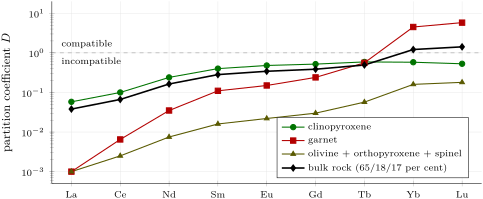
Because the rare earths differ smoothly in radius and nothing else, they fractionate smoothly: the light ones, lanthanum to samarium, are the least compatible; the heavy ones, gadolinium to lutetium, fit better into some minerals, above all garnet (figure below). In a rock with garnet, the heavy rare earths become compatible: a melt of such a rock is rich in light rare earths and poor in heavy ones.
3.5 Normalised diagrams
The abundances of neighbouring elements differ by large factors because of the nuclear history of matter: elements of even atomic number are more abundant than their odd neighbours, as the CI column of the rare earths shows (lanthanum 0.232, cerium 0.621, praseodymium 0.0928 ppm). Plotted raw, a rock’s rare earths form a saw-tooth that hides its geological history. Dividing by a reference removes it.
Definition 3.12 (Normalised diagram)
A normalised diagram plots, for a series of elements in a fixed order, the concentration in a sample divided by that in a reference, , on a logarithmic scale. The rare earths are normalised to CI chondrites in the order of atomic number; a longer set of incompatible elements, often called a spider diagram, is normalised to the primitive mantle and ordered by decreasing incompatibility in mantle melting.
A sample with the same proportions as the reference plots as a horizontal line; its height gives the enrichment. A slope shows a fractionation between light and heavy elements, measured by a ratio such as . A single element off the line is an anomaly.
Proposition 3.13 (Europium anomaly)
On a normalised diagram where the pattern is a straight line in between samarium and gadolinium, the value expected for europium, which lies midway, is . The europium anomaly is : below 1 it is negative, above 1 positive.
Proof. Samarium, europium and gadolinium are consecutive at equal steps along the axis. A straight line in takes at the middle point the mean of the end values: , the logarithm of the geometric mean. ∎
Europium is the one rare earth that can be divalent. has nearly the radius of and , so plagioclase feldspar takes it in where it rejects the trivalent rare earths. A melt from which plagioclase has crystallised has a negative anomaly; the plagioclase-rich rock left behind, a positive one.
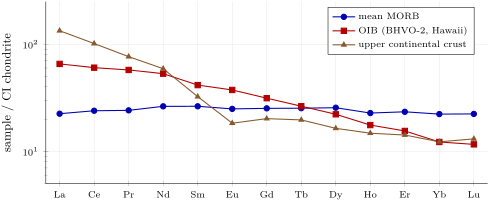
The three patterns of the figure above read as three histories. The mean MORB lies about 25 times above chondrite, nearly flat, with : its mantle source had already lost some of its most incompatible elements to earlier melts, the continental crust among them. The Hawaiian basalt is enriched in the light rare earths, , and its heavy rare earths are lower than those of MORB: it came from a smaller degree of melting, in which garnet was left behind holding the heavy ones. The upper continental crust is enriched more than a hundred times in lanthanum, with and : it is the product of repeated melting, and its europium deficit is consistent with plagioclase left behind in the deep crust.
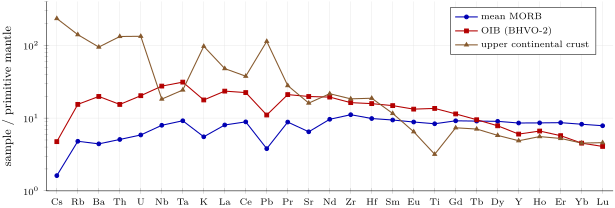
The spider diagram above sharpens the contrast. In the continental crust, niobium and tantalum stand far below their neighbours thorium and lanthanum, titanium below its neighbours, and lead well above: . In the Hawaiian basalt the same ratio is 1.17, and in the mean MORB it is 0.99. The crust’s pattern is the signature of melts above subduction zones, where fluids carried the LILE and lead into the mantle wedge and left the HFSE behind (later chapters); ocean island basalts lack it. A single sample’s spider diagram can therefore tell an arc lava from an ocean island lava, or reveal a basalt contaminated by continental crust (Exercise 3.11).
In the lab — From a rock to a list of trace elements

A geochemist who wants the trace elements of a basalt starts from a few hundred grams of its freshest interior, free of weathered rind and veins. The rock is crushed, then ground to a fine powder in a mill whose material will not contaminate the elements of interest. A small portion of the powder is brought into solution with acids, or fused with a flux, and the solution is analysed by mass spectrometry with an inductively coupled plasma, which measures most of the elements of the spider diagram at once. With every batch of samples the laboratory analyses reference materials of known composition, such as the Hawaiian basalt BHVO-2: its values come from a study that combined the means of many laboratories, 132 of them for lanthanum, and some of them, such as the neodymium and samarium values, by isotope dilution, which counts the atoms of an element against a known added amount of one of its isotopes. If the laboratory’s result for the reference material lies within the uncertainty of the accepted value, the results of the unknown samples are accepted with it.
3.6 Exercises
Exercise 3.1 ★
The basalt BHVO-2 holds 0.5130 per cent and 2.731 per cent by mass. With the atomic masses K 39.10, Ti 47.87 and O 16.00, compute its potassium and titanium contents in ppm.
Solution
Solution of Exercise 3.1.
Potassium is of the mass of , so of K. Titanium is of : of Ti.
Exercise 3.2 ★
In the bulk silicate Earth, the ratios divided by the CI ratios are 1.16 for aluminium, 0.22 for sodium, 0.077 for nickel and 0.0029 for iridium. The condensation temperatures of these elements are 1653, 958, 1353 and . Give the Goldschmidt class of each element and explain each depletion.
Solution
Solution of Exercise 3.2.
Aluminium is lithophile and refractory: the silicate Earth kept all of it, in near chondritic proportions (1.16). Sodium is lithophile but volatile (): it was lost before or during accretion, leaving 0.22. Nickel condenses with magnesium (), so volatility cannot explain 0.077: it is siderophile, and most of it went into the core. Iridium is refractory () and strongly siderophile: 0.0029, nearly all of it in the core.
Exercise 3.3 ★
The upper continental crust holds of lanthanum and of ytterbium; CI chondrites 0.232 and . Compute the chondrite-normalised values and . What does the ratio say about the crust?
Solution
Solution of Exercise 3.3.
, , and . The crust is enriched in all the rare earths, and eleven times more in the light ones than in the heavy ones: it is made of melts, which take the incompatible light rare earths most readily.
Exercise 3.4 ★
The upper continental crust holds 4.7, 1.0 and of samarium, europium and gadolinium; CI chondrites 0.145, 0.0546 and . Compute . Which mineral explains the result?
Solution
Solution of Exercise 3.4.
, , ; and , a negative anomaly. Plagioclase, which takes in , crystallised from the melts that built the upper crust and stayed deeper down.
Exercise 3.5 ★★
A garnet pyroxenite is made of 65 per cent clinopyroxene, 18 per cent garnet and 17 per cent olivine, orthopyroxene and spinel. The partition coefficients of lanthanum are 0.058, 0.001 and 0.001, those of lutetium 0.53, 5.8 and 0.18. Compute the bulk coefficients. Which element is compatible in the rock? Which mineral holds most of the rock’s lutetium?
Solution
Solution of Exercise 3.5.
; . Lutetium is compatible (), lanthanum strongly incompatible. Garnet carries per cent of the rock’s lutetium, though it is only 18 per cent of the rock.
Exercise 3.6 ★★
The bulk silicate Earth holds 22.8 per cent magnesium, of sodium and of nickel; CI chondrites 9.587 per cent, and . Compute the Mg-normalised ratios to CI for sodium and nickel. Both elements condense near or above; why is nickel the more depleted?
Solution
Solution of Exercise 3.6.
For sodium, the silicate Earth’s Na/Mg is and the CI value : the ratio is 0.224. For nickel, against : 0.0775. Sodium is depleted by its volatility (); nickel condenses above and is three times more depleted than sodium because it is siderophile: the core took most of it.
Exercise 3.7 ★★
A clinopyroxene crystallises from a melt with the composition of the mean MORB, of lanthanum and of lutetium. Its partition coefficients are 0.058 for lanthanum and 0.53 for lutetium. Compute its lanthanum and lutetium contents, and the ratio of in the crystal to that in the melt (CI: La 0.232, Lu ).
Solution
Solution of Exercise 3.7.
La: ; Lu: . The normalising values cancel in the ratio of ratios: : the crystal’s pattern is nine times steeper towards the heavy rare earths than the melt’s.
Exercise 3.8 ★★
Normalised to the primitive mantle (Nb , La ), compute for the upper continental crust (Nb 12, La ), the Hawaiian basalt (18.10, ) and the mean MORB (5.24, ). Which of them carries the signature of subduction zones?
Solution
Solution of Exercise 3.8.
Crust: . Hawaiian basalt: . MORB: . Only the crust, with a strong deficit of niobium, carries the subduction-zone signature.
Exercise 3.9 ★★
Potassium and uranium are both highly incompatible. Compute the mass ratio K/U in the primitive mantle (K , U ), in the mean MORB ( , U ) and in the upper continental crust ( , U ), using by mass. What does the near-constancy of the ratio mean, and why is K/U useful to estimate the potassium of a planet?
Solution
Solution of Exercise 3.9.
Primitive mantle: . MORB: K , K/U . Crust: K , K/U . Potassium rises a hundredfold from mantle to crust, yet K/U changes by less than a third: the two elements are about equally incompatible, and melting hardly separates them. Uranium is refractory, so its abundance follows from the chondritic model; K/U measured on lavas then gives the planet’s potassium, which, being volatile, cannot be taken from chondrites.
Exercise 3.10 ★★★
A small amount of melt is in equilibrium with the garnet pyroxenite of exercise 5. Show that, for two elements, the ratio equals . Compute it for lanthanum and lutetium, and explain why the melts of garnet-bearing mantle have steep rare earth patterns.
Solution
Solution of Exercise 3.10.
At equilibrium for each element (and a small melt fraction leaves the rock’s composition nearly unchanged), so for the rock’s , and the ratio is . For La and Lu: . The melt of a garnet-bearing mantle is 37 times richer in La relative to Lu than its source: garnet held back the heavy rare earths, and the melt’s pattern is steep.
Exercise 3.11 ★★★
A mean MORB (Th , Nb ) assimilates upper continental crust (Th , Nb ): a mass fraction of crust mixes with of basalt. Show that the concentrations of the mixture are linear in but that its ratio Th/Nb is not. Find for which Th/Nb reaches 0.2, and the ratio for .
Solution
Solution of Exercise 3.11.
for each element: linear in . The ratio is a quotient of two linear functions, a hyperbola in . Th/Nb when , that is , : about 7 per cent of crust raises Th/Nb from 0.077 to 0.2. For : Th , Nb , Th/Nb .
Exercise 3.12 ★★★
Removing water, carbon or a metal core that contains neither aluminium nor magnesium does not change the ratio Al/Mg of the rest: show it. In the bulk silicate Earth, is 1.16 times the CI value. If the Earth kept all its aluminium, what fraction of its chondritic magnesium is missing from the silicate Earth? With the Mg-normalised ratio of silicon, 0.83, what fraction of its chondritic silicon would be missing on the same assumption?
Solution
Solution of Exercise 3.12.
Removing a component that holds neither element leaves both masses, hence their ratio, unchanged. If all the aluminium was kept, times CI means that the silicate Earth holds of its chondritic magnesium: 14 per cent is missing. Silicon relative to aluminium is times the CI value: 28 per cent of the chondritic silicon would be missing.
3.7 Problem: Weighing the core with a chondrite
Problem 3.1
Weekend problem — reconstructing the bulk Earth from CI chondrites, the mantle and the core, and weighing the core
A planetary geochemist wants to weigh the Earth’s core without seismology, from chemistry alone. She takes CI chondrites as the starting material (Mg , Al 8500, Si , Fe , Ni ), the primitive mantle for the silicate Earth (MgO 37.8, FeO 8.05, NiO 0.25 per cent; Mg 22.8, Si 21.0 per cent), and a model core of 85.5 per cent Fe, 5.2 per cent Ni and 6.0 per cent Si. Atomic masses: Mg 24.31, Si 28.09, Fe 55.85, Ni 58.69, O 16.00. Mass of the Earth .
Part I — The chondritic starting point.
- Compute the mass ratios Fe/Mg, Ni/Mg, Si/Mg and Al/Mg of CI chondrites.
- Convert Fe/Si to an atomic ratio. Spectroscopy of the solar photosphere gives 0.81 iron atom per silicon atom: is the comparison sensible?
- CI chondrites hold 2.1 per cent hydrogen and 3.5 per cent carbon, bound in water-bearing minerals and organic compounds that the Earth did not keep. Why do the ratios of question 1 not need correcting for this loss?
- Why is magnesium a suitable reference element for the core problem, and why could iron not serve?
- Nickel, magnesium, iron and silicon condense within of one another (1353, 1336, 1334 and ). Why does this support the assumption that the bulk Earth kept their chondritic ratios? Which ratio of question 1 departs from this group, and what does the chapter say about it?
Part II — The silicate Earth.
- Convert the FeO and NiO of the primitive mantle into Fe and Ni.
- Compute Fe/Mg and Ni/Mg in the silicate Earth.
- What fraction of the chondritic Fe and Ni is missing from the silicate Earth, at constant magnesium?
- The same calculation for iridium (primitive mantle , CI ) gives a missing fraction of 99.7 per cent. Why is it larger than for nickel, and nickel’s than for iron?
- Where is iron in the silicate Earth, and why did all of it not go to the core?
Part III — Weighing the core.
- Write the iron balance of the Earth with the core mass fraction , and derive Proposition 3.5.
- Compute and from iron.
- Do the same from nickel.
- The two estimates do not agree exactly. Combine them by least squares: minimise , where are the two equations of questions 12 and 13, and give the best and .
- Why does the least-squares value lie so close to the iron estimate?
- From the two equations, compute the Fe/Ni ratio of the core that would make both exact. Compare with the model core.
- Give the mass of the core.
Part IV — Checks and consequences.
- Seismology gives a core of 32.5 per cent of the Earth’s mass. By how many per cent does the chemical estimate differ?
- With a core of 32.5 per cent, how much iron would the core need to hold to close the iron balance? Is this compatible with a core that is 10 per cent light elements?
- The model core holds 9.3 per cent of elements other than Fe and Ni. Which light elements are candidates, and what evidence in the chapter supports silicon?
- Compute, with of question 14, the silicon content of the core that would make the bulk Earth’s Si/Mg chondritic.
- Compare with the model’s 6 per cent. Suggest a reason, from the previous chapter, why some silicon might be missing from the Earth altogether.
- The model core holds of gold, the primitive mantle . With a core of 32.5 per cent, what fraction of the Earth’s gold is in the core?
- State the core mass fraction of the Earth obtained from chemistry alone, the key number of this problem.
Solution
Solution of Problem 3.1.
1. Fe/Mg ; Ni/Mg ; Si/Mg ; Al/Mg .
2. iron atom per silicon atom, within 7 per cent of the photosphere’s 0.81: sensible, since CI chondrites match the Sun for the rock-forming elements.
3. The loss of a component that holds neither element of a ratio leaves the ratio unchanged (Exercise 3.12): only the absolute concentrations change.
4. Magnesium is lithophile and does not enter the core; it is a major element, well determined in both the chondrites and the mantle. Iron is the element being shared between core and mantle: it cannot be its own reference.
5. Elements that condense together were not separated by volatility in the nebula, so the bulk Earth should keep their ratios. Al/Mg departs: aluminium is refractory (), and the silicate Earth’s Al/Mg is 1.16 times the CI value.
6. Fe per cent; Ni per cent.
7. Fe/Mg ; Ni/Mg .
8. Iron: , 85.6 per cent missing; nickel: , 92.3 per cent.
9. Iridium is more strongly siderophile than nickel, and nickel than iron: the more an element prefers metal, the more of it the metal took to the core.
10. In the silicates, as in olivine and pyroxene (8 per cent FeO): iron oxidised to FeO bonds with oxygen like a lithophile element and stayed in the mantle; only the metallic iron sank.
11. ; dividing by gives the proposition.
12. ; , .
13. ; , .
14. , .
15. Each equation weighs as the square of its coefficient: times more for iron, the far more abundant element.
16. , against in the model: 3 per cent apart.
17. .
18. per cent lower.
19. , Fe in the core per cent, and Ni per cent: 18 per cent light elements, about twice the 5 to 10 per cent allowed by the density. The Earth’s Fe/Mg must be somewhat higher than the CI value, or its silicate magnesium higher than the model’s.
20. Silicon, sulfur, carbon, oxygen and hydrogen. Silicon is short in the silicate Earth: its Mg-normalised ratio, 0.83, is below the refractory level.
21. ; per cent Si in the core.
22. 9.9 against 6 per cent: the core may hold more silicon than the model, or part of the silicon was never accreted. Silicon condenses at , a little below magnesium and iron (1336 and ): some may have stayed in the gas.
23. Core: of the Earth’s mass; silicate Earth: . The core holds per cent of the gold.
24. Chemistry alone puts of the Earth’s mass in its core, within 7 per cent of the seismological 32.5 per cent.
এই অধ্যায়ে সংজ্ঞায়িত পরিভাষা-শব্দ
- Bulk silicate Earth, primitive mantle
- CI chondrite
- Goldschmidt classification
- Large-ion lithophile and high-field-strength elements
- Mid-ocean ridge basalt, ocean island basalt
- Mineral–melt partition coefficient; compatible and incompatible elements
- Normalised diagram
- Rare earth elements
- Refractory and volatile elements
- Trace element