University Earth and Space Sciences — Year 2 · Bachelor Year 2
20Fossils and Palaeoenvironments
On a slab of grey sandstone lie three clues: the trail a trilobite ploughed through the mud, the ripples a current left behind, and a burrow that a worm dug and abandoned. None of them is a whole animal, and yet together they say that this hillside was once the floor of a sea, shallow enough for waves to stir it, salty enough for trilobites to live in it. Fossils are the remains and the traces of past life, and geologists read them twice: as clocks that date the rock, and as witnesses of the place where it formed. This chapter follows a living thing from its death to the collector’s drawer, opens the rare deposits where even soft bodies survive, and then reads the environment of a vanished sea, with numbers, in the cover of the Varden Hills.
You already know
From the school volumes: fossil, mould, cast and trace fossil; how burial and minerals turn a shell to stone; the succession of fossils through time. From the Year 1 volume: sedimentary facies and depositional environments, turbidites, reefs and ooids; biozones, index fossils and first appearance datums; compaction, decompaction, Athy’s law and the solid thickness of a layer; cement; accommodation. From earlier chapters: transgressions and regressions, the long-term sea level and the oceanic anoxic events (Chapter 19). How species evolve, and how animals and plants are classified, belong to the biology books.
20.1 From death to fossil
Most living things leave nothing behind. Bacteria and scavengers consume the soft parts within days or years, currents break and scatter the hard ones, and the acids of soils and pore waters dissolve what is left. A fossil is what survives all of these, and survives again the burial, the heating and the uplift of the rock that holds it.
Definition 20.1 (Taphonomy; preservation potential)
Taphonomy is the study of what happens to the remains of an organism from its death to its discovery as a fossil: decay, scavenging, transport, burial, and the chemical changes of diagenesis. The preservation potential of an organism, or of one of its parts, is the probability that it passes through these stages and survives in the rock.
Every stage removes something, adds something, or changes something. Decay and scavenging remove soft tissues; minerals from the pore water fill the pores of a bone or replace the aragonite of a shell, adding matter that the animal never had; heating alters the organic molecules that remain. Loron sorts all these post-mortem changes into three kinds, gain, loss and alteration, and writes them as one equation for the change of any measurable feature between an organism and its fossil. The figure below follows the stages and what each takes away.

The school volumes called a fossil any remains or trace of past life kept in rock. The two kinds behave so differently in the rock that they deserve their own names.
Definition 20.2 (Body fossil; trace fossil)
A body fossil is part of the body of an organism, or the mould or cast of that part: a shell, a bone, a tooth, a leaf, and in rare deposits a soft tissue. A trace fossil is a structure that an organism made by its activity in or on a sediment or a rock: a track, a trail, a burrow, a boring, a feeding pattern.
A trace fossil is part of the sediment it was dug in: a current that moved it would destroy it. It therefore records the conditions of the very place where its maker lived, which a shell, easily rolled along the floor, does not always do. Trace fossils are named like organisms, with a genus and a species, but the name describes the structure, not the animal: the same burrow can be dug by several kinds of animal, and one animal can leave several kinds of trace.
Burial against destruction
The race between burial and destruction can be put into a simple model. Remains lying on the floor are destroyed at a constant rate , the probability per unit time that they are eaten, broken up or dissolved; they are safe once a thickness of sediment covers them; and the sediment accumulates at the rate .
Proposition 20.3 (Burial before destruction)
Under these assumptions, the probability that a remain reaches safety is
It depends on the three quantities only through the ratio of the time to burial, , to the mean survival time on the floor, .
Proof. The remain needs the time to be covered by the thickness . With a constant rate of destruction , the probability of surviving to the time obeys , , so that ; at this is . ∎
Example 20.4 (A shell on a quiet floor)
Suppose a shell survives on the floor for 20 years on average, , and is safe under of mud. At the time to burial is 100 years and : fewer than one shell in a hundred survives. At , . A storm that dumps of sand in a day buries everything at once, and then is close to one. The numbers are assumed, but the lesson is not: fossils gather where sediment arrives fast or in sudden beds.
The model also shows why the record is biased. A soft-bodied worm, whose mean survival time on the floor is days rather than decades, has a value of hundreds of times larger than a thick shell, and so an exponentially smaller chance. The bulk of the fossil record is made of animals with shells and of microscopic remains. Tyler and Kowalewski tested how much a community loses on its way into the rock. At 51 sites of a coastal sea floor they counted 135 living species of invertebrates, 150 species among the shells and skeletons lying dead on the floor, and 112 that also have a fossil record. The dead outnumber the living because the shells on the floor gathered over many years, from animals that no longer live there. Detritivores and carnivores, mostly soft-bodied, are the least likely to be preserved; yet the main ecological groups of the living community were all found again among the dead.
20.2 Windows of exceptional preservation
Definition 20.5 (Lagerstätte)
A Lagerstätte (plural Lagerstätten) is a sedimentary deposit that preserves fossils of exceptional quality, in particular the soft, non-biomineralised tissues that decay destroys almost everywhere else; such a deposit is also called a Konservat-Lagerstätte.
Lagerstätten are rare, but much of what is known of soft-bodied animals comes from them, and the first great radiation of animals, in the Cambrian, is best understood from them.
The Burgess Shale
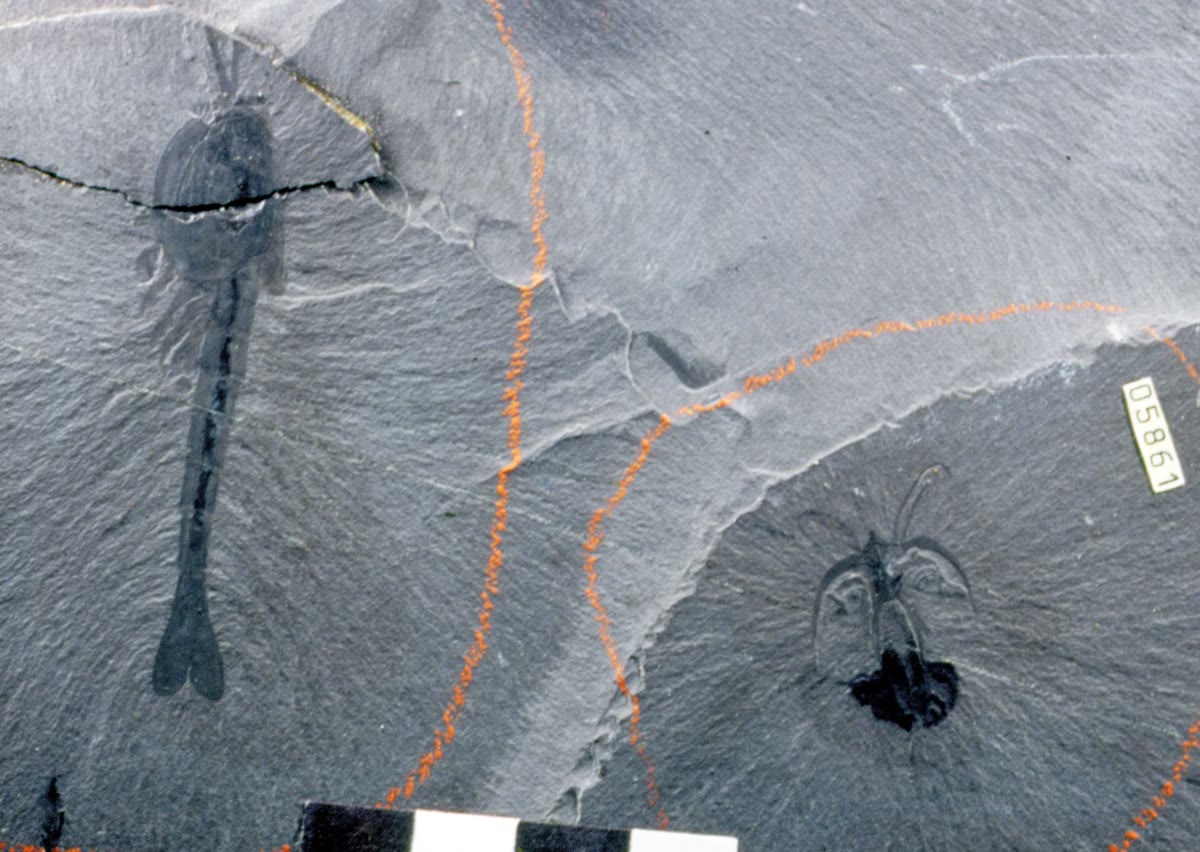
In 1909 Charles Walcott sketched in his field book a small arthropod he had found in the Burgess Shale of British Columbia. He later collected hundreds of specimens of it, Waptia, from a single interval about thick, the Phyllopod Bed; its modern description rests on more than 1800 specimens kept in two museums. The Burgess Shale, about 508 million years old, was laid down in deeper water, facing a steep submarine escarpment. Its fossils include animals without shells, preserved as flattened films of carbon, often whole bodies. Such preservation is tied to burial in oxygen-poor muds that animals did not burrow and currents did not rework: the losses of the figure above were stopped at once.
Solnhofen
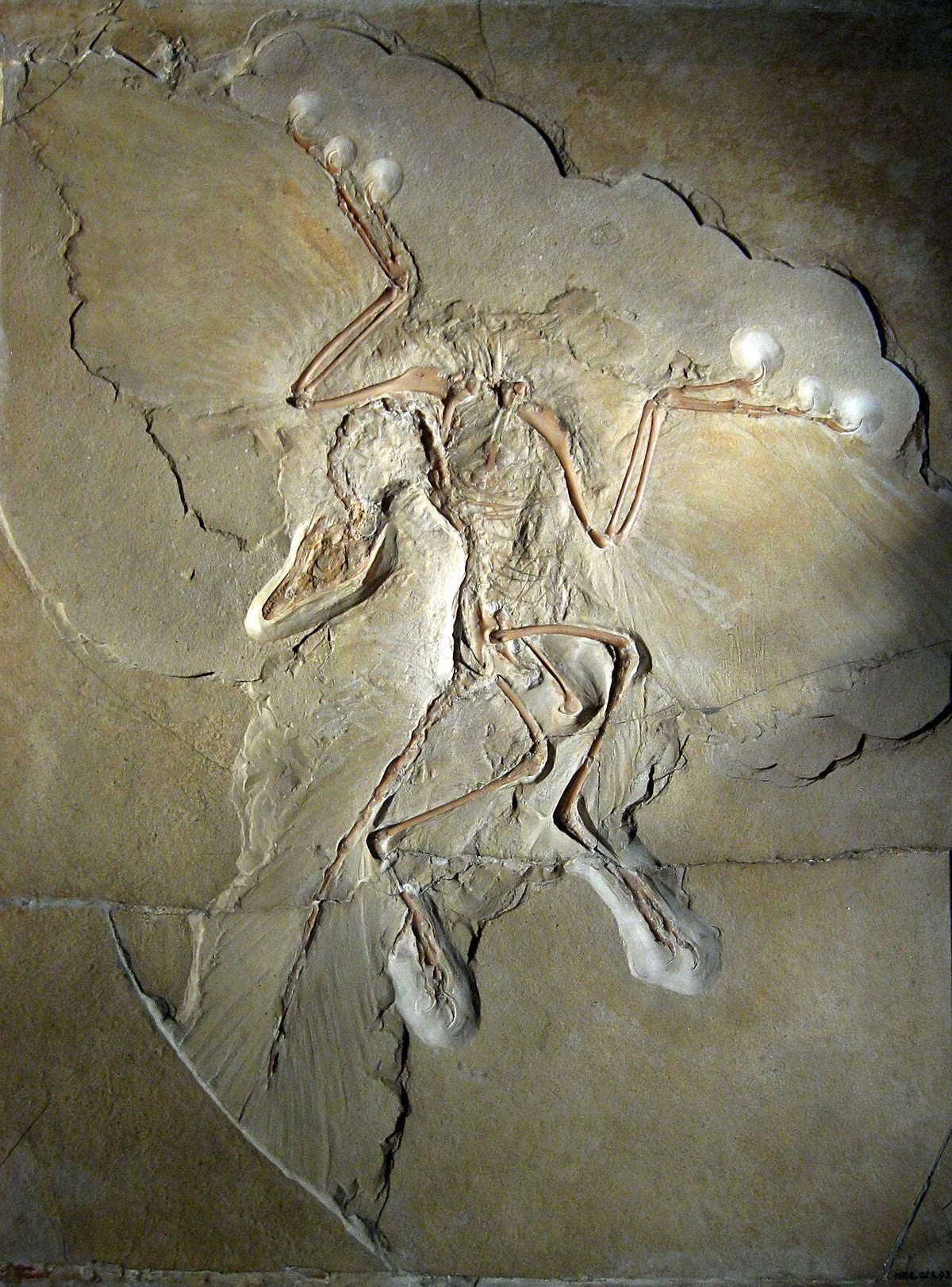
The fine-grained limestones of Solnhofen and Eichstätt, in Bavaria, were laid down in lagoons early in the Tithonian, the last age of the Jurassic, which began ago. They are the type locality of twelve specimens of Archaeopteryx, of many pterosaurs and of fish whose soft tissues and even colour patterns survive. Fossils there are rare, but their preservation is outstanding. Several conditions have been proposed, perhaps acting together: bottom waters about three times saltier than sea water or very alkaline, which slow bacterial decay; mats of bacteria that sealed the carcasses; oxygen-free bottom water, which kept scavengers away; and storms that stirred up the lime mud and buried the carcasses quickly. Each of them lengthens the survival time or shortens the time to burial .
Fossils as clocks
The Year 1 volume built the biozone, a body of strata defined by its fossils, and the index fossil that recognises it. How fine a clock do they make? A Jurassic ammonite zone can last about a million years: the earliest Toarcian zone, dated with uranium–lead ages of ash beds in Argentina, spans 183.73 to . Zones are divided into horizons, and in the Late Jurassic an ammonite horizon lasts on average . All the skeletons of Archaeopteryx come from a single zone that holds five horizons, so the bird is known over some 0.7 to 1 million years. The fossils, however, give only an order; the ages in years come from ash beds dated by uranium and lead, and from sedimentary cycles. The same ash beds put the base of the Toarcian at , with an uncertainty of and , where the international chart gives .
20.3 Fossils as witnesses of environment
To read an environment in a fossil, a geologist assumes that the organism lived where its living relatives live, and that the processes that act on sediment today acted in the same way then.
Definition 20.6 (Actualism)
Actualism is the method of interpreting past geological records by the processes, and the relations between organisms and their environment, that can be observed today.
In 1830 Charles Lyell gave the first volume of his Principles of Geology the subtitle “an attempt to explain the former changes of the Earth’s surface, by reference to causes now in operation”. The method has limits. Many groups are extinct, and their way of life must be inferred from their shape and from the sediment around them; and an environment of the past may have no exact counterpart today.
Definition 20.7 (Palaeoenvironment)
A palaeoenvironment is the set of physical, chemical and biological conditions that prevailed where and when a rock formed: the setting, the depth and energy of the water, its salinity, temperature and oxygen, the nature of the floor, and the life on it.
Where did the fossil live?
The first question is whether the fossils lived where they lie.
Definition 20.8 (Life and death assemblages; autochthonous and allochthonous fossils)
A life assemblage is a group of fossils of organisms that lived together, preserved where and as they lived; a death assemblage is a group of remains brought together after death, which may mix organisms of different places and different times. A fossil is autochthonous if it is preserved where the organism lived, and allochthonous if it was transported from elsewhere before burial.
The clues are those of transport. Shells still closed, a coral or a burrowing bivalve in its growth position, delicate spines intact, all ages of a population present: the fossils are probably autochthonous. Single valves sorted by size, worn and broken fragments, shells concentrated at the base of a graded bed: they were carried. A death assemblage of shells, like the one on the coastal floor above, still holds most of the community, but it gathers many years of it into one layer: its fossils are averaged over time.
Salinity and oxygen
Some animals tolerate only the salinity of the open sea: they are called stenohaline. Echinoderms, cephalopods, corals and, in the Palaeozoic, trilobites are typical stenohaline groups; their presence speaks for normal sea water, and their absence from a rich fauna can speak against it. The deposits of a Silurian estuary in Vietnam hold plant debris, fish bones, bivalves, gastropods and ostracods, but none of these groups. Echinoderms are also missing from the Chengjiang biota, a Lagerstätte about 518 million years old, although they occur in open-marine Lagerstätten of the Cambrian: the Chengjiang animals lived off a delta, where fresh water made the salinity fluctuate.
Oxygen leaves its mark through the burrowers. Where the bottom water has oxygen, animals mix the sediment and destroy its fine lamination; where it has none, the laminae survive, burrows are absent and pyrite forms, as in the black shales of the oceanic anoxic events of Chapter 19. The same lack of burrowers protected the carcasses of the Burgess Shale.
Ichnofacies
Trace fossils are the best witnesses of the floor, because they were not moved. Their makers respond to the energy of the water, the firmness of the floor, the food and the oxygen, and the same associations of traces recur through the Phanerozoic.
Definition 20.9 (Ichnofacies)
An ichnofacies is a recurrent association of trace fossils that reflects a set of environmental conditions; it is named after a characteristic trace.
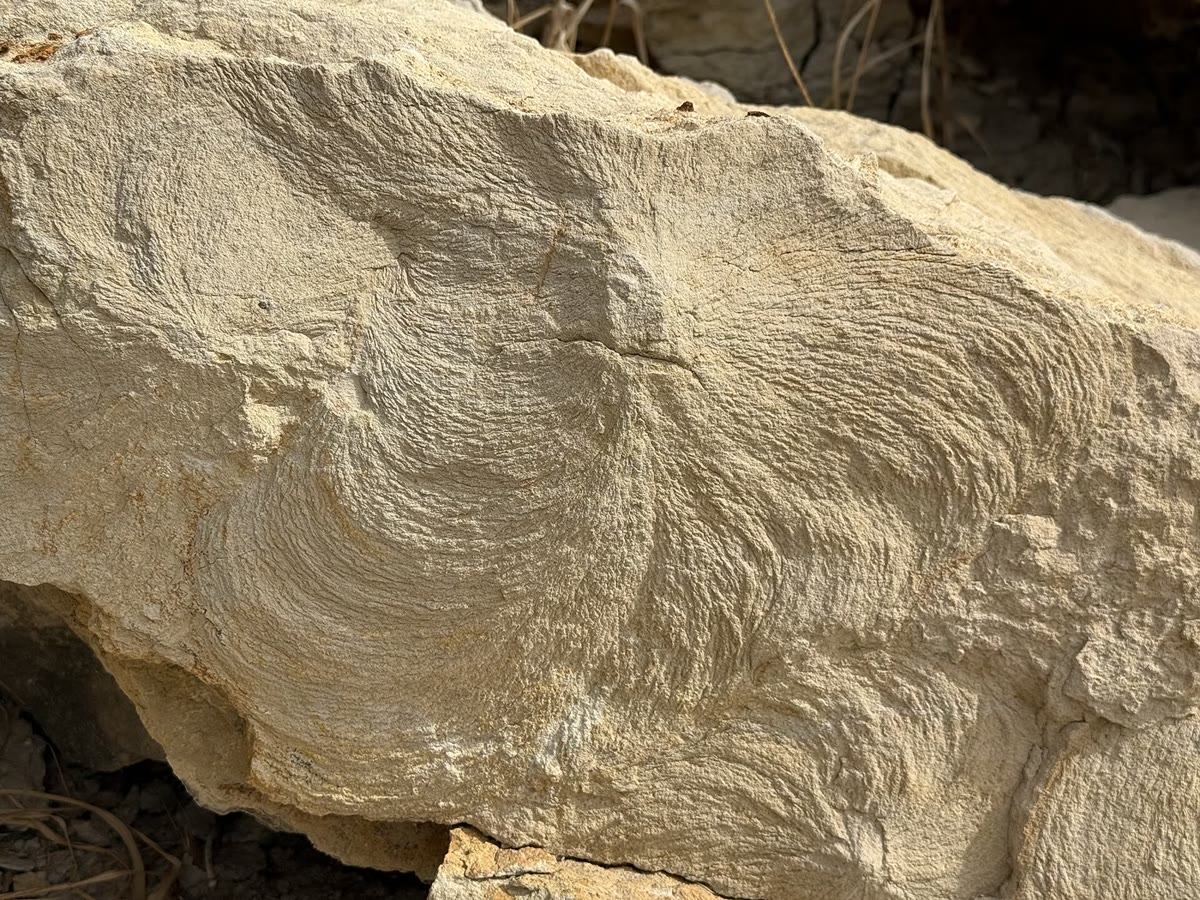
Along a marine profile, from the shore to the deep basin, four marine ichnofacies follow one another (figure below). The Skolithos ichnofacies, dominated by vertical, cylindrical or U-shaped dwelling burrows of suspension feeders, with few horizontal traces, is typical of the foreshore and the shoreface. The Cruziana ichnofacies, dominated by the burrows of deposit feeders, with the traces of grazers, carnivores and suspension feeders, is typical of the offshore: the floor between the fair-weather wave base, the depth above which ordinary waves stir the sediment, and the storm wave base, reached only by storm waves. The Zoophycos ichnofacies, named after a burrow that reworks the sediment in helicoidal sheets around a central axis, is typical of the shelf below the storm wave base and of the slope. The Nereites ichnofacies, with its regular meandering, spiral and network burrows, read as the traps and gardens of animals that found little food, is typical of the deep sea beyond the shelf break. In brackish bays and estuaries a Cruziana ichnofacies of few species is the rule.
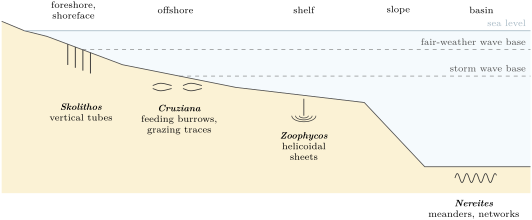
Depth does not act directly. In a deep-sea channel, where turbidity currents are strong, vertical burrows of the Skolithos ichnofacies appear far below any wave base; and near a delta, where fresh water and mud pour in, the offshore traces are poorer than elsewhere. The makers also moved through time: the burrow Zoophycos lived on the shelf in the Palaeozoic, on the lower shelf and the slope in the Mesozoic, and in the deep sea in the Cenozoic. An ichnofacies records the conditions on the floor, from which the depth is only inferred, and the inference must use the age of the rock.
In the field — Counting fossils bed by bed
A palaeontologist who reconstructs an environment from a section logs each bed with its lithology, thickness and sedimentary structures, and then its fossils: which groups, how many, whether shells are whole or broken, closed or open, sorted or not, and in what position they lie. Trace fossils are recorded where they are seen, on the bedding surfaces and in the vertical faces, with the depth to which the burrows reach. Because a shell can be moved but a burrow cannot, the two lists are kept apart; the environment is read from the traces first, and the body fossils are then checked for signs of transport.
20.4 Reading a vanished sea
Environments lie side by side: a beach, an offshore floor, a deeper shelf. When the sea rises or the floor sinks, each environment moves landward over its neighbour, and its deposits come to lie on top of those of the neighbour. A vertical succession of facies, without a break, thus repeats the order of the environments that lay next to each other; the Year 3 volume makes this rule, Walther’s law, its starting point. A log read from the bottom up is a film of the coast moving across one place.
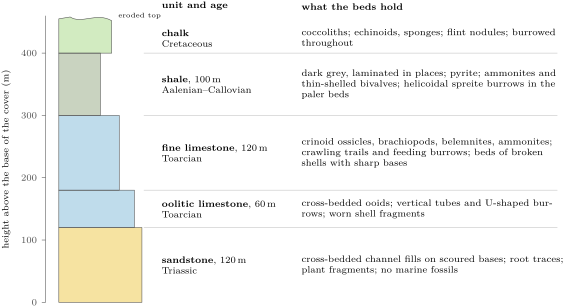
The cover of the Varden Hills, the series’ invented region, makes a complete example. Its thicknesses are those of the region’s model; the fossils of the figure below are invented for it, but each is chosen to be one that real rocks of that kind can hold. The limestone is given the Toarcian, from 184.2 to , and the shale the Aalenian to the Callovian, from to .
Example 20.10 (The base of the Varden cover)
The sandstone holds channel fills on scoured bases, roots and plant fragments, and no marine fossil: it was laid down by rivers on land. The oolitic limestone above has cross-bedded ooids, which grow as they roll in agitated water, vertical tubes and U-shaped burrows of the Skolithos ichnofacies, and worn shell fragments, all allochthonous: a shoal of the shoreface, swept by waves. Between the two the sea arrived: the contact records a marine transgression. In the order of Walther’s law, the river plain was followed by the shore, then the shoal.
How fast did the sea floor fill?
A biozone gives a duration, a log gives a thickness, and their ratio is a rate. But the thickness has shrunk since the sediment was laid down: the water of the pores has been squeezed out, and the grains alone are conserved.
Proposition 20.11 (Accumulation rate of a compacted layer)
A layer of present thickness and mean porosity , laid down over the time with the porosity , accumulated at the rate
of fresh sediment, and at the rate of grains, which does not depend on .
Proof. Per unit area, the layer holds the volume of grains , the solid thickness of the Year 1 volume. Compaction drives out water but neither adds nor removes grains, so the fresh sediment, of porosity , had the thickness with . Dividing and the solid thickness by gives the two rates. ∎
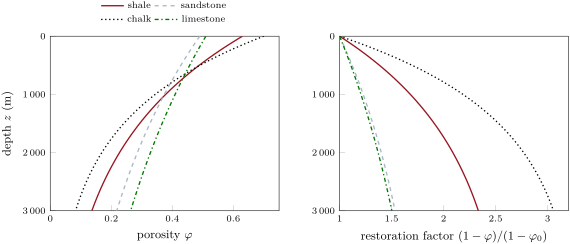
When the porosity was not measured, Athy’s law gives it from the depth. The figure below shows the law for four lithologies, and the factor by which a thin layer now at the depth must be stretched to give its thickness at the surface. Chalk and shale start with much water and lose it fast: a thin layer of shale at was 1.68 times thicker when it was laid down, a layer of chalk 2.19 times.
Example 20.12 (The Varden shale)
In the syncline of the Varden Hills the chalk is thick, so the shale lies between 766 and . With the constants of shale, and , the solid thickness of the Year 1 volume is , a mean porosity of 0.416. Brought back to the surface with the same grains, the layer is thick. Over the from the base of the Aalenian to the top of the Callovian, the shale accumulated at per million years as it now stands, at per million years of fresh mud, and at per million years of grains. The present thickness understates the rate by a third.
The shale may once have lain deeper still, under chalk since eroded; the correction is then a minimum. The weekend problem applies the proposition to the limestone, where the porosity was measured.
Exercises
Data for the exercises, unless stated otherwise: Athy’s law with , (shale), , (sandstone), , (chalk), , (limestone); calcite , pore water ; the ages of the international chart: Toarcian 184.2 to .
Exercise 20.1 ★
At 51 sites of a coastal floor, 135 species of invertebrates were found alive, 150 among the dead shells and skeletons on the floor, and 112 that also have a fossil record. (a) Express the third number as a fraction of each of the first two. (b) How can the dead outnumber the living? (c) Which feeding groups would you expect to be under-represented among the dead, and why?
Solution
Solution of Exercise 20.1.
(a) and . (b) The dead shells on the floor gather over years or more: they include species that lived there earlier, or rarely, or were carried in, so the death assemblage averages many generations of the community. (c) Soft-bodied groups, in particular detritivores and carnivores such as worms: without a skeleton they decay before burial.
Exercise 20.2 ★
A Late Jurassic ammonite horizon lasts on average . (a) How long do five horizons last? Compare with the 0.7 to 1 million years given for Archaeopteryx. (b) The earliest Toarcian zone spans 183.73 to : how many horizons of average length would it hold? (c) Why do horizons, not zones, matter for following the evolution of a lineage?
Solution
Solution of Exercise 20.2.
(a) , about , within the 0.7 to 1 million years. (b) , and : about six horizons. (c) A lineage changes within much less than a million years; only horizons separate the successive forms, while a zone lumps them together.
Exercise 20.3 ★
Name the ichnofacies and the setting of each suite. (a) Meandering grazing trails and regular burrow networks on the soles of thin turbidites. (b) Closely spaced vertical tubes in clean, cross-bedded sand. (c) Abundant horizontal burrows of deposit feeders and grazing traces in silty beds between storm sands. (d) Helicoidal spreite burrows in a fine, dark mud with no wave ripples, in Mesozoic rocks.
Solution
Solution of Exercise 20.3.
(a) Nereites ichnofacies: the deep-sea floor of a turbidite system, beyond the shelf break, where food is scarce. (b) Skolithos ichnofacies: foreshore or shoreface. (c) Cruziana ichnofacies: offshore, between the fair-weather and the storm wave bases. (d) Zoophycos ichnofacies: in the Mesozoic, the lower shelf or the slope, below the storm wave base.
Exercise 20.4 ★
Bed A holds crinoids, brachiopods, corals and trilobites; bed B, of the same age, holds plant debris, fish bones, a few bivalves and gastropods, and many individuals of only two species of ostracods. (a) What does each say about the salinity of its water? (b) Bed B lacks the groups of bed A: why is that absence an argument, while the absence of one fossil from one bed is not? (c) Which other observations would test the interpretation of bed B?
Solution
Solution of Exercise 20.4.
(a) Bed A holds stenohaline groups: normal sea water. Bed B, poor in species but rich in individuals, with plant debris and none of the stenohaline groups, suggests brackish water, for example an estuary. (b) The missing groups are several, common and well preserved in marine beds of the same age: their joint absence is a pattern, whereas one fossil can be missing by chance or by poor preservation. (c) The sediment (tidal or river channels, mud drapes, roots), the trace fossils (a Cruziana ichnofacies of few species), and the passage of bed B, laterally, into marine or into river deposits.
Exercise 20.5 ★★
Use Proposition 20.3 with the shell of Example 20.4, and . (a) Find the sedimentation rate at which half the shells reach safety. (b) By what factor does change when the rate is halved from that value? (c) A shell twice as thick survives twice as long on the floor. At , how much more likely is it to be preserved? (d) What does this imply for the proportions of thin and thick shells in a fossil assemblage?
Solution
Solution of Exercise 20.5.
(a) when : , a year. (b) Halving doubles the exponent: , half as much. (c) is halved: instead of , times more likely. (d) Thick, robust shells are over-represented, and the more so the slower the burial.
Exercise 20.6 ★★
Ash beds date the base of the Toarcian at Chacay Melehue to , , ; the international chart gives . (a) Is the chart’s value within the uncertainty? By how much does it miss the upper bound? (b) The earliest Toarcian zone ends at : find its duration. (c) Suppose this zone is thick in a section: what is the rate of accumulation? (d) Why can a biozone be the same everywhere in time while its thickness differs from place to place?
Solution
Solution of Exercise 20.6.
(a) The upper bound is : the chart’s lies outside it, by . (b) . (c) per million years. (d) A biozone is defined by fossils, whose appearances and disappearances are close to simultaneous over wide areas; the thickness of rock laid down during that time depends on the local rate of accumulation.
Exercise 20.7 ★★
In the Varden syncline the sandstone lies between 1046 and below the ground. (a) Find its porosity by Athy’s law at the top and at the base, and its mean porosity, rounded to three decimals, from the average of the two. (b) Find its solid thickness. (c) Restore it to the surface with the thin-layer factor at the mean porosity. (d) The exact restoration gives . Why is the thin-layer estimate a little too large?
Solution
Solution of Exercise 20.7.
(a) and ; mean . (b) . (c) . (d) The factor supposes the whole restored layer has the porosity of the surface; but a layer thick at the surface is less porous at its base than at its top, so the same grains fill less than .
Exercise 20.8 ★★
A density log reads in the Varden limestone, made of calcite grains with water in the pores. (a) Show that the porosity is and compute it. (b) At the mid-depth of the limestone in the syncline, , what does Athy’s law predict with the limestone constants? (c) Which process of diagenesis can explain the difference?
Solution
Solution of Exercise 20.8.
(a) A unit volume holds of water and of grains: , which gives the formula; . (b) . (c) Cementation: calcite precipitated in the pores, which carbonates undergo besides compaction, removes far more porosity than burial alone.
Exercise 20.9 ★★
A cliff of Jurassic rocks shows from the base up: thin turbidites with regular meanders and burrow networks; dark mud with helicoidal spreite burrows; silty beds with deposit-feeder burrows between storm sands; clean cross-bedded sand with vertical tubes; then a coal with roots. (a) Interpret each part. (b) Did the water deepen or shallow? (c) Name two causes that could produce this succession, and say what would decide between them. (d) Why is a sharp jump from the first part to the fourth, without the others, a warning?
Solution
Solution of Exercise 20.9.
(a) Deep-sea turbidites (Nereites ichnofacies); a Jurassic floor of the lower shelf or slope (Zoophycos); an offshore floor between the wave bases (Cruziana); a shoreface (Skolithos); a swamp on land. (b) The water shallowed upward: the coast moved seaward. (c) A fall of sea level, or a supply of sediment faster than the subsidence, as in front of a growing delta; a fall would be found at the same time in other basins, a delta would be local and its sediment would come from one side. (d) In a conformable succession neighbouring environments follow each other; a jump over the intermediate ones points to a gap in time or to a fault.
Exercise 20.10 ★★★
A soft-bodied animal survives on the floor for a year on average (), a shell for a century; both are safe under . (a) Compare their chances of preservation at 1, 10 and . (b) Find the rate at which one soft body in a hundred is preserved. (c) Is such a rate plausible for months on end? What kind of deposit buries the floor faster? (d) Which assumption of Proposition 20.3 fails for such a deposit, and how does the formula behave when it fails?
Solution
Solution of Exercise 20.10.
(a) The time to burial is = 100, 10 and . Soft body: , , . Shell (): , , . (b) , a year. (c) Hardly, over months; but a storm bed, a turbidite or an ash fall buries the floor in hours. (d) The constant rate of sedimentation: the time to burial is then much shorter than with the mean rate, and , with the actual time to burial, tends to one when is much less than .
Exercise 20.11 ★★★
(a) Show that the thin-layer factor follows from Proposition 20.11. (b) Apply it at the mid-depth of the Varden shale, , to restore the of shale. (c) Compare with the exact of Example 20.12, and explain the sign of the difference. (d) Show that the rate of grains, unlike the rate of fresh sediment, can be compared between a shale and a limestone without knowing how porous each was when laid down.
Solution
Solution of Exercise 20.11.
(a) A thin layer at the depth holds the grains ; at the surface they fill with . (b) ; , so . (c) too much: as in Exercise 20.7, the restored layer is not uniformly as porous as its surface. (d) The rate of grains, , uses only the present thickness and porosity, both measured.
Exercise 20.12 ★★★
Suppose the Toarcian ammonite horizons last on average, like Late Jurassic ones. (a) How many horizons would the of the Varden limestone hold? (b) What thickness of limestone does one horizon represent today, and what thickness of fresh sediment, given that the layer was thick when laid down? (c) To be sure of finding every horizon, a geologist samples at no more than half that present thickness: what spacing is that, and how many samples? (d) Why might some horizons be missing even so?
Solution
Solution of Exercise 20.12.
(a) horizons. (b) of limestone today, of fresh sediment. (c) At most : intervals, 121 samples. (d) Breaks in deposition, beds where ammonites are absent, and horizons condensed into a few centimetres where the sediment arrived slowly.
Problem 20.1
Weekend problem — The Jurassic sea of the Varden Hills
This problem reads the environment and the history of the Varden cover, with the log of Section 20.4 and the data of the exercises. The cover dips at on the limbs of the folds; in the syncline it is drilled through by a well.
Part I — The rocks and their thickness.
- On level ground on a limb, the limestone crops out over a width of , measured across the strike. Find its true thickness.
- The shale crops out over . Find its thickness.
- Which unit is the oldest, and on what principle?
- In the well, the shale starts at , the limestone at and the sandstone at below the ground. Check the thicknesses.
- The chalk is cut by the ground surface. What can be said of its thickness when the Cretaceous sea withdrew?
- Find the porosity of the chalk at the surface and at the base of the chalk in the well.
Part II — Environments.
- What do the crinoids, brachiopods, belemnites and ammonites of the fine limestone say about its water?
- Which ichnofacies do its traces form, and in which part of the profile?
- What do its beds of broken shells with sharp bases record?
- The shale is dark, laminated in places, with pyrite and few burrows. What does that say about the bottom water?
- Its paler beds hold helicoidal spreite burrows. Which ichnofacies, and which setting?
- Are the ammonites of the shale part of a life assemblage of the floor? Explain.
Part III — Time and rates. The lowest limestone beds hold the ammonites of the first Toarcian zone, the highest those of the last, and the shale begins with the first Aalenian zone.
- How long did the limestone take to accumulate?
- At what rate, as the limestone now stands?
- The density log of the well reads in the limestone. Find its porosity.
- Lime mud is laid down with a porosity of 0.51. Find the thickness of the fresh sediment.
- Find the rate of fresh sediment.
- Find the rate of grains.
- Compare with the shale of Example 20.12. What does the change of rate suggest about the supply of carbonate?
Part IV — The sea over Varden.
- Read the column from the sandstone to the chalk. Did the sea advance or retreat?
- On the long-term curve of Haq and others, global sea level stood about 41, 57 and above today’s at 184, 174 and . By how much did it rise over the limestone, over the shale, and in all?
- Suppose the floor went from of water on the shoal to at the top of the shale. Find the accommodation created from the base of the limestone to the top of the shale, counting the fresh thicknesses of both units, and its mean rate.
- What share of it can the global rise explain? What made the rest?
- To sum up: at what rate did the lime mud of the Varden limestone accumulate when it was laid down?
Solution
Solution of Problem 20.1.
1. . 2. . 3. The sandstone, by superposition: the limbs dip at only , so the beds are not overturned and the lowest is the oldest. 4. and . 5. At least there; its original top is eroded, so its full thickness is unknown. 6. 0.70 at the surface; at . 7. They are stenohaline groups: the water had the salinity of the open sea. 8. A Cruziana ichnofacies: the offshore, between the fair-weather and the storm wave bases. 9. Storms: their waves reached the floor, broke the shells and laid them down in beds with erosive bases. 10. The bottom water was poor in oxygen: few burrowers, laminae kept, pyrite formed. 11. The Zoophycos ichnofacies, in the Mesozoic the lower shelf or the slope, below the storm wave base; enough oxygen at times for burrowers. 12. No: ammonites swam in the water above; their shells sank or drifted to the floor after death and form a death assemblage. 13. . 14. per million years. 15. . 16. . 17. per million years. 18. per million years. 19. The shale gave 11.3 and per million years: the rate of grains fell about four times. The carbonate of the shoal and the shelf stopped arriving as the floor deepened, and only a slow rain of mud reached it. 20. It advanced: rivers, then a shoal, an offshore floor, a floor below the storm wave base, then the open sea of the chalk. The column records a transgression. 21. over the limestone, over the shale, in all. 22. , in : per million years. 23. : about , and less if the cycle chart exaggerates the amplitude. The rest came from the subsidence of the floor. 24. The lime mud of the Varden limestone accumulated at about per million years when it was laid down.