University Earth and Space Sciences — Year 2 · Bachelor Year 2
7Melting the Mantle
The mantle is solid. Seismic shear waves cross it from top to bottom, and the peridotite brought up from it is a crystalline rock. Yet along the ocean ridges alone it gives out some twenty cubic kilometres of new oceanic crust every year, every cubic metre of it made from a melt. The paradox dissolves once one knows that the mantle does not melt because it is heated: it melts because the pressure on it falls, or because water is added to it. Beneath a ridge the mantle rises, its pressure drops faster than its temperature, and it crosses its melting curve; above a sinking slab, water released from the slab lowers that curve under the mantle wedge. In both cases only a small fraction of the rock melts, and that fraction, separated from its residue, becomes the basalt of the ocean floor and of the volcanic arcs. This chapter first describes the mantle rock and the phase diagrams that tell how such rocks melt, then follows the mantle up beneath a ridge to the thickness of the crust it makes.
You already know
From the chemistry books’ Year 2 volume: binary phase diagrams, the solidus and the liquidus, the eutectic point, congruent melting, solid solutions and the lever rule, by which the proportions of two coexisting phases are inversely proportional to their distances from the bulk composition. From the physics books: the specific heat, the latent heat, the entropy and the second law, by which a reversible adiabatic process conserves entropy. From the Year 1 volume: the main rock-forming minerals, olivine, pyroxenes, garnet and spinel, their solid solutions and the Mg number; the mantle adiabat, ; the oceanic crust, thick away from hotspots and about over the core of a plume; subducting slabs and the water they carry. From Chapter 3: mid-ocean ridge basalt (MORB), partition coefficients and incompatible elements.
7.1 The mantle rock
Mantle rock reaches the surface as fragments carried up by magmas, the xenoliths, and as the base of slices of ocean lithosphere pushed onto the continents, the ophiolites. Almost all of it is peridotite.
Definition 7.1 (Peridotite and its kinds)
A peridotite is a coarse-grained ultramafic rock containing more than olivine, the rest being pyroxenes and a little of an aluminous mineral (spinel or garnet). A dunite contains more than olivine. Below that, a lherzolite contains both orthopyroxene and clinopyroxene; a harzburgite contains orthopyroxene but almost no clinopyroxene; a wehrlite contains clinopyroxene but almost no orthopyroxene. Rocks with less than olivine are pyroxenites.
The classification is read on a triangle whose corners are olivine, orthopyroxene and clinopyroxene (the figure below): each point stands for a rock, and its distances from the three sides give the proportions of the three minerals. A model composition of the depleted upper mantle that melts beneath the ridges has olivine, orthopyroxene, clinopyroxene and spinel: a lherzolite.
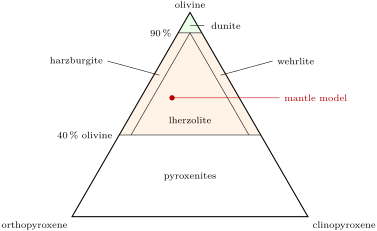
The three peridotites are not three independent rock types: they are stages of one process. Clinopyroxene and the aluminous mineral are used up first when peridotite melts (Section 7.4), so a lherzolite that has lost a melt becomes poorer in them; after enough melting it is a harzburgite, and a rock that has lost almost all its pyroxene is a dunite.
Definition 7.2 (Fertile and residual mantle)
A fertile mantle is a peridotite, typically a lherzolite, that still contains the clinopyroxene and aluminous mineral from which basalt is made. A residual mantle is the peridotite left behind once a melt has been extracted from it: poorer in clinopyroxene, aluminium, calcium and the incompatible elements, richer in olivine and with a higher Mg number.
The isotopic depleted mantle of Chapter 4 is a reservoir, defined by its ratios; a residual mantle is a rock, defined by what it has lost. The two are linked, since the depleted mantle is depleted because melt was extracted from it long ago, but one is read in a mass spectrometer and the other under the microscope.
7.2 Phase diagrams of rocks
A rock is a mixture of minerals, and it melts over a range of temperatures, not at one point. The diagrams that describe this were first measured on mixtures of pure synthetic minerals, by holding a small charge at a known temperature until it reached equilibrium, quenching it, and looking under the microscope for glass, which was liquid, and crystals.
A binary eutectic: diopside and anorthite
A basalt consists essentially of a calcic plagioclase and a clinopyroxene, and Bowen chose pure anorthite and diopside as its simplest model. Mixed and heated, they form an ordinary eutectic system (the figure below): diopside melts at and anorthite at , but a mixture of diopside and anorthite by mass melts completely at .
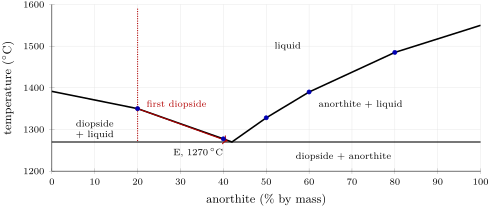
Read from above, the diagram tells the order of crystallisation. A liquid of anorthite begins to crystallise diopside at ; the liquid, losing diopside, grows richer in anorthite and moves down the liquidus until it reaches the eutectic, where anorthite joins diopside and the temperature stays at until all the liquid is gone. Read from below, it tells how the rock melts: whatever the proportions of the two minerals, the first liquid appears at and has the eutectic composition. That is the first lesson for the mantle. The first melt of a rock does not have the rock’s composition: it has the composition fixed by the minerals it melts from, and it appears at a temperature well below the melting points of all of them.
Incongruent melting: forsterite and silica
Some minerals do not melt into a liquid of their own composition.
Definition 7.3 (Incongruent melting, peritectic point)
A mineral shows incongruent melting when, on heating, it breaks down into another solid and a liquid of a different composition, instead of melting into a liquid of its own composition. On a binary phase diagram, the point where that liquid coexists with both solids is a peritectic point: unlike a eutectic, it does not lie between the compositions of the two solids.
Enstatite, the magnesian orthopyroxene , melts incongruently. At atmospheric pressure it breaks down at into forsterite, , and a liquid slightly richer in silica than itself; only at has all the forsterite dissolved (the figure below). Bowen and Andersen found in 1914 that the breakdown gives of forsterite and of liquid, as the lever rule predicts from the three compositions (Exercise 7.6). Further toward silica, enstatite and cristobalite melt together at a eutectic, .
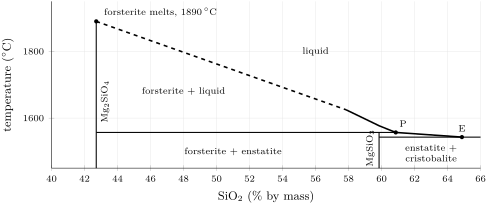
The peritectic is the second lesson for the mantle. When a peridotite melts, its orthopyroxene does not simply dissolve: it gives olivine to the residue and silica to the melt. The melt is therefore richer in silica than the pyroxenes, and the residue richer in olivine than the rock: the path from lherzolite to harzburgite and dunite.
Three components: the ternary diagram
Real rocks have more than two minerals. With three, the composition needs a triangle, and temperature becomes a third dimension.
Definition 7.4 (Ternary phase diagram, cotectic line, ternary eutectic)
A ternary phase diagram represents the equilibria of a system of three components at a given pressure: each point of a triangle stands for a composition, the corners for the pure components, and the liquidus surface is drawn as contours of temperature or as the fields of the minerals that crystallise first. A cotectic line is the line along which the liquid is saturated in two minerals at once and crystallises both as it cools. The cotectic lines descend from the binary eutectics on the sides of the triangle and meet at the ternary eutectic, the lowest temperature at which liquid exists, where the three minerals crystallise together.
Method 7.5 (Reading a crystallisation path on a ternary diagram)
Locate the bulk composition in the triangle and the field in which it lies: that field’s mineral crystallises first. While that mineral alone crystallises, the liquid moves in a straight line directly away from the mineral’s corner, through , because removing a pure component changes only its proportion; by the lever rule the mass fraction of crystals is the distance from to the liquid divided by the distance from the corner to the liquid. When the liquid reaches a cotectic line, the second mineral joins and the liquid follows the cotectic downhill to the ternary eutectic, where the last liquid crystallises. A component that enters none of the crystals stays in the liquid, so its concentration gives the fraction of liquid left: .
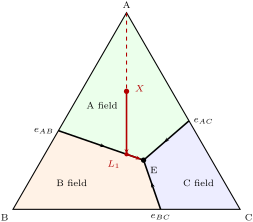
Systems of three rock-forming minerals are read in the same way. The rules that fix how many phases can coexist, and the free-energy surfaces from which such diagrams are computed, belong to the Year 3 volume of this series.
7.3 Solidus, adiabat and three ways to melt
Mantle peridotite has a solidus, the temperature at which its first melt appears, and a liquidus far above it. Both rise with pressure. Experiments on natural peridotites, compiled and fitted by Katz, Spiegelman and Langmuir in 2003, give for the dry solidus
(in degrees Celsius, in gigapascals): at the surface, at . At the same depths the mantle is hotter or colder than this depending on where it is, and to compare mantles one removes the effect of depth.
Definition 7.6 (Mantle potential temperature)
The mantle potential temperature is the temperature that a parcel of convecting mantle would have if it were brought up to the surface along the mantle adiabat, without exchanging heat and without melting.
Along the adiabat , the form in pressure of the gradient recalled above, since . With , and , it is about per gigapascal, a gigapascal being of mantle (Exercise 7.3). The Year 1 volume gave the mantle a potential temperature of about from mineral physics; petrological estimates for the mantle beneath ridges range from 1280 to .
Proposition 7.7 (Onset of decompression melting)
Mantle of potential temperature rising along the adiabat ( constant) begins to melt at the pressure where the adiabat meets the solidus , the smaller root of
A mantle hotter by begins to melt deeper, by .
Proof. At depth the adiabat is colder than the solidus, because the solidus rises more steeply ( against ). The two curves cross where , which rearranges into the quadratic. Differentiating gives . ∎
For the onset is at , about down, at ; every of potential temperature moves it by about , or . The figure below shows the solidus and the adiabats.
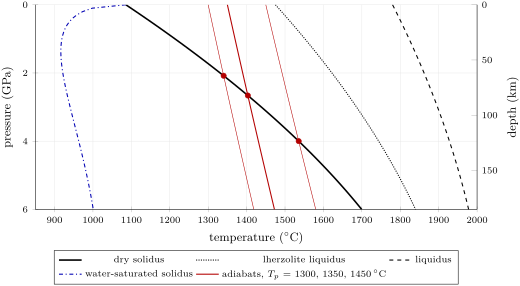
The diagram shows the three ways to bring a rock above its solidus.
Definition 7.8 (Partial, decompression and flux melting)
Partial melting is the melting of a fraction of a rock, between its solidus and its liquidus. Decompression melting is the partial melting of rock that rises, and so loses pressure, faster than it cools, until it crosses its solidus. Flux melting, or hydrous melting, is the partial melting caused by the addition of a volatile, chiefly water, which lowers the solidus below the rock’s temperature. The third way, heating a rock above its solidus at constant pressure, needs an outside source of heat, such as a hot magma.
Heating is the least efficient in the mantle, which conducts heat slowly; in the crust, the heat of basaltic magma can melt the rocks around it (Chapter 12). Decompression feeds the ridges and the hotspots; flux melting feeds the volcanic arcs.
7.4 Decompression melting beneath a ridge
Once the rising mantle crosses its solidus, it keeps rising, and the question becomes how much melt it makes.
Definition 7.9 (Melt fraction)
The melt fraction of a partially molten rock is the mass of melt it has produced divided by its initial mass. Between the solidus () and the liquidus (), the temperature on the melting surface is a function .
Melting takes heat: the latent heat, per kilogram of melt, where is the entropy of melting. A rising parcel exchanges no heat with its surroundings, so the latent heat comes from its own temperature, and it rises along a path of constant entropy that lies between the solidus and the liquidus.
Proposition 7.10 (Isentropic melt productivity)
For mantle rising without exchanging heat, with specific heat , thermal expansivity , density and entropy of melting , the melt productivity, the melt made per unit fall of pressure, is
with in kelvins.
Proof. The specific entropy of the partially molten rock changes by : the first two terms are those of a solid (the second is a Maxwell relation, recalled from the physics books), the third is the entropy gained by the mass that melts. A reversible adiabatic ascent keeps . On the melting surface . Substituting,
which is the result. ∎
The numerator is the excess of the melting curves’ slope over the adiabat’s, the drive; the denominator holds the latent heat and the heat needed to raise the temperature of the melting rock along the melting interval, the brakes. With the parameters of Katz and others, , and a melt fraction that rises linearly between the solidus and the lherzolite liquidus, the productivity at is about per gigapascal (Exercise 7.8): each kilometre of ascent melts about a third of a per cent of the rock. Their fitted melting function, which makes the first per cent of melt come slowly, gives a little less on average, about per gigapascal from the onset to the surface for . The productivity drops when clinopyroxene is used up, after melt fractions of in their model, some 25 to for a mantle with 13 to clinopyroxene: a harzburgite residue melts reluctantly.
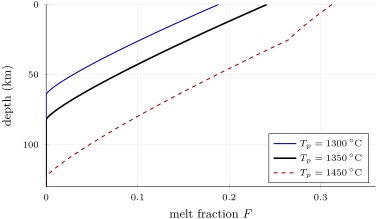
The melt does not stay where it forms. At about it is lighter than the solid peridotite, , so it separates from its residue and rises through it; beneath a ridge it is gathered towards the axis. The crust is built from the melts of a whole region of the mantle.
Proposition 7.11 (Crust of a triangular melting region)
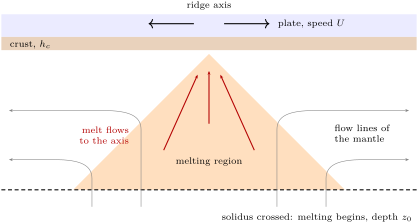
Beneath a ridge spreading at the half-rate , let the mantle rise vertically at the speed through a triangular melting region of height , apex at the top beneath the axis and sides at , and leave it horizontally at the speed across its sides; let the melt fraction grow linearly from at the base to at the apex, all the melt be extracted to the crust, and mantle and crust have the same density. Then the crust is
thick, and the aggregated melt has the mean melt fraction .
Proof. Measure from the axis and the height above the base. Mantle enters the base at and rises until it meets a side, at , having melted to . Per unit length of ridge and unit time, the melt made is . The crust leaves on both sides at the speed : . The mantle processed is , so the mean melt fraction is . Finally . ∎
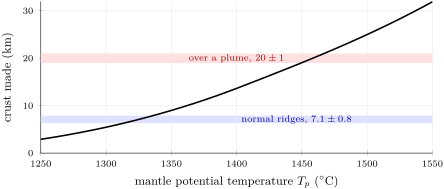
The result does not depend on the spreading rate, as observed (the Year 1 volume). For the column of the figure above, with its slow start, gives of crust, a little more than the measured; a mantle colder gives , and one hotter , close to the over the core of a plume (the figure below). Crustal thickness is a thermometer, and a sensitive one: since when productivity is constant, ten degrees change it by about a tenth (weekend problem).
7.5 Flux melting above a slab
At a subduction zone the mantle wedge does not rise; it is dragged down along the slab. What melts it is water. The slab carries water down in its minerals and releases it as they break down with pressure and temperature (the Year 1 volume); the water rises into the hot wedge above. Water dissolves in silicate melt, and a melt that holds water is stable at a lower temperature. In the parameterisation of Katz and others, per cent of water dissolved in the melt lowers the solidus by
for , for , up to the amount that saturates the melt, which is zero at atmospheric pressure, about at , and grows with pressure. The water-saturated solidus is the blue curve of the solidus figure: near between 1 and , some to below the dry one (Exercise 7.12).
Water is incompatible: it enters the melt far more readily than the minerals, with a partition coefficient of about 0.01. Even a mantle with a hundred or so parts per million of water therefore makes a first melt with about a per cent of water, which lowers its solidus by some , so that melting begins deeper than in dry mantle and a long tail of small melt fractions forms (Exercise 7.9). Above a slab the water supply is far larger, and the wedge melts where its temperature exceeds the wet solidus: the melts of the arcs are born wet.
7.6 Degree of melting and primary magmas
Definition 7.12 (Primary magma)
A primary magma is a melt whose composition has not changed since it left its source: it is in equilibrium with the residual mantle, and has neither crystallised minerals nor reacted with the rocks on its way up.
A magma that crystallises minerals on its way up, or mixes with others, is no longer primary; how it then changes is the subject of Chapter 8. A primary magma records its source: its melt fraction, since a low degree of melting concentrates the incompatible elements in the melt (Chapter 3), and the pressure at which it last equilibrated with the residue. How trace elements are shared between melt and residue during batch and fractional melting is modelled in the Year 3 volume. The residue, for its part, is the harzburgite and peridotite found at the base of ophiolites.
In the field — Reading the mantle at the surface
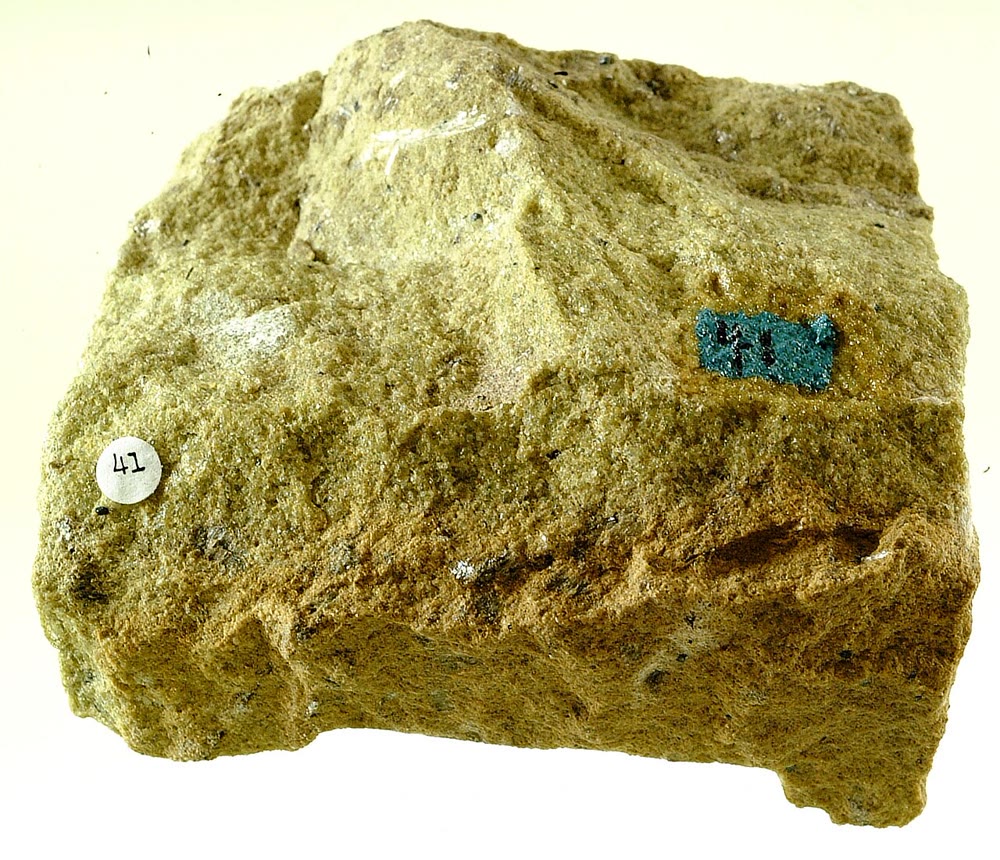
Geologists meet the mantle in two forms. Mantle xenoliths, nodules of green peridotite in basalts and kimberlites, were torn from the walls of the conduit and carried up within days to weeks, too fast to lose the minerals they had at depth. Ophiolites expose the mantle beneath a section of oceanic crust, its harzburgite and other peridotites at the base of the sequence. There, geologists map the peridotites and the dunite among them, sample them along traverses, and measure in the laboratory the proportions of the minerals, their compositions and the trace elements of the residues; each sample is placed on the classification triangle and on the melting paths of this chapter.
7.7 Exercises
Exercise 7.1 ★
Name each rock from its proportions of olivine, orthopyroxene and clinopyroxene (per cent): (a) 93, 5, 2; (b) 75, 25, 0; (c) 60, 27, 13; (d) 30, 45, 25. (e) Give the name of the model upper mantle (57, 28, 13 and spinel) after renormalising its three silicates to .
Solution
Solution of Exercise 7.1.
(a) More than olivine: dunite. (b) Olivine and orthopyroxene without clinopyroxene: harzburgite. (c) More than olivine with both pyroxenes: lherzolite. (d) Less than olivine: a pyroxenite (an olivine-websterite, with both pyroxenes). (e) , , : a lherzolite.
Exercise 7.2 ★
On the diopside–anorthite diagram, a liquid of anorthite cools. (a) At what temperature does it begin to crystallise, and which mineral forms? (b) At what temperature does the second mineral appear, and what is then the composition of the liquid? (c) What is the composition of the first liquid when a rock of diopside and anorthite is heated, and at what temperature does it appear?
Solution
Solution of Exercise 7.2.
(a) The liquidus at anorthite is , in the anorthite field: anorthite crystallises first. (b) Diopside appears at the eutectic, , when the liquid has anorthite. (c) The first liquid of any mixture of the two minerals is the eutectic liquid, anorthite, at .
Exercise 7.3 ★
(a) Compute the adiabatic gradient in kelvins per gigapascal for , , , . (b) How many kilometres of mantle make a gigapascal ()? Convert the gradient to kelvins per kilometre and compare with a typical geothermal gradient near the surface, about .
Solution
Solution of Exercise 7.3.
(a) . (b) , or per gigapascal; , about fifty times less than the near the surface, where heat is conducted, not carried.
Exercise 7.4 ★
(a) Compute the dry solidus of peridotite at 0, 1, 2 and . (b) By how many degrees does it rise per gigapascal near ? (c) Explain in one sentence why a mantle at at is solid, and the same mantle brought to without exchanging heat is partly molten.
Solution
Solution of Exercise 7.4.
(a) ; ; ; . (b) . (c) At , is below the solidus, ; rising to along the adiabat it cools by only about , to some , while the solidus falls to : the rock is now above its solidus and part of it melts.
Exercise 7.5 ★★
A liquid of diopside and anorthite cools. (a) Estimate its liquidus temperature by interpolating between the liquidus at anorthite () and at (). (b) Which mineral crystallises first? (c) What mass fraction of the system has crystallised when the liquid reaches the eutectic? (d) What are the proportions of diopside and anorthite in the final rock?
Solution
Solution of Exercise 7.5.
(a) . (b) The composition lies on the diopside side of the eutectic: diopside. (c) The liquid reaches the eutectic with anorthite; anorthite stays in the liquid, so the liquid fraction is and of the system has crystallised as diopside. (d) Everything crystallises: diopside and anorthite, the bulk composition.
Exercise 7.6 ★★
(a) Compute the mass percentage of in forsterite and in enstatite (, ). (b) Bowen and Andersen found the peritectic liquid to be and : what is its silica content? (c) Use the lever rule to compute the mass fraction of forsterite formed when enstatite melts at the peritectic, and compare with their . (d) What does this imply for the silica content of a melt of peridotite compared with that of its orthopyroxene?
Solution
Solution of Exercise 7.6.
(a) Forsterite: ; enstatite: . (b) . (c) Enstatite lies between forsterite and the liquid: the fraction of forsterite is , Bowen and Andersen’s value. (d) The melt is richer in silica than the orthopyroxene it comes from, and the residue gains olivine.
Exercise 7.7 ★★
With the adiabat and the dry solidus of the text, compute the pressure and the depth ( per gigapascal) at which melting begins for (a) and (b) . (c) By how many kilometres per does the onset deepen near ? Use Proposition 7.7.
Solution
Solution of Exercise 7.7.
(a) : , at . (b) : , at . (c) , so per , or .
Exercise 7.8 ★★
At , take the melt fraction to rise linearly from the dry solidus to the lherzolite liquidus . For : (a) compute the temperature of the melting rock; (b) compute and ; (c) compute the productivity with , and . (d) What would it be without latent heat?
Solution
Solution of Exercise 7.8.
(a) , ; , or . (b) ; . (c) ; with per gigapascal, the numerator is and the denominator : , per gigapascal. (d) , per gigapascal: the latent heat cuts the productivity by a factor of 2.7.
Exercise 7.9 ★★
(a) By how much do 1, 5 and of water dissolved in the melt lower the solidus? (b) What is the water-saturated solidus at ? (c) A mantle holds of water by mass, and water’s partition coefficient between minerals and melt is 0.01. At the very first melting, the melt holds : compute it and the solidus lowering it causes.
Solution
Solution of Exercise 7.9.
(a) ; ; . (b) . (c) is , so and .
Exercise 7.10 ★★★
(a) In Proposition 7.11, check that the mantle entering the base of the triangle each year equals the mantle leaving across its sides. Why must the sides be at for a mantle that rises at and leaves at ? (b) Show that, with constant productivity per gigapascal, (with ), so that the crust grows as the square of the depth of the onset. (c) A ridge spreads at a full rate of and makes of crust: what volume of crust does each kilometre of ridge make per year, and what volume of mantle does it melt if the mean melt fraction is ?
Solution
Solution of Exercise 7.10.
(a) The base is wide and the mantle crosses it at : per unit length of ridge and time. Each side spans the height and is crossed horizontally at : each, in all. With sides at the base would be wide and the inflow , equal to the outflow only if : in this model the angle is set by mass conservation. (b) With constant productivity the melt fraction at the apex is , and : . (c) Each year of new plate, of crust per kilometre of ridge; at mean melt fraction it comes from of mantle.
Exercise 7.11 ★★★
In the ternary system of the schematic figure, the liquid has A, B and C; the binary eutectic is at A 40, B 60 (per cent), and the ternary eutectic E at A 25, B 30, C 45. (a) Write the composition of the liquid when a mass fraction of pure A has crystallised, and show that the ratio of B to C stays at 1. (b) The cotectic from to E is the line of points : find where the liquid meets it, and the fraction of A crystallised by then. (c) When the liquid reaches E, what fraction of the system is still liquid? (C enters no crystal before E.) (d) How much A and how much B have crystallised by then?
Solution
Solution of Exercise 7.11.
(a) After a mass of A has left a unit mass of liquid, the liquid holds of A, 0.2 of B and 0.2 of C in a mass : , and B/C stays 1. (b) On the cotectic, ; B = C gives , : has A 28, B 36, C 36. Then , : of the system has crystallised as A. (c) C is all in the liquid: , still liquid. (d) A: ; B: ; with the liquid, .
Exercise 7.12 ★★★
The water content of a saturated melt is (per cent, in gigapascals). (a) Compute it at 1 and , the solidus lowering it gives, and the water-saturated solidus at both pressures. (b) Why does the saturated solidus hardly change between 1 and while the dry one rises by more than ? (c) In a mantle wedge at and , how much water must the melt hold for the rock to melt?
Solution
Solution of Exercise 7.12.
(a) , , saturated solidus ; , , saturated solidus . (b) The melt dissolves more water at higher pressure, and the larger lowering cancels the rise of the dry solidus. (c) The solidus must fall by : of water, less than the at saturation, so the wedge can melt.
7.8 Problem: Under the ridge
Problem 7.1
Weekend problem — from the mantle adiabat to the thickness of the oceanic crust, and back to the temperature of the mantle
Mantle rises beneath a ridge along the adiabat and melts. Data: thermal expansivity ; density ; specific heat ; entropy of melting ; ; dry solidus and lherzolite liquidus (, in ); mean productivity of the fitted melting model, per gigapascal; clinopyroxene reaction coefficient near the surface 0.50; observed crust at normal ridges and over the core of the Iceland plume. Take mantle and crust of the same density.
Part I — Where melting begins.
- Convert to kelvins.
- Compute the adiabatic gradient in kelvins per gigapascal, and round it to the nearest ten.
- How many kilometres of mantle make one gigapascal? Give the gradient in kelvins per kilometre.
- With the adiabat , write the quadratic for the onset pressure and solve it.
- Give the depth and the temperature at which melting begins.
- Check that the solidus at gives the same temperature.
Part II — How much melt.
- At , compute the solidus, the lherzolite liquidus and their difference.
- With a melt fraction rising linearly between them, give the temperature of the rock at , in degrees Celsius and in kelvins.
- Compute and there.
- Compute the productivity of Proposition 7.10, in per cent per gigapascal.
- The fitted model gives per gigapascal on average. Why is it lower? With , what is the melt fraction reached at the surface?
- The model mantle holds clinopyroxene. At what melt fraction is it used up near the surface? Is the residue beneath the axis a lherzolite or a harzburgite?
Part III — The crust.
- Use Proposition 7.11 with to compute the thickness of the crust.
- What is the mean melt fraction of the aggregated melt?
- Compare with the observed thickness.
- The full model of the figure gives . Why is it thinner than your estimate?
- Show that and compute in kilometres per square gigapascal.
Part IV — The temperature of the mantle.
- Compute the onset pressure that makes of crust.
- Give the corresponding depth of the onset.
- With the adiabat , compute the potential temperature that puts the onset at that pressure.
- Redo the calculation for 6.3 and : what range of does the scatter of the crust allow?
- The crust is thick over the core of the Iceland plume. Compute the potential temperature there, and its excess over that of question 20.
- Lavas of ocean islands suggest plumes 200 to hotter than the ambient mantle. Suggest why the crust gives a smaller excess.
- By how many per cent does the crust thicken for a mantle hotter, near the normal ridge?
- Very slow ridges make thinner crust. Explain why with the triangle.
- State the potential temperature of the mantle beneath a normal ridge that the thickness of the crust gives, the key number of this problem, and compare it with the from mineral physics and the range 1280 to from lavas.
Solution
Solution of Problem 7.1.
1. . 2. , rounded to . 3. ; . 4. , that is : . 5. ; . 6. . 7. ; ; difference . 8. , . 9. , : ; . 10. ; numerator ; denominator : , or per gigapascal. 11. With the fitted function , being the fraction of the way from solidus to liquidus, the temperature must rise steeply with to make the first per cent of melt, so is large near the solidus and melting starts slowly. , . 12. : clinopyroxene runs out at of melting. At the residue beneath the axis still holds a little: a lherzolite poor in clinopyroxene, on the edge of harzburgite. 13. . 14. . 15. is more than , above the range of normal crust. 16. Constant productivity gives the deepest mantle too much melt; the fitted model makes the first melt slowly, stays lower near the onset, and is smaller. 17. and (km): with . 18. . 19. . 20. , and . 21. For : , , . For : , , . The scatter of the crust allows . 22. ; ; , an excess of . 23. The two use different evidence. The lavas record the hottest mantle, at the centre of the plume; the crust averages the melts of all the mantle that passes through the melting region, much of it cooler. The simple model also keeps the productivity constant, although clinopyroxene runs out at while here: real hot mantle melts less, and needs a higher temperature to make the same crust. 24. ; ; since , , about a tenth per . 25. At a very slow ridge the mantle rises so slowly that it loses heat by conduction towards the cold surface; it leaves the adiabat, its melting stops deeper, and the top of the triangle, where is largest, is cut off: the crust is thinner. 26. The crust of normal ridges gives a mantle potential temperature of , within about : below the of mineral physics, which is uncertain by about as much, and well inside the range 1280 to from lavas. Three independent thermometers agree on a mantle near to .