University Chemistry — Year 3 · Bachelor Year 3
20Organometallic Chemistry: Bonding and Ligands
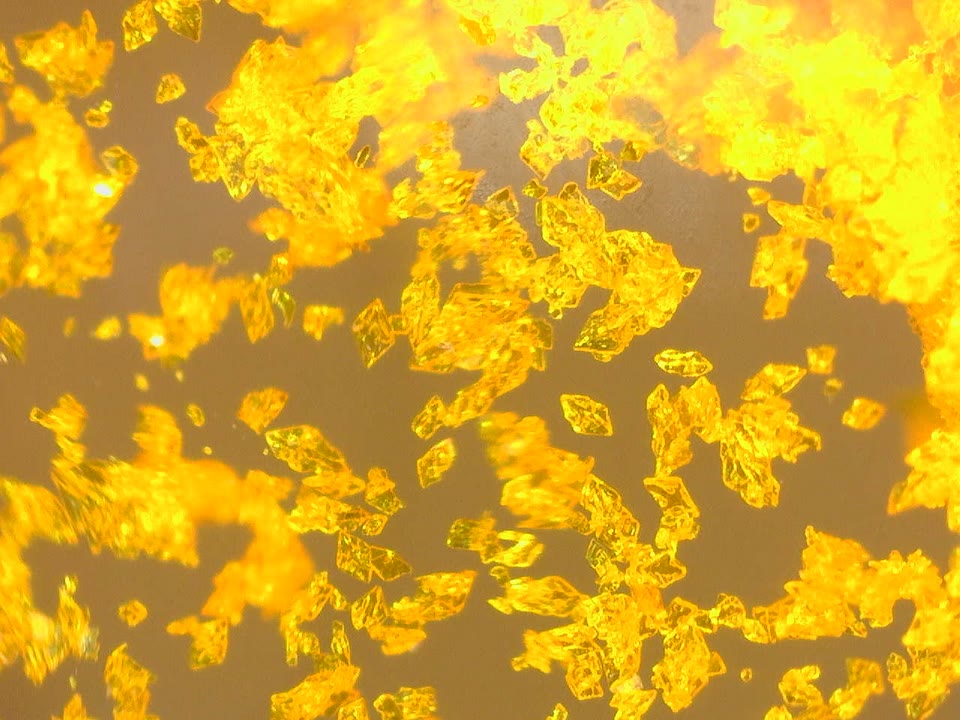
In 1951 two research groups, independently, obtained an orange, air-stable powder of formula that made no sense: iron does not usually form stable bonds to carbon, and certainly not to two cyclopentadienyl rings at once. Within a year its structure was established: the iron sits between two parallel rings, bonded equally to all ten carbon atoms, a sandwich. Ferrocene opened modern organometallic chemistry, whose catalysts now make most of the world’s polymers, drugs and fine chemicals (Chapter 21). This chapter explains how metals bond to carbon monoxide, phosphines, alkenes, rings, carbenes and to each other, and how the isolobal analogy connects organometallic fragments to the organic chemistry of carbon.
You already know
The Year 1 volume defined organometallic compounds and used Grignard reagents. The Year 2 volume introduced the 18-electron rule and valence electron counts, hapticity, -acceptor and -donor ligands with back-donation, the elementary steps of organometallic reactions (oxidative addition, reductive elimination, insertion) and fragment orbitals. Chapter 5 counted the IR-active CO stretches of carbonyls and built symmetry-adapted combinations; Chapter 18 related magnetic moments to unpaired electrons.
20.1 Electron counting and oxidation states
Method 20.1 (Counting electrons, two ways)
- Neutral-ligand (covalent) method: the metal brings its group number of electrons; each ligand, taken neutral, brings 1 (H, , Cl, the -allyl) or 2 (CO, , alkene) or more (- 5, - 6); add one per metal–metal bond and correct for the overall charge.
- Ionic method: ligands such as H, , Cl, are counted as anions (2, 2, 2 and 6 electrons), and the metal as the cation that results; neutral ligands as before.
- Both give the same total; the ionic method also gives the oxidation state and the count.
Example 20.2 (Counting)
: , iron(0), . Ferrocene: neutral method ; ionic method (, 6) () , iron(II). : each Mn (the Mn–Mn bond) . Square-planar complexes such as or Wilkinson’s catalyst have 16 electrons: their empty -like orbital is too high to fill, and 16-electron square-planar complexes are as stable as 18-electron ones.
20.2 Carbonyls and phosphines
Definition 20.3 (Metal carbonyls)
A metal carbonyl is a complex with carbon monoxide ligands. A terminal carbonyl is bonded to one metal through carbon; a bridging carbonyl spans two (or three) metals.
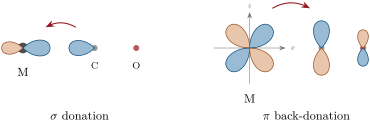
Ludwig Mond found in 1890 that nickel reacts with carbon monoxide at ordinary temperature to give the volatile liquid , which decomposes back to pure nickel on heating: the basis of a refining process. Carbon monoxide binds transition metals through its highest occupied orbital, a lone pair mostly on carbon, and accepts electrons into its empty orbitals, also larger on carbon.
Definition 20.4 (Synergic bonding)
Synergic bonding is the mutual reinforcement of donation from a ligand to a metal and back-donation from the metal to the ligand: donation makes the metal richer in electrons and readier to give them back, back-donation relieves the charge built up by donation.
Proposition 20.5 (CO stretching frequencies)
The more a metal back-donates into the orbitals of a CO ligand, the lower the C–O stretching wavenumber.
Argued. The orbitals of CO are antibonding between C and O: populating them weakens the C–O bond, lowers its force constant, and hence the stretching wavenumber, which varies as the square root of the force constant (Chapter 6). donation removes electrons from an orbital nearly non-bonding (slightly antibonding) for C–O, which by itself would raise the wavenumber a little: the observed decrease shows that back-donation dominates. ∎
Free carbon monoxide has its fundamental at ; terminal carbonyls of neutral complexes absorb roughly between 1900 and , bridging carbonyls lower still. Along an isoelectronic series, an anionic carbonyl absorbs at lower wavenumber than the neutral one, a cationic one at higher: the more electron-rich the metal, the more it back-donates. The number of bands, from symmetry (Chapter 5), gives the geometry.
Proposition 20.6 ( interactions and the ligand-field splitting)
In an octahedral complex, -acceptor ligands increase and -donor ligands decrease it.
Proof. The orbitals have symmetry only. The orbitals (, , ) match a combination of ligand orbitals: for , the four ligands in the plane each offer a orbital perpendicular to their M–L axis in that plane, and the combination with alternating signs has the symmetry of (the remaining combinations transform as , and and find no partner). Two orbitals of the same symmetry mix and repel: the lower is pushed down, the upper up. A acceptor offers empty orbitals above the set, which is pushed down: increases. A donor offers filled orbitals below it, which push it up: decreases. The level is unaffected in both cases. ∎
This is why CO and sit at the strong end of the spectrochemical series, and halides and hydroxide at the weak end, as the Year 2 volume stated.
Definition 20.7 (Tolman parameters)
The Tolman cone angle of a phosphine is the apex angle of the cone, centred on the metal at a standard distance, that just encloses the van der Waals surfaces of its substituents: a measure of its size. The Tolman electronic parameter is the wavenumber of the symmetric CO stretch of : the more strongly the phosphine L donates, the lower it is.
Phosphines are tuned independently in size and electron donation by their substituents: trialkylphosphines are stronger donors than triarylphosphines, phosphites the weakest; is far bulkier than . Bulky phosphines favour low coordination numbers and fast ligand dissociation, which is why they appear in so many catalysts.
20.3 ligands
Definition 20.8 (Dewar–Chatt–Duncanson model)
The Dewar–Chatt–Duncanson model of the bonding of an alkene to a metal combines donation from the C=C orbital to an empty metal orbital with back-donation from a filled metal orbital into the C=C orbital. Its limit of strong back-donation is a metallacyclopropane, a three-membered ring with two M–C bonds and a C–C single bond.
Proposition 20.9 (Consequences of back-donation to an alkene)
Coordination lengthens the C=C bond and bends the substituents back, away from the metal, more so as back-donation increases.
Argued. Removing electrons from the (bonding) orbital and adding them to the (antibonding) orbital both lower the C–C bond order. Mixing character rehybridises the carbons towards , whose bonds to the substituents point away from the metal, towards the metallacyclopropane geometry. ∎
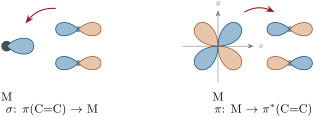
Zeise’s salt, , made in 1827, was the first organometallic compound of a transition metal; its ethene lies perpendicular to the plane, as the model predicts. Allyl (), dienes (), arenes () and the cyclopentadienyl ring () bind in the same way through several carbons at once.
Definition 20.10 (Metallocenes)
A sandwich compound has a metal between two parallel planar ring ligands bonded through all their carbons; a metallocene is a sandwich compound with two -cyclopentadienyl rings, .
Proposition 20.11 (The frontier orbitals of ferrocene)
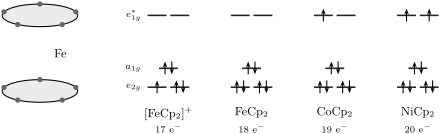
In a metallocene with parallel rings (), the metal orbitals split into (, ) and (), nearly non-bonding and close together, and (, ), strongly antibonding; ferrocene, with six electrons in , has 18 electrons and no unpaired electron.
Argued. The orbitals of the two rings combine into symmetry-adapted pairs , , , , , (from the five orbitals of each ring, with zero, one and two nodal planes through the axis). The filled ring combination overlaps strongly with , (one nodal plane through the axis each): they form bonding orbitals, mostly ring, and antibonding , mostly metal, pushed high. , (two nodal planes) meet only the empty ring orbitals and are slightly stabilised by back-donation; points at the hole in the middle of each ring and hardly overlaps. Six electrons fill and ; with the twelve electrons of the bonding ring combinations, the count is 18. ∎
20.4 Carbenes, carbynes and metal–metal bonds
Definition 20.12 (Carbenes and carbene complexes)
A carbene is a neutral species with a divalent carbon carrying two non-bonding electrons. A carbene complex has a ligand bonded to a metal by a double bond, . A Fischer carbene complex has a heteroatom substituent on the carbene carbon and a low-valent metal with -acceptor ligands; its carbene carbon is electrophilic. A Schrock carbene (alkylidene) complex has only C or H substituents and a high-valent early metal; its carbon is nucleophilic. An N-heterocyclic carbene is a cyclic carbene flanked by two nitrogen atoms, stable as a free compound and a strong -donor ligand.
The two kinds of carbene complexes differ in the way the M=C bond is shared. In a Fischer carbene a singlet carbene donates its lone pair to the metal and receives back-donation into its empty orbital, which the heteroatom lone pair also stabilises: the carbon stays electron-poor, attacked by nucleophiles. In a Schrock carbene two triplet fragments, metal and carbene, form a covalent bond, polarised towards carbon: the alkylidene behaves like a Wittig ylide.
Definition 20.13 (Carbyne complex)
A carbyne complex has a triple bond between a metal and a carbon carrying one substituent, .
Definition 20.14 ( bond, quadruple bond)
A bond is a bond whose orbital has two nodal planes containing the internuclear axis, formed by the face-to-face overlap of two orbitals such as and . A quadruple bond combines one , two and one bond between two metal atoms.
Proposition 20.15 (The quadruple bond of )
In (two , each), the eight electrons occupy : a bond order of 4, which requires the eclipsed arrangement of the two units.
Proof. With along the Re–Re axis and the Cl atoms along and on each Re, points at the chlorides and is used in Re–Cl bonding. The other four orbitals of each metal overlap pairwise: with along the axis (), with and with side by side (, twice), with face to face (, the weakest). Eight electrons fill the four bonding combinations. Rotating one unit by about turns its into , which has zero overlap with the other by symmetry: the bond, and with it the eclipsed preference, is lost. The other three overlaps are cylindrically symmetric or unchanged in magnitude. ∎
The Re–Re distance of in the potassium salt is very short for two metal atoms, and the chlorides of the two halves are indeed eclipsed, against their steric repulsion: the bond, weak as it is, holds them there.
![The component of the quadruple bond of [Re2Cl8]2-: the d_xy orbitals of the two rhenium atoms (four lobes each, signs blue and orange) face each other across the Re–Re axis, lobe over lobe of the same sign. The chlorides (green), eclipsed, lie along x and y, between the lobes.](/images/onecourse/chapters/chemistry-4/b3-organometallic-bonding/fig-3846e006a6f0.svg)
20.5 The isolobal analogy
Definition 20.16 (Isolobal fragments)
Two molecular fragments are isolobal when the number, symmetry, approximate energy and shape of their frontier orbitals, and the number of electrons in them, are similar. The isolobal analogy predicts that isolobal fragments can replace one another in molecules.
Proposition 20.17 (Isolobal series)
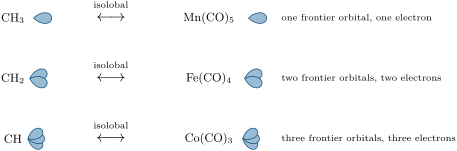
, and are isolobal (one frontier orbital, one electron); and (two orbitals, two electrons); and (three orbitals, three electrons).
Argued. is a tetrahedral fragment missing one bond: one -like orbital with one electron, one short of an octet. is an octahedron missing one ligand: the empty site holds one hybrid orbital pointing out; with electrons it is one short of 18, and its single electron sits in that hybrid. Removing two or three ligands (or bonds) gives two or three such orbitals and electrons, with the same counting on both sides: has 16 electrons (), two short of 18; has 15 (), three short. ∎
Method 20.18 (Predicting a structure by isolobal replacement)
- Break the compound into fragments and count each one’s frontier orbitals and electrons.
- Replace each fragment by its organic isolobal partner.
- The organic analogue, if it exists, suggests the bonding and the shape: is “ethane”, is “tetrahedrane” with three CH replaced by .
Definition 20.19 (Agostic interaction)
An agostic interaction is a three-centre, two-electron bond between a metal and a C–H bond of one of its own ligands, in which the C–H bonding pair donates into an empty metal orbital.
Agostic hydrogens show up as short metal–hydrogen distances in diffraction structures, as unusually low C–H stretching wavenumbers, and in NMR as a high-field shift and a reduced coupling. They are frozen snapshots of C–H activation, the first step of many catalytic reactions.
In the lab — Working with metal carbonyls
Metal carbonyls are handled in a fume hood with a working extraction, under nitrogen or argon, with no open flame: many release carbon monoxide on warming. Volatile carbonyls are transferred by cannula or on a vacuum line, never poured; residues are destroyed by slow oxidation (bleach or bromine water) in the hood. Nickel tetracarbonyl, the most dangerous, is not used in teaching laboratories at all.
Safety


Nickel tetracarbonyl: highly flammable, fatal if inhaled, suspected carcinogen, may damage the unborn child. Ferrocene: a flammable solid, harmful if swallowed; handled as a fine chemical with gloves and dust precautions.
History — Mond’s carbonyl and the sandwich
Ludwig Mond and his co-workers discovered nickel tetracarbonyl in 1890 while studying the corrosion of nickel valves by carbon monoxide, and built on it a process for refining nickel. Ferrocene was made in 1951 by Thomas Kealy and Peter Pauson, and independently by Samuel Miller, John Tebboth and John Tremaine; in 1952 Geoffrey Wilkinson and Robert Woodward, and Ernst Otto Fischer, proposed the sandwich structure. Fischer and Wilkinson shared the 1973 Nobel Prize in Chemistry for their work on sandwich compounds.
20.6 Exercises
Exercise 20.1 ★
Count the valence electrons of , (per Mn), , Zeise’s anion , and .
Solution
Solution of Exercise 20.1.
: . : per Mn. : . : . : . : .
Exercise 20.2 ★
Give the oxidation state and count of the metal in each compound of the previous exercise.
Solution
Solution of Exercise 20.2.
Fe(0) ; Mn(0) ; Mo(II) ; Pt(II) ; Cr(0) ; Zr(IV) .
Exercise 20.3 ★
Rank the CO stretching wavenumbers of , and , and justify.
Solution
Solution of Exercise 20.3.
: the more electron-rich the metal, the more it back-donates into and the weaker the C–O bonds.
Exercise 20.4 ★
Give the organic isolobal analogues of , and .
Solution
Solution of Exercise 20.4.
Ethane ( and are isolobal with ); ethane again; tetrahedrane with three CH replaced by .
Exercise 20.5 ★★
How many CO stretching bands do - and - show in the IR?
Solution
Solution of Exercise 20.5.
(): two (A + E). (): three (2A + B).
Exercise 20.6 ★★
Explain why replacing by in a catalyst can speed up a step that needs a ligand to leave the metal.
Solution
Solution of Exercise 20.6.
The bulky phosphine crowds the metal: dissociation relieves the strain, so it is faster, and low-coordinate intermediates are favoured.
Exercise 20.7 ★★
Classify and as Fischer or Schrock carbene complexes, and predict their reactions with an amine and with a ketone.
Solution
Solution of Exercise 20.7.
The chromium complex is a Fischer carbene (OMe substituent, Cr(0), CO ligands): an amine attacks the electrophilic carbene carbon and replaces OMe. The tantalum alkylidene is a Schrock carbene: its nucleophilic carbon attacks the carbonyl of a ketone, giving an alkene and a Ta=O unit, as in a Wittig reaction.
Exercise 20.8 ★★
What bond order would a staggered have? What is the bond order of , with two more electrons?
Solution
Solution of Exercise 20.8.
Staggered: no overlap, the two electrons are non-bonding: bond order 3. : , bond order 3.
Exercise 20.9 ★★
List three kinds of evidence for an agostic C–H interaction.
Solution
Solution of Exercise 20.9.
A short MH distance (diffraction, best neutron); a low C–H stretching wavenumber; an NMR signal at high field with a reduced one-bond C–H coupling.
Exercise 20.10 ★★★
Give examples of stable complexes with 16, 17 and 19 valence electrons, and explain each exception to the 18-electron rule.
Solution
Solution of Exercise 20.10.
16: square-planar (, Wilkinson’s catalyst), whose 18th-electron orbital is too high; early-metal metallocenes such as , too crowded for more ligands. 17: , which cannot dimerise for steric reasons. 19: cobaltocene, whose extra electron sits in an antibonding orbital (and is easily lost).
Exercise 20.11 ★★★
is colourless and diamagnetic. Explain, using the -acceptor effect on , why it is low spin and why its – bands lie in the ultraviolet.
Solution
Solution of Exercise 20.11.
CO is a strong acceptor: it lowers the level and makes large, far above the pairing energy: , diamagnetic. The – transitions, at , fall in the ultraviolet, and no visible light is absorbed.
Exercise 20.12 ★★★
The C–C bond of ethene lengthens from to in Zeise’s salt and to about in a complex of a low-valent metal with strong back-donation (data of the exercise). Interpret with the Dewar–Chatt–Duncanson model.
Solution
Solution of Exercise 20.12.
Donation from and back-donation into both lower the C–C bond order. In Zeise’s salt (Pt(II), moderate back-donation) the bond lengthens a little; a low-valent, electron-rich metal back-donates strongly and the complex approaches the metallacyclopropane limit, with a C–C bond close to a single bond.
20.7 Problem: Sandwiches
Problem 20.1
Weekend problem — sandwiches: electron counts of four metallocenes, their frontier orbitals and unpaired electrons, their redox chemistry, and two isolobal and spectroscopic questions
Metallocenes (-) are known for M = Fe, Co, Ni and for the ferrocenium cation.
Part I — Counting.
- Count the electrons of ferrocene by the ionic method.
- Count them by the neutral method.
- Count cobaltocene.
- Count nickelocene.
- Count the ferrocenium cation.
- Give the oxidation state and count of each metal.
Part II — Orbitals and magnetism.
- Classify the five orbitals in .
- Which of them overlap strongly with the ring orbitals, and with what consequence?
- Give the order of the -based levels.
- Fill them for ferrocene: unpaired electrons?
- Fill them for cobaltocene: unpaired electrons and spin-only moment?
- Fill them for nickelocene: unpaired electrons and spin-only moment?
- Fill them for ferrocenium: unpaired electrons? Why is its measured moment above the spin-only value?
Part III — Redox.
- Why is cobaltocene a strong reducing agent?
- Why is the ferrocene/ferrocenium couple fast and reversible?
- Why is it used as an internal reference in non-aqueous electrochemistry (Chapter 15)?
- What would you expect of nickelocene’s reactions with two-electron ligands?
Part IV — Fragments and spectra.
- Show that is isolobal with , and predict the structure of .
- What mixed dimer could it form with ?
- How does replacing a CO of by change the remaining CO stretches?
- How many CO bands does () show?
- Why can a -Cp ring slip to during a substitution?
- State the result: the spin-only magnetic moment of nickelocene.
Solution
Solution of Problem 20.1.
1. () . 2. . 3. . 4. . 5. . 6. Fe(II) ; Co(II) ; Ni(II) ; Fe(III) . 7. (), (, ), (, ). 8. The pair overlaps strongly with the filled ring combination: bonding orbitals mostly on the rings, antibonding mostly on the metal, high in energy. 9. . 10. : no unpaired electron. 11. One electron in : one unpaired electron, . 12. Two electrons in the two orbitals, parallel: two unpaired, . 13. : one unpaired electron. An hole gives an orbitally degenerate (E) state with an orbital contribution. 14. Its 19th electron is in an antibonding orbital and is easily removed, giving the 18-electron cobaltocenium cation. 15. The electron removed comes from a nearly non-bonding orbital: the structure hardly changes (small reorganisation energy, Chapter 19). 16. The couple is fast and reversible in most solvents, the compound is soluble and stable, and its potential depends little on the solvent because the charge is spread over a large ion. 17. With 20 electrons, two of them antibonding, it reacts by losing them: it adds ligands with slippage or loss of a ring, or is oxidised. 18. : electrons, one short of 18, one frontier orbital: isolobal with . The dimer is “ethane”, with an Fe–Fe bond (in practice two CO ligands bridge it). 19. , with an Fe–Mn bond. 20. is a better donor and a poorer acceptor than CO: the metal back-donates more to the remaining CO, whose stretches fall. 21. Two (A + E). 22. Ring slippage to frees two electrons’ worth of coordination: an entering ligand can bind associatively without the metal exceeding 18 electrons. 23. .