University Chemistry — Year 3 · Bachelor Year 3
5Group Theory Applied
Carbon dioxide makes up a few hundred molecules in every million of the air, nitrogen and oxygen nearly all the rest; yet it is carbon dioxide, not nitrogen or oxygen, that absorbs the infrared light the warm ground sends to space. A molecule absorbs infrared light only through a vibration that changes its dipole moment, and whether a vibration does so is decided by symmetry alone: nitrogen’s single vibration cannot, two of carbon dioxide’s four can. This chapter turns the character tables of Chapter 4 into tools: it reduces representations, builds symmetry-adapted orbitals, counts and labels vibrations, and derives the selection rules of infrared and Raman spectroscopy.
You already know
Chapter 4 defined symmetry operations, point groups, classes, representations, characters and character tables. The Year 2 volume built the molecular orbitals of , and from fragment orbitals and symmetry-adapted combinations of the hydrogen orbitals, naming them by labels that are derived here. The Year 1 volume read infrared spectra in wavenumbers and defined the polarisability of a molecule.
5.1 Reducing a representation
Any set of functions or vectors attached to a molecule carries a representation of its point group. Most are reducible.
Definition 5.1 (Reducible representation, totally symmetric representation)
A reducible representation is one whose matrices can all be brought, by one change of basis, to the same block-diagonal form; it is then a sum of irreducible representations, written . The irreducible representation whose characters are all 1 is the totally symmetric representation (, , …).
Theorem 5.2 (Great orthogonality theorem)
For two irreducible representations , of dimensions , of a group of order , written with unitary matrices,
Proof. Admitted at this level. ∎
The proof, by Schur’s lemmas, is treated in more advanced courses; its consequences for characters are what chemistry uses, and every character table of this book is checked against them.
Corollary 5.3 (Orthogonality of characters)
With the number of operations in class ,
and the number of irreducible representations equals the number of classes, with .
Proof. Set and in the theorem and sum over and : the left side becomes , the right side ; group the operations by class. The rows of the table are thus orthogonal vectors in a space whose dimension is the number of classes, so there are at most as many irreducible representations as classes; equality and come from applying the theorem to the regular representation (exercise 10). ∎
Theorem 5.4 (The reduction formula)
A representation of characters contains the irreducible representation exactly
times. This is the reduction formula.
Proof. Since , its characters are . Multiply by , sum over classes, and use the corollary: . ∎
Example 5.5 (The hydrogen orbitals of ammonia)
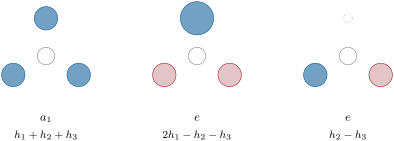
Take the three orbitals of the hydrogens of as a basis. leaves all three in place (), moves all three (), a leaves one in place and swaps two (). With the table: , , . So : the three hydrogens give one totally symmetric combination and a degenerate pair.
Method 5.6 (Reducing a representation)
- For each class, find the character: for a set of atom-centred functions, the number of functions left in place, each counted with the sign it acquires.
- Apply the reduction formula with the row of each irreducible representation, weighting each class by its size.
- Check: the results are non-negative integers, and equals the character under (the size of the basis).
5.2 Symmetry-adapted orbitals
Definition 5.7 (Projection operator)
The projection operator onto the irreducible representation is
where applies the operation to a function.
Proposition 5.8 (What the projection operator does)
Applied to any function , is either zero or a function that transforms as (a symmetry-adapted combination); for a one-dimensional it is unchanged, up to the sign , by each operation .
Partial proof. For : . Put , which runs over the whole group as does; for a one-dimensional representation (the characters are the matrices themselves). Hence . The general case uses the great orthogonality theorem and is admitted. ∎
Method 5.9 (Building symmetry-adapted combinations)
- Choose one function of the set, , and tabulate the function each operation sends it to.
- For each irreducible representation, multiply each image by the character of the operation, add, and normalise (neglecting overlap between the atomic functions).
- For a degenerate representation, project a second function to get a second member, then orthogonalise.
Example 5.10 (The combinations of ammonia and water)
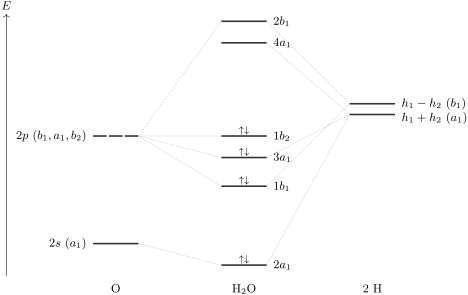
In , (all characters 1). For (characters ), ; projecting and orthogonalising gives the partner . Normalised: , , . In , placed in the plane, is and is (it changes sign under and under , which exchange the hydrogens). With the molecule in the plane, as some books prefer, the labels and are exchanged throughout.
Example 5.11 (Six ligands around a metal)
For six ligand orbitals pointing at a metal from the vertices of an octahedron, the characters on the classes of (, , , , , , , , , ) are , and the reduction gives . The metal’s (), and () and () orbitals find ligand partners; its , , () find none and stay non-bonding in — the origin of the / splitting of the Year 2 volume, developed in Chapters 20 and 18.
5.3 Vibrational modes
Definition 5.12 (Normal mode)
A normal mode of a molecule is a collective vibration in which all atoms oscillate at the same frequency and in phase, along the eigenvector of the mass-weighted Hessian (Proposition 3.3). Each normal mode transforms as an irreducible representation of the point group.
Proposition 5.13 (The representation of all motions)
Attach three displacement vectors , , to each atom. Under an operation the character of this -dimensional representation is
with for a rotation by and for an improper rotation (so 3 for , for , 0 for , 1 for , for ).
Proof. An atom moved to another position carries its vectors off the diagonal of the matrix: it contributes nothing to the trace. An atom left in place has its three vectors transformed by the matrix of , whose trace is computed in a frame with along the axis: for a rotation, the last entry becoming for an improper one. ∎
Proposition 5.14 (Counting vibrations)
, where is the representation of and that of ; a non-linear molecule has vibrations, a linear one .
Proof. The displacements describe every motion: three translations of the centre of mass, three rotations (two for a linear molecule, since turning about its own axis moves no nucleus), and the vibrations. These subspaces do not mix under the operations, so their representations add up. ∎
Example 5.15 (Water)
in , molecule in the plane. Atoms left in place: 3, 1, 3, 1; : ; so . The reduction gives . Translations and rotations removed: . The two modes are the symmetric stretch () and the bend (); the mode is the antisymmetric stretch ().

Example 5.16 (Four more molecules)
The same procedure (computed and checked in the figure data of this chapter) gives:
| molecule | group | modes | |
|---|---|---|---|
| 6 | |||
| 9 | |||
| (via ) | () | 4 | |
| 6 | |||
| 9 | |||
| 15 |
For a linear molecule the infinite group is replaced by its subgroup , in which the degenerate bend splits into .
5.4 Selection rules
Definition 5.17 (Direct product)
The direct product of two representations is the representation carried by the products of their basis functions; its characters are the products .
Theorem 5.18 (Vanishing integrals)
An integral over all space can be non-zero only if the direct product contains the totally symmetric representation.
Proof. A symmetry operation only relabels the points of space, so the value of the integral is unchanged when the integrand is transformed by any . Average the transformed integrand over the group: the average of the integrand’s components belonging to each irreducible representation is , which is the projection onto the totally symmetric representation (Definition 5.7 with all ). Every other component averages to zero; if the product contains no totally symmetric part, the integral is zero. ∎
Definition 5.19 (IR active, Raman active)
A fundamental vibration is IR active if it can absorb infrared light, Raman active if it appears in the Raman spectrum (Chapter 6).
Corollary 5.20 (Infrared and Raman selection rules)
A fundamental (from the ground level, totally symmetric, to one quantum of a mode of symmetry ) is IR active only if is the representation of , or , and Raman active only if is the representation of a quadratic function (, , …).
Proof. The intensity of absorption involves with the dipole components , which transform as , , ; is totally symmetric and transforms as . By the theorem the integral can be non-zero only if contains , which happens only if (the product of two irreducible representations contains the totally symmetric one only if they are equal, for real characters). Raman scattering involves the polarisability components , which transform as the products . ∎
Proposition 5.21 (Mutual exclusion rule)
In a molecule with a centre of inversion, no fundamental is both IR and Raman active: the mutual exclusion rule.
Proof. With an inversion centre every irreducible representation is or . The coordinates , , change sign under (they are ); quadratic functions do not (). A mode is IR active only if , Raman active only if . ∎
Example 5.22 (Carbon dioxide and the greenhouse)
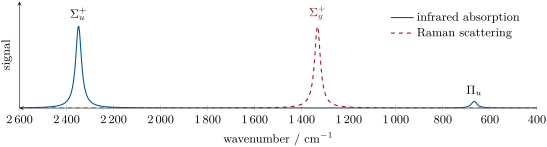
has a centre of inversion. Its symmetric stretch (, ) is Raman active only; the antisymmetric stretch (, ) and the bend (, ) are IR active only. The bend absorbs near , close to the peak of the Earth’s thermal emission: the reason carbon dioxide is a greenhouse gas. and have a single, , vibration: IR inactive.
Method 5.23 (Predicting a vibrational spectrum)
- Find the point group; compute from the atoms left in place.
- Reduce, subtract translations and rotations: .
- From the right-hand columns of the table, mark each mode IR active (, , ) and/or Raman active (quadratic); a mode that is neither is silent.
- Count bands: one per active mode, a degenerate mode giving one band.
Method 5.24 (Counting CO stretches)
In a metal carbonyl, take the C–O bond vectors as a basis (an atom left in place counts 1, nothing else): reduce to obtain , then apply the IR and Raman rules. The number of strong bands near identifies the isomer.
Example 5.25 (Cis and trans)
cis-, : characters , , two IR bands. trans-, : , one IR band () and one Raman band (). A single CO band in the infrared means trans.
5.5 Applications to electronic transitions
The same theorem applies to electronic transitions: an electronic transition between states and is allowed only if contains the representation of , or , and its light is polarised along that axis.
Example 5.26 (Transitions of water and formaldehyde)
In water (, plane), promoting an electron from (the lone pair) to gives an excited state of symmetry , which is : allowed, polarised perpendicular to the molecular plane. In formaldehyde (), the transition goes from an in-plane oxygen lone pair () to the orbital, built from orbitals perpendicular to the plane (; molecule in the plane, C=O along ): , which is none of , , : symmetry-forbidden, which is why its band (Chapter 7) is so weak.
History — Wigner, Bethe and the symmetry of molecules
Group theory entered quantum mechanics with Eugene Wigner’s work on atomic spectra (1927–31) and Hans Bethe’s paper on the splitting of atomic terms in crystals (1929). E. Bright Wilson applied it to molecular vibrations in 1934; Robert Mulliken gave the labels still used for orbitals and states.
In the lab — Infrared and Raman side by side
An infrared spectrometer measures the light a sample absorbs; a Raman spectrometer illuminates it with a laser and analyses the weak scattered light at shifted wavelengths. Recording both on the same compound is the classic test for a centre of symmetry: if no band coincides, the molecule is probably centrosymmetric. Raman lasers are class 3B or 4: the beam is enclosed and the operators wear goggles rated for its wavelength.
5.6 Exercises
Exercise 5.1 ★
Reduce the representation of with characters on . Check the dimension.
Solution
Solution of Exercise 5.1.
, , , : , of dimension 5.
Exercise 5.2 ★
is bent, like water. Give and say which modes are IR and Raman active.
Solution
Solution of Exercise 5.2.
Same atoms-in-place count as water: . () and () are IR active, and both are also Raman active (, ): three bands in each spectrum.
Exercise 5.3 ★
In , compute the direct products , and in (reduce the latter).
Exercise 5.4 ★
has fundamentals at 2917 (), 1534 (), 3019 and 1306 (both ) . Which appear in the infrared spectrum, which in the Raman spectrum?
Solution
Solution of Exercise 5.4.
Infrared: the two modes, 3019 and . Raman: all four (, , all transform as quadratic functions). No centre of inversion, so coincidences are allowed.
Exercise 5.5 ★★
For , derive from the atoms left in place, then count the IR and Raman bands. Which mode is seen in only one of the two spectra, and which in both?
Solution
Solution of Exercise 5.5.
Atoms in place times give , which reduces to . Remove (translations) and (rotations): . IR: , three bands; Raman: , three bands. (out-of-plane bend) is IR only, (symmetric stretch) Raman only, the modes appear in both.
Exercise 5.6 ★★
How many IR and Raman bands does show? Which mode is silent? Why does no band appear in both spectra?
Solution
Solution of Exercise 5.6.
IR: the two modes, two bands. Raman: , , , three bands. is silent. has a centre of inversion: mutual exclusion.
Exercise 5.7 ★★
Apply the projection operator to for the representation of and show that orthogonalising the result against gives .
Solution
Solution of Exercise 5.7.
Under , , the function goes to , , (characters 2, , ); reflections contribute 0. . Its overlap with (atomic overlaps neglected) is , and the latter has norm ; subtracting the projection, .
Exercise 5.8 ★★
Predict the number of IR CO bands of fac- and mer-, and of .
Solution
Solution of Exercise 5.8.
fac (, characters ): , two IR bands. mer (, characters ): , three bands. (): , one IR band ().
Exercise 5.9 ★★
Show that the six orbitals of the ligands of an octahedral complex span , and say which metal orbitals can combine with each.
Solution
Solution of Exercise 5.9.
Characters : only , the and along the axes (two ligands left in place), the three (four) and the six (two) keep ligands in place. The reduction gives . Metal (), and (), and , , () combine; stays non-bonding.
Exercise 5.10 ★★★
The regular representation has and for . Show with the reduction formula that it contains each irreducible representation exactly times, and deduce .
Solution
Solution of Exercise 5.10.
. The dimension of the regular representation is , and also .
Exercise 5.11 ★★★
Acetylene is linear. Working in , find , regroup it into labels, and predict the IR and Raman spectra.
Solution
Solution of Exercise 5.11.
In (molecule along ), atoms in place , , reducing to . Remove translations and the two rotations : , seven modes. In : . IR: and (two bands); Raman: and (three bands); no coincidence.
Exercise 5.12 ★★★
In water ( plane), which of these one-electron promotions give allowed transitions, and with which polarisation: , , , ?
Solution
Solution of Exercise 5.12.
: , , allowed, perpendicular to the plane. : , , allowed, along the axis. : , forbidden. : , , allowed, in the plane perpendicular to the axis.
5.7 Problem: Cis or Trans? A Carbonyl Complex Read by Its Spectrum
Problem 5.1
Weekend problem — point groups and CO-stretching representations of four isomers, their infrared and Raman bands, and the identification of a product from its measured spectrum
An octahedral metal M carries carbonyl ligands and other ligands L (each L counted as a point). Four isomers are considered: cis- and trans-, and fac- and mer-. Assume the L ligands do not lower the symmetry beyond what their positions impose. A synthesis of gives a product whose infrared spectrum shows three strong bands at 2048, 1965 and (data of the problem); its Raman spectrum shows three bands at nearly the same positions.
Part I — Point groups.
- Draw the four isomers on an octahedron.
- Give the point group of cis-.
- Of trans-.
- Of fac-.
- Of mer-.
- Which of the four have a centre of inversion?
Part II — The CO stretches.
- Explain why the C–O bond vectors carry a representation in which an operation contributes 1 per CO left in place.
- Find of the cis isomer.
- Of the trans isomer.
- Of the fac isomer.
- Of the mer isomer.
- Check each dimension against the number of CO ligands.
Part III — Activity.
- Count the IR-active CO stretches of each isomer.
- Count the Raman-active ones.
- Which isomer shows the mutual exclusion rule?
- In the trans isomer, describe the IR-active mode: do the two CO stretch in phase or out of phase?
- In the fac isomer, why do the three CO give only two bands?
- What would a band count of 1 (IR) tell you?
Part IV — The product.
- Which isomer does the infrared spectrum of the product indicate?
- Is the Raman spectrum consistent?
- The highest band is the in-phase stretch of the CO groups. To which irreducible representation does it belong in that isomer?
- Could the spectrum come from a mixture of the two isomers? What further measurement would decide?
- State the result: the number of IR-active CO stretches of the mer isomer, against that of the fac isomer.
Solution
Solution of Problem 5.1.
1. cis: the two CO on adjacent vertices; trans: opposite; fac: three CO on one face; mer: three CO on a meridian (two trans, one between). 2. . 3. . 4. . 5. . 6. Only trans-. 7. An operation that moves a CO onto another puts its vector off the diagonal (contribution 0); one that leaves a CO in place maps its bond vector onto itself (+1); none reverses a C–O vector. 8. Characters , with the plane of both CO: . 9. Characters 2 under , , , , , 0 elsewhere: . 10. : . 11. : . 12. 2, 2, 3, 3: one dimension per CO. 13. cis 2, trans 1, fac 2, mer 3. 14. cis 2, trans 1, fac 2, mer 3. 15. trans: its IR band () and Raman band () are different modes. 16. changes sign under : one CO lengthens while the other shortens, out of phase. 17. is a degenerate pair: two modes of the same frequency give one band, plus the band. 18. A trans-disubstituted, centrosymmetric isomer. 19. Three IR bands: mer (fac would give two). 20. Yes: mer has three Raman-active CO modes at the same frequencies, being non-centrosymmetric; fac would show two. 21. : the in-phase stretch is totally symmetric. 22. A fac/mer mixture would show up to five IR bands, with the fac bands at different positions; three clean bands fit a single isomer. A C NMR spectrum would decide: two carbonyl signals in the ratio 2:1 for mer, one signal for fac. 23. The mer isomer has three IR-active CO stretches, the fac isomer two: the product is mer.