University Chemistry — Year 3 · Bachelor Year 3
4Symmetry and Point Groups
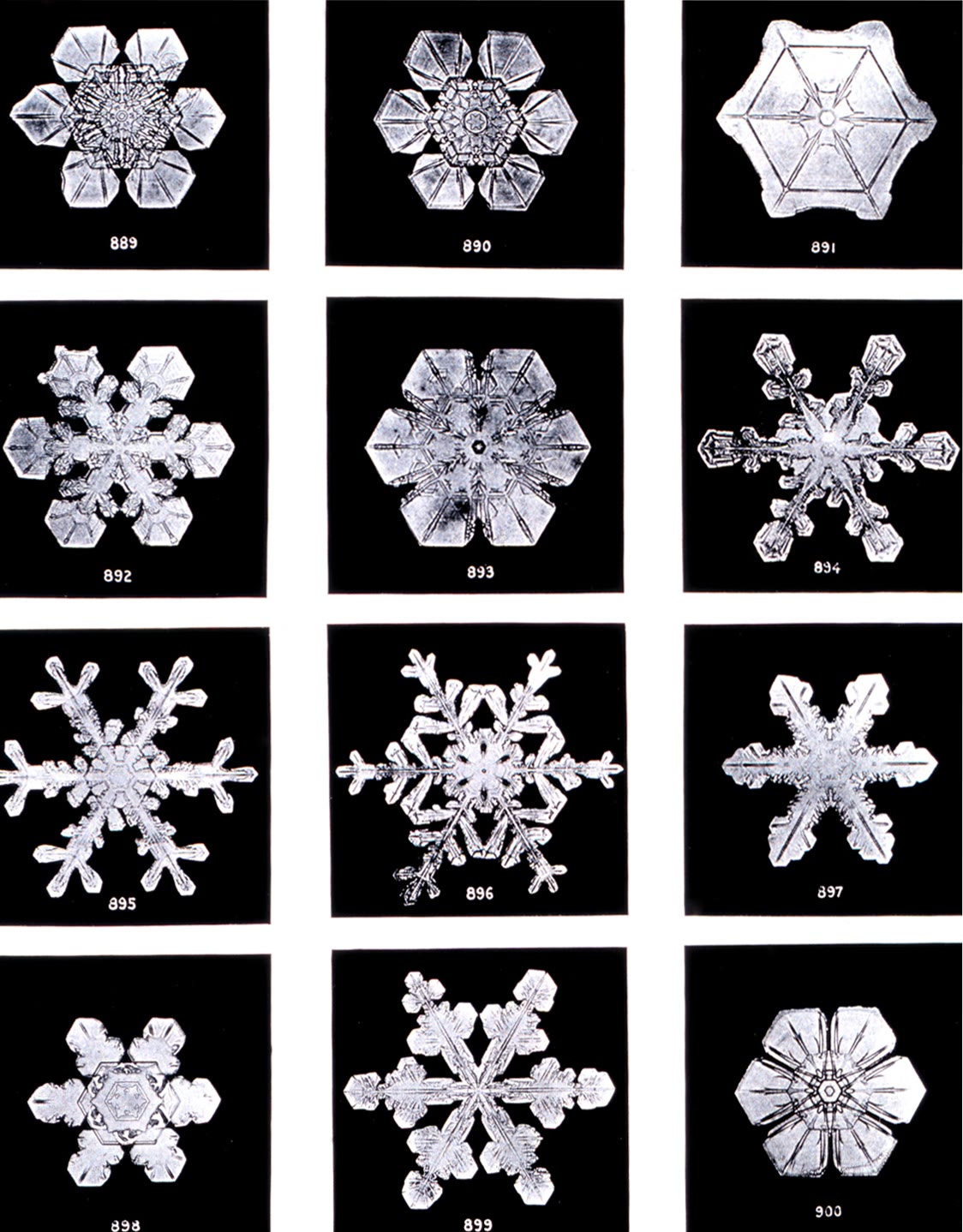
Turn a snowflake by sixty degrees and nothing changes; turn a benzene molecule by the same angle, and its six carbons and six hydrogens fall exactly on each other’s places. The symmetry of a molecule decides several of its properties before any calculation: whether it can have a dipole moment, whether it can exist as two mirror-image forms, which of its vibrations absorb infrared light, which orbitals may mix. To use it, chemists borrowed from mathematics the language of groups. This chapter defines the symmetry operations of a molecule, collects them into its point group, gives a procedure to find that group, proves two theorems on polarity and chirality, and introduces the character tables on which Chapter 5 builds.
You already know
The Year 1 volume predicted molecular shapes with the VSEPR model, defined the dipole moment of a polar molecule, and defined chirality: a chiral molecule cannot be superimposed on its mirror image. The Year 2 volume used symmetry in words to build the fragment orbitals of and .

4.1 Symmetry operations and elements
Definition 4.1 (Symmetry operation, symmetry element)
A symmetry operation is a motion or reflection that leaves a molecule in a configuration indistinguishable from the original (each atom on a position occupied before by an atom of the same kind). A symmetry element is the geometric object — a point, a line, a plane — with respect to which the operation is performed.
Every molecule has the identity operation , which does nothing. The others come in four kinds.
Definition 4.2 (Proper rotation axis, principal axis)
A proper rotation axis is a line about which a rotation by is a symmetry operation, also written ; its powers are rotations by , and . The axis of highest is the principal axis, taken as .
Definition 4.3 (Mirror planes)
A mirror plane is a plane through which reflection is a symmetry operation; . A mirror plane is a vertical mirror plane if it contains the principal axis, a horizontal mirror plane if it is perpendicular to it, and a dihedral mirror plane if it contains the principal axis and bisects the angle between two axes perpendicular to it.
Definition 4.4 (Centre of inversion)
A centre of inversion is a point through which inversion, , is a symmetry operation.
Definition 4.5 (Improper rotation axis)
An improper rotation axis is a line about which a rotation by followed by reflection in the plane perpendicular to it is a symmetry operation. and .
Example 4.6 (Elements of four molecules)
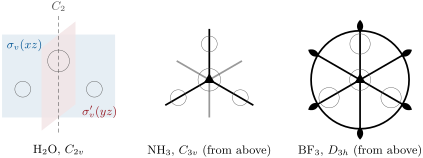
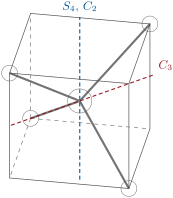
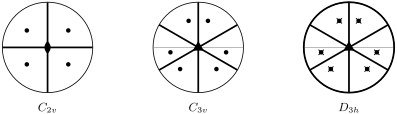
: , a axis bisecting the H–O–H angle, and two vertical planes, the molecular plane and the plane perpendicular to it. : , a through N (operations and ), and three , each containing one N–H bond. : a , three along the B–F bonds, (the molecular plane), three , and an . : four along the C–H bonds, three bisecting H–C–H angles, which are also axes, and six , each containing two C–H bonds (figure below).
4.2 Groups
Proposition 4.7 (Products of symmetry operations)
Performing two symmetry operations of a molecule in succession is again a symmetry operation of that molecule. Together with and the inverse of each operation, the set of symmetry operations is a group: an associative product, an identity, an inverse for each element.
Proof. Each operation leaves the molecule indistinguishable from itself, so two in succession do too. The product of operations (composition of maps of space) is associative; is the identity; an operation undone (a rotation by the opposite angle, a reflection repeated) is also a symmetry operation. ∎
Proposition 4.8 (A common point)
All the symmetry elements of a finite molecule pass through one point.
Proof. Every symmetry operation maps each atom onto an atom of the same mass, so it leaves the centre of mass unchanged. A rotation fixes only the points of its axis, a reflection those of its plane, an improper rotation or an inversion a single point: every element contains the centre of mass. ∎
Definition 4.9 (Point group, order of a point group)
The group of all symmetry operations of a molecule is its point group, named because one point stays fixed. The number of its operations is the order of a point group, .
Example 4.10 (The group of water)
The four operations , , , of form a group of order 4. Its multiplication table (row operation performed after the column one) is
For instance a point reflected in goes to , then rotated by about to : the same as one reflection in .
Definition 4.11 (Class of symmetry operations, subgroup)
Two operations and belong to the same class of symmetry operations if for some operation of the group: they are the same kind of operation, seen in a frame moved by . A subset of a group that is a group on its own is a subgroup; its order divides the order of the group.
Example 4.12 (Classes of )
In (), the three reflections form one class (a rotation carries each plane onto another), the two rotations and another, and is a class alone: three classes, written , , . In every operation is its own class: no operation turns one plane into the other.
Definition 4.13 (Schoenflies symbol)
A point group is named by its Schoenflies symbol: (one axis), (adding vertical planes), (adding ), (adding axes perpendicular to ), and (adding , or dihedral planes, to ), , the cubic groups , , of the tetrahedron, octahedron and icosahedron, and , , for molecules with only a mirror plane, only an inversion centre, or nothing at all. Linear molecules belong to or .
4.3 Assigning a point group
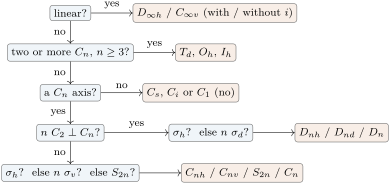
Method 4.14 (Finding the point group of a molecule)
- Is the molecule linear? With an inversion centre, (, ); without, (, ).
- Does it have several high-order axes ()? Tetrahedral shape: ; octahedral: ; icosahedral: .
- Find the principal axis (none: if a plane, if a centre, otherwise).
- Are there axes perpendicular to ? If yes, the group is (with ), else (with ), else .
- If no: (with ), (with ), (with only an collinear with ), else .
Example 4.15 (A gallery)
, , : . , : . , : . , : . : . Benzene: . Ethene: . Ethane: staggered, eclipsed. Allene : , the two planes at right angles. Cyclohexane in its chair: . trans-: . : .
4.4 Consequences: polarity and chirality
Theorem 4.16 (Polar molecules)
A molecule can have a permanent dipole moment only if its point group is , , or ; the dipole then lies along the principal axis (in the plane, for ).
Proof. The dipole moment is a vector property of the molecule, so every symmetry operation must leave it unchanged. A rotation about an axis leaves only vectors along that axis unchanged; two axes leave no non-zero vector; a , an or an reverses any vector along the axis; a keeps vectors in its plane. Hence a non-zero dipole requires at most one axis, no , no , no : the groups listed. ∎
Example 4.17 (Polar or not)
, , and (, ) can be polar, and are. (), (), (), () and trans- () cannot, whatever their polar bonds.
Theorem 4.18 (Chiral molecules)
A molecule is chiral if and only if it has no improper rotation axis (including and ).
Proof. If the molecule has an , then : the mirror image of the molecule equals applied to the molecule after , that is the molecule rotated — superimposable, hence achiral. Conversely, if the molecule is achiral, its mirror image can be brought onto by a proper motion (a rotation about the centre of mass): is then a symmetry operation. It is improper (it changes handedness, its matrix has determinant ), and every improper operation of a point group is an for some (a rotation followed by a reflection in the perpendicular plane). So the molecule has an . ∎
Example 4.19 (An achiral molecule without a plane)
Some molecules have neither a mirror plane nor a centre of inversion, yet are achiral because of an axis: the classic case is a spiro compound built from two identically substituted rings at right angles, of point group . Chirality cannot be judged by looking for a plane alone.
4.5 Representations and character tables
Each symmetry operation moves a point linearly: it can be written as a matrix.
Definition 4.20 (Matrix representation, character)
A matrix representation of a point group assigns to each operation a square matrix such that : products of operations become products of matrices. The character of in is the trace of .
Example 4.21 (The coordinates of )
For about , , of trace ; for , , trace 1; for , trace 3. The characters of this representation are on the classes . Every matrix is block-diagonal, a block for and a block for : the representation splits into two smaller ones.
Proposition 4.22 (Characters are class functions)
Operations of the same class have the same character in any representation.
Proof. If , then , and the trace is unchanged by such a change of basis: . ∎
Proposition 4.23 (Reducing by blocks)
If a basis can be split into subsets that every operation maps into themselves, all matrices are block-diagonal, and the representation is the sum of the smaller representations carried by the subsets; its characters are the sums of theirs.
Proof. An operation that maps each subset into itself has no matrix elements between different subsets; the trace of a block-diagonal matrix is the sum of the traces of its blocks. ∎
Definition 4.24 (Irreducible representation, character table, Mulliken symbol)
A representation that cannot be split further by any change of basis is an irreducible representation. The character table of a point group lists the characters of its irreducible representations, one row each, on its classes, one column each, with the Cartesian functions and rotations that transform like each row. The rows are named by their Mulliken symbol: or for one dimension (symmetric or antisymmetric under the principal rotation), for two, for three; subscripts 1, 2 (symmetric or antisymmetric under a or ), , (under inversion), primes (under ).
Proposition 4.25 (Size of a character table)
A point group has as many irreducible representations as classes, and the squares of their dimensions add up to the order: .
Status. Proved in Chapter 5 from the orthogonality of characters, itself admitted there. ∎
The tables needed most often in this book are those of water, ammonia and methane:
Method 4.26 (Reading a character table)
- The first column of characters (under ) is the dimension: the degeneracy of the levels or orbitals labelled by that row.
- A character means the function is unchanged by the operation, that it changes sign; a 0 in a degenerate row means the members of the set are mixed.
- To find how a function transforms, apply each operation to it and compare with the rows; the right-hand columns give the answer for , , , the rotations, and the quadratic functions (the shapes of orbitals).
Example 4.27 (The orbitals of oxygen in water)
In , the and orbitals of oxygen are unchanged by every operation: (lower-case for orbitals). changes sign under and : . : . These are the labels used for the water orbitals in the Year 2 volume; Chapter 5 derives the labels of the hydrogen combinations.
History — Schoenflies and the symmetry of crystals
Arthur Schoenflies, a mathematician, classified in 1891 the 230 space groups of crystals; the 32 crystallographic point groups he named are still written with his symbols. Chemists adopted the notation in the 1930s, when group theory began to be applied to molecular spectra.
In the lab — Symmetry with a model kit
The quickest way to find the elements of an unfamiliar molecule is to build it with a molecular model kit and turn it in the hand, looking for axes down which it looks the same after a fraction of a turn, and for planes that cut it into mirror halves. A computational program will also report the point group of an optimised structure, within a tolerance.
4.6 Exercises
Exercise 4.1 ★
List the symmetry elements and give the point group of: ethene, , , 1,3,5-trichlorobenzene.
Solution
Solution of Exercise 4.1.
Ethene: three perpendicular , three planes, : . (square planar): , four , , , , , : . (trigonal bipyramid): , three , , , : . 1,3,5-Trichlorobenzene: the same elements as : .
Exercise 4.2 ★
Give the point groups of staggered and eclipsed ethane and of the chair of cyclohexane.
Solution
Solution of Exercise 4.2.
Staggered ethane: , three perpendicular, three , , : . Eclipsed: , three , , three : . Chair cyclohexane: .
Exercise 4.3 ★
Which of these can be polar: , , , , , cis- and trans-1,2-dichloroethene?
Solution
Solution of Exercise 4.3.
(): no. (): yes. (): yes. (): no. (): yes. cis-1,2-dichloroethene (): yes; trans (): no.
Exercise 4.4 ★
Write the matrices of , and acting on , and their characters.
Solution
Solution of Exercise 4.4.
, ; , ; , .
Exercise 4.5 ★★
Build the multiplication table of , with operations , , , . Is every operation its own class?
Solution
Solution of Exercise 4.5.
With the diagonal matrices of the previous exercise: , , , each operation is its own inverse, and every product commutes. The group is commutative, so for all : each operation is a class alone (four classes, four irreducible representations of dimension 1).
Exercise 4.6 ★★
In compute and by following a point. Are they equal? What does this say about the group?
Solution
Solution of Exercise 4.6.
Take the plane. The point goes by to , then by to ; in the other order it goes to then . The two products are reflections in two different planes ( and ): the group is not commutative, which is why its reflections form a class of three.
Exercise 4.7 ★★
Show that biphenyl twisted by an angle between 0 and 90° between its rings belongs to , and conclude on its chirality.
Solution
Solution of Exercise 4.7.
Twisted biphenyl keeps the along the inter-ring bond and two perpendicular to it, bisecting the angles between the ring planes; every plane and the centre of inversion of the planar or perpendicular forms are lost. With three perpendicular and no improper element the group is : the molecule is chiral (its two twisted forms are enantiomers, separable when bulky ortho substituents prevent rotation).
Exercise 4.8 ★★
Using the table, find the labels of the oxygen orbitals in water (take the quadratic functions as their shapes).
Solution
Solution of Exercise 4.8.
and : (, , are ); : ; : ; : .
Exercise 4.9 ★★
Check on the table that and that the rows and are orthogonal when each column is weighted by the size of its class.
Solution
Solution of Exercise 4.9.
. .
Exercise 4.10 ★★★
Show that the product of two reflections in planes making an angle is a rotation by about their intersection. Deduce that a molecule with two vertical planes at 60° has a axis.
Solution
Solution of Exercise 4.10.
In the plane perpendicular to the intersection line, a reflection in a line at angle maps the polar angle to . Two reflections, at then : , a rotation by about the line. Two vertical planes at thus generate a rotation by : a .
Exercise 4.11 ★★★
Allene has the two groups in perpendicular planes. Find its elements, show that its point group is , and explain why 1,3-dichloroallene is chiral.
Solution
Solution of Exercise 4.11.
The C=C=C axis is a and an (turn by , which exchanges the two planes, then reflect through the central carbon’s plane); the two planes are ; two perpendicular to the axis bisect them. Order 8: , achiral. In the planes, the and the axial are destroyed by the substitution; only one perpendicular to the axis survives: , chiral — an axially chiral allene.
Exercise 4.12 ★★★
Going from () to , then to trans- and cis-, give each point group and show that each is a subgroup of . Which can be polar?
Solution
Solution of Exercise 4.12.
: (). : the through Cl and four : (). trans-: (). cis-: (). Each keeps a subset of the operations of , closed under products, and 8, 16, 4 divide 48. Polar: and cis-.
4.7 Problem: Substituting Methane
Problem 4.1
Weekend problem — the 24 symmetry operations of methane, the point groups of its chlorinated derivatives, polarity and chirality by the theorems, and the counting of isomers
Methane is drawn in a cube of side 2 centred at the origin, with hydrogens on the corners , , and .
Part I — The group of methane.
- Find the four axes and count the rotations they give.
- Find the three axes and check that each is also an axis; count the operations.
- Find the six mirror planes and the C–H bonds each contains.
- Add : what is the order of the group?
- Check that there is no centre of inversion. (Is a hydrogen position?)
- Group the operations into the five classes of the table.
Part II — Chlorinated methanes.
- Give the point group of , and its order.
- Same question for .
- Same question for and .
- Same question for and .
- Check that each group is a subgroup of , its order dividing 24.
- Which hydrogens of are interchanged by its operations?
Part III — Polarity and chirality.
- Which of the six molecules can be polar? Give the direction of each dipole.
- Which are chiral?
- For the chiral one, how many stereoisomers exist?
- Why is achiral although its carbon carries four bonds to three different kinds of atom?
- Could a methane derivative with four different substituents ever be polar and not chiral?
- Which representation of do the three orbitals of the carbon span?
Part IV — Counting isomers.
- Show that any two hydrogens of methane can be brought onto any other two by an operation of . How many isomers of exist?
- How many isomers of ? Of , counting enantiomers?
- For benzene (), how many dichlorobenzenes exist? Give their point groups.
- How many trichlorobenzenes? Give their point groups.
- A planar square “methane” () would have how many isomers of ? What did this argument prove historically?
- Check that the order of equals the sum of the squared dimensions of its irreducible representations, and state the result.
Solution
Solution of Problem 4.1.
1. Along the four body diagonals through C and each H; each gives and : 8 rotations. 2. Along , , through the face centres: maps , a hydrogen. A rotation by about followed by reflection in maps , a hydrogen: an ; with , 6 operations. 3. The planes , , ; contains and : each plane contains two C–H bonds. 4. . 5. Inversion maps to , which is not a hydrogen: no . 6. ; ; ; ; . 7. : , . 8. : , . 9. : ; : , . 10. : (); : (). 11. Each keeps those operations of that respect the substitution; 6, 4, 6, 24, 2, 1 all divide 24. 12. The three hydrogens, permuted by , and the three . 13. All but : along the axis for and , the axis for , in the mirror plane for , in no imposed direction for . 14. only (, no ). 15. Two enantiomers. 16. Its two hydrogens are equivalent: the plane through C, F and Cl bisecting H–C–H is a mirror plane. 17. No: four different substituents leave only ; with no the molecule is chiral (and may be polar). 18. : . 19. Two hydrogens are the ends of an edge of the tetrahedron; the 24 operations carry any edge onto any other (the 6 edges form one set): one . 20. : one. : two, a pair of enantiomers. 21. Three: ortho (), meta (), para (). 22. Three: 1,2,3- (), 1,2,4- (), 1,3,5- (). 23. Two (Cl atoms adjacent or opposite). Only one is known, which ruled out a planar carbon and supported the tetrahedral carbon proposed in 1874. 24. : the order of , the point group of methane, is .
Terms defined in this chapter
- Centre of inversion
- Class of symmetry operations, subgroup
- Improper rotation axis
- Irreducible representation, character table, Mulliken symbol
- Matrix representation, character
- Mirror planes
- Point group, order of a point group
- Proper rotation axis, principal axis
- Schoenflies symbol
- Symmetry operation, symmetry element