University Chemistry — Year 3 · Bachelor Year 3
25Supramolecular Chemistry
In 1962 Charles Pedersen, looking for something else, isolated a cyclic polyether that dissolved potassium permanganate in benzene and turned it purple. The ring had wrapped itself around the potassium ion and hidden its charge behind a hydrocarbon surface, dragging the permanganate along as the counter-ion. Chemistry beyond the molecule, the chemistry of assemblies held together by forces weaker than covalent bonds, began with that purple solution. This chapter measures those forces, explains why some hosts choose their guests so well, shows how binding constants are measured, and ends with molecules threaded and interlocked into machines.
You already know
The Year 1 volume treated intermolecular forces, the hydrogen bond, solvation, hydrophobic molecules, complexes, formation constants and chelates; the Year 2 volume the chemical potential, Gibbs energies and least-squares fitting. Chapter 8 described fast and slow exchange and coalescence, Chapter 12 the Eyring equation, and Chapter 10 the translational entropy of a gas.
25.1 Non-covalent interactions
Definition 25.1 (Supramolecular chemistry)
Supramolecular chemistry is the chemistry of assemblies of molecules held together by non-covalent interactions. In a host–guest complex, the host is the larger molecule, with a cavity or a cleft and binding sites converging on it, and the guest the smaller molecule or ion it binds.
The interactions are those of the Year 1 volume, ion–dipole, dipole–dipole, hydrogen bonds and London forces, plus a few with names of their own.
Definition 25.2 (Non-covalent interactions)
stacking is the attraction between flat aromatic rings lying face to face, usually offset or tilted. A cation– interaction is the attraction between a cation and the electron-rich face of an aromatic ring. A halogen bond is the attraction between the electron-poor tip of a covalently bound halogen atom, opposite its bond, and a Lewis base. The hydrophobic effect is the tendency of non-polar surfaces to come together in water, driven mostly by the release of the ordered water molecules around them.
The ion–dipole and cation– interactions are the strongest, and depend heavily on the solvent that competes for the ion; hydrogen bonds come next, then stacking and halogen bonds, then London forces, weak one by one but summed over large contact surfaces. In water, the hydrophobic effect often dominates: a host built to bind a guest by hydrogen bonds in chloroform may not bind it at all in water, whose own hydrogen bonds compete.
25.2 Molecular recognition
Definition 25.3 (Molecular recognition)
Molecular recognition is the selective binding of a guest by a host. It relies on complementarity, a match of size, shape and binding sites between host and guest, and is strengthened by preorganisation, a host whose binding sites are already held in the geometry of the complex before binding.
The association constant is a formation constant in the sense of the Year 1 volume, and . A flexible host must freeze its conformation on binding, which costs entropy; a rigid, preorganised one has paid that price in its synthesis.
Definition 25.4 (Chelate and macrocyclic effects)
The chelate effect is the greater stability of a complex with a polydentate ligand than with the equivalent number of monodentate ligands with the same donor atoms. The macrocyclic effect is the further stabilisation when the polydentate ligand is a ring rather than an open chain.
Proposition 25.5 (The chelate effect is mainly entropic)
In , where en is ethane-1,2-diamine, the same six metal–nitrogen bonds are present on both sides, and the reaction is driven by the increase in the number of free molecules.
Argued. The bonds made and broken are of the same kind, so is small. The number of independent molecules goes from four to seven: three more translational degrees of freedom of a whole molecule, each worth tens of joules per kelvin and per mole in solution (Chapter 10), so and . Seen kinetically, once one end of a chelate is bound, the other is held near the metal at a high effective concentration, and binds at once if it lets go. ∎
Proposition 25.6 (Enthalpy–entropy compensation)
In a series of related host–guest complexes, a more negative of binding usually comes with a more negative , so that varies less than either (an experimental observation).
A tighter complex binds more strongly but restricts the motions of host and guest more; a stronger hydrogen bond to the guest often means a weaker one to the water it displaced. The Gibbs energy, which sets selectivity, is the small difference of two large terms.
Definition 25.7 (Hosts)
A crown ether is a macrocyclic polyether, such as 18-crown-6, . A cryptand is a bicyclic polyether with two nitrogen bridgeheads, which encloses a cation in three dimensions in a cryptate. A cyclodextrin is a cyclic oligomer of glucose units, in the shape of a truncated cone with a hydrophobic cavity and hydroxy groups on its rims. A calixarene is a cup-shaped macrocycle of phenol units joined by methylene bridges.
![Left: 18-crown-6, a ring of twelve carbon atoms (corners) and six oxygen atoms, with a potassium ion at its centre bound by the six oxygens. Right: the [2.2.2]cryptand, three chains of two ether oxygens between two nitrogen bridgeheads, schematic: the cation is held inside a three-dimensional cage, by six oxygens and the two nitrogens.](/images/onecourse/chapters/chemistry-4/b3-supramolecular/fig-8ce9fbbe0866.svg)
Crown ethers select cations by size: 18-crown-6 binds more strongly than the smaller , which cannot reach all six oxygens at once, or the larger , which sits above the ring. The cryptands, more preorganised and wrapping the ion completely, bind more strongly still and select more sharply. Hidden inside the host, the cation drags its anion into non-polar solvents, where the anion, unsolvated, becomes very reactive: the basis of phase-transfer catalysis.
25.3 Measuring binding
Proposition 25.8 (Fast exchange)
When a host exchanges between its free and bound states much faster than the difference of their resonance frequencies, its NMR signal appears at the average , where are the fractions of host in each state.
Proof. Each host molecule visits both states many times during the measurement; its precession frequency, averaged over time, is the weighted mean of the two, with weights the fractions of time spent in each, which at equilibrium are the fractions of molecules in each state (Chapter 8). ∎
Theorem 25.9 (Exact 1:1 isotherm)
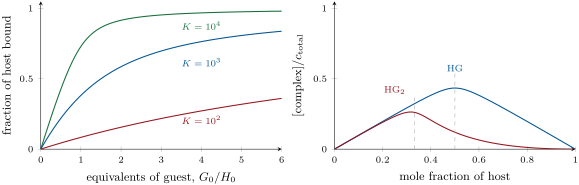
For with total concentrations and and association constant ,
Proof. With , , that is . Of the two roots, only the smaller is below both and (their product is and their sum exceeds ): it is the one with the minus sign. ∎
Method 25.10 (Binding constant from an NMR titration)
- Keep the host concentration fixed and add guest, from 0 to several equivalents; record a host signal at each point (fast exchange).
- Model: , with from the exact isotherm.
- Fit and by nonlinear least squares, minimising the sum of the squared residuals; take the standard errors from the curvature of that sum (the covariance matrix).
- Check the residuals for a trend (wrong stoichiometry) and that the bound fraction spans roughly 20 to 80 % (the data then constrain ).
Definition 25.11 (Job plot)
A Job plot (method of continuous variations) is a plot of the concentration of a complex, or of a signal proportional to it, against the mole fraction of one component, at a constant total concentration of the two.
Proposition 25.12 (Maximum of a Job plot)
For a single complex , the Job plot is maximal at the host mole fraction , whatever the binding constant.
Proof. With total concentration , , , complex , free , , and . Differentiating with respect to at the maximum, where : , so . Substituting, , so , that is : . ∎
Method 25.13 (Running a Job plot)
Definition 25.14 (Isothermal titration calorimetry)
Isothermal titration calorimetry (ITC) measures the heat released or absorbed at each injection of a guest solution into a host solution held at constant temperature.
Proposition 25.15 (Heat per injection)
Neglecting dilution, the heat of the -th injection into a cell of volume is .
Proof. The heat is the reaction enthalpy times the amount of complex formed during the injection, and that amount is the change of times the cell volume. ∎
Method 25.16 (Reading an ITC isotherm)
- Plot the heat per mole of injected guest against the molar ratio.
- The height of the plateau before saturation gives ; the molar ratio at the inflection gives the stoichiometry; the steepness gives .
- Fit all three with the exact isotherm; then and .
A single ITC experiment thus gives the whole thermodynamic signature of the binding, enthalpy and entropy, which an NMR or UV–visible titration gives only through a series of temperatures.
In the lab — An NMR titration
A solution of the host in a deuterated solvent, about a millimole per litre, is placed in an NMR tube and its spectrum recorded. A concentrated solution of the guest made up in the host solution, so that the host concentration stays constant, is added in small portions by microsyringe; after each addition the tube is shaken, equilibrated at the probe temperature, and the spectrum recorded. The shift of a host signal that moves is read at each point and fitted.
25.4 Hosts
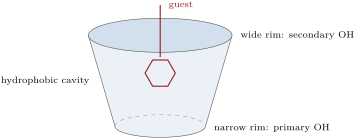
Cyclodextrins, made by enzymes from starch, have six, seven or eight glucose units (, , ). Their hydrophobic cavity holds non-polar parts of guests in water: they solubilise drugs, carry fragrances and remove cholesterol from cell membranes. Calixarenes and the pumpkin-shaped cucurbiturils, rigid macrocycles of glycoluril units with carbonyl-lined portals, bind cations and organic cations very strongly in water.
25.5 Self-assembly and molecular machines
Definition 25.17 (Self-assembly)
Self-assembly is the spontaneous and reversible organisation of components into a defined structure, under the control of the information contained in the components themselves: their shapes and binding sites.
Metal ions with fixed coordination angles and rigid bridging ligands assemble into squares, cages and capsules in a single step, because each bond can open and close until the most stable structure, without strain or dangling sites, is reached. Base pairing in DNA, and the folding of proteins, are the same idea on a grander scale.
Definition 25.18 (Mechanically interlocked molecules)
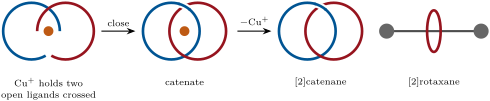
A mechanically interlocked molecule has parts that are not bonded to each other but cannot be separated without breaking a covalent bond. A rotaxane is a ring threaded on an axle with bulky stoppers at both ends; a catenane consists of interlocked rings.
Definition 25.19 (Template synthesis)
A template synthesis uses a temporary interaction, often with a metal ion, to hold reactive components in the geometry needed for a reaction that would otherwise be improbable, such as the closure of a ring around another ring.
Definition 25.20 (Molecular machines)
A molecular machine is an assembly whose components move relative to one another in a controlled way in response to a stimulus (light, a redox change, a change of pH), and can be made to do work.
In a molecular shuttle, a ring on a rotaxane axle sits at one of two stations; a stimulus that weakens its binding to the first sends it to the second, and the reverse stimulus sends it back. Light-driven rotary motors based on overcrowded alkenes turn in one direction only, by alternating photochemical isomerisations and thermal steps that cannot run backwards. The rate of shuttling between stations is measured by variable-temperature NMR, from the coalescence of the signals of the two forms (Chapter 8).
Safety

18-Crown-6: harmful if swallowed, irritating to the skin, eyes and airways. Crown ethers carry metal salts into organic solvents and through skin; they are weighed and handled with gloves.
History — Supramolecular chemistry and its machines
Charles Pedersen’s crown ethers (1967), Jean-Marie Lehn’s cryptands and Donald Cram’s preorganised hosts founded the field; the three shared the 1987 Nobel Prize in Chemistry. Jean-Pierre Sauvage made catenanes in high yield by the copper template in 1983, Fraser Stoddart built rotaxane shuttles, and Ben Feringa a light-driven rotary motor in 1999; they shared the 2016 Nobel Prize in Chemistry for the design and synthesis of molecular machines.
25.6 Exercises
Exercise 25.1 ★
Name the main interaction in: in 18-crown-6; two benzene rings face to face; above a benzene ring; iodopentafluorobenzene with pyridine; a guanine–cytosine pair.
Solution
Solution of Exercise 25.1.
Ion–dipole; stacking; cation–; halogen bond (I to N); three hydrogen bonds.
Exercise 25.2 ★
Compute at for a host–guest complex with .
Solution
Solution of Exercise 25.2.
.
Exercise 25.3 ★
In methanol, for and 4.4 for with 18-crown-6 (data of the exercise). Compute the selectivity and the difference in .
Solution
Solution of Exercise 25.3.
; the difference is in favour of potassium.
Exercise 25.4 ★
A Job plot peaks at a host mole fraction of 0.33. What is the stoichiometry?
Exercise 25.5 ★★
A host at with , and receives one equivalent of guest. Compute the bound fraction and the observed shift.
Solution
Solution of Exercise 25.5.
; : bound fraction 0.566, .
Exercise 25.6 ★★
For nickel(II), with ammonia and with ethane-1,2-diamine (data of the exercise). Compute the constant and at of , and say what drives it.
Solution
Solution of Exercise 25.6.
, ; . The six Ni–N bonds are of the same kind on both sides; the number of free molecules rises from four to seven: the gain of translational entropy drives the reaction.
Exercise 25.7 ★★
An ITC experiment at gives and . Compute , and .
Solution
Solution of Exercise 25.7.
; ; : enthalpy-driven binding, partly paid back in entropy.
Exercise 25.8 ★★
Explain the role of copper(I), and of its tetrahedral geometry, in Sauvage’s catenane synthesis. How is the copper removed at the end?
Solution
Solution of Exercise 25.8.
Copper(I) binds two bidentate phenanthroline units and, being tetrahedral, holds them at right angles, one threaded through the space where the other’s ring will close. Closing both chains into rings then interlocks them. A large excess of cyanide, which binds copper(I) much more strongly, removes the metal and leaves the free catenane.
Exercise 25.9 ★★
The two signals of a rotaxane shuttle, apart, coalesce at (data of the exercise). Compute the exchange rate constant at coalescence and the Gibbs energy of activation of the shuttling.
Solution
Solution of Exercise 25.9.
. Eyring: .
Exercise 25.10 ★★★
A drug has an intrinsic solubility of and forms a 1:1 complex with a cyclodextrin, (data of the exercise). Show that the total solubility in a solution of total cyclodextrin is , and compute it for .
Solution
Solution of Exercise 25.10.
With excess solid drug, the free drug is fixed at . Then and , so and the total solubility is . Here : , nearly six times the intrinsic value.
Exercise 25.11 ★★★
Show from the exact isotherm that when the bound fraction equals the number of equivalents up to one, then stays at one. Why does such a titration give only a lower bound on ?
Solution
Solution of Exercise 25.11.
When , : the bound fraction is up to one equivalent, then 1. The curve no longer depends on : any value large enough gives the same sharp break within the noise, so the data only show that exceeds some minimum.
Exercise 25.12 ★★★
For the host of Exercise 25.5, assume the association is diffusion-controlled, . Compute and show that the exchange is fast on the NMR time scale at .
Solution
Solution of Exercise 25.12.
. The shift difference is at ; coalescence would need . The exchange is thousands of times faster: one averaged signal.
25.7 Problem: Purple Benzene
Problem 25.1
Weekend problem — purple benzene: potassium in a crown ether, the extraction of permanganate into an organic solvent, a binding constant from an NMR titration, and why a catalytic amount of crown suffices
Data of the problem. In methanol at , for and 4.4 for with 18-crown-6. Extraction: an aqueous phase with and is shaken with an equal volume of toluene containing the crown L; the only extracted species is the ion pair , with , and the crown stays in the toluene. NMR titration of a crown ether () with a sodium salt in deuterated methanol, one signal (ppm) against equivalents of :
| equiv. | 0 | 0.25 | 0.5 | 0.75 | 1.0 | 1.5 | 2.0 | 3.0 | 4.0 | 6.0 | 8.0 |
| 3.560 | 3.590 | 3.612 | 3.635 | 3.649 | 3.674 | 3.688 | 3.697 | 3.704 | 3.708 | 3.714 |
Part I — The complex.
- Draw 18-crown-6 and its potassium complex.
- Compute of binding of and of .
- Compute the selectivity.
- With the six-coordinate radii and , explain the selectivity.
- Why is the complex soluble in toluene when is not?
- Why does the crown bind less strongly in water than in methanol?
Part II — Extraction.
- Write the extraction equilibrium.
- With the extracted concentration, write the equation for when .
- Solve it, and give the fraction of permanganate extracted.
- Compute the fraction with .
- Compute it with .
- Why is the toluene purple, and why is the extracted permanganate a stronger oxidant than in water?
Part III — An NMR titration.
- Why does one averaged signal move instead of two signals?
- Write the model for against the guest concentration.
- Fit and by least squares; give with its standard error.
- Give the residual scatter and comment.
- Over what range of equivalents is the bound fraction between 20 and 80 %?
- Why would the same titration fail to measure for potassium, ?
Part IV — Phase-transfer catalysis.
- An alkene in toluene is oxidised by the extracted permanganate. Where does the reaction take place?
- What happens to the crown after the reaction, and why does a catalytic amount suffice?
- Why is excess in the water useful?
- What cheaper catalysts do the same job in industry?
- Why is toluene used today where Pedersen used benzene?
- State the result: the fraction of permanganate extracted at .
Solution
Solution of Problem 25.1.
1. A ring of six units; in the complex sits at the centre, bound by the six oxygens pointing inwards, the groups outside.
2. : ; : .
3. .
4. The larger () reaches all six oxygens of the ring at once; the smaller () cannot, unless the ring folds, which costs strain.
5. Its outside is a hydrocarbon surface and its charge is buried; would need its ions solvated, which toluene cannot do.
6. Water solvates much better than methanol, and the ion must lose that water to enter the ring.
7. .
8. stays : .
9. With : , , : 73 % extracted.
10. gives : 99 %.
11. gives : 9 %, limited by the crown, which is 90 % loaded.
12. The permanganate ion keeps its purple colour in the toluene. There it is unsolvated, a naked anion, and reacts much faster than in water, where a hydration shell shields it.
13. The sodium ion comes and goes much faster than the difference of the two resonance frequencies: fast exchange.
14. , with from the exact isotherm, , , .
15. , .
16. The root-mean-square residual is , the size of the reading precision, with no trend: the 1:1 model fits.
17. Bound fraction at : 0.28 equivalent for and 2.1 for .
18. : the curve would break sharply at one equivalent and give only a lower bound; a competition experiment or calorimetry at lower concentration is needed.
19. In the toluene, a homogeneous solution of alkene and permanganate.
20. The reduced manganese leaves the organic phase (as manganese dioxide), and the crown, freed at the interface, picks up another and . Each crown molecule carries permanganate many times: a catalytic amount suffices.
21. multiplies : a high potassium concentration pushes the extraction.
22. Quaternary ammonium salts, such as tetrabutylammonium or benzyltriethylammonium chloride, whose cation is lipophilic by itself.
23. Benzene causes leukaemia; toluene does the same job with a much smaller hazard.
24. With of crown, 73 % of the permanganate is extracted into the toluene.