University Chemistry — Year 3 · Bachelor Year 3
26Pericyclic Reactions
Sunlight falling on skin opens a ring of 7-dehydrocholesterol in a fraction of a second; body heat then moves one hydrogen atom across seven carbon atoms, and the product is vitamin D. Neither step has an intermediate: bonds break and form together, around a ring of atoms, along a single transition state. The first step goes only with light and the second only with heat, and each gives one stereoisomer. This chapter explains why, from the symmetry of the molecular orbitals involved: the rules found by Robert Woodward and Roald Hoffmann, which predict whether such a reaction can happen and what it gives.
You already know
The Year 2 volume gave the Hückel coefficients of polyenes, aromatic and antiaromatic rings, HOMO, LUMO and frontier orbitals, concerted reactions, and the Diels–Alder reaction of a diene with a dienophile with its endo rule; the Year 1 volume Z/E descriptors. Chapter 4 defined the axis and the mirror plane, Chapter 14 excited states and the [2+2] photocycloaddition.

26.1 Four families
Definition 26.1 (Pericyclic reaction)
A pericyclic reaction is a concerted reaction whose transition state is a cyclic array of interacting orbitals, in which all the bonds are made and broken around the ring at the same time.
Definition 26.2 (Families of pericyclic reactions)
In an electrocyclic reaction a conjugated polyene closes into a ring by forming a bond between its termini, or the reverse. In a cycloaddition, two systems join into a ring by forming two bonds; an cycloaddition joins components of and atoms (or electrons). In a sigmatropic rearrangement a bond migrates along a system; in an shift the bond moves from atoms 1 and 1 to atoms and of the two fragments. A cheletropic reaction makes or breaks two bonds to the same atom, as when sulfur dioxide leaves a sulfolene. In an ene reaction an alkene with an allylic hydrogen adds to a bond, the hydrogen moving with it.
Definition 26.3 (Suprafacial and antarafacial)
A component reacts suprafacially when its two new bonds form, or its two old ones break, on the same face of its system (or with retention at a bond), and antarafacially when they are on opposite faces (or with inversion).
26.2 Electrocyclic reactions
Definition 26.4 (Conrotatory and disrotatory)
In an electrocyclic ring closure the two terminal groups rotate about the bonds that join them to the chain. The rotation is conrotatory when both turn in the same sense (both clockwise seen along the chain), and disrotatory when they turn in opposite senses.
Theorem 26.5 (Electrocyclic reactions)
A thermal electrocyclic reaction of a polyene with electrons is conrotatory, and with electrons disrotatory.
Proof. The new bond forms from the terminal p orbitals of the HOMO, which in the thermal reaction holds the highest-energy electrons; it is bonding only if the lobes that turn to face each other have the same sign. By the Hückel formula (Chapter 22) the coefficients of orbital of an -atom chain are proportional to , so the two termini, and , have coefficients and : the same sign for odd , opposite signs for even . With atoms and electrons the HOMO is . For , is even: the upper lobes of the termini have opposite signs, and the two termini must turn the same way, each bringing its lobe of the matching sign inwards: conrotatory. For , is odd: the upper lobes have the same sign, and turning them towards each other is disrotatory. ∎
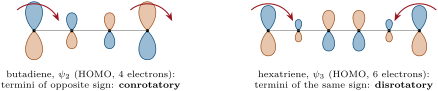
The rule is stereospecific. (E,E)-hexa-2,4-diene, heated, would close conrotatorily into trans-3,4-dimethylcyclobutene; in practice the strained cyclobutene is the one that opens, and cis-3,4-dimethylcyclobutene opens conrotatorily into (E,Z)-hexa-2,4-diene only. (E,Z,E)-octa-2,4,6-triene closes disrotatorily into cis-5,6-dimethylcyclohexa-1,3-diene.
Proposition 26.6 (Photochemical electrocyclic reactions)
Under light the rules are reversed: electrons, disrotatory; , conrotatory.
Proof. Absorbing a photon promotes an electron from the HOMO to the LUMO (Chapter 14), which is now the highest occupied orbital and controls the termini. Its has the opposite parity, so the relative sign of its terminal coefficients is reversed, and with it the sense of rotation. ∎
Method 26.7 (Predicting the stereochemistry of an electrocyclic reaction)
- Count the electrons of the open-chain polyene ( or ); note heat or light.
- Read the mode: thermal con, dis; photochemical reversed.
- Draw the termini with their substituents, in the conformation that closes (s-cis); turn them by 90° in the chosen mode.
- Read whether the two substituents end on the same face of the ring (cis) or on opposite faces (trans). For a ring opening, run the same analysis backwards.
26.3 Orbital correlation diagrams
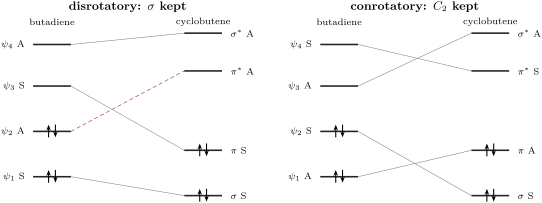
Woodward and Hoffmann’s original argument looks at all the orbitals, not only the HOMO. Along a conrotatory path the molecule keeps a axis; along a disrotatory path, a mirror plane . Each orbital of the reactant and of the product is symmetric (S) or antisymmetric (A) with respect to the element that is kept.
Definition 26.8 (Orbital correlation diagram)
An orbital correlation diagram links each orbital of the reactant to the orbital of the product of the same symmetry, with respect to the symmetry elements kept along the reaction path, taking them in order of energy: the lowest S with the lowest S, and so on.
Proposition 26.9 (Conservation of orbital symmetry)
If every orbital occupied in the reactant correlates with an orbital occupied in the product, the thermal reaction is allowed; if an occupied orbital correlates with an empty one, it is forbidden, with a high barrier.
Argued. Along the path, an orbital keeps its symmetry and its energy changes continuously; orbitals of the same symmetry cannot cross (they mix and repel), those of different symmetry can. When a doubly occupied orbital of the reactant must become an antibonding orbital of the product, the ground state of the reactant leads to a doubly excited state of the product, and the ground-state energy rises steeply until, late on the path, the states of the same symmetry mix: the barrier is high. ∎
Method 26.10 (Building a correlation diagram)
- Find the symmetry elements that bisect the bonds made and broken and are kept all along the chosen path.
- List the orbitals taking part, of reactant and product, in order of energy, and label each S or A for each element.
- Join the lowest orbital of each symmetry type on one side to the lowest of the same type on the other, then the next, never crossing two lines of the same symmetry.
- Check the occupied orbitals: all to occupied, allowed; one to empty, forbidden.
Definition 26.11 (State correlation diagram)
A state correlation diagram links the electronic states of reactant and product, each built from the orbital configurations and labelled by its overall symmetry, through the path; states of the same symmetry do not cross.
For the forbidden disrotatory path, the ground state of butadiene () correlates with a doubly excited state of cyclobutene (), but the first excited state () correlates with the first excited state of cyclobutene (): from the excited state, the disrotatory path is downhill. That is the photochemical reversal of Proposition 26.6, seen on the states.
26.4 Cycloadditions
Theorem 26.12 (Cycloadditions)
A thermal cycloaddition in which both components react suprafacially is allowed when electrons, and forbidden when ; under light the rule is reversed.
Proof. Both new bonds form between the HOMO of one component and the LUMO of the other, which face each other with their terminal lobes; with both reacting suprafacially, both bonds are bonding only if the terminal coefficients of the HOMO and of the LUMO have the same relative sign. For a component of electrons on atoms, the HOMO has and the LUMO ; terminal coefficients of the same sign for odd , opposite for even . In the [4+2] case, the diene HOMO () and the ethene LUMO () both have opposite terminal signs: they match. In the [2+2] case, the HOMO of one ethene (, same signs) meets the LUMO of the other (, opposite): one end bonding, one antibonding. In general the HOMO of the component and the LUMO of the component match when and have the same parity, that is when is odd: . Under light, the singly occupied LUMO of the excited component plays the part of its HOMO, and the parity condition is reversed. ∎
![Frontier orbitals facing each other in suprafacial cycloadditions (the lower lobes of the upper component meet the upper lobes of the lower one; lobe sizes from the Hückel coefficients). In the [4+2] reaction both new bonds are bonding; in the [2+2] reaction one end is bonding and the other antibonding.](/images/onecourse/chapters/chemistry-4/b3-pericyclic/fig-a728b149a0c5.svg)
Thermally, two alkenes do not give a cyclobutane in one concerted step; under light they do (Chapter 14). Ketenes are the exception that proves the rule: their C=O orbital, perpendicular to the C=C one, lets them react with an alkene in a [ + ] geometry, one component suprafacial and the ketene antarafacial, and they form cyclobutanones thermally.
Definition 26.13 (1,3-Dipolar cycloadditions)
A 1,3-dipole is a three-atom system with four electrons, written with formal charges at its ends or in the middle, such as an azide , a nitrile oxide or an ozone molecule. A 1,3-dipolar cycloaddition is its [3+2] cycloaddition, a six-electron reaction, with an alkene or alkyne, giving a five-membered ring.
The copper-catalysed reaction of an azide with a terminal alkyne, giving one regioisomer of a 1,2,3-triazole, is the reliable joining reaction of click chemistry. Ozonolysis starts with a 1,3-dipolar cycloaddition of ozone to the alkene.
26.5 Sigmatropic rearrangements and the general rule
Proposition 26.14 (Hydrogen shifts)
A thermal shift of hydrogen along a polyene is allowed suprafacially when the transition state holds electrons () and must be antarafacial when it holds (, ).
Proof. Treat the transition state as a hydrogen atom (1s) moving between the ends of a radical of atoms with electrons; the hydrogen bridges the two termini of the SOMO, . For , is odd, the termini have lobes of the same sign on one face, and the 1s orbital can bond to both on that face: suprafacial. For and , and are even, the same-sign lobes are on opposite faces at the two ends, and the hydrogen must pass from one face to the other: antarafacial. A shift cannot reach across so short a chain; a shift can, along a helical polyene. ∎
Definition 26.15 (Cope and Claisen rearrangements)
The Cope rearrangement is the [3,3] sigmatropic rearrangement of a hexa-1,5-diene; the Claisen rearrangement that of an allyl vinyl ether, or of an allyl aryl ether, into a -unsaturated carbonyl compound or an ortho-allylphenol.
![Chair transition states of [3,3] sigmatropic rearrangements: two allyl fragments face each other; the 3–4 bond breaks (red) while the 1–6 bond forms (green). In the Claisen rearrangement atom 3 is the ether oxygen, and the product is a carbonyl compound. The chair fixes the relative configuration of new stereocentres.](/images/onecourse/chapters/chemistry-4/b3-pericyclic/fig-77404c7bd3e0.svg)
The [3,3] shift is a six-electron, all-suprafacial process, allowed thermally; it runs through a chair-like transition state, like a cyclohexane, and substituents prefer its equatorial positions: (E,E) and (Z,Z) dienes give opposite relative configurations, predictably.
Theorem 26.16 (Woodward–Hoffmann rules)
A thermal pericyclic reaction is allowed when the total number of and components is odd; a photochemical one when it is even.
Partial proof. For each family treated above the count agrees with the frontier-orbital analysis: a thermal [4+2] cycloaddition has components and , one component, odd: allowed; the [2+2] has , two, even: forbidden, while has one: allowed; the conrotatory opening of cyclobutene is , one: allowed; the suprafacial -H shift is , where only counts: one, allowed. The general proof, valid for every array of components, belongs to more advanced courses. ∎
Definition 26.17 (Aromatic and Möbius transition states)
An aromatic transition state is a cyclic array of orbitals in a pericyclic transition state that, like a Hückel ring, is stabilised when it holds electrons. A Möbius transition state has an odd number of sign changes between neighbouring orbitals around the ring (one antarafacial twist); it is stabilised with electrons.
Proposition 26.18 (Aromatic transition states)
A thermal pericyclic reaction is allowed when its transition state is aromatic: Hückel topology with electrons, or Möbius topology with electrons.
Argued. The cyclic array of orbitals in the transition state behaves like a cyclic conjugated molecule. A Hückel ring has its lowest level non-degenerate and pairs above it, filled with electrons (Year 2 volume); a ring with one sign inversion has all its levels in pairs, filled with . A filled shell means stabilisation, an aromatic transition state and a low barrier. The count of sign changes is the count of antarafacial components, so this rule is equivalent to the Woodward–Hoffmann rule. ∎
Method 26.19 (Drawing and counting components)
- Mark the bonds made and broken; each system or bond that changes is a component, labelled with its type and electron count (, , , for an empty orbital).
- Choose s or a for each component from the geometry (same face, or opposite faces).
- Count the and components: odd, allowed thermally; even, allowed photochemically.
- Cross-check with the electron count around the ring: Hückel with , Möbius with .
In the lab — A Claisen rearrangement
An allyl aryl ether is heated under reflux, under nitrogen, in a high-boiling solvent such as 1,2-dichlorobenzene, or without solvent, at around , and the reaction followed by thin-layer chromatography: the ortho-allylphenol formed is more polar than the ether. The phenol is then extracted into aqueous sodium hydroxide, separated from neutral impurities, and recovered by acidification.
Safety


Buta-1,3-diene, a common diene: extremely flammable gas under pressure, may cause genetic defects and cancer. It is handled only in closed systems; in teaching, solid sulfolene, which releases it in a cheletropic reaction when heated, is used in its place in a closed apparatus.
History — Orbital symmetry
In 1965 Robert Woodward, who had found the puzzling stereochemistry of electrocyclic steps while synthesising vitamin B, and Roald Hoffmann published the rules of conservation of orbital symmetry. Kenichi Fukui had introduced frontier orbitals in 1952; Fukui and Hoffmann shared the 1981 Nobel Prize in Chemistry. Woodward, who had received the 1965 prize for his syntheses, died in 1979.
26.6 Exercises
Exercise 26.1 ★
Classify: the Diels–Alder reaction; the ring opening of cyclobutene; the Cope rearrangement; the loss of from sulfolene; the addition of ozone to an alkene; a -H shift in cyclopentadiene.
Solution
Solution of Exercise 26.1.
Diels–Alder: [4+2] cycloaddition. Cyclobutene opening: electrocyclic. Cope: [3,3] sigmatropic. Sulfolene losing : cheletropic. Ozone and alkene: 1,3-dipolar ([3+2]) cycloaddition. -H shift: sigmatropic.
Exercise 26.2 ★
Predict the mode, conrotatory or disrotatory, of the thermal and of the photochemical ring closure of hexa-1,3,5-triene and of buta-1,3-diene.
Solution
Solution of Exercise 26.2.
Hexatriene (6 electrons): thermal disrotatory, photochemical conrotatory. Butadiene (4): thermal conrotatory, photochemical disrotatory.
Exercise 26.3 ★
Which product does trans-3,4-dimethylcyclobutene give on heating?
Solution
Solution of Exercise 26.3.
Four electrons, thermal: conrotatory opening. The two methyl groups, on opposite faces of the ring, both turn outwards: (E,E)-hexa-2,4-diene.
Exercise 26.4 ★
Why does ethene not dimerise to cyclobutane on heating, while it does under light (with a sensitiser or by direct excitation)?
Solution
Solution of Exercise 26.4.
The suprafacial [2+2] reaction has electrons: in the ground state the HOMO of one ethene and the LUMO of the other overlap with one bonding and one antibonding end. In the excited state the singly occupied of one molecule plays the part of the HOMO, and both ends match.
Exercise 26.5 ★★
Build the orbital correlation diagram of hexatriene cyclohexa-1,3-diene for the disrotatory path, and conclude.
Solution
Solution of Exercise 26.5.
The mirror plane is kept. Hexatriene: S, A, S occupied; A, S, A empty. Cyclohexadiene, in order: S, S, A occupied; S, A, A empty. Joining by symmetry in order, , , : occupied to occupied, the disrotatory closure is thermally allowed.
Exercise 26.6 ★★
Under light, (E,Z,E)-octa-2,4,6-triene closes into which dimethylcyclohexadiene?
Solution
Solution of Exercise 26.6.
Six electrons under light: conrotatory, so the two terminal methyl groups end on opposite faces: trans-5,6-dimethylcyclohexa-1,3-diene (the thermal reaction gives the cis isomer).
Exercise 26.7 ★★
5-Methylcyclopenta-1,3-diene rearranges at room temperature into 1- and 2-methylcyclopentadienes. Explain with a -H shift, and say why it is suprafacial.
Solution
Solution of Exercise 26.7.
The hydrogen on C5 moves to C1 of the diene, its neighbour around the ring, through a six-electron transition state (), suprafacially: one migration gives 1-methyl-, a second 2-methylcyclopentadiene. A five-carbon chain allows the hydrogen to stay on one face, which the small ring forces anyway.
Exercise 26.8 ★★
Count the components of the cycloaddition of a ketene to an alkene, and show that it is thermally allowed.
Solution
Solution of Exercise 26.8.
(alkene) (ketene C=C, attacked on opposite faces through the perpendicular C=O ): the count of components is one (the alkene), odd: thermally allowed.
Exercise 26.9 ★★
Allyl vinyl ether, , undergoes the Claisen rearrangement on heating. Draw its chair transition state and give the product.
Solution
Solution of Exercise 26.9.
In the chair, the C=C of the vinyl group (atoms 1–2), the oxygen (3), the carbon (4) and the allyl C=C (5–6); the O–C bond breaks and the C1–C6 bond forms: the product is pent-4-enal, .
Exercise 26.10 ★★★
A transition state has eight electrons in a cyclic array with one antarafacial component. Is it aromatic? Is the reaction thermally allowed?
Solution
Solution of Exercise 26.10.
Eight electrons is ; with one antarafacial component the array is of Möbius topology, aromatic with electrons: the transition state is aromatic and the reaction thermally allowed (as the conrotatory closure of octatetraene).
Exercise 26.11 ★★★
In the 1,3-dipolar cycloaddition of an azide with a terminal alkyne, the largest HOMO coefficient of the azide is on the terminal nitrogen N3 and the largest LUMO coefficient of the alkyne on its terminal carbon (data of the exercise). Predict the regioisomer favoured without a catalyst by pairing the largest coefficients, and comment.
Solution
Solution of Exercise 26.11.
Pairing the largest coefficients joins N3 to the terminal carbon: the 1,4-disubstituted triazole. Without a catalyst the coefficients differ little and both 1,4 and 1,5 isomers form; copper(I) makes the reaction stepwise through a copper acetylide and gives the 1,4 isomer only.
Exercise 26.12 ★★★
Show, using the Hückel formula, that the -H shift must be antarafacial, and the -H shift suprafacial.
Solution
Solution of Exercise 26.12.
The hydrogen bridges the termini of the SOMO of a -atom radical, . Its terminal coefficients are proportional to and . For , : opposite signs, so the lobes of equal sign are on opposite faces at the two ends: antarafacial. For , : the same sign on the same face: suprafacial.
26.7 Problem: Sunlight, Skin and Vitamin D
Problem 26.1
Weekend problem — sunlight, skin and vitamin D: the photochemical ring opening of 7-dehydrocholesterol, the thermal hydrogen shift, the side products, and how long the body takes to finish the job
Data of the problem: at the conversion of previtamin D into vitamin D is first order with (its reverse is neglected); its activation energy is .
Part I — The ring opening.
- Which bond of 7-dehydrocholesterol breaks, and what system is formed?
- How many electrons take part, and what is the family of reaction?
- Why does it need light?
- Is the photochemical opening conrotatory or disrotatory? Justify with the orbitals.
- Why must the new central double bond of previtamin D be Z?
- Why can the same opening not happen thermally in the dark at body temperature?
Part II — The hydrogen shift.
- Name the atoms between which the hydrogen moves, and the type of shift.
- How many electrons take part in the transition state?
- Count the components and decide whether the thermal reaction is allowed suprafacially or antarafacially.
- Why is an antarafacial shift geometrically possible here, when a shift is not?
- Is the transition state Hückel or Möbius, and is it aromatic?
- Why does the shift not need light?
Part III — Side products.
- Previtamin D can close again under light. Which mode, and why can it give a ring stereoisomer of 7-dehydrocholesterol (lumisterol)?
- Light can also turn the central Z double bond into E (tachysterol). Why can tachysterol not undergo the -H shift?
- Why does prolonged sunlight not produce ever more vitamin D?
- Why is the ring opening fast but the hydrogen shift slow?
Part IV — Kinetics at body temperature.
- Compute the half-life of previtamin D at .
- Compute the fraction converted in one day.
- Compute the time to convert 90 %.
- Compute at .
- Compute the time to convert 90 % at .
- Why is it useful that the skin is warm?
- Why are vitamin D supplements made by irradiating a sterol and warming it, rather than by a classical synthesis?
- State the result: the time to convert 90 % of previtamin D at body temperature.
Solution
Solution of Problem 26.1.
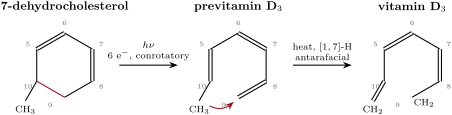
1. The C9–C10 bond of ring B; with the 5,7-diene it gives a hexatriene, C10=C5–C6=C7–C8=C9.
2. Six electrons (the two bonds and the bond): an electrocyclic ring opening.
3. Thermally, a cyclohexadiene and its open hexatriene equilibrate only slowly, through a high barrier, and the ring is the more stable side; the diene absorbs ultraviolet light, and its excited state opens within picoseconds.
4. Conrotatory: in the excited state the singly occupied LUMO of the triene system () has termini of opposite signs.
5. The C6=C7 bond comes from the ring: its two chain continuations, C5 and C8, were on the same side of it, and stay so: Z.
6. The thermal opening, allowed only disrotatorily, has a barrier far beyond what body heat can supply, and would lead uphill, towards the less stable triene.
7. From C19 (the methyl on C10) to C9: a -H sigmatropic shift.
8. Eight: the six electrons of the triene and the two of the C–H bond.
9. . Suprafacially both would be s, with one component from each: even, forbidden. With the triene antarafacial, : one counted component, odd, allowed.
10. Seven atoms in a helical, Z-configured chain let the hydrogen pass from one face to the other; a three-atom chain cannot twist that far.
11. Möbius (one antarafacial component) with eight electrons, : aromatic.
12. It is thermally allowed; its barrier is crossed slowly at body temperature.
13. Six electrons under light: conrotatory again, but it can turn the termini the other way and put H9 and the C19 methyl on the other faces: a ring-closed stereoisomer, lumisterol.
14. With the central bond E, C19 and C9 are on opposite sides of the chain and far apart: the hydrogen cannot reach.
15. Previtamin D itself absorbs and is converted into lumisterol and tachysterol, which do not give vitamin D; a photostationary mixture is reached, which caps the production.
16. The opening happens in the excited state, in femtoseconds to picoseconds; the shift is a thermal reaction with a barrier of .
17. .
18. .
19. .
20. .
21. , about 28 days.
22. The thermal step is seven times faster at than at , so the previtamin made in a morning in the sun is converted within days.
23. The steroid skeleton, with its many stereocentres, comes ready-made from the sterol; light and warmth then carry out the two pericyclic steps exactly as in the skin.
24. At body temperature, 90 % of the previtamin D becomes vitamin D in about , four days.