University Chemistry — Year 3 · Bachelor Year 3
18Electronic Spectra and Magnetism of Complexes
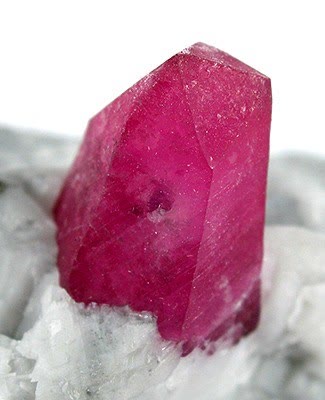
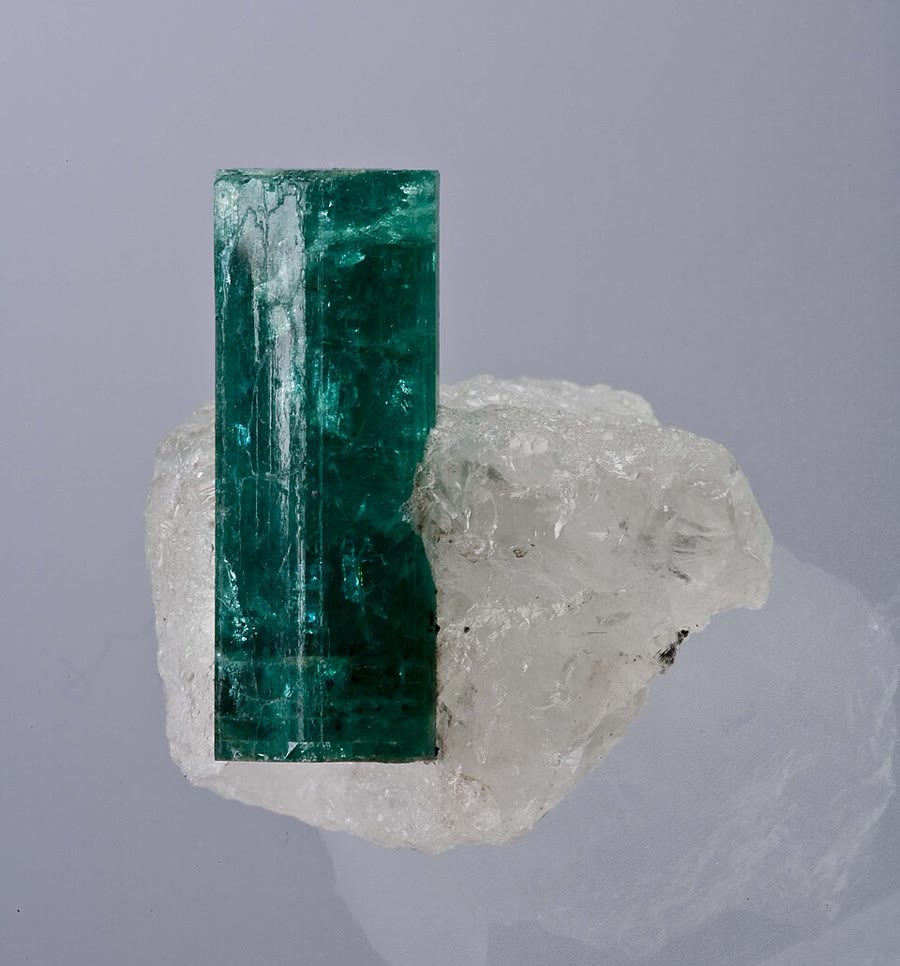
Ruby is red and emerald is green, yet both owe their colour to the same ion, , replacing a few aluminium ions in two different oxides: corundum, , for the ruby, the beryllium aluminium silicate beryl for the emerald. In both, the chromium sits in an octahedron of oxygen atoms; in beryl the octahedron is a little larger and the ligand field a little weaker, and the absorption bands of the ion move by about a thousand wavenumbers to the red. That is enough to change the transmitted colour from red to green. This chapter explains such spectra quantitatively: how the terms of a free ion split in a ligand field, how Tanabe–Sugano diagrams turn two band positions into the ligand-field splitting and the electron repulsion, why some bands are intense and others faint, why some complexes distort, and how magnetism counts the unpaired electrons.
You already know
The Year 2 volume treated transition elements and their configurations, crystal-field splitting , high- and low-spin complexes, pairing energy, crystal-field stabilisation energy, – transitions, the spectrochemical series, ligand field theory, and paramagnetic and diamagnetic substances. Chapter 2 derived term symbols and Hund’s rules, Chapter 5 reduced representations and direct products, Chapter 7 stated the spin and Laporte selection rules and described charge-transfer transitions, and Chapter 10 gave the Boltzmann distribution.
18.1 From free-ion terms to ligand-field terms
In a free ion the electron repulsion splits a configuration into terms (F, P, G… for , Chapter 2). In a complex, each term is further split by the ligands, and the levels are labelled by the irreducible representations of the point group of the complex.
Definition 18.1 (Ligand-field term)
A ligand-field term of a complex is a set of degenerate many-electron states labelled by its spin multiplicity and the irreducible representation of the point group to which its orbital part belongs, such as A or T in an octahedral complex.
Proposition 18.2 (Characters of the rotation group)
The states of a term of orbital angular momentum form a representation of the rotations whose character for a rotation by is
Proof. Admitted at this level. ∎
Theorem 18.3 (Splitting of free-ion terms in an octahedral field)
In an octahedral field the terms of a ion split into
| free-ion term | octahedral terms (same spin multiplicity) |
|---|---|
| S | A |
| P | T |
| D | E + T |
| F | A + T + T |
| G | A + E + T + T |
Proof. The octahedral group is the rotation group times the inversion; the functions are even, so every term of a configuration is even (), and it is enough to reduce in , whose classes are , , (), and . With the proposition, for : , , , and . The character table of (rows : 1, 1, 1, 1, 1; : 1, 1, 1, , ; : 2, , 2, 0, 0; : 3, 0, , 1, ; : 3, 0, , , 1) and the reduction formula of Chapter 5 give , , , and zero for and . The other rows are obtained in the same way (: ; : ; : ; : ). ∎
Method 18.4 (Splitting a free-ion term)
- Find the ground term of the free ion (Hund’s rules) and the excited terms of the same multiplicity.
- Read their octahedral components in the table; the spin multiplicity is unchanged.
- Order them: for the ground F term of , (high spin) the lowest is T; for , it is A (next proposition).
Proposition 18.5 (Holes and the tetrahedral inversion)
The terms of in an octahedral field are those of in reverse energy order; the terms of in a tetrahedral field are those of in an octahedral field (with the subscripts dropped).
Proof. A configuration is equivalent to positive holes in a full shell: the holes feel the ligand-field potential with the opposite sign, so every one-electron splitting, and hence every term splitting, is reversed (the electron repulsion between holes is the same as between electrons). A tetrahedral field has the opposite sign of an octahedral one (the orbitals lie lower) and no centre of symmetry: in behaves as with a reversed field, i.e. as in . ∎
Definition 18.6 (Correlation diagram)
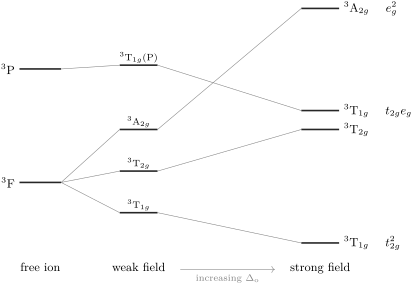
A correlation diagram joins the states of a system in two limiting situations, here the free-ion terms split by a weak field and the configurations of a strong field, connecting states of the same symmetry without letting two of them cross.
18.2 Tanabe–Sugano diagrams
Definition 18.7 (Racah parameters)
The Racah parameters , and are combinations of the Slater integrals of the shell that express all the electron-repulsion energies of a configuration; the energy differences between terms of the same configuration depend only on and , and those between terms of the same highest multiplicity on alone (for , , , : ).
Example 18.8 (Free-ion Racah parameters)
The levels of the free ion put the centre of gravity (weights ) of F at and that of P at above the ground level: , . The same calculation gives for and for .
Definition 18.9 (Tanabe–Sugano diagram)
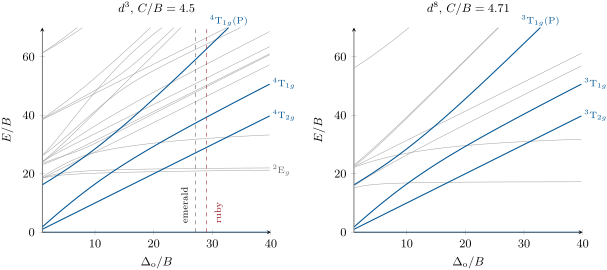
A Tanabe–Sugano diagram plots the energies of all the ligand-field terms of a ion, in units of and measured from the ground term, against , for a fixed ratio .
Proposition 18.10 (The three bands of a ion)
For a ion in an octahedral field the spin-allowed transitions from A are at
Partial proof. In the strong-field basis, A and T arise once each, from and , and their difference contains no electron repulsion: exactly. T arises twice, from and ; relative to A the matrix is (the electron-repulsion elements are admitted). Its eigenvalues are the roots of , which are the stated and . At they are 0 and (the F and P terms); the full diagonalisation of the figure reproduces them. ∎
Method 18.11 (Reading a Tanabe–Sugano diagram)
- Identify the ground term and the spin-allowed transitions (same multiplicity).
- Compute the ratio of two band energies, ; find the value of at which the diagram gives that ratio.
- Read for there: , then . For and , directly and the closed formula gives from .
- Compare with the free-ion value (nephelauxetic ratio) and check that the third band falls where the diagram predicts.
Definition 18.12 (Nephelauxetic effect)
The nephelauxetic effect (“cloud-expanding”) is the decrease of the Racah parameter of a metal ion in a complex compared with the free ion, caused by the delocalisation of the electrons onto the ligands; the nephelauxetic ratio is .
Ligands that bond more covalently reduce more: is near 0.9 for fluoride, 0.8 for water, 0.6 to 0.7 for oxide and heavier halides, and lower still for sulfide. Spin-forbidden transitions, between terms of different multiplicity, appear as weak, often sharp lines.
18.3 Intensities and charge transfer
Definition 18.13 (Vibronic coupling)
Vibronic coupling is the mixing of electronic and vibrational motion: an asymmetric vibration that removes the centre of symmetry of a complex mixes a little odd () character into its states, which makes Laporte-forbidden – transitions weakly allowed.
Proposition 18.14 (Intensities of absorption bands)
The molar absorption coefficients of the bands of complexes increase in the order: spin-forbidden – spin-allowed – in a centrosymmetric complex – in a tetrahedral complex charge transfer.
Argued. By Chapter 7, a transition is allowed when spin is conserved and parity changes. A – transition never changes parity: in an octahedral complex it borrows intensity only through vibronic coupling; in a tetrahedron, which has no centre, and orbitals mix permanently. A spin-forbidden transition borrows a further small fraction through spin–orbit coupling. A charge-transfer transition moves an electron between orbitals of different parity on metal and ligand, and is fully allowed. ∎
Definition 18.15 (Charge transfer)
In a ligand-to-metal charge transfer (LMCT) an electron goes from a ligand-based orbital to a metal-based one; in a metal-to-ligand charge transfer (MLCT), from the metal to a ligand orbital.
Permanganate and chromate, ions with no – transitions at all, owe their deep colours to LMCT from oxide to an empty metal orbital, easy for a metal in a high oxidation state. (bpy: 2,2-bipyridine) owes its orange colour to MLCT from ruthenium(II) to the orbitals of the ligands, the excited state used in photoredox catalysis (Chapter 14). In ruby, the two broad bands near 560 and are the spin-allowed – bands of Proposition 18.10; the light that passes is red, with some blue. Excited into these bands, the ion relaxes to the E level and emits from it the deep red R line near , the line of the first laser.
18.4 The Jahn–Teller effect
Theorem 18.16 (Jahn–Teller theorem)
A non-linear molecule in an orbitally degenerate electronic state is unstable with respect to a distortion that lowers its symmetry and removes the degeneracy. This is the Jahn–Teller theorem.
Proof. Admitted at this level. ∎
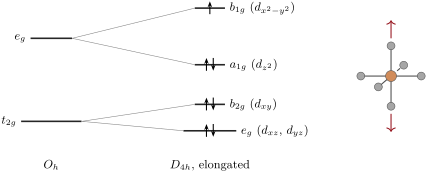
Its consequences for octahedral complexes follow from the occupation of the orbitals, which point at the ligands. In a ion () the configuration has the hole either in or in : an E state. Stretching the two axial bonds lowers and raises ; putting two electrons in the lowered orbital and one in the raised one gives a net stabilisation. Copper(II) complexes are indeed elongated octahedra, with four short and two long bonds. The same holds for high-spin (, ) and low-spin ; for unevenly filled sets (, , low-spin …) the orbitals point between the ligands and the distortion is small. The degenerate excited states of complexes distort too: the broad, often double-humped bands of and of copper(II) complexes are the spectroscopic signature.
18.5 Magnetism
Definition 18.17 (Magnetic susceptibility)
The magnetic susceptibility of a material is the ratio of its magnetisation to the applied field strength; the molar susceptibility is the susceptibility per mole. Paramagnetic substances have , diamagnetic ones a small . Chemists often use the cgs value of , in , equal to the SI value in divided by .
Definition 18.18 (Curie constant)
The Curie constant of a paramagnet obeying the Curie law is the product .
Theorem 18.19 (Curie law)
For independent spins with factor , at temperatures where ,
in cgs units . This is the Curie law.
Partial proof. For , the two levels have energies in a field . By the Boltzmann distribution the mean moment along the field is ; per mole, , and with , , which is the formula with . The general case (averaging over levels, ) is admitted. ∎
Definition 18.20 (Effective magnetic moment)
The effective magnetic moment of a paramagnetic ion is , in cgs . Its spin-only moment is the value that the spins alone would give with ; the excess of the measured moment over it is the orbital contribution.
Proposition 18.21 (Spin-only formula)
For unpaired electrons, : 1.73, 2.83, 3.87, 4.90 and for to 5.
Proof. , so . ∎
Proposition 18.22 (Orbital contributions)
In an octahedral complex, ions with A or E ground terms have moments close to the spin-only value; ions with T ground terms can have substantial orbital contributions.
Argued. An orbital moment needs an orbital that can be turned into an equivalent, degenerate one by a rotation about the field axis, with an electron free to move between them. In a T state ( set unevenly filled) the orbitals , , are related by rotations and the moment survives in part; in A and E states (, , partly filled) no such equivalent orbital is available and the orbital moment is quenched. ∎
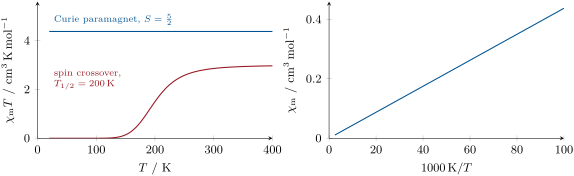
Definition 18.23 (Spin crossover)
Spin crossover is the conversion of a complex between a low-spin and a high-spin state with temperature, pressure or light, possible when is close to the pairing energy.
Proposition 18.24 (Crossover temperature)
If the conversion behaves as an equilibrium with enthalpy and entropy , the high-spin fraction is , one half at .
Proof. ; when . ∎
Both and are positive: the high-spin state has longer, weaker metal–ligand bonds and more spin states ( from the spin alone for iron(II), ), so it wins at high temperature.
Definition 18.25 (Cooperative magnetism)
In ferromagnetism the spins of neighbouring paramagnetic centres align parallel through an exchange interaction, giving a spontaneous magnetisation below the Curie temperature; in antiferromagnetism they align antiparallel, and the susceptibility falls below the Néel temperature.
In dinuclear complexes, the same exchange coupling appears as a that falls (antiferromagnetic) or rises (ferromagnetic) on cooling, from which the coupling constant is fitted; bridging ligands such as oxide or acetate usually couple the metals antiferromagnetically.
Method 18.26 (The magnetic moment by the Evans method)
- In an NMR tube, put the solution of the paramagnetic compound (known concentration ) with a little of an inert reference (tert-butanol, the solvent’s residual signal); in a coaxial inner tube, the same solvent and reference without the compound.
- Record the spectrum: the reference gives two lines separated by .
- In a superconducting magnet (field along the tube), the volume susceptibility difference is (SI, admitted); ( in ), corrected for the diamagnetism of the compound if needed; then .
In the lab — An Evans measurement
A flame-sealed capillary, or a commercial coaxial insert, holds the reference solvent inside the NMR tube. The measurement takes a minute on any routine spectrometer; the main errors come from the concentration and from the temperature, which must be known since varies as .
Safety


Potassium dichromate and the chromates used for charge-transfer spectra: oxidisers, toxic, may cause cancer and heritable genetic damage, very toxic to aquatic life. Weighed in a ventilated enclosure with gloves; chromium(VI) waste is reduced and collected separately.
History — Jahn and Teller, Tanabe and Sugano
Hermann Jahn and Edward Teller proved in 1937, by examining every point group, that orbital degeneracy and a symmetric nuclear framework are incompatible in non-linear molecules. Yukito Tanabe and Satoru Sugano computed in 1954 the energies of all the terms of to ions in octahedral fields, by diagonalising the same matrices as the figure of this chapter; their diagrams have been used to assign the spectra of complexes ever since.
18.6 Exercises
Exercise 18.1 ★
Give the octahedral components of the D, F and G terms, and check that the degeneracies add up to .
Solution
Solution of Exercise 18.1.
D: E + T (); F: A + T + T (); G: A + E + T + T ().
Exercise 18.2 ★
For to (high spin), give the free-ion ground term and the octahedral term it becomes the ground state of.
Solution
Solution of Exercise 18.2.
D T; F T; F A; D E; S A; D T; F T; F A; D E.
Exercise 18.3 ★
Compute the spin-only moments of high-spin , and , and of low-spin and .
Solution
Solution of Exercise 18.3.
High-spin () , (4) , (3) ; low-spin and (): 0, diamagnetic.
Exercise 18.4 ★
Rank by increasing intensity the visible bands of , , and , and justify.
Solution
Solution of Exercise 18.4.
(spin- and Laporte-forbidden, almost colourless) (Laporte-forbidden, vibronic) (no centre of symmetry) (allowed charge transfer).
Exercise 18.5 ★★
A nickel(II) hexaaqua complex shows bands at 8500, 14100 and (data of the exercise). Assign them, and using (the trace of the T matrix) find , and (free ion: ).
Solution
Solution of Exercise 18.5.
8500: AT, so ; 14100: T(F); 24900: T(P). , , .
Exercise 18.6 ★★
A chromium(III) hexaaqua complex absorbs at 17400 and (data of the exercise). Find , , , and predict the third band.
Solution
Solution of Exercise 18.6.
; solving : , . (), in the ultraviolet.
Exercise 18.7 ★★
Ruby and emerald have nephelauxetic ratios of 0.67, the hexaaqua chromium(III) ion 0.79. What does this say about the Cr–O bonds in the gems?
Solution
Solution of Exercise 18.7.
The electrons are more delocalised onto the oxide ions of the gems than onto water molecules: the Cr–O bonds there are more covalent.
Exercise 18.8 ★★
Predict a strong, weak or no Jahn–Teller distortion for octahedral , high-spin , low-spin , , high-spin and low-spin .
Solution
Solution of Exercise 18.8.
Strong ( unevenly filled): , high-spin , low-spin . None: (, A term) and low-spin (). Weak: high-spin (, T term).
Exercise 18.9 ★★
High-spin has a moment near in octahedral complexes and closer to in tetrahedral ones (data of the exercise). Explain from the ground terms.
Solution
Solution of Exercise 18.9.
Octahedral high-spin : ground term T, a T term with an orbital contribution, moment well above the spin-only . Tetrahedral ( octahedral ): ground term A, orbital moment quenched, close to spin-only (a little above, by mixing with excited T terms).
Exercise 18.10 ★★★
A complex has , independent of temperature. Compute and the number of unpaired electrons.
Solution
Solution of Exercise 18.10.
: three unpaired electrons ().
Exercise 18.11 ★★★
In an Evans measurement at and , a solution shifts the reference by (data of the exercise). Compute (cgs) and .
Solution
Solution of Exercise 18.11.
; , i.e. ; , : one unpaired electron.
Exercise 18.12 ★★★
For a spin-crossover compound with and , compute , the high-spin fraction at , and there (high spin ).
Solution
Solution of Exercise 18.12.
. At : , , ; .
18.7 Problem: One Ion, Two Gems
Problem 18.1
Weekend problem — one ion, two gems: the terms of chromium(III), the bands of ruby and emerald on the diagram, the ligand field and the electron repulsion of each, and the sharp red line of ruby
Absorption maxima (light polarised perpendicular to the crystal axis): ruby 17 820 and ; emerald 16 740 and . Ruby also shows a sharp line near . Free : centres of gravity of F and P at 547 and .
Part I — Chromium(III).
- Give the electron configuration of .
- Give its free-ion ground term.
- Split it in an octahedral field.
- Which component is the ground term, and why?
- What does the P term become?
- List the spin-allowed transitions.
Part II — The bands.
- Convert the ruby bands to wavelengths.
- Convert the emerald bands to wavelengths.
- Explain the two colours.
- Give of each gem.
- Why is exactly ?
Part III — Electron repulsion.
- Compute of the free ion.
- Using the formula for , find for ruby (solve numerically).
- Do the same for emerald.
- Compute the nephelauxetic ratios.
- Compute for each gem and place them on the diagram.
- Predict the third spin-allowed band of ruby. Why is it rarely seen?
- Suggest why the field is weaker in emerald.
Part IV — The R line.
- Compute the energy of the line at and its value in units of the ruby’s .
- The diagram drawn with puts E at . What does the difference tell about in ruby?
- Why is the line sharp, unlike the broad bands?
- Why is the emission slow?
- Why should the line sit at nearly the same position in emerald?
- Why does a long-lived excited level make a laser possible?
- State the result: the difference .
Solution
Solution of Problem 18.1.
1. [Ar]. 2. F. 3. A + T + T. 4. A, the term of , all three electrons in the lower orbitals. 5. T(P). 6. AT, T(F), T(P). 7. 561 and . 8. 597 and . 9. Ruby absorbs yellow-green and violet and transmits red (with a little blue); emerald’s bands, shifted to the red, absorb orange-red as well, and green is transmitted. 10. Ruby , emerald . 11. T () and A () have the same electron-repulsion energy; their difference is the one-electron promotion energy . 12. . 13. . 14. . 15. 0.67 for both. 16. 29.0 and 27.1. 17. () for ruby, in the ultraviolet, where charge-transfer absorption hides it. 18. The octahedral site of beryl is larger: longer Cr–O bonds give a smaller splitting, which varies steeply with the distance. 19. , . 20. E depends mainly on : the higher measured level means is larger, about 5.3 by the same diagonalisation. 21. E and A both belong to , differing only by a spin flip: the bonding, hence the geometry, is the same in both, and the transition has no vibrational progression (a 0–0 line). 22. It is spin-forbidden. 23. Its energy depends on and , almost not on (a flat line on the diagram), and is nearly the same in the two gems. 24. Ions pumped into the broad bands relax and accumulate in the long-lived E level, so that more ions can be in it than in the ground level: a population inversion. 25. : the whole difference between red and green.