University Chemistry — Year 3 · Bachelor Year 3
33Lab Techniques III: Research Practice
A bottle of butyllithium solution catches fire if a drop meets the air; a glovebox keeps oxygen and water below a few parts per million so that such compounds can be weighed like table salt. Research chemistry often begins by keeping the atmosphere out, and ends with a claim that others must be able to check: a new compound, its structure and purity proved by several independent methods, its data recorded and published so that the work can be repeated. This last chapter gathers the practice of research: handling air-sensitive substances, characterising a new compound, judging a result statistically, keeping a notebook and reading the literature, and assessing the risks of a procedure no one has run before.
You already know
The Year 1 volume treated hazards, risks, pictograms, H and P statements, safety data sheets and measurement uncertainty with its type A and B evaluations; the Year 2 volume inert atmospheres, work-up, drying agents, flash chromatography, mass spectrometry (HRMS, monoisotopic mass), C NMR, confidence intervals, Student’s coefficient, calibration, precision, trueness, bias, repeatability, method validation, the adiabatic temperature rise and thermal runaway. Chapter 8, Chapter 9 and Chapter 15 supplied the structural and electrochemical methods.
33.1 Working without air
Definition 33.1 (Air-sensitive compounds)
An air-sensitive compound reacts with dioxygen or water of the air, decomposing or losing its activity. A pyrophoric substance ignites spontaneously in air.
Definition 33.2 (Schlenk line and glovebox)
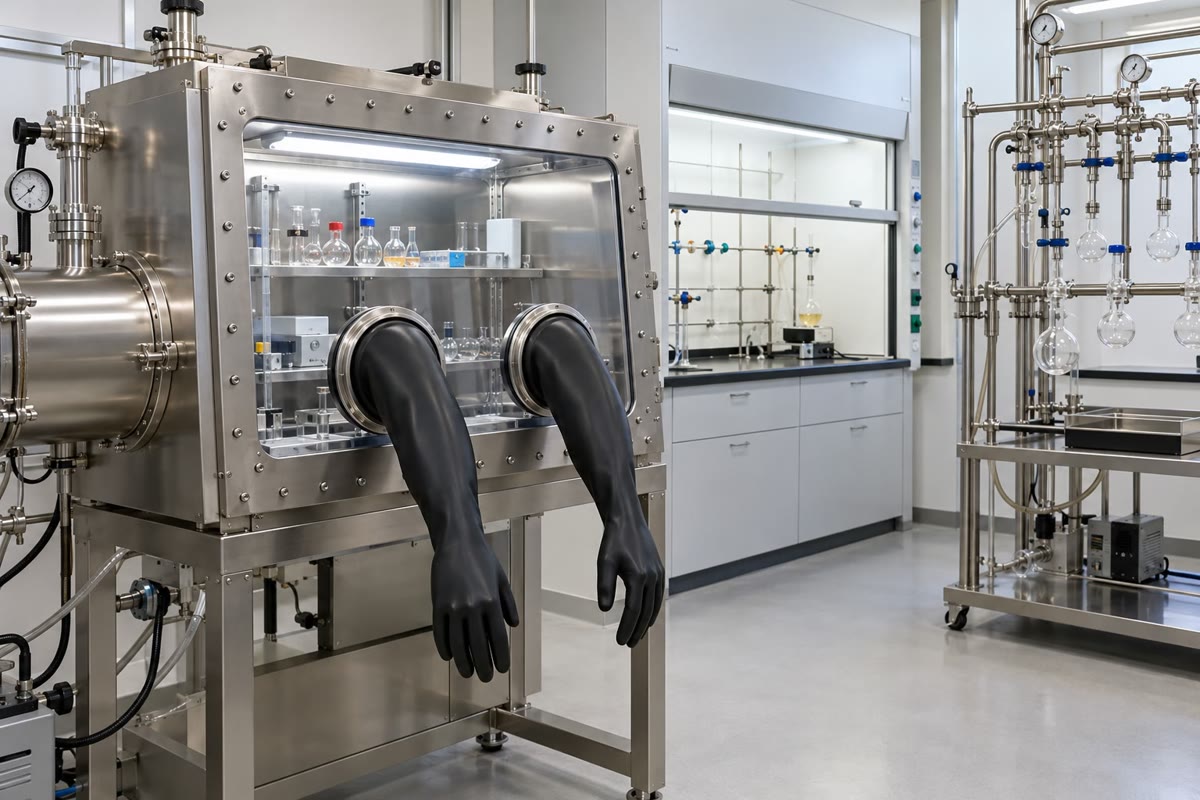
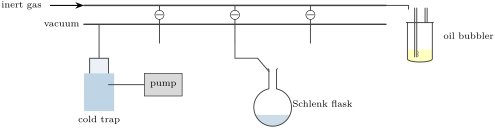
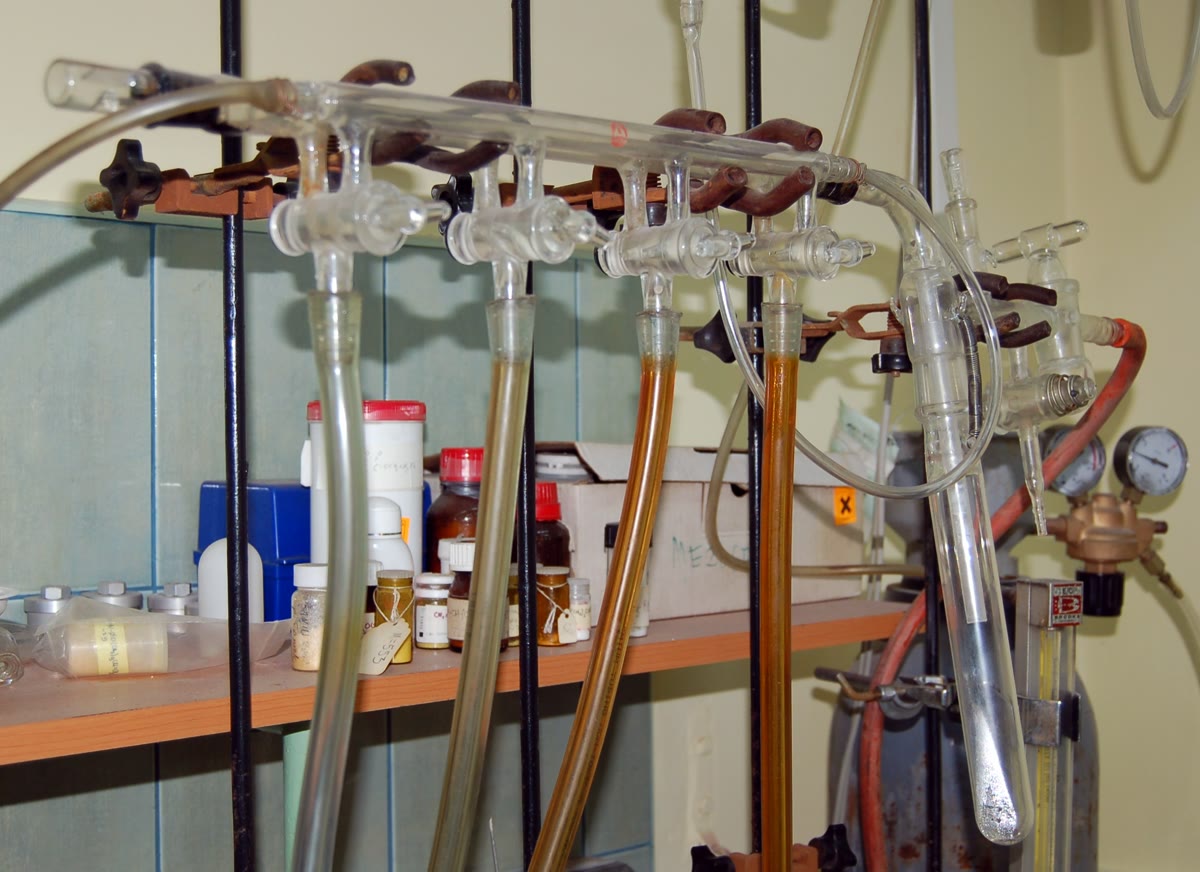
A Schlenk line is a double glass manifold, one tube connected to a vacuum pump through a cold trap, the other to a supply of dry inert gas vented through an oil bubbler, with taps that connect each outlet to either. A Schlenk flask has a side arm with a tap for connection to the line. A glovebox is a sealed box filled with inert gas, continuously purified, in which work is done through gloves.
Proposition 33.3 (Evacuate–refill cycles)
If a flask filled with air at pressure is evacuated to and refilled with pure inert gas, times, the fraction of the original air left is .
Proof. Evacuating to leaves a fraction of the gas, of the same composition; the refill with pure inert gas restores without adding air. Each cycle multiplies the air fraction by ; after cycles, . ∎
Three cycles to leave on paper of the air; in practice leaks, gas adsorbed on the glass and outgassing of grease and septa set the limit, which is why glassware is dried in an oven and assembled hot.
Definition 33.4 (Cannula transfer)
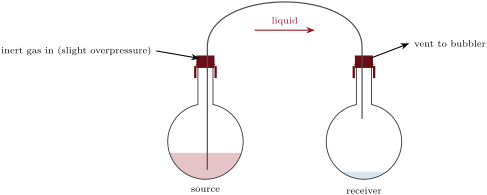
A cannula transfer moves an air-sensitive liquid from one sealed vessel to another through a long double-tipped needle, driven by a small overpressure of inert gas in the first vessel.
Method 33.5 (A cannula transfer)
- Put both flasks, sealed with septa, under inert gas on the Schlenk line.
- Purge the cannula with gas: insert one end into the source above the liquid until gas flows out of the other end, then insert that end into the receiver.
- Vent the receiver with a needle; push the cannula’s source end below the liquid surface: the overpressure drives the liquid across.
- To stop, lift the tip above the liquid; withdraw the cannula from the receiver first, and rinse it at once with a dry solvent, then with water, in the hood.
Definition 33.6 (Freeze–pump–thaw degassing)
Freeze–pump–thaw degassing removes dissolved gases from a liquid by freezing it in liquid nitrogen, evacuating the space above it, closing the tap and letting it thaw, so that dissolved gas escapes into the vacuum; the cycle is repeated three times.
Dry solvents now come from columns of activated alumina under inert gas rather than from stills over sodium. Organolithium solutions lose strength with time and are titrated before use, for instance against a weighed amount of diphenylacetic acid in dry THF: the first equivalent deprotonates the acid, the first drop in excess gives the yellow dianion.
Proposition 33.7 (Titre of an organolithium)
If a mass of diphenylacetic acid (molar mass ) needs a volume of an organolithium solution to reach the colour change, the concentration is .
Proof. Up to the end point each organolithium removes one proton from the acid; the colour appears when the acid is used up. The amounts are equal: . ∎
In the lab — The glovebox antechamber
Items go into a glovebox through its antechamber: they are placed inside, the outer door is closed, and the chamber is evacuated and refilled with the box’s gas three times, with a long final evacuation for porous items, which hold air; only then is the inner door opened from inside the box with the gloves. Solvents and open containers of volatile liquids are never pumped in the antechamber, and nothing that would poison the purifier (thiols, halogenated solvents) is opened inside without permission.
33.2 Characterising a new compound
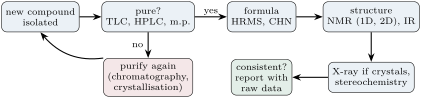
Method 33.8 (Characterising a new compound)
- Purity: one spot in TLC in two eluents, one peak in HPLC or GC, a sharp melting point; quantitative NMR if a mass purity is needed.
- Formula: HRMS within a few ppm of the calculated mass, and the isotope pattern; or elemental analysis.
- Structure: H and C NMR with 2D experiments for the connections (Chapter 8), IR for the functional groups; a single-crystal X-ray structure when crystals grow (Chapter 9).
- Stereochemistry: NOE, coupling constants, optical rotation, ee by chiral chromatography.
- Report every datum with its conditions, and the spectra in the supporting information.
Definition 33.9 (Elemental analysis)
Elemental analysis (combustion analysis) determines the mass percentages of carbon, hydrogen, nitrogen and sulfur in a sample by burning it in oxygen and measuring the carbon dioxide, water, dinitrogen and sulfur dioxide formed.
Proposition 33.10 (Mass percentages from a formula)
For a formula of molar mass , the mass percentage of carbon is , and likewise for the other elements.
Proof. One mole of compound, of mass , contains moles of carbon atoms, of mass ; the ratio, times 100, is the mass percentage. ∎
Most chemistry journals ask for found C, H and N values within 0.4 percentage points of the calculated ones, or for an HRMS measurement within a few ppm (5 ppm for some), as evidence of composition. A large interlaboratory study found that even pure samples miss the 0.4 criterion surprisingly often, a reminder that a criterion is not a law of nature.
Proposition 33.11 (HRMS error)
The error of a measured mass against the calculated is ppm; for an ion, is computed from monoisotopic masses minus (or plus) the mass of the electrons removed (or added).
By definition. The ppm error is the relative difference expressed in parts per million; the ion’s mass differs from the neutral formula’s by the electrons, each, a few ppm at masses of a few hundred. ∎
Definition 33.12 (Quantitative NMR)
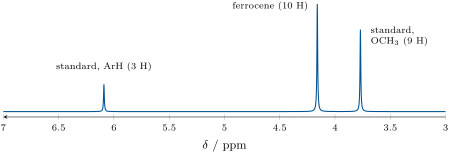
Quantitative NMR (qNMR) determines amounts or purities from signal integrals, which are proportional to the number of nuclei when the spectrum is recorded with full relaxation between pulses, against an internal standard of known purity weighed with the sample.
Proposition 33.13 (qNMR purity)
For a sample of mass weighed with a standard of mass and purity , with signals of integrals and from and protons,
Proof. The integrals are proportional to the numbers of protons: . With and , solving for gives the formula. ∎
33.3 Statistics of a research result
Definition 33.14 (Significance tests)
A significance test decides whether data are compatible with a null hypothesis, usually that there is no difference or no effect, at a chosen level of risk of rejecting it wrongly (often 5 %).
Theorem 33.15 (Two-sample test)
For two sets of and independent measurements drawn from normal distributions of equal standard deviation, with means , and pooled standard deviation , the statistic follows Student’s law with degrees of freedom when the two true means are equal.
Proof. Admitted at this level. ∎
Proposition 33.16 ( test)
Under the same assumptions, the ratio of two sample variances follows Fisher’s law with degrees of freedom when the true variances are equal.
Proof. Admitted at this level. ∎
Method 33.17 (Is a new yield better?)
- Repeat both procedures several times under the same conditions; record every result.
- Compare the spreads first ( test); if they are similar, pool them: .
- Compute and compare with Student’s coefficient for degrees of freedom at the chosen level.
- Larger: the difference is significant. Smaller: the data do not show one, which does not prove that there is none.
A suspect value is never deleted because it is inconvenient. Outlier tests flag it, but the decision rests on the notebook: a recorded cause (a weighing error, a contaminated flask) justifies rejecting it; without one, it is kept, or the experiment repeated.
33.4 The notebook, research data and the literature
Definition 33.18 (Notebook and raw data)
The laboratory notebook is the dated, continuous, unaltered record of the experiments made, as they were made. Raw data are the original records of measurements (instrument files, weighing tickets, spectra) before any processing.
Method 33.19 (Writing a notebook entry)
- Date, title, aim, and a reference to the previous related experiment.
- The reaction scheme with amounts (masses, volumes, moles, equivalents), reagent sources and batches, and the risk assessment.
- What was done and observed, in order and at the time, including what went wrong; never erase, strike through so that the original stays readable.
- Results: yields, the names of the raw data files, and a conclusion; sign it.
Definition 33.20 (FAIR data)
FAIR data are research data that are Findable, Accessible, Interoperable and Reusable: described with rich metadata and a persistent identifier, retrievable by standard protocols, in open formats, with a clear licence and provenance.
Definition 33.21 (Research integrity)
Research integrity is the honest and transparent conduct and reporting of research. Its gravest breaches are fabrication (inventing data), falsification (altering data, images or procedures) and plagiarism (presenting others’ work as one’s own).
Definition 33.22 (The literature)
The primary literature reports original research (articles, patents, theses); the secondary literature reviews and organises it (reviews, handbooks, databases), and textbooks form a tertiary layer. Peer review is the evaluation of a manuscript by independent experts before publication. The supporting information of an article holds the experimental details and data needed to repeat and check the work.
Method 33.23 (Reading a published procedure)
- Read the experimental section and the supporting information, not only the abstract and the scheme.
- Check the scale, concentrations, temperatures, times and work-up; note what is missing.
- Check the characterisation of the products against the method above.
- Look for later papers that used or corrected the procedure; run it first on a small scale.
Structure and reaction databases index the primary literature by compound and by transformation, and are searched by drawing a structure or a reaction rather than by words.
33.5 Risk assessment of a new procedure
Definition 33.24 (Risk assessment)
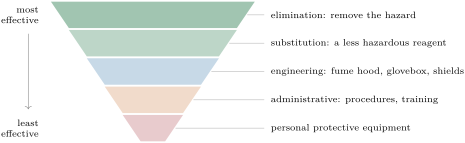
A risk assessment of a procedure identifies its hazards, estimates the likelihood and severity of harm in the planned conditions, and sets the controls that reduce the risk to an acceptable level. The hierarchy of controls ranks them from most to least effective: elimination, substitution, engineering controls, administrative controls, personal protective equipment.
Definition 33.25 (Peroxide formers)
A peroxide former is a compound, such as diethyl ether, tetrahydrofuran or 1,4-dioxane, that slowly forms explosive peroxides with air on storage, especially after opening and in light.
Method 33.26 (Assessing the risks of a new procedure)
- List every substance (reagents, solvents, products, by-products, gases released) with its hazards from the safety data sheet.
- List the operations and their conditions (heating, pressure, scale, quench, waste); estimate the heat released and the adiabatic temperature rise before scaling up.
- For each hazard, choose controls down the hierarchy; plan the emergency response (spill, fire, exposure) and the waste route.
- Write it down, have it checked, and review it after the first run.
Safety


Butyllithium solutions: pyrophoric, react violently with water releasing flammable gas, cause severe burns; handled only under inert gas, with a dry sand bucket at hand and no water nearby. Sodium hydride likewise releases hydrogen with water and moisture, and is used as a dispersion in oil. Diethyl ether and THF are highly flammable peroxide formers: dated on opening, tested for peroxides before distillation or evaporation, and discarded on schedule.
History — Schlenk’s glassware
Wilhelm Schlenk, studying organoalkali compounds and radicals in the 1910s, designed the flasks and techniques that let him handle them without air; the line and the flask still bear his name. The first gloveboxes were built in the 1940s for radioactive materials and soon adopted by chemists working with air-sensitive compounds.
33.6 Exercises
Exercise 33.1 ★
A flask is evacuated to and refilled to with argon three times. What fraction of the original air remains, in theory? What really limits the result?
Solution
Solution of Exercise 33.1.
. Leaks, gas adsorbed on the glass and outgassing of grease and septa leave far more than that; dry, hot glassware and good joints matter more than extra cycles.
Exercise 33.2 ★
A butyllithium solution has a titre of . What volume must be transferred to deliver ?
Solution
Solution of Exercise 33.2.
.
Exercise 33.3 ★
Compute the exact mass of the ferrocene radical cation from monoisotopic masses (C 12 exactly, H 1.00782503, Fe 55.93493633, electron ), and the error of a measured 186.0129 in ppm.
Solution
Solution of Exercise 33.3.
. Error: ppm, well within 5 ppm.
Exercise 33.4 ★
Classify as primary, secondary or tertiary literature: a review article, a journal article reporting a new synthesis, a patent, a handbook of physical constants, a thesis, a textbook.
Solution
Solution of Exercise 33.4.
Primary: the journal article, the patent, the thesis. Secondary: the review, the handbook of constants. Tertiary: the textbook.
Exercise 33.5 ★★
Compute the C, H and N mass percentages of caffeine, , and decide whether the found values C 49.31, H 5.22, N 28.71 % meet the usual 0.4-point criterion.
Solution
Solution of Exercise 33.5.
: C %, H %, N %. Differences 0.17, 0.07 and 0.16 points: within 0.4, the analysis supports the formula.
Exercise 33.6 ★★
A sample of of diphenylacetic acid () needs of a butyllithium solution to reach the yellow end point. Compute the titre.
Solution
Solution of Exercise 33.6.
; (two significant figures, set by the volume read).
Exercise 33.7 ★★
An old procedure gave yields of 72, 75, 71, 74 and 73 %; a modified one 76, 78, 75, 77 and 79 %. With Student’s coefficient 2.31 for 8 degrees of freedom at 95 % (data of the exercise), is the improvement significant?
Solution
Solution of Exercise 33.7.
Means 73.0 and 77.0 %; both standard deviations ; . , larger than 2.31: the improvement is significant at the 95 % level.
Exercise 33.8 ★★
Two methods give six results each, with standard deviations 0.80 and 0.30 (same units). With a critical of 5.05 for (5, 5) degrees of freedom at 95 % (data of the exercise), do their precisions differ?
Solution
Solution of Exercise 33.8.
: the first method is significantly less precise.
Exercise 33.9 ★★
Propose a storage and testing plan for a laboratory’s bottles of THF and diethyl ether.
Solution
Solution of Exercise 33.9.
Buy small bottles with inhibitor, date each on receipt and on opening, store closed, dark and cool; test for peroxides before any distillation or evaporation and at fixed intervals after opening; dispose of bottles past their date, or positive, through the hazardous-waste route without concentrating them.
Exercise 33.10 ★★★
A student plans to deprotonate an alcohol with sodium hydride in DMF at 60 °C on a 50 g scale. Identify the hazards (including the thermal ones of this solvent with the base) and choose controls down the hierarchy.
Solution
Solution of Exercise 33.10.
Hazards: hydrogen released (fire, pressure), the reactivity of NaH with water, and a known exothermic decomposition of DMF with sodium hydride that can run away on heating; DMF is also toxic to reproduction. Controls: substitute the solvent (THF or 2-methyltetrahydrofuran) or the base; if kept, run small first, at low temperature, adding NaH in portions with the temperature followed, in a hood behind a shield, venting through a bubbler, with a cooling bath ready; written procedure, a second person present, protective equipment last.
Exercise 33.11 ★★★
Propagate the relative standard uncertainties of , (0.50 % each), and ( on 20.0 and 15.0 mg) and (0.10 %) through the qNMR formula, and give the relative uncertainty of . Which term dominates?
Solution
Solution of Exercise 33.11.
Relative contributions: 0.50, 0.50, , and 0.10 %; combined %. The two integrals dominate: better signal-to-noise and careful baseline and phase correction matter more than the balance.
Exercise 33.12 ★★★
Five titrations give 81.2, 82.0, 80.6, 81.5 and 89.0 (in mL). A Dixon test gives against a critical value of 0.71 (data of the exercise). Should the last value be rejected? Explain what you would check first.
Solution
Solution of Exercise 33.12.
: the test flags it. Before rejecting it, check the notebook for a cause (a misread burette, an air bubble, a different batch of titrant); if one is found, reject it and say why; if not, keep it, report the test, or repeat the measurement.
33.7 Problem: From Flask to Paper
Problem 33.1
Weekend problem — from flask to paper, a new air-sensitive compound: the synthesis of ferrocene under nitrogen, its characterisation, its purity by quantitative NMR, and the risk assessment of the procedure
Data of the problem. Anhydrous iron(II) chloride (5.00 g) reacts with sodium cyclopentadienide (two equivalents, from cyclopentadiene and sodium hydride in THF) under nitrogen; 5.86 g of orange ferrocene, , are isolated. The flasks are purged by three cycles to from . HRMS gives 186.0129 for ; elemental analysis C 64.41, H 5.47 %. In , ferrocene gives a singlet at 4.16 ppm (10 H). For qNMR, 20.0 mg of the sample and 15.0 mg of 1,3,5-trimethoxybenzene (purity 99.9 %, aromatic singlet at 6.09 ppm, 3 H) give , with relative standard uncertainties 0.50 % for each integral, for each mass and 0.10 % for .
Part I — Synthesis under nitrogen.
- Write the equation of the synthesis.
- Why must the reaction be run without air?
- Compute the theoretical mass of ferrocene and the yield.
- Compute the fraction of air left after the three purge cycles.
- How is cyclopentadiene obtained from its dimer, and why must it be used at once?
- Why is the sodium hydride added in portions?
Part II — Characterisation.
- Compute the exact mass of and the error of the measurement in ppm.
- Compute the C and H mass percentages and compare with the analysis.
- Why does ferrocene show a single H signal?
- What would C NMR show?
- Which further method would prove the sandwich structure?
- Is ferrocene itself air-sensitive once made? Compare with its precursors.
Part III — Purity by qNMR.
- Why choose 1,3,5-trimethoxybenzene as the standard here?
- What must the NMR acquisition guarantee for the integrals to be quantitative?
- Compute the molar masses of ferrocene and of the standard.
- Compute the purity of the sample.
- Compute its relative and absolute standard uncertainty.
- Is the elemental analysis consistent with this purity?
Part IV — Risks and a last measurement.
- List the hazards of the procedure.
- Choose controls for sodium hydride and for THF.
- How should the excess sodium hydride be destroyed at the end?
- What does a cyclic voltammogram of ferrocene show, and why is ferrocene used as a reference in electrochemistry?
- What must the notebook entry and the supporting information contain?
- Why should the raw spectra be archived in an open format?
- State the result: the qNMR purity of the ferrocene sample with its standard uncertainty.
Solution
Solution of Problem 33.1.
1. .
2. Sodium cyclopentadienide is destroyed by oxygen and water, and iron(II) chloride is oxidised to iron(III) in moist air.
3. ; ; yield %.
4. (in theory).
5. By heating the dimer, which undergoes a retro-Diels–Alder reaction, and distilling off the volatile monomer; at room temperature the monomer dimerises again by a Diels–Alder reaction, so it is kept cold and used at once.
6. Each portion releases hydrogen and heat: adding it slowly keeps the gas flow and the temperature under control.
7. ; error ppm.
8. C %, H %; found 64.41 and 5.47: differences and , within 0.4.
9. The ten hydrogens are equivalent by symmetry, and the rings rotate fast.
10. A single signal, all ten carbons being equivalent.
11. A single-crystal X-ray structure.
12. No: as an 18-electron complex (Chapter 20) it is stable in air, unlike its precursors.
13. Its signals do not overlap ferrocene’s, it is a pure, non-volatile, non-hygroscopic solid that can be weighed accurately, and it is inert towards the sample.
14. Full relaxation of every signal between scans (a delay of several ), a uniform excitation, enough signal-to-noise, and careful phase and baseline correction.
15. Ferrocene ; 1,3,5-trimethoxybenzene .
16. : 98.0 %.
17. Relative %; absolute percentage point.
18. Yes, but weakly: a 2 % impurity of similar composition changes C and H by less than the analysis can detect; qNMR is the more informative purity measurement.
19. Sodium hydride (hydrogen with water, fire), hydrogen evolved, THF and cyclopentadiene (highly flammable; THF a peroxide former), hot cracking of the dimer, iron(II) chloride (irritant), and ferrocene (flammable solid, harmful).
20. Sodium hydride: weighed as an oil dispersion under inert gas, added in portions to a stirred, cooled solution, the gas vented through a bubbler, no water near. THF: dry and peroxide-free from a column, used in the hood under nitrogen.
21. Under inert gas and with cooling, by slow addition of isopropanol, then ethanol, then water, waiting each time until gas evolution stops.
22. A reversible one-electron wave, , with peaks about 59 mV apart at (Chapter 15); the couple is fast, stable and nearly insensitive to the solvent, which makes it a convenient internal reference.
23. The notebook: date, scheme, amounts and sources, the risk assessment, what was done and seen, yields and the file names of the raw data. The supporting information: the full procedure and all characterisation data with copies of the spectra.
24. So that others, and the authors years later, can reopen and re-process them whatever software they have: findable, accessible, interoperable and reusable.
25. The qNMR purity of the ferrocene sample is % (standard uncertainty).