Primary & Middle School Earth and Space Sciences · Grades 1–9
1Watching the Weather
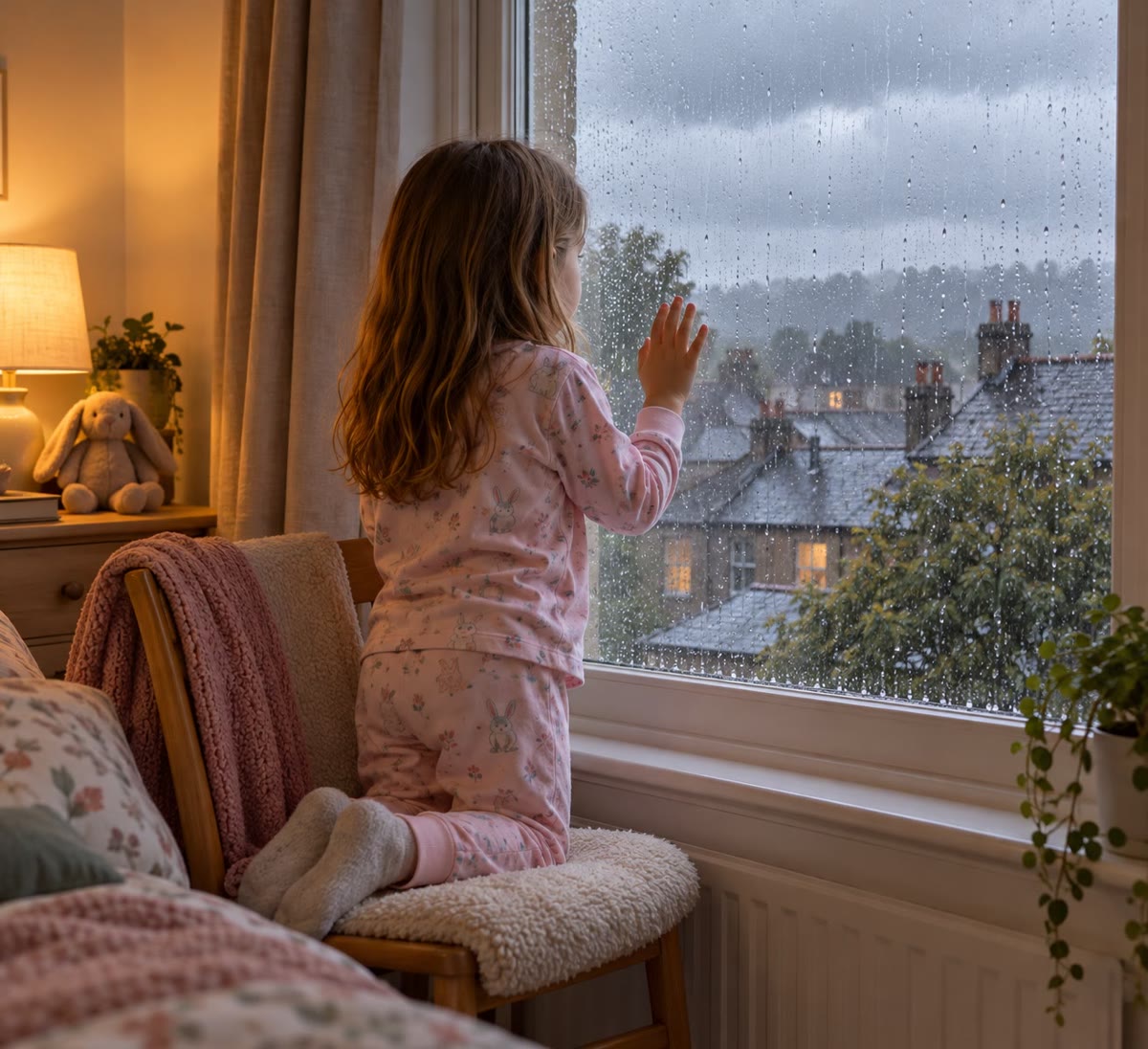
It is early in the morning. Lena wakes up, climbs onto the chair by her bedroom window and looks outside. The sky is grey. Little drops of water run down the glass. The roofs across the street are wet and shiny, and the tree in the garden is dripping.
“What shall I wear today?” she asks.
To answer, Lena does not need a book or a machine. She only needs to look out of the window. The window is her first weather station.
You already know
Every morning the Sun rises, and the day begins; every evening it sets, and the night comes. In the physics books you have seen why day follows night. In this chapter we look at something else that changes all the time: the weather.
1.1 What is the weather?
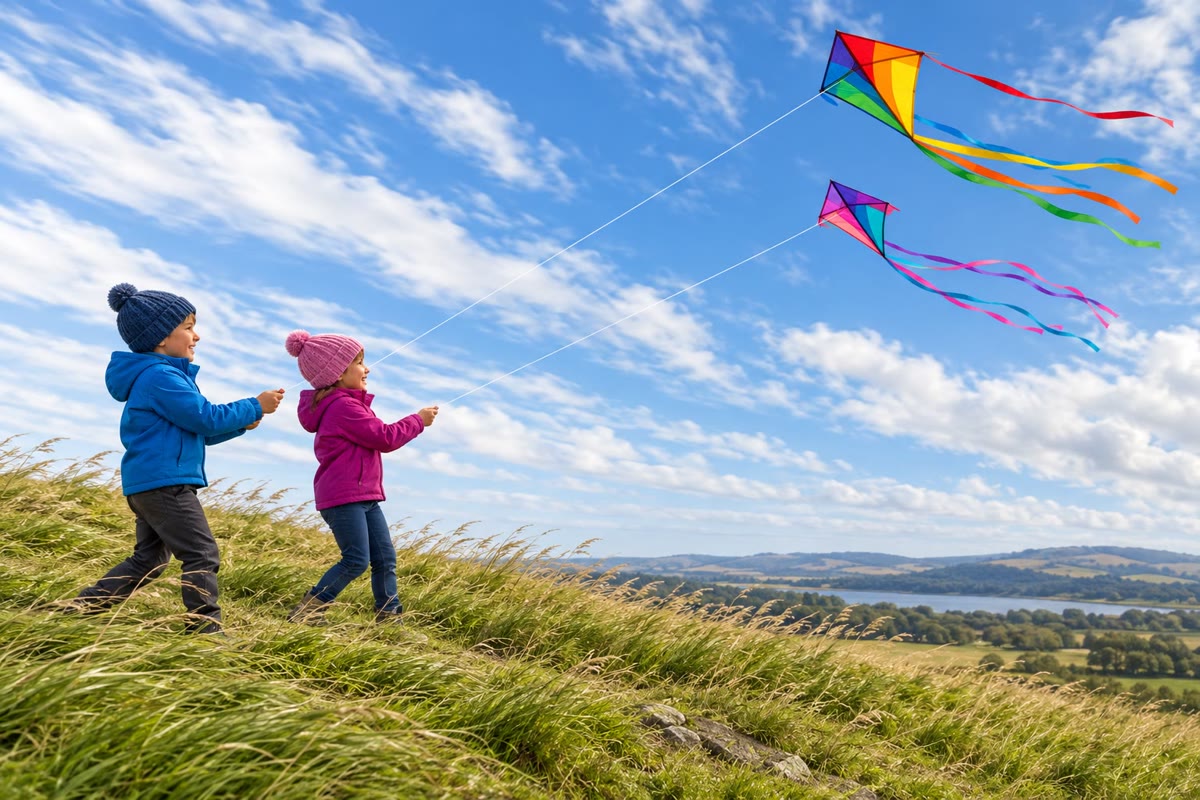
When we go outside, we feel the air on our face. It may be warm or cold. It may be still, or it may push our hair and our clothes: then there is wind. We look up at the sky. It may be blue and bright, or covered with clouds. Sometimes rain falls from the clouds, sometimes snow. All of this together is the weather.
Definition 1.1 (Weather)
The weather is what the air and the sky are like in one place at one moment: sunny or cloudy, dry or rainy or snowy, calm or windy, warm or cold.
To describe the weather, we answer a few simple questions:
- What does the sky look like? Is it blue, with the Sun shining? Are there a few clouds, or is the sky all grey?
- Is anything falling from the sky? Rain? Snow? Nothing?
- Is there wind? Do the leaves of the trees move? Does a flag flap?
- Is it warm or cold? Do we need a coat?



Example 1.2 (Fog)
On some mornings the air itself looks white, and the trees at the end of the street seem to disappear. This is fog. Fog is a cloud that touches the ground. When the day warms up, the fog often goes away.
1.2 Weather symbols and the weather chart
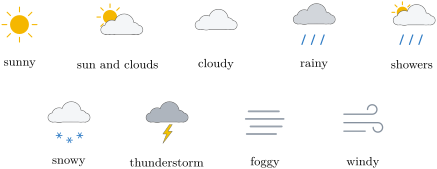
Drawing the weather with words takes a long time. People who watch the weather use small pictures instead: weather symbols. Each symbol is easy to draw and easy to recognise.
Definition 1.3 (Weather chart)
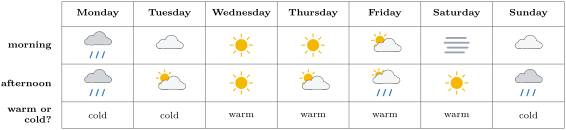
A weather symbol is a small drawing that shows one kind of weather. A weather chart is a table in which we write down, day after day, the weather we have seen, with weather symbols.
A class can keep a weather chart for a whole week. Every morning, and again every afternoon, one child looks outside and draws the symbol in the right box. We also write whether it is warm or cold.
Method 1.4 (Reading a weather chart)
To read a weather chart:
- find the column of the day you want;
- look at the row: morning, or afternoon;
- name the weather that the symbol shows.
To find how many days were sunny, run your finger along a row and count the sun symbols.
Example 1.5 (Reading the class chart)
On the chart of this class, Monday morning was rainy and cold. On Wednesday it was sunny all day. On Saturday a fog in the morning gave way to sunshine in the afternoon. In the mornings of the week, the class drew the sun on 2 days: Wednesday and Thursday.
1.3 The weather changes
The weather does not stay the same. It changes during the day, from one day to the next, and over the year.
- During one day. A grey morning can turn into a sunny afternoon. A clear blue morning can end with a storm. In the early morning and at night it is usually cooler than in the afternoon.
- From one day to the next. Look at the class chart: no two days of the week are exactly the same.
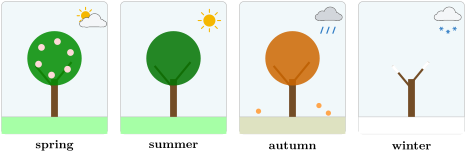
- Over the year. In summer the days are usually warm, and in winter they are usually cold; in many places snow falls only in winter. The physics books explain why the seasons come back every year.

Remark 1.6 (Where the wind comes from)
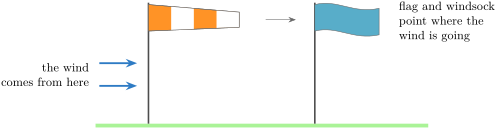
We cannot see the wind, but we can see what it does. A flag, a windsock or the smoke from a chimney is pushed by the wind: they point to where the wind is going, so the wind comes from the other side.
1.4 Why do we watch the weather?
Many people need to know what the weather will be like.
- Farmers watch the sky before they cut the hay: rain would spoil it. In spring they fear a frosty night that could kill the young plants.
- Sailors and fishermen watch the wind: a strong wind makes big waves, and boats stay in the harbour.
- Pilots need to know about fog, storms and wind before an aeroplane takes off.
- A class that goes on an outing to the forest wants to know whether to take raincoats or sun hats.
Every day, people called meteorologists watch the weather all over the world and tell us, on the radio, on television or on a phone, what the weather will probably be like in the next days.
Example 1.7 (Signs in the sky)
Long before radios and phones, people learnt to read the sky. When small white clouds grow, in the afternoon, into tall dark towers, a shower or a thunderstorm is coming. When the wind turns and the sky slowly fills with a grey veil, rain often follows a few hours later. These signs are not always right, but they are often useful.
1.5 Dressing for the weather
Now Lena can answer her question. It is raining and it is cold, so she will wear her raincoat and her boots. Tomorrow the weather may be different, and she will choose again.
Method 1.8 (Choosing clothes for the weather)
Look at the sky and feel the air, then:
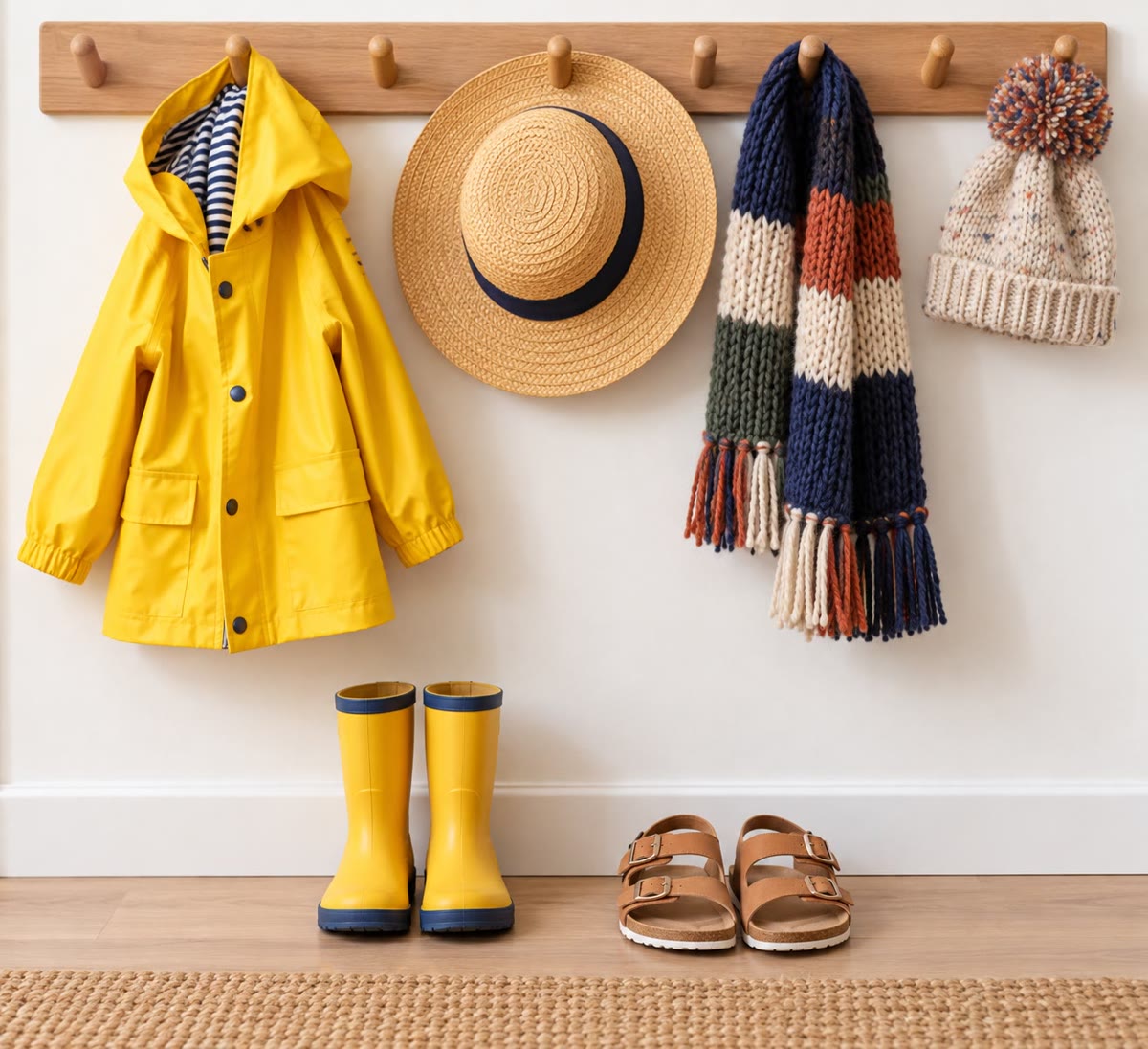
- rain or showers: a raincoat or an umbrella, and boots;
- cold or snow: a warm coat, a scarf, a hat and gloves;
- strong sunshine and heat: a sun hat, light clothes, and water to drink;
- wind: a coat that closes well; an umbrella is not much help.
Safety
Never look straight at the Sun, not even for a moment, and never through glasses, binoculars or a camera: it can hurt your eyes for ever. When there is a thunderstorm, stay indoors or in a car, keep away from tall trees and from water, and wait until the storm has passed.
1.6 Exercises
Exercise 1.1 ★
Draw the symbol for each kind of weather: sunny; rainy; snowy; cloudy.
Solution
Solution of Exercise 1.1.
Sunny:  rainy:
 snowy:
 cloudy:
 . Any clear drawing of a sun, a cloud with drops, a cloud with snowflakes and a cloud alone is right.
Exercise 1.2 ★
What is the weather like in each of the four pictures of the section “What is the weather?”? Use one or two words for each.
Solution
Solution of Exercise 1.2.
The park: sunny and warm. The street: snowy and cold. The hill: windy (and some clouds). The school gate: foggy.
Exercise 1.3 ★
Look at the class weather chart. What was the weather on Tuesday morning? On Friday afternoon? On Sunday afternoon?
Solution
Solution of Exercise 1.3.
Tuesday morning: cloudy. Friday afternoon: showers. Sunday afternoon: rainy.
Exercise 1.4 ★
On the class weather chart, on which day was it sunny in the morning and in the afternoon?
Solution
Solution of Exercise 1.4.
Wednesday: the sun is drawn in the morning and in the afternoon. (On Thursday the afternoon has sun and clouds.)
Exercise 1.5 ★
Match each piece of clothing with a weather: a sun hat; boots and a raincoat; a scarf and gloves. The weathers are: cold and snowy; hot and sunny; rainy.
Exercise 1.6 ★
Lena says: “Look, the flag is flapping!” What kind of weather is it?
Exercise 1.7 ★
True or false? Explain.
- The weather is always the same in the morning and in the afternoon.
- Fog is a cloud that touches the ground.
- The rule “never look at the Sun, not even with one eye” is a good rule.
Solution
Solution of Exercise 1.7.
- False: the weather can change during the day, for example a grey morning and a sunny afternoon.
- True.
- True: the Sun is so bright that it can hurt the eye for ever, even in a moment.
Exercise 1.8 ★★
On the class weather chart, count the afternoons with rain or showers. Count the cold days. Was the week mostly warm or mostly cold?
Solution
Solution of Exercise 1.8.
Afternoons with rain or showers: Monday (rain), Friday (showers) and Sunday (rain), so 3. Cold days: Monday, Tuesday and Sunday, so 3. The other 4 days were warm, so the week was mostly warm.
Exercise 1.9 ★★
Here is what Sam saw from his window during one day: in the morning, a grey sky; at lunchtime, drops on the window; in the evening, a blue sky with a few clouds. Draw the three weather symbols in the right order.
Solution
Solution of Exercise 1.9.
Morning: (grey sky); lunchtime: (rain); evening:  (blue sky with a few clouds).
Exercise 1.10 ★★
On the picture of the windsock and the flag, the wind comes from the left. On another day, a flag points to the left. From which side does the wind come that day?
Solution
Solution of Exercise 1.10.
A flag points to where the wind is going. If it points to the left, the wind is going to the left, so it comes from the right.
Exercise 1.11 ★★
Look at the drawing of the same tree in the four seasons. In which season does the tree have no leaves? In which season does it have blossom? Which weather symbol is drawn for winter, and why does it fit that season?
Solution
Solution of Exercise 1.11.
No leaves: in winter. Blossom: in spring. Winter has the snow symbol: in winter it is cold, and in many places snow falls only in that season.