书籍暂未推出简体中文版——当前显示英文版。
Primary & Middle School Earth and Space Sciences · 1–9 年级
7Clouds, Rain and Snow
It is a hot summer afternoon. At lunchtime the sky was blue, with a few small white clouds like balls of cotton wool. By three o’clock, one of them has grown. It swells upwards, higher and higher, like a white cauliflower standing on a flat grey base. Its top spreads out. Its base turns dark. A gust of cool wind blows, the first big drops fall, and for twenty minutes it pours. Then the cloud moves away, the sun comes back, and the wet pavements steam.
Where did that cloud come from? What is it made of? And how much rain fell in those twenty minutes?
You already know
The weather is the state of the air at a given place and time: sunny, cloudy, rainy, snowy, windy, foggy; we write it down on a weather chart (Chapter 1). Water from the sea, the lakes and the ground goes up into the air, and comes back down as rain (Chapter 3). The physics books tell how water evaporates (liquid to an invisible gas), condenses (gas back to tiny drops of liquid) and freezes (liquid to ice), and how a thermometer measures the temperature in degrees Celsius.
7.1 What is a cloud?
The air around us always holds some water, as an invisible gas: water vapour. When air rises, it cools. When it cools enough, part of its water vapour condenses into droplets of water so tiny that the slightest breath of air keeps them floating. Billions of these droplets, side by side, make a cloud we can see. High up, where the air is very cold, the droplets freeze, and the cloud is made of tiny pieces of ice.
Definition 7.1 (Cloud and fog)
A cloud is a great number of tiny droplets of water, or tiny pieces of ice, floating together in the air. Fog is a cloud that touches the ground.
Example 7.2 (Your breath on a cold morning)
On a cold morning, your breath makes a little white cloud in front of your mouth. The air you breathe out is warm and holds water vapour. The cold air cools it at once, the vapour condenses into tiny droplets — and a miniature cloud appears, then vanishes as the droplets evaporate again.
A cloud is white because its droplets scatter the sunlight in every direction. When it is very thick, little light gets through to its base, and from below it looks grey, or nearly black: that is the sign of a heavy cloud, full of water.
7.2 The cloud families
Clouds take many shapes, and weather observers all over the world sort them in the same way, by their shape and by how high they float.
Definition 7.3 (Cloud families)
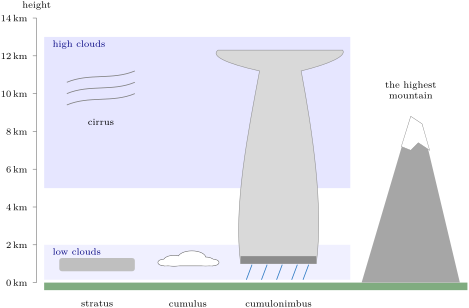
The four cloud families to know are:
- cumulus: heaped clouds, white and puffy, with a flat base, like balls of cotton wool;
- stratus: layered clouds, a flat grey sheet that covers the whole sky, low down;
- cirrus: wispy clouds, thin white threads or curls, very high, made of ice;
- cumulonimbus: the storm cloud, a huge tower that rises from a low dark base to a very great height, and whose top often spreads out flat.
The names are Latin words: cumulus means a heap, stratus a layer, cirrus a curl of hair, and nimbus a rain cloud.
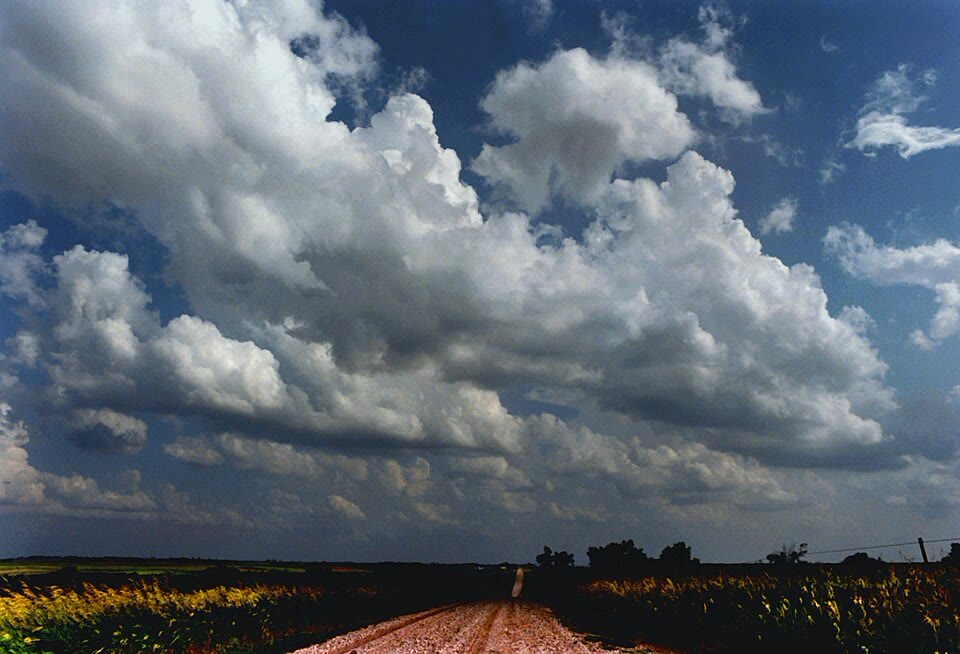
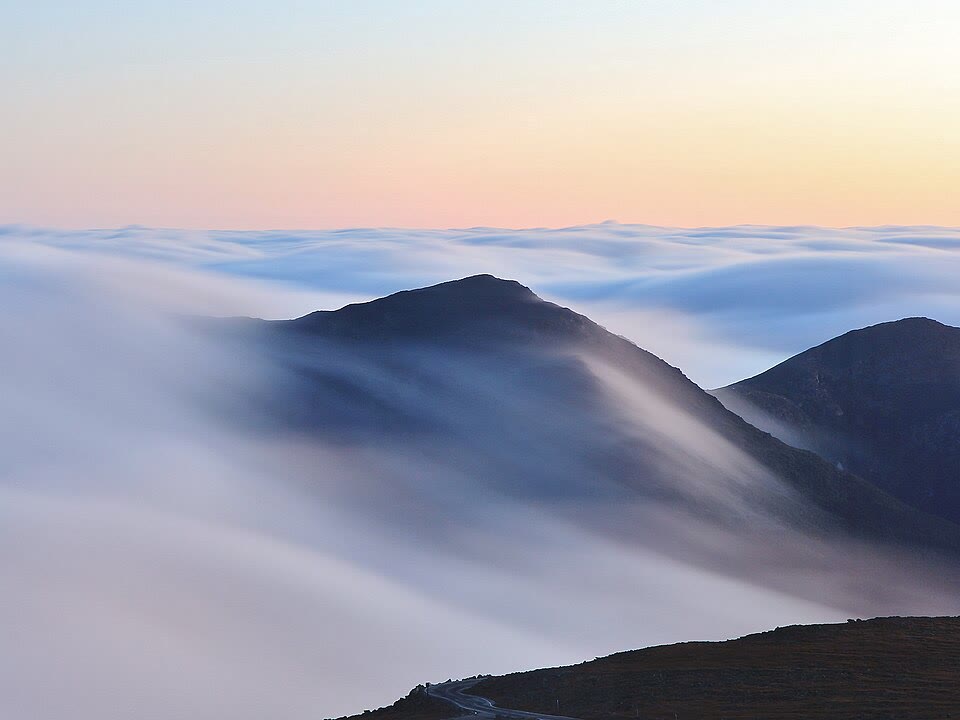
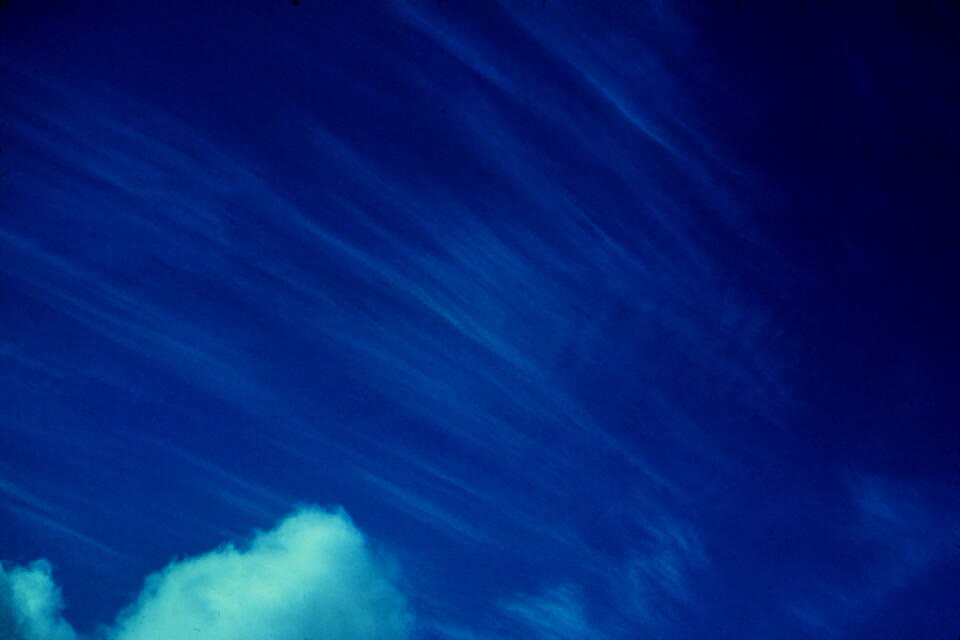
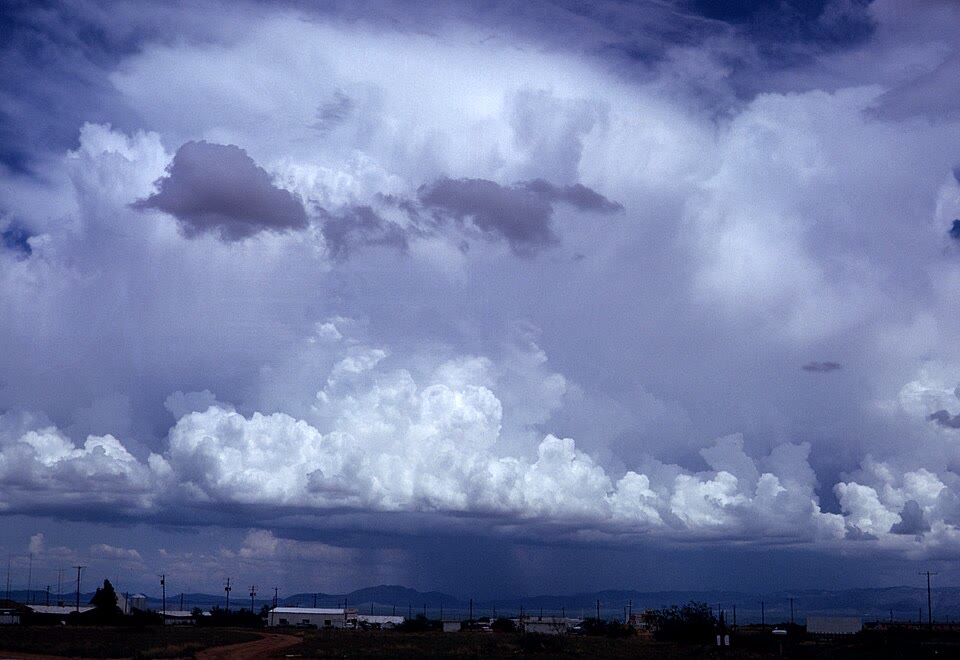
How high do clouds float? It depends on the family. Low clouds, like stratus and the base of cumulus, float from just above the ground up to about 2 kilometres. Cirrus float very high, between about 5 and 13 kilometres outside the tropics and the polar regions — often higher than the highest mountain on Earth. A cumulonimbus stretches all the way from a low base to the very top of the cloud levels.
Method 7.4 (Naming a cloud)
Look at the sky and ask three questions:
- Is it a heap with a flat base? Then it is a cumulus — and if it rises into a huge dark tower, a cumulonimbus.
- Is it a flat, even sheet that hides the whole sky? Then it is a stratus.
- Is it made of thin white threads, very high? Then it is a cirrus.
Remark 7.5 (Clouds tell the weather)
Small cumulus in a blue sky mean fair weather. A grey stratus brings a dull day, sometimes with drizzle. A cumulonimbus brings a short, heavy shower, often with thunder, lightning and gusts of wind — sometimes hail. Cirrus bring no rain, but when they spread and thicken, rain often follows a day later.
7.3 Rain, snow and hail
Inside a cloud, the tiny droplets bump into one another and join, or ice crystals grow at the expense of the droplets. A cloud drop, or a crystal, that has grown big and heavy enough can no longer float: it falls.
Definition 7.6 (Precipitation)
Precipitation is water that falls from a cloud to the ground: rain (drops of liquid water), snow (flakes made of ice crystals stuck together) or hail (balls of ice, called hailstones, that fall from storm clouds).
Whether it rains or snows depends on the temperature of the air the precipitation falls through. Snowflakes form high in the cold cloud. If the air below is above for long enough, they melt on the way down and reach us as rain. If the air is freezing all the way to the ground, they arrive as snow.

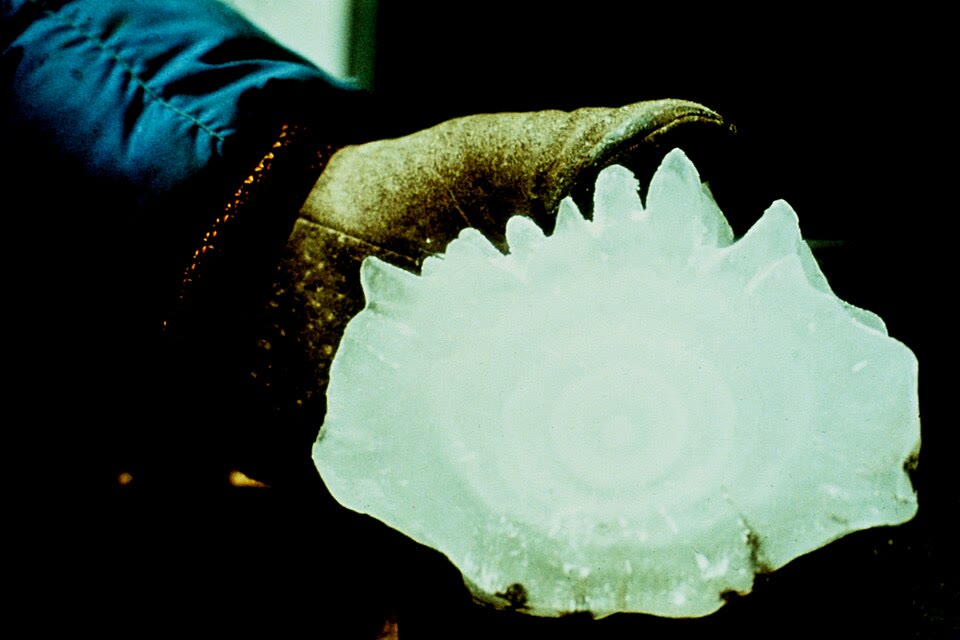
Hail falls only from cumulonimbus. Inside the tower, strong upward winds carry ice pellets up and down several times; each trip adds a new layer of ice, like the layers of an onion, until the hailstone is too heavy for the wind to hold.
7.4 Measuring the weather
To say how much it rained, how warm it was or where the wind blew from, words are not enough: we need instruments, and numbers.
Definition 7.7 (Rain gauge)
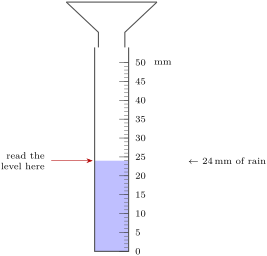
A rain gauge is a container that collects the rain falling on its opening. The depth of water it collects is measured in millimetres: “5 millimetres of rain” means that the rain would have made a layer of water 5 millimetres deep on flat ground, if none of it had run off or soaked in.
Remark 7.8 (A millimetre of rain is a lot of water)
A millimetre of rain looks tiny in the gauge. But on a square of ground one metre by one metre, it is one litre of water: a big bottle. On a school playground of one thousand square metres, a rain of 10 millimetres brings ten thousand litres: enough to fill a thousand buckets of 10 litres each.
Definition 7.9 (Wind vane)
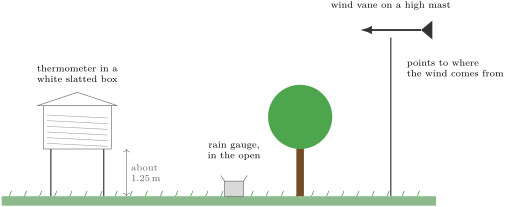
A wind vane is an arrow that turns freely on a mast. The wind pushes its tail, so the arrow always points to the direction the wind is coming from.
Definition 7.10 (Weather station)
A weather station is a place where the weather is measured every day, always in the same way, with instruments: a thermometer in a ventilated white box, a rain gauge in the open, a wind vane on a mast.
The thermometer is kept in the shade, in a white box with slatted sides that let the air through but keep out the sunshine and the rain. The Met Office, the weather service of the United Kingdom, sets it above the ground. The rain gauge stands in the open, away from walls and trees that would shelter it from the rain, its opening a little above the ground. The wind vane stands high on its mast, above the obstacles that would turn the wind.
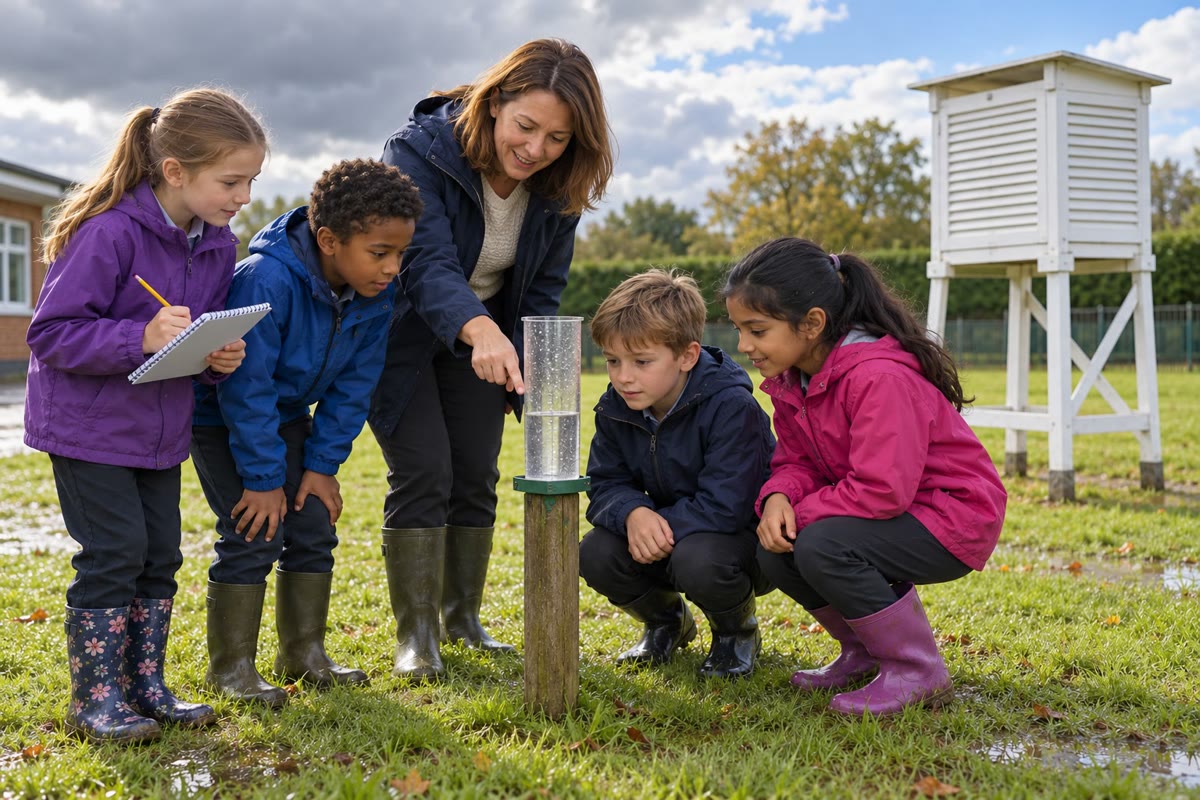
In the field — A weather station in the schoolyard
Many schools keep a small weather station in a corner of the playground. Every morning at the same time, two pupils read the thermometer, read and empty the rain gauge, and note where the wind vane points. Over the weeks, the class builds a record of its own weather.
Method 7.11 (Drawing a bar chart of the rain)
To draw the rain of a week:
- draw a horizontal line and write the days under it, equally spaced;
- draw a vertical line on the left and mark it in millimetres, with equal steps (for example every 2 millimetres);
- above each day, draw a bar as high as the rain of that day; a day with no rain gets no bar at all;
- give the chart a title and write the unit, mm, on the vertical line.
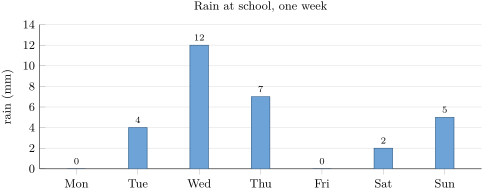
Example 7.12 (A week of rain at school)
The class read the rain gauge every morning for a week and found: Monday 0, Tuesday 4, Wednesday 12, Thursday 7, Friday 0, Saturday 2, Sunday 5 millimetres. The wettest day was Wednesday. It did not rain on Monday nor on Friday. In the whole week, millimetres fell. Wednesday alone brought 12 of the 30 millimetres, that is of the week’s rain.
7.5 Exercises
Exercise 7.1 ★
Exercise 7.2 ★
Name the cloud: (a) a flat grey sheet that hides the whole sky; (b) thin white threads very high in a blue sky; (c) white heaps with flat bases, like cotton wool; (d) a huge dark tower with a flat top, bringing thunder.
Exercise 7.3 ★
Rain, snow or hail? (a) balls of ice that fall from a storm cloud; (b) drops of liquid water; (c) flakes made of ice crystals.
Exercise 7.4 ★
Which instrument measures: (a) the rain; (b) the temperature; (c) where the wind comes from?
Exercise 7.5 ★
In the rain gauge drawn on page 45, the water now reaches the mark 17. How many millimetres of rain have fallen? How many more millimetres would bring it to 20?
Solution
Solution of Exercise 7.5.
17 millimetres of rain have fallen. : 3 more millimetres would bring the water to the mark 20.
Exercise 7.6 ★
Look at the bar chart on page 46. Which day was the wettest? On which days did it not rain? Which day had 7 millimetres?
Solution
Solution of Exercise 7.6.
The wettest day was Wednesday (12 millimetres). It did not rain on Monday and on Friday. Thursday had 7 millimetres.
Exercise 7.7 ★★
On the morning of a snowy day, the snowflakes reach the ground in the mountain village, but in the valley below it rains. Explain the difference, using the temperature of the air.
Exercise 7.8 ★★
Another week, the class finds: Monday 3, Tuesday 0, Wednesday 1, Thursday 9, Friday 6, Saturday 0, Sunday 1 millimetres. Draw the bar chart. How many millimetres fell in the week? Which fraction of the week’s rain fell on Thursday?
Solution
Solution of Exercise 7.8.
The bar chart has seven bars of heights 3, 0, 1, 9, 6, 0 and 1 (no bar on Tuesday and Saturday). In the week, millimetres fell. Thursday brought 9 of the 20 millimetres: of the week’s rain.
Exercise 7.9 ★★
Why must the rain gauge stand in the open, far from walls and trees? Why is the thermometer kept in a white box in the shade, and not in full sun?
Solution
Solution of Exercise 7.9.
Walls and trees shelter the ground near them from the rain, especially when the wind blows the rain sideways, and drops can drip from leaves into the gauge: near them the gauge would catch too little, or too much. The thermometer has to measure the temperature of the air; in full sun it would be warmed by the sunshine itself and would read too high. The white slatted box keeps the sun off and lets the air through.
Exercise 7.10 ★★
The wind vane points to the west. Where does the wind come from? Where is it going?
Solution
Solution of Exercise 7.10.
A wind vane points to where the wind comes from: the wind comes from the west. It is going towards the east.
Exercise 7.11 ★★★
On a playground of 500 square metres, 8 millimetres of rain fall. Using Remark 7.8, how many litres of water fell on the playground? A watering can holds 10 litres: how many watering cans is that?
Solution
Solution of Exercise 7.11.
One millimetre of rain on one square metre is one litre. On one square metre, 8 millimetres give 8 litres. On 500 square metres: litres. With watering cans of 10 litres: watering cans.