Primary & Middle School Earth and Space Sciences · Grades 1–9
30Resources from the Earth
A smartphone fits in a pocket, yet it holds dozens of chemical elements: copper for its wires, neodymium for the magnets of its speaker, gallium for the light of its screen, indium for the thin coating of its screen that carries electricity, and many more. Every one of them was dug out of the ground somewhere on the Earth. A house holds far more: an average family house needs about a hundred tonnes of sand, gravel and crushed stone, and its share of the streets and schools around it about three times as much. Where in the Earth are these materials found, and why there?
You already know
In chemistry, you learn that the materials we take from nature are resources; an ore is a rock from which a metal can be extracted; a renewable resource is renewed by nature as fast as we use it; coal, oil and natural gas are fossil fuels; and oxygen, silicon, aluminium and iron are the most abundant elements of the crust. Groundwater fills the pores of an aquifer, and rain refills it (Chapter 17). Sediments pile up in layers and become sedimentary rocks (Chapter 21), over times counted in millions of years (Chapter 22).
30.1 Why a metal has to be concentrated
Copper is everywhere: an ordinary rock holds a little of it, a few grams in every hundred kilograms. But to get one kilogram of copper out of such a rock, you would have to dig, crush and treat tonnes of it. Mining is worth the cost only where nature has gathered the metal into a much richer rock.
Definition 30.1 (Ore deposit and concentration factor)
An ore deposit is a body of rock in which natural processes have concentrated a metal or a mineral enough for it to be extracted at a profit. The concentration factor of a metal is the number of times its content in the ore is greater than its average content in the crust:
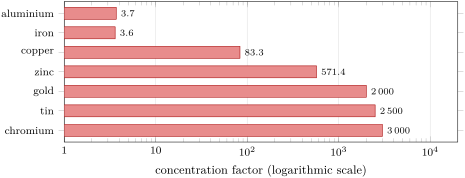
The common metals of the crust, aluminium and iron, need to be concentrated only about four times. Copper needs about 80 times, zinc about 600 times, and the rarest metals of the chart, gold, tin and chromium, thousands of times. The rarer a metal in the crust, the more nature has to work to make an ore of it, and the fewer places where it has done so.
Example 30.2 (Copper)
The crust holds on average of copper; a copper ore can be mined from about . The concentration factor is , about 80, or close to . Another textbook takes () for ordinary rock and for the ore: . The two numbers differ, but both say the same thing: a copper ore is about a hundred times richer than ordinary rock.
Method 30.3 (Computing a concentration factor)
30.2 How ore deposits form
Nature concentrates metals in several ways. Three of them are shown below.
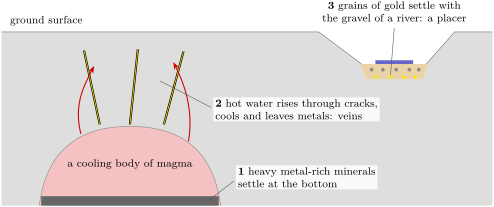
In the magma. When a body of magma cools, the minerals that crystallize first are not always the lightest. In magmas from the mantle, heavy minerals rich in nickel and copper sink to the bottom and gather into a rich layer. Most of the nickel mined in the world comes from deposits of this kind.
In cracks, from hot water. Groundwater that flows near a body of magma, a few kilometres below the surface, is heated and rises through the cracks of the rock. Hot water dissolves metals from the rocks it crosses. When it reaches cooler rock nearer the surface, the metals come out of the water as minerals and fill the cracks: these are veins. Many gold deposits are veins of this kind. Around some bodies of magma, hot water has crossed a whole mass of broken rock and left copper in it, spread out but over a huge volume: these are the largest copper deposits in the world.
In river gravels. Gold does not rust and hardly weathers. When erosion wears down a gold vein, the gold is freed as dust, flakes, grains and sometimes nuggets, and rivers carry it downstream. Gold is very dense: about pure, against about for ordinary rock. In floods, when the whole bed of sand and gravel moves, the heavy grains of gold work their way down and collect on the bedrock. Geologists call such deposits placers.
30.3 Coal, oil and gas
Coal, oil and natural gas are the remains of living things, buried before they could rot. Almost all the organic matter of a dead plant or animal is turned back into carbon dioxide within weeks to decades. Only the part cut off from the oxygen of the air, at the bottom of a stagnant swamp or of a deep sea, can be buried and kept for millions of years.
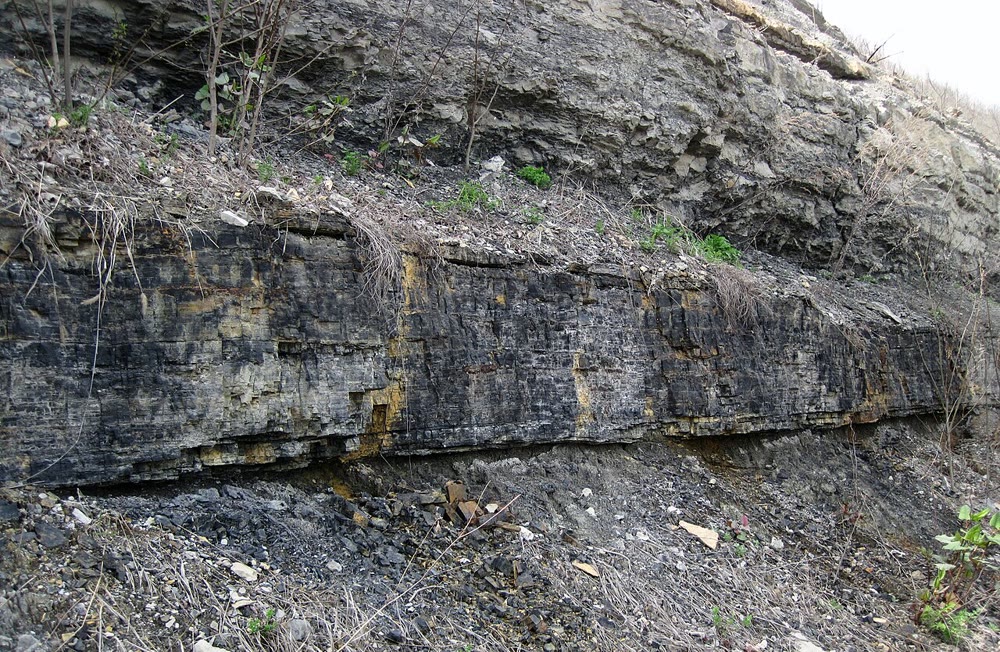
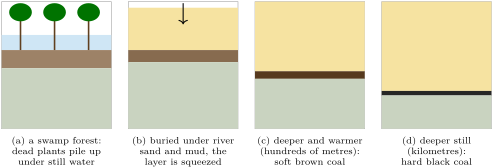
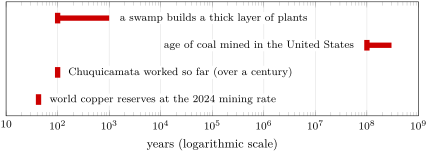
Coal. Coal starts in swamps beside rivers and deltas, in warm and wet climates, where plants grow fast. Dead trunks and leaves fall into still water that holds little oxygen, and do not rot. The swamp has to last for centuries to millennia to build a thick layer. One day a river changes course or floods, and covers the swamp with sand and mud. As more sediments pile up, the plant layer is pressed and heated, and turns into coal: first a soft, brown coal with about a third of carbon, some hundreds of metres down; a hard black coal, with up to 86 % of carbon, a few kilometres down. The coal mined today in the United States, for instance, is mostly 100 to 300 million years old.
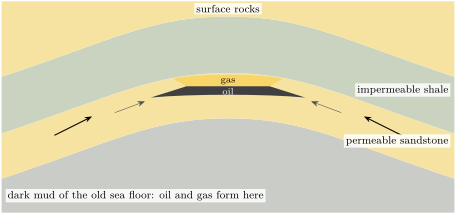
Oil and gas. Oil and most natural gas come from the tiny plants and animals that live in the sea, such as diatoms. Their remains sink with the mud to the sea floor, and some are buried before they decay. Millions of years and kilometres of sediment later, heat and pressure change them: below about , between about 60 and , into oil; hotter still, into gas. Oil and gas are lighter than water. They creep slowly upwards through the pores of permeable rocks, and many reach the surface and are lost. The ones we find were stopped on their way by a layer of impermeable rock, often at the top of an upfold, where they gather: gas at the top, oil below it, and water underneath.
30.4 Water from the ground
Groundwater is also a resource from the Earth, the one we use every day. Unlike a metal or coal, it is renewed: rain refills the aquifers. But it is renewed slowly, and only as fast as rain soaks in. An aquifer pumped faster than it is refilled sees its water table fall, and wells run dry (Chapter 17). Groundwater is a renewable resource only as long as it is not drawn faster than it is renewed.
30.5 Sand and gravel
The solid material that people dig out of the ground in the largest amounts is neither coal nor a metal ore: it is sand and gravel.
Definition 30.4 (Aggregate)
Aggregates are the sand, the gravel and the crushed stone used in building: in concrete, under roads and railways, and to fill the ground.
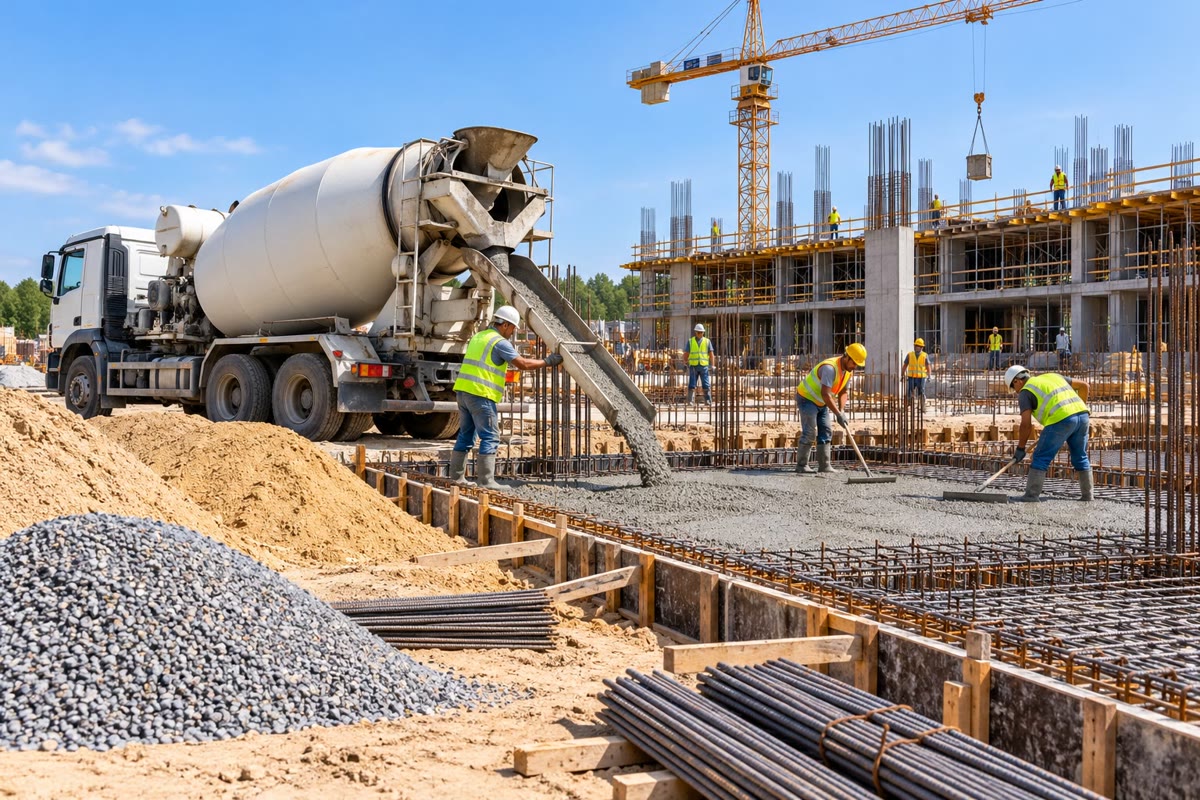
Most sand goes into concrete, a mix of sand, gravel, water and cement. In 2019 the world needed about 50 billion tonnes of sand and gravel a year, that is tonnes, or about for every person on the Earth, every day. Sand and gravel are dug from pits on land, from riverbeds and, more and more, from the sea floor. Taken from a river, they leave less sand to reach the coast, and beaches downstream wear away.
30.6 Renewable or finite?
A resource that nature renews within a human lifetime, like the water of an aquifer that is not overpumped, can be used for ever. An ore deposit, a coal seam or an oil field took millions of years to form. We use it in a few decades: on our time scale, it is not renewed at all.
How long will a resource last? Geologists count only what is known and can be extracted.
Definition 30.5 (Reserve)
The reserve of a mineral resource is the part of the known deposits that can be extracted at a profit, with the techniques and the prices of the day.
A reserve is not everything that is in the ground. It grows when new deposits are found, when techniques improve or when prices rise, and it shrinks as the deposits are mined. In 1970 the world’s copper reserves were estimated at 280 million tonnes. Since then, about 700 million tonnes of copper have been mined, two and a half times that reserve, and yet the reserves of 2024 were estimated at 980 million tonnes.
Figures as of 2025
In 2024 the mines of the world produced about 23 million tonnes of copper. At that rate, the reserves of 980 million tonnes would last years. Such a number is not a date when copper will run out: it is a measure of the copper that is known and worth extracting today.
A metal, unlike coal or oil, is not destroyed when it is used: the recycling of materials, met in the chemistry books, gives it back. The copper of an old cable, of a scrapped engine or of the offcuts of a factory can be melted and refined again. In the United States in 2024, copper recovered from scrap made up about of all the copper used.
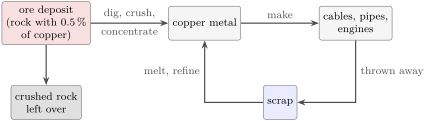
Example 30.6 (The rock that recycling saves)
An ore with of copper holds of copper in each tonne of rock. To make one tonne of copper, about tonnes of ore have to be dug, crushed and treated, and almost all of it ends as waste rock. Each tonne of copper made from scrap leaves those 200 tonnes of rock in the ground — and the deposit lasts longer.
30.7 Exercises
Exercise 30.1 ★
Complete with the right word (ore deposit, concentration factor, aggregate, reserve). (a) Sand used in concrete is an … (b) The part of the known copper that can be extracted at a profit today is the copper … (c) A rock where a metal is rich enough to be mined is an … (d) The number of times a metal has been concentrated is its …
Solution
Solution of Exercise 30.1.
(a) Aggregate. (b) Reserve. (c) Ore deposit. (d) Concentration factor.
Exercise 30.2 ★
Which way of concentrating a metal does each sentence describe: in the magma, in cracks from hot water, or in river gravels? (a) Gold nuggets lie on the bedrock under a stream’s gravel. (b) Hot water fills a crack with quartz and gold. (c) A layer of heavy nickel minerals lies at the bottom of an old body of magma. (d) Gold is freed from a vein by erosion.
Solution
Solution of Exercise 30.2.
(a) In river gravels. (b) In cracks, from hot water. (c) In the magma. (d) This is the first step of a river-gravel deposit: the freed gold is then carried by the river.
Exercise 30.3 ★
Put these steps in order: (a) the plant layer is buried under river sand; (b) trees grow in a swamp; (c) a hard black coal forms kilometres down; (d) dead plants pile up under still water; (e) a soft brown coal forms.
Solution
Solution of Exercise 30.3.
(b), (d), (a), (e), (c).
Exercise 30.4 ★
On the scale of a human life, is each resource renewable or not? Explain in one sentence. (a) Coal. (b) The water of an aquifer pumped less than the rain refills it. (c) Copper ore. (d) The same aquifer pumped twice as fast as it is refilled.
Solution
Solution of Exercise 30.4.
(a) Not renewable: it takes millions of years to form. (b) Renewable: the rain refills what is taken. (c) Not renewable: an ore deposit forms over very long times. (d) Not renewable at that rate: the water table falls and the wells end up dry.
Exercise 30.5 ★★
Compute the concentration factor, then write it as a power of ten, rounded: (a) zinc, in the crust, ore from ; (b) tin, in the crust, ore from ; (c) iron, in the crust, ore from . (d) Why does iron need so little concentration?
Exercise 30.6 ★★
Pure gold has a density of about ; ordinary rock about . (a) How many times denser is gold? (b) What is the mass of a grain of gold of , and of a grain of rock of the same size? (c) Explain why, in a flood, the gold ends up at the bottom of the gravel, on the bedrock.
Exercise 30.7 ★★
Use the chart of concentration factors. (a) Which metals need a factor of more than ? (b) Between which powers of ten does copper lie? (c) How many times more does chromium need to be concentrated than aluminium? (d) Which of the seven metals would you expect to find mined in the fewest places? Explain.
Solution
Solution of Exercise 30.7.
(a) Gold, tin and chromium. (b) Between and , close to . (c) times. (d) Chromium (or tin, or gold): the higher the concentration factor, the rarer the places where nature has concentrated the metal enough.
Exercise 30.8 ★★
The world needs about of sand and gravel per person and per day. (a) How much is that per person in one year, in tonnes? (b) Write 50 billion tonnes in scientific notation. (c) A truck carries . How many days does it take for one person’s share to fill it? (d) Why can taking sand from a river make a beach downstream shrink?
Exercise 30.9 ★★
(a) From what living things do most oil and gas come? (b) Below about , at what temperatures does oil form? (c) Why do oil and gas move upwards through the rocks? (d) What kind of rock stops them, and where do they gather?
Solution
Solution of Exercise 30.9.
(a) From tiny plants and animals of the sea, such as diatoms, buried in the mud of the sea floor. (b) Between about 60 and . (c) They are lighter than water, which fills the pores of the rocks. (d) An impermeable layer, such as shale; they gather under it, often at the top of an upfold, gas above oil.
Exercise 30.10 ★★
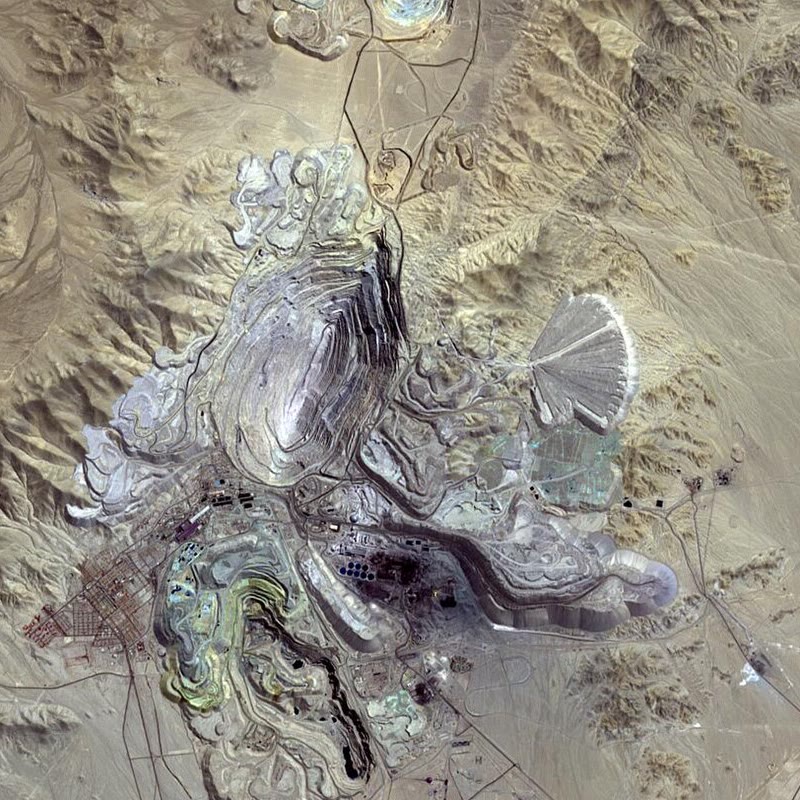
The Chuquicamata mine has produced over 29 million tonnes of copper in over 100 years. (a) Write 29 million tonnes in scientific notation. (b) Roughly what is the average production per year? (c) If the ore held of copper, how many tonnes of ore were dug to get 29 million tonnes of copper? Use scientific notation. (d) Why does a mine of such a poor ore have to be so large?
Solution
Solution of Exercise 30.10.
(a) tonnes. (b) tonnes a year, roughly. (c) The ore is 100 times heavier than the copper it holds: tonnes. (d) Every tonne of ore gives only of copper, so billions of tonnes of rock have to be dug.
Exercise 30.11 ★★★
In 1970, the world’s copper reserves were estimated at 280 million tonnes. From 1970 to 2024, about 697 million tonnes were mined, and the reserves of 2024 were 980 million tonnes, with 23 million tonnes mined in 2024. (a) If the 1970 reserve had been all the copper there was, when would it have run out? Compare with what was mined. (b) How many times larger is the 2024 reserve than the 1970 one? (c) Compute how many years the 2024 reserve would last at the 2024 rate. (d) Give two reasons why a reserve can grow even while it is being mined.
Solution
Solution of Exercise 30.11.
(a) At 23 million tonnes a year it would have lasted about years, until the early 1980s; yet 697 million tonnes were mined, much more than that reserve. (b) times. (c) years. (d) For example: new deposits are discovered; better techniques or higher prices make poorer deposits worth mining.
Exercise 30.12 ★★★
A coal seam is years old. Its swamp lasted years, and the seam is mined out in 50 years. (a) Write 50 years in scientific notation. (b) How many times longer than the mining did the swamp last? (c) How many times older than the time of mining is the seam? (d) Use these numbers to explain why coal is called a non-renewable resource.
Solution
Solution of Exercise 30.12.
(a) years. (b) times. (c) times. (d) The coal took millions of times longer to form than we take to use it: nature does not renew it on our time scale.
30.8 Problem: Concrete for a new town
Problem 30.1
Weekend problem — a new town is built with the sand of a local pit; the final answer is the number of years the pit’s sand reserve would last
A new town of homes is to be built in ten years, near an old sand pit dug in the gravels of a river terrace. Counting its share of the streets, the schools and the shops, each home needs about of aggregates, of which is sand. The pit’s sand layer is long, wide and thick; one cubic metre of its sand has a mass of . The pit also sells tonnes of sand a year to the rest of the region.
Part I — How much sand?
- A family house alone needs about of aggregates. Write this mass in kilograms, in scientific notation.
- How many tonnes of aggregates will the whole town need?
- How many tonnes is that per year, over the ten years?
- How many tonnes of sand per year does the town need?
Part II — The reserve.
- Compute the volume of the sand layer, in cubic metres, in scientific notation.
- A third of the layer lies under a village and a road and will not be dug. What volume can be extracted?
- What is the mass of this reserve, in tonnes?
- How many tonnes of sand will the pit sell each year, to the town and to the region together?
Part III — Renewable or not?
- Each year, the river brings about tonnes of new sand to the area. How many times more sand does the pit sell?
- On the scale of the town’s life, is this sand a renewable resource? Explain.
- If the town replaced a quarter of its sand with crushed old concrete, how many tonnes of sand would it save each year?
- Without that recycling, how many years would the pit’s sand reserve last?
Solution
Solution of Problem 30.1.
1. kg kg.
2. t t.
3. t per year.
4. t of sand per year.
5. m.
6. Two thirds of it: m.
7. t.
8. t t per year.
9. times more.
10. No: the pit is emptied 80 times faster than the river renews the sand. On the scale of the town, this sand is a finite resource.
11. t of sand a year.
12. : 20 years.