书籍暂未推出简体中文版——当前显示英文版。
Primary & Middle School Earth and Space Sciences · 1–9 年级
8Volcanoes and Earthquakes: A First Look
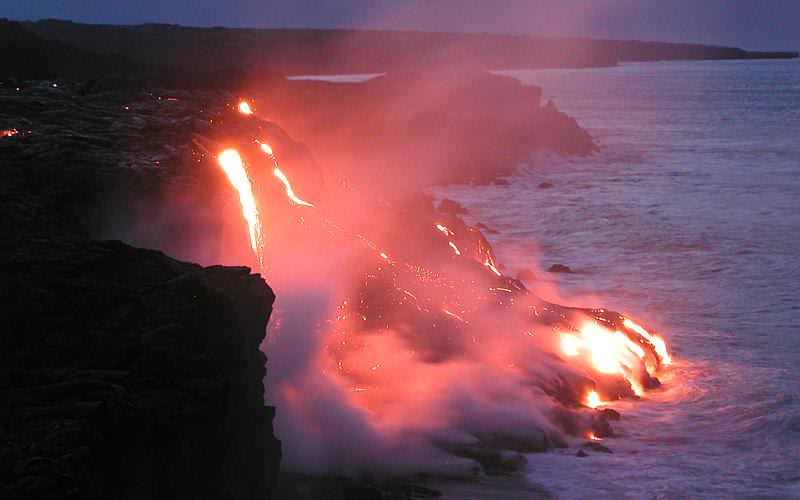
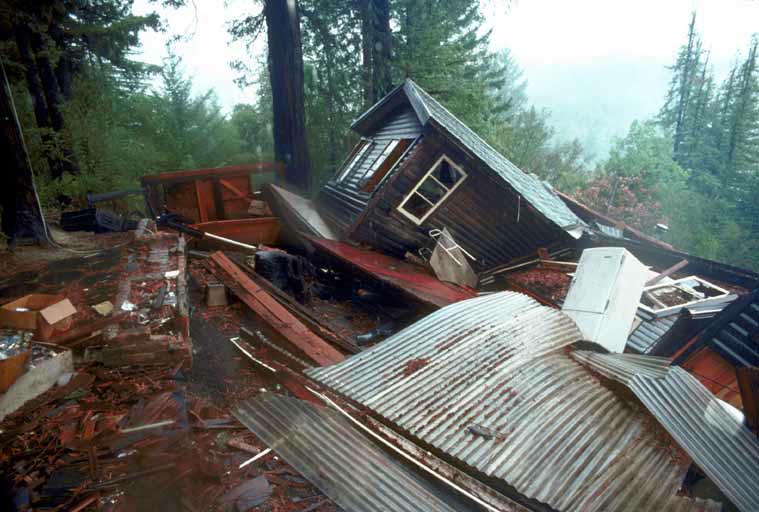
On Monday evening, the news shows a volcano on an island far away. In the dark, a fountain of glowing orange rock spurts from a crack in the ground, and rivers of fire flow slowly down the slope into the sea, hissing and steaming. On Thursday, the news shows another place: a small town where, at dawn, the ground shook for half a minute. Chimneys fell into the street, and one old house slid off its base.
Two very different events. Yet both come from deep inside the Earth, and, as we shall see, both happen far more often in some parts of the world than in others.
You already know
Mountains, hills, valleys and plains are the shapes of the land (Chapter 2). The Earth’s land is gathered in seven continents, between five oceans; the Pacific is the largest ocean (Chapter 6).
8.1 A volcano erupts
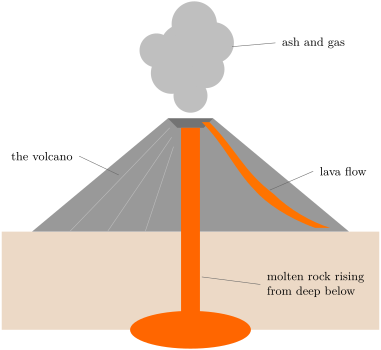
Deep under our feet, the Earth is very hot. In some places, rock down there is so hot that it has melted. This molten rock is lighter than the solid rock around it, so it slowly rises, like a cork in water. Where it finds a way out to the surface, a volcano is born.
Definition 8.1 (Volcano)
A volcano is a place where molten rock from deep inside the Earth comes out at the surface, and the hill or mountain that the molten rock builds there, layer after layer.
Definition 8.2 (Eruption, lava and volcanic ash)
An eruption is the time when a volcano throws out molten rock, ash and gas. Lava is molten rock that pours out onto the surface; it flows, then cools and hardens into new rock. Volcanic ash is made of tiny pieces of rock and glass blown into the air by an eruption; it falls back like a grey snow.
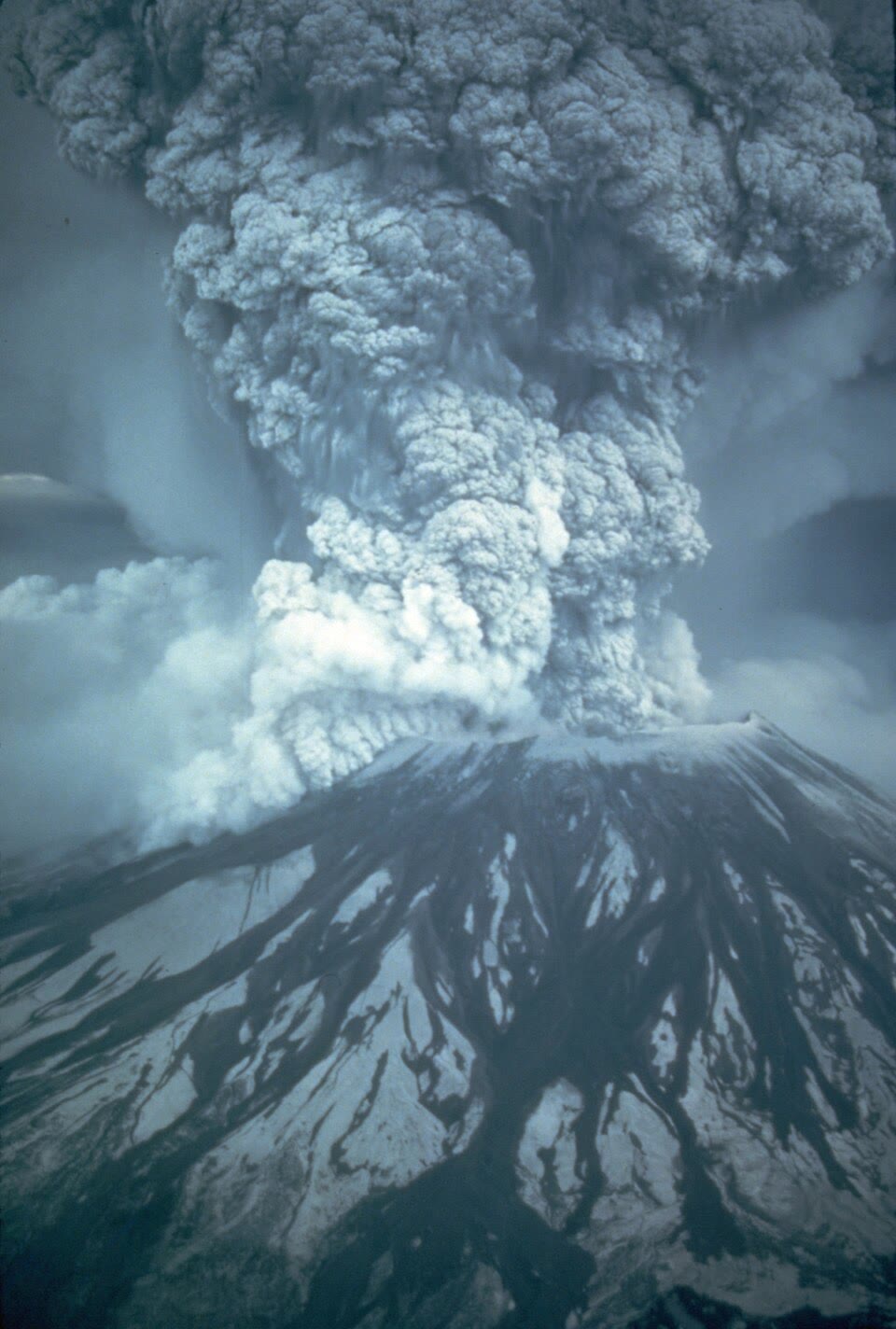
Not all eruptions look alike. In some, the lava is runny: it pours out quietly in glowing rivers that can flow for kilometres, sometimes all the way to the sea. In others, the molten rock is thick and full of gas, like a shaken bottle of fizzy drink: when it bursts out, it explodes into a huge column of ash that rises high into the sky.
Example 8.3 (Mount St. Helens, 1980)
In the spring of 1980, a bulge grew on the side of Mount St. Helens, as molten rock pushed up inside the mountain. On the morning of 18 May, a small earthquake shook the mountain, the bulge slid away in a giant landslide, and the volcano exploded sideways and upwards. The top 400 metres of the mountain were gone: the summit became a huge crater.
8.2 The ground shakes
The rocks deep under our feet are not perfectly still. Very slowly, they are pushed and pulled. They bend a little, like a ruler you push at both ends — until, suddenly, they break and slip. The jolt sends the ground shaking for kilometres all around.
Definition 8.4 (Earthquake)
An earthquake is a sudden shaking of the ground, caused by rocks that break and slip, deep underground.
An earthquake usually lasts only a few seconds, sometimes a minute or two for the largest. Most earthquakes are so small that nobody feels them: only instruments notice them. A strong one can make the ground roll like the deck of a ship, crack roads, and bring down walls and houses.
Remark 8.5 (How often?)
Geologists keep a list of all the large earthquakes on Earth. Over the 50 years from 1976 to 2025, the list counts 7 031 large ones (strong enough to damage buildings near them): about 141 in a year, or almost 3 every week. The very largest, which can destroy whole towns, are about 14 in a year. Over the same Earth, about 1 200 volcanoes have erupted in the last twelve thousand years or so.
8.3 Where volcanoes and earthquakes happen
If volcanoes and earthquakes happened anywhere at random, the dots on a world map would be sprinkled evenly over it. They are not.
The map below shows a striking pattern. Most volcanoes and most large earthquakes lie in long, narrow belts. The longest of all runs round the Pacific Ocean: from New Zealand up through Indonesia, the Philippines and Japan, across to Alaska, then all the way down the west coast of the Americas to the tip of Chile. Because of its many volcanoes, it is often called the “Ring of Fire”.
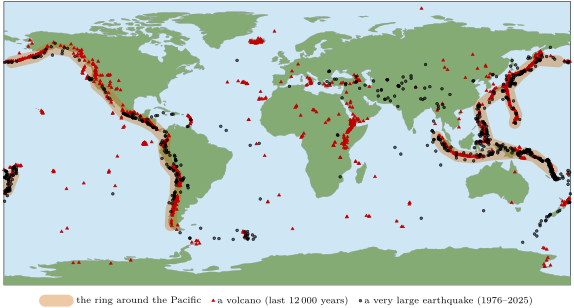
Other belts are smaller: one crosses southern Europe and Asia, from the Mediterranean Sea to the Himalaya; others run down the middle of the oceans, where volcanoes are hidden under the water. Some places, like Hawaii, have volcanoes far from any belt. Why the belts are where they are is a question for Chapter 18: the answer explains the shape of the whole map.
8.4 Staying safe
Nobody can stop an eruption or an earthquake. But knowing what to do saves lives.
Safety
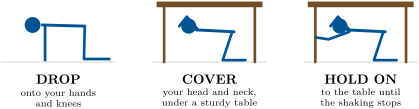
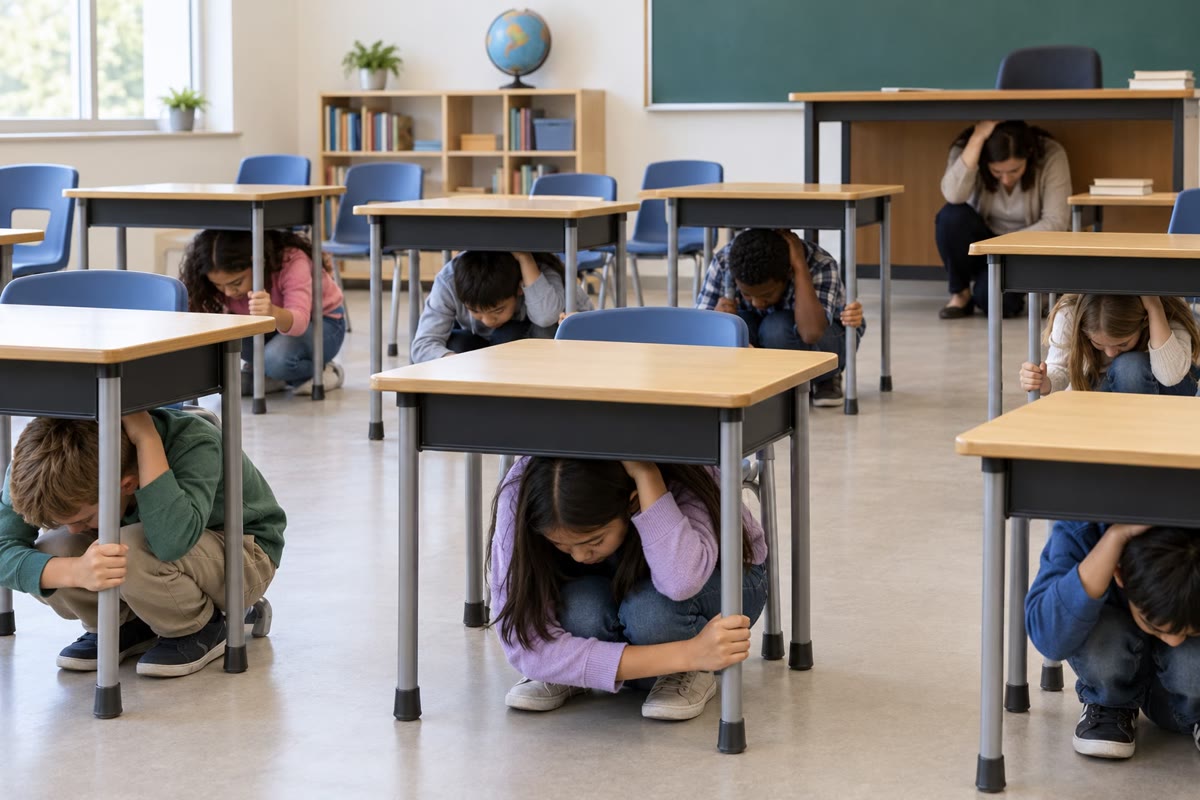
In an earthquake. As soon as you feel the ground shake: drop onto your hands and knees; cover your head and neck with your arm, and crawl under a sturdy table or desk if one is near; hold on to it until the shaking stops. Do not run outside while the ground shakes, and do not stand in a doorway: falling glass and objects are the main danger. When it stops, leave the building calmly, as you practise in school drills.
Near a volcano. Scientists watch volcanoes that may wake up. If they warn that an eruption is coming, the authorities tell people to leave the area. Follow their instructions at once, and never go closer to watch.
8.5 Exercises
Exercise 8.1 ★
Lava, ash or gas? (a) a river of glowing molten rock flowing down a slope; (b) tiny pieces of rock blown into the sky, that fall back like grey snow; (c) something invisible that escapes from the volcano with the ash.
Exercise 8.2 ★
What is an earthquake? Does it last hours, or seconds?
Solution
Solution of Exercise 8.2.
An earthquake is a sudden shaking of the ground, caused by rocks that break and slip deep underground. It lasts seconds (a minute or two for the very largest), not hours.
Exercise 8.3 ★
Put the three steps in order: hold on; drop; cover.
Solution
Solution of Exercise 8.3.
Drop, cover, hold on.
Exercise 8.4 ★
On the map on page 51, around which ocean do most volcanoes lie?
Exercise 8.5 ★
True or false? (a) Most earthquakes are too small to be felt. (b) Lava stays liquid for ever. (c) When the ground shakes, the safest thing is to run outside.
Exercise 8.6 ★
Look at the drawing of the volcano on page 49. Where does the molten rock come from? Where does it come out?
Exercise 8.7 ★★
On the map, find: (a) a country of the Americas with many volcanoes along its whole length; (b) a group of islands in the middle of the Pacific Ocean, with volcanoes, that is not on the ring.
Exercise 8.8 ★★
About 141 large earthquakes happen in a year. About how many is that in a month? (A year has 12 months; give a whole number.)
Solution
Solution of Exercise 8.8.
is a little less than 12 (because ): about 12 large earthquakes a month.
Exercise 8.9 ★★
About 3 out of every 4 very large earthquakes happen in the ring around the Pacific. Out of 20 very large earthquakes, about how many would you expect in the ring? And outside it?
Solution
Solution of Exercise 8.9.
Out of 20, a quarter is 5, so three quarters is : about 15 in the ring, and about outside it.
Exercise 8.10 ★★
During an earthquake drill, Leo runs to stand in the classroom doorway. What should he have done instead, and why?
Solution
Solution of Exercise 8.10.
He should have dropped onto his hands and knees, covered his head and neck under his table, and held on to it until the shaking stopped. A doorway does not protect him from falling or flying objects, and running while the ground shakes can make him fall.
Exercise 8.11 ★★★
Of the 1 214 volcanoes on the map, 837 are in the ring around the Pacific. How many are outside it? Is “about 2 out of 3” a good way to describe the share in the ring? (Hint: what is two thirds of 1 200?)
Solution
Solution of Exercise 8.11.
Outside the ring: volcanoes. A third of 1 200 is 400, so two thirds of 1 200 is 800. The ring holds 837, a little more than 800 out of about 1 200: “about 2 out of 3” is a good description.