Primary & Middle School Earth and Space Sciences · Grades 1–9
2Landscapes Around Us
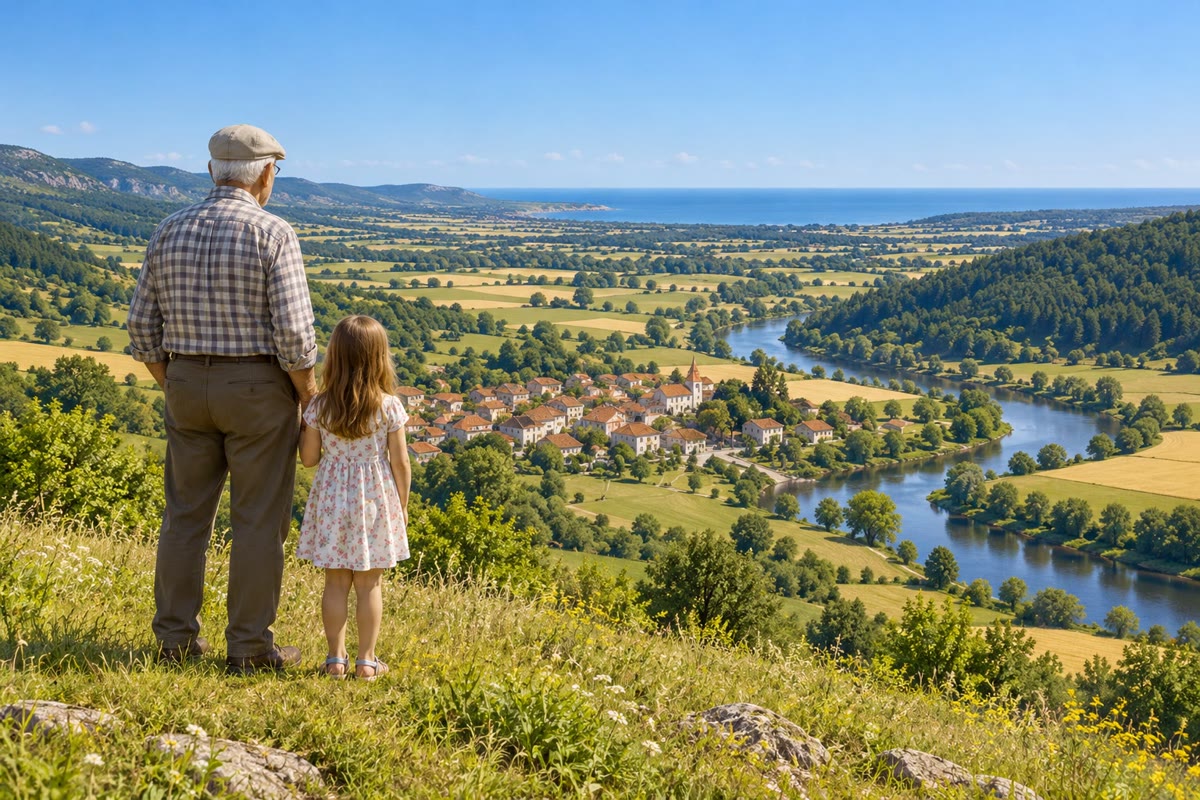
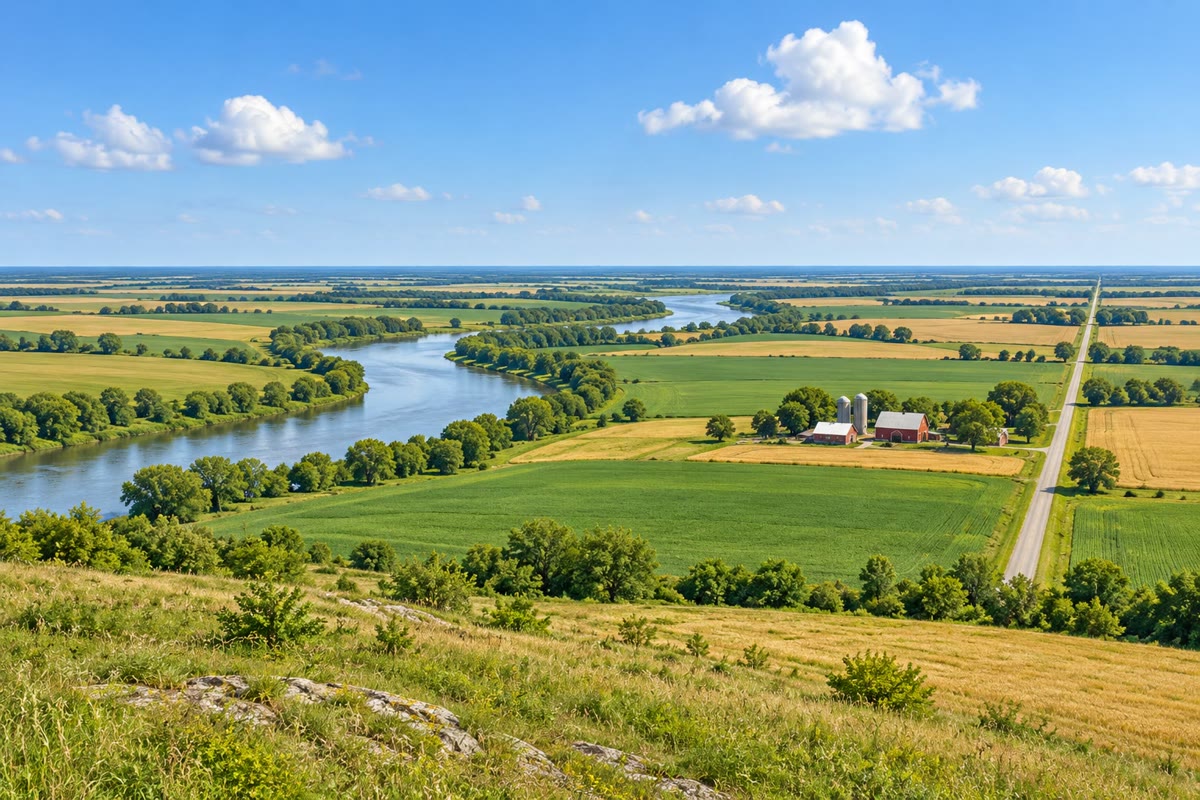
Mia and her grandfather have walked all the way up the hill behind the village. At the top they sit on the grass to catch their breath, and they look. Below them, the red roofs of the village crowd around the church. A river winds between green and yellow fields and passes under a bridge. There is a dark forest on the next hill. And far, far away, at the very end of the land, there is a thin line of blue.
“That is the sea,” says her grandfather.
Everything Mia can see from the top of the hill, near and far, is a landscape.
2.1 What is a landscape?
Definition 2.1 (Landscape)
A landscape is everything we can see of the land in one look, from where we stand to the far horizon: the shape of the ground, the water, the plants, and the things people have built.
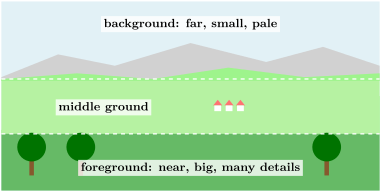
A landscape has parts that are near and parts that are far. The part nearest to us is at the bottom of what we see; it looks big and we see its details. The far part is at the top, close to the sky; it looks small and pale.
2.2 The shapes of the land
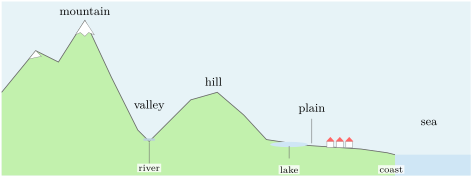
The ground is not flat everywhere. In some places it rises high into the sky; in others it goes down into long hollows; elsewhere it is flat as far as we can see. We give a name to each shape.
Definition 2.2 (Landforms)
A landform is a shape of the land’s surface.
- A mountain is a very high landform with steep slopes; its top is called the summit. The highest mountains have snow on top even in summer.
- A hill is a landform that rises above the land around it, lower and rounder than a mountain.
- A valley is a long, low hollow between hills or mountains; there is often a river at the bottom.
- A plain is a wide, flat, low stretch of land.
Example 2.3 (Mountain or hill?)
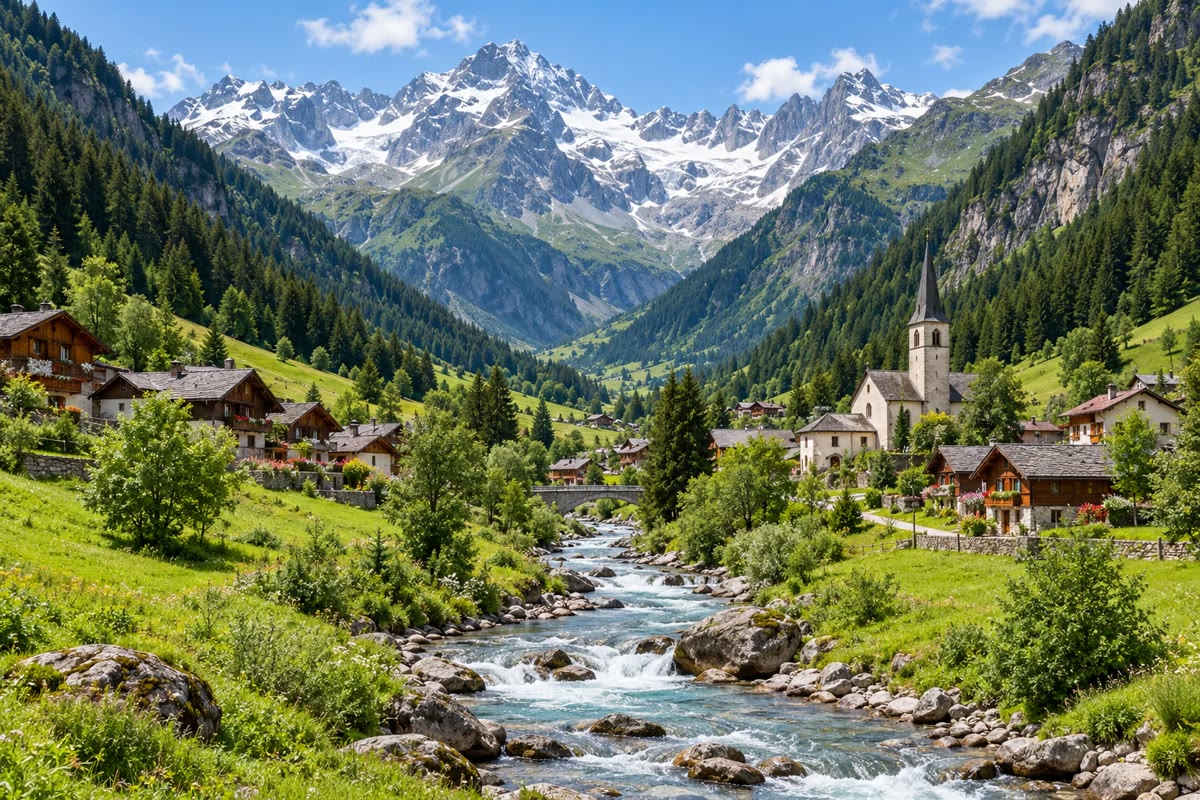
There is no exact height at which a hill becomes a mountain. We look at the shape: a mountain is high and steep, often rocky, sometimes with snow on top; a hill is lower and rounder, often covered with grass, fields or woods, and we can walk to its top in a short time.
2.3 Water in the landscape
Water is part of most landscapes. It flows down from the hills and the mountains, gathers in hollows, and reaches the sea.
Definition 2.4 (Water in a landscape)
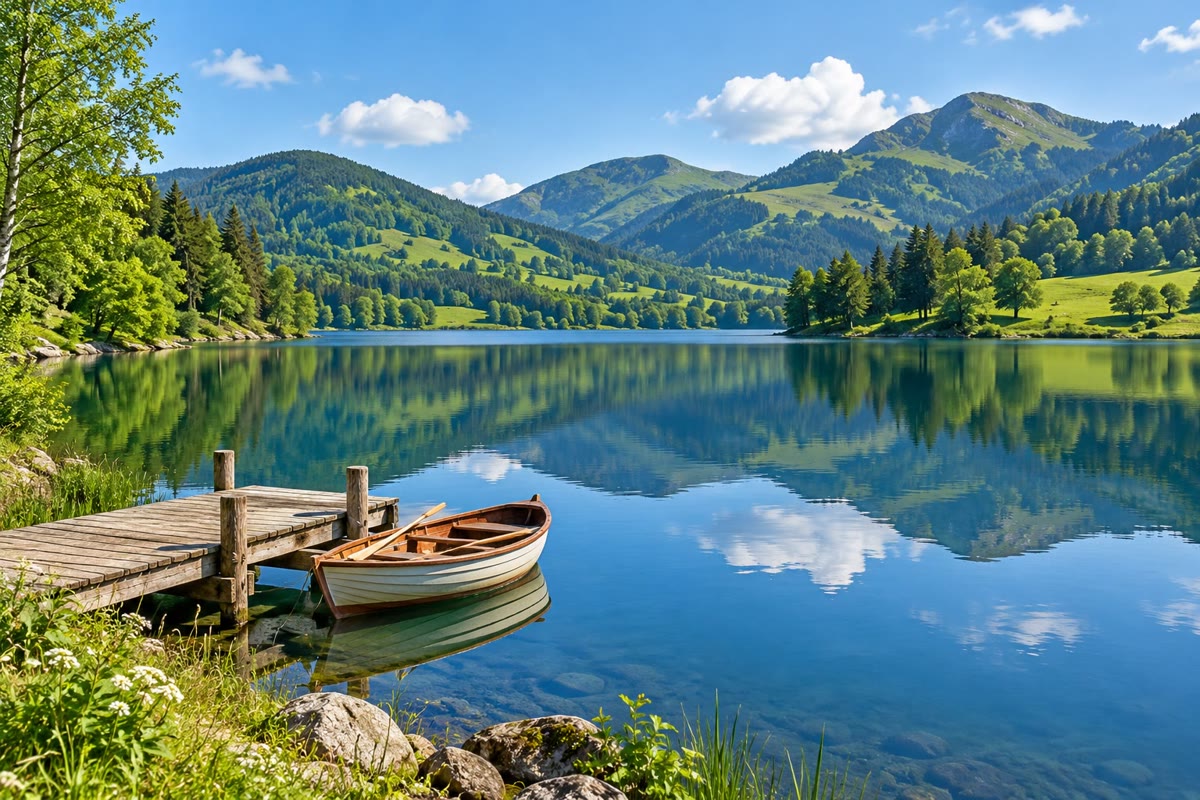
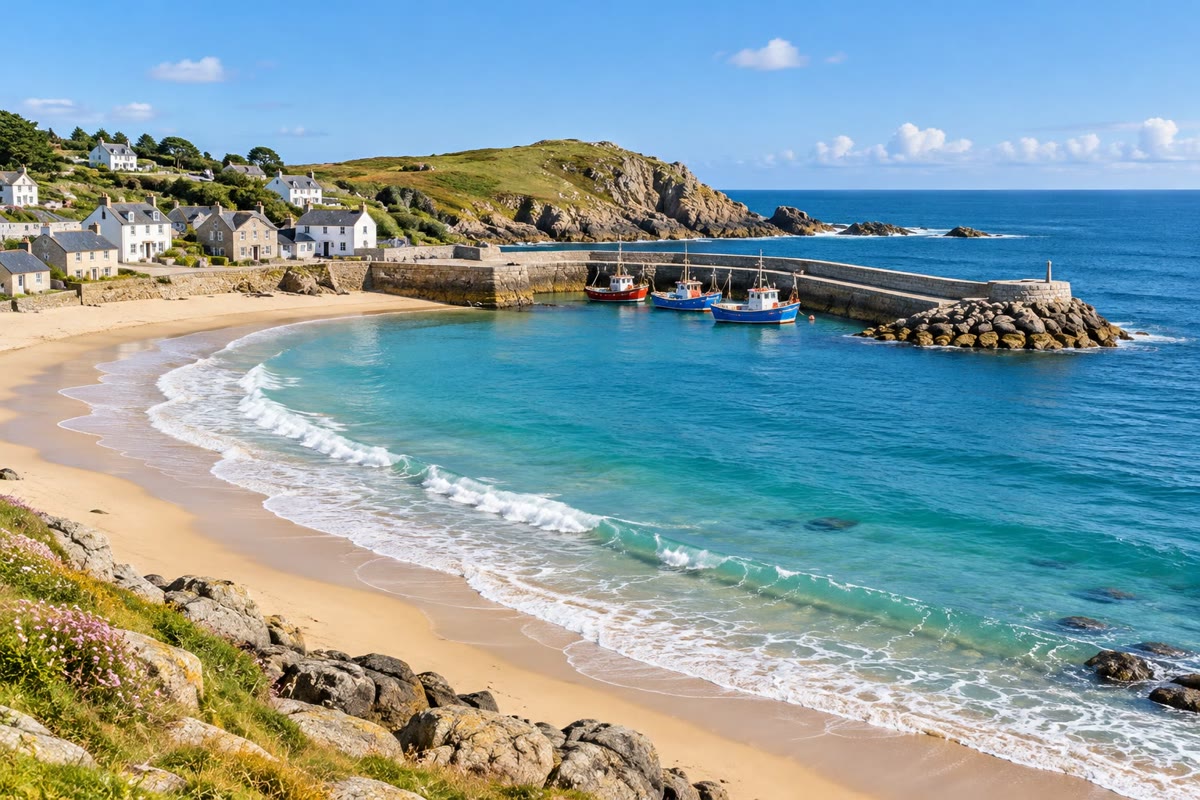
A river is water that flows all the time in a long channel, from higher land down to a lake or to the sea. A lake is a large body of water surrounded by land. The coast is the place where the land meets the sea.
Remark 2.5 (Water always runs downhill)
A river always flows from higher ground to lower ground. That is why rivers run at the bottom of valleys, and why, in the end, they reach a lake or the sea, which are lower than the land around them.
2.4 Natural parts and built parts
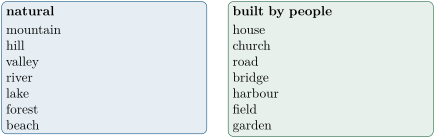
Some parts of a landscape were there before people came: the mountains, the rivers, the forests. Other parts were made by people: houses, roads, bridges, fields.
Definition 2.6 (Natural and built parts)
A natural element of a landscape is a part that was not made by people: a mountain, a river, a lake, a forest, a beach. A built element is a part made or shaped by people: a house, a road, a bridge, a harbour, a field, a garden.
2.5 Landscapes change
A landscape is not the same for ever. Some changes are quick, and some are so slow that nobody sees them in a lifetime.
- With the seasons: the fields are brown after ploughing, green in spring, golden before the harvest; the trees lose their leaves in autumn; snow can cover everything in winter.
- Because of people: a village grows into a town; a forest is cut down to make fields; a new road and a bridge cross the valley.
- Because of water and weather: after a great storm, a river may leave its bed and cover the fields for a few days; on the coast, the waves slowly wear the rocks away.
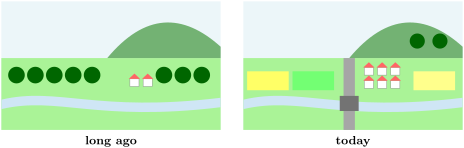
Example 2.7 (Town and countryside)
In a town, almost everything we see was built: streets, houses, shops, bridges, parks. In the countryside we see mostly fields, woods and meadows, with a few farms and villages. Both are landscapes. Even in the middle of a big town the shapes of the land are still there: a river crosses the town, and some streets climb up a hill.
2.6 Describing a landscape
Method 2.8 (Describing a landscape in four steps)
To describe a landscape, from a hilltop or from a picture:
Example 2.9 (Mia’s landscape)
In the foreground, the grass at the top of the hill. In the middle ground, a valley with a river, a bridge and a village, fields around it, and a forest on the next hill. In the background, a plain and, at the end of the land, the coast and the sea. Natural: the hills, the valley, the river, the forest, the sea. Built: the village, the church, the bridge, the fields.
2.7 Exercises
Exercise 2.1 ★
Name the four shapes of the land you have learnt in this chapter.
Exercise 2.2 ★
Exercise 2.3 ★
Natural or built? A river; a road; a forest; a bridge; a beach; a house.
Solution
Solution of Exercise 2.3.
Natural: the river, the forest, the beach. Built: the road, the bridge, the house.
Exercise 2.4 ★
Where is the coast: where the land meets a river, or where the land meets the sea?
Solution
Solution of Exercise 2.4.
Where the land meets the sea.
Exercise 2.5 ★
Look at the picture of the mountains and their village. Name one natural element and one built element.
Solution
Solution of Exercise 2.5.
For example: natural, the mountains, the forest on the slopes or the stream; built, a house or the church of the village.
Exercise 2.6 ★
On the drawing of the shapes of the land, which landform is the highest? Where does the river flow?
Exercise 2.7 ★★
Where does a river flow from, and where does it go? Why does it never flow up to the top of a hill?
Exercise 2.8 ★★
In a picture of a landscape, a tree at the bottom of the picture looks bigger than a whole hill at the top. Why?
Solution
Solution of Exercise 2.8.
The tree is near us, in the foreground; the hill is far away, in the background. Things that are far away look smaller than things that are near.
Exercise 2.9 ★★
Describe the picture of the plain with its river in three bands: what is in the foreground, in the middle ground and in the background?
Exercise 2.10 ★★
A field of wheat is green or golden, like grass. Why do we say it is a built element of the landscape and not a natural one?
Solution
Solution of Exercise 2.10.
Because people made it: they cleared the land, ploughed it and sowed the wheat. Without people there would be grass, bushes or forest there, not a field of wheat.
Exercise 2.11 ★★
Look at the drawing of the valley long ago and today. Name two things that have not changed and three things that people have added.