Primary & Middle School Earth and Space Sciences · Grades 1–9
15Rocks and Minerals
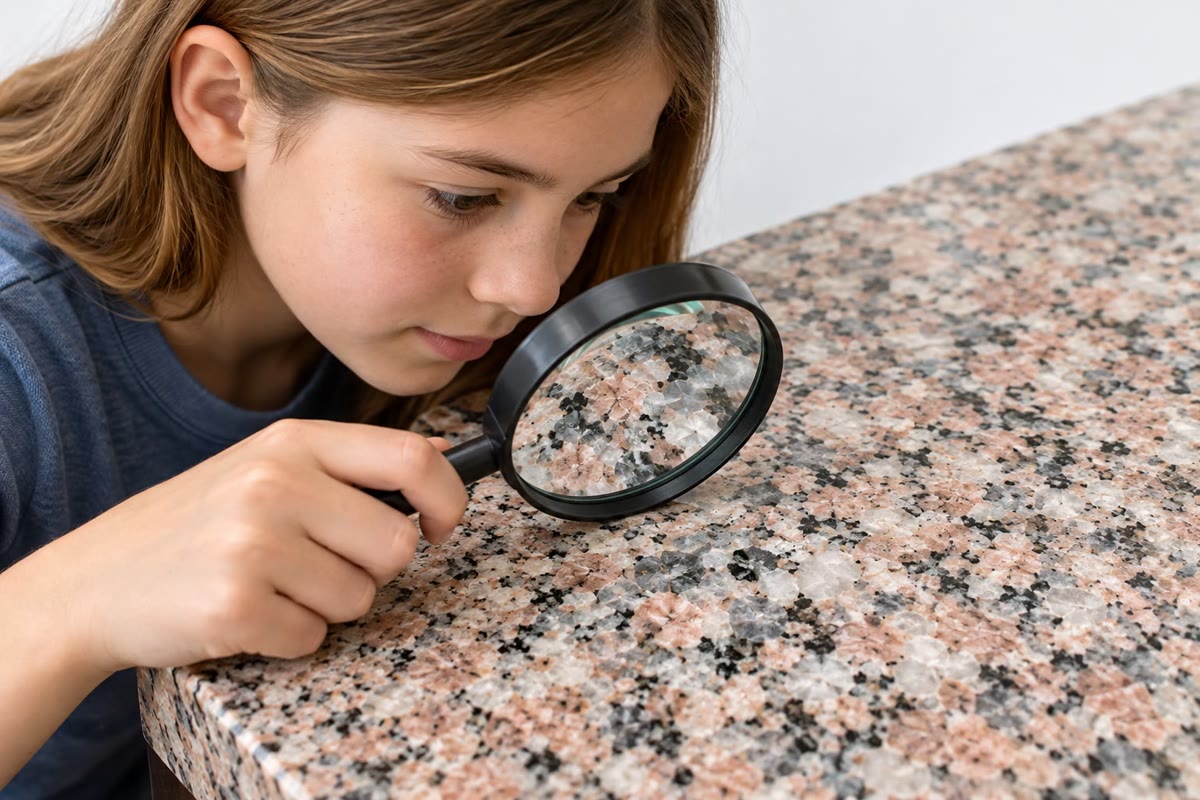
Sam leans over the kitchen worktop with a hand lens. The polished stone, which looks grey from far away, turns into a crowd of specks: pink ones, white ones, glassy grey ones and tiny black ones that shine when the light catches them. Each speck has flat, shiny faces, and the specks fit together like the pieces of a jigsaw. What are they?
You already know
Rocks are the hard material of the Earth’s crust: they can be broken into stones, rolled by rivers into pebbles, and ground into sand (Chapter 5). Water, ice and wind wear rocks away (weathering), carry the pieces off (erosion) and drop them further down (deposition) (Chapter 10). At a volcano, molten rock comes out as lava (Chapter 8).
15.1 A rock is made of minerals
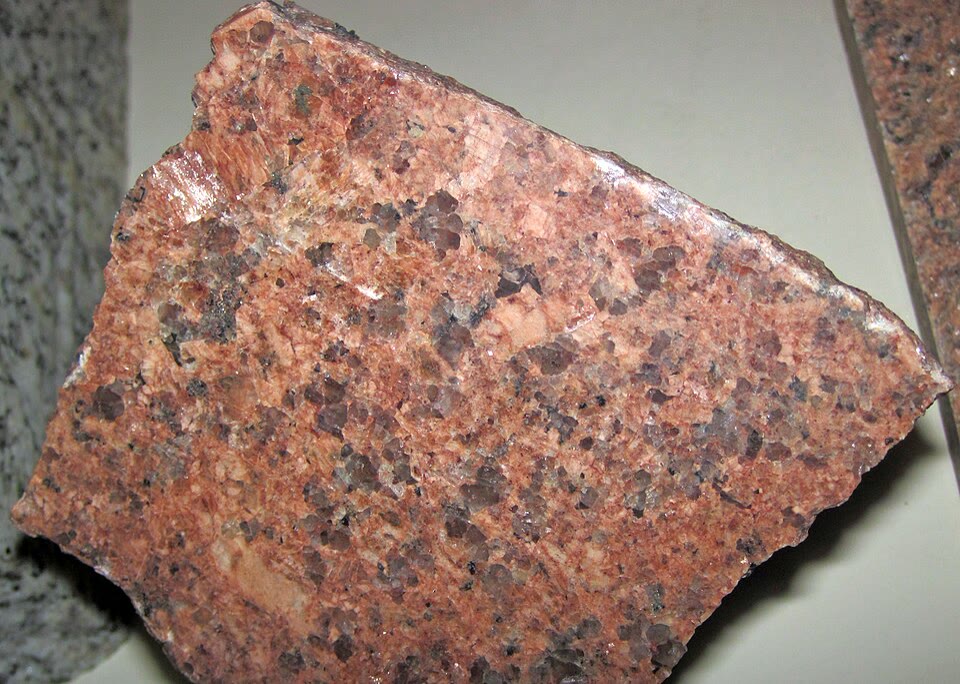
The specks of the worktop are minerals, and the stone is a granite.
Definition 15.1 (Mineral)
A mineral is a natural solid substance, not made by living things, always with the same make-up and with its atoms arranged in a regular way. A rock is made of one mineral or, more often, of several minerals stuck together.
Granite is made mostly of three minerals: feldspar (pink or white), quartz (grey and glassy) and mica (black or silvery, in thin shiny flakes). Other rocks are made of a single mineral: limestone, for example, is made almost only of calcite.
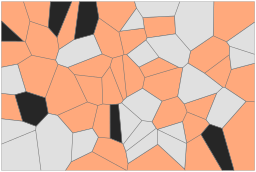
 feldspar
 quartz
 mica
15.2 Crystals
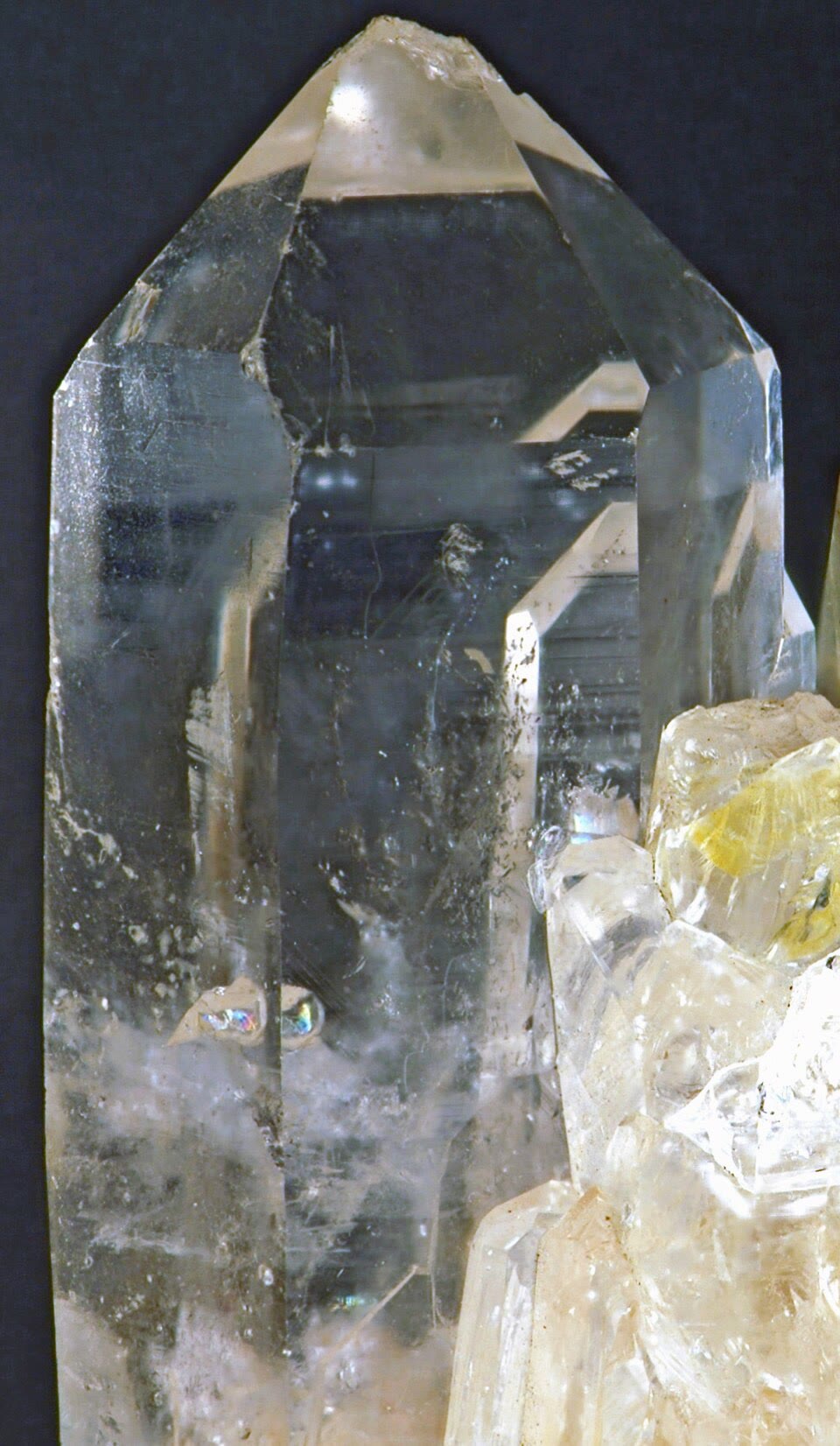
Under the lens, many mineral grains show flat, shiny faces and straight edges. Where a mineral has had room to grow freely, in a hollow of the rock, it forms a crystal: a solid with a regular shape bounded by flat faces. Its shape comes from the regular arrangement of its atoms, studied in the chemistry books. A quartz crystal, for example, is a column with six sides ending in a point; a mica crystal splits into sheets thinner than paper.
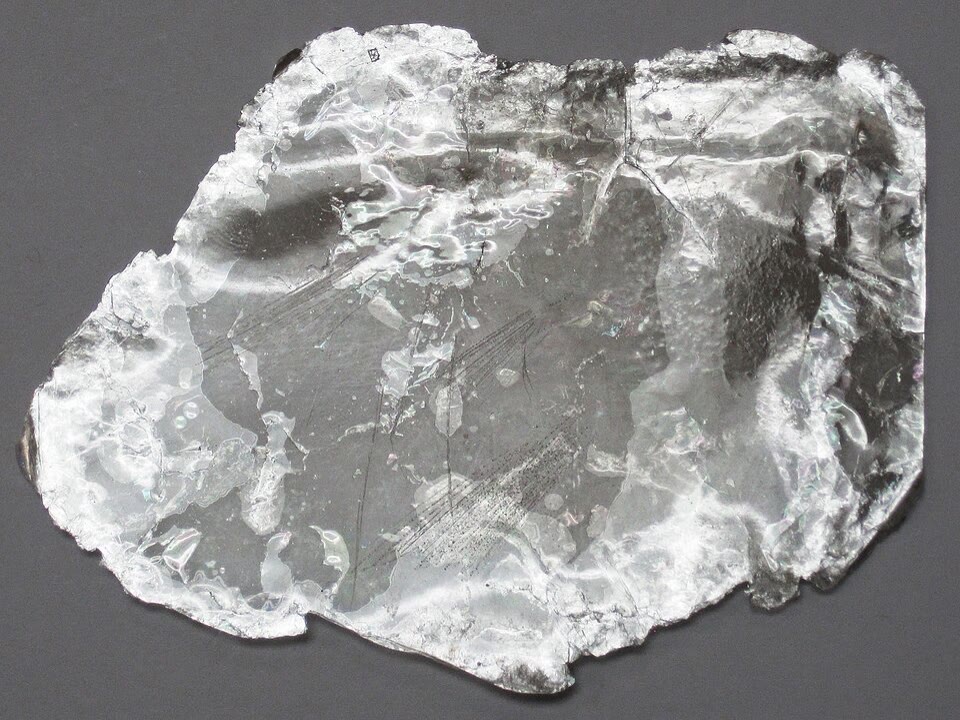
In granite, the grains grew pressed against each other, so they are not nicely shaped: they fit together like a jigsaw. Their size tells a story. Granite forms deep underground, where molten rock cools very slowly: its grains have time to grow large enough to be seen with the eye. Molten rock that cools quickly at the surface, as lava, gives rocks with grains too small to see.
15.3 The three rock families
Geologists sort rocks into three families, not by their colour, but by the way they formed.
Definition 15.2 (The three rock families)
An igneous rock forms when molten rock cools and becomes solid: granite deep underground, basalt from lava. A sedimentary rock forms at the Earth’s surface from grains of sand and mud, or from the shells of living things, laid down in layers and then hardened: sandstone, shale, limestone. A metamorphic rock is a rock that has been transformed, without melting, by heat and pressure deep underground: marble (from limestone), slate (from shale).
The name igneous comes from the Latin word for fire. Sedimentary rocks often show layers, one on top of the other, like the pages of a book. Metamorphic rocks are often squeezed and folded; some, like slate, split into flat sheets.
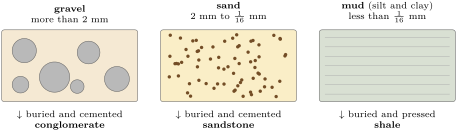
Many sedimentary rocks are made of the grains you sorted by size in Chapter 5: pebbles and gravel, sand, mud. Once buried, the grains lose their water and are stuck together by a natural cement. The size of the grains gives the rock its name.
In the field — Reading the stones of a town
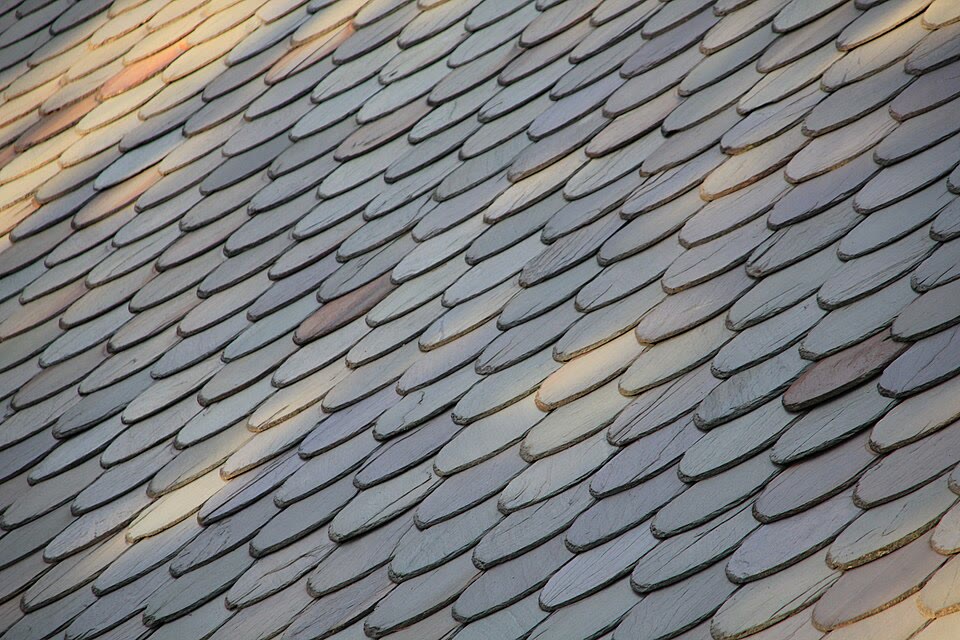
Towns are open-air rock collections. Walk with an adult past old walls, steps, statues, church fronts and paving, and look closely, without scratching or breaking anything. Some kerbs and steps are granite: look for its glassy quartz and shiny mica. Many old walls and fronts are limestone or sandstone: look for shells, or rub a fingertip on a fallen crumb of sandstone to feel the sand. Roofs may be slate, split into thin sheets. Note in a notebook where each stone is, its colour, its grains, and the family you think it belongs to; a photograph helps to compare later with the table of this chapter.
15.4 The rock cycle
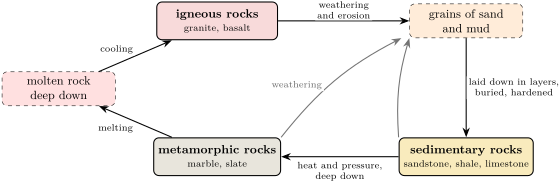
Rocks are not eternal. A granite mountain is slowly weathered; its grains are carried by rivers to the sea and laid down there in layers; buried deeper and deeper, the layers harden into sandstone. If the sandstone is carried still deeper, heat and pressure transform it into a metamorphic rock; deeper still, it can melt, and the molten rock, cooling, makes a new igneous rock. Little by little, over millions of years, the material of the rocks goes round and round.
Definition 15.3 (Rock cycle)
The rock cycle is the endless journey by which rocks of each family are slowly changed into rocks of the other families: by weathering and erosion at the surface, by burial and hardening, by heat and pressure, by melting and cooling.
15.5 Recognising common rocks
Here are seven rocks that are often met in buildings, pavements and landscapes.
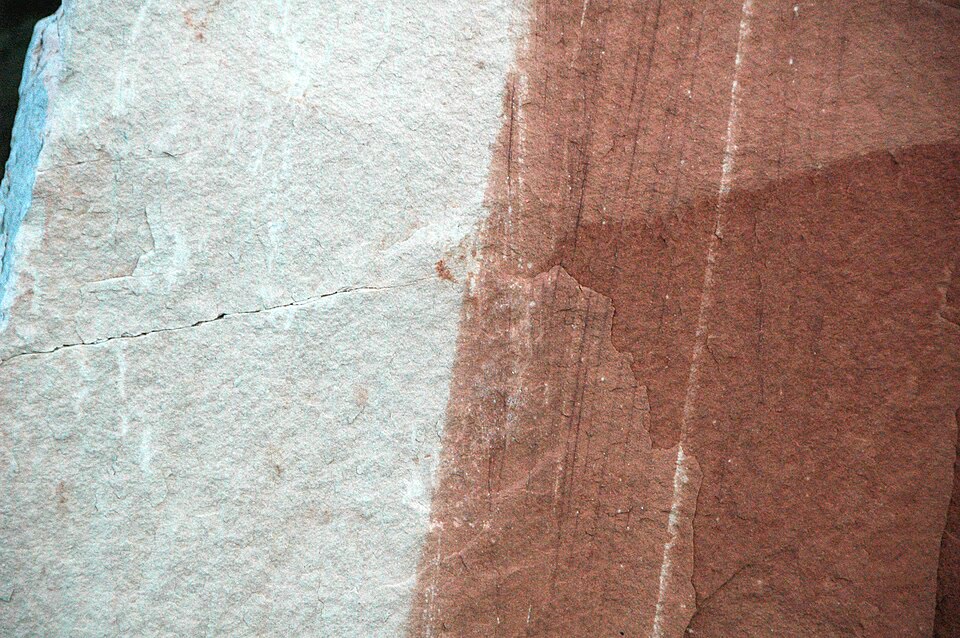
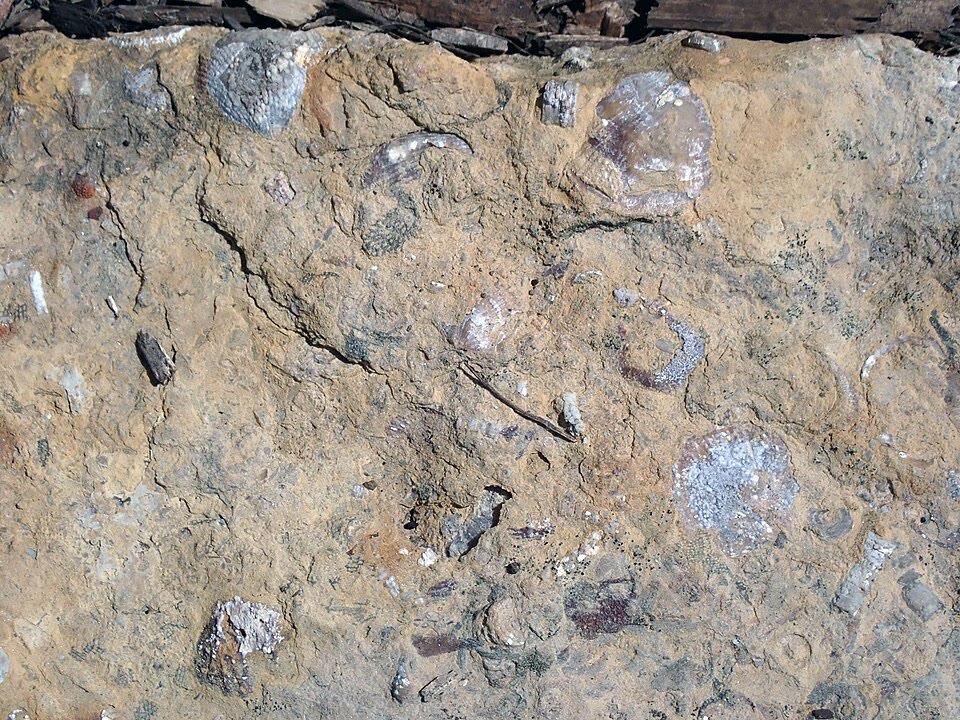
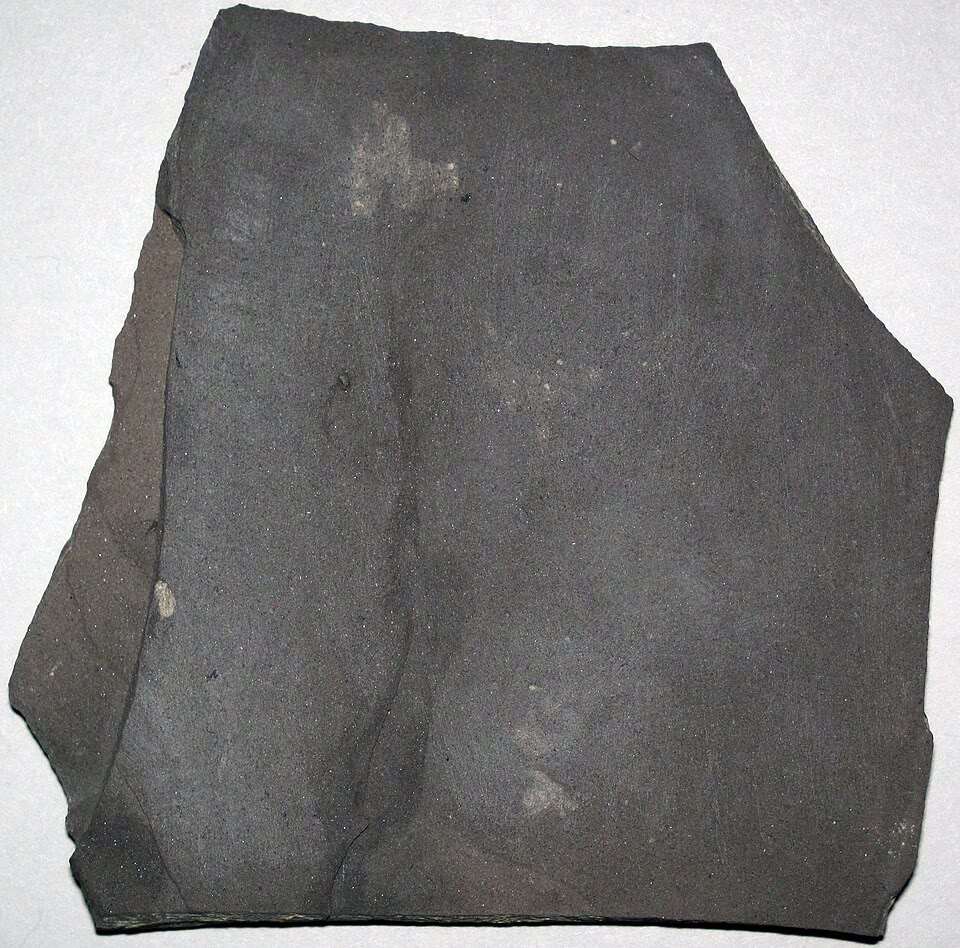
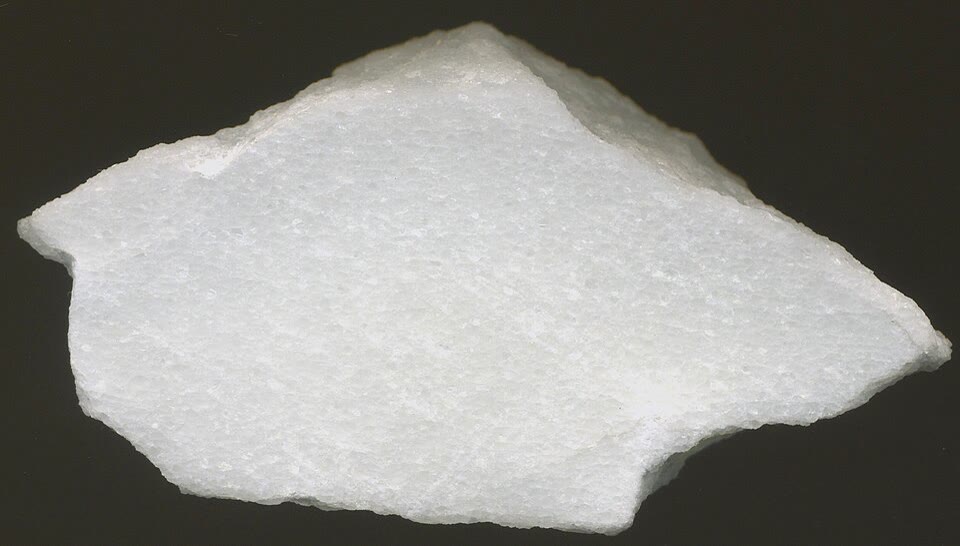
| rock | family | what to look for |
|---|---|---|
| granite | igneous | large grains of several colours: pink or white feldspar, grey glassy quartz, black shiny mica |
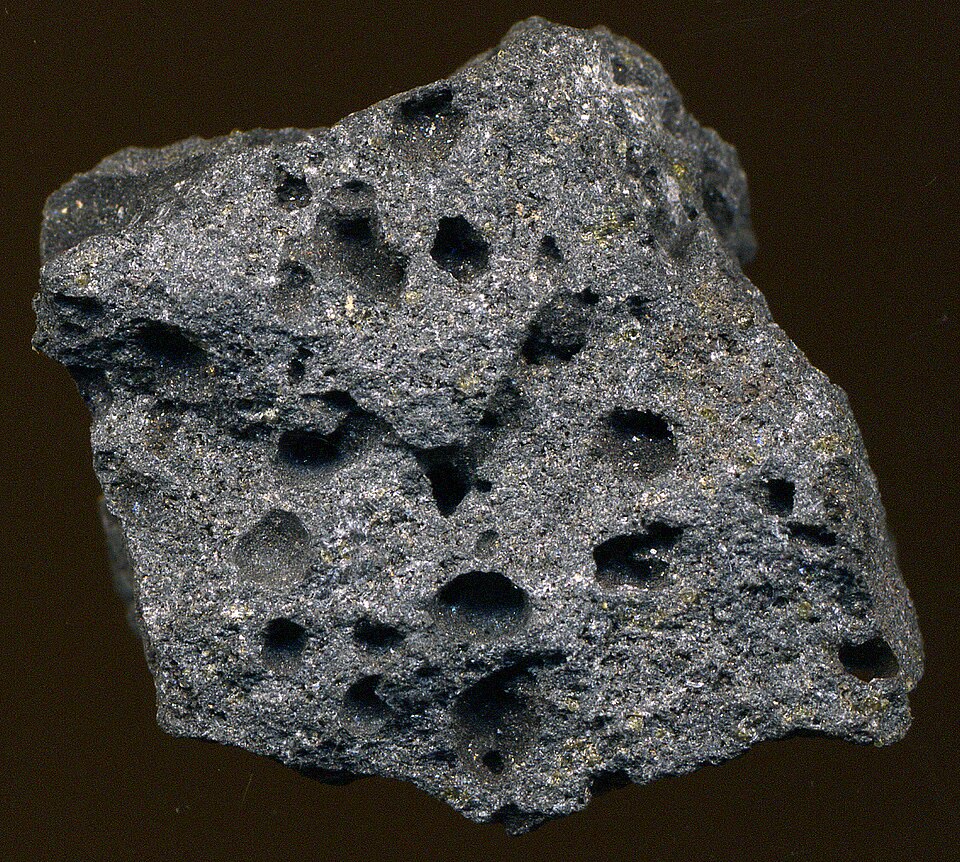
| basalt | igneous | dark grey to black, grains too small to see, often small round holes left by gas bubbles |
| sandstone | sedimentary | grains of sand you can feel, rough like sandpaper |
| limestone | sedimentary | pale, often with shells; fizzes under a drop of dilute acid |
| shale | sedimentary | very fine and soft, made of hardened mud (clay); in thin layers |
| marble | metamorphic | white or coloured, made of shiny crystals that sparkle like sugar; fizzes under acid |
| slate | metamorphic | grey, very fine, splits into thin, hard, flat sheets |
Safety
The acid test is done only by an adult, with goggles and gloves, using a very dilute acid. Never taste a rock or a powder, and never break rocks with a tool: looking through a hand lens tells a great deal.
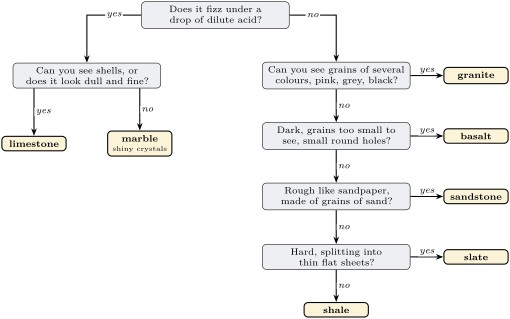
A key is a list of questions, each with two answers, that leads step by step to the name of a rock.
Hardness. One more clue helps to recognise a mineral: how easily it can be scratched.
Definition 15.4 (Hardness and the Mohs scale)
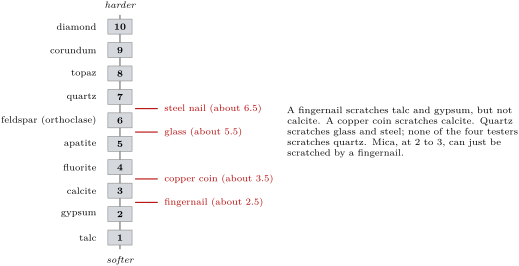
The hardness of a mineral is how well it resists being scratched: a mineral scratches every softer one and is scratched by every harder one. The Mohs scale ranks hardness from 1 to 10 with ten reference minerals, from talc (1), the softest, to diamond (10), the hardest.
Method 15.5 (The scratch test)
- Try to scratch the mineral with your fingernail, then with a copper coin. (Glass and steel are used only by an adult.)
- Rub the mark with a finger: a true scratch stays, a trace of powder from the tester rubs off.
- The hardness is between that of the hardest tester that does not scratch it and that of the softest tester that does.
Example 15.6 (Quartz or calcite?)
Two white minerals look alike. The first one is scratched by a copper coin: its hardness is less than 3.5; it is calcite (3). The second one is not scratched by a steel nail and scratches glass: its hardness is more than 6.5; among the reference minerals, it is quartz (7).
15.6 Exercises
Exercise 15.1 ★
To which family does each rock belong: granite, sandstone, marble, basalt, limestone, slate?
Solution
Solution of Exercise 15.1.
Granite: igneous. Sandstone: sedimentary. Marble: metamorphic. Basalt: igneous. Limestone: sedimentary. Slate: metamorphic.
Exercise 15.2 ★
Is quartz a mineral or a rock? And granite? Explain the difference in one sentence.
Exercise 15.3 ★
Put these minerals in order, from the softest to the hardest: quartz, talc, diamond, calcite. Which of them can scratch all the others?
Solution
Solution of Exercise 15.3.
Talc (1), calcite (3), quartz (7), diamond (10). Diamond, the hardest, scratches all the others.
Exercise 15.4 ★
Copy and complete with the words cooling, heat and pressure, weathering: “Molten rock becomes an igneous rock by … A limestone becomes a marble by … A granite turns into grains of sand by …”
Solution
Solution of Exercise 15.4.
“Molten rock becomes an igneous rock by cooling. A limestone becomes a marble by heat and pressure. A granite turns into grains of sand by weathering.”
Exercise 15.5 ★★
Use the key. (a) A rock does not fizz under acid; it is dark, with grains too small to see and small round holes. (b) A rock fizzes under acid and is made of shiny crystals that sparkle like sugar. (c) A rock does not fizz; it is rough like sandpaper. Name each rock.
Solution
Solution of Exercise 15.5.
(a) Basalt. (b) Marble. (c) Sandstone.
Exercise 15.6 ★★
A mineral is scratched by a copper coin but not by a fingernail. Between which two hardness values is it? Which reference mineral of the Mohs scale could it be?
Solution
Solution of Exercise 15.6.
Its hardness is more than that of a fingernail (about 2.5) and less than that of a copper coin (about 3.5). It could be calcite (3).
Exercise 15.7 ★★
In the drawing of granite in this chapter, there are 60 grains: 33 of feldspar, 21 of quartz and 6 of mica. What percentage of the grains are quartz? Feldspar? Mica? Check that the three percentages add up to 100 %.
Solution
Solution of Exercise 15.7.
Quartz: , that is 35 %. Feldspar: , that is 55 %. Mica: , that is 10 %. Check: .
Exercise 15.8 ★★
Granite and basalt are both igneous rocks. Why can we see the grains of granite with our eyes, but not those of basalt?
Solution
Solution of Exercise 15.8.
Granite cools very slowly, deep underground: its grains have a long time to grow, and become large. Basalt comes from lava, which cools quickly at the surface: its grains have no time to grow and stay too small to see.
Exercise 15.9 ★★
Marble is made from limestone. (a) To which family does each belong? (b) What happened to the limestone to turn it into marble? (c) Why do both fizz under acid?
Solution
Solution of Exercise 15.9.
(a) Limestone is sedimentary; marble is metamorphic. (b) Deep underground, heat and pressure transformed it without melting it: its calcite grew into shiny crystals that fit together. (c) Both are made of the same mineral, calcite, and it is calcite that fizzes under acid.
Exercise 15.10 ★★
Using the Mohs scale: (a) can quartz scratch a glass bottle? (b) Can fluorite? (c) Can a steel nail scratch feldspar?
Solution
Solution of Exercise 15.10.
(a) Yes: quartz (7) is harder than glass (about 5.5). (b) No: fluorite (4) is softer than glass. (c) Yes: a steel nail (about 6.5) is harder than feldspar (6).
Exercise 15.11 ★★★
Tell the journey of a grain of quartz, in five steps, from a granite mountain to a metamorphic rock. Name the process at each step, and the family of the rock at the start and at the end.
Solution
Solution of Exercise 15.11.
For example: (1) the granite of the mountain (igneous) is broken up by weathering, and its quartz grains are set free; (2) a river carries them off: erosion; (3) the grains are laid down in layers at the bottom of the sea: deposition; (4) buried under other layers, they are pressed and cemented into a sandstone: hardening (the rock is now sedimentary); (5) carried deep underground, the sandstone is transformed by heat and pressure into a metamorphic rock.
Exercise 15.12 ★★★
A grey glassy mineral is not scratched by a steel nail, scratches glass, and is scratched by topaz. (a) What is its hardness on the Mohs scale? Name it. (b) Grains of sand are rolled for years by waves and rivers. Using its hardness, explain why grains of this mineral last much longer than grains of calcite or mica.
Solution
Solution of Exercise 15.12.
(a) Not scratched by steel (about 6.5) and able to scratch glass: harder than 6.5. Scratched by topaz (8): softer than 8. Its hardness is 7: it is quartz. (b) Quartz is harder than almost everything that rubs against it (other grains, pebbles): it is hardly worn away. Calcite (3) and mica (2 to 3) are much softer: rubbing grinds them into tiny pieces that are carried away.
15.7 Problem: The stones of the town square
Problem 15.1
Weekend problem — the rocks of a town square, the hardest mineral among them, and how many rock families are present
On a school trip, the class observes the stones of the old town square (observing only: nobody breaks or scratches the monuments). The teacher has brought loose pieces of the same stones from the stonemason’s yard for the hardness tests.
The fountain: its basin shows large grains, pink, white, grey and glassy, and black and shiny. The paving: pale slabs in which you can see small fossil shells; a drop of dilute acid, put by the teacher on a loose piece, fizzes. The roof of the town hall: thin, flat, grey sheets of a very fine-grained stone. The statue: a white stone made of shiny crystals that sparkle like sugar; it fizzes too.
Part I — The fountain, the paving, the roof.
- Name the rock of the fountain and its family. Name its three minerals.
- Name the rock of the paving and its family. What were the shells before they were in the stone?
- Name the rock of the roof and its family. From which rock did it form?
- Name the rock of the statue and its family. From which rock did it form?
Part II — A hardness test.
- The teacher tries to scratch a grey glassy grain of the fountain with a steel nail: no scratch. The grain scratches glass. What is this mineral, and what is its hardness?
- The pink grains are scratched by the steel nail but not by glass. Between which two values is their hardness? Which mineral of the Mohs scale is it?
- The black flakes can just be scratched by a fingernail. Which mineral is it?
- Can a copper coin scratch the paving? Explain with the hardness of calcite.
Part III — The rock cycle.
- After centuries of rain, the statue has lost its fine details. Which process of the rock cycle is at work?
- The granite of the fountain came from a mountain. Over millions of years, what could become of the quartz grains of that mountain, and in which rock could they end up?
- How many of the three rock families are present in the square? Name the rock or rocks of each.
- What is the Mohs hardness of the hardest mineral found in the stones of the square?
Solution
Solution of Problem 15.1.
1. Granite, an igneous rock; its minerals are feldspar (pink or white), quartz (grey, glassy) and mica (black, shiny).
2. Limestone, a sedimentary rock. The shells belonged to animals that lived in the sea; their remains were laid down and hardened into the rock.
3. Slate, a metamorphic rock, formed from shale.
4. Marble, a metamorphic rock, formed from limestone.
5. Quartz: not scratched by steel (about 6.5), it scratches glass (about 5.5); its hardness is 7.
6. Scratched by steel (about 6.5) but not by glass (about 5.5): between 5.5 and 6.5. It is feldspar (orthoclase, 6).
7. Mica (hardness 2 to 3).
8. Yes: the paving is limestone, made of calcite (3), softer than a copper coin (about 3.5).
9. Weathering: the rain slowly wears the surface of the stone away.
10. The mountain is weathered; its quartz grains are carried by rivers and laid down in layers, at the bottom of a lake or of the sea; buried and hardened, they can become a sandstone, a sedimentary rock.
11. All three families are present: igneous (the granite of the fountain), sedimentary (the limestone of the paving), metamorphic (the slate of the roof and the marble of the statue).
12. The hardest mineral is the quartz of the granite: Mohs hardness 7.