Primary & Middle School Earth and Space Sciences · Grades 1–9
12Natural Hazards
It is Friday evening. On the radio, the music stops and a calm voice reads a warning: a strong storm will reach the coast tonight, with very strong winds and heavy rain. People are asked to stay indoors from nine o’clock and to tie down or bring in anything the wind could carry away.
Lena’s family gets to work. Her father brings the garden chairs and the table into the shed. Her mother checks that the torches work and puts spare batteries on the kitchen table. Lena fills two big bottles with water. By nine o’clock, everyone is inside, and the wind is already howling.

You already know
A volcano can erupt, throwing out lava, ash and gas; an earthquake is a sudden shaking of the ground; in an earthquake, we drop, cover and hold on (Chapter 8). A river that receives more water than its channel can hold floods its floodplain (Chapter 10). Each place has its own climate, and the hot, temperate and cold zones go round the globe (Chapter 11).
12.1 What a natural hazard is
Nature is not always calm. The wind can blow strongly enough to break trees, rivers can flood, the ground can shake. These events are part of how the Earth works: they happened long before there were people, and they will go on happening.
Definition 12.1 (Natural hazard)
A natural hazard is a natural event that can harm people or damage what they have built: a storm, a flood, a drought, an earthquake, a volcanic eruption, a landslide…
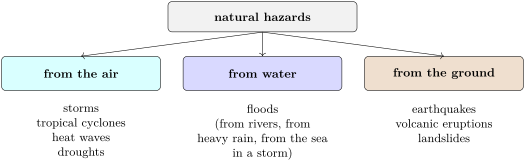
We can sort natural hazards by where they come from: from the air, from water, or from the ground.
12.2 Hazards from the air
Definition 12.2 (Storm)
A storm is a time of very strong wind, usually with heavy rain or snow, and sometimes with thunder and lightning.
A strong storm breaks branches, knocks down trees, tears tiles off roofs, and can throw garden chairs through windows. On the coast, its wind piles the sea up against the shore and sends huge waves over the sea walls.
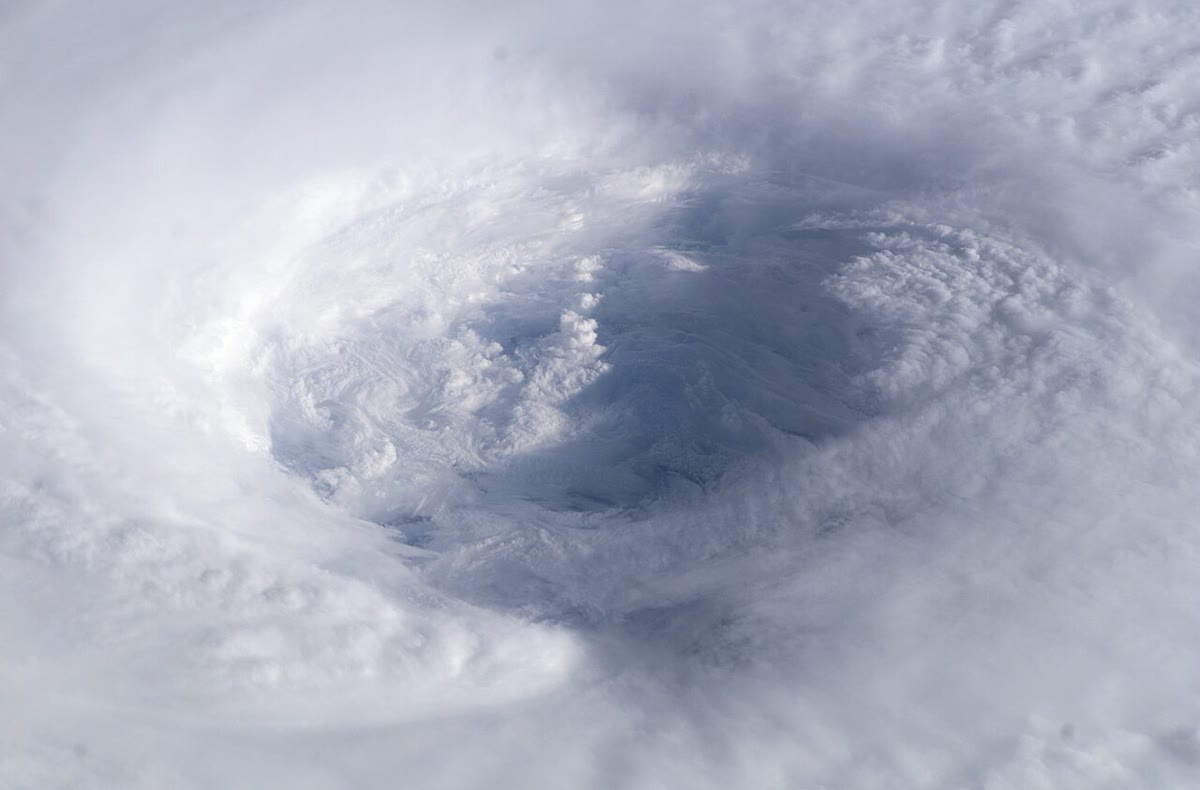
The most powerful storms on Earth form over warm tropical seas. They are huge, spinning storms: from space, they look like a giant spiral of clouds, with a calm, clear hole in the middle, the eye. Around the eye blow the strongest winds. The same kind of storm has different names in different oceans: it is called a hurricane in the North Atlantic and in the eastern Pacific, a typhoon in the north-west Pacific, and a tropical cyclone in the South Pacific and the Indian Ocean.
Some hazards from the air are slow and quiet. A heat wave is a period of several days and nights that are much hotter than usual. It is dangerous above all for very old people, babies and the sick.
Definition 12.3 (Drought)
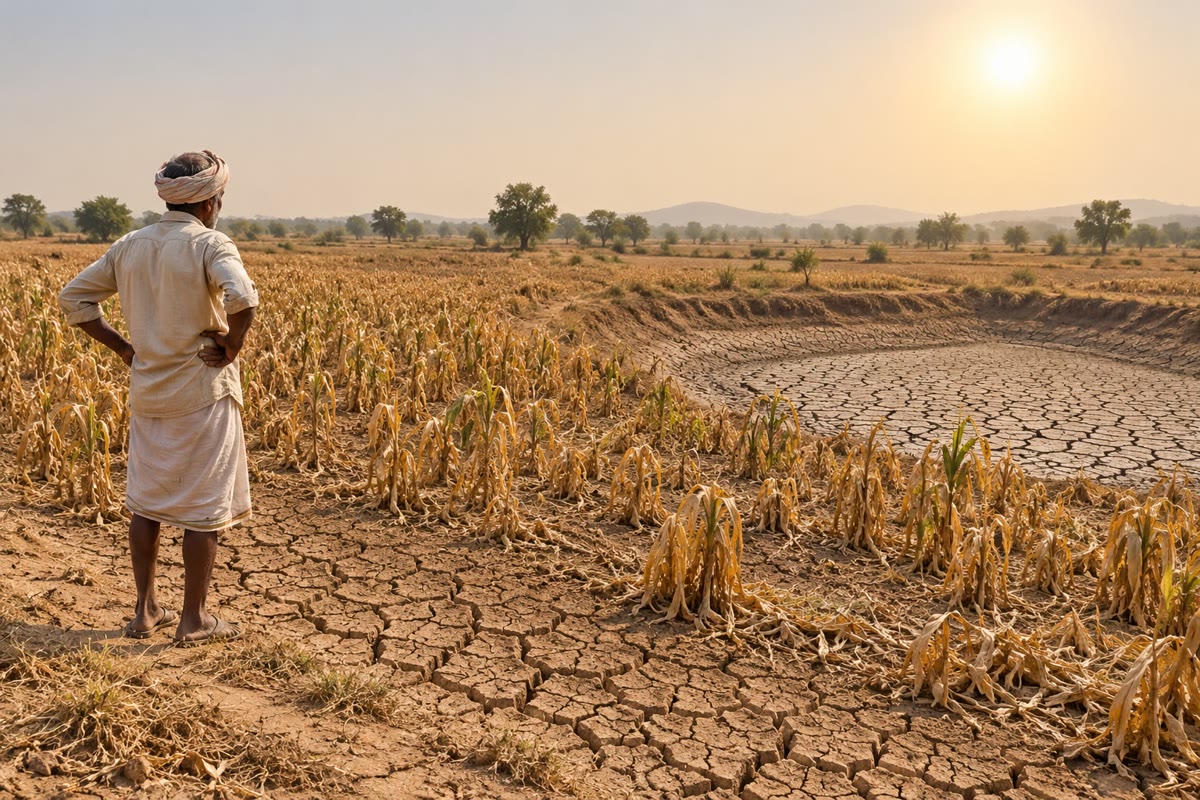
A drought is a long period, of months or even years, with much less rain than usual for that place. The soil dries out, rivers and lakes shrink, crops wilt and die.
A drought creeps up slowly: no one can say on which day it starts. But a long drought can leave farmers without a harvest and towns short of water.
12.3 Hazards from water
You already know the floods of rivers (Chapter 10). After days of rain, or when the snow melts fast, a river rises above its banks and covers its floodplain. Some floods come very fast: a violent downpour on a steep valley can turn a quiet stream into a roaring torrent within an hour. Others come from the sea, when a storm pushes the water up onto a low coast.
12.4 Hazards from the ground
You already know earthquakes and volcanic eruptions (Chapter 8). There is a third hazard from the ground, and water often triggers it.
Definition 12.4 (Landslide)
A landslide is a mass of rock, earth or mud that suddenly slides or falls down a slope.
A steep slope soaked by long rains becomes heavy and slippery, and it can let go all at once. An earthquake can also shake a slope loose. A landslide can bury a road, block a river, or carry houses away.
12.5 From a hazard to a disaster
A storm over the open ocean, an earthquake in an empty desert, a flood in a valley where no one lives: these are natural hazards, but they harm no one. The same events become dangerous when they strike where people live.
Definition 12.5 (Natural disaster)
A natural disaster happens when a natural hazard strikes a place where people live and does great harm: people are hurt or killed, homes are destroyed, roads, water and electricity are cut.
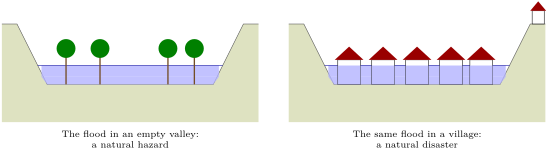
We cannot stop a storm or an earthquake. But we can do a great deal to keep a hazard from becoming a disaster: build away from floodplains and from the foot of unstable slopes, make buildings strong, watch the weather and the ground, warn people in time, and teach everyone what to do.
Warnings
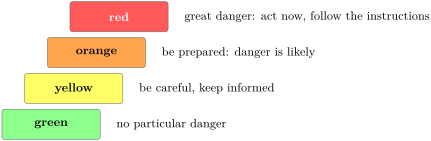
Weather services watch the sky day and night. When a storm, a heat wave or a flood is coming, they send out warnings by radio, television, phone and the internet. Many countries use colours, from the calmest to the most serious.
Safety
In a storm. Stay indoors, away from windows. Do not go out to look, and keep away from trees, which can fall, and from fallen electric wires.
In a flood. Move to higher ground or to an upper floor. Never walk, cycle or ride in a car through flood water: a little fast water is enough to knock you over or carry a car away.
In a heat wave. Drink water often, stay in the shade or in a cool room during the hottest hours, and check on elderly neighbours.
In an earthquake. Drop, cover, hold on (Chapter 8).
Always. Listen to the warnings and do what the people in charge say, at once.
12.6 Exercises
Exercise 12.1 ★
Natural hazard only, or natural disaster?
- [(a)] An earthquake shakes an empty desert.
- [(b)] A storm tears the roofs off many houses in a town.
- [(c)] A landslide falls into a mountain valley where no one lives.
- [(d)] A river floods a village and fills its houses with water.
Solution
Solution of Exercise 12.1.
(a) A natural hazard only: no one is harmed. (b) A natural disaster: homes are damaged. (c) A natural hazard only. (d) A natural disaster.
Exercise 12.2 ★
Sort these hazards into three families (from the air, from water, from the ground): a landslide; a heat wave; a flood; a volcanic eruption; a storm; a drought; an earthquake.
Exercise 12.3 ★
What is a drought? Give two ways in which a long drought harms people.
Exercise 12.4 ★
The radio announces a red storm warning for tonight. Give three things your family should do.
Solution
Solution of Exercise 12.4.
For example: bring in or tie down anything the wind could carry away (garden chairs, toys, bins); check the torches and keep spare batteries and water ready; stay indoors, away from the windows, during the storm; keep listening to the radio for news.
Exercise 12.5 ★
A great spinning storm with an eye forms over a warm tropical sea. What is it called if it strikes (a) the coast of Florida, in the North Atlantic; (b) Japan, in the north-west Pacific; (c) the coast of India, on the Indian Ocean?
Solution
Solution of Exercise 12.5.
(a) A hurricane. (b) A typhoon. (c) A tropical cyclone.
Exercise 12.6 ★
Put the four warning colours in order, from the calmest to the most serious. What should you do at the most serious level?
Solution
Solution of Exercise 12.6.
Green, yellow, orange, red. At the red level, there is great danger: act at once and follow the instructions of the people in charge.
Exercise 12.7 ★★
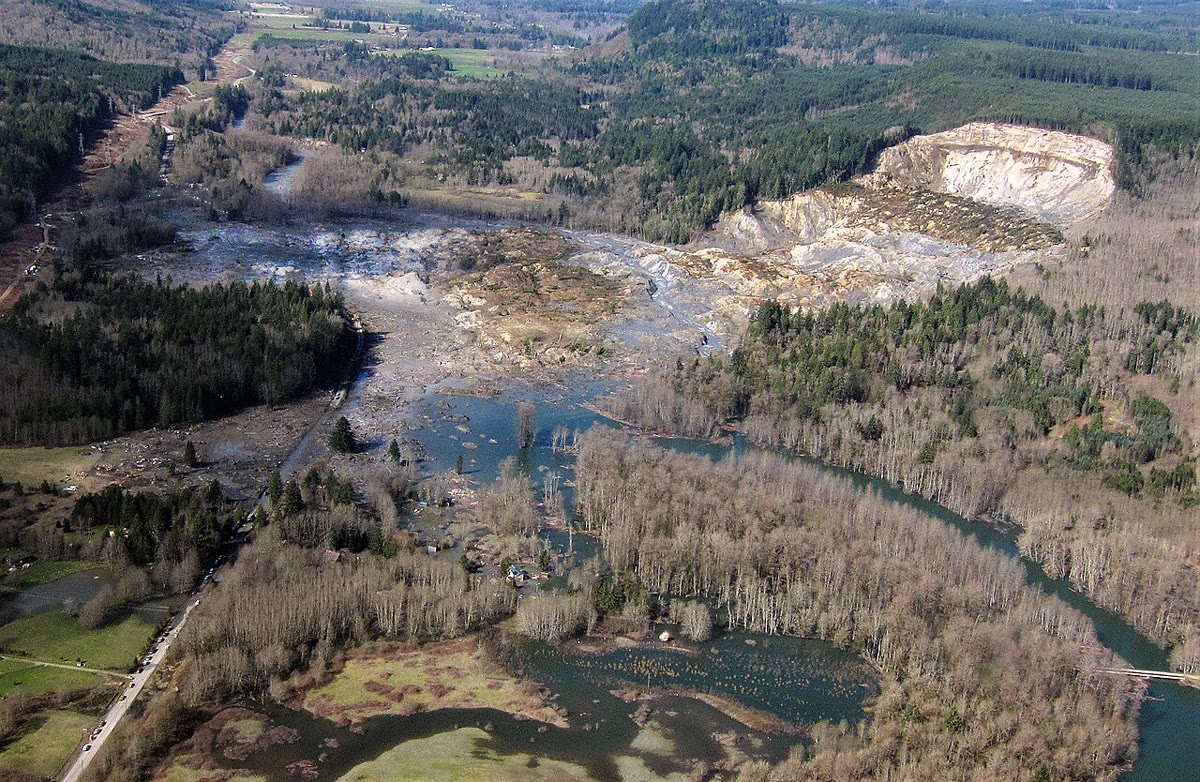
Look at the photograph of the landslide on page 76. Describe what the landslide did to the valley: to the hillside, to the road and to the river. Why is the land upstream now under water?
Solution
Solution of Exercise 12.7.
Part of the hillside on the right broke away and slid down, leaving a bare scar. Its mud spread right across the valley floor, covering the road. It also blocked the river like a dam: the river water, which can no longer flow away, has piled up behind it and flooded the woods upstream.
Exercise 12.8 ★★
Tom says: “Floods are natural, so nothing can be done about them.” Lena says: “We cannot stop a river from flooding, but we can stop a flood from becoming a disaster.” Who is right? Explain with two examples.
Solution
Solution of Exercise 12.8.
Lena is right. We cannot stop the rain or the river, but we can keep people out of harm’s way. For example: build houses on higher ground instead of on the floodplain; warn people in time with flood warnings, so that they move to higher ground; teach everyone never to walk or drive through flood water.
Exercise 12.9 ★★
In an imaginary farming region, about 60 millimetres of rain usually fall each month. During a drought, only a quarter of the usual rain fell in each of four months.
- [(a)] How much rain usually falls in four months?
- [(b)] How much fell during the drought, in the four months?
- [(c)] How much rain was missing?
Solution
Solution of Exercise 12.9.
(a) millimetres. (b) A quarter of 60 is 15; in four months, millimetres. (c) millimetres were missing: three quarters of the usual rain.
Exercise 12.10 ★★
An imaginary town has 1 200 homes. A quarter of them stand on the floodplain of its river.
- [(a)] How many homes stand on the floodplain?
- [(b)] The town helps the owners of a third of those homes to move to higher ground. How many homes are still on the floodplain?
Solution
Solution of Exercise 12.10.
(a) homes. (b) A third of 300 is 100; so homes are still on the floodplain.
Exercise 12.11 ★★★
Two villages, far apart, are hit by storms of the same strength on the same night. In the first, no one is hurt and the damage is small. In the second, many houses are destroyed. Give at least three different reasons that could explain the difference.
Solution
Solution of Exercise 12.11.
Possible reasons: the first village had been warned in time and people had prepared (shutters closed, objects brought in), the second had not; the houses of the first are solidly built, those of the second are fragile; the second village lies on a low coast or a floodplain, where the storm also brought a flood, while the first stands on higher ground; trees close to the houses fell on them in the second village. The same hazard does not cause the same harm everywhere: it depends on where and how people live, and on how well they are prepared.