书籍暂未推出简体中文版——当前显示英文版。
Primary & Middle School Earth and Space Sciences · 1–9 年级
23The Atmosphere
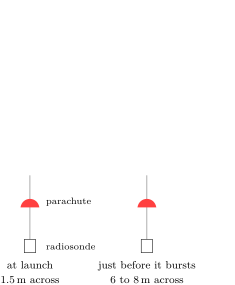
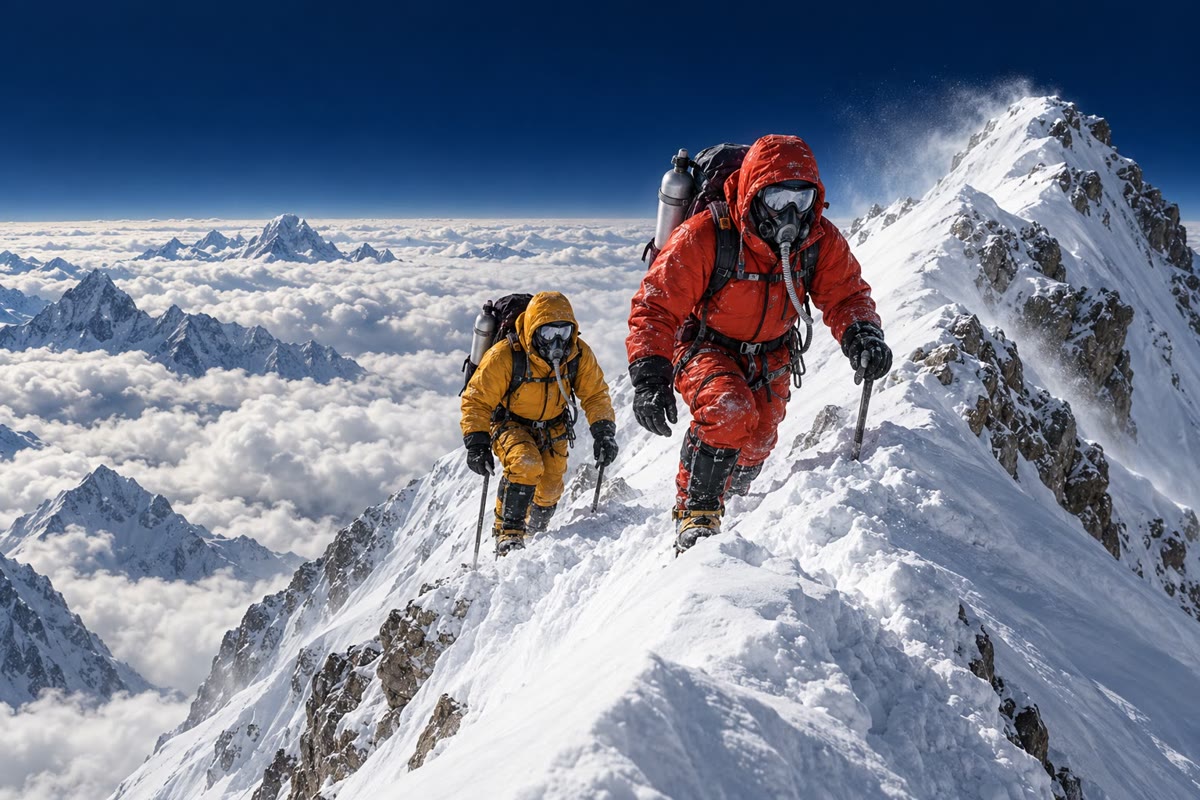
At a weather station, just before the agreed hour, a meteorologist walks out onto the grass holding a balloon filled with hydrogen or helium, about across. Below it, on a long string, hang a small orange parachute and an instrument box of 60 to 80 grams: a radiosonde. She lets go. The balloon climbs about every minute, and every second the radiosonde radios down the pressure, the temperature, the humidity and its position. As it rises, the balloon swells, until it is 6 to across and bursts, often more than up, two hours after the launch. At the same hours of every day, the same scene takes place at more than 800 stations around the world.
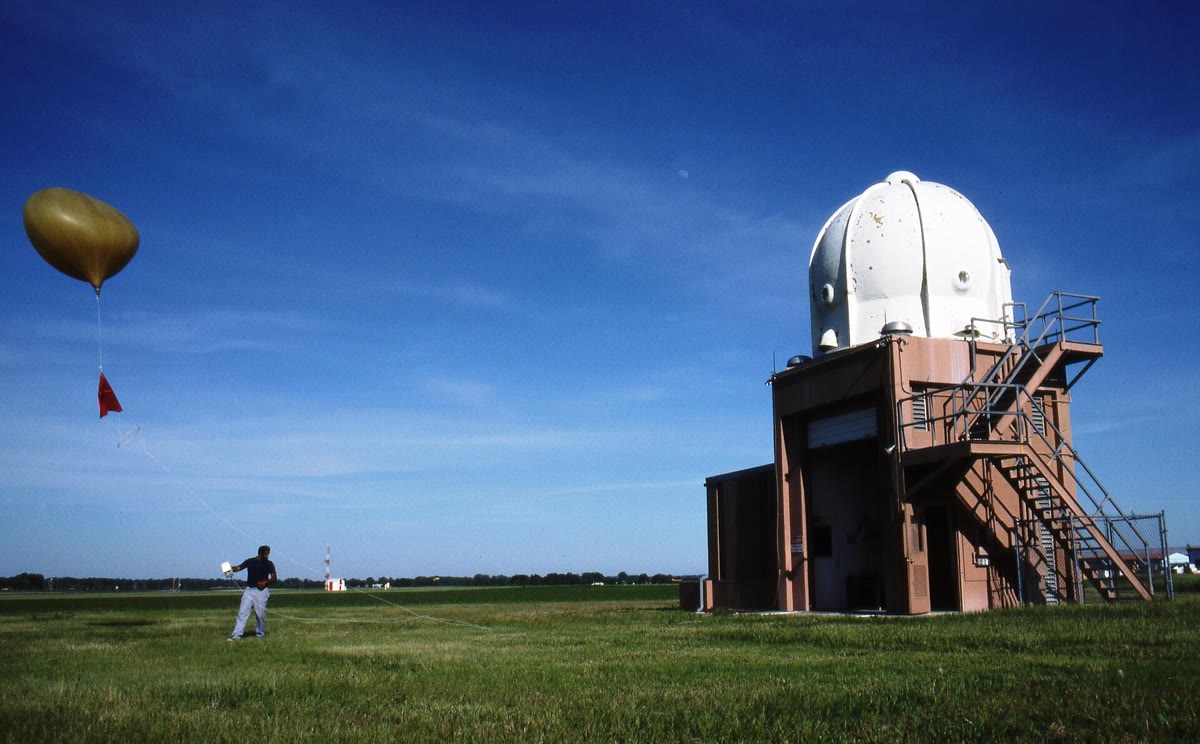
Why does the balloon swell as it rises? What does the radiosonde measure on its way up, and why does the temperature not simply keep falling? Where does the air end?
You already know
The atmosphere is the layer of air around the Earth. Air presses on everything it touches: this is air pressure, measured with a barometer (the physics books). Weather services give it in hectopascals (hPa); at sea level it is about . Dry air is made of about 78 % nitrogen and 21 % oxygen, with a little argon, carbon dioxide and other gases (the chemistry books). Clouds are made of tiny droplets of water or crystals of ice (Chapter 7).
23.1 A thin envelope
Seen from the International Space Station, the atmosphere is a thin glowing line along the edge of the Earth. Most of the air, and almost all the clouds, are in its lowest few kilometres.
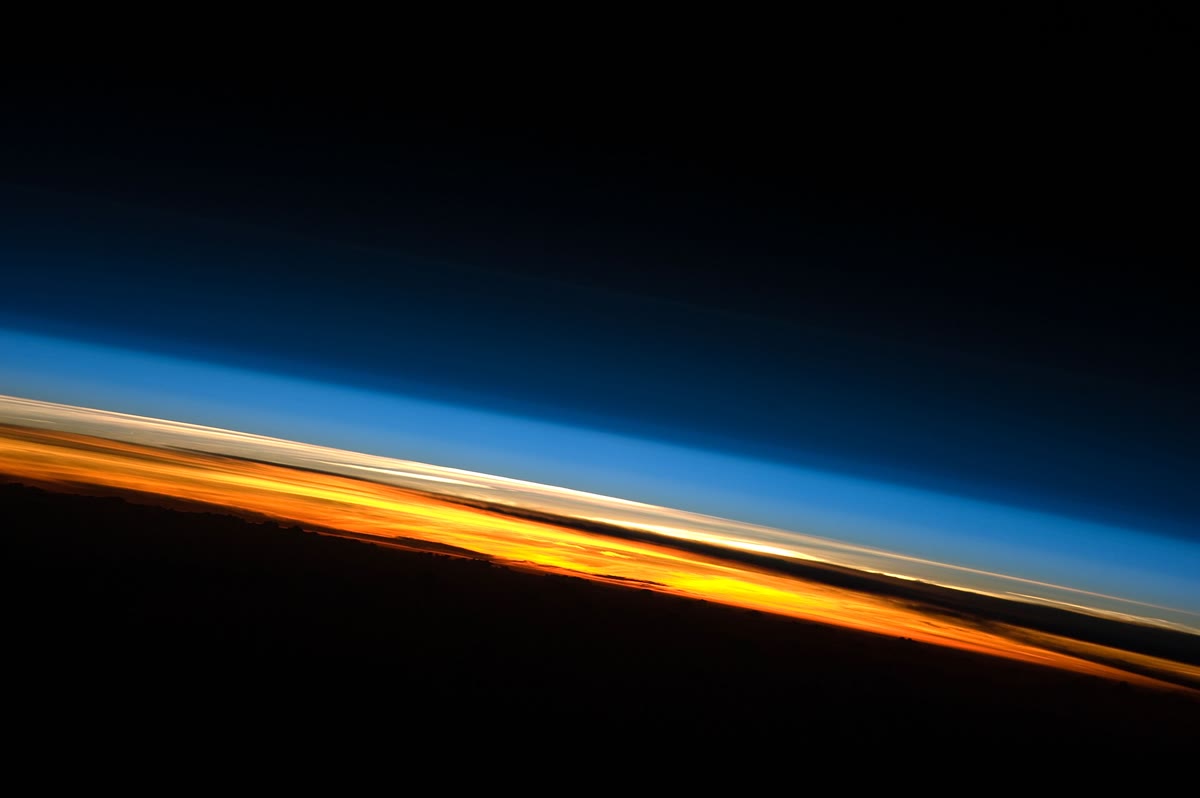
There is no sharp top to the atmosphere: the air gets thinner and thinner with height. By convention, space begins at about . Compared with the Earth’s radius, , that is very little: , less than 2 % of the radius. On a globe across, the whole atmosphere would be a film about thick.

23.2 Pressure falls with altitude
The air at the bottom of the atmosphere carries the weight of all the air above it. The higher one climbs, the less air is left overhead, and the lower the pressure. In the standard model of the atmosphere used by meteorologists and engineers, the pressure is at sea level, half of that at about , and a quarter at about .
Since the pressure measures the weight of the air above, the half-pressure level is also the height below which half of all the air lies: half of the atmosphere is squeezed into its lowest . Below lies about 78 % of the air, below about 99 %.
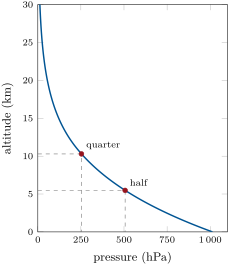
Higher up, the pressure keeps falling, by about half again for every few kilometres, so it soon becomes tiny. Powers of ten are the best way to write it. At , the pressure is about , roughly of its sea-level value (one hundredth); at , about , roughly ; at , about , roughly of the sea-level pressure.
23.3 Temperature and the layers
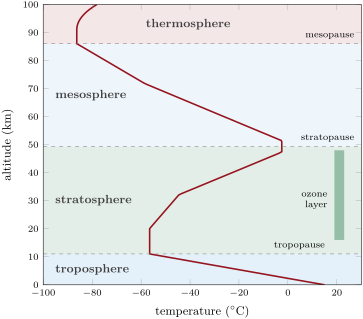
Everyone who has climbed a mountain knows that the air gets colder with height. The radiosondes show that this is true only in the lowest part of the atmosphere. Higher up, the temperature stops falling, then rises, then falls again, then rises once more. These changes divide the atmosphere into layers.
Definition 23.1 (The layers of the atmosphere)
From the ground up, the atmosphere is divided into four layers by the way its temperature changes with height:
- the troposphere, where the temperature falls with height and where almost all the weather happens; its top is the tropopause;
- the stratosphere, where the temperature rises with height, up to about ;
- the mesosphere, where the temperature falls again, up to about ;
- the thermosphere, where the very thin air gets hotter and hotter with height.
The troposphere holds about 99 % of the atmosphere’s water vapour, so nearly all clouds, rain and snow form in it. Its air is stirred all the time. The top of the troposphere is not at the same height everywhere: the tropopause is highest above the equator, where it can reach , and lowest above the poles, where it can come down to in winter. It is also higher in summer than in winter. In the standard atmosphere, an average for the middle latitudes, it lies at .
Definition 23.2 (Environmental lapse rate)
The environmental lapse rate is the rate at which the temperature of the air falls with height in the troposphere, in degrees Celsius per kilometre. It changes from day to day and from place to place; the standard atmosphere uses an average of per kilometre.
Method 23.3 (Reading a temperature profile)
- Find the altitude on the vertical axis and go across to the curve; read the temperature below it.
- Where the curve leans to the left as it goes up, the air cools with height; where it leans to the right, the air warms with height; where it is vertical, the temperature does not change.
- The limits between layers are where the curve turns.
Example 23.4 (An airliner at cruising height)
An airliner cruises at , near the tropopause. On the profile, the temperature there is about . With the lapse rate: from at sea level, the air cools by degrees, which gives . On the pressure curve, the pressure is about , less than a quarter of the pressure on the ground: the cabin has to be pressurised.
Above the tropopause, in the stratosphere, airliners find a calmer ride: the air there gets warmer with height, so it is not stirred from below. In the mesosphere most meteors burn up, and at its top, near , is the coldest air of the whole atmosphere, about . In the thermosphere, the Sun’s X-rays and ultraviolet light heat the very thin air to hundreds, at times thousands, of degrees; yet there is so little air that it would not feel warm. Many satellites orbit the Earth there.
23.4 The ozone layer
The stratosphere gets warmer with height because it absorbs part of the Sun’s light. The gas that does most of this is ozone, a form of oxygen (its chemistry is in the chemistry books).
Definition 23.5 (Ozone layer)
The ozone layer is the part of the stratosphere, between about and , where about 90 % of the atmosphere’s ozone is found. It absorbs most of the Sun’s harmful ultraviolet light.
Even in the ozone layer, ozone is rare: only 1 to 10 molecules in a million. Yet together with oxygen, it stops between 95 % and 99.9 % of the ultraviolet light that reaches the Earth, including the most harmful kinds. The energy it absorbs is turned into heat, which is why the temperature rises through the stratosphere. Without the ozone layer, the ultraviolet light reaching the ground would harm living things.
In the field — Following the weather balloons
Weather services publish the measurements of their radiosondes, often as a chart of temperature against height for each launch. With an adult, look for the soundings of the station nearest to you, made at 00:00 or 12:00 UTC. Find the height where the temperature stops falling: that is the tropopause on that day. Compare a winter sounding with a summer one.
23.5 Exercises
Exercise 23.1 ★
Match each layer with its description: troposphere; stratosphere; mesosphere; thermosphere. (a) The temperature rises with height and the ozone layer is found there. (b) Almost all the weather happens there. (c) The coldest air of the atmosphere is at its top. (d) The very thin air is heated to hundreds of degrees; many satellites orbit there.
Solution
Solution of Exercise 23.1.
(a) stratosphere; (b) troposphere; (c) mesosphere; (d) thermosphere.
Exercise 23.2 ★
Use the temperature profile of the standard atmosphere. (a) What is the temperature at sea level? (b) At ? (c) At ? (d) At ? (e) Between which altitudes does the temperature not change?
Solution
Solution of Exercise 23.2.
(a) . (b) About . (c) About . (d) About . (e) From to about (and over a few kilometres near and just above ).
Exercise 23.3 ★
True or false? Correct the false sentences. (a) The temperature of the air always falls with height. (b) Half of all the air lies below about . (c) The ozone layer is in the troposphere. (d) The tropopause is higher above the equator than above the poles.
Solution
Solution of Exercise 23.3.
(a) False: it falls in the troposphere, rises in the stratosphere, falls in the mesosphere and rises again in the thermosphere. (b) True. (c) False: it is in the stratosphere. (d) True.
Exercise 23.4 ★
In which layer is each of these? (a) A rain cloud. (b) An airliner at . (c) A weather balloon just before it bursts, at . (d) A meteor burning up at .
Solution
Solution of Exercise 23.4.
(a) The troposphere. (b) The stratosphere (in the standard atmosphere the tropopause is at ). (c) The stratosphere. (d) The mesosphere.
Exercise 23.5 ★★
On a summer day, it is at sea level. Suppose the air cools by per kilometre. (a) What is the temperature at ? (b) At ? (c) At about what height does the air reach ? Round to one decimal.
Solution
Solution of Exercise 23.5.
(a) . (b) . (c) The air has to cool by 20 degrees: , so at about .
Exercise 23.6 ★★
A mountain hut stands at . A walker leaves a village at where it is . Using a lapse rate of per kilometre: (a) How many kilometres does the walker climb? (b) By how many degrees does the air cool? (c) What temperature can the walker expect at the hut?
Solution
Solution of Exercise 23.6.
(a) . (b) : about 16 degrees. (c) .
Exercise 23.7 ★★
Suppose the pressure halves every , starting from at sea level. (a) What is the pressure at ? At ? At ? (b) The standard atmosphere gives about , and at these three heights (for at sea level). Is the halving rule good near the ground? Higher up?
Solution
Solution of Exercise 23.7.
(a) , and . (b) Near the ground the rule is good ( against ). Higher up it gives too much: against , and against . The halving rule is only a rough guide.
Exercise 23.8 ★★
At sea level the pressure is about , that is hPa. (a) At it is about . Write this as a power of ten, and say how many times smaller it is than at sea level. (b) At it is about . Write it as a power of ten. (c) How many times smaller than at sea level is it?
Solution
Solution of Exercise 23.8.
(a) hPa; : a hundred times smaller. (b) hPa. (c) : a hundred thousand times smaller.
Exercise 23.9 ★★
A weather balloon is across at launch and across when it bursts. (a) How many times wider is it when it bursts? (b) Explain why it swells as it rises. (c) Why do weather services hang a parachute below it?
Solution
Solution of Exercise 23.9.
(a) times wider. (b) As it rises, the air around it presses less and less, so the gas inside spreads out and the balloon grows until its skin breaks. (c) After the balloon bursts, the parachute slows the fall of the radiosonde, so that it does not hurt anyone or damage anything.
Exercise 23.10 ★★
The tropopause can reach above the equator and come down to above the poles in winter. (a) How many times thicker is the troposphere above the equator in this case? Round to one decimal. (b) On the standard profile, the tropopause is at . Is the standard atmosphere closer to the equator or to the poles? (c) A pilot flies from a polar region to the equator at a constant height of . Is the plane in the troposphere or the stratosphere at the start (in winter)? At the end?
Solution
Solution of Exercise 23.10.
(a) times thicker. (b) Closer to the poles: is above but below (it describes the middle latitudes, not the equator). (c) At the start the tropopause is at about , below the plane: the plane is in the stratosphere. At the end the tropopause is at about : the plane is in the troposphere.
Exercise 23.11 ★★★
The share of all the air that lies below a height is , where is the pressure at that height and the pressure at sea level. (a) At , : what share of the air lies below? (b) At , . (c) At , . Give the answers in per cent, to whole numbers. (d) What share of the air lies above ?
Solution
Solution of Exercise 23.11.
(a) : 50 %. (b) : 78 %. (c) : 99 %. (d) About 1 %.
Exercise 23.12 ★★★
A school globe is across, so its radius, , stands for the Earth’s radius, . (a) How many kilometres does of the globe stand for? Round to the nearest kilometre. (b) How thick, in millimetres, would the atmosphere up to be on this globe? (c) And the troposphere, thick? (d) A sheet of paper is about thick. How many sheets would make the troposphere of the globe?
Solution
Solution of Exercise 23.12.
(a) km for each centimetre. (b) cm, about . (c) cm, about . (d) : two or three sheets of paper.
23.6 Problem: Following a weather balloon
Problem 23.1
Weekend problem — a weather balloon climbs through the atmosphere; its temperatures show the layers, and its pressures show where a quarter of the sea-level pressure is left
A radiosonde is launched from a station at sea level. Its balloon rises at about per minute. The table gives the pressure and the temperature it measures (the values of the standard atmosphere, rounded).
| altitude (km) | 0 | 2 | 4 | 6 | 8 | 10 | 12 | 14 |
|---|---|---|---|---|---|---|---|---|
| pressure (hPa) | 1013 | 795 | 617 | 472 | 357 | 265 | 194 | 142 |
| temperature (C) | 15 | 2 | ||||||
| altitude (km) | 16 | 18 | 20 | 22 | 24 | 26 | 28 | 30 |
| pressure (hPa) | 104 | 76 | 55 | 40 | 30 | 22 | 16 | 12 |
| temperature (C) |
Part I — The climb.
- How many metres does the balloon climb in 10 minutes?
- How long does it take to reach ? And ?
- The balloon bursts at . How long has the flight lasted, in hours and minutes?
- Name the layer the balloon is in at , and the layer it is in when it bursts.
Part II — The temperature.
- By how many degrees does the temperature fall between the ground and ?
- What is the lapse rate in degrees per kilometre in this part of the climb?
- Between which altitudes does the temperature stay the same? Where is the tropopause?
- What happens to the temperature above ? Which gas explains it?
Part III — The pressure.
- What is half of the sea-level pressure? Between which altitudes is it reached?
- What is a quarter of the sea-level pressure? Round to the nearest hectopascal.
- Between which two altitudes of the table is this quarter reached?
- The pressure falls by between and . Supposing it falls evenly, at about what altitude is the pressure a quarter of its sea-level value? Round to one decimal.
Solution
Solution of Problem 23.1.
1. m.
2. minutes; minutes.
3. 100 minutes, that is 1 hour and 40 minutes.
4. At : the troposphere (the temperature is still falling). At : the stratosphere.
5. degrees.
6. per kilometre.
7. From to it stays at . The cooling stops between and : the tropopause is at about .
8. It rises: at , at . The balloon is in the stratosphere, warmed by the ozone that absorbs the Sun’s ultraviolet light.
9. ; it is reached between () and ().
10. .
11. Between () and ().
12. From , the pressure has to fall by hPa more, out of the 71 hPa it loses over 2 km: km. The pressure is a quarter of its sea-level value at about .