书籍暂未推出简体中文版——当前显示英文版。
Primary & Middle School Earth and Space Sciences · 1–9 年级
17Water Underground
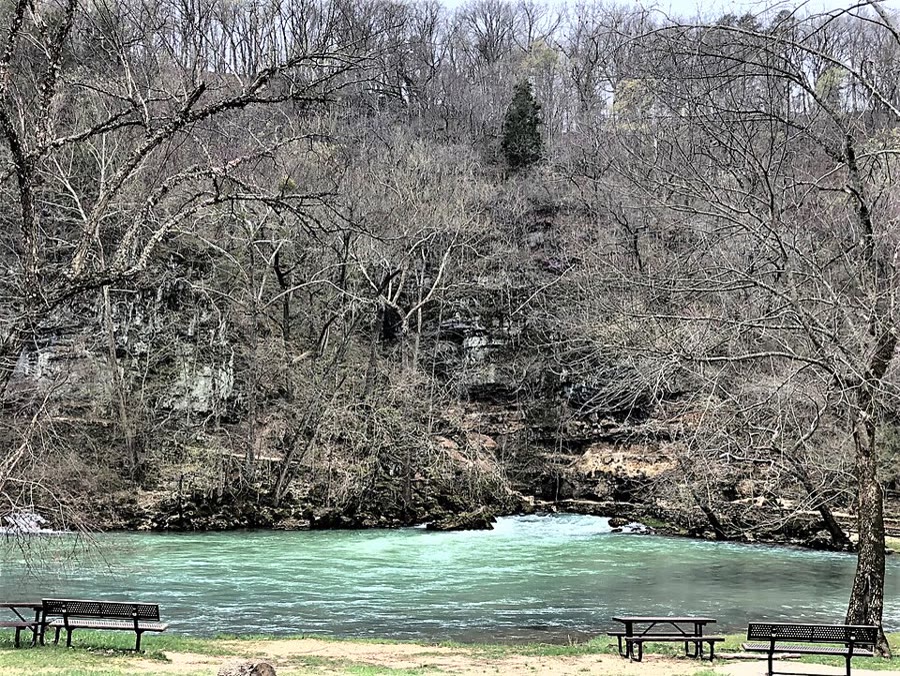
On a hot summer day, the fields are dry and the streams are low. Yet at the foot of a hill, water keeps rising out of the ground, cold and clear, as it did all winter, and fills a pool. It has not rained for weeks. Where does this water come from, and how does it get out of the rock?
You already know
Almost all the water on the Earth is salt water; fresh water is a small part, kept mostly as ice and under the ground (Chapter 3). Rocks such as sandstone and limestone are made of grains or shells stuck together, while clay and shale are made of very fine particles (Chapter 15). In the physics book, you have followed water around the water cycle: it evaporates from the seas, condenses into clouds and falls back as rain or snow.
17.1 Rain soaks in
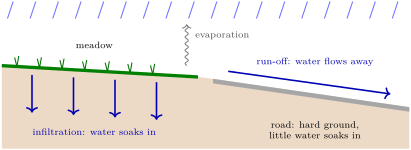
When rain falls on the land, the water can take three paths. Part of it evaporates back into the air. Part of it flows over the surface, down the slopes, into streams and rivers: this is run-off. The rest soaks into the ground.
Definition 17.1 (Infiltration)
Infiltration is the soaking of rain water, or melted snow, into the ground, through the soil and down into the rocks.
How much water soaks in depends on the ground. On a steep slope, on bare or hard ground, on a road or a car park, or when the soil is already soaked, most of the water runs off. On a gentle slope, under grass and trees, on sandy soil, more of it has time to soak in.
17.2 Porous and permeable rocks
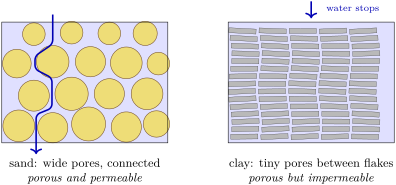
Look at a handful of dry sand through a hand lens: between the grains there are tiny empty spaces. Pour water on it and the water fills these spaces. Many rocks are like that: they are full of small holes between their grains, or of thin cracks.
Definition 17.2 (Porosity)
The pores of a rock are the empty spaces between its grains and in its cracks. A rock with pores is porous. Its porosity is the share of its volume made of pores, written as a percentage.
Definition 17.3 (Permeability)
A rock is permeable when water can flow through it, because its pores are large enough and connected to one another. It is impermeable when water cannot flow through it. Permeability is how easily water flows through a rock.
The two ideas are not the same. Clay is very porous: half of its volume is made of pores. But its pores are so tiny that the water stays stuck in them: clay is impermeable. Sand has fewer pores than clay, but they are wide and connected: sand is permeable. Granite without cracks has almost no pores at all.
The table gives the porosity of a few materials, and the share of water that drains out of them by itself when they are full of water. The rest stays stuck to the grains.
| material | porosity (%) | water that drains out (%) |
|---|---|---|
| soil | 55 | 40 |
| clay | 50 | 2 |
| sand | 25 | 22 |
| gravel | 20 | 19 |
| limestone | 20 | 18 |
| sandstone | 11 | 6 |
| granite | 0.1 | 0.09 |
Method 17.4 (How much water does a rock hold?)
Example 17.5 (A cubic metre of sand)
One cubic metre of sand, full of water, holds litres of water in its pores. Of these, litres drain out by themselves; 30 litres stay stuck to the grains. One cubic metre of clay holds twice as much water, 500 litres, but only 20 litres drain out.
In the lab — Sand or clay? (in class, with the teacher)
Two flowerpots with a hole at the bottom stand over two glasses. One is filled with dry sand, the other with dry clay soil pressed down. The teacher pours the same glass of water into each, at the same time. Through the sand, water soon drips into the glass below. On the clay, the water stays on top as a puddle and only a few drops come through, slowly: the sand is permeable, the clay is not.
17.3 Groundwater and the water table
Dig a hole in the sand of a beach, a few steps from the sea: after a while, water appears at the bottom of the hole. You have reached the place where all the pores of the sand are full of water.
Definition 17.6 (Groundwater)
Groundwater is the water under the ground that fills the pores and cracks of the soil and of the rocks.
Definition 17.7 (Water table)
Below a certain depth, all the pores of the rock are full of water. The water table is the top of this water-filled zone. Above it, the pores hold air and a little water; below it, they are full of water.
The water table is not flat. It follows the shape of the land, but more gently: higher under the hills, lower under the valleys. It also moves up and down with the seasons. After a rainy season, the rain that has soaked in raises it; after a long dry season, the water slowly flows away to springs and rivers, and the water table goes down.
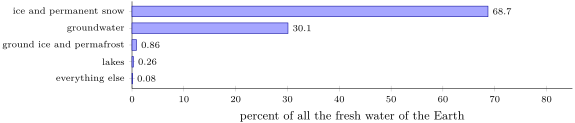
Groundwater is a great store of fresh water. Of all the fresh water of the Earth, about 69 % is ice and permanent snow, and about 30 % is groundwater; the fresh water of all the lakes makes only about a quarter of one percent. Groundwater is more than a hundred times as abundant as the fresh water of the lakes.
17.4 Springs and wells
Definition 17.8 (Spring and well)
A spring is a place where groundwater comes out of the ground by itself, where the water table meets the surface. A well is a hole dug or drilled down below the water table, so that groundwater fills its bottom and can be lifted out.
The section below crosses a valley of the Varden Hills, the region of our exercises. The hills are made of chalk, a white, soft, porous and permeable limestone. Under the chalk lies a layer of shale, which is impermeable. Rain soaks into the chalk, fills its pores and stops on the shale.
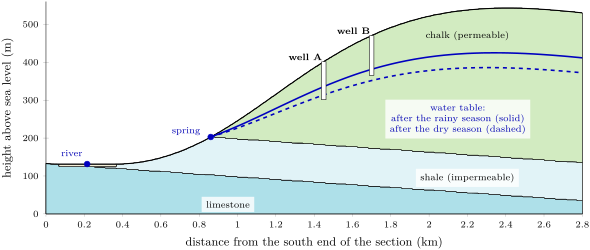
The spring flows where the base of the chalk meets the hillside: the water cannot go down through the shale, so it flows along the top of the shale and comes out on the slope. As long as there is water in the chalk above the shale, the spring keeps running, even in a dry summer: that is the answer to the question asked at the start of the chapter.
Look at the two wells. Well A is 100 m deep; its bottom is below the water table in every season, so it always gives water. Well B is even deeper, 105 m, but it was dug higher up the hill: its bottom is below the water table after the rainy season and above it after the dry season. In summer, well B runs dry. What matters is not how deep a well is, but how far its bottom goes below the lowest water table.
Remark 17.9 (A well can run dry)
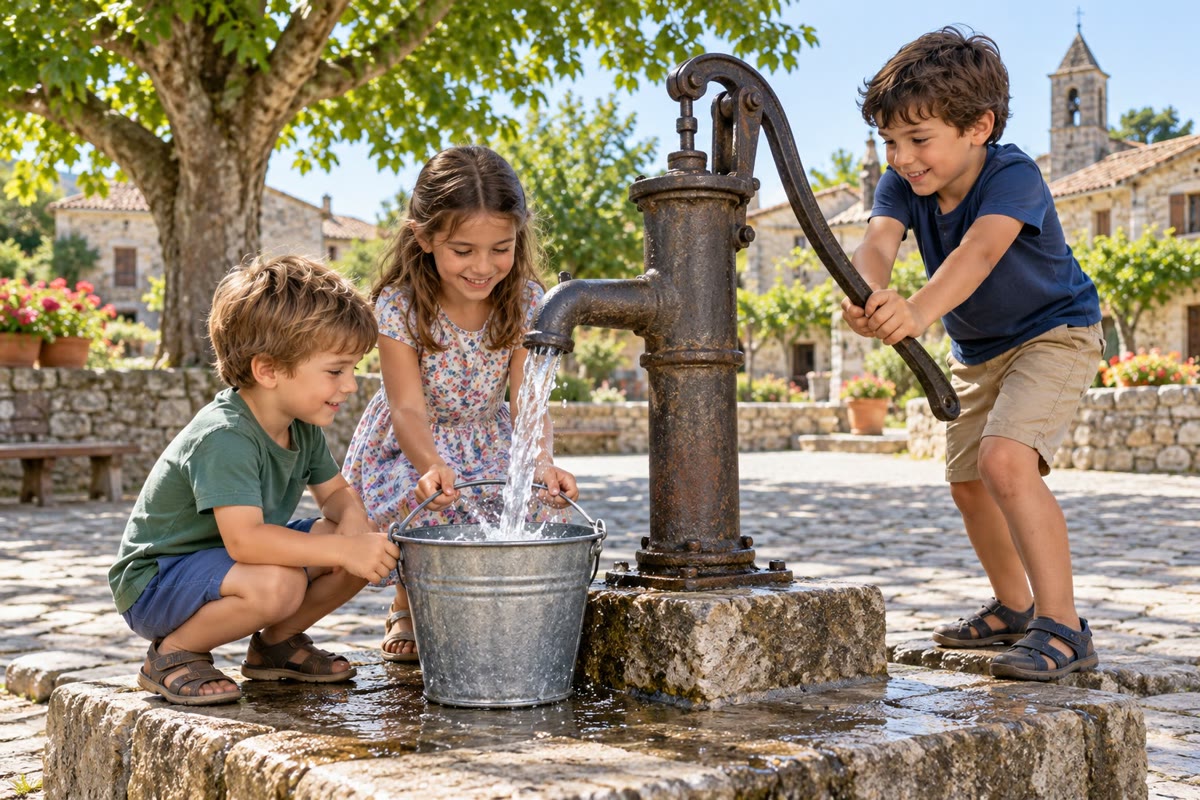
Pumping water out of a well lowers the water table around it. If water is pumped out faster than the rain refills the rock, the water table goes down and down: the well gives less and less water and can run dry. Two neighbours pumping from the same rock share the same water: one pump can dry out the other’s well.
17.5 Aquifers
Definition 17.10 (Aquifer)
An aquifer is a layer of porous and permeable rock, full of groundwater, that lets this water flow out to springs and wells. The rain that soaks in refills it.
The chalk of the Varden Hills is an aquifer: it is porous, it is permeable, and the farms of the hills draw their water from it. The shale under it is not an aquifer: water cannot flow through it. Deeper still, under the shale, lie a limestone and a sandstone, which can hold water too; to reach it, a well has to be drilled right through the shale.
Groundwater is part of the water cycle. Rain soaks into an aquifer; groundwater flows slowly through the pores; it comes out at springs and into rivers, which carry it to the sea; there it evaporates, and falls again as rain. Taking water from an aquifer is like taking water from a tank that the rain fills slowly: it lasts only if we do not take more than the rain brings back.
17.6 Keeping groundwater clean
Water that soaks into the ground is filtered on its way: leaves, soil particles and small creatures are held back by the soil and the rock. That is why water from a spring or a well usually looks crystal clear. But substances dissolved in the water are not held back: they travel down with it to the water table.
Groundwater can be spoilt by what people put on the ground: fertilisers and pesticides spread on fields and gardens, salt spread on icy roads, fuel leaking from a tank, waste dumped in the open, the overflow of badly kept waste-water tanks of houses. Once dissolved in an aquifer, these substances are hard to remove, and the water may no longer be safe to drink without treatment. So the water of a well has to be tested before it is drunk, and fertilisers, fuel and waste are best kept far from wells and springs.
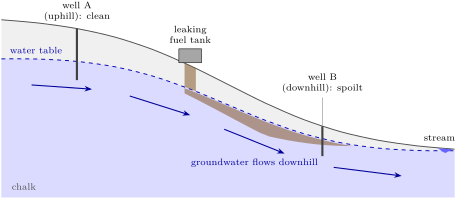
Dissolved substances travel with the groundwater. Below the water table, the water creeps slowly downhill: from where the water table is high, under the hills, to where it is low, at the springs and the rivers. A spill that soaks in therefore does not stay where it fell. It sinks to the water table, then drifts downhill with the groundwater, towards whatever lies below it on the slope.
Method 17.11 (Is a well at risk?)
- Find where the water table is high and where it is low: it is high under the hills and low near the springs and the rivers.
- The groundwater flows from high to low: draw its direction with an arrow.
- A well or a spring that lies downhill of a source of pollution, on the path of that arrow, is at risk; a well uphill of it is not.
Example 17.12 (A new fuel tank for the farm)
A farmer on a chalk hillside drinks the water of her own well, halfway up the slope, and wants to put a new fuel tank in one of two fields: one uphill of the well, one downhill of it, near the stream. The groundwater flows downhill. A leak from the field uphill would drift down towards the well; a leak from the field downhill would drift away from it, towards the stream. The field downhill of the well is the better choice for the well — and a tank on a tray that holds any leak is better still, since the stream matters too.
In the field — Spotting springs
On a walk with an adult, look along the foot of a slope. A spring often shows itself as a patch of wet ground, a line of greener grass or of reeds in a dry field, a small stream that starts from nowhere, or a stone basin or a trough built to catch the water. On a detailed walking map, springs are marked with a small symbol. Observe from the path: never drink the water of a spring that has not been tested.
17.7 Exercises
Exercise 17.1 ★
Sort these materials into “permeable” and “impermeable”: sand, clay, gravel, granite without cracks, shale, chalk.
Solution
Solution of Exercise 17.1.
Permeable: sand, gravel, chalk. Impermeable: clay, granite without cracks, shale.
Exercise 17.2 ★
Match each word with its meaning: spring; well; water table; aquifer. (a) The top of the zone where all the pores are full of water. (b) A porous and permeable layer that holds groundwater. (c) A place where groundwater comes out by itself. (d) A hole that goes down below the water table.
Exercise 17.3 ★
(a) Name the three paths that rain water can take when it falls on the land. (b) After a storm, where does more water run off: on a car park or on a meadow? Why?
Solution
Solution of Exercise 17.3.
(a) It evaporates back into the air; it runs off over the surface into streams; it soaks into the ground (infiltration). (b) On the car park: its hard surface lets almost no water soak in, so the water runs off. In the meadow, the soil and the grass let much of it soak in.
Exercise 17.4 ★
True or false? Correct the false sentences. (a) A porous rock is always permeable. (b) Below the water table, the pores are full of water. (c) The water table is flat, like the surface of a lake. (d) There is more fresh water under the ground than in all the lakes.
Solution
Solution of Exercise 17.4.
(a) False: clay is very porous but impermeable, because its pores are tiny. (b) True. (c) False: it follows the shape of the land, more gently, and it goes up and down with the seasons. (d) True: about 30 % of all fresh water is groundwater, against about a quarter of one percent in the lakes.
Exercise 17.5 ★★
A bucket holds 10 litres of dry sand. The porosity of the sand is 25 %. How much water can you pour into the bucket before it overflows? How much water would drain out through a hole in the bottom (22 %)?
Solution
Solution of Exercise 17.5.
: you can pour 2.5 litres before it overflows. : 2.2 litres would drain out through the hole.
Exercise 17.6 ★★
A block of limestone measures 2 m by 1 m by 1 m. (a) What is its volume, in cubic metres and in litres? (b) Its porosity is 20 %: how many litres of water does it hold when it is full? (c) Of this water, 18 % of the volume drains out. How many litres drain out, and how many stay stuck?
Solution
Solution of Exercise 17.6.
(a) cubic metres, that is 2000 litres. (b) litres. (c) litres drain out; litres stay stuck.
Exercise 17.7 ★★
Use the section through the Varden Hills. (a) At what height is the spring? the river? (b) Is the spring above or below the river? Where does the water of the spring go? (c) Why is there no spring in the middle of the chalk hillside?
Solution
Solution of Exercise 17.7.
(a) The spring is at about 203 m, the river at about 132 m. (b) The spring is about 70 m above the river: its water runs down the slope into the river. (c) Inside the chalk hillside the water table is below the ground; it meets the surface only where the base of the chalk, resting on the impermeable shale, comes out on the slope.
Exercise 17.8 ★★
At well A, the ground is at 401 m; the water table is at 336 m after the rainy season and at 314 m after the dry season. (a) How deep is the water below the ground in each season? (b) By how many metres does the water table go down between the two seasons?
Solution
Solution of Exercise 17.8.
(a) After the rainy season: m; after the dry season: m. (b) m.
Exercise 17.9 ★★
A farmer wants a new well at the top of the hill, at the right end of the section. Must the well be deeper or shallower than well A? Explain with the water table.
Solution
Solution of Exercise 17.9.
Deeper. The water table follows the shape of the land, but more gently: at the top of the hill it is higher than under well A, but the ground rises much more, so the water lies farther below the surface (on the section, more than 110 m down).
Exercise 17.10 ★★
A cubic metre of clay holds 500 litres of water but gives only 20 litres. Explain why a well dug into clay gives almost no water, although the clay is full of it.
Solution
Solution of Exercise 17.10.
The pores of clay are tiny: the water stays stuck to the flakes and cannot flow through the clay towards the well. Clay is porous but impermeable, so only a little water (20 litres out of 500) drains out.
Exercise 17.11 ★★★
Of all the fresh water of the Earth, 30.1 % is groundwater and 0.26 % is in lakes. (a) How many times more fresh water is there under the ground than in the lakes? (b) Of all fresh water, about 69 % is ice and snow. What share is left for everything else (groundwater, lakes, rivers, the air, the soil…)? (c) Why is groundwater so important for drinking water?
Solution
Solution of Exercise 17.11.
(a) : more than a hundred times more. (b) : about 31 % is left, and groundwater alone is about 30 of them. (c) It is by far the largest store of liquid fresh water; the ice is frozen and mostly far away, in the polar regions and on mountains. And groundwater is found almost everywhere under our feet.
Exercise 17.12 ★★★
Two farms stand side by side on the same chalk. One summer, the first farm installs a powerful pump and fills a large pond; a few weeks later, the well of the second farm runs dry, although nobody touched it. Explain what happened, and what the two farmers could do.
Solution
Solution of Exercise 17.12.
Both wells draw on the same chalk aquifer. The powerful pump took water out faster than the rain refills the chalk, so the water table went down all around, below the bottom of the second well, which ran dry. The farmers could agree to pump less, especially in summer, share one well, or deepen the second well; above all they should not take more water than the rain brings back.
17.8 Problem: The farm well of the Varden Hills
Problem 17.1
Weekend problem — the rocks under a farm of the Varden Hills, the water stored in its chalk, and how many days it would last without rain
A farm of the Varden Hills stands on the chalk, next to well A of the section. The farmer wants to know how long the well could keep the farm going in a long drought, if no rain at all came to refill the chalk.
Part I — The rocks under the farm.
- Name the rock on which the farm stands, and the rock under it. Which one is permeable?
- Explain why a spring flows at the foot of the slope below the farm.
- Use the section: the ground at the farm is at 401 m and the water table is at 336 m after the rainy season. How far down is the water?
- After the dry season, the water table is at 314 m. Well A is 100 m deep. Does it still reach the water? By how many metres?
Part II — The water in the chalk. The farmer can drain the chalk around the well in a block 100 m long, 50 m wide and 2 m thick, below the water table. The chalk is a limestone: use a porosity of 20 % and a share of water that drains out of 18 %.
- What is the volume of the block, in cubic metres?
- How many cubic metres of water fill its pores?
- How many cubic metres of water drain out of it into the well? How many stay stuck in the chalk?
- Write the water that drains out in litres.
Part III — How long it lasts.
- The farm (house, animals and vegetable garden) uses 18 cubic metres of water a day. How many litres is that?
- How much water does the farm use in a week?
- Why does the store of water in the chalk not run out in a normal year?
- Without any rain at all, for how many days would the water draining out of the block supply the farm?
Solution
Solution of Problem 17.1.
1. The farm stands on chalk; under it lies shale. The chalk is permeable, the shale is not.
2. Rain soaks into the chalk and stops on the shale. Where the base of the chalk comes out on the slope, the water table meets the ground and the water comes out: that is the spring.
3. m below the ground.
4. The bottom of the well is at m, below the water table at 314 m: the well still reaches the water, by m.
5. cubic metres.
6. cubic metres.
7. cubic metres drain out; cubic metres stay stuck.
8. litres.
9. litres a day.
10. cubic metres a week.
11. The rain of the wet season soaks into the chalk and refills it every year (as long as the farms do not pump more than the rain brings back).
12. 100 days: a little more than three months without any rain.