书籍暂未推出简体中文版——当前显示英文版。
Primary & Middle School Earth and Space Sciences · 1–9 年级
10Water Shapes the Land
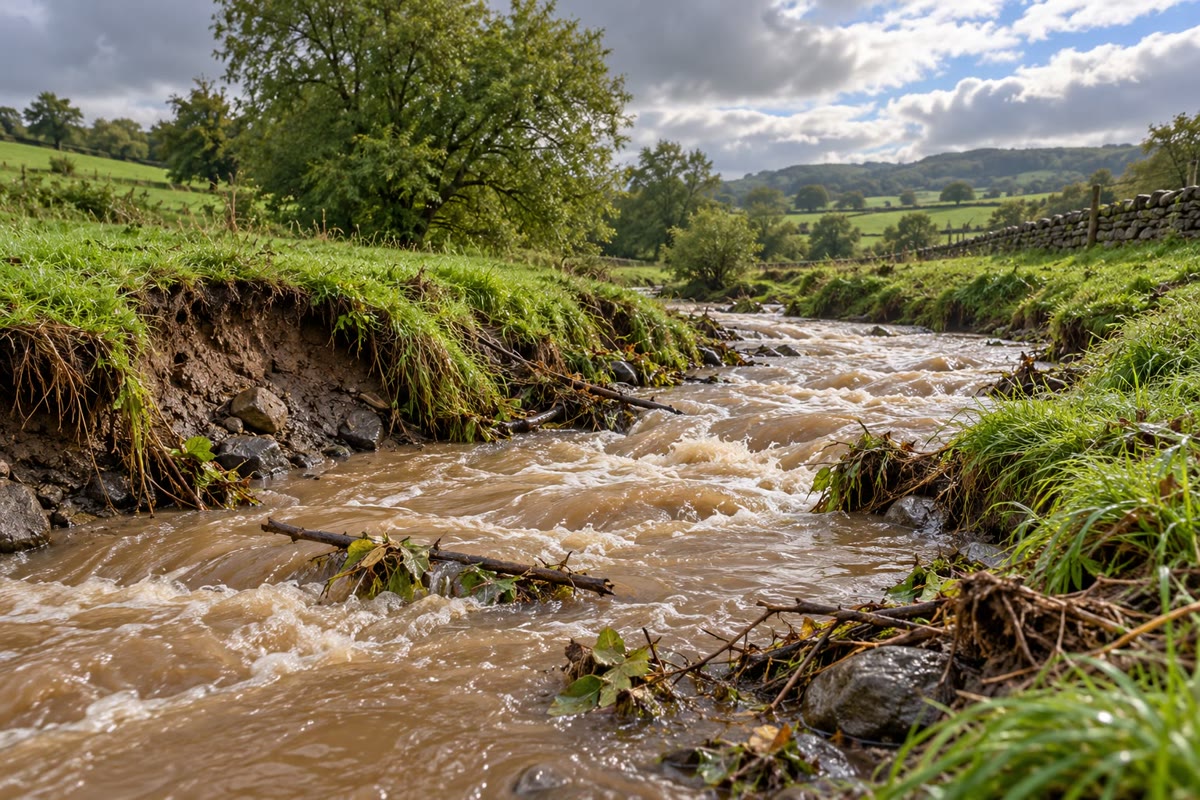
All night long, the storm drummed on the roof of the school. In the morning the sky is clearing, and Lena and Tom run to the little stream behind the playground. Yesterday it was clear and quiet: they could count the pebbles on its bed. Today it is wide, fast and brown, the colour of milky chocolate. It carries twigs, leaves, and something they cannot see one by one: mud and sand, torn from its banks and from the fields upstream.
“Where is all that mud going?” asks Tom. Downstream, a little further every minute. The stream is carrying the land away, grain by grain. In this chapter we follow those grains, from the rock they come from to the place where they settle.
You already know
Rock is the hard material of the Earth; broken into pieces it gives stones, pebbles rounded by water, sand whose grains we can see one by one, and mud whose grains are too small to see (Chapter 5). A river flows all the time in a long channel, from higher land down to a lake or to the sea (Chapter 2). Rain that falls on the land runs off into streams and rivers, which bring the water back to the sea (Chapter 3).
10.1 Rock breaks where it stands
Even the hardest rock does not last for ever. Where it lies in the open, under the sun, the rain and the frost, it slowly cracks and crumbles.
Definition 10.1 (Weathering)
Weathering is the slow breaking-up of rock where it stands, by frost, by water, by the roots of plants and by heat and cold. The rock is broken into pieces, but the pieces stay in place.
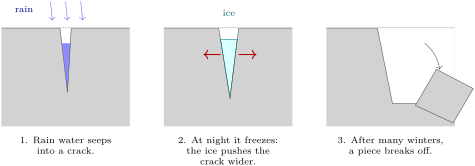
Frost is one of the strongest tools of weathering. Rain water seeps into a thin crack in the rock. On a cold night it freezes, and when water freezes it takes up a little more room: the ice pushes on the sides of the crack and opens it a tiny bit wider. The next day the ice melts, more water seeps in, and the next night it freezes again. After many winters, a piece of rock breaks off.
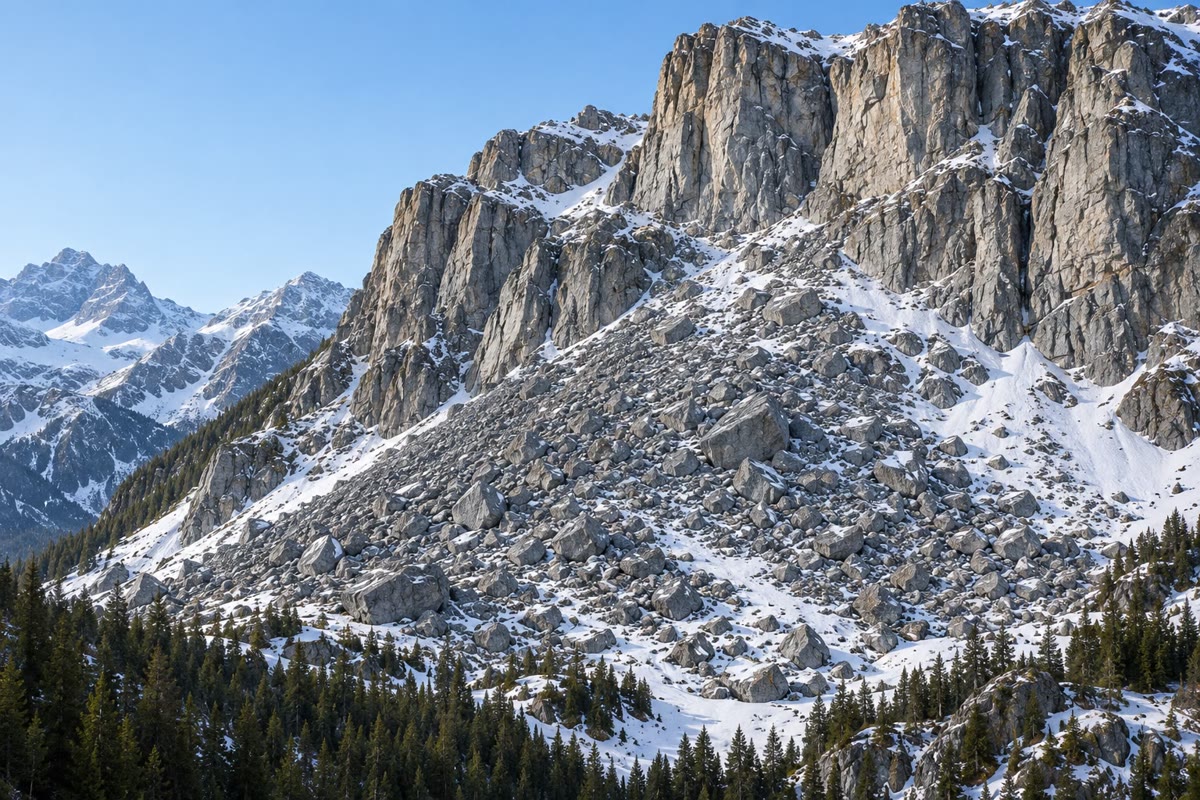
Below a cliff of bare rock high in the mountains, the pieces broken off by the frost slide and tumble down, and pile up in a slope of sharp stones. They are not rounded: no water has rolled them yet.
Plants help too. A tree root slips into a crack and, as it grows thicker year after year, it splits the rock like a slow wedge. Rain water itself slowly softens some rocks and turns them into clay and sand: that is how the soil gets its mineral grains.
10.2 Water carries the pieces away
Once the rock is broken, the pieces can move. Something must carry them.
Definition 10.2 (Erosion)
Erosion is the wearing-away of the land and the carrying-away of the pieces of rock, by running water above all, but also by the wind, by ice and by the waves of the sea.
Running water does most of the work. The rain washes soil and grains down the slopes into the streams; the streams tear more from their own banks, the way Tom and Lena’s stream did after the storm. The faster the water flows, the more it can carry, and the bigger the pieces it can move: a calm stream carries only fine mud; a stream in flood rolls pebbles and even boulders along its bed.
On their way, the stones knock against each other and against the bed. Their corners break off, and they become rounded pebbles, then smaller and smaller grains: sand and mud.
The wind does the same work in dry places, where nothing holds the sand: it blows it into dunes. Ice, in the mountains and near the poles, drags stones along under its great weight. On the coast, waves pound the cliffs and roll the pebbles of the beach back and forth.
Remark 10.3 (How much?)
Together, all the rivers of the world bring more than 12 billion tonnes of mud and sand to the sea every year. That is about a billion tonnes every month.
10.3 Water lays the pieces down
A river cannot carry its load for ever. Where it slows down, it no longer has the strength to move its biggest grains, and they settle on the bed.
Definition 10.4 (Deposition)
Deposition is the laying-down of the pieces of rock carried by water, wind or ice, where they slow down and stop.
The heaviest pieces settle first: pebbles drop where the current slackens a little, sand where it slows more, and the fine mud only where the water is almost still, in a lake or in the sea. That is why a river’s bed is pebbly in the mountains and sandy or muddy near the sea.
Weathering, erosion and deposition are three steps of one long journey: the rock is broken where it stands, its pieces are carried away, and they are laid down somewhere else. Slowly, water moves the mountains, grain by grain, down to the plains and into the sea.
Method 10.5 (Naming what water does)
To name what is happening to rock in a picture or a story, ask three questions:
- Is the rock being broken, but the pieces stay where they are? That is weathering.
- Are the pieces being worn away and carried off? That is erosion.
- Are the pieces settling down and piling up? That is deposition.
Example 10.6 (The stream after the storm)
The brown water of Tom and Lena’s stream carries mud torn from its banks: that is erosion. A week later, the stream is clear again, and a thin layer of mud covers the bottom of the calm pool at the end of the playground: that is deposition.
10.4 A river from its source to its mouth
Every river has a beginning and an end.
Definition 10.7 (Source, mouth and tributary)
The source of a river is the place where it begins: a spring, a melting glacier, or a high, wet land where many tiny streams start. Its mouth is the place where it ends, flowing into the sea, a lake or a bigger river. A tributary is a smaller river that flows into a bigger one.
Along its way, a river changes. We split its length into three parts, its upper, middle and lower course.
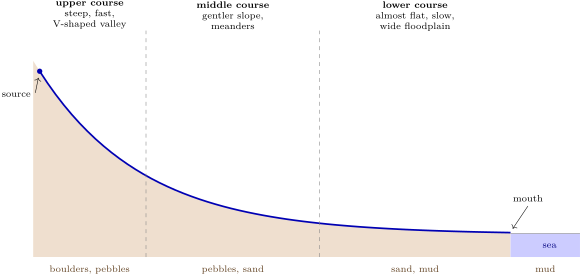
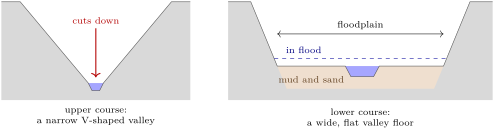
In its upper course, in the mountains, the river is young and steep. Its water rushes down, rolls boulders along its bed and cuts downwards into the rock. It digs a narrow valley with steep sides, shaped like the letter V.
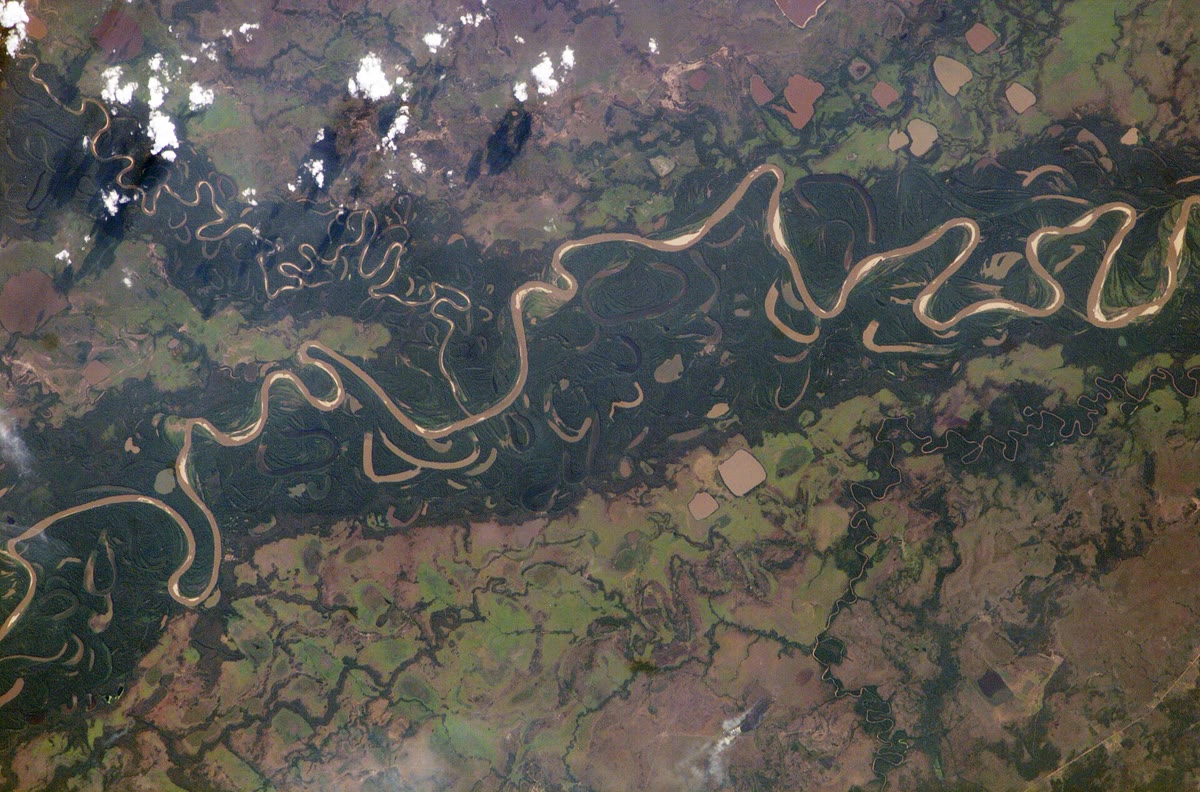
In its middle course, the slope is gentler. The river swings from side to side in great loops.
Definition 10.8 (Meander)
A meander is a loop of a river that winds across a flat valley floor.
A meander does not stay still: it moves. On the outside of each bend, the water flows fast and deep: it eats into the bank, which becomes a small cliff. On the inside of the bend, the water flows slowly: it drops sand and gravel, which build a gentle beach. Year after year, the outer bank is worn back and the inner beach grows, and the loop swings wider and wider.
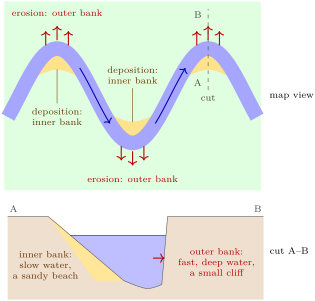
Sometimes two loops grow so close that, during a flood, the river breaks through the narrow neck of land between them and takes the short cut. The old loop is left behind as a curved lake.
In its lower course, the land is almost flat. The river flows slowly across a wide, flat valley floor, made of the mud and sand it has laid down itself over a very long time.
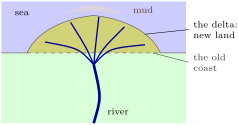
At last the river reaches its mouth. There the water slows down almost completely, and the river drops the last of its load. Where the waves and the tides of the sea are too weak to carry all of it away, the mud and sand pile up, and new land grows out into the sea.
Definition 10.9 (Delta)
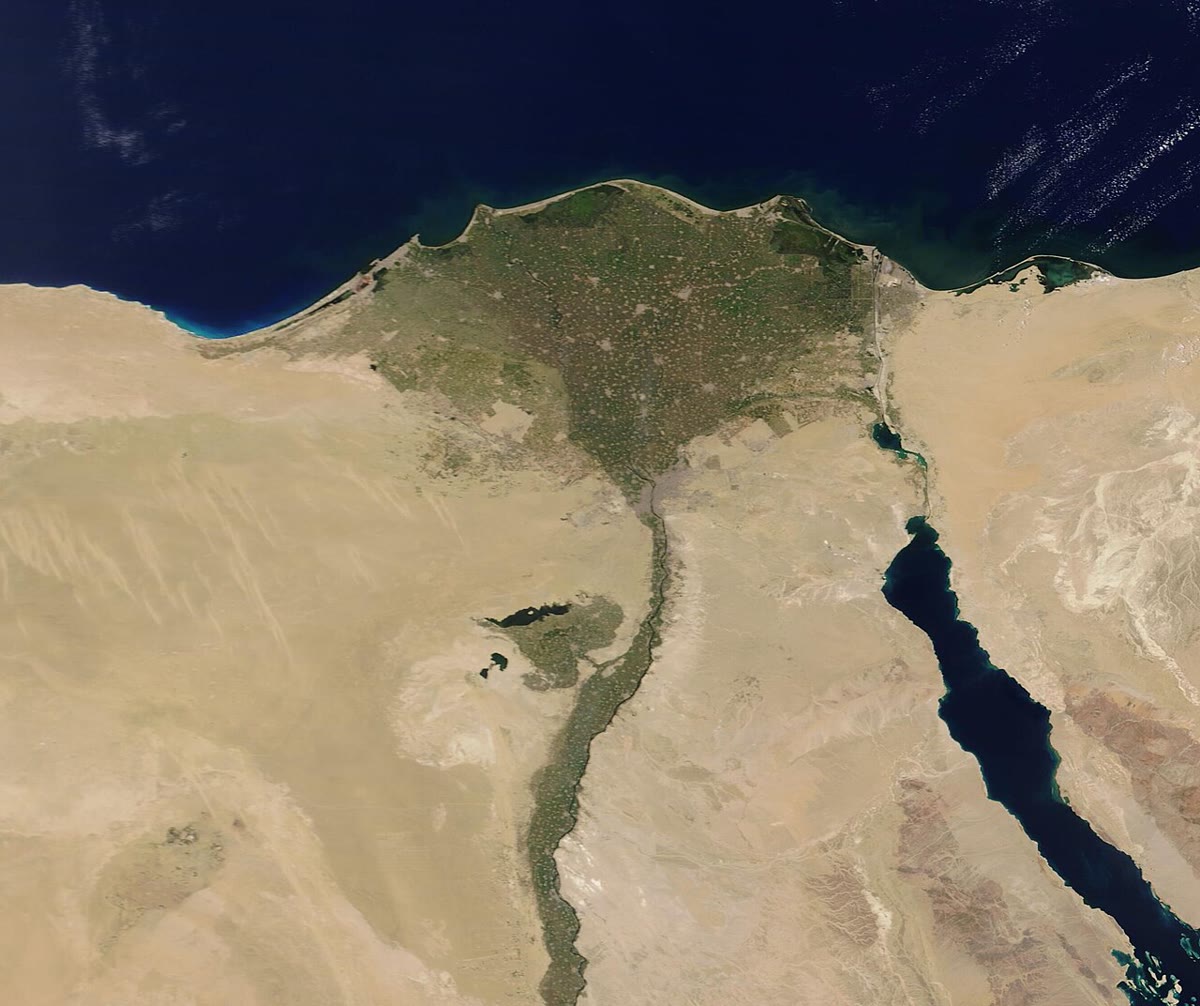
A delta is new, flat land built by a river at its mouth from the mud and sand it lays down. The river splits into several branches that spread across it, often in the shape of a fan.
The name comes from the Greek letter (delta), a triangle, because the delta of the Nile, in Egypt, has that shape.
Some rivers end without a delta. Where strong waves and tides sweep the mud away, the river ends in a wide, funnel-shaped mouth where the sea comes in and out with the tides: an estuary.
10.5 Floods
After long days of rain, or when the snow melts fast in spring, a river receives more water than its channel can hold.
Definition 10.10 (Flood and floodplain)
A flood happens when water covers land that is usually dry. A river floods when it rises above its banks and spreads over the flat land on either side of it. That flat land, which the river covers from time to time, is its floodplain.
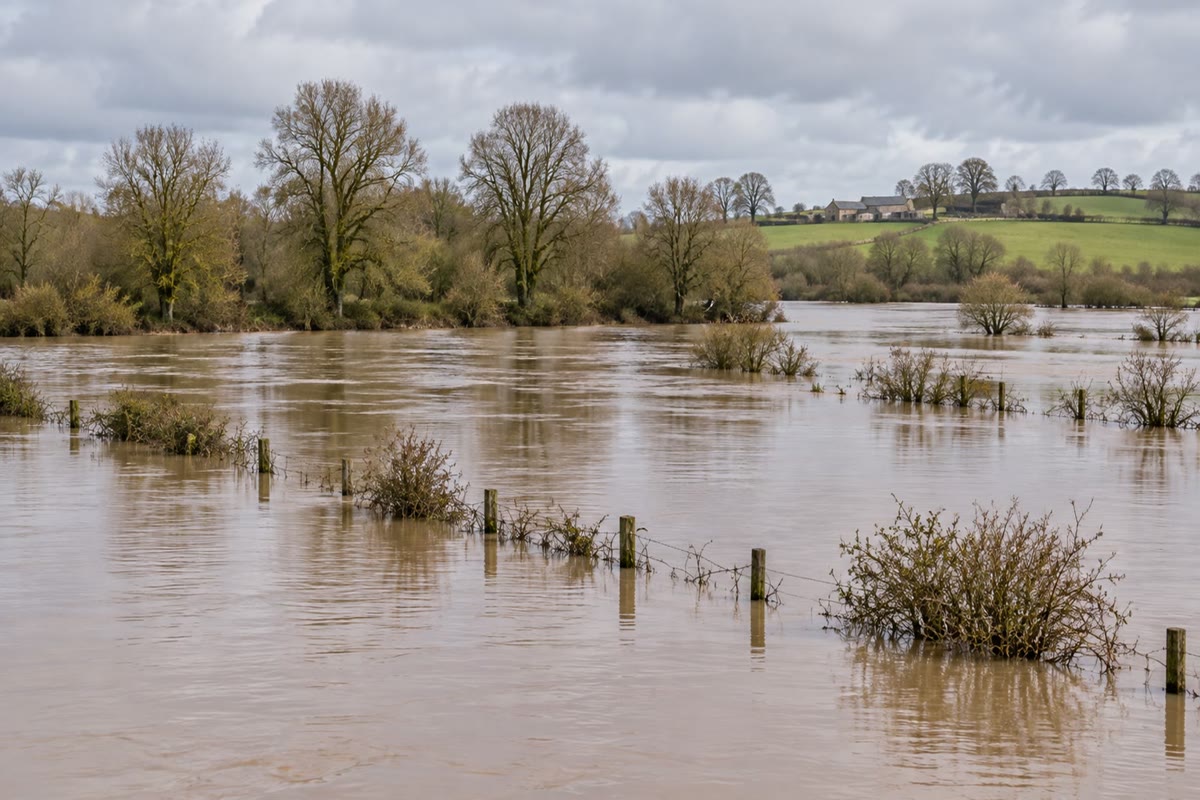
A river that floods is not doing anything strange: it is doing what rivers have always done. The floodplain is its territory. In fact the river built it: each flood leaves behind a thin layer of mud on the fields, which is why floodplains have such rich soil. Long ago, farmers in Egypt waited for the yearly flood of the Nile, which watered their fields and brought them new mud.
But a flood is dangerous for people who live on the floodplain. Houses built on it can be filled with water, and fast flood water can sweep away cars and people. A wise town builds on higher ground and leaves the floodplain to fields, meadows and parks. In Chapter 12 we will see how people prepare for floods and stay safe.
Safety
Never walk, cycle or play in flood water, and never go near a river in flood: the water is stronger and deeper than it looks, and it can hide holes and open drains. Keep away until the grown-ups in charge say it is safe.
10.6 Exercises
Exercise 10.1 ★
Name the process: weathering, erosion or deposition?
- [(a)] Ice in a crack splits a rock on a mountain.
- [(b)] A river in flood carries sand away from its banks.
- [(c)] A layer of mud settles at the bottom of a calm lake.
- [(d)] A tree root splits a stone wall.
Solution
Solution of Exercise 10.1.
(a) Weathering: the rock is broken where it stands. (b) Erosion: the sand is worn away and carried off. (c) Deposition: the mud settles. (d) Weathering: the root breaks the stone where it stands.
Exercise 10.2 ★
What is the source of a river? What is its mouth? What is a tributary?
Exercise 10.3 ★
Put these parts of a river in order, from the source to the sea: the meanders; the delta; the narrow V-shaped valley; the source.
Exercise 10.4 ★
True or false? Explain.
- [(a)] Hard rock never changes.
- [(b)] A fast river can carry bigger stones than a slow river.
- [(c)] The finest mud settles first, near the source.
Solution
Solution of Exercise 10.4.
(a) False: frost, water, roots, heat and cold slowly break even hard rock (weathering). (b) True: the faster the water, the bigger the pieces it can move. (c) False: the heaviest pieces settle first; the finest mud settles last, where the water is almost still, in a lake or in the sea.
Exercise 10.5 ★
Here is a bend of a river seen from above.
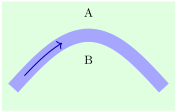
On which bank, A or B, does the river wear the land away? On which bank does it drop sand?
Solution
Solution of Exercise 10.5.
A is on the outside of the bend: the water there is fast and deep, and it wears the bank away (erosion). B is on the inside of the bend: the water there is slow, and it drops sand (deposition).
Exercise 10.6 ★
In the mountains, the bed of a river is covered with large stones. Near the sea, it is covered with sand and mud. Why?
Solution
Solution of Exercise 10.6.
In the mountains the river is steep and fast: it can roll large stones along, and it carries the small grains away. Near the sea the river is slow: it can no longer move large stones, only sand and mud, and it drops them there. On the way, too, the stones have been broken and worn into smaller grains.
Exercise 10.7 ★★
A river is 600 kilometres long. Its upper course is the first of its length, and its middle course the next .
- [(a)] How long is the upper course? the middle course?
- [(b)] How long is the lower course? What fraction of the river is it?
Solution
Solution of Exercise 10.7.
(a) Upper course: kilometres. Middle course: kilometres. (b) Lower course: kilometres. Since , it is of the river. (Check: .)
Exercise 10.8 ★★
Look again at the photograph of the Mamoré River seen from the space station, on page 64. What are the pale patches on the inside of the bends? What are the dark curved lakes beside the river? How were they made?
Solution
Solution of Exercise 10.8.
The pale patches are sand and gravel laid down on the inside of the bends, where the water is slow (deposition). The dark curved lakes are old loops of the river: two loops grew so close that the river broke through the neck of land between them, took the short cut, and left the old loop behind as a lake.
Exercise 10.9 ★★
A town wants to build a new school in the flat green meadows beside its river, because the land there is flat and cheap. What would you tell the town council? Use the words flood and floodplain.
Solution
Solution of Exercise 10.9.
The flat meadows beside the river are its floodplain: the land the river covers when it floods. They are flat precisely because the river built them from its own mud. One day the river will flood again and fill the school with water, and fast flood water is dangerous. The school should be built on higher ground, and the meadows kept as fields, meadows or a park.
Exercise 10.10 ★★
The rivers of the world bring about 12 billion tonnes of mud and sand to the sea every year.
- [(a)] How many tonnes is that every month, on average?
- [(b)] A big lorry carries 10 tonnes. How many lorry-loads would it take to carry one month’s mud and sand?
Solution
Solution of Exercise 10.10.
(a) A year has 12 months: billion billion tonnes a month on average. (b) One billion is ; divided by 10, it is : a hundred million lorry-loads.
Exercise 10.11 ★★★
Tell the story of a grain of sand. It starts as part of a rock high on a mountain, and it ends, many years later, in a delta. Use the words weathering, erosion and deposition, and say what happens to the grain in the upper, middle and lower course of the river.
Solution
Solution of Exercise 10.11.
One possible story. The grain is part of a rock high on a mountain. Frost opens a crack around it, night after night, until a piece of rock breaks off: that is weathering. The piece falls to the stream below. In the upper course the water is fast and steep: it rolls the piece along (erosion), and knocking against other stones it breaks into pebbles and then into grains of sand. In the middle course the river slows; the grain rests for a while on the sandy beach inside a meander bend, until a flood picks it up again. In the lower course the river is slow and wide; the grain travels with the water to the mouth. There the water almost stops, and the grain settles with the mud and sand of the delta: that is deposition.