书籍暂未推出简体中文版——当前显示英文版。
Primary & Middle School Earth and Space Sciences · 1–9 年级
5Stones, Pebbles and Sand
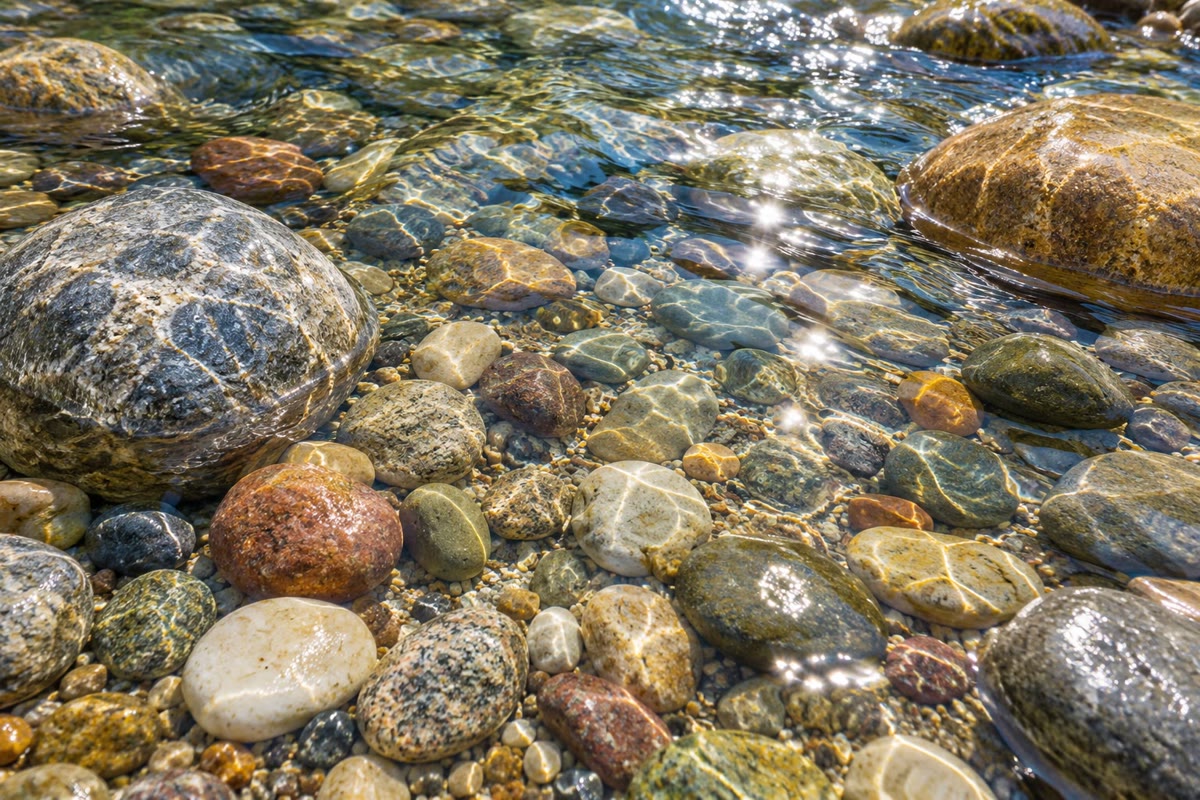
Tom is on holiday by a river. On the gravel bank, where the water is shallow, he picks up a pebble. It is smooth and round, almost like an egg, and it fits in his hand. Last week, walking with his parents on a mountain path high up the same valley, he saw stones of the same colour lying under a rocky slope — but those stones were sharp, with edges and corners.
How did a sharp stone from the mountain become a smooth, round pebble down in the valley? To find out, let us start with the rock itself.
You already know
In a landscape there are mountains, hills, valleys and plains, and rivers that flow from the high land down to the sea (Chapter 2). The top layer of the ground, where plants grow, is the soil: the biology books tell how living things make it.
5.1 Rock: the hard ground under our feet
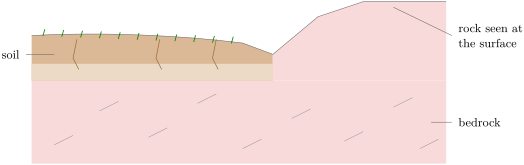
Dig a deep hole in a garden. First you find dark, soft soil with roots in it. Below, the soil becomes lighter and stonier. And if you could dig deep enough, you would always reach something hard that a spade cannot cut: rock.
Definition 5.1 (Rock and bedrock)
A rock is a hard, natural material that the solid Earth is made of. The bedrock is the solid rock that lies under the soil everywhere on the land, and under the sand and the mud of the sea floor.
In most places the bedrock is hidden by the soil, the grass and the trees. We see it where there is no soil to cover it: in the steep sides of mountains, in cliffs by the sea, and along roads that have been cut through a hill.
5.2 From rock to pebbles
Rock is hard, but it does not last for ever. In winter, water gets into the cracks of a rock, freezes and swells, and pushes the cracks wider. Roots grow into cracks too. Little by little, pieces break off and fall: that is where the sharp stones under the mountain slopes come from.
When a sharp stone falls into a mountain stream, the water rolls it along the bottom, knocks it against other stones, and drags it over sand. Its corners are the first to wear away. The farther it travels, the rounder and smoother it becomes. By the time it reaches the lower valley, it has become a pebble.
Definition 5.2 (Pebble and gravel)
A pebble is a small piece of rock that has been rounded and smoothed by water rolling it along, in a river or on a beach. Gravel is a mass of small stones and pebbles lying together, with grains bigger than grains of sand.

Remark 5.3 (Reading the shape of a stone)
The shape of a stone tells us its story. A sharp stone has not travelled far from the rock it broke from. A round, smooth pebble has been rolled for a long time by water, in a river or by the waves of the sea.
5.3 Sand and mud
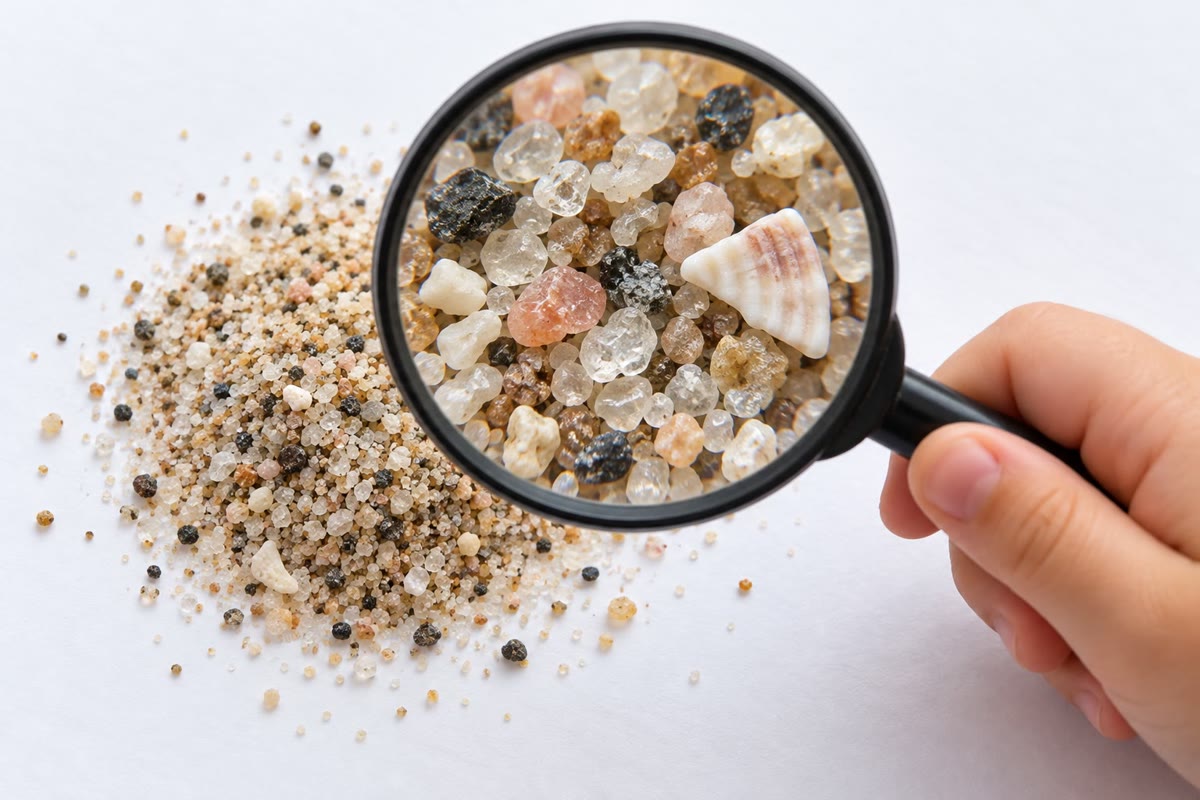
The stones and pebbles that bump into one another also chip off tiny pieces. Over a very long time, these tiny pieces become sand. Look at sand through a magnifying glass: each grain is a little piece of rock, or of a shell, often rounded too.
Definition 5.4 (Sand and mud)
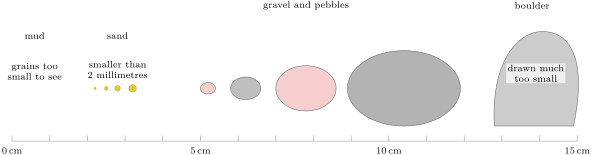
Sand is made of loose grains of broken rock smaller than 2 millimetres across: we can still see each grain. Mud is made of grains so small that we cannot see them one by one; wet, it is soft and sticky.
Geologists sort broken pieces of rock by size, from the biggest to the smallest: boulders, pebbles and gravel, sand, and mud.
Method 5.5 (Sorting broken rock by size)
To name a piece of broken rock, look at its size:
- if you cannot see the grains, even close up, it is mud;
- if you can see each grain, but each one is smaller than 2 millimetres (the thickness of a coin), it is sand;
- if the pieces are bigger than that, but you can hold one in your hand, they are gravel and pebbles;
- if a piece is too heavy to lift, it is a boulder.
Example 5.6 (Where do we find each size?)
Fast water can carry big stones; slow water drops them and carries only small grains. So boulders and sharp stones lie in the steep mountain streams; pebbles and gravel lie on the banks of the river in the valley; sand gathers on beaches and in quiet bends of the river; and mud settles where the water is almost still, in ponds, lakes and the mouths of rivers.
5.4 Hard rocks and soft rocks
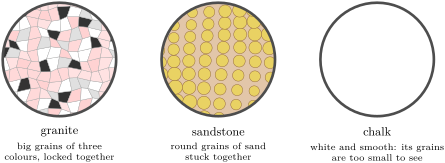
Not all rocks are equally hard. Some, like granite, are so hard that they scratch glass and last for thousands of years in a wall. Others crumble in the hand, like chalk, which leaves a white mark on a board. Some rocks are made of grains that we can see; others are smooth and look all the same from one side to the other.
Example 5.7 (Three rocks compared)
Granite is speckled with pink, white and black grains and is very hard. Sandstone is made of grains of sand stuck together; rubbed with a finger, it sometimes lets a few grains go. Chalk is white, soft and powdery. You will learn in a later year how each of them was formed.
Method 5.8 (Looking closely at a stone)
To describe a stone, look at it and touch it, without breaking it:
- its colour, or its colours;
- its shape: sharp with corners, or round and smooth;
- its grains: can you see them? are they all the same, or of several colours?
- its feel: hard, or soft enough to leave a mark on paper?
Write what you see in a table, one line for each stone.
Example 5.9 (A table of three stones)
Mia describes three stones from a box at school.
| Stone | Colour | Shape | Grains |
|---|---|---|---|
| A | pink, white and black | round | big, three colours |
| B | yellow-brown | sharp | small, all alike |
| C | white | sharp | none to see |
Stone C also leaves a white mark on paper. From the example above, stone A looks like granite, stone B like sandstone and stone C like chalk. Stone A is round: water has rolled it for a long time.
5.5 The stones we build with
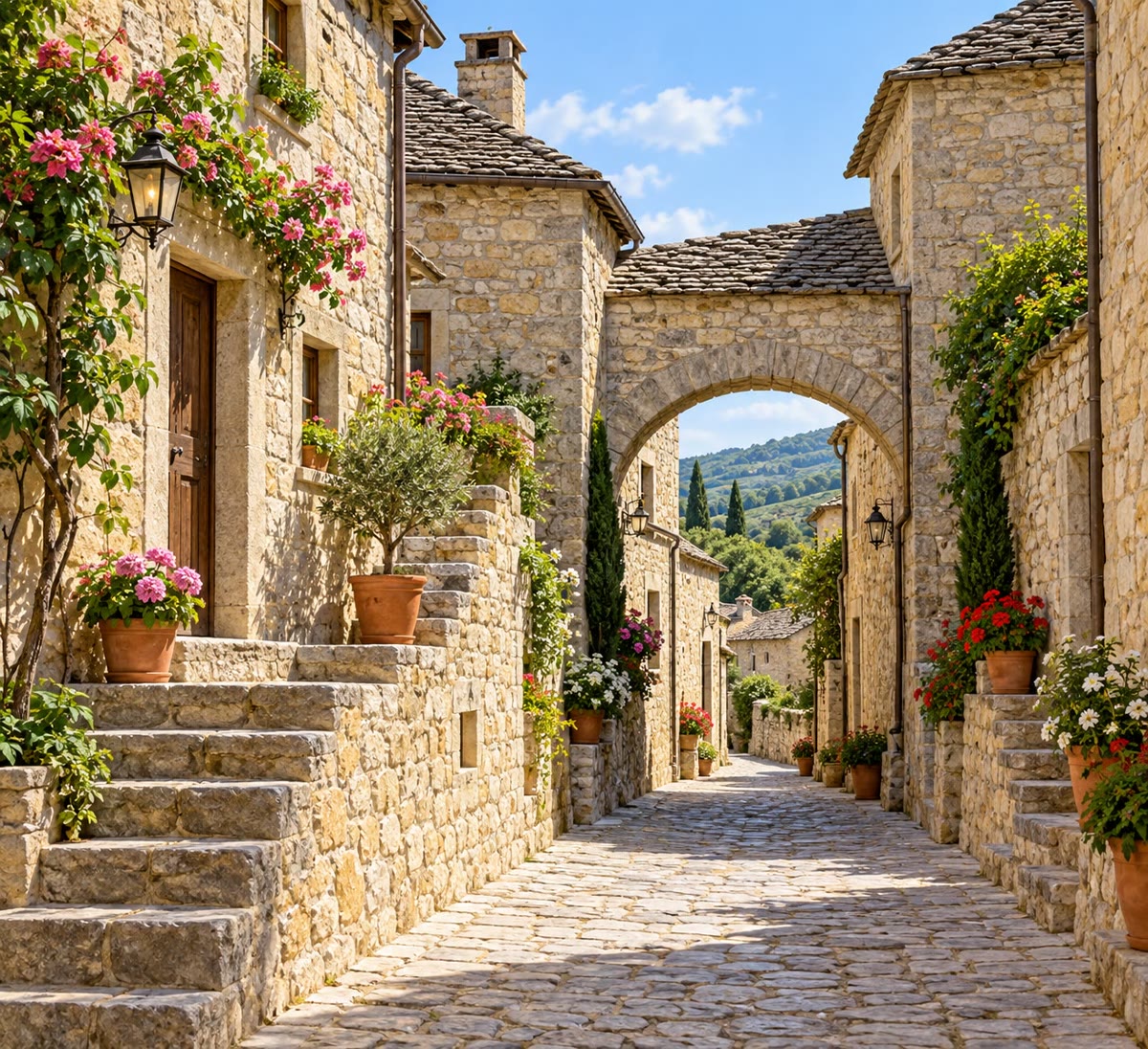
For thousands of years, people have built with the rock around them. In the old villages of a region, the walls are often all of the same colour, because they were built with the stone of the nearest hill.
Definition 5.10 (Building stone)
A building stone is a rock that is cut or shaped to build walls, roofs, steps, bridges or pavements.
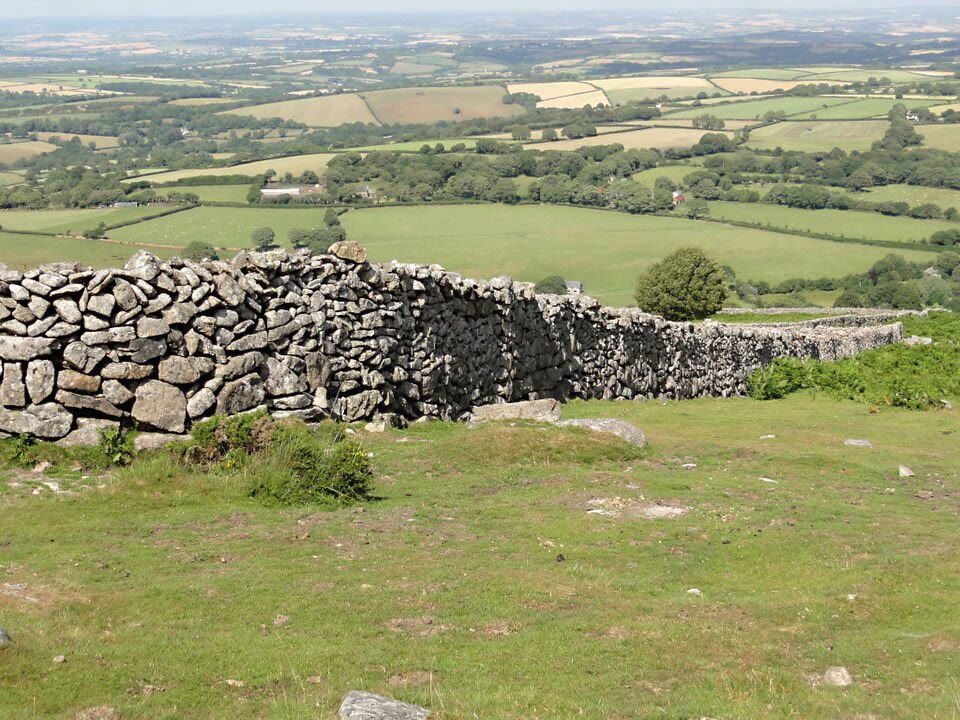
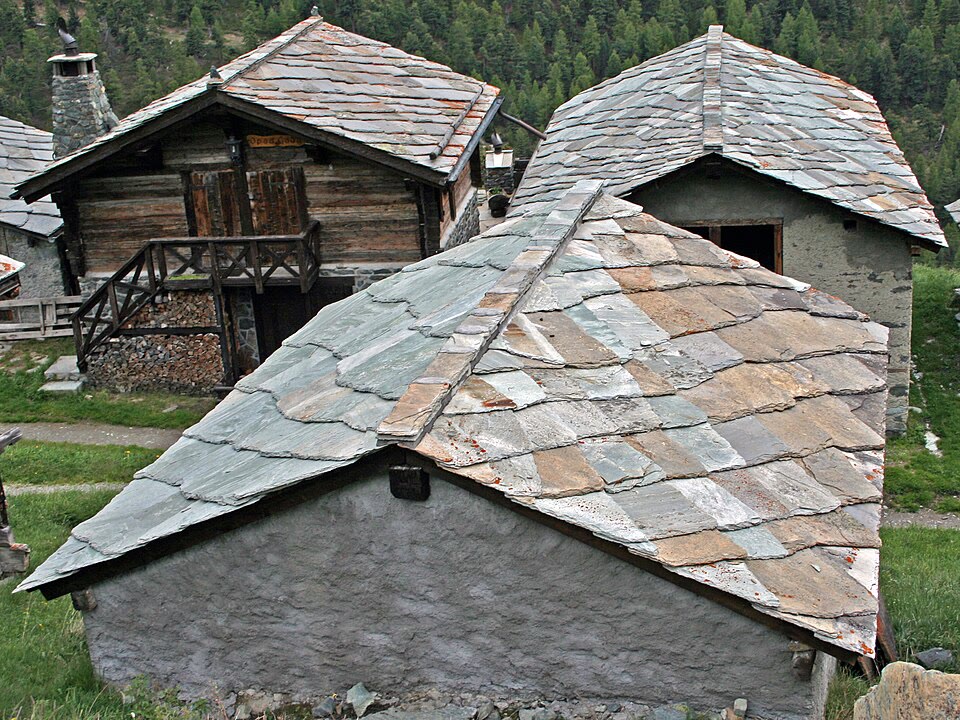
Each rock is good for something. Hard granite makes walls, steps and kerbs that last for centuries. Some rocks, like slate, split into thin, flat sheets: laid one over the other, they make roofs that keep the rain out. Sandstone and limestone are soft enough to be cut into neat blocks.
Today we also build with bricks, concrete and glass. But a brick is made of baked clay, concrete is made of sand, gravel and cement, and glass is made from sand: all of them come from the rocks of the Earth too.
5.6 Exercises
Exercise 5.1 ★
What is the bedrock? Where can we see it without digging?
Exercise 5.2 ★
Put in order of size, from the smallest to the biggest: pebble, mud, boulder, sand.
Exercise 5.3 ★
A grain is 1 millimetre across. Is it sand or gravel? Another grain is 3 millimetres across: sand or gravel?
Exercise 5.4 ★
Natural or made by people? A pebble; a brick; a block of granite; a sheet of glass; sand on a beach.
Exercise 5.5 ★
Why does a pebble from a river have no sharp corners?
Solution
Solution of Exercise 5.5.
The water of the river has rolled it along the bottom and knocked it against other stones for a long time: its corners have worn away.
Exercise 5.6 ★
Name two building stones and say what each is used for in the photographs of this chapter.
Solution
Solution of Exercise 5.6.
Granite, for a wall; thin, flat stone slabs (a rock like slate), for roofs.
Exercise 5.7 ★★
Tom finds two stones of the same rock: one is sharp, the other is round. Which one has travelled farther? Explain.
Solution
Solution of Exercise 5.7.
The round one: the longer a stone is rolled by water, the more its corners wear away. The sharp one has not travelled far from the rock it broke from.
Exercise 5.8 ★★
On the grain-size drawing, how many centimetres long is the biggest pebble? How many sand grains of 2 millimetres would fit side by side along 1 centimetre?
Solution
Solution of Exercise 5.8.
The biggest pebble is 3 centimetres long. One centimetre is 10 millimetres, and : five grains of 2 millimetres fit along 1 centimetre.
Exercise 5.9 ★★
Where would you expect to find mud: in a fast mountain stream or in a quiet pond? Why?
Solution
Solution of Exercise 5.9.
In the quiet pond. Fast water keeps the tiny grains of mud moving; only where the water is almost still can they settle to the bottom.
Exercise 5.10 ★★
Bricks, concrete and glass are made by people. Why can we still say that they come from the rocks of the Earth?