Primary & Middle School Earth and Space Sciences · Grades 1–9
3Water on Earth
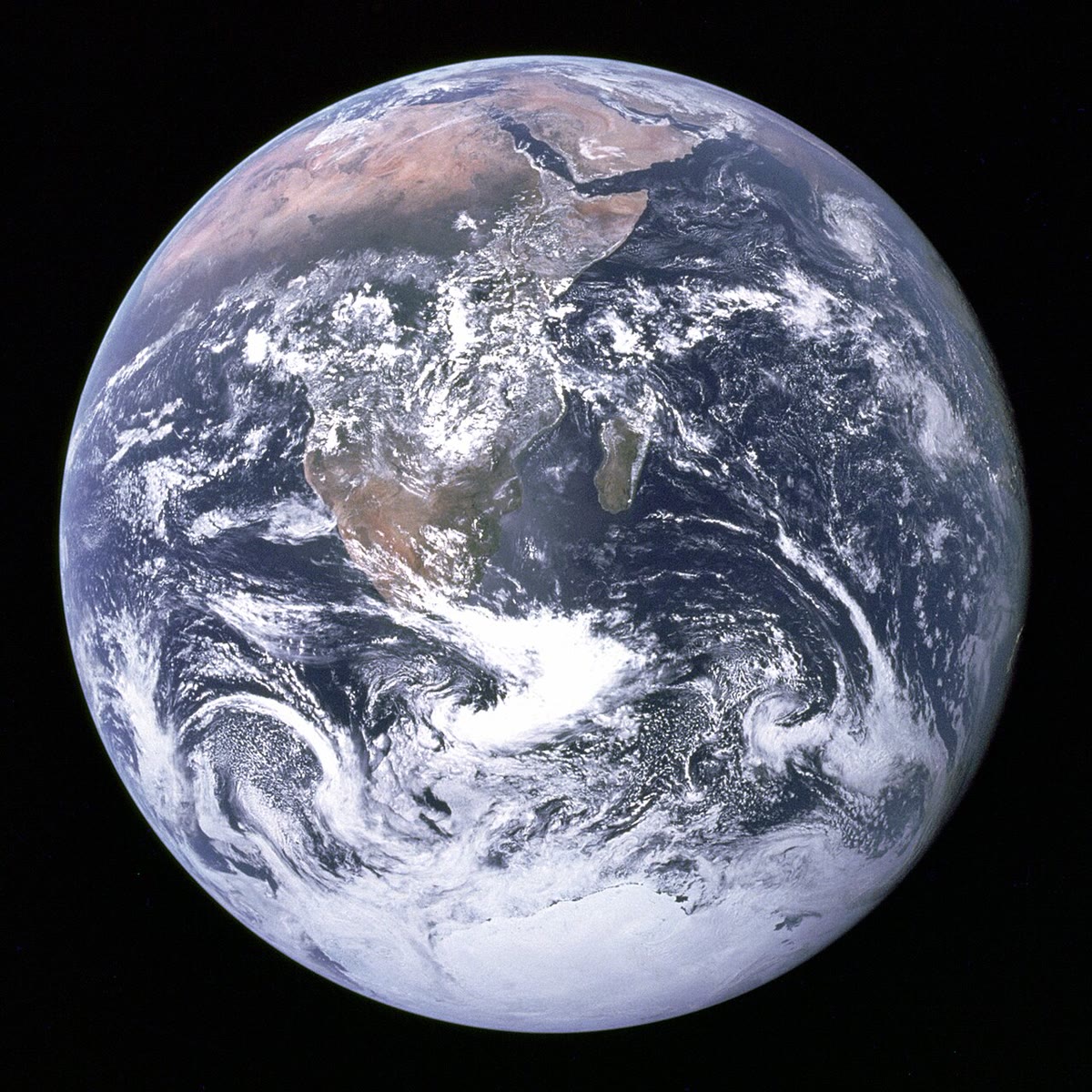
On the 7th of December 1972, three astronauts on their way to the Moon turned their camera back towards the Earth. Their photograph became one of the most famous pictures ever taken. Look at it. You can see white clouds, a little brown and yellow land, the white ice at the bottom — and blue, blue everywhere. Seen from space, our planet is a blue planet.
You already know
Water can be a solid (ice), a liquid, or a gas that we cannot see (water vapour). Liquid water left in the sun slowly turns into vapour: it evaporates. When the vapour cools, it turns back into tiny drops: it condenses. You have met these changes in the physics books. In a landscape, water flows in rivers and lies in lakes (Chapter 2).
3.1 The blue planet
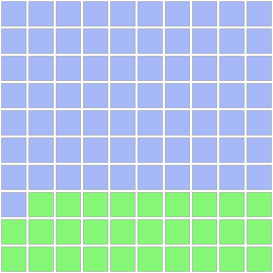
Most of the Earth is covered by water. Imagine the whole surface of the Earth cut into 100 equal squares. If we colour in blue every square that is covered by sea, we colour 71 squares. Only 29 squares are land.
The great stretches of salt water that cover most of the Earth have names.
Definition 3.1 (Ocean and sea)
An ocean is one of the very large stretches of salt water that cover most of the Earth and lie between the continents. A sea is a smaller stretch of salt water, usually at the edge of an ocean and partly closed in by land.
All the oceans are joined to one another: a boat could sail from any ocean to any other without crossing land. Their names, and where they lie on a globe, are in Chapter 6.
3.2 Salt water and fresh water
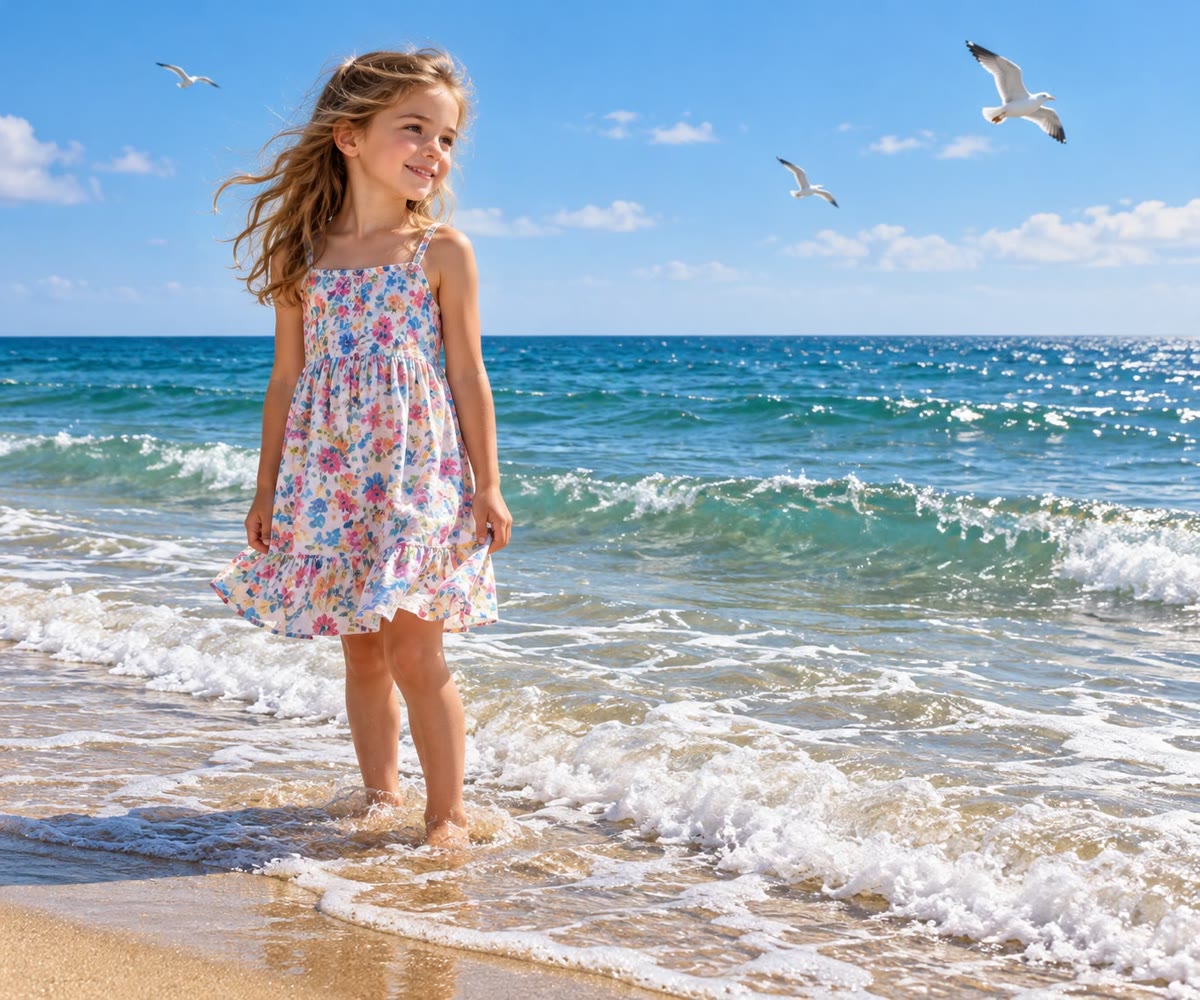
If you have ever swallowed a mouthful of sea water while swimming, you know: it tastes very salty. The water of rivers and lakes does not.
Definition 3.2 (Salt water and fresh water)
Salt water has a lot of salt dissolved in it: it is the water of the oceans and the seas. Fresh water has very little salt: it is the water of rain, of most rivers and lakes, of the ice and the snow, and of springs.
Example 3.3 (How salty is the sea?)
In a bottle holding one kilogram of sea water — about one litre — there are about 35 grams of salt. If we let all the water evaporate, the salt stays behind as white crystals at the bottom. That is how sea salt is made in salt marshes by the sea, where the sun and the wind slowly dry out shallow pools of sea water.
Remark 3.4 (We cannot drink sea water)
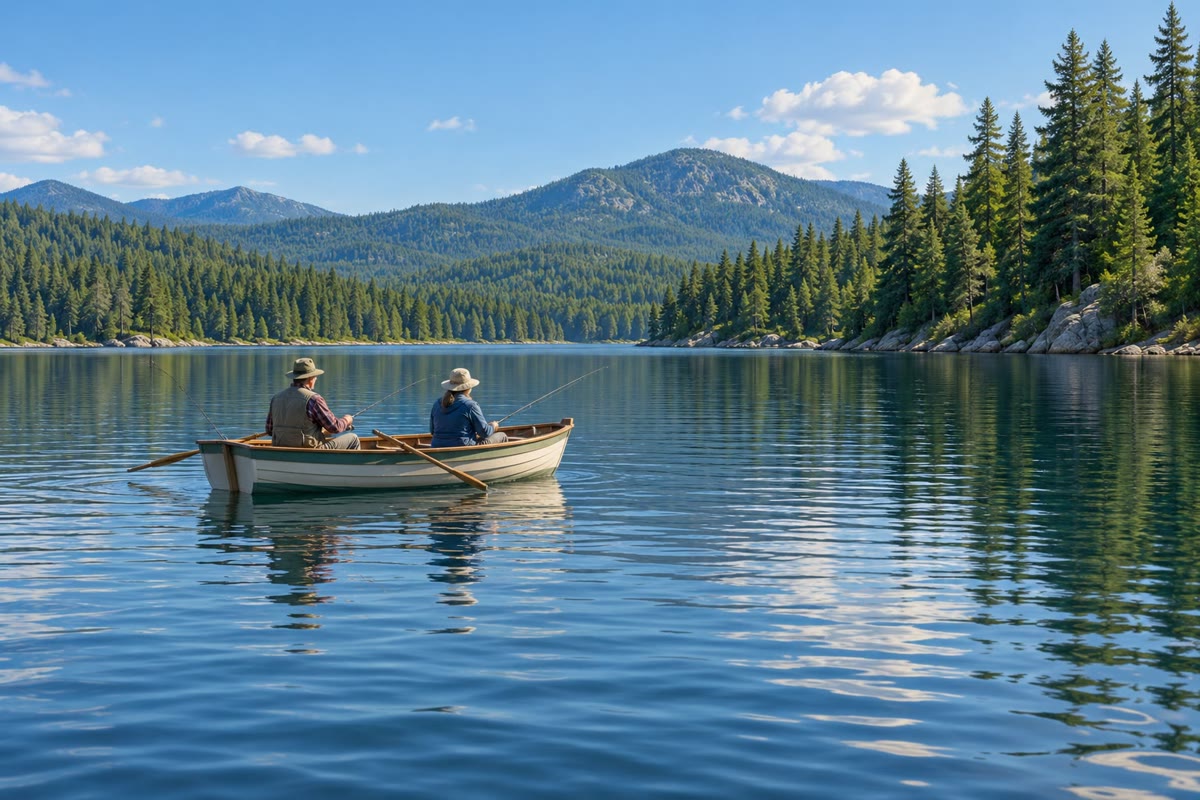
People and land animals cannot drink sea water: there is too much salt in it, and drinking it makes the body lose water instead of gaining it. Sailors far out at sea, surrounded by water, have always had to carry their fresh water with them.
3.3 Where is all the water?
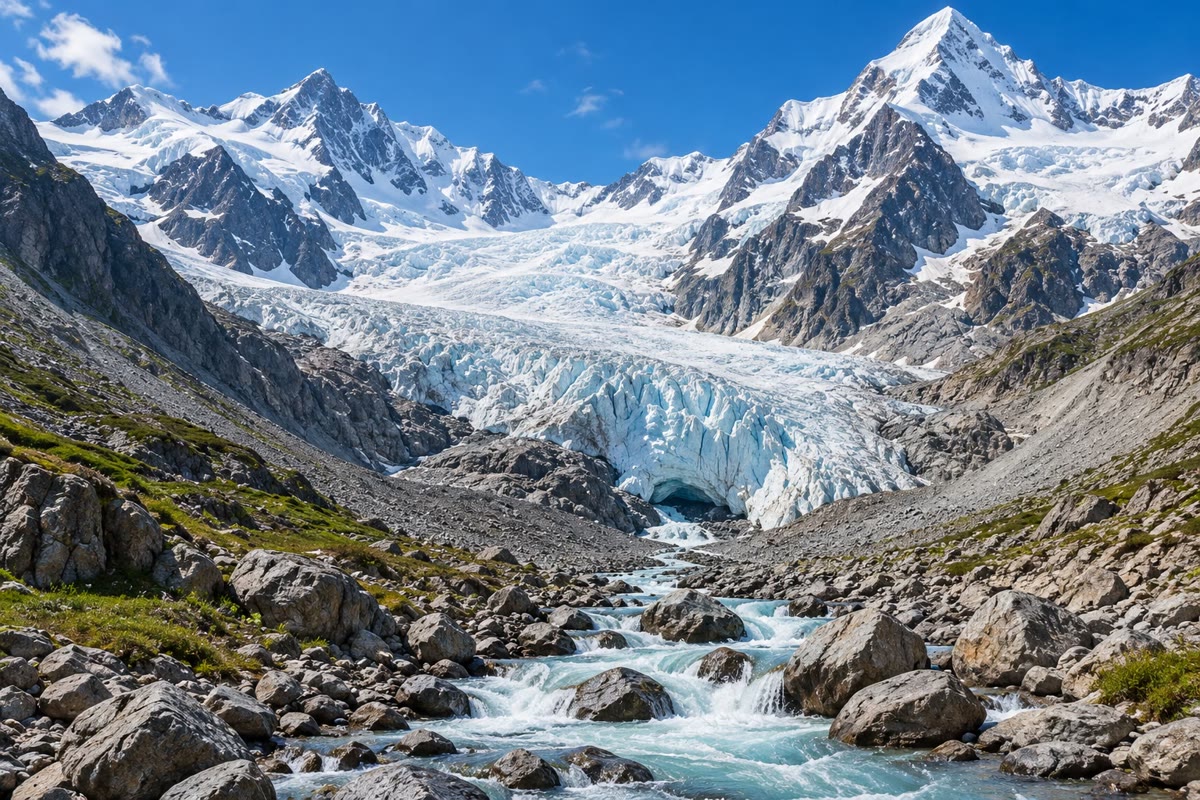
Fresh water is not only in rivers and lakes. A lot of it is frozen: in the great white ice of Antarctica and Greenland, and on the high mountains. And a lot of it is hidden under our feet, in the ground, where it fills the tiny spaces between grains of sand and cracks in the rock.
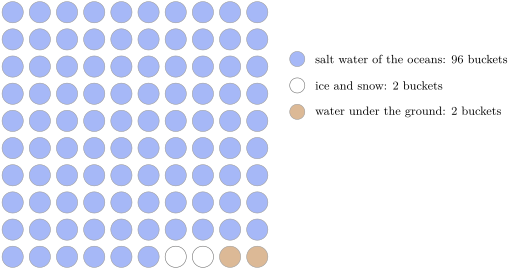
Imagine that we could pour all the water of the Earth into 100 buckets of the same size. How many buckets would each kind of water fill?
Proposition 3.5 (Most of the Earth’s water is salty)
Out of 100 buckets of all the water on Earth, 96 are the salt water of the oceans. The fresh water we drink is only a very small part of all the water: most of it is frozen in the ice, or hidden under the ground.
3.4 Where does the rain go?
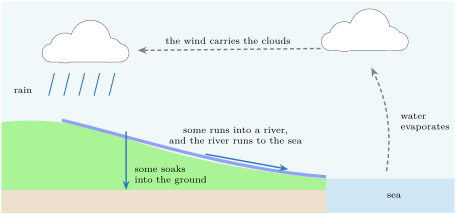
When it rains, the water does not stay where it falls. Watch the yard of the school after a shower: some water runs over the ground into the gutters, some soaks into the soil of the flower beds, and puddles slowly disappear as the sun comes back.
Method 3.6 (Following a drop of rain)
To follow a drop of rain, ask three questions in turn:
- Where does it fall: on the sea, on a roof, on the soil, on a mountain?
- Does it soak into the ground, run off over the surface, or freeze into ice?
- Where does it go next: into a river, a lake, the sea, the ground, or back into the air?
In the end, every drop comes back to the sea or to the air, and the journey starts again.
Example 3.7 (A drop on the mountain)
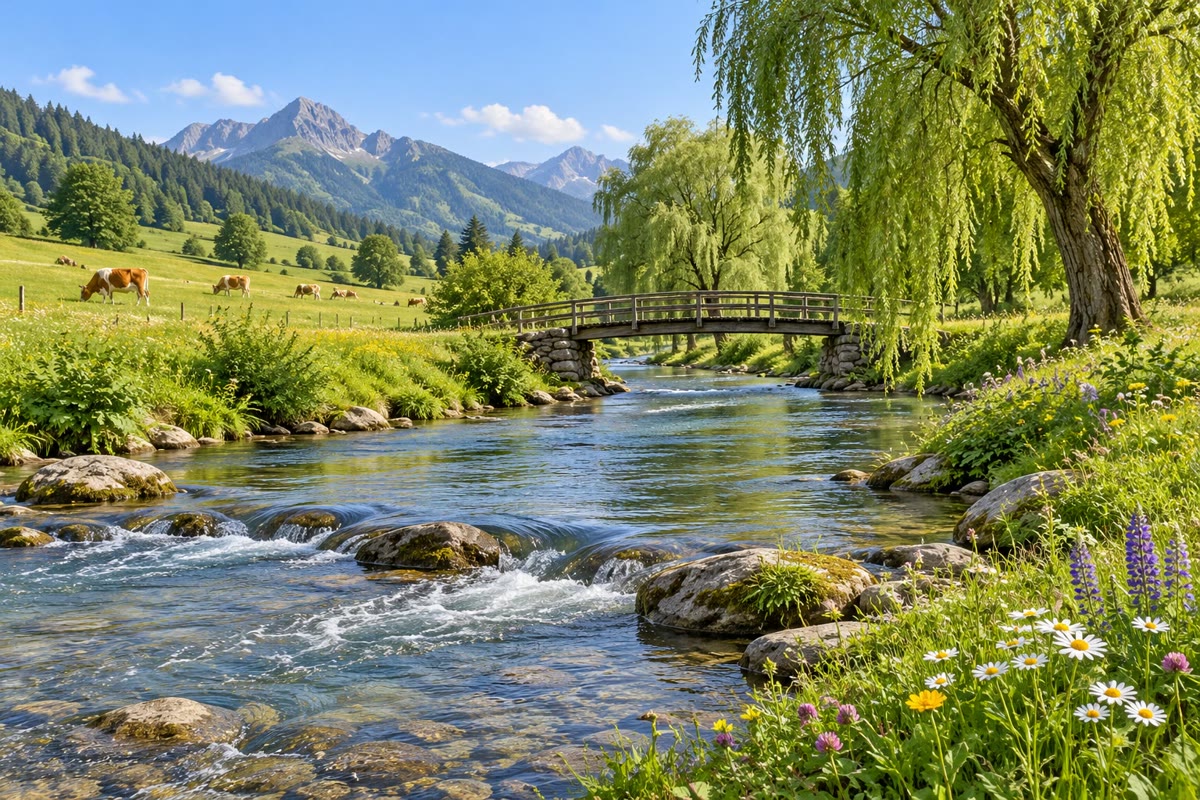
A drop of rain falls as snow on a high mountain in winter. It stays there, frozen, until the warm days of summer. Then it melts, runs down into a mountain stream, joins a river, and the river carries it to the sea. One sunny day the drop evaporates from the sea and rises into the air, where it becomes part of a new cloud.
3.5 Exercises
Exercise 3.1 ★
Salt water or fresh water? The sea; a river; rain; a lake in the mountains; an ocean; the ice on a mountain.
Solution
Solution of Exercise 3.1.
Salt water: the sea, the ocean. Fresh water: the river, the rain, the lake in the mountains, the ice on the mountain.
Exercise 3.2 ★
Why do we call the Earth the “blue planet”?
Solution
Solution of Exercise 3.2.
Because most of its surface is covered by the blue water of the oceans: seen from space, it looks blue.
Exercise 3.3 ★
On the grid of 100 squares, 71 squares are blue. How many squares are land?
Solution
Solution of Exercise 3.3.
squares are land.
Exercise 3.4 ★
Which is bigger, an ocean or a sea?
Solution
Solution of Exercise 3.4.
An ocean is bigger: a sea is a smaller stretch of salt water, often at the edge of an ocean.
Exercise 3.5 ★
Can a sailor in the middle of the ocean drink the water around the boat? Why?
Solution
Solution of Exercise 3.5.
No: the water of the ocean is salt water, and drinking it makes the body lose water. The sailor has to carry fresh water.
Exercise 3.6 ★
Name three places where fresh water is found.
Exercise 3.7 ★★
In the picture of the 100 buckets, how many buckets are salt water? How many are fresh water (ice and water under the ground together)?
Solution
Solution of Exercise 3.7.
Salt water: 96 buckets. Fresh water: buckets. (Strictly, part of the water under the ground is salty too; the picture counts it with the fresh water.)
Exercise 3.8 ★★
Put these in order, from the one that holds the most water to the one that holds the least: the rivers; the oceans; the ice and the snow.
Exercise 3.9 ★★
It rains on a field. Give two things that can happen to the water.
Solution
Solution of Exercise 3.9.
It can soak into the ground; it can run over the ground into a stream or a river; it can evaporate back into the air when the sun comes out.
Exercise 3.10 ★★
A pan of sea water is left in the sun for many days, until the water has gone. What is left at the bottom of the pan? Where did the water go?
Solution
Solution of Exercise 3.10.
Salt is left at the bottom of the pan. The water has evaporated: it has gone into the air as water vapour.
Exercise 3.11 ★★
Tell the journey of a drop of rain that falls on the roof of the school, until it is back in a cloud.